A COMPARATIVE STUDY ON TWO METHODS OF NAVASAGAR
SHODHANA
*1Dr. Mrunmayi Mhaskar and 2Dr. Ninad Sathe
1
PG Scholar (Rasashastra & Bhaishajya Kalpana Department),
2
Professor (Rasashastra & Bhaishajya Kalpana Department), Vice Principal,
Dr. G.D. Pol Foundation’s, Y.M.T. Ayurvedic Medical College, Kharghar, Navi Mumbai.
ABSTRACT
In Rasashastra (the branch of Ayurveda that deals with pharmaceutical processing of Ayurvedic formulations), shodhana is a process that is employed either to detoxify, purify or to potentiate the efficacy of the
raw materials (of herbal, mineral, metal or animal origin). Navasagar
(NH4Cl) is used in Ayurveda as a single drug as well as in the
preparation of many Ayurvedic medicines. It may contain impurities &
adulterants like sand, NaCl, etc. Navasagar shodhana aims at
removing these impurities. In this paper we have documented
Navasagar shodhana done by 2 methods & the Elemental analysis of
Navasagar before & after shodhana using XRF technique.
KEYWORDS: Navasagar, Shodhana, Rasashastra.
INTRODUCTION
Ayurveda involves the use of drugs obtained from plant, animal & mineral origin. These crude drugs/ raw materials are naturally available, so they generally possess unwanted
impurities, adulterants & toxic substances, which can lead to harmful health problems. Hence
to prevent this, shodhana (purification/ detoxification) process of these raw materials is
described in Ayurveda before they can be used as medicines. Shodhana is a process in which,
kshalana (washing), mardana (pounding), bhavana (levigation), swedana (boiling), bharjana
(frying), nirvapa (heating & dipping in specified liquids), etc. are carried out on raw
materials with a view to eliminate impurities.[1]Navasagar (Ammonium chloride (NH4Cl)) is
an inorganic salt which comes under the group of ‘Sadharana rasa’ in Rasashastra.[2] In
Ayurveda, Navasagar is used as a Jatharagni pradipak (improves digestion/ appetizer),
Volume 8, Issue 2, 788-795. Research Article ISSN 2277– 7105
Article Received on 27 Nov. 2018,
Revised on 17 Dec. 2018, Accepted on 07 Jan. 2019
DOI: 10.20959/wjpr20192-13989
*Corresponding Author
Dr. Mrunmayi Mhaskar
PG Scholar (Rasashastra &
Bhaishajya Kalpana
Department), Dr. G.D. Pol Foundation’s, Y.M.T.
Ayurvedic Medical College,
saraka (purgative), expectorant, etc.[3] It is also used in the preparation of many Ayurvedic
medicines such as – Rasasindur, Shankha drava, Shwet parpati, Vrishchik danshahara lepa,
etc.[4] Raw Navasagar may contain impurities & adulterants like sand, NaCl, etc.[5]
Navasagar shodhana aims at eliminating these impurities. In the classical Ayurvedic text
‘Rasatarangini’, two methods of Navasagar shodhnana are mentioned, they are-[3]
1. Dissolving the Ashuddha Navsagar in 3 times water, filtering it through filter cloth &
then heating the solution till all the water evaporates leaving behind Shuddha
Navasagar.[3]
2. By Urdhvapatana (sublimation) using Damruyantra.[3]
MATERIALS AND METHOD Table 1: Materials for first method.
Ashuddha Navasagar Khalwa yantra Weighing machine Water
Measuring cylinder Stainless steel vessels & spoon Cloth for filtration Gas stove
Table 2: Materials for second method.
Ashuddha Navasagar Khalwa yantra Weighing machine 2 earthen pots Cloth Multani mati (soil) Gas stove Water Pyrometer Knife
Navasagar shodhana method 1
Ashuddha Navasagar was taken in khalwa yanta & powdered. With the help of weighing
machine, 200 gm of Ashuddha Navasagar powder was weighed & taken in stainless steel
vessel.
To this, 3 times water i.e. 600 ml water was added. The mixture was stirred till the
Navasagar completely dissolved in water.
The above solution was filtered through 4 layers of filter cloth. Filtration was repeated 3
times.
Then the solution was heated on gas stove on medium-low flame (initially on medium
flame & when most of the water evaporated, the gas was turned to low flame; during this
period the Navasagar solution was stirred continuously) till all the water evaporated
leaving behind Shuddha Navasagar in fine white powder form.
Navasagar shodhana method 2
o With the help of weighing machine, 180 gm of powdered Ashuddha Navasagar was
weighed & taken in one earthen pot.
o Another earthen pot having a round bottom was inverted & placed on top of the first
earthen pot such that the mouths of both the earthen pots were perfectly aligned on each
other.
o This joint between the two pots was sealed by matkapad layer (cloth strip was wrapped
on the joint & multani mati paste (multani mati + water) layer was given on it). Then it
was allowed to dry. Seven such matkapad layers were given to completely seal the joint.
Thus the ‘Damruyantra’ was prepared.
o The Damruyantra was then placed on the gas stove & heat was given to the lower pot.
o A Wet cloth was placed on top of the upper pot & I.V. drip set was used to ensure a slow
steady flow of cool water on this cloth to keep the cloth continuously cool throughout the
process, thus maintaining the cool temperature of the upper pot in comparison to the
lower pot. (Fig. 1).
o Temperature of the upper pot & lower pot was monitored throughout the process using
pyrometer.
o The outer temperature of the lower pot was maintained between 300-3200C since
Navasagar sublimates at 3380C. Outer temperature of the upper pot was maintained in
between 40-500C.
o This process was carried out for 3 hours.
o After 3 hours, heating was stopped & the Damruyantra was allowed to cool down at room temperature.
o After that, the matkapad layer seal was scrapped & removed using a knife. The upper pot
was carefully separated.
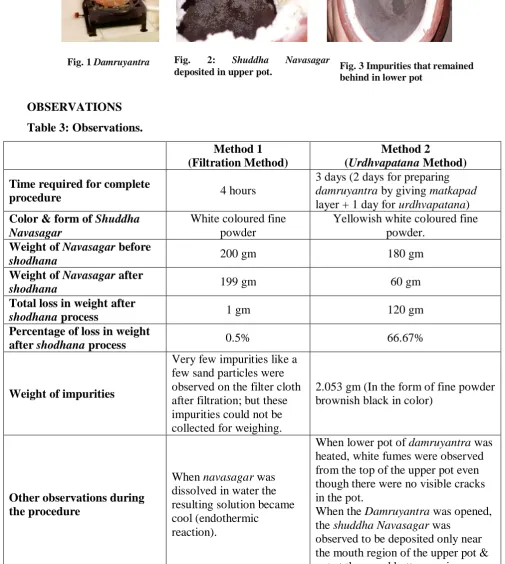
o Shuddha Navasagar deposited inside the upper pot (Fig. 2) was collected & weighed.
o The impurities that remained behind in the lower pot (Fig. 3) were also collected
OBSERVATIONS Table 3: Observations.
Method 1 (Filtration Method)
Method 2
(Urdhvapatana Method) Time required for complete
procedure 4 hours
3 days (2 days for preparing
damruyantra by giving matkapad
layer + 1 day for urdhvapatana)
Color & form of Shuddha Navasagar
White coloured fine powder
Yellowish white coloured fine powder.
Weight of Navasagar before
shodhana 200 gm 180 gm
Weight of Navasagar after
shodhana 199 gm 60 gm
Total loss in weight after
shodhana process 1 gm 120 gm
Percentage of loss in weight
after shodhana process 0.5% 66.67%
Weight of impurities
Very few impurities like a few sand particles were observed on the filter cloth after filtration; but these impurities could not be collected for weighing.
2.053 gm (In the form of fine powder brownish black in color)
Other observations during the procedure
When navasagar was
dissolved in water the resulting solution became cool (endothermic
reaction).
When lower pot of damruyantra was
heated, white fumes were observed from the top of the upper pot even though there were no visible cracks in the pot.
When the Damruyantra was opened,
[image:4.595.45.551.151.715.2]the shuddha Navasagar was observed to be deposited only near the mouth region of the upper pot & not at the round bottom region.
Fig. 1 Damruyantra Fig. 2: Shuddha Navasagar
deposited in upper pot. Fig. 3 Impurities that remained
RESULTS
Table 4: Elemental analysis result of Ashuddha Navasagar by XRF technique.
No. Component Result
1 Cl 98.4 mass%
2 K 0.461 mass%
3 Ca 0.460 mass%
4 Si 0.448 mass%
5 Fe 0.122 mass%
6 Br 0.0243 mass%
7 Pb 0.0231 mass%
8 Cu 0.0173 mass%
9 Zn 0.0131 mass%
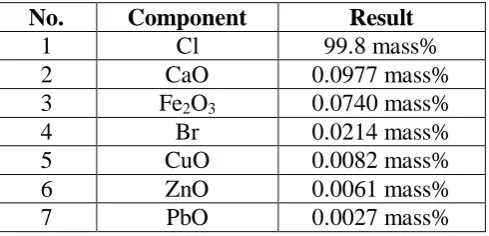
Table 5: Elemental analysis result of Shuddha Navasagar obtained by first method (filtration method) by XRF technique.
No. Component Result
1 Cl 99.8 mass%
2 CaO 0.0977 mass%
3 Fe2O3 0.0740 mass%
4 Br 0.0214 mass%
5 CuO 0.0082 mass%
6 ZnO 0.0061 mass%
7 PbO 0.0027 mass%
Table 6: Elemental analysis result of Shuddha Navasagar obtained by second method (Urdhvapatana method) by XRF technique.
No. Component Result
1 Cl 99.8 mass%
2 Fe2O3 0.101 mass%
3 CaO 0.0714 mass%
4 Br 0.0115 mass%
5 CuO 0.0082 mass%
6 ZnO 0.0070 mass%
7 SrO 0.0008 mass%
DISCUSSION
The two methods of Navasagar shodhana are based on the properties of Navasagar i.e. it is
easily soluble in water & it sublimates at 3380C temperature.[5]
The first method is based on the property of Navasagar that it is easily soluble in water.
Using the first shodhana method, we can eliminate only those impurities & adulterants that
cannot be eliminated by this method as they would also dissolve in water along with
Navasagar & easily pass through the filter cloth & sediment back when heated.
The second method i.e. urdhvapatana is based on the sublimation property of Navasagar. Sublimation is the process in which a solid turns to a gas without first forming a liquid (or
vice versa).[6] When Navasagar in the lower pot of Damruyantra is heated, it sublimates at 3380C & is converted in to gaseous state. These vapours then rise up in the Damruyantra & come in contact with the cool surface of the upper pot, which converts the vapours back into
solid state & it gets deposited inside the upper pot. This method of shodhana can be used to
eliminate impurities that are both soluble & insoluble in water since sublimation is the special
property of Navasagar & all those substances that cannot sublimate will remain behind in the
lower pot & only Shuddha Navasagar will sublimate & get deposited in the upper pot of
Damruyantra.
After the filtration process, the percentage of loss in weight of Navasagar was only 0.5%,
since only insoluble impurities were eliminated by this process. Whereas after urdhvapatana
process, the percentage of loss in weight of Navasagar was 66.67% even though the
impurities that remained behind amounted to only 1.14%. The remaining 65.53% loss may be
due to the percolation of water that was used to cool the upper pot through the porous surface
of the earthen pot. Navasagar being readily soluble in water, must have dissolved in it &
must have been brought to the surface of the upper pot of Damruyantra, some of it must have
flowed down along with the water, whereas some of it may have evaporated. This may be one
of the reasons why white fumes were observed from the top of the upper pot even though
there were no visible cracks in the pot. This also explains why, when the Damruyantra was
opened, the shuddha Navasagar was observed to be deposited only near the mouth region of
the upper pot & not at the round bottom region. All the Navasagar that reached the round bottom region of the upper pot must have dissolved in the water that was used to cool the pot
& since the area near the mouth of the upper pot was not in direct contact with water, the
shuddha Navasaagar that deposited in this part remained as it is.
So it may be better to use a pot that is not porous instead of the traditional earthen pot used
for making the Damruyantra. This can be the further scope for this study.
eliminated after the second shodhana method. An increase of 1.4 mass% can be seen in the
mass% of Cl in both shuddha Navasagars in comparison to the ashuddha Navasagar. It can
also be observed that the rest of the elements have also been eliminated to some extent after
both the shodhana processes & have remained only in trace quantities. The SrO element is
seen in very trace quantity (0.0008 mass %) in shuddha Navasagar obtained by
urdhvapatana method which may be the addition from the earthen pot.
CONCLUSION
Filtration method of Navasagar shodhana is useful for eliminating only those impurities that
are insoluble in water.
Urdhvapatana (sublimation) method of Navasagar shodhana is useful to eliminate impurities that are both soluble/ insoluble in water. But instead of the porous earthen pot used for
making damruyantra, it may be better to use some other pot (like borosilicate glassware) that
is not porous, to prevent loss of shuddha Navasagar.
Since Navasagar contains impurities that are both soluble/ insoluble in water, it is better to use urdhvapatana (sublimation) method to eliminate all the impurities from it.
ACKNOWLEDGEMENT
The authors are grateful to-
1. Dr. Sheela Pargunde, HOD of Rasashastra & Bhaishajya kalpana department
2. Dr. Meenakshi Amrutkar, Reader of Rasashastra & Bhaishajya Kalpana department
3. Dr. Ashwini Deshmukh, Reader of Rasashastra & Bhaishajya kalpana department
4. Dr. Vaishali Khobragade, Lecturer of Rasashastra & Bhaishajya kalpana department
5. Dr. Ashish Punde, Lecturer of Rasashastra & Bhaishajya kalpana department
At Y.M.T. Ayurvedic Medical College, Kharghar, Navi Mumbai, for their encouragement &
support.
REFERENCES
1. Dr. Murulidhar N., Dr. Mohan Kumar B.N., A unique process: concept of shodhana,
World Journal of Pharmacy and Pharmaceutical Sciences, 2016; 5(11): 657-663.
2. Acharyah Shree Vagbhat, Prof. Siddhi Nandan Mishra; Rasaratna samuchchayah, 2011;
3. Pandit Kashinath Shastrinam; Rasatarangini; 8th edition, 2014, Delhi; Motilal
Banarasidas.
4. Dr. Ninad Sathe; Rasashastra; 1st edition, 2008, Shantanu prakashan, Pune.
5. Pubchem open chemistry database. National Center for Biotechnology Information. Pub
Chem Compound Database; CID=25517,
https://pubchem.ncbi.nlm.nih.gov/compound/25517.
6. Clugston M.J., Lord N.J., Meatyard B.T., Scarfe J.A., Whyte J.R.C.; Dictionary of
science; 2nd edition, 2004, Penguin books.