
Transverse Spin Effects in Future Drell-Yan Experiments
Jen-Chieh Peng1,a
1Department of Physics, University of Illinois at Urbana-Champaign, Urbana, Illinois 61801, USA
Abstract.We review the current status and future prospect for probing the transverse momentum dependent (TMD) parton distributions using the Drell-Yan process. We focus on the Boer-Mulders and Sivers functions, which are expected to undergo a sign-change from semi-inclusive deep-inelastic scattering (SIDIS) to Drell-Yan process. The constraints of existing Drell-Drell-Yan and SIDIS experiments on the signs of these functions are discussed. Future Drell-Yan measurements for the TMDs are also presented.
1 Introduction
In this article, we review the current status and future prospect for studying the transverse momentum depen-dent (TMD) parton distributions in the nucleons using the Drell-Yan process. There has been intense theoretical and experimental effort in recent decades to investigate these novel parton distributions. There are many reasons for ex-ploring the transverse structures of the nucleons. For many years after the discovery of scaling in DIS and partonic structures in the nucleons, only the longitudinal momen-tum distributions of the partons were investigated. The transverse degrees of freedom of the partons, accessed through the TMDs, are expected to provide new insights on the nucleon structure. The characteristics of the TMDs can also provide stringent tests for various nucleon mod-els. Moreover, the progress in lattice QCD also allows direct comparison between the lattice calculations and ex-periments.
The novel TMDs are accessible by experiments us-ing either lepton or hadron beams. The bulk of the ex-perimental information on TMDs has been obtained thus far from the semi-inclusive DIS (SIDIS) carried out at DESY (HERMES), CERN (COMPASS), and the Jefferson Lab. A promising experimental tool to access the TMDs is the Drell-Yan process [1]. Proposed in 1970 to explain the underlying mechanism for producing massive lepton pairs in high-energy hadron-hadron collisions, the Drell-Yan process involves quark-antiquark annihilating into a virtual photon via electromagnetic interaction. According to Yan [2], “The process has been so well understood the-oretically that it has become a powerful tool for precision measurements and new physics". Indeed, the Drell-Yan process has provided unique information on the antiquark distributions in nucleons and nuclei, as well as the parton distributions of mesons and antiproton. Figure 1 shows the proton-induced Drell-Yan cross sections measured at different beam energies and NLO calculations [3]. The
ae-mail: [email protected]
10-10 10-8 10-6 10-4 10-2 1 102 104 106 108 1010 1012
0.08 0.09 0.1 0.2 0.3 0.4 0.5 0.6
Figure 1. Next-to-leading order Drell-Yan calculations com-pared to dimuon data taken at various beam energies. From [3].
Drell-Yan data taken at different energies fall on smooth curves corresponding to the NLO calculations. This is reminescent of the good agreement between DIS data and NLO calculations. The well understood mechanism of the Drell-Yan process provides a solid theoretical foundation for extracting novel parton distributions, like the TMDs, using this reaction.
To access the TMDs in the Drell-Yan process would usually require transversely polarized beam and/or tar-get. Such transversely polarized Drell-Yan experiments have never been performed yet, and are being pursued in many hadron facilities. These polarized Drell-Yan experi-ments could indeed provide qualitatively new information on hadron physics.
C
Owned by the authors, published by EDP Sciences, 2015
In the following, we first discuss the unique features of the Drell-Yan process in probing the TMDs. We then discuss the status and outstanding issues in TMDs which could be addressed with future Drell-Yan experiments. We conclude with a discussion on the status and prospect for measuring the signs of the Sivers and Boer-Mulders func-tions in the Drell-Yan process.
2 TMDs and the Drell-Yan Process
Comprehensive discussions on the theoretical and exper-imental aspects of TMDs can be found in several review articles [4–6]. In this paper, we focus on three TMDs, the transversity distributions, the Boer-Mulders functions [7], and the Sivers functions [8]. There are three transverse quantities for nucleons and quarks, namely, the nucleon’s transverse spin (SN
⊥), the quark’s transverse spin (sq⊥), and quark’s transverse momentum (k⊥q). From these three quantities, one could form three different correlations. The correlation between the quark’s transverse spin and nu-cleon’s transverse spin is the transversity distribution. The correlation between quark’s transverse momentum and nu-cleon’s transverse spin leads to the Sivers function. Fi-nally, the Boer-Mulders function corresponds to the cor-relation between quark’s transverse spin and its transverse momentum. Although there are other TMDs, most of the recent progress in TMD centered on these three distribu-tions. In this paper, we focus our discussion on these dis-tributions.
The TMDs can be accessed via semi-inclusive DIS via measurements using unpolarized beam and target, polar-ized target, or polarpolar-ized beam and polarpolar-ized target. In leading twist formulation, the different TMDs can be iden-tified through their distinct azimuthal angular distribu-tions. For example, the Boer-Mulders function would give a cos 2φh azimuthal distribution in unpolarized SIDIS, whereφhis the hadron azimuthal angle relative to the lep-ton scattering plane. The transversity and Sivers function would yield a sin(φh+φs) and sin(φh−φs) angular depen-dence, respectively, in SIDIS with a transversely polarized target (φsrefers to the azimuthal angle of target spin direc-tion relative to the lepton scattering plane). An impressive progress has been made in the last decade to extract the TMDs in several extensive SIDIS experimental programs, reviewed in Ref. [5, 6].
TMDs can also be accessed via Drell-Yan experiments in unpolarized hadron-hadron collision, singly polarized hadron collision, or doubly polarized hadron-hadron collision. The earliest discussion of probing TMDs via the Drell-Yan process was by Ralston and Soper [9], who pointed out that the chiral-odd transversity distribu-tion can be measured in doubly transversely polarized p-p Drell-Yan p-process. Detailed discussions on how vari-ous TMDs can be measured in polarized and unpolarized Drell-Yan, including the W/Z boson production which can be considered as generalized Drell-Yan where the pho-ton is replace by W/Z, have been discussed in the litera-ture [10, 11]. Following the demonstration that TMDs can be measured via the SIDIS experiments, it is important
to address the question "what can the Drell-Yan experi-ments offer in probing and understanding the TMDs?". It turns out that the Drell-Yan experiments can provide many unique information on TMDs complementary to what the SIDIS can offer.
First, the Drell-Yan cross section involves the convolu-tion of two parton distribuconvolu-tions (one or both of which can be a TMD), while the SIDIS cross section is a convolu-tion of a parton distribuconvolu-tion and a fragmentaconvolu-tion funcconvolu-tion. The absence of the fragmentation process in the Drell-Yan implies that no information on the often poorly known fragmentation functions is required to extract the TMDs. This important feature of the Drell-Yan process allows a truly independent measurement of TMDs and provide a very significant check of the results obtained from SIDIS. Second, the TMDs of mesons and antiprotons can not be accessed by SIDIS since they are not available as targets. Fortunately, they can be accessed via the Drell-Yan pro-cess since meson and antiproton beams are available. This also applies to hyperons, although no hyperon beams are currently available anywhere. Third, as demonstrated in existing Yan experiments, the proton-induced Drell-Yan process is sensitive to the antiquark distributions in the nucleons. While the effects of the nucleon’s anti-quark TMDs are usually overshadowed by those of the valence quark’s TMDs in SIDIS, the antiquark’s TMDs of the nucleons could be sensitively probed in the Drell-Yan process. Finally, the celebrated prediction that the time-reversal-odd TMDs, namely, the Sivers and the Boer-Mulders functions, must undergo a sign reversal between the space-like SIDIS and the time-like Drell-Yan reactions awaits experimental confirmation. This has become a ma-jor physics goal of several proposed polarized Drell-Yan experiments.
3 Status and Outstanding Issues in TMDs
3.1 Transversity
The transversity distribution, described in the quark-parton model as the net transverse polarization of quarks in a transversely polarized nucleon, can be measured in SIDIS using transversely polarized targets. The az-imuthal angular modulation in sin(φh + φs) is propor-tional toh1⊗H1⊥, which is the convolution of transversity and the Collins fragmentation function. An important in-gredient for extracting the transversity distribution is the measurement of a sizable Collins fragmentation function at Belle [12]. Recent SIDIS experiments using transe-versely polarized targets have been carried out at HER-MES [13, 14], COMPASS [15, 16], and JLab [17, 18].
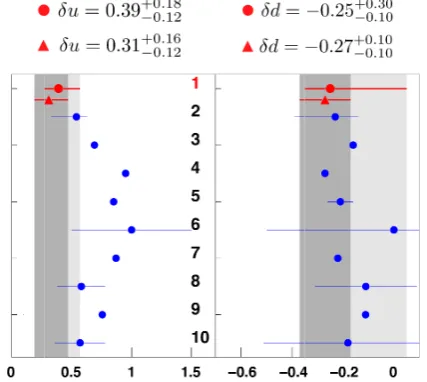
Figure 2.Tensor chargesδuandδdobtained from the fits to the semi-inclusive DIS data atQ2 =2.4 GeV2 in comparison with
various calculations. From [19].
tensor charges δu and δd, defined as δq ≡ 01[δq(x)−
δq¯(x)]dx, have also been determined from this analysis, as shown in Fig. 2. The central values of the tensor charges areδu=0.31 andδd=−0.27, significantly smaller in ab-solute magnitude than the axial charges,Δu =0.787 and
Δd =−0.319. As shown in Fig. 2, the extracted value of
δuis significantly smaller than the predictions of various models and lattice calculations [19].
Since sea quark transversity is neglected in the recent extraction of transversity distributions [19], it could intro-duce systematic uncertainties in the determination of the tensor chargesδuandδd. It is interesting to examine the theoretical predictions on the sign and magnitude of the sea-quark transversity. In the non-relativistic limit, one expects the same sea-quark transversity and helicity dis-tributions. Model predictions, however, do not necessar-ily follow this non-relativistic expectation. In the largeNc limit [20], the chiral-quark soliton model predicts [21] that
δu¯(x)−δd¯(x)<0, which is opposite to the case of helicity distribution,Δu¯(x)−Δd¯(x)>0. A qualitatively different prediction ofδu¯(x)−δd¯(x)>0 is obtained in a statistical model [22]. Very recently, an interesting new approach to calculate thexdependence of the isovectorδu¯(x)−δd¯(x) in lattice QCD indicated large negative values [23]. It would certainly be very interesting to measureδu¯(x) andδd¯(x) to test the predictions of these models.
It is clear that remarkable progress has been made in measuring the illusive chiral-odd transversity distributions via SIDIS. Some remaining challenges to be addressed by future experiments include
• Independent measurements of the transversity distribu-tions. There exist other reactions involving two chiral-odd functions which are sensitive to the transversity dis-tributions. First results [24, 25] on dihadron SIDIS us-ing the correspondus-ing interference fragmentation func-tions determined at Belle [26] are becoming available. The extracted transversity distributions [27] are
consis-tent with those extracted in single-hadron SIDIS [19]. Additional dihadron SIDIS data are expected using the SoLID detector at the 12 GeV JLab. The proposal to measure Drell-Yan with polarized antiproton beam col-liding with polarized proton at FAIR [28] would clearly provide a much anticipated measurement of transversity entirely free of the uncertainty of fragmentation func-tions.
• Magnitude and sign of the sea-quark transversity distri-bution. As discussed above, some theoretical models and the recent lattice calculation suggest sizable sea-quark transversity. A recent SIDIS measurement [18] at JLab shows a large negative sin(φh+φs) amplitude for K− production on a transversely polarized3He tar-get, suggesting a large sea-quark transversity. Future high-statistics SIDIS experiments at the 12 GeV JLab upgrade, as well as doubly polarized Drell-Yan experi-ments inppcollision, uniquely sensitive to the antiquark transversity distribution in the proton, are required to pin down the role of sea quarks in transversity distributions. • Q2 evolution of the transversity distributions. The ab-sence of the gluon transversity distribution implies a slowerQ2-evolution for the quark transversity distribu-tions. This expectation remains to be tested. The chal-lenge in the SIDIS, however, is to disentangle theQ2 -evolution effect of the Collins fragmentation function. A more definitive measurement would require the Drell-Yan process, which only involves the convolution of two transversity distributions.
3.2 Sivers Functions
It was suggested by Sivers that single-spin asymmetries in various processes can originate from the correlations be-tween the transverse momentum of the quark and proton’s transverse spin, called the Sivers function [8]. As a time-reversal odd object, the Sivers function requires initial- or final-state interactions via a soft gluon. Such interactions are incorporated in a natural fashion by the gauge link needed for a gauge-invariant definition of the TMD [29– 31]. The Sivers function is related to the forward scat-tering amplitude in which the helicity of the nucleon is flipped. This helicity flip must involve the orbital angu-lar momentum of unpoangu-larized quark. In this respect, the Sivers function is connected to the angular momentum of the quark. An unambiguos measurement of Sivers func-tion is valuable for understanding the nature of the TMDs and the spin content of the nucleons.
antiquarks, it is reasonable to expect that antiquarks carry non-zero orbital angular momentum. Using chiral-quark solition model, it was shown that ¯uand ¯dhave significant contributions to the orbital angular momentum component of the proton’s spin [37]. Moreover, a recent lattice QCD calculation [38] found a significant fraction of proton’s spin comes from the orbital angular momentum of ¯uand ¯d quarks. These results suggest that the Sivers functions for sea quarks can be sizable and measurable. Future polar-ized SIDIS experiments at JLab and EIC are expected to provide definitive measurements on the characteristics of the sea-quark Sivers functions.
Unlike collinear parton distribution functions (PDFs), the TMDs are not necessarily universal and could depend on the process they are extracted from. Fortunately, the process-dependence of TMDs is limited to a possible sign-change, due to the invariance of QCD under parity and time-reversal [30]. The TMD, fq/p↑(x,k⊥, S), for find-ing an unpolarized quark inside a transversely polarized proton extracted from SIDIS and Drell-Yan proces satis-fies [30, 39]
fqS IDIS/p↑ (x,k⊥, S)=fqDY/p↑(x,k⊥,−S). (1)
The Sivers function, f1T⊥(x,k⊥), is proportional to [fq/p↑(x,k⊥, S)−fq/p↑(x,k⊥,−S)]/2. Therefore, Eq. 1 im-plies that the Sivers function changes sign from SIDIS to Drell-Yan
f1T⊥S IDIS(x,k⊥)=−f1T⊥DY(x,k⊥) (2)
This sign-change prediction, which is a consequence of factorization of TMD in QCD, has generated tremen-dous interest to test it experimentally. Since the signs of valence quark Sivers function have already been deter-mined from SIDIS, the test only requires measurements of valence-quark Sivers functions in singly polarized Drell-Yan experiments utilizing transversely polarized proton beam or target. As discussed by Chiosso in this Work-shop [40], a dedicated Drell-Yan experiment at COM-PASS using 190 GeV pion beam on transversely polar-ized target is scheduled to take data in 2015 [41]. Teryaev also presented the plan to measure polarized Drell-Yan at NICA [42]. Other polarized Drell-Yan experiments, proposed at existing or future hadron facilities, include RHIC at BNL [43], PAX [28] and PANDA [44] at FAIR, J-PARC [45], E1027 [46] and E1039 [47] at Fermilab. While it is highly anticipated that the first result on this test would be obtained at COMPASS [40], it is essential to perform experiments using different hadron beams (pion, proton, antiproton) covering different kinematic regions in xandQ2.
3.3 Boer-Mulders Functions
The Boer-Mulders function [7], h⊥1(x,k⊥), is another ex-ample of a time-reversal odd TMD. It represents the cor-relation betweenk⊥ and the quark transverse spin,s⊥, in an unpolarized nucleon. Similar to the Sivers function, the Boer-Mulders function also owes its existence to the pres-ence of initial/final state interactions.
The flavor and x dependencies of the Boer-Mulders functions have been calculated in various models. In the quark-diquark model taking into account both the scalar and axial-vector diquark configurations, significant dif-ferences in the flavor dependence are found between the Sivers and Boer-Mulders functions [48]. In particular, while the Sivers function is negative for the u and posi-tive for the d valence quarks, theuandd valence quark Boer-Mulders functions are predicted to be both negative. Other model calculations using the large-Nc model [49], the MIT bag model [50], the relativistic constituent quark model [51], as well as lattice QCD [52], all predict theu anddvalence Boer-Mulders functions to be negative.
While the Sivers functions do not exist for spin-zero hadrons, the Boer-Mulders functions can exist for pions. Calculations for pion’s valence-quark Boer-Mulders func-tions using the quark-spectator-antiquark model predict a negative sign [53], just like the u and d Boer-Mulders functions for nucleons. Using the bag model, the valence Boer-Mulders functions for nucleons and mesons were predicted [54] to have same signs with similar magnitude. This prediction of a universal behavior of the valence-quark Boer-Mulders functions for pions and nucleons also awaits experimental confirmation.
For nucleon’s antiquark Boer-Mulders functions there exists one calculation using the meson cloud model [55]. Since the meson cloud is an important source for sea quarks in the nucleons, as evidenced by the large ¯d/u¯ flavor asymmetry observed in DIS and Drell-Yan exper-iments (for a recent review see [56]), the valence Boer-Mulders functions in the pion cloud can contribute to nu-cleon’s antiquark Boer-Mulders functions [55]. An inter-esting prediction is that nucleon’s antiquark Boer-Mulders functions would have negative signs, same as the valence Boer-Mulders functions for pion.
For a TMD with a tensor spin projection,
fh1q/p↑(x,k⊥, S), Eq. 1, which relates the TMDs mea-sured in SIDIS and Drell-Yan, becomes [39, 57]
fhS IDIS1q/p↑(x,k⊥, S)=−fhDY1q/p↑(x,k⊥,−S). (3)
The minus sign in Eq. 3 relative to Eq. 1 is due to the replacement of the vector spin projection γ+ in the TMD fq/p↑(x,k⊥, S) by the tensor spin projection σ+⊥ in the TMD fh1q/p↑(x,k⊥, S). Since the Boer-Mulders function is proportional to the sum [fh1q/p↑(x,k⊥, S) +
fh1q/p↑(x,k⊥,−S)]/2, it follows from Eq. 3 that the Boer-Mulders function measured in Drell-Yan will have a sign opposite to that measured in SIDIS, namely,
h⊥1qS IDIS(x,k⊥)=−h⊥1qDY(x,k⊥). (4)
Table 1.Theoretical predictions for the signs of various Boer-Mulders functions for nucleons (N) and pions (π) in SIDIS
and Drell-Yan.Vπsignifies the valence quarks in the pions. The
paranthesis forVπin SIDIS indicates that it can not be measured
in practice.
uN dN Vπ uN¯ dN¯
SIDIS − − (−) − −
Drell-Yan + + + + +
the experimental status on extracting the Boer-Mulders functions from the SIDIS and Drell-Yan experiments, and we compare the predictions listed in Table 1 with data. We also identify future experiments which can further test these predictions.
3.3.1 Boer-Mulders functions from SIDIS
The Boer-Mulders functions can be extracted from the hadron’s azimuthal angular distribution in unpolarized SIDIS. The cos 2φterm is proportional to the product of the Boer-Mulders function h⊥1 and the Collins fragmen-tation function H1⊥ at leading twist, where φ refers to the angle between the hadron plane and the lepton plane. Thecos 2φmoments have been measured by the HER-MES [58, 59] and COMPASS [60, 61] collaborations. An analysis of the pion SIDIS data, taking into account the higher-twist Cahn effect [62], has been performed [63]. The functional form for the Boer-Mulders function was assumed as
h⊥q1 (x,k2
⊥)=λqf1T⊥q(x,k2⊥), (5)
whereh⊥q1 and f1T⊥qare the Boer-Mulders and Sivers func-tions, respectively, for quark q. The best-fit values are found to be λu = 2.0±0.1 andλd = −1.111±0.001. Since the Sivers function for u(d) is negative (positive), these values show thath⊥u1 andh⊥d1 are both negative, in agreement with the theoretical expectation listed in Ta-ble 1. It must be cautioned that the extracted signs of the Boer-Mulders functions depend on the signs of the Collins functions adopted in the analysis. Although the signs cho-sen for the Collins functions are based on plausible argu-ments, some uncertainties do exist in the determination of the signs of the Boer-Mulders functions from this analysis. New results on the azimuthal cos 2φmodulations for
π±,K±, and unidentified hadrons in unpolarizede+pand e+d SIDIS were recently reported by HERMES [59]. These new HERMES data are expected to provide a more precise extraction of the valence Boer-Mulders functions. Moreover, these data are sensitive to the sea-quark Boer-Mulders functions. In particular, the cos 2φmoments for K−are observed to be large and negative [59]. Since the valence quark content ofK−,su¯, is different from those of the nucleons, the largeK−cos 2φmoments suggest sizable sea-quark Boer-Mulders functions. An extension of the global fit in Ref. [63] to include the new HERMES data could lead to a determination of the sign and magnitude of sea-quark Boer-Mulders functions in SIDIS.
3.3.2 Boer-Mulders functions from Drell-Yan
The Boer-Mulders functions can be extracted [10] from the azimuthal angular distributions in unpolarized Drell-Yan process. The expression for the Drell-Drell-Yan angular distribution is
dσ
dΩ ∝1+λcos
2θ+μsin 2θcosφ+ν 2sin
2θcos 2φ, (6)
whereθandφcorrespond to the polar and azimuthal decay angles of thel+ in the dilepton rest frame. Boer showed that the cos 2φterm is proportional to the convolution of the quark and antiquark Boer-Mulders functions in the beam and target hadrons [10]. The cos 2φangular depen-dence can be qualitatively understood by noting that the Drell-Yan cross section depends on the transverse spins of the annihilating quark and antiquark. A correlation be-tween the transverse spin and the transverse momentum of the quark, as represented by the Boer-Mulders func-tion, would lead to a correlation between the transverse spin and transverse momentum of the dimuons, resulting in the cos 2φdependence.
0 0.2 0.4 0.6 0.8 1
0 0.5 1 1.5 2 2.5 3 3.5 4
pT (GeV/c)
ν
π
+ W at 194 GeV/c
π
+ W at 252 GeV/c
p + d at 800 GeV/c
Figure 3. The cos 2φamplitudeνfor pion- and proton-induced Drell-Yan measurements. Curves are fits to the data using an empirical parametrization discussed in Ref. [66].
Pronounced cos 2φ dependence, observed in the NA10 [64] and E615 [65] pion-induced Drell-Yan exper-iments, was attributed to the Boer-Mulders function. The cos 2φ dependence of proton-induced Drell-Yan process was also measured for thep+dandp+pinteractions at 800 GeV/c [66, 67]. Unlike the pion-induced Drell-Yan, significantly smaller (but non-zero) cos2φazimuthal an-gular dependence was observed in thep+dandp+p re-actions, as shown in Fig. 3. While the pion-induced Drell-Yan cross section is dominated by a valence antiquark in the pion annihilating a valence quark in the nucleon, the proton-induced Drell-Yan process must involve a sea anti-quark in the nucleon. Therefore, thep+dandp+presults suggest [66, 67] that proton’s Boer-Mulders functions for sea quarks are smaller than those for valence quarks.
re-0 1 2 qT -0.1
-0.05 0 0.05 0.1 0.15 0.2 0.25
νpd
0 1 2
qT -0.1
-0.05 0 0.05 0.1 0.15 0.2 0.25
νpp
Figure 4.Fits to the cos 2φamplitudeνfor thep+dandp+p
Drell-Yan data [69]. The dotted lines indicate the uncertainty of the fitted parameters. qTin unit of GeV refers to the transverse momentum of the dimuon pair.
sults obtained by Lu and Schmidt [69] are shown in Fig-ure 4. Although the statistical precision of the data does not yet allow an accurate extraction of the Boer-Mulders functions, the analysis shows that both the ¯uand ¯d Boer-Mulders functions can be extracted from the Drell-Yan. Ongoing unpolarized proton- and pion-induced Drell-Yan experiments at Fermilab and COMPASS are expected to provide new information on the Boer-Mulders functions.
3.3.3 prospect for tesing the sign-reversal of Boer-Mulders functions
While the prospect for testing the sign-reversal of the Sivers functions has been discussed extensively in the lit-erature, much less attention has been devoted to examin-ing the possibility for checkexamin-ing the sign-reversal for the Boer-Mulders functions. This is possibly due to the fact that the Boer-Mulders functions are just beginning to be extracted from SIDIS data. On the other hand, while the Sivers functions have only been extracted from the SIDIS data, information on the Boer-Mulders functions has been obtained from both the SIDIS and the Drell-Yan experi-ments. In fact, Boer-Mulders functions are the only TMD functions ever measured in the Drell-Yan experiments so far. It is natural to ask whether these existing data have al-ready tested the prediction that the Boer-Mulders function changes sign from SIDIS to Drell-Yan.
As shown in Table 1, theoretical models predict that the valence quark Boer-Mulders functions have negative signs in SIDIS. This prediction is consistent with the anal-ysis of the existing SIDIS data on the cos 2φangular de-pendence, showing that bothh⊥1uandh⊥1din SIDIS are neg-ative [70]. Unfortunately, SIDIS data do not yet allow the extraction of sea-quark Boer-Mulders functions, whose ef-fects are overshadowed by the valence quarks. Neverthe-less, the cos 2φ dependence in p + p and p +d Drell-Yan is proportional to the convolution of the valence and sea Boer-Mulders functions, namely,ν ∼ h⊥1q(x1)h⊥1 ¯q(x2), allowing a direct extraction of sea-quark Boer-Mulders function in the Drell-Yan experiment. Assumingu-quark dominance, the positive values ofνshown in Fig. 4 already suggest that the Boer-Mulders functions foruand ¯uhave the same sign in Drell-Yan. The Boer-Mulders function
for u quark, determined in SIDIS to have negative sign, is expected to become positive in Drell-Yan. It follows that both theuand ¯uBoer-Mulders functions in Drell-Yan should have positive signs. This is consistent with the re-sults obtained by Lu and Schmidt [69] and by Barone et al. [70]. However, one can not exclude the alternative pos-sibility that bothuand ¯uBoer-Mulders functions in Drell-Yan have negative signs. At this moment, one can only conclude that all existing SIDIS and Drell-Yan data are not in disagreement with the predictions shown in Table 1. Future SIDIS and Drell-Yan data are required to provide a definitive test on the sign-change of the Boer-Mulders functions.
3.4 Summary
The massive Drell-Yan process in hadron-hadron colli-sions continues to be a powerful tool for probing the partonic structure of hadrons and for understanding the dynamics of QCD in perturbative and nonperturbative regimes. The Drell-Yan process is complementary to the DIS in many aspects, and together, they provide interest-ing and often surprisinterest-ing information on the quark and an-tiquark contents of the nucleons.
The Drell-Yan process is also complementary to SIDIS in extracting TMDs. It is necessary to use both the Drell-Yan process and SIDIS to study TMDs, because of the non-universality of TMDs and the expected sign change. In this respect, the Sivers and Boer-Mulders functions are the most interesting TMDs to explore. The Drell-Yan production of massive lepton pairs with polarized beam and/or target provide the immediate access to these two TMDs. With several ongoing and future experiments at existing or future hadron facilities dedicated to measuring singly or doubly polarized Drell-Yan, the full potential of the Drell-Yan process in studying TMDs is just beginning to be explored.
References
[1] S.D. Drell and T.M. Yan, Phys. Rev. Lett. 25, 316 (1970).
[2] T.M. Yan, Proceeding of the “Sid Drell Symposium", 1998. arXiv: hep-ph/9810268; T.M. Yan and S. Drell, arXiv: 1409.0051.
[3] P.L. McGaughey, J.M. Moss and J.C. Peng, Ann. Rev. Nucl. Part. Sci.49, 217 (1999).
[4] V. Barone, A. Drago and P.G. Ratcliffe, Phys. Rept. 359, 1 (2002).
[5] V. Barone, F. Bradamante and A. Martin, Prog. Part. Nucl. Phys.65, 267 (2010).
[6] C.A. Aidala, A.D. Bass, D. Hasch and G.K. Mallot, Rev. Mod. Phys.85, 655 (2013).
[7] D. Boer and P. Mulders, Phys. Rev.D57, 5780 (1998). [8] D.W. Sivers, Phys. Rev.D41, 83 (1990).
[9] J.P. Ralston and D.E. Soper, Nucl. Phys.B152, 109 (1979).
[11] A. Arnold, A. Metz and M. Schlegel, Phys. Rev.D79, 034005 (2009).
[12] R. Seidlet al., Phys. Rev.D86, 039905 (2008). [13] A. Airapetian et al., Phys. Rev. Lett. 94, 012002
(2005).
[14] A. Airapetianet al., Phys. Lett.B693, 11 (2010). [15] E.S. Ageevet al., Nucl. Phys.B765, 31 (2007). [16] C. Adolphet al., Phys. Lett.B717, 376 (2012). [17] X. Qianet al., Phys. Rev. Lett.107, 072003 (2011). [18] Y.X. Zhaoet al., arXiv:1404.7204 [nucl-ex]. [19] M. Anselmino, M. Boglione, U. D’Alesio, S. Melis,
F. Murgia and A. Prokudin, Phys. Rev. D87, 094019 (2013).
[20] P. Schweitzer, D. Urbano, M.V. Polyakov, C. Weiss, P.V. Pobylitsa and K. Goeke, Phys. Rev.D64, 034013 (2001).
[21] M. Wakamatsu, Phys. Lett.B653, 398 (2007). [22] C. Bourrely, F. Buccella and J. Soffer, Mod. Phys.
Lett.A24, 1889 (2009).
[23] H.W. Lin, Talk presented at the ECT Workshop on “Flavor Structure of the Nucleon Sea", 2013; H.W. Lin, J.W. Chen, S.D. Cohen and X. Ji, arXiv:1402.1462. [24] A. Airapetianet al., JHEP06, 017 (2008). [25] C. Adolphet al., Phys. Lett.B713, 10 (2012). [26] A. Vossenet al., Phys. Rev. Lett.107, 072004 (2011). [27] A. Bacchetta, A. Courtoy and M. Radici, Phys. Rev.
Lett.107, 012001 (2011); JHEP1303, 119 (2103). [28] V. Baroneet al., arXiv:hep-ex/0505054.
[29] S.J. Brodsky, D.S. Hwang and I. Schmidt, Phys. Lett. B530, 99 (2002).
[30] J.C. Collins, Phys. Lett.B536, 43 (2002). [31] X. Ji and F. Yuan, Phys. Lett.B543, 66 (2002). [32] A. Airapetian et al., Phys. Rev. Lett. 103, 152002
(2009).
[33] M. Alekseevet al., Phys. Lett.B673, 127 (2009). [34] M. Alekseevet al., Phys. Lett.B692, 240 (2010). [35] M. Anselminoet al., Eur. Phys. J.A39, 89 (2009). [36] P. Sun and F. Yuan, Phys. Rev.D88, 034016 (2013). [37] M. Wakamatsu, Eur. Phys. J.A44, 297 (2010). [38] M. Dekaet al.arXiv:1312.4816.
[39] J.C. Collins and A. Metz, Phys. Rev. Lett.93, 252001 (2004).
[40] M. Chiosso, this Proceedings.
[41] O. Denisov, Mod. Phys. Lett.A24, 3033 (2009). [42] O. Teryaev, this Proceedings.
[43] G. Bunce, N. Saito, J. Soffer and W. Vogelsang, Ann. Rev. Nucl. Part. Sci.50, 525 (2000)
[44] K. Brinkmannet al., Nucl. Phys.A790, 75 (2007). [45] J.C. Peng, G.T. Garvey, J.M. Moss, S. Sawada and J.
Chiba, hep-ph/0007341.
[46] W. Lorenzon, P. Reimeret al., Fermilab proposal P-1027 (2012).
[47] A. Klein, X. Jianget al., Fermilab proposal P-1039 (2013).
[48] L.P. Gamberg, G.R. Goldstein and M. Schlegel, Phys. Rev.D77, 094016 (2008).
[49] P.V. Pobylitsa, hep-ph/0301236. [50] F. Yuan, Phys. Lett.B575, 45 (2003).
[51] B. Pasquini, M. Pincetti and S. Boffi, Phys. Rev.D76, 034020 (2007).
[52] M. Gockeler et al., Phys. Rev. Lett. 98, 222001 (2007).
[53] Z. Lu and B.-Q. Ma, Phys. Lett.B615, 200 (2005). [54] M. Burkardt and B. Hannafious, Phys. Lett. B658,
130 (2008).
[55] Z. Lu, B.Q. Ma and I. Schmidt, Phys. Lett. B639, 494 (2006).
[56] W.C. Chang and J.C. Peng, Prog. Part. Nucl. Phys. 79, 95 (2014).
[57] J.C. Peng and J.W. Qiu, Prog. Part. Nucl. Phys.76, 43 (2014).
[58] F. Giordano and R. Lamb, AIP Conf. Proc.1149, 423 (2009).
[59] A. Airapetianet al., Phys. Rev.D87, 012010 (2013). [60] W. Kafer, arXiv:0808.0114.
[61] A. Bressan, arXiv:0907.5511.
[62] R.N. Cahn, Phys. Lett.B78, 269 (1978).
[63] V. Barone, S. Melis and A. Prokudin, Phys. Rev. D81, 114026 (2010).
[64] S. Falciano et al., Z. Phys. C31, 513 (1986); M. Guanziroliet al., Z. Phys.C37, 545 (1988).
[65] J.S. Conwayet al., Phys. Rev.D39, 92 (1989). [66] L. Zhuet al., Phys. Rev. Lett.99, 082301 (2007). [67] L. Zhuet al., Phys. Rev. Lett.102, 182001 (2009). [68] B. Zhang, Z. Lu, B.-Q. Ma and I. Schmidt, Phys. Rev.
D77054011 (2008).
[69] Z. Lu and I. Schmidt, Phys. Rev. D81, 034023 (2010).


![Figure 4. Fits to the cos 2Drell-Yan data [69]. The dotted lines indicate the uncertainty ofthe fitted parameters.φ amplitude ν for the p + d and p + p qT in unit of GeV refers to the transversemomentum of the dimuon pair.](https://thumb-us.123doks.com/thumbv2/123dok_us/8184766.1366875/6.595.68.279.65.175/figure-indicate-uncertainty-tted-parameters-amplitude-refers-transversemomentum.webp)
