ISOLATION AND IDENTIFICATION OF XYLANASE PRODUCING
MICROORGANISMS FROM SOIL
Rajakumar R.* and Rameshwara Reddy Naru
Post graduate and Research Department of Biotechnology, Marudupandiyar College,
Thanjavur-613 403, Tamil Nadu, India.
ABSTRACT
The xylanase enzyme produced by microorganisms, can be used for
food and non-food industries. Such as paper bleaching, waste
processing, animal feed and area of food industry such as for juice
purification, bread making, producing xylitol sugar and ethanol. In the
present study investigated that the four bacterial and six fungal species
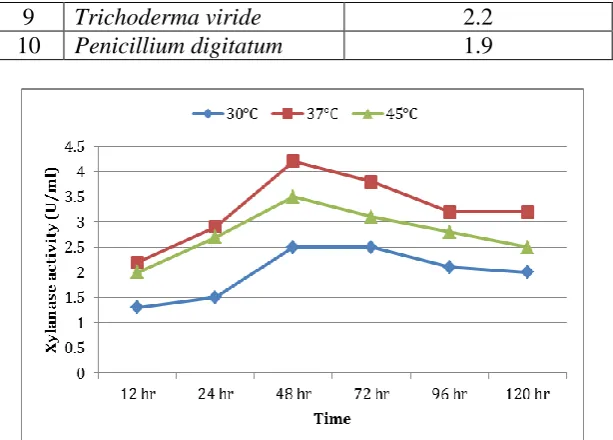
were isolated from soil. Among the potent xylanse producers, Bacillus amyloliquefaciens and Aspergillus niger showed the highest xylanolytic activity (4.2 U/ml and 3.5 U/ml) at 48 hr after incubation.
Temperature and pH are the important parameters that determine the
enzyme activity. A high level of xylanase activity was obtained in the
culture medium with optimum temperature at 37 °C at 48 hr (4.2 U/ml)
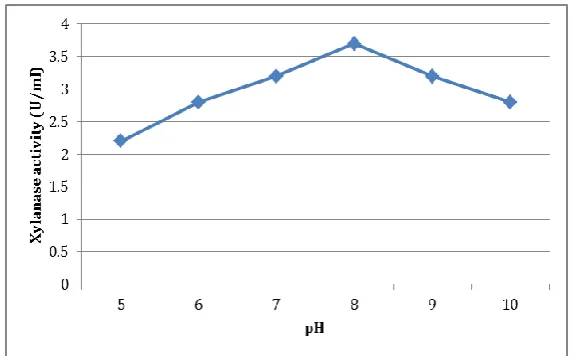
in B. amyloliquefaciens and 45°C at 48 hr (3.5U/ml) in A. niger. The pH ranging from 5 to 10 was studied for the detection of optimum pH with high xylanase
production by A.niger. The optimum pH found to be pH 8 (3.7 U/ml) and minimum was noted at pH 5 (2.2 U/ml).
KEYWORDS: Temperature, pH, Xylanase and Aspergillus niger.
INTRODUCTION
One of the major characteristics of all bacteria is their ability to produce and secrete a range
of enzymes for the degradation of various organic compounds. Most of the screening
procedures devised for the detection of xylanolytic microorganisms involve the enrichment
technique. As we know that the required organism is accompanied by many unwanted
species, so it is necessary to enrich such organisms. This is generally done by using
enrichment technique. In this method, a specific environment is selected and a sample is
Volume 7, Issue 7, 1146-1156. Research Article ISSN 2277– 7105
Article Received on 10 Feb. 2018,
Revised on 02 Mar. 2018, Accepted on 23 Mar. 2018,
DOI: 10.20959/wjpr20187-11655
*Corresponding Author
Rajakumar R.
Post graduate and Research
Department of
Biotechnology,
Marudupandiyar College,
Thanjavur-613 403, Tamil
inoculated. The sample is incubated for one or more weeks and an inoculum is then
transferred to a new container of the same selected environment. This is further incubated
until the organism of choice appears. This may require few or many transfers. To isolate
alkaliphiles alkaline medium must be used. Sodium carbonate or sodium hydroxide is
generally used to adjust the pH, because alkaliphiles usually require at least some sodium
ions.
Xylanase constitute up to 35% of the total dry weight of higher plant and is built from
homopolymeric backbone chain of 1, 4-linked β-D-xylopyranose units, including short chains
Oacetyl, α-L-arabinofuranosyl and D-glucuronyl or O-methyl- D-glucuronyl residues. The
degradation of lignocellulosic materials by hydrolyzing xylan is an important step for nature.
Chemical hydrolysis of xylan by the industries is accompanied with the formulation of toxic
components which is hazardous to environment. The use of site specific microbial enzymes
for xylan hydrolysis makes the process eco-friendly. Xylanases, catalyze the hydrolysis of 1,
4-β-D-xylosidic linkages in xylan. They are characterized as exo- and endo-xylanases and
release xylo-oligosaccharides and xylose. Initially the main hydrolysis products are
β-D-xylopyranosyl oligomer, but at later stage, small molecules such as mono-, di- and
trisaccharides of β-D-xylopyranosyl may be produced (Kuhad et al., 1997).
Xylanases occur widely in bacteria, yeasts and fungi. Many microorganisms are known to
produce different types of xylanases, the nature of the enzymes varies between different
organisms. Many reports on xylanases from Clostridium sp (Berenger et al., 1985),
Streptomyces sp (Sreenath and Joseph, 1982), and other microorganism are available. A
Bacillus sp an alkaliphile isolated from an alkaline soda lake reported by Amare Gessesse (1998). An alkaline bacterium, also Bacillus sp, produces alkali stable xylanases without cellulose and one of them has a strong affinity for insoluble xylan. Xylanase have important
applications in the pulp and paper industry (Viikari et al., 1994). They can also be used to increase the digestibility of animal feed stock and in the baking and brewing industries
(Linko et al., 1989).
Xylanase may also be used to prepare materials for scientific research, besides being research
materials themselves. Well characterized xylanases may be useful for the characterization of
polysaccharides and plant cell walls. Although many bacteria have been studied for xylanase
biotechnological applications. Commercial applications suggested for xylanases involve the
conversion of xylan, which is present in wastes from agricultural and food industry into
xylose. Similarly, xylanases could be used for the clarification of juices, for the extraction of
coffee, plant oils and starch and for the production of fuel and chemical feedstock (Linko et al., 1989). Recently, the use of xylanolytic enzymes in pulp bleaching has considered as one of the most important new biotechnological applications of these enzymes. This study
investigated that the isolation and identification of xylanase producing microorganisms from
soil.
MATERIALS AND METHODS
Collection of soil sample
The soil sample was collected near farm land at Thanjavur, Tamil Nadu and India. The soil
was collected in sterile container and stored at 4 °C until used.
Isolation of Microorganisms
One gram of soil sample was suspended in 10 mL sterile distilled water and serial dilutions
were made. The 50 µL of the diluted sample (10-6) was spread on nutrient agar plates and
Czapek Dox agar plates. Pure cultures of individual isolates were identified by conventional
methods (Gilman, 1959; Ellis, 1971 and Barnett et al 1972). The composition of the medium was (g.L-1): Xylan (Hi media), 0.1%; peptone, 5.0; yeast extract, 5.0; K2HPO4, 1.0;
MgSO4.7H2O, 0.2 and agar, 20.0. The inoculated plates were incubated for 7 days at 30ºC.
Plates were flooded with 0.1% (w/v) Congo red after 30 min, washed with 1 M NaCl and
observed for zone of clearance around the bacterial and fungal growth. The clearing zones
around their colonies were selected for further studies.
Identification of the bacterial isolate
The xylanase producing microorganisms were identified on the basis of their physiological,
morphological and biochemical characteristics in our laboratory using Bergey’s Manual of Systematic Bacteriology guidelines. The strain was stored and maintained on nutrient agar
slants at 4°C. The various type of media used in the study were sterilized at 1.05 kg/cm2 for
20 min before utilized in the process.
Identification of the fungal isolate
Fungal identification was done based on structural characters and colony morphology
recorded. Mount prepared was stained with lacto phenol cotton blue. The fungal
characteristics were described and identified based on the description given by Pitt and
Samson (2000).
Xylanase production by Microorganisms
Bacteria
The selected bacterial isolates were incubated in medium for 18 h up to 24 h at 37 °C at 150
rpm. Then each strain with 0.1 OD was transferred to 250ml Erlenmeyer flasks containing
30ml liquid medium and incubated at 37°C for 4 days on rotary shaker (150 rpm). A 2 ml
sample of culture media was removed every 24h and centrifuged at 10000 g for 10 min at 4
°C then, the supernatant were collected and used for extracellular enzyme assay. For
obtaining the intercellular fraction of the xylanase, the cell pellet was washed three times
with sodium phosphate buffer (pH7). After centrifugation at 10000 g for 10 min, the pellet
was resuspended in the same buffer and sonicated using an ultrasonic cell disrupter in order
to disperse bacterial aggregates. Then, the cell debris was removed by centrifugation at
10000×g for 10 min. The cell–free supernatant was used for intercellular enzyme assay.
Fungi
The fungal isolate which showed maximum zone consistently on the screening media was
selected for the production of xylanase. The spore suspension was prepared by adding spore
suspension of fungal growth from the 7 day incubated SDA plate in to 50 ml of sterile
distilled water. The tube was shaken to make homogeneous mixture of spore suspension. The
cultivation was carried out in a Czapek Dox liquid medium containing (1%) xylan as the sole
carbon source. An Erlenmeyer flask (250 ml) containing 100 ml of the growth medium was
inoculated with 5X10⁸ spore suspension and cultured for 15 days at 28 °C on an orbital
shaker set at 250 rev min-1.Broth was filtered with Whatsman filter paper. The Filtrate was
centrifuged at 10,000 rpm for 15 min at 40° C. The culture supernatant obtained was used for
the assay of xylanase activity.
Optimization of xylanase producing microbes
Effect of temperature
To determine the temperature optimum xylanase activity was measured at different
temperatures (30°C to 45°C) under standard assay conditions. The temperature stability of
xylanase was determined by pre -incubating an aliquot of enzyme at 30°C to 45°C for 12 to
Effect of pH
The effect of pH on xylanase activity was studied by using the substrate prepared in buffer
(0.05 M) of different pH ranging from 5.0 to 10.0 viz, citrate buffer (pH 5-6); phosphate
buffer (pH 6-8) and Tris-HCl buffer (pH 8-10), under standard assay conditions. The pH
stability of the enzyme was determined by pre -incubating an aliquot of enzyme with buffers
of different pH for 24 h at 37°C followed by measurement of xylanase activity using sodium
phosphate buffer (0.05 M, pH 7) after varying time interval for 5 h. The residual activity (%)
at each pH was calculated.
RESULTS AND DISCUSSION
Isolation and Identification of microbial strains
For a primary isolation, several morphological and biochemical tests were performed to
characterize the isolated bacterial and fungal species. In the present study four bacterial and
six fungal species were isolated from soil samples as a source of xylanolytic organisms. The
both bacterial and fungal strains were collected by spreading sample dilution on different
xylane agar plates (Table.1). Among this Bacillus amyloliquefaciens and Aspergillus niger
were showed the xylanolytic activity in the samples.
Xylanase production
Four bacterial and six fungal isolates which produced large and clear zones in shorter time
were transferred in to liquid medium. The xylanase activity was measured by DNS method.
Among the potent xylanse producers, Bacillus amyloliquefaciens and Aspergillus niger
showed the highest xylanolytic activity (4.2 U/ml and 3.5 U/ml) at 48 hr after incubation.
Regarding the specific activity, the best results were obtained with the strains A.niger and
Bacillus amyloliquefaciens. For this reason, in the further studies the combination of the best xylanolytic strains will be evaluated. The data obtained with the strains tested in these
experiments are comparable with those communicated by other authors for Aspergillus niger, A. flavus, A brasiliensis, Trichoderma viride, T. harzianum (Jafaru, 2013). For P.digitatum
the synthesis of xylanases is less documented in literature (Cole and Wood, 1970) and the
results obtained suggest that the strain used in this experiment is promising for further studies
related the xylan degradation. The selected fungal isolates are dominant heterologous enzyme
producing microorganism (Sathiyavathi and Parvatham, 2011), which are very much attracted
by industries for a varying reasons, including their high growth rates leading to short
physiology and generics of some of these isolates are well studied, facilitating further
development and greater exploitation for industrial purposes (Alexopoulus and Mims, 1952).
Optimization of xylanase producing microbes
Effect of temperature on Bacteria
Temperature is one of the important parameters that determine the enzyme activity. The
effect of temperature on xylanolytic enzymes production by B.amyloliquefaciens was investigated by growing culture at different temperature at 30°C, 37°C and 45°C. A high
level of xylanase activity was obtained in the culture medium with optimum temperature at
37 °C at 48 hr (4.2 U/ml) (Fig.1). Higher xylanase production was also reported from
alkalophilic Bacillus sp. using SSF at the optimum growth conditions (Gessesse and Mamo, 1999). Similar findings were also reported by some species i.e. Bacillus sp and B.subtilis YJ1 which have optimum temperature of 50ºC (Kim et al. 2011).
Effect of temperature on Fungai
The high level of xylanase activity was obtained in the optimum temperature at 48 hr
(3.5U/ml) by A. niger. The different temperature at 35°C, 45°C and 55°C were examined for the detection of optimum temperature required for the production of enzyme and the results
showed optimum to be 45°C at 48 hr (3.5U/ml) and minimum was observed at 35°C at 12 hr
(1.2U/ml) (Fig.2). At 50°C, a significant decline in xylanase activity was evident. The
optimum temperature for xylanase production by P. oxalicum was similar to some thermophilic fungi, such as Thermomyces lanuginosus (Purkarthofer et al., 1993),
Thermoascus aurantiacus (Kalogeris et al., 1998), and Sporotrichum thermophile (Topakas
et al., 2003) which were grown in SSF. The results clearly indicated the thermophilic nature of the fungus. The optimum temperature for xylanase production is similar to the optimum
temperature for the growth of the fungus. This observation was in agreement with those
reported by Sudgen et al., (1994), who showed that the highest xylanase activities were obtained at temperatures that were optimum for the growth of the fungi in solid-state
fermentation.
Effect of pH on Bacteria
The effect of pH on xylanolytic enzyme production by B. amyloliquefaciens was investigated at different pH between 5 and 10. A high level of xylanase activity was obtained in the
culture medium with pH 8 (4U/ml). Three different buffers (0.05 M) were used. Citrate
glycine-NaOH buffer was used for pH from 8 to 10 (Fig.3). To test the optimum pH, the purified
enzyme recorded (4U/ml) at pH=8.0 and the decline of the enzyme activity noted in the pH 9
and 10 (3.8 and 3.4 U/ml). In the previous study, Among the xylanases from Bacillus species, highest pH optima had been reported for Bacillus Tar-1, C-125 and Bacillus sp. NCL-86-6-10 (Techapun et al., 2003). However, several alkaline-tolerant fungal xylanases have also been characterized recently (Tseng et al., 2002).
Effect of pH on Fungai
The pH ranging from 5 to 10 was studied for the detection of optimum pH with high xylanase
production by A.niger. The optimum pH found to be pH 8 (3.7 U/ml) and minimum was noted at pH 5 (2.2 U/ml) (Fig.4). The xylanase has pH optima around 8 but the activity at pH
value of 7 – 9 makes it suitable for enzyme production. The residual enzyme activity was
estimated at 1 h intervals during the 2 h period of incubation. Xylanase from a fungal source
A. terreus UL 4209 showed maximum pH activity at 6.0 (Nakamura et al.,1993) Thermostable alkaline xylanase from a Bacillus sp. showed three optimum peaks for pH 6.5, 8.5 and 10.5. A wide range of pH activity from 5.0 - 8.0 was observed in B. circulans BL53 upon solid state cultivation (Júlio et al., 2006)The persistence of activity in a large range of pH is a desirable quality of an industrial enzyme.
CONCLUSION
In present study, 10 microorganisms were subjected to a screening for their ability of xylan
degradation. Among this, the highest xylanase activity was obtained with B. amyloliquefaciens and A. niger. This enzyme was found to be cellulase free and exhibits alkalophilic and thermophilic properties that suggest its potential role in industrial
application. The exploration of the biodiversity and exploitation of microbial enzyme is good
for the human welfare and for the environment.
Table 1: Preliminary screening of isolated microorganisms.
S.No Microorganisms Xylenase activity (U/ml)
1 Bacillus amyloliquefaciens 4.2 2 B. subtilis 2.2 3 B.pumilus 1.8 4 Pseudomonas sp., 1.5 5 Fusarium culmorum 2.5 6 Aspergillus flavus 2.8
7 A.niger 3.5
9 Trichoderma viride 2.2 10 Penicillium digitatum 1.9
[image:8.595.155.440.336.518.2]Fig. 1: Effect of Temperature on xylanase production by Bacillus amyloliquefaciens.
Fig. 2: Effect of Temperature on xylanase production by Aspergillus niger.
[image:8.595.150.446.559.732.2]Fig. 4: Effect of pH on xylanase production by Aspergillus niger.
REFERENCES
1. Alexopoulus. C.J. 1952. Introductory Mycology. Mac Willey INC. London Sydney.
2. Barnett, H.L. and Hunter, B.B. Illustrated genera of Imperfecti fungi. 1972. 3rd ed.
Burgess Publishing Company U.S.A.
3. Berenger, J. F, Frixon. C and Creuzet. N. Production, purification and properties of
thermostable xylanase from Clostridium stercorarium. Can. J. Microbial., 1985; 31: 635-643.
4. Cole A.L.J., Wood R.K.S., Production of hemicellulases by Penicillium digitatum. Phytochemistry, 1970; 9(4): 695-699.
5. Ellis, M.B. Dematiaceous Hyphomycetes C.M.I. Publication, 1971. Kew, Survey,
England.
6. Gessesse. A and Mamo. G. “Purification and characterization of an alkaline xylanase
from alkalophilic Micrococcus sp. AR- 135,” Journal of Industrial Microbiology and Biotechnology, 1998; 20: 210–214.
7. Gilman, J.C.A manual of soil fungi. Published by oxford and IBH publishing Co. 2nd ed.
1959; 449.
8. Ja’afaru M.I., 2013. Screening of fungi isolated from environmental samples for xylanase
and cellulase production. ISRN microbiology, 2013: 1-7.
9. Júlio X. H, Luís H. B. S, Plinho F. H, and Marco A. Z. A, 2006. Purification and
properties of a xylanase produced by Bacillus circulans BL53 on solid-state cultivation.
10.Kalogeris. E, Christakopoulos. P, Kekos. D, Macris. B.J. Studies on the solid-state
production of thermostable endoxylanases from Thermoascus aurantiacus: Characterization of two isozymes. J. Biotechnol., 1998; 60: 155-163.
11.Kim DY, Su-Jin H, Hyun JL, Han-Young C, Ji-Hoon K, Yi-Joon K, Dong-Ha S, Young
HR, Kwang-Hee S, Ho-Yong P. 2011. Cloning and characterization of a modular GH5
β-1, 4-mannanase with high specific activity from the fibrolytic bacterium
Cellulosimicrobium sp. Strain HY-13. Bioresour Technol, 102: 9185-9192.
12.Kuhad. R.C, Singh. A, Eriksson. K.E.L. 1997. Adv. Biochem. Eng. Biotechnol., 1997;
57: 47-125.
13.Linko. M, Poutanen. K and Viikari. L. Enzyme systems for Lignocellulose degradation,
Coughlan, M.P., Ed., Elsevier, London, 1989; 331-346.
14.Nakamura S, Wakabayashi K, Nakai R, Aono R, Horikoshi K. Appl. Environ. Microbiol.,
1993; 59(7): 2311- 2316.
15.Nakamura, S., R. Nakai, K. Namba, T. Kubo, K. Wakabayashi, R. Aono, and K.
Horikoshi. Structure-function relationship of the xylanase from alkaliphilic Bacillus sp.
strain 41M-1.Nucleic Acids Symp., 1995; 34: 99-100.
16.Panbangredd. W, Shinmyo. A, Kinoshita. S and Okada. H. Purification and properties of
endoxylanase produced by Bacillus pumilus. Agri. Biol. Chem., 1983; 47: 957-963. 17.Pitt, J.I. and Samson, R. A. Integration of modern taxonomic methods for Penicillium and
Aspergillus classification. Hardwood Academic Publishers.; 2000; 83-113.
18.Purkarthofer, H., Sinner, M. and Steiner, W. Cellulase-free xylanase form Thermomyces
lanuginosus: optimization of production in submerged and solid-state culture. Enzyme
Microb. Technol.; 1993; 15: 677-682.
19.Sathiyavathi. M and Parvatham. R. Identification and molecular characterisation of
laccase and xylanase producing fungus isolated from paper mill effluent. Int. J. Pharma. Biol. Sci., 2011; 2(4): 54-66.
20.Sreenath. H. K and Joseph. R. Purification and properties of extracellular xylan
hydrolases of Streptomyces exfoliates, Folia Microbiol, 1982; 27: 107-115.
21.Sudgen, C. and Bhat, M.K. Cereal straw and pure cellulose as carbon sources for growth
and production of plant cell wall degradation enzymes by Sporotrichum thermophile. World J. Microbiol. Biotechnol.; 1994; 10: 444-451.
22.Techapun C., Poosaran N., Watanabe M., Sasaki K., Thermostable and alkaline-tolerant
required for use in pulp bleaching bioprocess: a review. Process Biochemistry, 2003; 38:
1327-1340.
23.Topakas. E, Katapodis. P, Kekos. D, Macris. B.J, Christakopoulos. P. Production and
partial characterization of xylanase by Sporotrichum thermophile under solid-state fermentation. World J. Microbiol. Biotechnol., 2003; 19: 195-198.
24.Tseng. M.T, Yap. M.N, Ratanakhanokchai. K, Kyu. K.L, Chen. S.T Purification and
characterization of two cellulase free xylanases from an alkalophilic Bacillus firmus. Enzyme Microbiol. Technol., 2002; 30: 590- 595.
25.Viikari L, Kantelinen A, Buchert J, Puls J Enzymatic accessibility of xylans in