www.wjpr.net Vol 7, Issue 10, 2018. 458
PRODUCTION AND OPTIMIZATION OF CATECHOL 1,
2-DIOXYGENASE FROM OIL CONTAMINATED SOIL ISOLATES OF
BACILLUS SUBTILIS
N. Suganthi* and S. Deepika
Dept. of Microbiology, Kandaswami Kadar’s College, Velur-82.
ABSTRACT
This study aimed to evaluate the media conditions for enzyme activity
of catechol 1, 2-dioxygenase (C1, 2O) produced by Bacillus subtilis in
cell-free extracts. The optimum conditions of pH, temperature,
Nitrogen and Carbon sources were determined. Peak activity of C1, 2O
occurred at pH 7.0 and 37°C. Among the five nitrogen and carbon
sources, highest activity was observed from yeast extract and glucose
respectively. After optimization process, enzyme was purified with
different method. The enzyme value was improved by gel filtration
chromatography than other methods. Furthermore, the enzyme was
subjected to molecular characterization with SDS PAGE analysis. The
SDS-PAGE analysis reveals that the enzyme has a molecular weight of 30 k Dalton.
KEYWORDS: Biodegradation, Catechol 1, 2-dioxygenase, Catechol, Bacillus subtilis,
SDS-PAGE.
INTRODUCTION
Enzymes are the bio-catalysts playing an important role in all stages of metabolism and
biochemical reactions. Certain enzymes are of special interest and are utilized as organic
catalysts in numerous processes on an industrial scale. Many enzymes from microbial sources
are already being used in various commercial processes. The use of microbial enzymes for
biodegradation of toxic organic compounds such as PAH is promoting excellent results in the
clean-up of different environments including water, sludge and soil.
Volume 7, Issue 10, 458-465. Research Article ISSN 2277– 7105
Article Received on 21 March 2018,
Revised on 10 April 2018, Accepted on 01 May 2018,
DOI: 10.20959/wjpr201810-12239
*Corresponding Author
N. Suganthi
Dept. of Microbiology,
Kandaswami Kadar’s
www.wjpr.net Vol 7, Issue 10, 2018. 459 Among the microbial enzymes, Catechol 1,2- dioxygenases play important roles in the
degradation pathways of various aromatic compounds and are ubiquitous in
microorganisms.[1,2,3]
Catechol 1, 2-dioxygenase (EC 1.13.11.1) has Fe3+ as a prosthetic group and belongs to the
enzymes that perform intradiol cleavage. Many bacterial species do not have
identical α and β subunits (αβ-Fe3+)n; while others have simple polypeptides (α α-Fe3+) and
present little or no activity to chloro-catechols. Catechol 2,3-dioxygenase (EC 1.13.11.2)
however, belongs to the extradiol cleaving enzyme class and has four identical subunits of
32kda and contains a catalytic iron ion (Fe2+) per subunit.[4]
Many bacterial strains such as Pseudomonas sp. BP10, Stenotrophomonas nitritireducens,[5]
P. aeruginosa PSA5, Rhodococcus sp. NJ2 and Ochrobactrum intermedium[6] were reported
to produce degradative enzymes during the biodegradation of hydrocarbons. According to
previous studies, few authors only optimize the catechol 1, 2-dioxygenase production.
Therefore, present study was to optimize the production of enzyme with different carbon and
nitrogen source, T° and ph.
MATERIALS AND METHODS
Collection of soil samples
For the current study, 20 samples from petroleum contaminated soil were collected from 20
different locations of petroleum filling stations (Petrol Bunk) and workshops around the
Namakkal area. The samples were collected in sterilized plastic bags and each bag was
labeled to show the date and site of sample collection. The samples were then brought to the
university laboratory for further processing.
Screening of bacterial isolates from oil contaminated soil
The serially diluted soil samples were spread on Bushnell Haas agar plates overlaid with 100
μl of Hydrocarbon (Crude oil) and were incubated at 25°C for 14 days, any isolate which
grow on Bushnell Haas agar plate were confirmed as degraders. Same colonies were
inoculated into nutrient agar plates and incubate at 24hrs to 48hrs for further analysis.
Screening of isolates for enzyme production
The potential isolates (6 isolates) were selected based on the highest millimeter of the zone of
www.wjpr.net Vol 7, Issue 10, 2018. 460 Dioxygenase. Bacterial inoculums (1ml) was transferred into 5ml minimal salt medium and
was supplemented with Catechol as the carbon source, incubated at 30°C at 170 rpm in
shaker incubator for a period of 7days.
The single potential isolate was selected for the enzyme production. The bacteria inoculam
(10%) from 7 days incubation of mineral salt medium culture were then transferred to
1000ml of freshly prepared same medium (2.75g/l of K2HPO4, 2.225g/l of KH2PO4, 1.0g/l of
(NH4)2SO4, 0.2g/l of Mgcl2.6H20, 0.1g/l of Nacl, 0.02g/l of Fecl3.6H2O and 0.01g/l of Cacl2)
ph 7.0, supplemented with 1% of Catechol. The medium were incubated at 30° C on a rotary
shaker at 200rpm.[7]
Preparation of cell-free extract
The cells were harvested by centrifugation at 10,000 × g for 10 min and washed twice with 2
volumes of 0.9% Nacl. Wet cells (10 g) were resuspended in 50 ml of 50 mm sodium
phosphate buffer (pH 7.4), and cells were disrupted with a vortex for 2 min with ice-water
cooling. The debris was removed by centrifugation at 12,000 × g for 20 min, and the
supernatant solution was used as the cell-free extract.
Catechol 1, 2 dioxygenase assay
The activity of Catechol 1, 2 dioxygenase was prepared by mixing 2 ml of 50 mm Tris hcl
buffer (ph 8.0), 0.7 ml distilled water, 0.1 ml of 100 mm 2-mercaptoethanol, 0.1 ml cell free
extract and 0.1 ml catechol from 1 mm (Sigma) in sterile tube. The sample was read in a
quartz cuvette. A control was prepared by replacing the catechol with distilled water. The
formation of cis, cis muconic acid from ortho cleavage pathway was monitored using
spectrophotometer at wavelength 260 nm for 10 minutes at 1 minute interval. The calculation
was followed by according to Arezoo and Ainon’s[8]
procedure.
Production and Optimization of antibacterial substance
The single isolate was selected based on the highest enzyme production; this was utilized for
the production and optimization process. The process parameters were optimized using
mineral salt medium in a series of experiments to obtain higher productivity of the enzyme.
The various carbon sources, nitrogen sources, pH and Temperature were utilized for
www.wjpr.net Vol 7, Issue 10, 2018. 461 Protein estimation
Protein estimation was done by the Lowry method using Bovine Serum Albumin as a
standard.[9]
RESULTS AND DISCUSSION
Role of microbial activity in the biodegradation of hydrocarbons has been well recognized for
more than a century. The native bacterial populations in the crude oil contaminated soil sites
possess the capacity to mineralize hydrocarbons. In our study, 20 petrochemical
contaminated soil samples were collected from Namakkal area. All samples were serially
diluted with distilled water and spread on the oil contains media, among the 20 soil samples
were collected; 9 (45%) of samples had the oil tolerating isolates. From the 9 samples, 6
isolates were selected based on the highest zone of clearance surrounding the colonies. The
previous study of Marcelo[10] and Wang[11] were observed the hydrocarbon degrading bacteria
with crude oil containing soil samples.
The previous study of Jayanthi and Hemashenpagam[12] were also observed the number of
bacterial isolates from oil contaminated soil samples in two wheeler work shop area.
Petroleum hydrocarbon is composed of carbon and hydrogen and many microorganisms have
the ability to utilize the hydrocarbon as a sole source of carbon energy and these isolates are
widely present in soil.
The use of microbial enzymes for biodegradation of toxic organic compounds such as PAH is
promoting excellent results in the clean-up of different environments including
water, sludge and soil. Among the different enzymes, catechol oxygenases have an important
role in fundamental pathway in the carbon biochemical cycle and a high biotechnological
potential in treatment of liquid wastes contaminated with aromatics compounds. Number of
authors was observed enzyme producing isolates from oil containing soil samples (8, 13&14).
In the present study, among the six isolates, single isolate was showed highest enzyme
activity (0.288U/ml) (Table 1).
Several factors were involved in Catechol oxygenase activities. The product of enzyme can
be changed based on used substrate, nutrient content, pH and Tº. Therefore, medium was
improved with different pH, Temperature, carbon source and nitrogen source, which was
considered to be optimized primarily as reported by many researchers.[15] Among the five
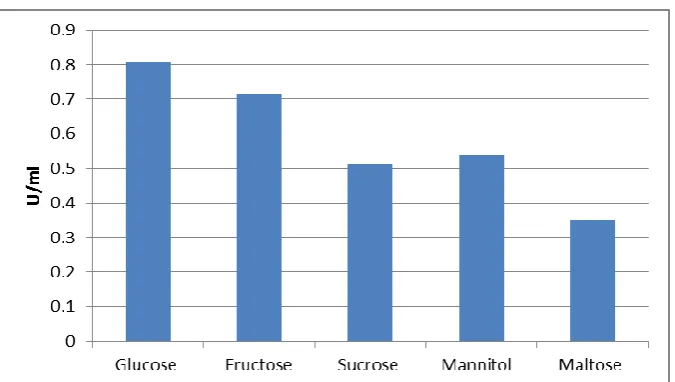
www.wjpr.net Vol 7, Issue 10, 2018. 462 Han et al, produce the catechol 1-2 dioxygenases with yeast extract. In case of carbon source,
glucose showed good enzyme production (Fig 2).
Extreme values of pH can inhibit microbial growth by interfere the microbial metabolism.
Most natural environments have pH values between 5.0 and 9.0. In the present study, highest
activity was observed when using pH 7. This result was contrary with previous study of
Andrea;[8] they were observed better activity with pH 8 (Fig 3). But same time our finding
was similar to the enzyme isolated by Kou and Li[16] who reported the C12D isolated from
Pseudomonas putida 84103 to exhibit highest activity at the optimum pH 7.5-8.0. Most
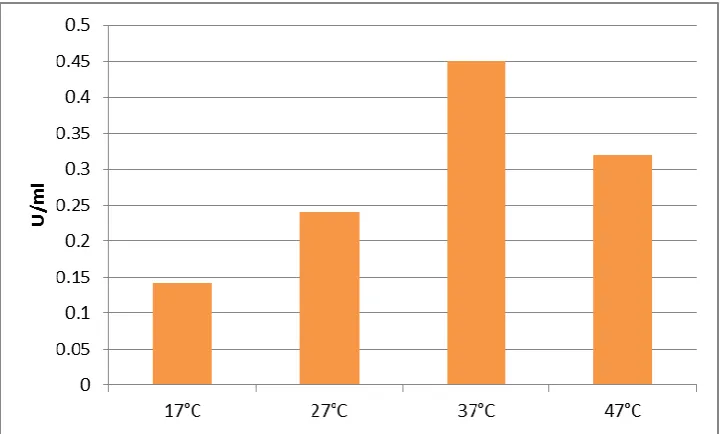
microbes prefer to grow at temperatures in a range of about 10 to 38°C. This activity slightly
increased until 27°C, than strongly increased until the maximum activity at 27 °C. Above
37°C, it was drastically reduced the activity (Fig 4). Similar study was observed with Silva et
al reports.[13]
After the optimization, the enzyme was produced with best parameters. Then enzyme was
purified with ammonium sulphate precipitation, dialysis and coloumn chromatography. The
enzyme value was improved compared than ammonium sulphate and dialysis (Table 5). In
this study, SDS PAGE was carryout for the molecular characterization of enzyme. The
SDS-PAGE analysis shows that the molecular weight of the Catechol 1, 2 dioxygenase was near
about 30 KD.
Furthermore, enzyme producing isolate was identified with biochemical tests, according to
that the isolate belongs to genera Bacillus and species as subtilis. In recently Jayanthi and
Hemashnbagam (12) was isolated the Catechol 1, 2 dioxygenase producing soil isolate of
Bacillus cereus. They were also observed the enzyme assay with same method.
Table 1: Screening of catechol 1, 2-dioxygenase producing isolates.
S. No. Isolates name Results U/ml
1. C1 -
2. C2 0.288
3. C3 -
4. C4 0.214
5. C5 0.258
www.wjpr.net Vol 7, Issue 10, 2018. 463 Fig. 1: Effect of nitrogen source on production of Catechol 1,2-dioxygenase.
Fig. 2: Effect of carbon source on production of Catechol 1,2-dioxygenase.
[image:6.595.126.471.534.723.2]www.wjpr.net Vol 7, Issue 10, 2018. 464 Fig 4: Effect of temperature on production of Catechol 1,2-dioxygenase.
Table 2: Purification of Catechol 1, 2-dioxygenase.
Purification steps Enzymes (U/ml) Protein
mg/ml
Specific Activity U/m
Purification Fold
Crude extract 1.74 1.1 1.581 -
Ammonium sulphate
precipitation 1.32 0.82 1.609 1.017
Dialysis 0.99 0.56 1.767 1.098
Gel filtration 0.61 0.30 2.033 1.150
REFERENCE
1. Broderick, J.B. and T.V. O’Halloran. Overproduction, purifcation, and characterization of
chlorocatechol dioxygenase, a non-heme iron dioxygenase with broad substrate tolerance.
Biochemistry, 1991; 30: 7349-7357.
2. Latus, M., H.J. Seitz, J. Eberspächer and F. Lingens. Purifcation and characterization of
hydroxyquinol 1, 2-dioxygenase from Azotobacter sp. strain GP1. Appl. Environ.
Microbiol., 1995; 61: 2453-2460.
3. Sauret-Ignazi, G., J. Gagnon, C. Beguin, M. Barrelle, J. Markowicz, J. Pelmont, and A.
Toussaint. Characterization of a chromosomally encoded catechol 1,2-dioxygenase
(E.C.1.13.11.1) from Alcaligenes eutroohus CH34. Arch. Microbiol, 1996; 166: 42-52.
4. Andrea Scaramal Silva, Flávio Anastacio de Oliveira Camargo, Robson Andreazza,
Rodrigo Josemar Seminoti Jacques, Daiana Bortoluzzi Baldoni, Fátima M. Bento.
Enzymatic activity of catechol 1,2-dioxygenase and catechol 2,3-dioxygenase produced
www.wjpr.net Vol 7, Issue 10, 2018. 465 5. Nitanshi Jauhari Shweta Mishra BabitaKumari S.N.Singh. Bacteria-mediated aerobic
degradation of hexacosane in vitro conditions. Bioresource Technology, 2014; 170:
62-68.
6. Mishra S., Singh S. N. Microbial degradation of n-hexadecane in mineral salt medium as
mediated by degradative enzymes. Bioresour. Technol, 2012; 111: 148–154.
7. Olukunle, O.F., Babajide, O., Boboye, B. Effects of Temperature and pH on the Activities
of Catechol 2,3- dioxygenase Obtained from Crude Oil Contaminated Soil in Ilaje, Ondo
State, Nigeria. The Open Microbiology Journal, 2015; 9: 84-90.
8. Arezoo Tavakoli and Ainon Hamzah. Characterization and evaluation of catechol
oxygenases by twelve bacteria, isolated from oil contaminated soils in Malaysia.
Biological Journal of Microorganism, 2016; 5(20): 71-80.
9. Lowry, Nira J. Rosebrough, A Lewis Farr and Rose J. Randall, “Protein Measurement
with the Folin Phenol Reagent”, The Journal of Biological Chemistry, 1951; 265–275.
10.Marcelo HO, Maria TL da Silva, Maria LOM, José Carlos R, Ederio DB. Benzene,
toluene and xylene biodegradation by Pseudomonas putida CCMI 852. Brazilian Journal
of Microbiology, 2005; 36: 258-261.
11.Wang D, Liu Y, Lin Z, Yang Z, C H. Isolation and identification of surfactin
producing Bacillus subtilis strain and its effect of surfactin on crude oil. Wei Sheng Wu
Xue Bao, 2008; 48: 304–311.
12.Jayanthi. R and Hemashenpagam. N. Isolation and identification of petroleum
hydrocarbon degrading bacteria from oil contaminated soil samples. International journal
of novel trends in pharmaceutical sciences, 2015; 5(3): 102-106.
13.Silva, R.J.S. Jacques., R. Andreazza, F.M. Bento, L.F.W. Roesch, F.A.O. Camargo.
Properties of catechol 1,2-dioxygenase in the cell free extract and immobilized extract of
Mycobacterium fortuitum. Brazilian Journal of Microbiology, 2013; 44(1): 291-297.
14.Li Han, Pi Liu, Jixue Sun, Yuanqing Wu, Yuanyuan Zhang, Wujiu Chen, Jianping
Lin, Qinhong Wang & Yanhe Ma. Engineering catechol 1, 2-dioxygenase by design for
improving the performance of the cis, cis-muconic acid synthetic pathway
in Escherichia coli. Scientific Reports, 2015; 5: 13435: 1-5.
15.Trinetta, V., Rollini, Manzoni, M. Development of a low cost culture medium for sakacin
A production by Lactobacillus sakei. Process Biochemistry, 2008; 43(11): 1275-1280.
16.Kou and Li. The preparation and properties of catechol-1,2-dioxygenase from