© 2019, IRJET | Impact Factor value: 7.211 | ISO 9001:2008 Certified Journal
| Page 4810
EXPERIMENTAL STUDY OF VARIATION IN EMISSION OF ENGINE USING
PONGAMIA BIODIESEL AS FUEL WITH EXHAUST GAS
RE-CIRCULATOR (EGR)
Mr. Fazal Razi M
1, Mr. C Senthilkumar
2, Mr. S Sivakumar
31
PG student, Department of Mechanical Engineering, RVS College of Engineering and Technology
Coimbatore-641402, TN, India
2
Assistant professor, Department of Mechanical Engineering, RVS College of Engineering and Technology
Coimbatore-641402, TN, India
3
Assistant professor, Department of Mechanical Engineering, RVS College of Engineering and Technology
Coimbatore-641402, TN, India
---***---Abstract - The need to search for alternative sources of energy which are renewable, safe and non- polluting assumes top priority in view of the uncertain supplies and frequent price hikes of fossil fuels in the international market. Biodiesel (fatty acid methyl ester) which is derived from triglycerides by transesterification, has attracted considerable attention during the past decade as a renewable, biodegradable and nontoxic fuel.When Bio-diesel is used as a substitute for diesel, it is highly essential to understand the parameters that affect the combustion phenomenon which will in turn have direct impact on thermal efficiency and emission. In the present energy scenario lot of efforts are being focused on improving the thermal efficiency of IC engines with reduction in emissions.
Key Words: Biodiesel, Alternative fuels, Variation in engine emission, Exhaust gas recirculation, Pongamia Pinnata,
1. INTRODUCTION
Better fuel economy and higher efficiency with lower maintenance cost has increased the popularity of diesel engine vehicles. Diesel engines are used for bulk movement of goods, powering equipment, and to generate electricity more economically than any other device in this size range. Diesel fuel is moderately cheaper than gasoline and has a higher energy density, i.e. more energy can be extracted from diesel as compared with the same volume of gasoline. Therefore, diesel engines in automobiles provide higher mileage, making it an obvious choice for heavy duty transportation and equipment. Diesel is heavier and oilier compared with gasoline, and has a boiling point higher than that of water.
Even though the diesel fuel give more benefits, but in today's world, where fuel prices are increasing as a consequence of spiraling demand and diminishing supply, so we need to choose a cost effective fuel to meet our needs. Bio-diesel is one of the alternative fuels, which can be effectively used in diesel vehicles.
1.1 Biodiesel
Bio-diesel refers to a vegetable oil or animal fat-based diesel fuel consisting of long-chain alkyl (methyl, propyl or ethyl) esters. Biodiesel is typically made by chemically reacting lipids with an alcohol producing fatty acid esters.
ASTM International (originally known as the American Society for Testing and Materials) defines Bio-diesel as a mixture of long-chain mono alkyl esters from fatty acids obtained from renewable resources, to be used in diesel engines.
Bio-diesel is a clean, domestic, renewable fuel for diesel engines. It is made from agricultural co-products and byproducts such as soybean oil, Jatropha oil and other natural oils. Bio-diesel can be used in any blend with petroleum diesel fuel and are free from sulphur. It is nontoxic and biodegradable. Bio-diesel has a higher oxygen content, which allows it to burn completely, causing lower emissions. It causes far less damage than petroleum diesel if spilled or released to the environment. It is safer than petroleum diesel because it is less combustible. The flash point for Bio-diesel is more than 130°C, compared with about 98°C for petroleum diesel. Bio-diesel has excellent properties as a lubricant also. Bio-diesel is safe to handle, store, and transport.
1.2 Pongamia
© 2019, IRJET | Impact Factor value: 7.211 | ISO 9001:2008 Certified Journal
| Page 4811
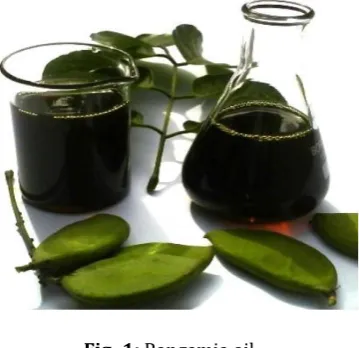
[image:2.595.82.262.162.336.2]erosion. Its root, bark, leaves, sap, and flowers also have medicinal properties and are traditionally used as medicinal plants. The seeds are largely used to extract oil known as ‘Karanja oil’
Fig- 1: Pongamia oil
2. Methodology and Experimental setup
This chapter explains the experiments which have been carried out during the project work. It also explains the experimental setup and the procedure for synthesis of biodiesel. It also explains the experimental engine setup and the procedure of the engine operation and working principle of instrument.
2.1 Biodiesel synthesis
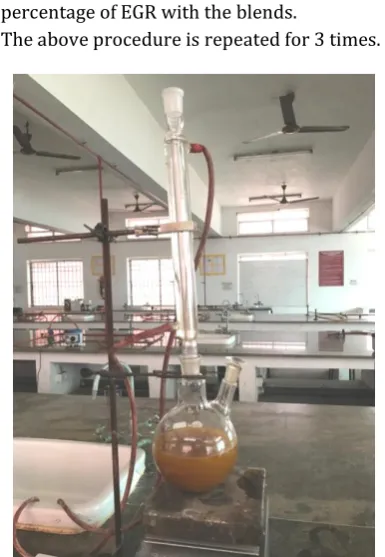
Crude Pongamia oil was collected locally and used. Chemicals including Methanol, sodium hydroxide (NaOH) and potassium hydroxide (KOH), sulphuric acid were obtained and used without any further purification. Pongamia oil was preheated prior to its use in transesterification process to remove the moisture content.
Pongamia oil contains high free fatty acids first we need to do esterification by using sulphuric acid and followed by transesterification reaction.
2.2 Details of experimental engine
The existing 4-Stroke single cylinder diesel engine of Kirloskar was fitted with an EGR setup and regulates the EGR percentage by using valve. Scheme of experimentation was planned to fulfill the objective framed under the present work.
The experiments will be conducted on a single cylinder four stroke naturally aspirated direct injection water cooled diesel engine test rig.
The time taken for 10ml of fuel consumption is noted. By using density of fuel, calorific value of fuel and time
for 10ml consumption the engine parameters Brake thermal efficiency, Brake specific energy consumption are calculated.
Engine 4 stroke single cylinder CI engine
Make
Kirloskar Power
5.0 KW @ 1500 RPM Bore X Stroke
0.08 m Stroke length 0.11 m
Load measurement Strain Gauge load cell Break drum diameter 0.3 m
Rope diameter 0.015 m
Table -1: Specifications of the diesel engine test rig
2.3 Experimental setup
Whole set of experiments were conducted for rated speed of 1500 rpm. The engine was started by hand cranking with diesel fuel supply, and is allowed to get its steady state (for about 10 minutes). Water to engine cooling jacket was maintained at constant flow rate throughout the experiments, this water flow pressure was maintained by water pump. The experiments were conducted at no load, 4Kg, 8Kg, 12Kg, and 15Kgwith diesel operation. Data such as fuel flow, air flow NOx, CO, CO2, O2 and HC emissions were
recorded at these conditions.
[image:2.595.308.557.551.751.2]The engine was run with the biodiesel blends of Pongamia for the same above condition. Performance and emissions test were carried out as before. Initially the experiments were conducted with zero percentage EGR. Similar experiments were conducted with 5%, 10%, 15%and 20% EGR for each load. The above experiment is carried out at three blends PB10, PB30 and PB50
© 2019, IRJET | Impact Factor value: 7.211 | ISO 9001:2008 Certified Journal
| Page 4812
2.4 Experimental procedure
1.
Fill the fuel tank and start the engine.2.
After that engine is allowed to run at rated speed of 1500rpm at least 10 minutes for stabilization.3.
Apply the required load on the engine and maintainthe speed 1500rpm.
4.
Note the time consumption for 10 ml of fuel, emission, smoke readings.5.
The performance and emissions are noted for all loads (no load, 4Kg, 8 Kg, 12 Kg and 15 Kg).6.
The above experimental procedure is repeated for the blends PB10, PB20,PB507.
The experiment is carried at 5%, 10%, 15% and 20% percentage of EGR with the blends. [image:3.595.64.257.277.556.2]8.
The above procedure is repeated for 3 times.Fig -3: Biodiesel synthesis by transesterification
3. RESULTS AND DISCUSSION
3.1 Oil extraction
The extraction of oil from Karanja seeds were done by Mechanical expelling method, yield obtained 24 %.
3.2 variations of engine performance and exhaust emission against load
Experiments were carried out at three blends of Pongamia biodiesel with diesel. Then experiment carried with the 5%, 10%, 15% and 20% EGR at no load, 4 Kg, 8 Kg, 12 Kg and 15 Kg load. Variation of engine performance and exhaust
emission against load were interpreted in graphs. They are shown below.
3.2.1 Brake thermal efficiency (BTE)
The variation of brake thermal efficiency of the engine with PB10 fuel through different EGR percentage is compared with the brake thermal efficiency obtained with diesel fuel. From the test result it is observed that by increasing load the brake thermal efficiency of the diesel and the blend are increasing. The brake thermal efficiency of the blend is lower than diesel fuel throughout the entire range.
It is also observed that brake thermal efficiency of the blend is increasing with increase in the percentage of EGR. This is due to increase in inlet gas temperature and combustion of the un-burnt hydrocarbons in the re-circulated exhaust gas. The increase in inlet gas temperature decreases the ignition delay and result in complete combustion. It also observed that the BTE of PB10 at 15% EGR is higher (2.46% at 8 Kg load, 1.03 % at 12 Kg % load) than PB10 without EGR. At 20% EGR the BTE of PB20 is lower (2.2%) than the 15% EGR. This is attributed to the decrease in oxygen concentration of the inlet gas of an engine.
The variation of brake thermal efficiency of the engine with PB30 fuel through different EGR percentage and compared with the brake thermal efficiency obtained with diesel fuel. From the test result it is observed that by increasing load the brake thermal efficiency of the diesel and the blend are increasing. The brake thermal efficiency of the blend is lower than diesel fuel throughout the entire range.
The variation of brake thermal efficiency of the engine with PB50 blend through different EGR percentage is compared with the brake thermal efficiency obtained with diesel fuel. From the test result it is observed that by increasing load the brake thermal efficiency of the diesel and the blend are increasing. The brake thermal efficiency of the blend are lower than diesel fuel throughout the entire range. It is also observed that brake thermal efficiency of the blend is increasing with increase in the percentage of EGR. This is due to increase in inlet gas temperature and combustion of the un-burnt hydro carbon in the re-circulated exhaust gas. It is observed that the BTE of PB50 at 15% EGR is higher (1.12% at 12Kg load) than biodiesel fuel without EGR. After that with increase in % of EGR the BTE of PB50 is decreasing. This is due to the negative effect of decrease in oxygen concentration in the inlet gas of an engine. Due to higher viscosity and poor volatility adversely effected the mixture formation and hence poor performance of PB50 fuel than PB10 and PB30 fuel.
3.2.2 Carbon monoxide emission
The variation of carbon monoxide emission of the engine with PB10, PB30 and PB50 fuels through different EGR percentage is shown. From the test result it is observed that by increasing load the CO emission of the diesel and the
B
T
E
(%
© 2019, IRJET | Impact Factor value: 7.211 | ISO 9001:2008 Certified Journal
| Page 4813
blend are decreasing and then it is increasing at 100% load. The CO emission of the blend are higher than that of diesel fuel for all loads. It is also observed that CO emission of the blend is increasing with increasing the percentage of EGR. This is mainly due to decrease in oxygen concentration in the inlet gas of an engine. Higher values for B50 compared to B10 and B30 may due to poor mixture preparation, and inefficient combustion due to higher viscosity and poor volatility. Dissociation of CO2 will also contribute more CO at
high loads.
3.2.3 Un-burnt hydrocarbon emission
The variation of HC emission for PB10 fuel with respect to load and through different EGR rate is compared with the HC emission obtained with diesel fuel. From the test result it is observed that by increasing load the HC emission of the diesel and the blend are increasing. It is also observed that HC emission of the blend is increasing with increase in the percentage of EGR. The combustion air fuel mixture in diesel is heterogeneous. In the combustion chamber due to insufficient oxygen a rich air-fuel mixture is formed in some regions. This result in high HC emission at higher EGR rate. The HC emission for the PB10 (26, 27 and 32 ppm at No load, 4Kg, and 8 Kg load respectively) fuel without EGR is lower than diesel (28, 30 and 33 ppm at No load, 4Kg, and 8 Kg load respectively) fuel. This is due to the lower calorific value of the PB10 fuel than diesel.
From the test result it is observed that by increasing load the HC emission of the diesel and the blend are increasing. It is also observed that HC emission of the blend is increasing with increase in the percentage of EGR. The combustion air fuel mixture in diesel is heterogeneous. In the combustion chamber due to insufficient oxygen a rich air-fuel mixture is formed in some regions. This result in high HC emission at higher EGR rate. Higher values of HC for PB50 compared to PB30 and PB10 due to decrease in calorific value (PB10: 41.99, PB30: 40.97 and PB50: 39.95 Mj/ Kg) so incomplete combustion take place as a result un-burnt HC will increase.
3.2.4 NOx emission
The variation of NOx emission of PB10 fuel with
respect to load and through different EGR rate is compared the NOx emission obtained with diesel fuel. From the test
result it is observed that the NOx emission is increasing by
increasing load. This is due to increase in combustion temperature at higher load. It is also observed that NOx
emission of the blend is decreasing with increase in the percentage of EGR. This is due to insufficient oxygen, and low combustion temperature. The NOx emission is reduced
35.23% at 20% EGR. The NOx reduction is higher at full load
than part load. Because at part load the available oxygen sufficient for NOx formation.
The variation of NOx emission of PB30 and PB50 fuels
with respect to load and through different EGR rate is
shown in the figure 4.41 and figure 4.42. and compared with the NOx emission obtained with diesel fuel. From the test
result it is observed that the NOx emission is increasing by
increasing load. This is due to increase in combustion temperature at higher load. It is also observed that NOx
emission of the blend is decreasing with increase in the percentage of EGR. This is due to insufficient oxygen. The NOx emission is reduced 29.49% at 20% EGR in PB30 and
for PB50 it is 20.14%. The NOx reduction is higher at full
load than part load. Because at part load the available oxygen sufficient for NOx formation. Higher values of NO for
PB50 due to more percentage of oxygen in PB50 than in PB30 and PB10.
4 CONCLUSIONS
Biodiesel is a viable substitute for petroleum-based diesel fuel. Its advantages are improved lubricity, higher cetane number, reduced global warming, and enhanced rural development. Karanja oil has potential as an alternative energy source. However, this oil alone will not solve our dependence on foreign oil within any practical time frame. Use of this and other alternative energy sources could contribute to a more stable supply of energy. Major production canters on the level of modern petroleum refineries have not been developed.
The economics of biodiesel fuels compared to traditional petroleum resources are marginal; public policy needs to be revised to encouraged development. Increased Karanja oil production would require a significant commitment of resources. Land for production would need to be contracted, crushing and biodiesel production plants need to be built, distribution and storage facilities constructed, and monitoring of users for detection of problems in large scale use are all needed to encourage development of the industry. To meet the challenges of excessive import, we have to strengthen our oilseed sector and lay special emphasis on harnessing the existing and augmenting future potential source of green fuel.
The organized plantation and systematic collection of Karanja oil, being potential bio-diesel substitutes will reduce the import burden of crude petroleum substantially. The emphasis should be made to invest in agriculture sector for exploitation of existing potential by establishing model seed procurement canters, installing pre-processing and processing facilities, oil extraction unit, trans-esterification units etc. There is also need to augment the future potential by investing largely on compact organized plantation of Karanja on the available wastelands of the country. This will enable our country to become independent in the fuel sector by promoting and adopting bio-fuel as an alternative to petroleum fuels
© 2019, IRJET | Impact Factor value: 7.211 | ISO 9001:2008 Certified Journal
| Page 4814
oil is currently much more expensive than diesel fuels due to relatively high cost of edible oil.
There is a need to explore non edible oils as alternative feed stock for the production of biodiesel non-edible oil like Karanja. It is easily available in many parts of the world including India and it is cheaper compared to edible oils. Production of these oil seeds can be stepped up to use them for production of biodiesel. The production of biodiesel from this non edible oil provides numerous local, regional and national economic benefits. To develop biodiesel into an economically important option in India some innovations required for modification into the process to increase the yield of ester
Based on the observation, the brake thermal efficiency of engine is increasing with increase in the percentage of EGR and then it is decreasing with increase in EGR percentage. The HC, CO emissions are increasing with increase in the percentage of EGR. The NOx emission is
decreasing with increase in the percentage of EGR.
The brake thermal efficiency of PB10 is better than PB30 and PB50, PB10 with 15% EGR is higher (2.85%) than the brake thermal efficiency of JB10 with same EGR rate.
The CO and HC emissions were found to be higher for PB 50 compared to other blends, these emissions for JB is lower than PB
The NOx emission were found to be lower for PB10
than other blends of PB, The NOx emission of P10
with 20% EGR is lower (27 ppm) than NOx emission
of JB10 with same EGR rate.
From the above it is concluded that the PB fuel is having better performance in BTE and emission of NO compared to JB fuel.
REFERENCES
[1] Gaurav Dwivedi, M.P.Sharma (2014)Prospects of
biodiesel from Pongamia in India, www.elsevier.com/locate/rser
[2] T.C Venkateswarulu, Cherukuwada v Raviteja,
Kodali v Prabhaker, D John Babu, A Ranganadha Reddy, M Indira, A Venkatanarayana (2014) A Review on Methods of Transesterification of oil and fats in biodiesel formation, International Journal of Chemtech Research
[3] Bobade S.N and Khyade V.B (2012) Detail study on
the Properties of Pongamia Pinnata (Karanja) for the Production of Biofuel
[4] V.R. Kattimani and B.M. Venkatesha,(2013)
Technologies for biodiesel production from non-edible oils: a review, Indian journal of energy vol 2(6) 129-133
[5] N.Manikanda Prabhu, (2013) Experimental Analysis
of Jatropha Curcas Bio-Diesel for Optimum Blend Characteristics, Researchgate
[6] K. Nantha Gopal and R, Thundil Karupparaj, (2014)
effect of Pongamia biodiesel on emission and combustion characteristics of DI compression ignition engine, ain shams engineering journal
[7] Bhupendrasingh Chauhan, Naveen kumar and
haengmukcho (2010) performance and emission studies on an agriculture engine on neat jatropha oil
[8] Devendra S Rawat, Girdhar Joshi, Bhawna Y Lamba,
Avanish K Tiwari, Sudesh Mallick (2014), Impact of additives on storage stability of Karanja (Pongamia Pinnata) biodiesel blends with conventional diesel sold at retail outlets, Elsevier Pages 30-37
[9] I. M. Monirul, H. H. Masjuki, M. A. Kalam, N. W. M.
Zulkifli, H. K. Rashedul, M. M. Rashed, H. K. Imdadul and M. H. Mosarof (2015) A comprehensive review on biodiesel cold flow properties and oxidation stability along with their improvement processes, Royal society of chemistry
[10] Gajendrasingh, SC Moses, KC Pandey and HL
Kushwaha (2015) Biodiesel from Karanja oil as an Alternative Fuel for Diesel Engine, International Journal of Research Studies in Agricultural Sciences (IJRSAS) Volume 1, Issue 2, June 2015, PP 1-6 ISSN 2454–6224
[11] Malya, Naik,LC, Meher, SNNaik and LM Das (2008)
production of biodiesel from high free fatty acid karanja (Pongamia Pinnata) oil, Biomass and bio energy 32 (2008) 354-357.
[12] Nagendra Krishnamurthy (2010) investigation of
fouling in wavy-fin exhaust gas re-circulator
[13] Hountalasetal (2008) Effect of exhaust gas
recirculaton temperature for various EGR rates on heavy-duty diesel engine performance and emission
[14] H.E Saleh (2009) Effect of exhaust gas recirculation
on diesel engine nitrogen oxide reduction operating with jojoba methyl ester
[15] S.M Palash, M.A Kalam, H.H Masjuki, B.M Masum, I.M
Rizwanul Fattah, M Mofijur (2013) impacts of biodiesel combustion on NOx emission and their