.~
•.
~
"">ii~"rI',!!:_J~I'!';'S2;;;~
...~~,._.!
.
...,,"i~,.t%!J
...
~
crJilC irrtraduces tthe aDD
Ii'U~""ltl40
lOisirriibuied &tellProcessing™ Sysiem.
Blending .lata l=tetrieval, I:ntry J\nd Management, the XL40 combines the newest distributed processing and data entry tech-nology with an exceptional file retrieval capability. Distributed
KeyProcessing means data is entered, validated, and managed at the source-where it originates-by people who really know what the information represents. Distributed KeyProcessing reduces your data processing costs by detecting and correcting errors before they reach the mainframe, providing local pre-processing, and optimizing the management of your organization's data.
First in a family of CMC Distributed KeyProcessing Systems, the XL40 is available with one to seven keystations in a choice of keypunch-style keyboard or typewriter style with numeric pad, and features expandable disk capacity from 4.4 to 35.2 megabytes. Using a variety of industry-standard protocols, including HASP workstation, the XL40 communicates with your mainframe wherever it's located. CIRCLE 4 ON READER CARD
Your software dreams come true with a fully compatible subset of ANSI COBOL and XL/OS, an automatic and dynamic multi-task operating system specially designed for the XL family. XL/OS provides disk and memory allocation, ensures data and system integrity, and controls all system resources. The XL40's information retrieval package, COSAM (COBOL Shared Access Method) features indexed files which you can retrieve and update on the spot, ensuring instantaneous response at the source.
Don't just dream about it, call or write today for our brochure on the XL40 Distributed KeyProcessing System, The DREAM Machine for Data Retrieval, Entry And Management. With the XL40, just as with dreams ... the possibilities are unl·imited.
KeyProcessing is a trademark of
a division of Pertec Computer Corporation
IN FINANCIAL PACKAGING
w
THERE 15 ONLY ONE ALTERNATIVE
TO ITEL.
And that's no exaggeration, either.
It's something we can back up with fact after fact.
Take our Packaged Lease, for example. We not only supply you with a total computer system (com-parable to the best of IBM), but we
supply it all at the lowest possible prices.
The savings are enormous. Moreover, if you want you can sublease everything at attractive rates...:...making our Packaged Lease a virtual no risk proposition.
It's this kind of all out creative effort that has put us right up there with IBM. Not only in financial pack-aging. But in field engineering. In computer peripherals. In systems and software. In total computer capability.
CIRCLE 55 ON READER CARD
When it comes to experience and reputation, it's either IBM. Or Itel.
When you get to price/perform-ance, however, there is no altemative.
There is only Itel.
VOLUME 22 NUMBER 12
This issue 141,700 copiesDECEMBER 1976
FEATURES
50 POWER, POLITICS
AND DP
Joseph Rue. A Machiavellian handbook of survival for the dp manager.
53 HUMANIZING
INFORMATION
SYSTEMS
Theodor D. Sterling and Kenneth Laudon. Ombuds-men expose another kind of computer abuse.
61 THE COMPUTERIZED "LIBRARIAN"
R. A. Baker and J. C. Jefferies. Where a Librarian is needed, the position can sometimes be filled by a pro-gram.
67 SOURCE PROGRAM MANAGEMENT
Larry K. Miller and David Ostrom. That Librarian pro-gram might be nearly free, too.
79 SOFTWARE ENGINEERING AND LIFE CYCLE
PLANNING
Robert L. Patrick. For those who are more interested in
NEWS IN PERSPECTIVE
148 CONFERENCES
Info 76 conference in Chicago drew the types that ex-hibitors consider to be their kind of people.
150 COMPANIES
Canada's Consolidated Computer is on the road to re-cove ry-aga in.
156 MICROCOMPUTERS
Mini/ Micro show is a success in an awkward way.
157 SERVICES
Change is focus of Adapso talks.
159 ANTITRUST
" West Coast cases open in Los Angeles with CaIComp vs. IBM.
DEPARTM ENTS
7 LEITERS
About that Malik book on IBM, an opposing view on school district dp, and is programmer certification
pre-mature? '
11 PEOPLE
Bob McGrath: Selling terminals and ex-IBMers; Bill Weksel: three of him; Stan Bootie: selling ADAM
17 LOOK AH EAD"
22 CALENDAR
'77 topics: automation, word processing, & design.
27 SOURCE DATA
"Making Computers Pay" and other books reviewed or briefed, plus reports, references, vendor literature, courses.
December, 1976
getting the work out than in creating a new programming language.
83 RAMIS AT CITIBANK
Robert E. Roach. IMS was too difficult, MARK IV too rigid.
94 OS/CB Release 1
Gary P. Becker. An unusual memory trace for all our good buddies out there.
99 ON THE DP ROAD TO SOUTHEAST ASIA
Bill Orr. Technology transfer, leapfrogging, and the search for regional identity in Southeast Asia.
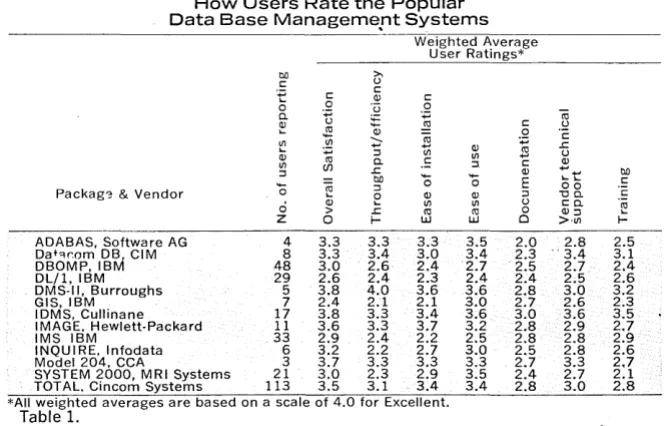
108 SOFTWARE PACKAGE RATINGS
Herbert L. Gepner. Everyone has heard the vendors' claims for these 250 popular packages; now here's what the users say.
146 IBM'S SERIES/1 MINICOMPUTERS
Angeline Pantages and Philip Dorn. The giant again en-ters a market late-but with massive resources.
199 FORUM
John M. Eger. Datran was the victim of a massive over-dose of obstruction administered by Ma Bell.
162 MANAGEMENT
DPMA makes good in Las Vegas.
163 ELECTRONIC FUNDS TRANSFER
EFT: other issues and legislation.
166 COMMUNICATIONS
Bell wears people down to capture markets from a to z.
172 BENCHMARKS
Justice Dept. vs. Bell; deButts on Bell bill; Another car-rier; Another voice in Washington; Must improve service; High rating for DEC; Quadrupled earnings; Components firms merge; But no trophy.
49 EDITOR'S READOUT
A sampler of problems that are a by-product of bigness.
176 HARDWARE
The Pertec/Computer Machinery Corp. merger bears fruit: the "DREAM machine" for data entry/management.
182 SOFTWARE
&SERVICES
System Language/1, the latest attempt at automatic programming, information retrieval, new mini OS ...
188 MARKETPLACE
196 ADVERTISERS' INDEX
About the Cover
We look into software packages again, while our cover literally stacks them one against the other. Design is by our Art Director.
4
DIVIS/OS
THE OnlY comPLETE DASD mAnAGER
ARCHIVAL
Data set and PDS member group designation. multiple versions of archived data. inclusion/exclusion of PDS member groups. data set and member index display and update • TRANSPARENT RESTORE
SEL·ECTIVE DUMP/RESTORE
Copy to archive. designation of number of copies. direct by data set name. PDS member and member group selectivity
VOLUME CONFIGURATOR
Fragmentation control of individual modules. data sets from mul-tiple volumes to one volume. selective reblocking and realloca-tion • designarealloca-tion of data sets by group. pOSirealloca-tion control of data sets on target volume • 3 modes of operation simulate/ allocate/migrate
PDS MANAGEMENT
Tailored data set status reporting. member n-up listing. group reporting of members • capacity threshold notification • com-pression of directory and member reallocation
DATA SET RETENTION CONTROL
Automatic scratch/archival • optional user modification • six scratch options
INTEGRITY
Transparent restart. generation and recovery of files and tables. duplication of archived tapes. archive index reconstruction of archived tapes. reserves and dequeues of shared DASD • audit trail/and traces
MANAGEMENT REPORTS
Idle space calculations. table for format control. volume alloca-tion summaries • data selecalloca-tion during VTOC scan • single JCL procedure for all reports
ADDITIONAL SUPPORT MODULES
1. DASD Space Billing (track days, megabytes, device type, user option)
2. TSO Command Processor 3. CICS, IMS/TP Interface
4. MSS Support (3850 Compatible)
DMS/OS is designed and documented to be self installable and re-quires no OS modification assemblies or link edits. DMS/OS is avail-able for all versions of the full IBM 360/370 operating system (MFT, MVT, VS1, VS2, MVS and VM) and supports all current IBM compatible drives.
* DOS v /S version available first qtr. 1977
For an on site evaluationof DMS/OS or for further information contact Software Module Market-ing or please circle our reader service card number.
~
E(]fTWflRE r:I(][)ULE
r:lflRKET~r.i[j
THE SUPERMARKET OF SOFTWARE
CROCKER BANK BUILDING/PENTHOUSE
1007 7th STREET. SACRAMENTO, CA 95814 • (916) 441-7234
CIRCLE 120 ON READER CARD
DRTRMRTION
..
EDITORIAL STAFF Editor
Articles Editor International Editor European Editor Products Editor Source Data Editor Calendar Editor Reprint Editor News Editor Bureau Managers
San Francisco Los Angeles Greenwich New York Washington, D.C. Correspondents
Minneapolis Southwest Australia Editorial Advisor Technical Advisor Contributing Editors
EDITORIAL OFFICES
John L. Kirkley Richard A. McLaughlin Angeline Pantages Nancy Foy Michael Cashman Daniel P. Schlosky Gloria Tidstrand Pat Minford Tom McCusker Edward K. Vasakl Edith D. Myers Angeline Pantages laton McCartney Linda J. Flato James K. Johnson Robert F. Alexander Ken McGregor . Robert L. Patrick Lowell Amdahl Paul Armer, Howard Bromberg, Philip H. Dorn, louis B. Marienthal, Carl Reynolds F. G. Withington. William Helgason John M. Eger
Headquarters: 1801 S. la Cienega Blvd., los An-geles, CA 90035. Phone (213) 559-5111. Eastern: 35 Mason St., Greenwich, CT 06830, (203) 661-5400. 420 lexington Ave., New York, N.Y. 10017; 134 Mt. Auburn St., Cambridge, Mass. 02138, 6605 Burlington Pl., Springfield, VA 22152, (703) 569-3383. Southwestern: 2711 Cedar Springs, Dallas, TX 75201. (214) 744-0161. Western: 2680 Bayshore Frontage Rd., Suite 401, Mountain View, CA 94043, (415) 965-8222. Foreign: 8 Pellerin Rd., london N. 16; (01) 249-1177; 24 Stafford Road, Artarmon, Sydney, NSW 2064, Australia, 41-5748. GRAPHIC DESIGN & PRODUCTION
Art & Production
Director Cleve Marie Boutell Advertising
Production Manager Marilee Pitman Production Assistant Alberta R. Martin CIRCULATION
35 Mason Street, Greenwich, CT 06830 Circulation Manager Suzanne A. Ryan Marketing Research
Manager Publisher Assistant Publisher Circulation audited
Deborah Dwelley James M. Morris F. Douglas De Carlo by Business Publications
Audit
..
American
Member A Business
-wABP
Press, Inc.,DATAMATION Is pub-lished monthly on or about the first day of every month by Tech-nical Publishing Company, 1301 South Grove Ave., Barrington, Illinois 60010; Arthur L. Rice, Jr., Chairman of the Board; James B. Tafel, President; Gardner F. landon, Executive Vice President. Executive, Circulation and Advertising offices, 35 Mason Street, Greenwich, CT 06830, (203) 661-5400. Editorial offices, 1801 S. la Clenega Blvd., los Angeles, CA 90035. Published at Chicago, III. DATAMATION is circulated without charge by name and title to certain qualified individuals in the United States and Canada who are employed by companies involved with automatic information handling equipment. Available to others by sub-scription at the rate of $24. Reduced rate for qualified students, $14. Foreign subscriptions are available for £20.00 or for the equivalent of $40 U.S. in most West European currencies. Sole agent for all subscriptions outside the U.S.A. and Canada is J. B. Tratsart, Ltd. 154 A Greenford Road, Harrow, Middlesex HA13QT, England. No subscription agency is authorized by us to solicit or take orders for subscriptions. Controlled circu-lations paid at Columbus, OH and Form 3579 to be sent to Technical Publishing Company, P.O. Box 2000, Greenwich, CT 06830. © Copyright 1976 Technical Publishing Company. ® "Datamation" registered trademark of. Technical Publishing Company. Microfilm copies of DATAMATION may be obtained from University Microfilms, A Xerox Company, 300 No. Zeeb Road, Ann Arbor, Michi-gan 48106. Printed by Beslow Associates, Inc.
The
LIBRARIAN®
and MetaCOBOr from ADR
Boost Efficiency at Computer Power, Inc.
Computer Power, Inc., Jacksonville, Florida, provides complete data processing services for a number of banks, mortgage bankers and saving and loans whose mortgage port-folios have over 1,250,000 mortgage loans valued at over 24 billion dollars.
Over 8,400 program modules are now used to provide cli~nt services-modules which require storage space equivalent to 2.7 mil-lion card images.
Until The LIBRARIAN was installed, program storage and management was an expensive and time consuming problem According to Technical Support Manager Roy Fileger, "Before we installed The LIBRARIAN, we stored everything on 17 IBM model 2314 disk packs. That meant we had 17 different source statement libraries. We were making 1000 pack changes a month and we were spending over 50 hours of com-puter time each month reorganizing files." "Program standardization was a problem too. Programmers would make changes to one pack and not duplicate the changes on the other packs."
The LI BRARIAN enabled Computer Power, Inc., to cut disk storage by 94%.
After The LIBRARIAN was installed 2 years ago the entire source statement library was immediately compressed with the result that Computer Power, Inc., using the IBM 3330 disk system, now stores all of its 8400 pro-gram modules on a single disk, constantly on-line. The benefits were far greater than just the savings in disk use, however. Time required for file reallocation was virtually eliminated. Elimination of disk shutdowns and disk changes added another 50 hours a month of usable computer time. And standardization rapidly improved because common program changes no longer had to be duplicat~d on many different disks.
"We really have file backup now. And that's tremendous."
Roy Fileger remembers, "When we had 17 packs our backup and savings procedure~
were extremely time consuming. Now, with The LIBRARIAN and only one disk pack, we are able to save everything every single day in just 20 minutes."
ADR's MetaCOBOL is doing more than just conversion. Computer Power, Inc., is in the final phases • of conversion of more than 6000 program modules from DOS to os/ ANS. According to Roy Fileger, "We're running through Meta-COBOL and coming out with state-of-the-art programs, OS/ ANS, single entry, single exit with I/O completely changed. All the pro-grams we have converted so far have exe-cuted perfectly the first time."
Programs are being standardized as they go through MetaCOBOL. "Everything coming out is looking alike.
Meta-COBOL is picking up errors in violation of COBOL specifications that the compilers would let go through. As a result, our pro-grams are really coming out clean," he continued.
"As far as I know, there is no alternative to MetaCOBOL." . "Any other system would have required
hand-made changes involving a staggering amount of time," Roy Fileger added.
ADR software products are an integral part of over 5,000 installations worldwide. Each ADR product is not just a program, but a complete package with full documentation and on-site support. ADR is the only soft-ware company with 50 branch offices and representatives in 31 countries-each staffed with ADR-trained technicians.
~
-~-~;~~:.c~~
•.;:rw;.:,,":oAI.'~n; .~;:.-:n:'''''''''''''':'',",.3'''.£~.tS-4
• •~~!I''1!''''''"""
. . .
APPLIED DATA RESEARCH
THE SOFTWARE BUILDERS®l~
ADR software products: in use at over 5,000 installations worldwide.u.s. offices in Boston (617) 245-9540, Chicago (312) 694-2244, Cleveland (216) 228-0880, Housto~ (713) 526-3188, los Angeles (213) 826-5527, New York (212) 986-4050, Princeton (609) 924-9100, Washington (703) 281-2011.
Foreign offices in Australia, Austria, Belgium, Brazil, Canada, Denmark, England, Finland, France, Germany, Hong Kong, Israel, Italy, Japan, Korea, Malaysia, Mexico, Netherlands, New Zealand, Norway, Philippines, Portugal,Puerto Rico, Republic of South Africa, Singapore, Spain, Sweden, SWitzerland, Taiwan, Thailand, Venezuela.
"You can't
buy
a 132-column
printer for any
less.
01;
get
any
m2r!!'
But the low initial
price for the Centronics 700 Series
132-column printer isn't the whole story.
It's the lower
cost-of
ownership based on the 700's
inherent reliability and simplified construction.
The 700's unique modular construction using four different modules -
print-ing, electronics, forms handling and keyboard - and less moving parts mean easier
maintenance, lower cost and a smaller spares inventory.
Write for the full details of this tremendous offer . . . and information on the
rest of the printers and teleprinters in the new Centronics 700 Series.
Centronics means more than low price.
And more than hardware. It's the widest range of models, features, options
• Financially strong· Proven delivery response • Over 70,000 printers installed • 109
world-wide sales/service locations • Stringent quality control • Advanced R&D and
manufacturing • Long-term spare parts availability • Customizing for specific needs.
I:EnTROnII:S® IS PRinTERS
Centronics Data Computer Corp., Hudson, N.H. 03051, Tel. (603) 883·0111, Twx. 710-228-6505, Tlx. 94-3404; Eastern Region: (617) 272-8545 (MA); Central Region: (513) 294-0070, Twx. 810-459-1784 (OH); Western Region: (714) 979-6650, Twx. 910-595-1925 (CA) Centronics Data Computer (Canada) Ltd., Ontario, Tel. (603) 883-0U1,Twx.
710-228-6505; Centronics Data Computer (UK) Ltd., Cheam, Surrey, England, Tel. 643 0821-4, Tlx. 851945756; Centronics Data Computer, GmbH, 6 Frankfurt/Main., West Germany, Tel. 663321/22, Tlx. 841413224; Centronics of Puerto Rico, Dorado, Puerto Rico, Tel. (809) 796-1881. Tlx. 3859349
letters
With Malik aforethought
Oh dear, oh dear! I have upset Mr. Gardner [see the review of Mr. Malik's And Tomorrow the World? Inside IBM, September p. 29] that he should splutter on in such an incoherent fash-ion. However, whatever else he may write, he should not be allowed to ac-tively misrepresent me without chal-lenge.
Why sources, when quoted, are not identified, the reliance placed on IBM documents which have or are appear-ing in the lawsuits it has and is in-volved in, and the fact that the conclu-sions were arrived at after the study of the evidence, all this was carefully ex-plained in the book, some of it at length.
Mr. Gardner is entitled to disagree with what I wrote, or the reasons for doing so. He is entitled to challenge the reasons, but before doing so he should at least read them.
As to the charge of animosity, a blanket charge at that, it must also be denied. I found the case against IBM at times overwhelming, and where I did so, I wrote accordingly. I dislike the implication within Mr. Gardner's re-view that while it is permissible, to write pro or "objective" material about IBM, it is not permissible to write otherwise. That smacks much too much of the sort of writing with which this industry is too often treated, or, not to put too strong a term on it, PR flakery.
As to the history, in the twentieth century, Turing is the boy. One must go by the evidence, even if you have to wait for my next book but two to find it. Though it's not too difficult, it has been there all along if you know where to look.
As I wrote in A n,d Tomorrow . . . The World: Inside IBM, "The mythol-ogy of American knowhow, Yankee shrewdness and foresight can stand on its own quite effectively without having to be stretched to) encompass things which were, and are, manifestly not true." I try to deal in truth, or the nearest approximation to it that one can get at. History is not about wheth-er the Russians, Amwheth-ericans, British or Germans are ten feet tall; it is about what actually happened, and why it did so. While the truth is supposed to set you free, freedom is not necessarily comfortable.
Anyway, thanks for "the only game in town." And there, given that I live in Europe, and IBM is an American
December, 1976
company, is a reflection on our pro-fession.
REX MALIK London, England
Mr. Gardner replies: I remain consis-tent in my feelings about Mr. Malik's writing: I find his letter as muddled as his book. For the record, I did read his book, but it was very tough going.
Another manager's view
In Jackson Granholm's article, "The View from the Manager's Office," (August p. 52), an individual was in-terviewed who expressed some very negative feelings about data processing in the public school systems. As Chair-man of the California Association of School Business Officials, Data Process-ing Research & Development Com-mittee, and being well acquainted with the organization in which the inter-viewee in the article works, I feel that the attitudes and opinions expressed in that article are not representative at all of dp, at least in the California public school system.
The individual stated that there was a problem of low motivation. To this I must reply that I have never seen in the
1
private sector the degree of motivation that I have seen in the public school data processing departments. Given limited resources and sometimes unre-alistic time requirements, some very innovative and creative computer sys-tems have been designed to serve the 1,200 school districts throughout the state.
The article also implied that all school district computer systems should be identical, and each district should use them all in the same way. Granted, there is room for improve-ment in standardization of information definition and information exchange procedures, but individual school dis-tricts perceive their own needs differ-ently and it's rare to find the emphasis in any two school district d,p centers to be in the same areas. Whether one approach is better than another is for the local taxpayers to decide and not for a statewide (or county-wide) man-date to dictate ...
DENNIS VLASICH Director Data Processing Claremont Unified School District Claremont, California
Mr. Vlasich is mistakenly making a straw man of our anonymous manager by attributing statements to him which he never made. Mr. Vlasich accuses the manager of calling for "standardi-zation" in all school districts, when in fact the manager said that 18 of 20 districts with dp capabilities "prefer to
have the public pay for duplicating everything" rather than share common dp solutions. This is a call for some standardization perhaps, but the man-ager never said "that all school district computer systems should be identical, and each district should use them all in the same way."
IBM's little brother?
Norman J. Harris ("People," October, p. 14) is apparently quite proud of his role as IBM'S little brother. In these days of investigations of conflicts of interest, the acceptance of a foreign trip as IBM'S "Data Processing Execu-tive of 1975" should cause his present and any future employers to examine closely any of his recommendations to further increase his big brother's "mar-ket penetration." I am quite sure Banc-Ohio Corp. would not be overjoyed at the prospect of its customer base switching their business to the Bank of America to avoid the stigma of becom-ing "losers," [since BancOhio is not the "big brother" in the banking indus-try].
JOHN J. SPELLMAN Roper Corporation Systems/ Programming Manager Outdoor Power Group
Is certification premature?
Ms. Miller's reply to Mr. Ray (October p. 7) appears to rest her case for certifi-cation of dp practitioners on the prece-dent of other practitioners, which she attributes to public demand that they (CPA'S, lawyers, etc.) have their com-petence certified to provide public as-surance of their qualification to prac-tice.
If one were to study the history of CP A certification, admissions to the bar, etc., I strongly suspect that the motivations behind those, programs had little to do with public demand for qualified practitioners and much to do with a desire on the part of the practi-tioners to protect themselves from un-due competition from too many practi-tioners.
At the time of this writing a local furor is raging over the failure rate for the Utah Bar exam. The administra-tors of that exam have been accused of elevating the failure rate to restrain local competition in the legal profes-sion. Whether this accusation is true or not is beside the point, which is that the bar exam is publicly viewed locally not as a device to protect the public from unqualified lawyers (although we have our share of such around here), but as a device to protect established lawyers from competition from aspir-ing ones not yet established.
If this is a more accurate view of the history of certification programs in other professions, then the question of the relevance of those precedents to our situation requires very close atten-tion.
letters
An even greater problem, in my opinion, is that other profession~ are possessed of a body of pro~es~lO?al
knowledge which defines the dIsCIplIne associated with the profession. We have as yet no such di~cipline, nor a body of professional knowledge which comes very close to defining one. Until that body of knowledge is defined, a certification program seems premature. R.W.PRATT,CDP Data Base Administrator Salt Lake City, Utah
S/3 Programmers
The claim is made in the September news item, "S/3 Programmers Any-one?" (p. 176), that the Los Angeles Urban League Training Center is "what may be the first training school for IBM System/3 programmers."
We at San Antonio College would like to backdate the claim by a few years. In September 1971 a System/3 was installed in the student laboratory of the Data Processing Department. Since then, we have had 155 "Associ-ate in Applied Science in Computer Programming" graduates from our training program. Most of these stu-dents were trained to program and op-erate the System/3 as a part of their degree plan. In addition, they were all trained to program the IBM System/370 in BASIC, COBOL, FORTRAN, and ASSEMBLER. Many of the grad-uates were also trained to operate the System/370.
MERLE VOGT Associate Professor San Antonio College San Antonio, Texas
Safegard (not the soap)
Relative to Mr. Oliver Cairns' letter and your response (September p. 8): The origin of the Safegard data en-cryption package is not unknown or even disputed. In fact, I wrote the Safegard package in 1972 with assis-tance by Mr. Melvin Sabel while devel-oping a budgeting application concern-ing the New York State Univ. system. Safegard and several other packages were subsequently acquired by Com-puter Linguistics which is actively sup-porting, maintaining, and marketing Safegard.
How Bell Labs became even re-motely connected with the product is still a mystery to me. Such a false rumor certainly was not started by any of the CLI staff. As I recall, Bell was remotely associated through Western Electric with the Safeguard anti-ballis-tic missile project but neither CLI, Digi-tal Solutions, nor Safegard was. There
8
is also a soap named "Safegard," but this connection seems unlikely.
As Mr. Cairns states, HEW has not endorsed Safegard for their or anyone else's use, as is their policy. Howev~r,
several civilian government agenCIes have endorsed the encryption tech-nique in order to partially satisfy the data security provisions of the Pnvacy Act of 1974. In fact, an FDA memoran-dum concerning "Assessment of Stan-dards for ADP System Security" states:
"u
ndercertain circumstances of high risk,' data encryption may be needed for the protection of personal data in networks. However, determina-tion of the need to encrypt data is the responsibility of the System Manage~."This, combined with a customer lIst which includes HEW, NIOSH, FTC, . Army, IBM, UPS, Xerox, and Mutual of Omaha, among many others, speaks for itself. I would appreciate your set-ting the record straight on this entire issue.
STEVEN S. HERRICK President Computer Linguistics Inc. Albany, New York
SOS Fortran legacy . . .
The principal FORTRAN capabIhtIes which Dennis Merrill suggests in the October Forum (p. 191) for improv-ing program structure were available to SDS (later Xerox Data Systems) Ex-tended FORTRAN IV users in the sixties. The restriction regarding single expres-sion execution as a result of a logical IF statement was eliminated by Extended FORTRAN'S "compound statement." With this feature, the example used by Mr. Merrill could be written:
IF(I.EQ.I) A=B+C; D=E+F;GOTO 10 U=V+W
X=Y+Z 10 CONTINUE
While this structure still utilizes an "infamous GO TO statement," the logic flow is much cleaner than standard FORTRAN's double GO TO configuration, and no more complicated than the im-plied GO TO at the end of Mr. Merrill's DO 10 block. Further, XDS Extended FORTRAN's REPEAT statement had both a REPEAT . . . FOR and a REPEAT . . . WHILE capability, which greatly ex-panded the flexibility ~f the DO. t~pe
loop while at the same time permIttmg substantially less cluttered coding.
That these concepts should be incor-porated into ANSI FORTRAN in one man-ner or another is clear. That the com-pany which promoted such desirable FORTRAN features threw in the data processing towel, should serve to signal that we may be in for a long wait.
TED HEITHECKER Manager, Metal Buildings Dept. Synercom Technology, Inc. Houston, Texas
DATAMATION welcomes correspon-dence about the computer industry and its effect on society, as well as comments on the contents of this publication. Letters should be typed and limited in length to 250 words, if possible. We reserve the right to edit or select excerpts from letters submitted to us. Write to 1801 S. La Cienega Blvd., Los Angeles, CA 90035.
"I understand they playa very scientific game."
© DATAMATION <!I
~J'
~
..
.
iYou're outgrowing your
3270.
Now what?
Things really bloomed when you first put your 3270 on line.
But now your system's growing like a jungle.
Your phone lines or your mainframe go down ... so your 3270 just sits idle.
And when everything is working, your lines jam up and your mainframe bogs down ... so your 3270 works a lot more slowly than you'd expect.
Errors keep cropping up, but your 3270 can't weed them out.
And you'd like to keep a small data base at your terminal ... but your 3270 can't handle that.
Solution? Add or replace with the Sanders 8170.
The Sanders 8170 is completely compatible with the 3270. Emulates it 100%, without requiring debugging or new software. Costs less, too.
As you grow, Sanders enhance-ments keep your 8170 growing by
distributing the processing ... without wiping out your software investment. When your phone lines are clogged or down, Sanders Queued Transaction Handling stores your data locally until your mainframe becomes available.
Operator errors? Sanders Local Validation and Arithmetics catch errors on the spot. Sanders Local File
Reference lets you see names or descriptions whenever you enter an account number.
Sanders Local Format Storage speeds up your operation by eliminat-ing the transmission of lengthy formats. Sanders Automated Keystrokes give you multi-key entry from a single key depression. And Sanders Formatted Local Print lets you select, rearrange, and print data without host intervention.
Sanders 8170, The Intelligent Answer. Immediately available, so you can replant before you get lost in the jungle.
Sanders Associates, Inc
Home Office: Daniel Webster Highway South, Nashua, New Hampshire 03061 (603) 885-6685 • Sales Offices: California (415) 692-2485; (213) 641-4613 • Colorado (303) 771-4380· Connecticut (203) 246-7289· Florida (305) 592-7424· Georgia (404) 451-8815· lIIinojs (217) 529-0'221; (312) 693-2087· Louisiana (504) 887-7904· Massachusetts (617) 899-9061 • Michigan (313) 649-3660· Minnesota (612) 854-5695· Missouri (314) 647-1111 • New Jersey (20 I) 636-0722; (609) 665-3350· New York (212) 489-7750· North Carolina (704) 527-2642· Ohio (216) 888-7300. Oklahoma (405) 235-1421 • Pennsylvania (412) 563-3313· Texas (713) 681-5821; (214) 233-0691 • Virginia (804) 270-0602; (703) 920-5204 • Washington (206) 363-3930 • Wisconsin (414) 543-6240 • International Subsidiaries;
Germany [Frankfurt] 67 8039 • UK [London] (01) 499-9452; [Manchester] (061) 228-3565 • International Distributors: Australia [North Ryde NSW] 888-8111 • Denmark [Copenhagen] 14.63.04 • Italy [Milan] 34.44.59 • Japan [Tokyo] 543-7611 • New Zealand [Lower Hutt] 664-149 • Venezuela [Caracas] 781-8888
UNIVERSAL'S
For two-wire, full-duplex operation at 1200 BPS, Universal Data
Systems proudly announces the Model 12-12, the newest addition
NEWEST
to the UDS family of data modems. The unit operates
synchro-nously or asynchrosynchro-nously over unconditioned dial-up or private
MODEM
telephone lines.
Terminal interface discipline with the 12-12 is identical to that
commonly used for
103/113
modems. Usingexpe,rience-proved
phase shift modulation techniques, the UDS-12-12 transmits at
1200 BPS or any integral sub-multiple rate, without restrapping
or adjustments.
The 12-12 is insensitive to word length, and it includes integral
provision for automatic remote and localloopback testing.
De-livery: 45 days ARG. For technical details contact UDS today.
$600 Single Unit Price.
(ij]
universal daba s9sbenri
4900 Bradford Drive • Huntsville, Alabama 35805 • Telephone (205) 837-8100 - TWX 810-726-2100people
Selling Terminals
And Ex-IBMers
Being Director, International and OEM marketing for Courier Terminal Sys-tems Inc. makes Bob McGrath a busy man. Lately he's been traveling a lot, setting up marketing programs for Courier in Asia, the Far East and Cen-tral and South America.
But he still finds time to be president of his own company, EX-IBM Corp., an enterprise he started in 1970. McGrath resigned from IBM in January 1970 after 16 years with the firm he still admires but finds it difficult and a challenge to sell against. All his years with IBM were in sales related jobs with the data processing division. EX-IBM started with the IBM Alumni Directory (May 1972, p. 139) but it's much more than that now.
EX-IBM not only distributes its· IBM alumni directory, now produced every six months as opposed to quarterly when it first came out, but a major league sports alumni directory, numer-ous training films, computer related books, labels of IBM alumni, and IBM alumni directory supplements se-quenced by company and/ or zip code and title.
McGrath insists EX-IBM is a hobby. It's one he doesn't want to give up. His most recent job change came early in 1976 when he joined Courier. He had been head of the international depart-ment of Action Communication Sys-tems, Inc., Dallas. A management change there made him want to leave and he had a number of possibilities open to him. One that was quite promising in many ways, he dismissed because it "was apparent he couldn't keep EX-IBM going."
Why did McGrath leave IBM? "I finally realized that nothing I did for the company really made much dif-ference." He was a national- accounts manager in Cleveland at the time. He and his family headed for Dallas be-cause "I had a brother-in-law there." He was also fleeing cold weather. McGrath graduated from St. Bona-venture Univ. in Olean, N.Y. which he describes as "snow country. I've been running away from snow ever since."
In Dallas he set himself up as a sales training consultant. He was well quali-fied having run sales training programs in Europe for IBM World Trade for
December, 1976
several years. That's where he help eo develop the training films he now sells under the EX-IBM umbrella.
As a consultant, he learned that "risk is a two-headed coin," and he opted for tails, joining Recognition Equipment Inc. in September 1971 as international vice president. He de-scribes his activities in this job as "push-ing bacon, eggs, and sell"push-ing tips."
He left REI to join Action Com-munication Systems, Inc. in September of 1973. ACS was just beginning to
think international. The company was exploring various avenues for market-ing its Telecontroller programmable . communications processor systems and its Watsbox long distance telephone cost-control system overseas. The job was handed to McGrath.
When he left ACS and moved from
Dallas to Phoenix where Courier is headquartered, the trip was typical of
BOB McGRATH
... a printing press for sale.
the activities of EX-IBM which has be-cQme something of a family enterprise. En route between the two southwest cities the family was getting out a pro-motional mailing. "As we collated, stuffed and sealed, we mailed. Some were mailed from Albuquerque, some from Santa Fe or wherever we hap-pened to stop."
EX-IBM doesn't have any employees if you discount the McGrath family but it does have capital equipment. The company owns a plate maker, a slicer, a folder and a printing press. The latter is up for grabs. It's a desktop sized device McGrath would dearly love to sell. He used it for two issues of the IBM Alumni Directory in 1975 and "got more ink on myself and in splotches on the i~sues" than where the ink should properly have gone.
His children, he says, are a big help in getting his directories and his mail-ings out. His daughter types labels and her young brothers help with folding and collating. The IBM Alumni Direc-tory which originally came out
quarterly now comes out twice a year. Each one, he says, contains more names than its predecessor. One of his biggest customers is the IBM library. His . charges for the directory are $10 for a single issue and $14 for four consecutive issues. A company se-quence supplement costs $14 as does a title or zip code sequency supplement but, "when it comes down to it, I'll take anything I can get."
McGrath sells his major-league sports alumni directory for $5 per copy. He got into this two years ago as a result of a call from Mike Connelly, a Dallas stock broker who had heard about the IBM Alumni Directory and thought a sports directory would be something McGrath could handle. He could and did. It's now in its seventh edition. As with the IBM directory he started with known "alumni" who led him to others. Edition number seven contains 1,829 names of alumni of ma-jor league baseball and football teams.
With the IBM Alumni Directory, McGrath's first step was to write 25 letters to old friends still with IBM, outlining his project and asking their personal help in collecting names from their Christmas card lists and the like. The first reply came immediately. "Such requests should be sent to the home, dummy!" But the second one said, "I have tried to react to your request," and contained 152 names and addresses. The first issue with an eventual 717 names was off and run-ning. The latest issue, number 17, con-tains 2,329 names.
McGrath doesn't do much to pro-mote the directory beyond listing it among the things he offers for sale in occasional mailing pieces. But it sells up to 1,500 copies per issue. Who buys it? IBM alumni, of course but head-hunters are a good market, says
McGrath. .
Maybe the next time he puts out a flyer, McGrath will add to his list of things EX-IBM has to offer-one slight-ly used printing press.
The Three
William Weksels .
Bill Weksel, entrepreneur. Dr. William Weksel, Ph.D. in Communications and holder of an NSF fellowship to study psycholinguistics. Senor Weksel, mas-ter's degree in Spanish literature.
The three personalities seem to trip over each other but, for the moment at least, the businessman is leading. Bill Weksel took over Information Dis-plays Inc., Mt. Kisco,
N.Y.,
18 months ago. 101, a pioneer in graphics for 15 years, was in deep trouble. Costspeople
were out of hand, debt was mounting, and marketing had fallen off to a hit and miss proposition. In that short pe-riod, Weksel renegotiated the debt, slashed the administrative and staff overhead, reorganized marketing and
DR. WilLIAM WEKSEl Restoring business sanity
has put the company back on the road to profitability.
Once a leader, (IDI'S IDIOM system was recognized as just about the best system available in the '60s) the com-pany had lost its technical leadership to newer and more aggressive competi-tors. Worse, it gradually had become ensnared in the university-oriented, one-of-a-kind type of graphics system that make for interesting reading but very little profitability.
A key element in the industrial pro-cess is the creation and modification of engineering drawings. There is nothing very glamorous about this. It's slow, tedious and labor-intensive. It is this arena into which Weksel has taken IDI,
Selling ADAM
Stan BootIe lays claim to having sold "literally untold millions of dollars worth of computing equipment" in Europe.
Now he's trying to sell ADAM (No-vember 1975, p. 164) in the U.S. ADAM is described by its manufacturer, Logical Machine Corp. of Sunnyvale, Calif., as "the self-organizing business computer." It was the creation of an Englishman, John Peers, so it's proba-bly fitting that another Englishman, Bootle, should help sell it.
BootIe sold in Europe for Redifon Computers, Ltd., Sperry Univac, Sing-er and IBM. He's a graduate of Cam-bridge Univ. where he obtained honors in math.
Setling computers isn't his only
14
using a computer-based system to in-crease the productivity of a draftsman. The key is being able to change an existing drawing in a hurry. At least 60% of all board work involves modi-fications. It has long been known that the retrieval and display characteristics of a digital computer are appropriate for the job. What was missing was the ability to get it done in a cost effective manner. IDI'S new systems are pointed in this direction.
The technology is expensive but IDI has paid its dues. The refresh graphic technology is established. The FOR-TRAN-based software is well estab-lished. The system will run on its own, Weksel says, without a massive main-frame for support. "Draftsmen have to be taught that the transition from an eraser to a light pen is not nearly as traumatic as they might think."
Weksel (his linguistic background keeps sneaking through) has long been interested in problems relating to hav-ing a graphics system speak to users in their language. But, he says, it has taken years to get people to understand that such a system needs to be com-plete. "A partial system is of little use." Weksel, previously with IBM, Ampex and The Diebold Group as well as having had a fling in his own micro-fiche company, came to IDI to salvage "a company in trouble." He's gotten past the first hurdles. IDI is intact and its technical reputation is unimpaired. Now he must prove that the marriage of graphic technology to the com-mercial world can generate growth rev-enues. He says that " ... to succeed in this business you have to be able to bring your technology out of the ivory tower and down to the marketplace. IDI was in the clouds so long it almost disappeared. Fortunately it never lost its technology." Now Weksel is restor-ing business sanity.
claim to fame. Under a nom-de-plume, Stan Kelly, Bootie has become well
STAN BOOTlE AKA-Stan Kelly
known as a folk singer and songwriter. His "Liverpool Lullaby" was recorded by eight different artists. He co-authored a guide book to the Liverpool dialect called "Lern Yerself Scouse" which now is in its 13th edition. He also has written a book on soccer chants and songs called "The Terrace Muse."
Maybe he can make ADAM go.
In New Posts
RONALD R. NICKBARG has been named vice president of operations for M icrodata Corp .... FRANK A. FIE-SER was elected to the newly cre-ated position of vice president-manage-ment information systems for The Clorox Co . . . . NESTOR M. DE ARMAS was promoted to vice presi-dent of finance at Florida Software Services, Inc. . . . NICHOLAS W. CARDELL was appointed vice presi-dent and general manager of interna-tional marketing for Bunker Ramo Corp. 's Information Systems Div . . . . ROBERT COLTEN, formerly director of corporate planning at Ampex Corp., joined Input, a Menlo Park, -Calif. management consulting firm, as direc-tor of research . . . ROBERT B. MC FARLAND was appointed a vice pres-ident of Dataproducts Corp., Wood-land Hills, Calif. and was assigned re-sponsibility for operations of the com-pany's memories and printer groups in Sunnyvale, Calif., Dublin, Ireland, and Hong Kong ... ROBERT D. RANCK was- promoted to vice president of busil!ess development at Datatrol, Inc., Hudson, Mass .... Directors of Harris Corp., Cleveland, 0., elected JOHN T. HARTLEY, JR., previously vice-pres-ident-group . executive, . to the newly created post of executive vice-president . . . TOM Me CRYSTAL was ap-pointed director of marketing for Epic Data Sales Ltd., Vancouver, B.C., a newly formed subsidiary of Ebco In-dustries Ltd . . . . DAUSE L. BIBBY, former chairman and chief executive officer of Stromberg-Carlson Corp., was elected chairman of the board of directors of Decision Data Corp., Hor-sham, Pa. . . . NORMAN D. HEL-LER was named director of systems development in the marketing depart-ment of Microdata Corp . . . . Zircon Co., Inc., Marblehead, Mass., appoint-ed BENJAMIN J. COHEN corporate vice-president in charge of software development for its Management Sys-tems Program . . . BRUCE V AN A IT A, associate director of the Com-puter Center at the University of Ro-chester, received the Association for Computing Machinery's (ACM) Out-standing Contribution Award. :0
You can spend $2.50to
$25,000 cleaning tapes.
Our free analysis
shows you where
to draw the line.
Every computer room has its own character, its own individuali1y. A media maintenance program thats right for one data center may be totally wrong for another.
Your needs should determine which 1ype of equipment you select from the wide varie1y of tape cleaners and
cleaner /evaI Uators available.
To help you decide, DDI has a media maintenance analyst. He has facts and figures gamered from his years in the field that can provide you with sound economic justifications for your selection. Numbers you can also use to convince your superiors. He can help you with a lot of other tough questions, too.
Should you buy, lease or hire a service? Are you better off with a new machine or will a reconditioned one do? Should you trade in an old unit and upgrade or stay where you are?
He'd like fo send you a Mo-page questionnaire so he 'can do a free analysis of your computer room media maintenance needs.
If that sounds good to you, circle the reader service number and we'll take it from there.
Data Devices
The Economic Ones. Data Devices International. Inc. Make Us Prove It.
. Write.
6301 De Soto Avenue Woodland Hills, Ca. 91364 (213) 884-5500
Introducing the data sxstem for people
who know how hard it is
to
get
a data
system up and running.
Anyone who's ever put in a data system will tell you how hard it is to get it up and running. And how expensive.
But it doesn't have to be that way anymore. Because Data General has developed a new interactive data entry and access system that's a lot easier to work with. Which makes your programmers more productive.
The ECLIPSE Idea system.
The Idea system has screen formatting and a data access/retri"eval capability that's hard to believe. Because it's incredibly easy and economical to get it up and running.
What makes it possible is the Idea software. It's so powerful and easy to use, you can probably do interactive screen formatting and Idea compiling the day the system is installed.
And you won't have to worry about multi terminal control. Because the software to handle up to 16 terminals is already written. For single applications. Or for as many applications as there are terminals.
The Idea software is designed to work with INFOS (our data management software). It's so powerful that all your users can get at the same data at the same time. And so easy to use that they can access data records even if they know only half a reference.
And you won't have to worry about a lot of duplicate data. Because INFOS is designed to provide a single source of information that's always up to the minute.
Also, Idea software runs on our new ECLIPSE C/330 and C/300 commercial computers. They have just what's needed to keep all your users' information up to the minute. Because they run the Real-time Disc Operating System that controls multiterminal applications concurrently with batch or telecommunications jobs. And the commercial ECLIPSE computers include ADD, MOVE, COMPARE and decimal arithmetic instructions designed specifically for commer-cial applications.
With the ECLIPSE C/330 and C/300, you won't have to worry about compatibility either. Because they come with large systems languages like IBM-compatible RPG II and ANSI '74 COBOL implemented at the highest levels. Plus industry compatible nine-track: magnetic tape units and communications controllers that let you pass data between . computers.
And because Idea systems come from Data General, they come with the full support, range of field and systems services, and financial alternatives only a major computer manufacturer can offer.
Write for our brochure on the ECLIPSE Idea systems. It won't tell you anything you don't already know about how data systems work. But it will tell you about one that'll . take less work.
ECLIPSE Idea
systems
~
, Data General
ECLIPSE is a registered trademark of Data General Corporation. INFOS is a trademark of Data General Corporation.
Data General, Route
9,
Southboro, Mass.01772, (617) 485-9100.
Data General (Canada) Ltd., Ontario.Data General Europe,
15
Rue Le Sueur, Paris75116,
France. Data General Australia, Melbourne(03) 82-1361
~
LOOK AI-EAD
~
HORE EFFICIENT USE OF HEMORY IN RUHORED IBM LINEOne of the more detailed, if not wild, rumors concerning IBM's future offerings suggests they'll be evolutionary upgrades of the 370 line, rather than revolutionary products as was indicated in the now abandoned Future Systems line. Replacing the 370/115 and 125 will be a model 231. The recently-announced 138 and 148 will be followed by a 241 and the 168 by a 258. Rental prices will range from $7K/mo. for the 231 to $35K/mo. for the 168. Other versions of the 168 also are rumored: a 268 with three times the power of the 168, renting at $55K/mo., and an even more power-ful 278 renting at $85K/mo. Memory size for the 138 and 148 replacements is 2 megabytes. Four megabyte memories are mentioned for the 258 and 268 and 6 megabytes for the 278.
The rumors are circulating overseas. IBM has followed its customary practice and is refusing to comment on speculation of future product announcements. According to the rumors, the new offerings will be announced late in the first quarter of 1977 and are to be shipped six months thereafter. The fixed size memory probably will be built in such a way as to prevent foreign attachments. The smaller size of the memories also suggest that IBM has decided to make much more efficient use of memory, probably using microprocessor-based devices for back and front end tasks.
According to the rumors, DOS/VS disappears and is replaced by VM/OS/VS3. That would reflect the fact that small customers in the 135-148 range are happily running
VM today, much to the surprise of many who thought of it as a big machine system.
IBM IN SERVICE BUSINESS--SETTING THE SCENE
Now that the mini makers have seen the reality of the IBM Peachtree threat the next group that must wait and worry are the service bureaus. In 1979, the ban on IBM's reentry into the services business will be over. (A six-year moratorium was imposed in the IBM-Control Data antitrust settlement.) Rumbles are that IBM is studying the how and when of reentry, not the whether.
The big question mark in IBM's plans must be the implementation of Satellite Business Systems. Experts are speculating that, using this facility, IBM will go for big network services. Emphasis, they guess, will be on targeted proprietary software packages, on entry level customers, and on high-level security--if the user stays with IBM from the remote system to communications to host processor. Such services could be a big boost to IBM's General Systems Div. GSD products like the System 32, Series/1, and 5100 (or their upgrades) not only could become part of the network's offering, but they also could be sold to customers who outgrow the service and want to obtain their own processors. The large service bureau, Automatic Data Processing, already has a similar strategy, using Microdata minicomputers.
Those who want to watch IBM's evolution in services before 1979 should look to Europe and Canada, where, we're told, IBM has been testing many concepts that will be imported to the U.S. One trend in the last year is the increasing emphasis on remote computing services and proprietary applications software.
IBM SERIES/I: OUTSIDE IDEAS AND INSIDE MARKETING
IBM's reputation as a highly efficient sales machine isn't about to be tarnished with the giant's invasion of the minicomputer market. A source in on the buy at Citibank, New York, says that "as near as I can tell, these salesmen are the really good ones from everywhere within IBM--the guys who have been able to sell the big accounts successfully." As for what they will be selling, our source says the engineering talent behind the machine "came from many, many outside companies."
The "how" of the sell is as interesting as the product itself. "Discounting is an issue that has raged within IBM for years," says Frederic G. Withington of A.D. Little, "and declining, at least at the outset, to discount will preclude IBM from the high volume iron business." Companies such as Computer Automation would seem to be nearly unaffected by the announcement because they sell tremendous volumes of minis to a relative handful of customers.
LOOKAI-EAD
feels the Series/l might not move well except in installations with IBM-only pur-chasing policies for two reasons: the lack of discounts and the bland performance. And the lack of a single high-level language doesn't help. "Wow--it's 1965 again," says Anderson.
In addition to "blue room" installations, IBM might do surprisingly well in very small order systems house installations. One DEC customer, a successful implementor of high-ticket banking systems, has been screaming at DEC to get better account
service, but feels that since he buys fewer than 20 systems per year, he has no "pull" at DEC. Discounts in these situations aren't nearly as important as the
multi-hundred, or thousand unit deals, and the IBM market entry gives this buyer both a choice--and some leverage with his vendor.
PROCESS OF ELIMINATION
Among the projects of the Senate's Rules and Administrative Subcommittee on Computer Services are two which aim to eliminate. One would eliminate some letter writing and the other could eliminate some Senate committees. Sen. Howard Cannon of Nevada, chairman of the subcommittee, says the Senate post office handles some one million letters per month.
His subcommittee's project would come up with a computer based system which would compose answers -- prearranged text with specific answers to specific questions which would be personalized. The system also would keep track of what people wrote about what issues and would see to it they are kept informed of what is happening with these issues. A second project is in support of a Senate committee to study commit-tees. This group is supposed to determine an ideal number of standing Senate com-mittees with a goal of cutting down the number of assignments each senator has currently an average of 20 apiece. Cannon's group is helping with a computer model which asks such "what if" questions as, "what if we had no committees at all."
IT'S COOL
"The District Attorney has said Valcomp is innocent and no Valcomp employees were charged with anything," said John Cool, president of the Westlake Village, Calif., subsidiary of Tymshare Inc., a computer refurbishment firm. He was talking about an alleged theft of $8.7 million worth of computer circuit boards and memories investi-gated by the D.A. beginning last July. Valcomp premises were searched at that time and a Valcomp employee was questioned. Cool said Valcomp, in the meantime, has been growing, from 50 employees early in the year to a current 70, helped by a contract from Ampex Corp. under which it supports with parts and maintenance all out-of-pro-duction Ampex tape drives worldwide.
IN COURT AND ON THE BLOCK
Martin Wolf Inc., San Diego supplier of small business systems, moved quietly into Chapter XI when the California First National Bank, a subsidiary of the Bank of Tokyo, called a $440,000 note. Just as quietly, two prospective buyers last month were talking purchase of the assets, which a source close to the company said were only $1000,000 less than the $1,370,000 total indebtedness of Martin Wolf at the time of the filing. The company's systems, of which some 120 to 130 are installed. were billed as totally turnkey and totally usable by non-computer personnel.
THE HIGH PRICE OF TESTIMONY
Computer consultants Frederic G. Withington, of A. D. Little, and Felix Kaufman, of Coopers
&
Lybrand, will testify for the government against IBM for a fee of $700 a day. The Justice Dept. issued contracts to the two men last Nov. 11, and in late November their lawyers were seeking clarification of some clauses in the contracts from the Justice Dept. Both had balked last summer v7hen called to testify because they said proprietary company information would be involved and that they couldn't be forced to testify against their wills without being compensated. Kaufman said his daily rate was $150 an hour. Withington fixed his daily fee at $110 an hour. They won their case before a Federal appeals court last JulyB.
The Justice Dept.'s antitrust trial against IBM is in its 19th month. Justice Dept. spokesmen said the two consultants will be paid for time during interviews before going to court, during court, and later for the time it takes defendant IBM
••••••
•••••••••
...
•••
...
•
••
•••••
••••••••
••••••••
•••
•••
•••
•••
•••••••
•
••••••
···""l~
.... ::: ....
•••
•
•••
• •••
•••
••••••
•••
•••
• ••
•
••
•••••••
••••
•
•••
••••••
•••
•••
• ••
•••
•
•••
•
•••
•
•••••••••••••••••
.
..
,~:~
..
:::
..
Who's published
the best profile
of our sort team?
Our competitor!
(IBM, you must be talking about us.)
Call (201) 568-9700
Check out this
team for yourself.
100.0
' - r - - -100.0
••••••
···1:·
•••
•••
•
• ••
••
•••
•
.
•
....
•••••••
,
..
•
••••
•••
•••
•••
•••
•
••••••
•••
•
•••••••
•••
•••
•
•
••••••
••
•••
•••
•
•
•••••
••••••
•••
•
•••••
•••
•
••••••••••••
•
••
•
••••••••••••••
•
••••••••••••
One of the nice things about the Computer Giant is that he publishes so much helpful information for data-processing people.
Take the article called, "A guided bibliography to sorting," by H. Lorin, which appeared in the IBM Systems Journal. *
It contains the best description we've ever seen of what it takes to make a top sorting team:
'''Developers of sort systems must be thoroughly familiar with the characteristics of the hardware of the sorting machine, they must be knowledgeable in program generation techniques, competent in program optimization and balanCing methods, familiar with design technology and the operating system and I/O areas, as well as being competent sort specialists. In addition, since the performance of a sort is critical, a sort development team must be competent to undertake extensive prediction, analysis and test of their product's performance characteristics."
Why that's a perfect description of our people! That's what they do all the time -:- develop SyncSort, the best high-performance sort on the market today, and then test it against the competition. That is to say, IBM.
*Volume Ten, Number Three, 1971.
The last time this happened, we matched our SyncSort Ill-and-half against t.he Hardware Manufacturer's SM1-5734 and SM1-5740 (PEER/ICEMAN).
Frankly, the results weren't even close. IBM sent its own MF-1 monitor to evaluate the tests, and a human observer to make certain that everything was according to Hoyle. But all to naught.
SyncSort performed better than the other two sorts in every category, as illustrated below:
100.0
127.9 r
-OVERSEAS REPRESENTATIVES-'CAP-Gemini/CES, Brussels; Gemini GMBLL, Dusseldorf; CAP-SOGETI, Geneva; CAP-Gemi-ni/Pandata, London; Syntax, Milano; CAP-Sogeti Prodvits, Paris; BRA, Stockholm; Advanced Technology, Tel Aviv; Shell Oil Co.of Australia, Melbourne; Deltacom Do Brasil, Sao Paulo.
84.9
r - f -86.1
. - - 93.3
r
-WHITLOW
ELAPSED TIME
~
a:
o
en
o z
>-en
I 3~0
a:
o
en
o z
>-en
DISK KILOBYTE MINUTES
~
a:
o
en
o z
>-en
CHANNEL TIME
~
a:
o
en
o z
>-en
TOTAL CPU TIME
Do we have some kind of magic formula? Well, we do have a few Top Secret and very scarce ingredients that go into every sort: intelligence, imagination, experience and hard work.
We call 'em the four horsemen.
COMPUTER SYSTEMS Inc.
560 Sylyan Ave., Englewood Cliffs, N.J. 07632"~
.~'~"
/