Single and Multi Coding Schemes for Efficient Wireless
Sensor Networks
Nora Ali1, Hany ElSayed1, Magdi El-Soudani1, Hassanein Amer2
1Electronics and Communications Engineering Department, Cairo University, Giza, Egypt 2Electronics Engineering Department, American University in Cairo, Cairo, Egypt Email: {nora_a_ali, helsayed }@ieee.org, [email protected], [email protected]
Received November 17, 2011; revised December 28, 2011; accepted January 30, 2012
ABSTRACT
Wireless Sensor Networks (WSN) has become an appealing field of research because of its wide range of applications in different fields. In recent years, a significant amount of research has focused on improving network lifetime irrespec-tive of the network throughput. This paper focuses on improving network throughput by using efficient coding tech-niques and different coding schemes without affecting the lifetime. It is shown that throughput increases with the in-crease of the BCH coding rate. Also, the use of multi coding is investigated. Different rates/codes are studied between sensor nodes and the network master (NM) and between the NM and the sink.
Keywords: WSN; BCH; AWGN; Rayleigh Fading
1. Introduction
Wireless Sensor Networks (WSN) consist of hundreds or thousands of multi-functioning sensor nodes where each sensor is capable of sensing its surrounding and process-ing data. WSN has a wide range of applications in dif-ferent fields such as environmental monitoring, electro-magnetic pollution monitoring, military, industrial and medical applications [1-5]. The main problem in WSN is that the sensor nodes have limited power capacity. There- fore, prolonging network lifetime is essential in sensor networks [2,6].
In some applications such as health or medical appli- cations, lifetime is not the only concern; receiving the data of all sensors correctly at the sink might be more im- portant to prevent making any wrong decision at the sink [4]. In a noisy environment, it is more difficult to receive all data correctly at the sink. Therefore, using Error Cor-recting Codes (ECC) is essential in sensor networks to improve data integrity [6,7] in spite of its adverse effect on the lifetime due to the energy required for the encod-ing and decodencod-ing processes.
This work focuses on improving network throughput without affecting the lifetime by introducing a simple hardware implementation for the encoding and decoding circuits of the used coding technique. BCH codes with different rates are used as example of ECC. BCH codes are capable of correcting multiple errors according to the chosen design parameters [7,8]. Also, two different cod-ing schemes are studied. In the first scheme, the same code is used between the sensor and Network Master
(NM) and between the NM and the sink. In the second scheme, two different rates/codes are used; the first be-tween the sensor and the NM and another bebe-tween the NM and the sink.
This paper is organized as follows. Section 2 describes the previous work. Section 3 describes the proposed al-gorithm, the network parameters and the calculation of the processing energy when coding is used. Section 4 describes the effect of using a single coding scheme on network performance and the effect of the role of the NM on network lifetime and throughput. Section 5 describes the multi coding scheme and the simulation results. Fi-nally, Section 6 concludes the paper.
2. Previous Work
for selecting the NMs. It then informs all other sensors about the current NM. Two algorithms were investigated. The first algorithm consists of rounds, each starting with the NM selection by the sink. This node remains as NM for a fixed number of cycles “Cf”, after which a new
round starts. Before the selection of the NM, the energies of sensors are compared with two thresholds. The first threshold is the energy required by each sensor to trans-mit its data to the farthest possible NM node for one complete round. A sensor that has energy below this threshold, means that it is no longer active and cannot perform any useful function. The second threshold is the energy required by the sensor to act as an NM. This is the energy needed for one complete round. It is calculated for each sensor according to its distance from the sink. A sensor that has energy below this threshold, cannot act as an NM for the network. This algorithm increased the lifetime compared to LEACH and LEACH-C algorithms [10, 11]; however, some energy will remain (residual energy) after network failure. Therefore, another algo-rithm was developed in [9]. This algoalgo-rithm is simply run once at the sink based on its knowledge of the sensors locations. The sink can calculate the energy consumed by any sensor node to send to another node and the energy consumed by any node to send to the sink. Assume that each sensor acts as an NM for a certain number of cycles “Ci”, before and after which it acts as an ordinary node (active node). Since each sensor will act as a NM only once for “Ci” cycles, then the total lifetime, in number of cycles, is the summation of the different “Ci”s of the sensors inside the network and is calculated according to the following relation:
Sensorj i
E E
important issue in many WSN applications in order to
H code is consid-er
(1)
for j1, 2, , M
where Ei is the initial energy (it equals 2J) and M is the
number of sensor nodes.
Using this algorithm the residual energy is reduced (close to zero) and the lifetime is improved compared to the first algorithm. Furthermore, different geometric dis-tributions were examined in [12] instead of the random distribution and different sink locations were investigated in order to prolong the lifetime.
However, some points are not investigated in [9,12] such as, improving the network throughput which may be essential in critical applications. Also, improving net-work lifetime in case of no data aggregation is not inves-tigated. Therefore, attempts to investigate these points are introduced in the next sections.
3. The Proposed Algorithm and Network
Parameters
The use of Error correcting code (ECC) is becoming an
guarantee data integrity at the destination (sink) [7]. In multi hop WSN, there are multiple hops between the sensor node and the sink. Consequently, more errors will be introduced due to noise on these hops. In this paper, only two hops are considered; the first one from the sen-sor node to the NM and the other one from the NM to the sink. Therefore, the following assumptions are made. Sensors encode the data and send it to the NM that col-lects the data from all sensors, decodes it then re-encodes the data again before sending it to the sink. It is also as-sumed that the encoding and decoding processes are part of the hardware architecture of the sensor node and the processing energy for encoding or decoding is assumed to be the number of binary operations multiplied by the energy per binary operation [13]. This energy per binary operation Eopercan be defined as the processing energy of a two-in OR gate that is implemented using static or dynamic CMOS. The design using static CMOS is assumed in this research because it is widely used in sensor networks [1,14] and the value of the energy per binary operation depends on the fabrication technology [15, 16]. Typical values are within the range from 1010 J
to 1014 J according to the different technologies from old
to new respectively. These values were used in [17] and the results proved that changing these values had very low effect on the lifetime. In this research, the value of 1012J will be used. These assumptions are applied to the
network parameters given in Table 1. As mentioned before, the use of BC
put X
ed. By assuming that each sensor node transmits a fixed frame of length L with an amount of data that
var-ies according to the used code, the processing energy for encoding (Eenc) and decoding (Edec) will be as follows:
2
Eenc k ts NEoperEoh (2)
dec Syndrome Correction oh
E E E E
where
(3)
2
Syndrome s oper
E k t NE (4)
1
Correction s oper
E k t N k NE (5)
Table 1. Network Parameters.
Parameter Value
Network Size 100m×100m
Number of Sensors (M)
ctronics ( ) 50 nJ/bit
1
(0, 5)
me Length
100
Transmitter /Receiver Ele Eelec
Transmitter Amplifier (Eamp) 0pJ/bit/m
2
Path Loss Factor (p) 2
Sink Location −12
where k is the information block length, tsi ua
th
s the number his number is eq differ-of added parity bits; t l to the ence between the codeword length and e information block length, N is the number of codewords in the
trans-mitted frame and Eoh is the overhead energy due to the firmware instructions in the sensor’s microprocessor (Eoh
is assumed to be a percentage of the coding processing energy).
Based on all the previous assumptions and using the second algorithm in [9], the total energy consumed by the NM (that includes receiving the encoded data from nodes, decoding it, then encoding the corrected data to send it to the sink) and the energy consumed by any sen-sor node will be as follows:
1 1
M M M M
NM rx enc dec tx
i i
i j i j
j
E E E E E
(6)1 1
i i
i j i j
1
M
sensor j NM i enc tx NM i
i j
j j
E C E C E E
j i
for where
L (8)
(7)
1, 2, ,
j M
rx elec
E E
sink
p tx elec amp j
E E L E L d (9)
p txjNMi elec amp tx NM
E E L E L d j i (10)
where is the receiving energy, is the energy consum rxby the NM to transmit a frame of le
E
ed , d
tx
E
NM
ngth L to
the sink sinkjis the distance from the j to the sink,
txjNMi
d is the distance between a sensor and the NM,
txjNMi
E is the energy consumed for transmission by the
node when it acts as an active node and Cj is the r of Cycles allocated to NMj and is calculated
ac-cording to Equation (1).
4. Single Coding Scheme
numbe
-ffect of using the single
where r is the code rate of the used coding
the sensor node and BER is the bit error rate and is
de-tigated to see the ef
channel. The figure shows that the th
e used code. Th
As mentioned before, data throughput is expected to im prove when using ECC. The e
coding scheme on the network throughput (T) will be
studied next. T can be defined as the amount of
informa-tion that can correctly reach the sink during the lifetime. It can be calculated according to the following equation:
1 1
1 M M
i j
j i i j
T BER L r C
(11)technique at
fined as the number of errors in the received frame by the sink divided by the total frame length.
In this single coding scheme, the sensor and the NM will use the same BCH code with the same length.
Dif-ferent lengths of BCH code are inves
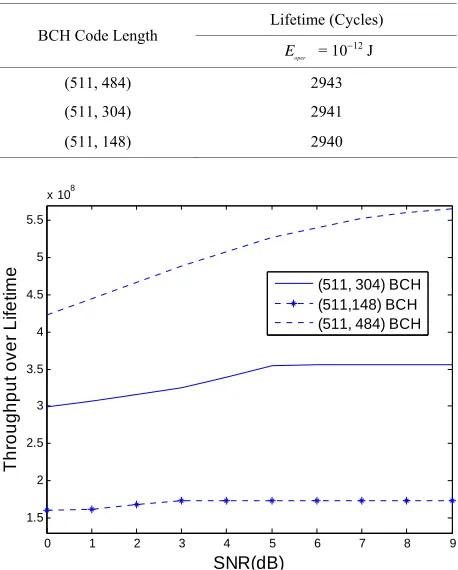
[image:3.595.57.289.259.417.2]fect of using a low rate BCH code of high error cor-recting capability and a high rate BCH code of low error correcting capability, on network performance. A simu-lation model is built using MATLAB [18] to study the effect of using this scheme on network lifetime and throughput. The WSN lifetimes when using different lengths of BCH are shown in Table 2. These values prove that the use of the BCH code has very low effect on network lifetime using the suggested hardware im-plementation. It produces almost the same lifetime as that of the uncoded system (noise free system) which is equal to 2950 cycles.
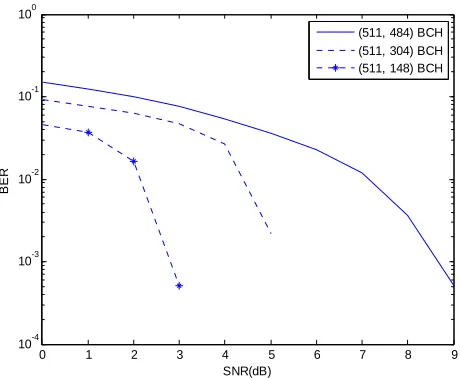
Figure 1 shows the throughput over the lifetime for different rates of BCH code over additive white Gaussian noise (AWGN)
roughput of the high-rate BCH code such as the (511, 484) outperforms the throughput of low-rate BCH code such as the (511, 148) or the (511, 304). This is in spite of the fact that the low rate codes provide a lower BER than high rate codes (as shown in Figure 2).
The rationale behind these results is investigated next. In this single coding scheme, the NM transmits a frame of fixed length irrespective of the code rate of th
is means that the energy consumed for transmission will be the same for any BCH code length. The processing
Table 2. The lifetime of different lengths of BCH code.
Lifetime (Cycles) BCH Code Length
oper
E = 1012 J
(511, 484) 2943
(511, 304) 2941
(511, 148) 2940
0 1 2 3 4 5 6 7 8 9
1.5 2 2.5 3 3.5 4 4.5 5 5.5
x 108
T
hr
oug
hput
over
Li
fet
im
e
(511, 304) BCH (511,148) BCH (511, 484) BCH
[image:3.595.309.538.424.709.2]SNR(dB)
0 1 2 3 4 5 6 7 8 9 10-4
10-3 10-2 10-1 100
BER
SNR(dB)
[image:4.595.58.288.84.273.2](511, 484) BCH (511, 304) BCH (511, 148) BCH
Figure 2. BER of different lengths of the BCH code. energy of the BCH code (that can differentiate between its different lengths) is negligible compared to the trans-mitting energy using the proposed hardware implementa-tion. Therefore, the different rates BCH code used in this scheme will have almost the same lifetime and the code rate will be the main factor that affects the overall throughput. Consequently, using this scheme causes the throughput of the high rate BCH code such as the (511, 484) to outperform the throughput of the low rate BCH codes such as the (511, 304) or the (511, 148).
In order to generalize the result for any frame length, the throughput is calculated as a ratio to the frame length. Figure 3 shows the throughput of different BCH code lengths as a ratio of the frame length. It is clear from this figure that the throughput using the (511, 484) BCH at the high SNR reaches its maximum value which is the
cod be
qual to 94.7% of any frame length used. In contrast, the
d (4) and co
e rate (0.947). This means that the throughput will e
throughput using the (511, 148) BCH code cannot exceed 0.29 (its code rate value). Therefore, the maximum throu- ghput will represent only 29% from any frame length.
As mentioned before, the lifetimes of systems with different BCH rates, are almost the same. But the lifetime of a system with a low rate code is slightly lower than that of a system with a high rate code, as shown in Table 2. Since the processing energy for the encoding and de-coding processes is directly proportional to the amount of added parity as seen in Equations (1), (3) an
nsequently to the error correcting capability, the sys-tem with the low rate code and high error correcting ca-pability will consume more energy than the system with the high rate code and low error correcting capability. So, the simulation is performed at another energy per opera-tion, namely 1010 J (the highest energy per operation in
the assumed range) and the corresponding values of life-time is shown in Table 3. The values show that the low
0 1 2 3 4 5 6 7 8 9
0.3 0.4 0.5 0.6 0.7 0.8 0.9 1
SNR(dB)
T
hr
o
ug
hp
ut
i
n
r
a
ti
o
[image:4.595.308.538.85.266.2](511, 484) BCH (511, 304) BCH (511, 148) BCH
[image:4.595.309.538.323.404.2]Figure 3. Throughput relative to the frame length for dif-ferent BCH code rates
Table 3. Lifetime due to different lengths of the BCH code.
Lifetime (Cycles) BCH Code Length
= 1010 J
oper
E
(511, 484) 2850
(511, 304) 2820
(511, 148) 2590
rate BCH codes produce a lower lifetime than the high rate BCH codes; consequently, the overall throughput over the lifetime for low rate codes is less than the over-all throughput over the lifetime of the high rate codes.
Therefore, this result confirms the fact that the throu- ghput over the lifetime of the high rate BCH code out-
y per operation.
fixed data length and variable frame length. This means
th ve the same a and each
sens e with length o
the code rate d. The simulation hat the lengt ansmitted frame usin high rate codes is sm red to that of the low code. This me-
ans th rgy consumed for tr of
igh rate codes is less than that of the low rate codes. performs the throughput over the lifetime of the low rate BCH code irrespective of the frame length and the ene-rg
The single coding scheme is investigated next with
at all sensors ha
or transmits a fram amount of dat varying according t use
h of the tr
results show t g the
all compa rate
at the ene ansmission in case h
Therefore, the lifetime of the system with high rate code such as the (511, 484) BCH is higher than the lifetime of the system with the low rate code such as the (511, 148) BCH. Consequently, the throughput over the lifetime of the (511, 484) BCH still outperforms the throughput of the low rate code such as the (511, 304) BCH or the (511, 148) BCH.
to consider the effect of fading as well. Therefore, slow fa
ts show a slight increase in lifetime because th
e determined ac
e codes that he NM in the high rate codes ding with Rayleigh distribution is added to the AWGN channel; this is more realistic in sensor networks [8]. The simulation results show that the throughput over the life-time of the high rate BCH code still outperforms the overall throughput of the low rate BCH code. However, some degradation in the throughput values is noticed in comparison to the case of AWGN channel.
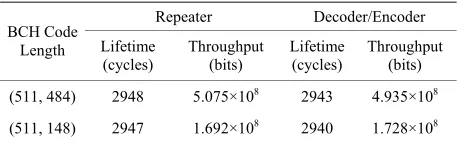
In the above results, the NM performed Decode and Encode operations on the received packets from the dif-ferent sensor nodes. Next, the case where the NM acts as a repeater is considered, i.e., the NM collects data from
sensors and forwards it to the sink without decoding or encoding. Table 4 shows the values of the lifetime over any SNR and the throughput over the lifetime at SNR = 4dB (low SNR to show the coding effect).
The resul
e processing at the NM is negligible using the proposed hardware implementation. On the other hand, the case of the NM as a repeater may be efficient when using high rate codes, where the error correcting capability is small and the probability of wrong decoding is high at low SNR (the long packets can suffer more errors which cannot be detected or corrected). But, in low rate codes, the probability of incorrect decoding is very small even if at low SNR due their high error correcting capability. Consequently, the role of the NM must b
cording to the code rate or the error correcting capabil-ity of the used coding technique in order to improve overall performance. For example, it is preferred that the NM act as a repeater for high rate BCH code such as the (511, 484) BCH and act as a Decoder/Encoder for low rate BCH code such as the (511, 148) BCH.
5. Multi Coding Scheme in WSN
As mentioned in the previous section, the problem of using the single coding scheme is the code rate of the used BCH which is the only factor that affects the throu- ghput irrespective of the BER. Furthermore, the lifetime remains approximately constant for different lengths of BCH code, because the processing energy is negligible with respect to the transmitting energy using the pro-posed hardware implementation. Therefore, another cod- ing scheme is investigated to improve overall performa- nce. In this scheme, the coding method from the sensor to the NM and from the NM to the sink will be comple- tely different in length or in type or in both. In the deplo- yment area, the average distance from the NM to the sink is larger than the distance from the sensor to the NM which means that the channel from the NM to the sink is noisier than the channel from the sensor to the NM. Therefore, it is reasonable to use the low rat
[image:5.595.309.540.111.183.2]have high error correcting capability at t link from the NM to the sink and use the
Table 4. Lifetime and throughput for NM: repeater and decoder/encoder.
Repeater Decoder/Encoder BCH Code
Length Lifetime
(cycles)
Throughput (bits)
Lifetime (cycles)
Throughput (bits)
(511, 484) 2948 5.075×10⁸ 2943 4.935×10⁸
(511, 148) 2947 1.692×10⁸ 2940 1.728×10⁸
at the sensor in the link from the sensor to the NM. The simulation using MATLAB [18] is performed in order to study the effect of using the multi coding scheme on network performance. The (511, 484) BCH is examined as an example of the high rate code between the sensor nodes and the NM and the (511, 148) BCH is examined as an example of low rate code between the NM and the sink. The simulation results show that this method has a very bad effect on the lifetime as shown in Table 5. The table shows that the lifetime will be re-duced by 46% compared to the lifetime of the uncoded system. The rationale behind this result is that the appli-cation of a low ra rom the N
in-c a of y as shown in
Ta Re r th ns m
f 048 but lle d ll
sens d tr its fram differe ese
l ll b rmi ing e code rate of
e code that is used by the NM. If the NM uses a low nt of ad
5. The values in the table also sh
te code f M to the sink reases the
ble 5.
mount data sent b
a se
the NM
membe t the or trans its a fixed rame of 2
ors an
bits ansm
the NM co es of
cts the nt lengt
ata from a hs. Th engths wi e dete ned accord to th
th
rate code such as the (511, 148) BCH, the amou ded parity will be very high and the amount of trans-mitted data will be very large. Consequently, the energy consumed for transmission will increase and the lifetime will be reduced which leads to a decrease in the overall throughput over lifetime.
This result is taken a step further by applying the low rate code at the sensor in the link between the sensors and the NM and the high rate code at the NM in the link from the NM to the sink. Simulations show that this method has a very good effect on the lifetime.
The values of lifetime shown in Table 5 prove that the lifetime has increased by about 98% compared to the case of single coding regardless of the used code rate and by about 97% over the lifetime of the uncoded system. The reason behind that is the reduction in the transmit-ting energy consumed at the NM. This reduction is caused by the use of a high rate code which adds a rela-tively small amount of parity to the information and makes the total amount of data sent by NM small com-pared to the previous case and comcom-pared to the uncoded system. Remember that, in the uncoded system, all bits in the frame represent information bits; this causes the NM to transmit large amount of data compared to the coded system as shown in Table
Table 5. Lifetime and amount of data sent by NM in multi coding scheme.
Code Length Amount of data sent byNM per cycle (bits) Lifetime(cycles)
(511, 484) BCH - (511, 148) BCH 661745 1580
(511, 148) BCH - (511, 484) BCH 61831 5840
(7, 4) Hamming - (511, 484) BCH 122129 4600
The uncoded sysetm 202752 2950
of using a low rate then high rate BCH code is equal to 9% of the amount of data sent by the NM in the case of using a high rate then low rate BCH code.
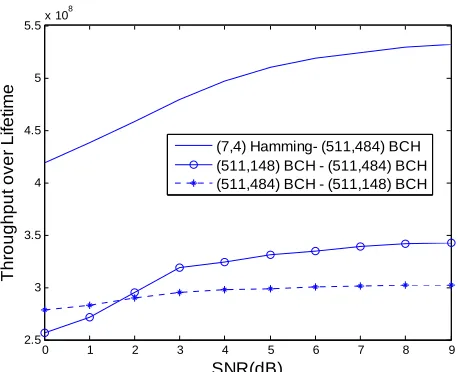
This great increase in the lifetime affects the through-put and makes the overall throughthrough-put over the lifetime outperform the overall throughput of using the low rate code at the NM as shown in Figure 4.
Furthermore, applying different coding techniques in the links between the sensor and the NM and then be-tween the NM and the sink, is investigated. The (7, 4) Hamming code is examined
BCH bet nsors an s
by ab over t
time of the uncoded system. Also the throughput is usin 511,148 a ustification for this increase in the throughput is that the code rate of the (7, 4)
Ham-ming code rate o 11, 148
y about 97%. On the other hand, the lifetime in case of
ch as the (7, 4) is
instead of the (5 d the NM. Table
11, 148) 5 show ween the se
that the lifetime is increased out 56% he
life-greater than the throughput of g the ( ) BCH s shown in Figure 4. The j
is larger than the f the (5 ) BCH b
the (511, 148) BCH outperforms the lifetime in case of the (7, 4) Hamming by only 21% and the overall per-formance using low rate Hamming code su
better than the overall performance using the low rate BCH code. Therefore, using the multi coding scheme with low rate then high rate codes is preferred in sensor networks.
6. Conclusions
Wireless Sensor Networks (WSN) has become one of the most interesting fields of research where the major chal-lenge is prolonging network lifetime. But in some appli-cations where it is necessary to receive the data intact, the throughput may be more important. So, this paper focuses on improving the throughput without affecting the lifetime by using efficient coding techniques to re-duce the bit error rate and introducing a simple hardware implementation for the encoder and decoder circuit of the coding technique. The coding is done at both the sensor and the NM, where the sensor encodes the data and sends it to the NM that decodes then re-encodes the data again before sending it to the sink.
The BCH code is investigated and it is found that the encoding and decoding processes suggested in this work
0 1 2 3 4 5 6 7 8 9
2.5 3 3.5 4 4.5 5 5.5x 10
8
SNR(dB)
Thr
o
ughpu
t o
v
er
Li
fet
im
e
(7,4) Hamming- (511,484) BCH (511,148) BCH - (511,484) BCH (511,484) BCH - (511,148) BCH
Figure 4. Throughput (bits) over Lifetime in Multi Coding Scheme.
have a negligible effect on the lifetime and provide al-most the same lifetime as the uncoded system. Different code rates are examined and it is observed that the high rate BCH code provides a higher throughput than the low rate BCH code by using the single coding scheme.
The study is taken a step further by examining another coding scheme which is the multi coding scheme. It is found that using this scheme will be more efficient and has a very good effect on network lifetime and through-put when the low rate BCH code such as the (511, 148) is used at the sensor node and the high rate BCH such as the (511, 484) is used at the NM. It is found that the life-time is increased by about 98% over the lifelife-time of the single coding irrespective of the code rate used and by about 97% over the lifetime of the uncoded system.
Furthermore, the (7, 4) Hamming is examined at th
d that the lifetime is increased by about 56%
. M. Daoud, H. H. Amer and H. M. ElSayed, “Monitoring
e sensor node instead of the (511, 148) BCH and by keep-ing the (511, 484) BCH as a high rate code at the NM. It
notice is
over the lifetime of the uncoded system and the overall throughout outperforms the throughput of using the (511, 148) BCH as a low rate code.
REFERENCES
[1] T. H. Teo, G. K. Lim, D. S. David, K. H. Tan, P. K. Gopalakrishnan and R. Singh, “Ultra Low-Power Sensor Node for Wireless Health Monitoring System,” Proceed-ings of the International Symposium on Circuits and Sys-tems ISCAS, New Orleans, May 2007, pp. 2363-2366.
[2] C. Castelluccia, E. Mykletun and G. Tsudik, “Efficient Aggregation of Encrypted Data in Wireless Sensor Net-works,” ACM Transactions on Sensor Networks, San
Di-ego, July 2005, pp. 109-117.
[image:6.595.56.287.112.202.2]ireless Sensor Networks Ap-plications,” Proceedings of the IEEE International Con-ference on Co s INFOCOM
de Janeiro, Br
Electromagnetic Pollution Using Wireless Sensor Net-works,” Proceedings of the 15th International Conference on Emerging Technologies and Factory Automation ETFA, Bilbao, Spain, September 2010.
[4] C. B. Margi, B. T. de Oliveira, G. T. de Sousa, M. A. Simplicio, F. H. Freitasy, P. S. Barretoy, T. C. Carvalhoy, M. Näslundz and R. Goldz, “Demo: Security Mechanisms Impact and Feasibility on W
mputer Communication
azil, April 2009.
, Rio
[5] J. Tavares, F. J. Velez and J. M. Ferro, “Application of Wireless Sensor Networks to Automobiles,” Measure-ment Science Review, Vol. 8, No. 3, 2008, pp. 65-70. doi:10.2478/v10048-008-0017-8
[6] D. Schmidt, M. Berning and N. When, “Error Correction
, “Coding for
En-gies and Factory
Automa-zelman, A. Chandrakasan and H. Balakrishnan,
in Single-Hop Wireless Sensor Networks—A Case Study,”
Proceedings of the Design, Automation and Test in Eu- rope Conference DATE, Nice, France, April 2009, pp. 1296-1301.
[7] G. Balakrishnan, M. Yang, Y. Jiang and Y. Kim, “Per-formance Analysis of Error Control Codes for Wireless Sensor Networks,” Proceedings of the 4th International Conference on Information Technology ITNG, Las Vegas,
USA, April 2007, pp. 876-879. [8] H. Karyonen and C. A. Pomalaza-Ráez
ergy Efficient Multihop Wireless Networks,” Proceedings of the Nordic Radio Symposium, Oulu, Finland, August
2004.
[9] S. Botros, H. ElSayed, H. H. Amer and M. S. El-Soudani, “Lifetime Optimization in Hierarchical Wireless Sensor Networks,” Proceedings of the 14th International Con-ference on Emerging Technolo
tion ETFA, Mallorca, Spain, September 2009, pp. 1-8.
[10] W. Heinzelman, A. Chandrakasan and H. Balakrishnan, “Energy-Efficient Routing Protocols for Wireless M crosensor Networks,” Proceedin
i-gs of the 33rd Hawaii
International Conference on System Sciences HICSS,
Maui, USA, January 2000. [11] W. Hein
“An Application Specific Protocol Architecture for Wire-less Micro Sensor Networks,” IEEE Transactions on Wireless Communications, Vol. 1, No.4, October 2002, pp. 660-670. doi:10.1109/TWC.2002.804190
[12] S. Nouh, R. A. Abbas, D. AbouElSeoud, N. A. Ali, R. M.
Y. Xu, “An Address Coding
ensor
Infor-enerations,”
Pro-M. ElSayed, Pro-M. S. El-Soudani and H. H. Daoud, H. H. Amer and H. M. ElSayed, “Effect of Node Distributions on Lifetime of Wireless Sensor Networks,”
Proceedings of the IEEE International Symposium on Industrial Electronics ISIE, Bari, Italy, July 2010.
[13] P. Karlsson, L. Oberg and
Scheme for Wireless Sensor Networks,” Proceedings of the 5th Scandinavian Workshop on Wireless Ad-hoc Net-works, Stockholm, Sweden, May 2005.
[14] C. C. Enz, A. El-Hoiydi, J.-D. Decotignie and V. Peiris, “WiseNET: An Ultra-Low-Power Wireless S
work Solution”, IEEE Computer Society Press, USA, August 2004.
[15] K. Ragini and D. R. B. K. Madhavi, “Ultra-Low-Power Digital Logic Circuits in Sub-threshold for Biomedical Applications,” Journal of Theoretical and Applied mation Technology, 2009.
[16] M. Hempstead, G. Wei and D. Brooks, “Architecture and Circuit Techniques for Low Throughput, Energy Con-strained Systems across Technology G
ceedings of the International Conference on Compilers, Architecture, and Synthesis for Embedded Systems CASES, Seoul, Korea, October 2006, pp. 368-378.
[17] N. A. Ali, H.
Amer, “Effect of Hamming Coding on WSN Lifetime and Throughput,” Proceedings of the IEEE International Con- ference on Mechatronics ICM, Istanbul, Turkey, 13-15
April, 2011, pp. 749-754. [18] Official Site for MATLAB.