IMPLEMENTATION OF
NON-*
Munde
Department of Technology, Shivaji University, Kolhapur, India
ARTICLE INFO ABSTRACT
Now a day an image fusion
processing. The process of integrating multiple input images into a new single composite image with more informative than any of input image. There are different image fusion transform techn proposed by many researchers. Out of that transform techniques a Non
adds the property of shift
of edges more accurately as compared to other t transform and Non
of software simulation of Non application of image
implement a model which is able to do the pixel level averaging image fusion. Non shearlet transform is implemented with the filter banks whose levels can be adjusted. T
reconstruction can be obtained with the down sampling of the images. NSST decomposition provides a simple hierarchical framework to fuse images with different spatial resolution. It is a powerful tool to separate the spectral content of an image
Copyright©2017, Munde Vaijnath and Pradip C. Bhaskar
permits unrestricted use, distribution, and reproduction in any medium, provided the original work is properly cited.
INTRODUCTION
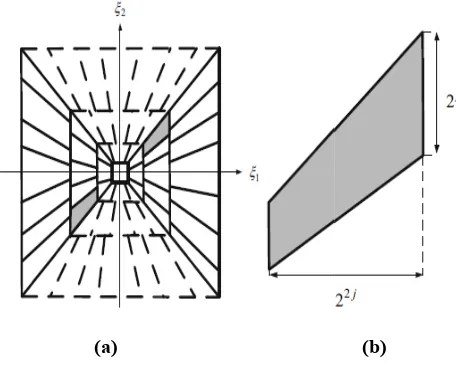
The NSST is the shift-invariant version of shearlet transform, which can capture 2-D geometrical structure much more effectively than that traditional multi-scale transforms Yang et al., 2015). When the NSST is introduced into the image fusion field, more information for fusion can be obtained and the impacts of miss-registration on the fused results can also be reduced effectively. Moreover, the computational complexity of NSST is lower than that of the NSCT. Therefore the NSST is suitable for image fusion (Xingbin Liu 2015). The frequency support of shearlet is a pair of trapezoidal
region which is symmetric relatively for the origin along the direction of the slope s in different scales and
is 2 ×2 , and the frequency partition of NSST is shown in Fig.1 (Xingbin Liu et al., 2015) An illustration of this frequency tiling is shown in Fig.1. (Xingbin Liu
Shearlet are well localized and exhibit highly directional sensitivity, and the number of orientations doubles at each finer scale. The key idea of Shearlet transform is to filter signal in pseudo polar grid by one dimensional band
(Jingming Yang et al., 2016). It is more important that frequency-domain implementation of Shearlet transform
*Corresponding author: Munde Vaijnath,
Department of Electronics, Shivaji University, Kolhapur, India
ISSN: 0975-833X
Article History:
Received 16th December, 2016 Received in revised form 08th January, 2017
Accepted 15th February, 2017 Published online 31st March,2017
Citation: Munde Vaijnath and Pradip C. Bhaskar, of Current Research, 9, (03), 47868-47872.
Key words:
Image Fusion, Simulink,
Discrete Wavelet Transform (DWT), Non-subsampled Shearlet Transform (NSST),
Peak Signal to Noise Ratio (PSNR).
RESEARCH ARTICLE
-SUBSAMPLED SHEARLET TRANSFORM FOR IMAGE FUSION
Munde Vaijnath and Pradip C. Bhaskar
Department of Technology, Shivaji University, Kolhapur, India
ABSTRACT
Now a day an image fusion is an emerging field and powerful technology in the area of image processing. The process of integrating multiple input images into a new single composite image with more informative than any of input image. There are different image fusion transform techn proposed by many researchers. Out of that transform techniques a Non
adds the property of shift-invariant, capture more directional information and represent the directions of edges more accurately as compared to other transform techniques such as discrete wavelet transform and Non-subsampled contourlet transform (NSCT) techniques.
of software simulation of Non-subsampled shearlet transform based decomposition algorithm for application of image fusion using MATLAB Simulink Library. Simulink library Blockset is used to implement a model which is able to do the pixel level averaging image fusion. Non
shearlet transform is implemented with the filter banks whose levels can be adjusted. T
reconstruction can be obtained with the down sampling of the images. NSST decomposition provides a simple hierarchical framework to fuse images with different spatial resolution. It is a powerful tool to separate the spectral content of an image from the spatial information.
Munde Vaijnath and Pradip C. Bhaskar. This is an open access article distributed under the Creative Commons Att use, distribution, and reproduction in any medium, provided the original work is properly cited.
invariant version of shearlet transform, D geometrical structure much more scale transforms (Yong . When the NSST is introduced into the image fusion field, more information for fusion can be obtained registration on the fused results can also be reduced effectively. Moreover, the computational hat of the NSCT. Therefore
Xingbin Liu et al., The frequency support of shearlet is a pair of trapezoidal
region which is symmetric relatively for the origin along the es and the size of which and the frequency partition of NSST is shown in
An illustration of this
Xingbin Liu et al., 2015). Shearlet are well localized and exhibit highly directional sensitivity, and the number of orientations doubles at each finer scale. The key idea of Shearlet transform is to filter signal in pseudo polar grid by one dimensional band-pass filter banks . It is more important that domain implementation of Shearlet transform
Department of Electronics, Shivaji University, Kolhapur, India.
(Xingbin Liu et al., 2015). Whose filtering is done in frequency domain directly without critical sampling operation, so the distortion in directional filtering is avoided and the translation invariance is ensured. This transform can adaptively capture the geometrical characteristic of multidimensional data and is more efficient in representing images containing edges (Xingbin Liu et al., 2015). So In more details, Non sampled Shearlet transform (NSST) with translation is designed to improve effectiveness algorithm al., 2015).
Related work
In the last few years, there are different image fusion algorithms proposed by many researchers. Amira
has shown that fast Walsh
transforms are important in many signal
applications including speech compression, filtering and coding. Two novel architectures for the fast Hadamard transforms using both a systolic archite
arithmetic techniques are presented.
(2015) have discussed a Laplacian Pyramid Transform analysis and comparison of different algorithms; Laplacian pyramid transform focused on pixel level as our fusion methodolog Mobile computing is used, as the whole process is done on the mobile device without uploading to the cloud. The result of our project realizes the enhancement of reality, improves
International Journal of Current Research
Vol. 9, Issue, 03, pp.47868-47872, March, 2017
INTERNATIONAL
OF CURRENT RESEARCH
Munde Vaijnath and Pradip C. Bhaskar, 2017. “Implementation of non-subsampled shearlet transform for image fusion
SUBSAMPLED SHEARLET TRANSFORM FOR IMAGE FUSION
Department of Technology, Shivaji University, Kolhapur, India
is an emerging field and powerful technology in the area of image processing. The process of integrating multiple input images into a new single composite image with more informative than any of input image. There are different image fusion transform techniques proposed by many researchers. Out of that transform techniques a Non-subsampled shearlet transform invariant, capture more directional information and represent the directions ransform techniques such as discrete wavelet subsampled contourlet transform (NSCT) techniques. This paper presents concept subsampled shearlet transform based decomposition algorithm for fusion using MATLAB Simulink Library. Simulink library Blockset is used to implement a model which is able to do the pixel level averaging image fusion. Non-subsampled shearlet transform is implemented with the filter banks whose levels can be adjusted. The perfect reconstruction can be obtained with the down sampling of the images. NSST decomposition provides a simple hierarchical framework to fuse images with different spatial resolution. It is a powerful tool
from the spatial information.
is an open access article distributed under the Creative Commons Attribution License, which
. Whose filtering is done in frequency domain directly without critical sampling operation, so the distortion in directional filtering is avoided and the translation-invariance is ensured. This transform can adaptively capture
c of multidimensional data and is more efficient in representing images containing edges . So In more details, Non-sub-sampled Shearlet transform (NSST) with translation-invariant is designed to improve effectiveness algorithm (Yong Yang et
In the last few years, there are different image fusion algorithms proposed by many researchers. Amira et al. (2001) has shown that fast Walsh-Hadamard transforms. These transforms are important in many signal-processing applications including speech compression, filtering and coding. Two novel architectures for the fast Hadamard transforms using both a systolic architecture and distributed arithmetic techniques are presented. Tianjiao Zeng et al. have discussed a Laplacian Pyramid Transform analysis and comparison of different algorithms; Laplacian pyramid transform focused on pixel level as our fusion methodology. Mobile computing is used, as the whole process is done on the mobile device without uploading to the cloud. The result of our project realizes the enhancement of reality, improves INTERNATIONAL JOURNAL
OF CURRENT RESEARCH
resolution and intelligibility. Ligia Chiorean and
Vaida (2009) has presented a discrete wavelet transform, so the image fusion process allows combination of salient feature of these images. The dedicated application considers Java technology for using its facilities as a future development, regarding a remote access mechanism. Fitri Amia, Syiah Kuala, Banda Aceh (2009) improve perceptual quality of a robust Discrete Cosine Transform (DCT) domain watermarking scheme, a wavelet based image fusion has proposed instead of spatial masking techniques The robust watermarking is, achieved by inserting watermark sequences in the low frequency DCT coefficients of a host image. Then, the host and the watermarked image are decomposed using a two level Discrete Wavelets transform (DWT). The image fusion is done by means of replacing the approximate and detail coefficients of the watermarked image with the new coefficients that obtained by applying a certain rule. Zhang, Bao-long Guo (2009) has discussed the Multi image fusion using the non-subsampled contourlet trans It significantly outperforms the traditional discrete wavelet transform-based and the discrete wavelet frame transform based image fusion methods in terms of both visual quality and objective evaluation, especially when the source images are not perfectly registered. Siji Quan, Weiping Qian, Junhai Guo (2014) has shown that the Visible and infrared image fusion based on Curvelet transform. Curvelet transform
images to different resolutions, and standard fusion rules are built to integrate information from both images. This algorithm is carried out on a set of standard image set, and is compared to a traditional method. It proves that this fusion algorithm based on Curvelet transform is effective enough to accomplish visible and infrared image fusion.
[image:2.595.48.276.445.632.2](a)
Fig.1. The structure of the frequency partition by NSST
Yong Yang, Song Tong, Shuying Huang and Pan Lin has shown that Multifocus Image Fusion Based on
sampled contourlet transform (NSCT) and Focused Area Detection. First, the source multi-focus images are decomposed using the non-subsampled contourlet transform (NSCT). The low-frequency sub-band coefficients are fused by the sum-modified Laplacian based local visual contrast, whereas the high-frequency sub-band coefficients are fused by the local Log-Gabor energy. The initial fused image is subsequently reconstructed based on the inverse NSCT with the fused coefficients. Second, after analyzing the similarity
47869 Munde Vaijnath and Pradip C. Bhaskar
Chiorean and Mircea-Florin has presented a discrete wavelet transform, so the image fusion process allows combination of salient feature of these images. The dedicated application considers Java technology for using its facilities as a future development, Fitri Amia, Syiah improve perceptual quality of a robust Discrete Cosine Transform (DCT) domain watermarking scheme, a wavelet based image fusion has proposed instead of spatial masking techniques The robust king is, achieved by inserting watermark sequences in the low frequency DCT coefficients of a host image. Then, the host and the watermarked image are decomposed using a two-level Discrete Wavelets transform (DWT). The image fusion is
acing the approximate and detail coefficients of the watermarked image with the new coefficients that obtained by applying a certain rule. Qiang has discussed the Multi-focus subsampled contourlet transform. It significantly outperforms the traditional discrete wavelet based and the discrete wavelet frame transform-based image fusion methods in terms of both visual quality and objective evaluation, especially when the source images are Siji Quan, Weiping Qian, Junhai Guo has shown that the Visible and infrared image fusion based on Curvelet transform. Curvelet transform decompose images to different resolutions, and standard fusion rules are formation from both images. This algorithm is carried out on a set of standard image set, and is compared to a traditional method. It proves that this fusion algorithm based on Curvelet transform is effective enough to accomplish
(b)
The structure of the frequency partition by NSST
Yong Yang, Song Tong, Shuying Huang and Pan Lin (2015) Multifocus Image Fusion Based on
non-sub-and Focused Area focus images are subsampled contourlet transform band coefficients are fused by modified Laplacian based local visual contrast, band coefficients are fused by Gabor energy. The initial fused image is subsequently reconstructed based on the inverse NSCT with the fused coefficients. Second, after analyzing the similarity
between the previous fused image and the source images, the initial focus area detection map is obtained; this is used for achieving the decision map obtained by employing a mathematical morphology post processing technique. Finally, based on the decision map, the final fused image is obtained by selecting the pixels in the focus areas
in the focus region boundary as their corresponding pixels in the initial fused image. Xingbin Liu
that the non-sub sampled shearlet transform algorithm for image fusion. In that algorithm the source images are decomposed into several
sub-directions by NSST and the low frequency sub
pass sub-band coefficients are obtained. Sec
frequency sub-band coefficients, the singular value decomposition method in the gradient domain is used to estimate the local structure information of image, and an adaptive ‘weighted averaging’ fusion rule based on the sigmoid function and the extracted features. And finally, the fused image is obtained by performing the inverse NSST on the combined coefficients. Hence the NSST has higher computational efficiency and stronger selectivity of anisotropic direction.
Proposed technique
Fusing of images using non-sub
has become as an important tool in many areas of image processing. Methodology as given below will be implemented in proposed work:
A new image fusion algorithm based on the non
shearlet transform (NSST) is presented. First, an initial fused image is acquired by using a conventional multi
image fusion method (Xingbin Liu
those source multi-focus images, which have smaller square error with the corresponding pixels of the initial fused image, are considered in the focused regions
2015). Based on this principle, the focused regions are determined, and the morphological opening and closing are employed for post-processing (
the focused regions and the focused border regions in each source image are identified and used to guide the fusion process in NSST domain. Finally, the fused image is obtained using the inverse NSST. Experimental results show that this proposed method can not only extract more important detailed information from source images, but also avoid the introduction of artificial information effectivel
Yang et al., 2016).
The proposed image fusion method consists of four steps:
1. Perform a J-level NSST on source images
2,…….,K), respectively, to obtain the corresponding low-pass sub-band coefficients and the
directional sub-bands coefficients.
2. Detect the focused regions of the source images.
3. Employ the proposed fusion rules to construct the NSST coefficients of the fused image.
4. Reconstruct the fusion image based on the fused coefficients by taking an
fusion image is obtained.
The block diagram of proposed technique is as shown in the Figure 2.
Munde Vaijnath and Pradip C. Bhaskar, Implementation of non-subsampled shearlet transform for image fusion
between the previous fused image and the source images, the ection map is obtained; this is used for achieving the decision map obtained by employing a mathematical morphology post processing technique. Finally, based on the decision map, the final fused image is obtained by selecting the pixels in the focus areas and retaining the pixels in the focus region boundary as their corresponding pixels in
Xingbin Liu et al. (2015) has shown sampled shearlet transform algorithm for image fusion. In that algorithm the source images are -bands of different scales and
and the low frequency sub-band and band-band coefficients are obtained. Secondly, for the low
band coefficients, the singular value decomposition method in the gradient domain is used to estimate the local structure information of image, and an adaptive ‘weighted averaging’ fusion rule based on the and the extracted features. And finally, the fused image is obtained by performing the inverse NSST on the combined coefficients. Hence the NSST has higher computational efficiency and stronger selectivity of anisotropic
sub sampled shearlet transform has become as an important tool in many areas of image processing. Methodology as given below will be implemented
A new image fusion algorithm based on the non-subsampled ansform (NSST) is presented. First, an initial fused image is acquired by using a conventional multi-resolution
Xingbin Liu et al., 2015). The pixels of focus images, which have smaller square error with the corresponding pixels of the initial fused image, are considered in the focused regions (Yong Yang et al., . Based on this principle, the focused regions are rmined, and the morphological opening and closing are (Yong Yang et al., 2015). Then the focused regions and the focused border regions in each source image are identified and used to guide the fusion nally, the fused image is obtained using the inverse NSST. Experimental results show that this proposed method can not only extract more important detailed information from source images, but also avoid the introduction of artificial information effectively (Jingming
The proposed image fusion method consists of the following
level NSST on source images (k = 1, 2,…….,K), respectively, to obtain the corresponding band coefficients and the band-pass
bands coefficients.
Detect the focused regions of the source images. Employ the proposed fusion rules to construct the NSST coefficients of the fused image.
Reconstruct the fusion image based on the fused coefficients by taking an inverse NSST, and then the fusion image is obtained.
Fig.2
Source Image A
Source Image B
Coefficient
Band Directional Coefficient
Coefficient
Band Directional Coefficient NSST
NSST
Fig.2. Block diagram of proposed technique
Fig.3. MATLAB Simulink model
Low-pass Coefficient
Band-pass Directional Coefficient
Fused Low-pass Coef ficient
Fused Band-pass Directional Coefficient Low-pass
Coefficient
Band-pass Directional Coefficient
Inverse NSST Fusion
Rule1
Fusion Rule2
Implementation
Simulink is an additional toolbox that runs on top of MATLAB. To start this, type “Simulink” in the Command Window or click on the Simulink icon.
provides various blocks that particularly for image processing applications. Image source and image viewer are Simulink block sets by using these blocks image can give as input and output image can be viewed on image viewer block set. Imag pre-processing and image post-processing unite are common for all the image processing applications which are designed using Simulink block sets. Here in this model some of the image processing blocks are used such as image from file which is used to browse the required image. Along with this resize block is used to equalize the number of pixels before that R’G’B’ to intensity block performs the gray conversion of image. Thus the two images are preprocessed using the preprocessing blocks in the Simulink library. These images are then given as input to the Discrete FIR filter which are designed as Low Pass Filter and High Pass filter respectively. Thus these images are filtered and up sampled to decomp the images with level of 2. Thus the low frequency components i.e. low pixel value and high frequency component i.e. high pixel values are separated and then added in the ADD block of the Simulink library. Low valued pixels as well as high valued pixels from individual images are added together to fuse the two different images but as when two pixels are added its value increases beyond limits. Therefore there is need to divide the pixel value by two so that Divide Block of Simulink library is used. These images are then up sampled to form a composite image. Simulink library provides two separate sampling blocks such as up sample and down sample along with this to display the images the block Video display is used. Thus the model is divided in the three sections such as 1) Image acquisition and preprocessing 2) decomposition 3) Image fusion.
47871 Munde Vaijnath and Pradip C. Bhaskar
Simulink is an additional toolbox that runs on top of MATLAB. To start this, type “Simulink” in the Command Window or click on the Simulink icon. Simulink library provides various blocks that particularly for image processing applications. Image source and image viewer are Simulink block sets by using these blocks image can give as input and output image can be viewed on image viewer block set. Image processing unite are common for all the image processing applications which are designed using Simulink block sets. Here in this model some of the image processing blocks are used such as image from file wse the required image. Along with this resize block is used to equalize the number of pixels before that R’G’B’ to intensity block performs the gray conversion of image. Thus the two images are preprocessed using the ibrary. These images are then given as input to the Discrete FIR filter which are designed as Low Pass Filter and High Pass filter respectively. Thus these images are filtered and up sampled to decompose Thus the low frequency omponents i.e. low pixel value and high frequency component i.e. high pixel values are separated and then added in the ADD block of the Simulink library. Low valued pixels as well as high valued pixels from individual images are added together two different images but as when two pixels are added its value increases beyond limits. Therefore there is need to divide the pixel value by two so that Divide Block of Simulink library is used. These images are then up sampled to Simulink library provides two separate sampling blocks such as up sample and down sample along with this to display the images the block Video display is used. Thus the model is divided in the three sections such as 1) ) decomposition 3)
Image fusion is obtained using the averaging method the mean value is calculated of two different images after the decomposition of images. The algorithms are developed and models are built for image fusion application using two level de-composition. These models are simulated in Matlab Simulink environment with suitable simulation time and simulation mode and tested. The reflected results can be seen on a video display.
RESULTS
The result of the image fusion based on the non
shearlet transform technique which is implemented using MATLAB Simulink Library is as shown in the
composite fused image obtained is having the resolution as per the variable size which is designed u
results obtained are shown above
Conclusion
The non-sub-sampled shearlet transforms is the very good technique for the image fusion provide a high quality spectral content, Hence NSST has stronger selectivity of anisotropic direction, higher computational efficiency, and provides additional information about the geometry of the set of singularities such as edges and other discontinuities compared to NSCT. Therefore, NSST is more applicable in various applications of image fusion. And further it can be implemented on hardware platform in optimized manner. non-sub-sampled shearlet transform (NSST) is found to be best algorithm for image fusion.
library is a new application in image processing and offer friendly environment design for the processing, because processing units are designed by blocks. This tool support software simulation, but the most important is that can be used synthesize in FPGAs hardware using system generator, with
Fig.4. Fused image
Munde Vaijnath and Pradip C. Bhaskar, Implementation of non-subsampled shearlet transform for image fusion
Image fusion is obtained using the averaging method the mean value is calculated of two different images after the decomposition of images. The algorithms are developed and image fusion application using two level composition. These models are simulated in Matlab Simulink environment with suitable simulation time and simulation mode and tested. The reflected results can be seen
the image fusion based on the non-sub sampled shearlet transform technique which is implemented using MATLAB Simulink Library is as shown in the Fig.4. The composite fused image obtained is having the resolution as per the variable size which is designed using resize block. Thus the
above:
sampled shearlet transforms is the very good technique for the image fusion provide a high quality spectral content, Hence NSST has stronger selectivity of anisotropic irection, higher computational efficiency, and provides additional information about the geometry of the set of singularities such as edges and other discontinuities compared to NSCT. Therefore, NSST is more applicable in various on. And further it can be implemented on hardware platform in optimized manner. So sampled shearlet transform (NSST) is found to be best The MATLAB tool Simulink library is a new application in image processing and offers a friendly environment design for the processing, because processing units are designed by blocks. This tool support software simulation, but the most important is that can be used synthesize in FPGAs hardware using system generator, with
the parallelism, robust and speed, this features are essentials in image processing.
Future scope
In the Future discussion the main objectives are the Implementation and simulation of Simulink based model on XILINX System Generator using Xilinx Blockset and further it can be implemented on hardware platform in optimized manner. The hardware platform may be the VIRTEX or SPARTAN FPGA Board.
REFERENCES
Amira, A., A.Bouridane, P.Milligan and M.Roula, Dec 2001. “Walsh-Hadamard transforms for signal processing”, IEEE Transactions Circuits Syst. II, Volume: 148, PP. 377-383.
Cunha, A.L., Zhou, J., Do, M.N. 2006. “The non-subsampled contourlet transform: theory, design, and applications”, IEEE Transactions on Image Processing, 15, (10), PP. 3089–3101.
Fitri Amia, Syiah Kuala, Banda Aceh, 2009. “Multi-focus image fusion using discrete wavelet transform”, IEEE Transactions Circuits Syst. II, Analog Digital Signal Process, PP.718-726.
Gao Guorong, Xu Luping, Feng Dongzhu, 2013. “Multi-focus image fusion based on non-subsampled shearlet transform”, IET Image Processing, Vol. 7, Iss. 6, pp. 633– 639.
Jingming Yang, YanyanWu, Yajie Wang, Yulin Xiong, 2016. “A Novel Fusion Technique for CT and MRI Medical Image Based on NSST”, IEEE Transactions on Image Processing, PP.4367-4372.
Ligia Chiorean, Mircea-Florin Vaida, 2009. “Medical image fusion based on discrete wavelet transform using Java technology”, Information Technology Interfaces, 10.1109/ITI
Longxu Jin and Guoging Li, 2008. “Discrete cosine transform for multi-focus image fusion” IEEE Transactions Circuits Syst. II, PP.88-96
Qiang Zhang and Bao-long Guo: 2009. “Multi-focus image fusion using the non-subsampled contourlet transform”, IEEE Transactions on Signal Processing 89, PP.1334– 1346.
Shen R, Cheng I. and Basu A. 2013. “Cross-Scale coefficient selection for volumetric medical image fusion”, IEEE Transactions on Bio-medical Engineering, 60(4), PP.1069-1079.
Siji Quan, Weiping Qian, Junhai Guo, November 2014. “Visible and infrared image fusion based on Curvelet transform”, IEEE International Conference on Systems and Informatics (ICSAI), 15-17.
Tianjiao Zeng, Renyi Hu, Yaodong He, and Yunqi Wang: “Image Fusion Using Laplacian Pyramid Transform”, ECE Capstone Design Project, Springer 14, September, 2015. PP.1-27.
Xingbin Liu, Wenbo Mei, Huiqian Du, Jiadi Bei, 2015. “A novel image fusion algorithm based on non-subsampled
shearlet transform”, Springer-Verlag London, PP.559-566. Yong Yang, Member, Song Tong, Shuying Huang and Pan
Lin, May 2015. “Multi-focus Image Fusion Based on NSCT and Focused Area Detection”, IEEE Sensors Journal, Volume 15, NO. 5, PP.2824-2838.