ISSN Online: 2160-5858 ISSN Print: 2160-5831
DOI: 10.4236/jdm.2019.91003 Feb. 28, 2019 24 Journal of Diabetes Mellitus
Diabetes Management in Resource Poor
Countries
Andrew G. Stratton, Coral D. Matus, Keith Sweitzer
University of Toledo, College of Medicine, Toledo, Ohio, USA
Abstract
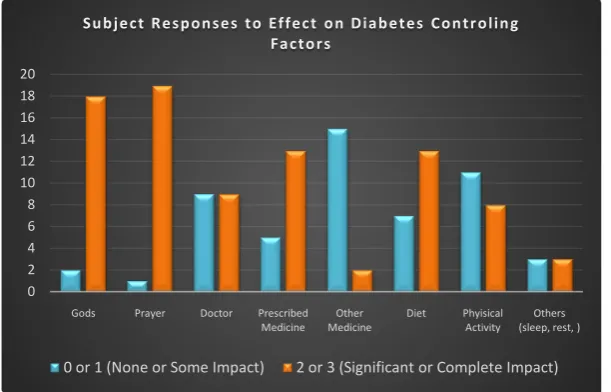
The aim of this study was to evaluate the diabetes status and health beliefs of individuals living in villages in Northeast Guatemala. Our study explored current understanding of diabetes in the Peten region of Guatemala concern-ing the cause, treatment, and effect of type two diabetes by engagconcern-ing and in-terviewing 21 diabetic patients in a qualitative study. Interview results showed that among study participants, the cause of diabetes was often “unknown”. With an average of 3.5 years of education among survey participants and many reporting being mostly or fully illiterate, it is likely that health educa-tion status plays a major role in their concept of diabetes. The majority of responses claimed some form of “asusto”—defined as a negative emotional event causing physical maladies—to have caused their diabetes. Patient sur-veys revealed that God and prayer ranked the highest among factors control-ling their diabetes, with medications being seen as a tertiary control factor, as seen in Figure 1. Only two study participants (2/21) ranked diet/exercise as more impactful on their diabetes than god/prayer. Survey responses also show that most individuals agree that taking their medications is important, with the most commonly reported barriers to control of their blood sugar being cost of medications and lifestyle barriers. Altogether, lack of education and resource availability appears to be the most heavily implicated reasons why uncontrolled diabetes is on the rise in Guatemala—it is clear that health education needs to be a major part of therapeutic efforts in this region.
Keywords
Type II Diabetes, Global Health, Guatemala, Health Education, Health Beliefs
1. Introduction
Diabetes is a major, yet largely underexplored issue in the developing world. How to cite this paper: Stratton, A.G.,
Matus, C.D. and Sweitzer, K. (2019) Di-abetes Management in Resource Poor Countries. Journal of Diabetes Mellitus, 9, 24-30.
https://doi.org/10.4236/jdm.2019.91003 Received: January 13, 2019
Accepted: February 25, 2019 Published: February 28, 2019
Copyright © 2019 by author(s) and Scientific Research Publishing Inc. This work is licensed under the Creative Commons Attribution International License (CC BY 4.0).
http://creativecommons.org/licenses/by/4.0/
DOI: 10.4236/jdm.2019.91003 25 Journal of Diabetes Mellitus Figure 1. Subject Reported Factors Contributing to the Control of Diabetes.
With the number of cases expected to surpass 366 million globally by the year 2030, diabetes is rapidly approaching global pandemic status [1]. This may largely be due to the increasing westernization of diet and surging prevalence of overweight/obesity worldwide, estimated in 2014 by WHO to exceed 1.9 billion adults, joining malnutrition and infectious disease as major issues to be dealt with in global public health [2]. In South and Central America, more than 50% of adults are overweight/obese, and type two diabetes prevalence is 8% on aver-age, but as many as 50% of cases may be undiagnosed [3]. Type II diabetes is also a leading cause of amputation and new blindness in the developing world. The International Diabetes Federation estimated that 1.25 million diabetes-related foot amputations were performed in South and Central America, the developing world representing an incidence of diabetic amputations more than double that of the developed world [4]. The aim of this study was to evaluate the diabetes status and health beliefs of individuals living in villages in Northeast Guatemala. Chary et al., described major barriers to diabetes management in Guatemala, high among those were patient understanding of the disease, and cost of medi-cation. Our study expanded upon this understanding, by engaging and inter-viewing twenty-one diabetic patients in a qualitative study to discern current understanding of diabetes in the Peten region of Guatemala concerning the cause, treatment, and effect of type two diabetes.
2. Methods
2.1. Study Design
The study was composed of two phases: identification of potential patients, and patient interviewing. IRB approval was sought and obtained for this study.
2.2. Patient Selection
Non-pregnant patients over the age of 18 with a previous or new diagnosis of 0
2 4 6 8 10 12 14 16 18 20
Gods Prayer Doctor Prescribed
Medicine MedicineOther Diet Phyisical Activity (sleep, rest, )Others Subject Responses to Effect on Diabetes Controling
Factors
DOI: 10.4236/jdm.2019.91003 26 Journal of Diabetes Mellitus type two diabetes mellitus who were seen in the SewHope clinic in Peten, Gua-temala during the months of May and June 2017 were invited to participate in the study.
2.3. Interviewing
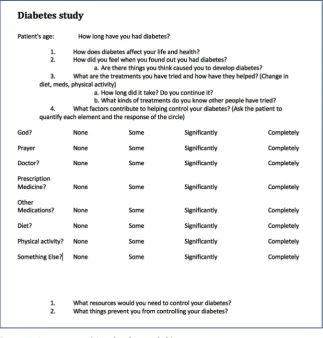
[image:3.595.211.535.375.714.2]Patients who consented to participate in the study were administered a two-page questionnaire via interview in Spanish. Patients were either inter-viewed at the conclusion of their visit or returned later in the same week to be interviewed. The questions (see Figure 2) were aimed at an understanding of the patient’s concept of the development, control, and cause of their diabetes. The survey also asked patients to rank their confidence in various controlling factors of diabetes. Factors questioned included: God, prayer, doctor, prescrip-tion medicine, other medicines, diet, physical activity, and other. Patients could select from “no impact”, “some impact”, “significant impact”, and “com-plete control.” Careful consideration was taken to prevent bias, and interview-ers were instructed not to provide any responses or information to patients during the interview. After completion of the surveys, patients were invited to join an information/discussion session to answer any questions they may have had.
DOI: 10.4236/jdm.2019.91003 27 Journal of Diabetes Mellitus
2.4. Statistical Methods
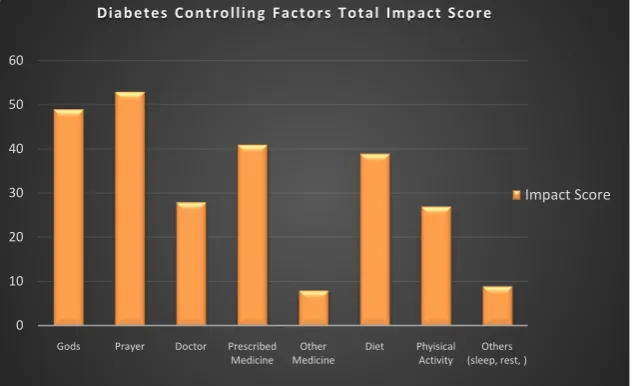
Survey responses were analyzed, and diabetes factors were ranked and tabulated by assigning a score to each response. “No impact” responses were given a score of 0, “some impact” responses were given a score of 1, “significant impact” res-ponses were given a score of 2, and “complete control” resres-ponses were given a score of 3. The total impact score for each category was the sum of the scores (e.g. 0, 1, 2, or 3) for each response (e.g. none, some, significant, complete) in that category (e.g. prayer, god, medicine, doctor). Graphs were generated from these results and were placed below.
3. Results
Survey Findings
[image:4.595.216.534.509.702.2]Twenty-one patients were interviewed between June 9th and 18th, 2017. Patients had ages ranging from 30 to 87. Three patients were male, and eighteen were female. The average length of education was 3.5 years. Patients had reported to know about their diabetes for an average of 3.6 years. The most commonly oc-cupation reported was “housewife” (n = 13) other ococ-cupations included, “con-struction worker” (n = 2), “cleaner” (n = 2), and “cook” (n = 1). God (n = 11) and prayer (n = 14) had the highest number of “complete control” responses for diabetes controlling factors. “Doctor”, “diet”, and “prescription medicine” had 5, 7, and 10 “complete control” responses respectively. See Figure 1 and Figure 3 below for complete results. “Prayer”, “god”, and “prescribed medicine” had the highest total impact scores, with 53, 49, and 41 respectively. Based on a 95% con-fidence interval, the error range for these results is ±0.95, ±0.45, and ±1.25 respec-tively. Only two study participants (2/21) ranked diet/exercise as more impactful on their diabetes than god/prayer. Written responses were analyzed for responses, and numbers were tabulated as such: Twelve (12/21) patients responded that
Figure 3. Total Impact Score.
0 10 20 30 40 50 60
Gods Prayer Doctor Prescribed
Medicine MedicineOther Diet Phyisical Activity (sleep, rest, )Others Diabetes Controlling Factors Total Impact Score
DOI: 10.4236/jdm.2019.91003 28 Journal of Diabetes Mellitus money or resources for medicine were the major barriers to controlling their diabetes. Eight (8/21) responded that diet change was a major impeding factor to controlling their diabetes. When asked what was the cause of the develop-ment of diabetes, eleven (11/21) patients stated that it was due to their emo-tional status or an emoemo-tional event, six (6/21) reported that they didn’t know or were unclear as to the cause, two (2/21) stated it was diet related, two (2/21) mentioned it may be a familial condition, and one (1/21) stated it was due to sleep disturbance.
4. Discussion
4.1. Study Findings, Diabetes Control
DOI: 10.4236/jdm.2019.91003 29 Journal of Diabetes Mellitus highly suggestive that health education should be considered as a portion of any type two diabetes therapy for patients in this region. A large number of patients stated that financial resources prevent them from treating their di-abetes, likely due to high costs of medicine. Therapeutic efforts should there-fore focus on creative solutions to bypass this financial barrier. More impor-tantly however, this evidence further supports that non-pharmaceutical inter-ventions are of critical importance in type two diabetes treatment in Guatemala, this can likely be expanded to most resource-poor countries in Central America and globally.
4.2. Study Limitations, Confounding Factors
In addition to a somewhat small geographic footprint, a possible confounding factor herein relates to the large number of females in the study. Our clinic was open during daytime hours, meaning only those available during those hours could attend. The clinic also offers ultrasound and other OB/GYN services and is connected to a women’s clinic. This may account for the high proportion of fe-male study participants, who reported “housewife” as their profession. Further studies should be expanded to a larger number of patients, across a wider demo-graphic range, and include quantitative data on diabetes status. Further studies planned also include expansion on this investigation outside of Guatemala. A second confound could be that some patients were previously treated at this clinic, and may have received health education from staff, skewing the results in favor of the importance of drug therapy. Future studies could eliminate this bias by selecting only new patients to the clinic.
Acknowledgements
The authors would like to thank SewHope Clinic for allowing our study to be conducted on their premises in Guetemala.
Conflicts of Interest
The authors declare no conflicts of interest regarding the publication of this paper.
References
[1] Wild, S., Roglic, G., Green, A., Sicree, R. and King, H. (2004) Global Prevalence of Diabetes: Estimates for the Year 2000 and Projections for 2030. Diabetes Care, 27, 1047-1053. https://doi.org/10.2337/diacare.27.5.1047
[2] World Health Organization (2017) Obesity and Overweight. World Health Organi-zation, n.d.
[3] Aschner, P., et al. (2014) Diabetes in South and Central America: An Update. Di-abetes Research and Clinical Practice, 103, 238-243.
https://doi.org/10.1016/j.diabres.2013.11.010
DOI: 10.4236/jdm.2019.91003 30 Journal of Diabetes Mellitus Diabetes Voice. International Diabetes Foundation, n.d.
[5] US State Dept. International Religious Freedom Report for 2016. Bureau of De-mocracy, Human Rights, and Labor.
http://www.state.gov/j/drl/rls/irf/religiousfreedom/index.htm