A PROPOSITION FOR SMART HEALTH CARE CENTER USING IOT FOR INDIAN SCENARIO
*Rina Yadav
Department of Information Technology
Mumbai
ARTICLE INFO ABSTRACT
The start of this research thought is to create shrewd well fundamentally misuses the
innovation and foundation. The work has been spurred by the way that India is deficient as far as number of well
particularly. All the more unmistakably if a well
either are not willing to serve the country territories or they are not accessible 24x7 prompting provincial populace swinging to urban areas notwithst
long lines in clinics and parcel of irritation to patients. Keeping in mind the end goal to maintain a strategic distance from previously mentioned constraints, the proposed demonstrate plans to address the pati
produced without Doctor. It is normal that such a shrewd framework would encourage debilitated as well as will add flourishing in a roundabout way to towns. The propo
change the social insurance area of India.
Copyright © 2018, Rina Yadav and Rajesh Bansode. This unrestricted use, distribution, and reproduction in any medium,
INTRODUCTION
Internet of Things (IOT) is gaining widespread popularity among research community because of its potential to digitize real world physical objects around us. IOT has emerged due to present wireless telecommunication services and ubiquitous presence of Internet. Wireless sensor networks, RFID tags, actuators and various handheld intelligent devices such as mobile phones, PDAs, Tabs etc. are leading to the em of IOT. IOT seems appealing and its emergence is being accepted by research and industries, due to its impact on our day to day life both in production and consumption processes. It has opened up wide spectrum of innovative scenarios to improve quality of human life. Sensor networks have already proved their excellence in making human life easy in routine tasks such as controlling water tanks, to save electricity at public places like museums, libraries as well as critical tasks such as habitat monitoring, controlling/ assisting industrial processes etc. Intelligent devices such as mobile phones have been transformed from embedded keypad based traditional phones to lightweight touch screen-based devices.
*Corresponding author: Rina Yadav,
Department of Information Technology, Thakur College of Engineering and Technology, Kandivali (E)
Maharashtra, India.
ISSN: 0975-833X
Article History:
Received 27th November, 2017
Received in revised form 29th December, 2017
Accepted 18th January, 2018
Published online 28th February, 2018
Citation: Rina Yadav and Rajesh Bansode, 2018 Current Research, 10, (02), 65512-65516.
Key words:
IOT, RFID TagLoWPAN, CoAP Protocol, Arduino, Mobile Technology.
RESEARCH ARTICLE
A PROPOSITION FOR SMART HEALTH CARE CENTER USING IOT FOR INDIAN SCENARIO
Rina Yadav and Rajesh Bansode
Department of Information Technology, Thakur College of Engineering and Technology,
Mumbai-400101 Maharashtra, India
ABSTRACT
The start of this research thought is to create shrewd well-being focuses in India. The proposition fundamentally misuses the possibility of Internet of things and intends to utilize the current innovation and foundation. The work has been spurred by the way that India is deficient as far as number of well-being focuses comparing to the number of inhabitants in nation and in town particularly. All the more unmistakably if a well-being focus is accessible, Doctors for the most part either are not willing to serve the country territories or they are not accessible 24x7 prompting provincial populace swinging to urban areas notwithstanding for easygoing illnesses. This adds to long lines in clinics and parcel of irritation to patients. Keeping in mind the end goal to maintain a strategic distance from previously mentioned constraints, the proposed demonstrate plans to address the patient without even physically going by the well-being focus and furthermore solution can be produced without Doctor. It is normal that such a shrewd framework would encourage debilitated as well as will add flourishing in a roundabout way to towns. The propo
change the social insurance area of India.
This is an open access article distributed under the Creative Commons medium, provided the original work is properly cited.
Internet of Things (IOT) is gaining widespread popularity among research community because of its potential to digitize us. IOT has emerged due to present wireless telecommunication services and ubiquitous presence of Internet. Wireless sensor networks, RFID tags, actuators and various handheld intelligent devices such as mobile phones, PDAs, Tabs etc. are leading to the emergence IOT seems appealing and its emergence is being accepted by research and industries, due to its impact on our day to day life both in production and consumption processes. It has opened up wide spectrum of innovative scenarios to ality of human life. Sensor networks have already proved their excellence in making human life easy in routine tasks such as controlling water tanks, to save electricity at public places like museums, libraries as well as critical tasks itoring, controlling/ assisting industrial Intelligent devices such as mobile phones have been transformed from embedded keypad based traditional
based devices.
Department of Information Technology, Thakur College of Engineering and Technology, Kandivali (E), Mumbai-400101
Applications of sensors in our day to day life are numerous which indicates their importance,
due to limited battery life which limits their use. Radio Frequency Identification Tags (RFID) technology provided substitute to sensors as these tags can be used to identify, track and locate any object using unique Electronic product code (EPC) which is encoded in these tags.
a small chip, an antenna and a cover for encapsulating chip and antenna. Antenna receives signal from RFID reader device and transmits the tag ID to it. These tags can be either active or passive based on power source. Active tags are associated with a battery life and thus depend on it for their lifetime, just like sensors. However, passive tags acquire energy from reader device either through magnetic induction or electromagnetic wave capture techniques (Ant, 2006
RFID antenna, produces a current in it through induction, which is further utilized by the antenna to revert back the tag ID to the reader. This technique can help transmit tag Id to a radio range of few kilometers. T
battery limitation of sensors, further being small in size they can be embedded in any real life object for its monitoring. Thus RFID tags are helping great deal to convert every real life physical object into digital entity. Such R
will form their RFID sensor networks with reader devices as sinks of data generated. Emergence of these RFID sensor networks, in our day to day life will fill the gap in omnipresence of Internet and will help IOT spread its roots in
International Journal of Current Research
Vol. 10, Issue, 02, pp.65512-65516, February, 2018
8. “A proposition for smart health care center using IoT for Indian scenario
Available online at http://www.journalcra.com
z
A PROPOSITION FOR SMART HEALTH CARE CENTER USING IOT FOR INDIAN SCENARIO
Thakur College of Engineering and Technology, Kandivali (E)
being focuses in India. The proposition possibility of Internet of things and intends to utilize the current innovation and foundation. The work has been spurred by the way that India is deficient as far as being focuses comparing to the number of inhabitants in nation and in towns being focus is accessible, Doctors for the most part either are not willing to serve the country territories or they are not accessible 24x7 prompting anding for easygoing illnesses. This adds to long lines in clinics and parcel of irritation to patients. Keeping in mind the end goal to maintain a strategic distance from previously mentioned constraints, the proposed demonstrate plans to address being focus and furthermore solution can be produced without Doctor. It is normal that such a shrewd framework would encourage debilitated as well as will add flourishing in a roundabout way to towns. The proposed structure would get a huge
Commons Attribution License, which permits
Applications of sensors in our day to day life are numerous which indicates their importance, however they are constrained due to limited battery life which limits their use. Radio Frequency Identification Tags (RFID) technology provided substitute to sensors as these tags can be used to identify, track and locate any object using unique Electronic product code C) which is encoded in these tags. RFID tag comprises of a small chip, an antenna and a cover for encapsulating chip and antenna. Antenna receives signal from RFID reader device and transmits the tag ID to it. These tags can be either active or sed on power source. Active tags are associated with a battery life and thus depend on it for their lifetime, just like sensors. However, passive tags acquire energy from reader device either through magnetic induction or electromagnetic Ant, 2006). Signal received by RFID antenna, produces a current in it through induction, which is further utilized by the antenna to revert back the tag ID to the reader. This technique can help transmit tag Id to a radio range of few kilometers. Thus RFID tags eliminate battery limitation of sensors, further being small in size they can be embedded in any real life object for its monitoring. Thus RFID tags are helping great deal to convert every real life physical object into digital entity. Such RFID sensing objects will form their RFID sensor networks with reader devices as sinks of data generated. Emergence of these RFID sensor networks, in our day to day life will fill the gap in omnipresence of Internet and will help IOT spread its roots in INTERNATIONAL JOURNAL
OF CURRENT RESEARCH
our society. ‘Anytime, Anywhere, Any media’ computing has turned into reality with every object embedded with either RFID tag or sensors, these when combined with already existing wireless communication technologies make everything digitized and on Internet. This gives avenue for large range of innovative applications such as smart homes, E healthcare, traffic monitoring and route management, resource management at retail stores, automated checkouts at shopping centers, condition based maintain of vehicles ar
possibilities. Applications of IOT have four categories i.e.
Transportation and logistics domain
• Healthcare domain
• Smart environment (home, office, plant) domain • Personal and social domain
The current proposal focuses on developing smart healthcare centers and it outlines a framework for mobile based portable health care services for ruler population in India. Next section provides an overview of relevant literature in this field. Section 3 provides proposed framework and section 4 finally concludes with requirements to develop the proposed smart healthcare center and its future scope.
Related work
This section explores work already done in the field of IOT. Atzori et al. (2010) presented a survey on Internet of Things highlighting the most appealing point of IOT which is the integration of several technologies and communication solutions. Their work emphasized that any contribution towards advancement of IOT must be a result of
activities in various fields such as telecommunications, informatics, electronics and social science .
Eksteen (2011) have elaborated IOT domain and emphasized that various application domains such as Green IT, energy efficiency and logistics have already started gaining benefits from it. Because of large potential of this domain, IOT has grabbed higher priority on the research agenda of academia, industry and governments such as IBM’s Smarter Planet, Microsoft’s Eye-on-Earth platform and HP’s Earth initiative, just to list a few. European commission and Chinese Government is also making efforts in this direction.
advancements in IOT is also raising trust and security issues simultaneously. Standardized protocols and governan strategies are required for IOT to work at global level. Survey on IOT presented by Mckinsey Global Institute
2011) highlighted that most IOT data being captured today is not used currently. Presently the captured data is used only for anomaly detection and control; however it may be used for optimization and prediction which is of more importance. Further, they pointed that there is large scope for IOT in developing economies such as India. The critical investigation of available literature clearly reflects that IOT is the demand and strong requirement of developing countries and there is a huge gap prevailing between theory and practice. The proposal submitted aims to fulfill this gap in one of the domains i.e. health care. Next section presents a proposal for Mobile E Health Services using IOT for Indian Scenario.
Porposed smart health model
USING RFID- Lo WPAN
This work aims at designing and implementing an IOT
Smart Health Care having as main peculiarity, the capability to society. ‘Anytime, Anywhere, Any media’ computing has turned into reality with every object embedded with either RFID tag or sensors, these when combined with already existing wireless communication technologies make This gives avenue for large range of innovative applications such as smart homes, E-healthcare, traffic monitoring and route management, resource management at retail stores, automated checkouts at shopping centers, condition based maintain of vehicles are some been divided into
Smart environment (home, office, plant) domain
The current proposal focuses on developing smart healthcare centers and it outlines a framework for mobile based portable health care services for ruler population in India. Next section provides an overview of relevant literature in this field. Section 3 provides proposed framework and section 4 finally concludes with requirements to develop the proposed smart
This section explores work already done in the field of IOT. presented a survey on Internet of Things highlighting the most appealing point of IOT which is the integration of several technologies and communication solutions. Their work emphasized that any contribution towards advancement of IOT must be a result of synergetic activities in various fields such as telecommunications, electronics and social science .Coetzee and
have elaborated IOT domain and emphasized that various application domains such as Green IT, energy logistics have already started gaining benefits from it. Because of large potential of this domain, IOT has grabbed higher priority on the research agenda of academia, industry and governments such as IBM’s Smarter Planet, and HP’s Earth initiative, just to list a few. European commission and Chinese Government is also making efforts in this direction. However, advancements in IOT is also raising trust and security issues simultaneously. Standardized protocols and governance strategies are required for IOT to work at global level. Survey on IOT presented by Mckinsey Global Institute (Jara et al., highlighted that most IOT data being captured today is not used currently. Presently the captured data is used only for maly detection and control; however it may be used for optimization and prediction which is of more importance. Further, they pointed that there is large scope for IOT in The critical investigation re clearly reflects that IOT is the demand and strong requirement of developing countries and there is a huge gap prevailing between theory and practice. The proposal submitted aims to fulfill this gap in one of the domains i.e. resents a proposal for Mobile E-care Health Services using IOT for Indian Scenario.
This work aims at designing and implementing an IOT – aware Smart Health Care having as main peculiarity, the capability to
readily combine different, yet complementary, technologies enabling novel functionalities. Basically, the system we envision should be able to collect, in real time, both environmental conditions and patients’ physiological parameters and deliver them to a control center.
an advanced MA (Medical Assistant) should analyze the received data and send alert messages in cas
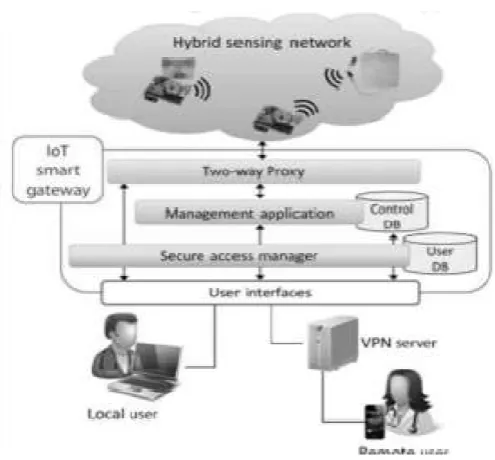
The conceived SHS has been put into effect according to the architecture illustrated in Figure 2.
• As shown, it is composed of three main parts: The RFID-WSN (Wireless Sensing Network).
• The IOT smart gateway;
• The user interfaces for data management.
The same interface allows doctors with specific privileges to access both real time and historical patient data. Such information can also be managed remotely by the medical staff through a mobile software application. The H
integrated RFID-WSN 6LoWPAN network composed of four typologies
• 6LowPAN border routers (6LBR); • 6LowPAN routers (6LR);
[image:2.595.311.559.376.606.2]• 6LowPAN router readers (6LRR); • 6LowPAN host tag (HT).
Figure 1. Architecture for Proposed RFID
According to the 6LoWPAN standard, the 6LBR is in charge of connecting the network to the Internet by translating 6 PAN packets into IP v6 packets and vice versa, whereas the 6 LR provides forwarding and routing capabilities.
the proposed RFID-WSN integrated system, the 6LRR is defined as a 6 LR node interfaced with an RFID reader while HT identifies a typical 6 Low
routing and forwarding capabilities) interfaced with an RFID Gen2 tag. The proposed SHS assumes that several 6
deployed in the hospital to collect data from the environment, such as temperature, pressure, and ambient light conditions. In addition to the sensing capabilities, the main function of 6 LRR nodes, instead, is to track patients, nursing staff, and biomedical devices labeled with RFID tags.
readily combine different, yet complementary, technologies enabling novel functionalities. Basically, the system we be able to collect, in real time, both environmental conditions and patients’ physiological parameters and deliver them to a control center. At this point, (Medical Assistant) should analyze the received data and send alert messages in case of emergency. The conceived SHS has been put into effect according to the architecture illustrated in Figure 2.
As shown, it is composed of three main parts: The WSN (Wireless Sensing Network).
The IOT smart gateway;
interfaces for data visualization and
The same interface allows doctors with specific privileges to access both real time and historical patient data. Such information can also be managed remotely by the medical staff through a mobile software application. The HSN consists of an WSN 6LoWPAN network composed of four
6LowPAN border routers (6LBR); 6LowPAN routers (6LR);
6LowPAN router readers (6LRR); 6LowPAN host tag (HT).
Architecture for Proposed RFID-Lo WPAN
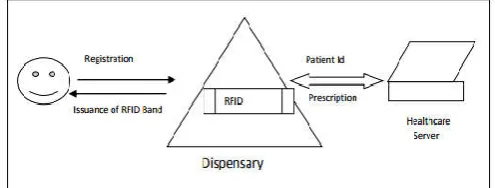
In particular, we envision patients wearing an HT node, which is capable to detect important physiological parameters such as heartbeat and motion. Sensed data are periodically logged on the user memory of the RFID, thus allowing 6LRR nodes deployed in the environment to retrieve and deliver them to the IOT Smart Gateway. This last one is connected, on one hand, directly with the HSN and, on the other hand, with the Internet through a local area network (LAN). From literature review it is clear that IOT has large possibilities for innovative applications to help improve human life. Among four main categories of IOT applications listed above, healthcare domain (Jara et al., 2011) is the one, most beneficial for common people, especially in India. In India large population still lives in villages and is deprived of good healthcare facilities. However, in villages also, the Internet facility is being made available (Owing the credit to Scheme Digital India) and rural population is already making use of mobile phones to its maximum extent. This factor motivates the present proposal that using basic internet or telecommunication services, RFID tags and existing dispensaries in villages, we can facilitate promising basic healthcare services to everyone. This proposal can also contribute towards Government of India Digital India initiative. Presently, all most all villages in India have at least one health center to provide basic healthcare services, however there is scarcity of doctors in those dispensaries, due to which people have to visit nearest urban cities to avail medical facilities. Because of limited number of government hospitals in urban cities and still limited doctors in those hospitals, creates bottleneck in providing satisfactory medical facilities to all citizens. Long queues at all hospitals in India, clearly indicates demand for a better alternative. Using IOT and its enabling technologies, existing government health centers can provide services for common diseases, such as common flu, cold, cough, typhoid, malaria etc. This meagerly requires establishing one computer system with internet connectivity to healthcare server established at nearest urban government hospital or the server may be established in cloud. Villagers will be required to visit local health center once where with the help of a medical assistant they will undergo registration on healthcare server. On registration, present status of vital organs will be recorded along with any medical history and a unique RFID tag will be issued to the person, containing registration identity of that person. While RFID tag being very small can be embedded within a wrist band, the RFID reader will remain available online at the health center itself. Now whenever a person is sick, instead of visiting the health center physically, the patient will only be required to press a button in RFID band which in turn transmits the identity information to RFID reader at health center.
On this call, RFID reader identifies the patient with its registration number and will access patients health card from healthcare server. The health card along with present symptoms of the patient will be submitted to an expert medical system such as Mycin (a new software may also be developed), which will be installed at healthcare server. This expert system is capable of generating a prescription to the patients, even in the absence of a doctor based on present symptoms and past medical history of the patient. Based on generated prescription, medical assistant may provide medicines to the patient (in the absence of Doctor too). This Expert system and health care database may be kept on cloud, so as to make it accessible everywhere in the country. Thus, the patient can move anywhere in India and can avail medical facilities using that RFID tag, which will help any doctor to
[image:3.595.309.557.135.229.2]become familiar with patient’s history and medicines already prescribed and taken. Further, common problem of villagers will get timely identified and resolved avoiding long queues which in turn would save lot of time, money and energy. Figure 2 provides high level view of proposed Smart E- Health Services System.
Figure 2. High Level View of E-Health Care Smart System
USING Co AP
Overview of Co AP (Constrained Application Protocol) It is a software protocol intended to be used in very simple electronics devices that allows them to communicate interactively over the Internet. It is particularly targeted for small low power sensors, switches, valves and similar components that need to be controlled or supervised remotely, through standard Internet networks. Therefore, efficiency is very important. CoAP can run on most devices that support UDP or a UDP analogue. Message types involved in CoAP are Confirmable, Non confirmable, Acknowledgement, Reset messages. Confirmable requires Acknowledgement whereas Non-Confirmable doesn’t require Acknowledgment. Reset message indicates missing of few contexts.
• GET: The GET method helps in retrieving information from that of server.
• POST: The POST method requests the server to provide data for the user.
• PUT: The PUT method helps in updating or creating the information in the corresponding URI
• DELETE: The DELETE method helps in erasing the information stored.
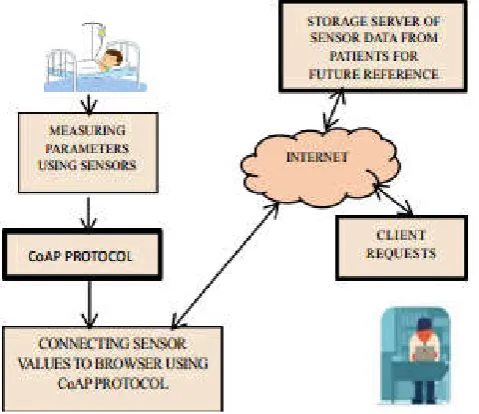
The usage of CoAP in patient monitoring application is to form a client-server relationship, whereas Doctors use the browser as client and the server program runs in the GUI for updating the browser dynamically. Thus the Method definitions are used efficiently for remote monitoring application. As per Figure 3, Patient is monitored by the sensors mounted on them. Servers will host the information on the network. The server collects the data from the sensors. On the other side, Doctors are acting as clients. If doctors request server for data, the CoAP protocol helps to connect server with client to display the current status and check for variation of sensor values (Chander et al., 2012). If there is any variation, Doctors can give medication indicating emergency situation for the patient. This medication is done in browser using CoAP Protocol. The data of patient is stored in some data storage device for future purposes. In multi-hop flat wireless topology as shown in figure 4, there are one or more intermediate nodes along the path that receive and forward packets via wireless links. During transmission and reception in multi-hop networks, nodes communicate with each other using wireless channels and do not have the need for common infrastructure or centralized control. The above Figure 4 explains the Multi-hop topology with Border router, Client and server.
Figure 3. Architecture of proposed system using CoAP
Figure 4. Communication between border router, Client & Server
USING ARDUINO
Here proposed system is designed to reduce the difficulties of rural people. It merges the idea of an active E-Health Care System. The system mainly reduces the human effort by connecting to people from distant places. The sensors play a major role in this human less health care facility. Temperature sensors are used to measure the body temperature of a patient. The sensors are interfaced with Arduino using a coding. Likewise, a heartbeat sensor is used to measure the pulse of the human body. Also, a ECG sensor module is inter faced, it is used to measure the rhythm of heart and blood flow through it. These sensors are together interfaced with Arduino. Then, a server and web page part are introduced with respect to IOT which acts as a link between the patient and doctor. A power supply which is given either by means of USB cable or battery. In order to control the power supply, a charge controller might be used to minimize the effect. These supplies are connected to an Arduino controller. Then, the interfacing of sensors takes place from the temperature sensor. The connection pin of 5V, A0 and GND are connected to Arduino and interfaced. Heart beat sensor are also connected in same procedure to measure the heartbeat pulse. Then, an ECG sensor module is used. This sensor has a five-pin connection. They are connected with respect to Arduino. It measures the difference in PQRST waveforms of heart. These things are interfaced together with the Arduino. Next, the Wi-Fi module is connected to the Arduino. It acts as a source of creating a specific hotspot connection through a connection between the hardware and the system is made together. The system gets the specific set of
URLs through which the interfacing results are displayed through it.
Conclusion
The proposed model can be effectively executed utilizing existing RFID-Lo WPAN, CoAP and Arduino innovation and a specialist social insurance framework, for example, Mycin. Another smart e-wellbeing framework can likewise be planned considering the Indian medical problems and conditions. The proposition would go about as a guide to wiped out and would likewise contribute towards Digital India. It is noted from the above studies that: The RFID per user is a system associated gadget that can be for all time appended or versatile. It utilizes radio recurrence waves to transmit signals that actuate the tag. Once enacted, the tag sends a wave back to the radio wire, where it is converted into information. Lo WPAN is a class of advances that are intended for low-control, long-go remote correspondence, thus they are perfect for use inside vast scale arrangements of low-control IoT gadgets like remote sensors. Constraint application proto colis especially focused for little low power sensors, switches, valves and comparative segments that should be controlled. Arduino can detect the earth by accepting contribution from an assortment of sensors and can influence its surroundings by controlling lights, engines, and different actuators.
REFERENCES
Ant, R. 2006. An introduction to RFID technology. Pervasive
Computing, IEEE, 5(1), 25-33, January-March,2006.
Atzori, L., Iera, A., and Morabito, G. 2010. The internet of things: A survey.Computer networks, 54(15), 2787-2805. Babar, S., Stango, A., Prasad, N., Sen, J., and Prasad, R. 2011,
February. Proposed embedded Security framework for internet of things (IOT). In Wireless Communication, Vehicular Technology, Information Theory and Aerospace
& Electronics Systems Technology, (Wireless VITAE),
2011 2nd International Conference on (pp. 1-5). IEEE. Chander, R.P.V., Elias, S., Shivashankar, S, and Manoj, P.
2012. A REST based design for Web of Things in smart environments. International Conference on Parallel
Coetzee, L., and Eksteen, J. 2011, May. The Internet of Things-promise for the future? An introduction. In
IST-Africa Conference Proceedings, 2011 (pp. 1-9). IEEE.
Dimcic, T., Krco, S. and Gligoric,N. 2012. CoAP (Constrained Application Protocol) implementation in M2M
Environmental Monitoring System.E-society Journal 21.
Distributed and Grid Computing pp: 337-342.
Istepanian, R. S., Zitouni, K., Harry, D., Moutosammy, N., Sungoor, A., Tang, B., and Earle, K. A. 2009. Evaluation of a mobile phone telemonitoring system for glycaemic control in patients with diabetes. Journal of Telemedicine
and Tele care, 15(3), 125-128.
Istepanian, R.S.H., Jara, A., Sungoor, A, and Philips N. 2010. Internet of Things for M-health applications (IoMT). AMA-IEEE medical technology conference on individual healthcare, Washington.
Jara, A. J., Zamora, M. A., and Skarmeta, A. F. 2011. An internet of things---based personal device for diabetes therapy management in ambient assisted living (AAL).
Personal and Ubiquitous Computing, 15(4), 431-440.
Sunkari, V. 2015. Framework for Providing Security and Energy Saving Using Elliptic Curve Cryptography in Wireless Sensor Networks. IJCSIT 6: 3604-3608.
The Internet of Things: Mapping the Value beyond the Hype, Executive Summary by Mckinsey Global Institute, and June 2015.
Ukil, A., Sen, J., and Koilakonda, S. 2011, March. Embedded security for Internet of Things. In Emerging Trends and
Applications in Computer Science (NCETACS), 2011 2nd
National Conference on (pp. 1-6). IEEE.
Weber, R. H. 2010. Internet of Things–New security and privacy challenges. Computer Law & Security Review, 26(1), 23-30