Boolean Satisfiability
BOOLEAN SATISFIABILITYis a widely used model-ing tool in EDA. Well-known applications of SAT include test-pattern generation for stuck-at faults, delay and bridg-ing faults, equivalence checkbridg-ing, redundancy removal, and logic synthesis.1
More recent applications include FPGA routing, bounded model checking, and crosstalk noise analysis. In addition to finding new applications of SAT to EDA, researchers have strived to propose algo-rithms for solving instances of the SAT problem that state-of-the-art EDA tools will have to solve.
Given a Boolean function ψwith nvariables, the SAT problem consists of assigning values to the variables such that ψassumes value 1, or prove that no such assignment exists and the function is equal to 0. A Boolean product of sums, or conjunctive normal form
formula, is the most often used representation of the Boolean function.
A CNF formula is a conjunction of clauses, each of which is a disjunction of literals. A literal is either a vari-able or its negation. For example, CNF formula ψ= (a+b)(b+c+d) contains two clauses, (a+b) and (b+c+d), and five literals. A clause is satisfiedif at least one of its literals assumes value 1, unsatisfiedif all its literals assume value 0, unitif all but one literal assume value 0, and unresolvedotherwise. Literals with no assigned Boolean value are free literals. A formula is satisfied if all its clauses are satisfied, and unsatisfied if at least one clause is unsatisfied. It is often simpler to
refer to clauses as sets of literals, and to the CNF formula as a set of clauses.
Here, we review current algorithms for solving instances of SAT, emphasizing the algorithms that are particularly sig-nificant for SAT in combinational cir-cuits, and the attempts to develop unified algorithmic frameworks. Con-sequently, we study the techniques Marques-Silva et al. proposed,2–4but also
review techniques by Bayardo and Schrag5
and Tafertshofer, Ganz, and Henftling.6
Current SAT solvers
Of the many approaches proposed for solving the SAT problem, the two most widely used are local search
and backtrack search. Local search is seldom used in EDA, because local search algorithms cannot prove unsatisfiability. Consequently, backtrack search algo-rithms are the most promising for solving SAT in EDA.
Most, if not all, backtrack search SAT algorithms apply the unit clause rule7—that is, if a clause is unit, the
formu-la can be satisfiable only if the sole free literal has value 1. The iterated application of the unit clause rule is often referred to as Boolean constraint propagation (BCP).
Implementing some of the techniques shared by some backtrack search algorithms requires explaining the Boolean variable assignments implied by the CNF formula clauses. For example, let (w+z+u) be a CNF formula, and assume variable assignments {w= 0, u= 1}. To satisfy the clause according to the unit clause rule, the value of z
must be 1. The implied assignment, z= 1, has explanation {w= 0, u= 1}. A more formal description of explanations for implied variable assignments in the SAT context, as well as a description of identification mechanisms, is avail-able elsewhere.4
Figure 1 illustrates a generic backtrack search SAT algorithm that captures the organization of several of the
Solving Satisfiability in
Combinational Circuits
Editor’s note:
As EDA evolves, researchers continue to find modeling tools to solve problems of test generation, design verification, logic, and physical synthesis, among others. One such modeling tool is Boolean satisfiability (SAT), which has very broad applicability in EDA. The authors review modern SAT algorithms, show how these algorithms can account for structural information in combinational circuits, and explain what recursive learning can add to SAT. —Marcelo Lubaszewski, Federal University of Rio Grande do Sul
João Marques-Silva and Luís Guerra e Silva
tion selects an assignment. Selected assignments have no explanation because these assignments are not implied by a unit clause. The algorithm also associates a decision level, λ, with each selected assignment.
The Deduce( )function, which usually corresponds to the BCP procedure, identifies implied necessary assign-ments. Whenever a clause becomes unsatisfied, the
Deduce( )function returns a conflict indication, which the Diagnose( )function analyzes. The conflict’s diagno-sis returns a backtracking decision level, β(the level to which the search process can provably retrace its steps). The Backtrack( )function clears variable assignments from current decision level λup to decision level β.
Currently, the most efficient SAT algorithms imple-ment several key techniques for solving difficult instances of SAT:
■ The algorithms can use conflict analysis to imple-ment nonchronological backtracking strategies. Hence, they can skip assignment selections deemed irrelevant during the search.4,5
■ They can also use conflict analysis to identify and record new clauses that denote implicates of the Boolean function associated with the CNF formula (recall that an implicate, α, of Boolean function fis such that α= 0 ⇒f= 0). Clause recording plays a key role in new SAT algorithms, even though most large recorded clauses will eventually be deleted.4,5 ■ Relevance-based learning extends the life spans of
large recorded clauses that will eventually be deleted.5 ■ Conflict-induced necessary assignments4denote
vari-able assignments that will prevent a given conflict from recurring during the search.
Before executing the actual search, the SAT algo-rithm can apply different forms of preprocessing to the CNF formula.4 In general, a Preprocess( ) function
denotes the desired preprocessing techniques. The search-pruning techniques described above rely extensively on the search algorithm’s ability to explain the conflicts’ causes. Most approaches to identifying conflict causes construct a new clause that can subse-quently prevent the same conflict from recurring.
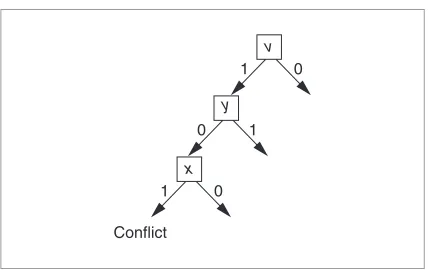
The CNF formula in Figure 2 illustrates clause record-ing. Assume a sequence of decision assignments, {v= 1,
y= 0, x= 1}. The last decision assignment causes clause (y+ w+ z) to become unsatisfied. Because this conflict
is due to assignments {v= 1, y= 0, x= 1}, we can say
However, we want the formula to be satisfied (ψ = 1), so we must have v= 0∨y= 1∨x= 0 or, in clausal form (v+y+x). Thus, by identifying the con-flict’s causes, we can create an implicate of the CNF for-mula, which we can add to the formula as a new clause. The most competitive SAT algorithms implement tech-niques for recording new clauses from conflict causes.4,5
SAT in combinational circuits
The algorithms described in the previous section have proven to effectively solve real-world instances of SAT. In particular, using CNF models and SAT algo-rithms has important advantages:
( v = ) ^ ( 1 y = ) ^ ( 0 x = ) 1 →ψ = 0 while ( Decide(ψ, λ) == DECISION ) {
if ( Deduce(ψ, λ) == CONFLICT ) { β= Diagnose(ψ, λ) ; if ( β== –1 )
return UNSATISFIABLE; else {
Backtrack(ψ, λ , β); λ = β;
} }
λ= λ+ 1; }
[image:2.612.279.548.63.247.2]return SATISFIABLE; }
Figure 1. Generic satisfiability algorithm.
v
1 0
y
0 1
x 1
Conflict 0
Figure 2. Diagram of the clause recording
example ψ= (y+w+z)(z+x)(w+v+x). The assignments v = 1, y = 0, and x = 1 imply a
[image:2.612.278.492.281.416.2]■ Existing and extensively validated SAT algorithms can replace dedicated algorithms.
■ Improvements and new SAT algorithms can be easi-ly applied to target applications.
However, their use in combinational circuits also has several drawbacks:
■ As Tafertshofer, Ganz, and Henftling observe, the cir-cuit’s structural information, often crucial, is lost.6 ■ In many EDA problems, designers must solve
numer-ous instances of SAT for each circuit. Hence, map-ping a given problem description into SAT can take a significant percentage of the overall running time. ■ Computed input patterns are generally overspecified, a serious drawback in applications such as circuit testing and binate constraint solving.
■ Powerful circuit-based reasoning techniques, such as recursive learning,8
cannot easily be applied.
Our approach uses structural information in SAT algo-rithms. We add a layer that maintains circuit-related information (fan in and fan out, for example) and value justification relations to a generic SAT algorithm. (We can use any SAT algorithm that will accept this layer.)
This approach eliminates some of the drawbacks of
using CNF models and SAT algorithms in combination-al circuits—the inaccessibility to structurcombination-al information and overspecification of input patterns, for example. Unlike Tafertshofer, Ganz, and Henftling’s approach,6
[image:3.612.122.335.63.207.2]ours does not require modifying the data structures used for SAT, so we can easily augment existing algo-rithmic SAT solutions with the layer we propose for han-dling structural information. Moreover, our approach requires only minor modifications to SAT algorithms, making it significantly simpler.6
Figure 3 illustrates the proposed unified approach for solving SAT in combinational circuits. Basically, adding new layers to an existing SAT algorithm lets us exploit circuit structure and incorporate search tech-niques targeted specifically to combinational circuits.
We start by formalizing the Boolean satisfiability prob-lem in combinational circuits. Assume we want to satis-fy property Cpof combinational circuit Cto objective value o. We denote this satisfiability problem by (Cp, o) and map it into SAT instance ψ. To solve instances of SAT in combinational circuits, and with the goal of using structural information in the SAT algorithm, we associate the following information with each vari-able xof ψ, which also represents circuit node xof C:
■ FI(x) denotes the set of fan-in nodes of x. ■ FO(x) denotes the set of fan-out nodes of x. ■ υv(x) denotes the threshold value on the number of
suitable assigned inputs of xneeded to justify value
von node x.
■ ιv(x) denotes the actual number of assigned inputs of xthat are involved in justifying value von node x.
According to these definitions, each circuit node xwith assigned value vbecomes justified whenever ιv(x) ≥υv(x). Table 1 lists example threshold values on the num-ber of assigned inputs required for justifying a given node. For example, an AND gate needs at least one input assigned value 0 to justify assigning 0 to x, where-as to where-assign value 1 to x, all inputs must be assigned 1. Hence, υ0(x) = 1 and υ1(x) = |FI(x)|. As another
exam-ple, an XOR gate justification of any assigned value requires assignments to all gate inputs; hence, υ0(x) =
υ1(x) = |FI(x)|. This information is easy to derive for
other simple gates as well, and in all cases we have υ0(x), υ0(x) ∈{1, FI(x)}.
For any simple gate with output x, we can associate each fan-in node wwith the counters to be updated as a result of assigning value vto w. For an AND gate, for example, assigning 0 to fan-in node wincrements ι0(x)
Boolean Satisfiability
Circuit structure
Recursive learning Boolean
satisfiability
Figure 3. Proposed layered approach for solving
SAT.
Table 1. Threshold values on justification counters.
Gate υ0(x) υ1(x)
AND/NAND 1 |FI(x)|
OR/NOR |FI(x)| 1
BUFF/NOT |FI(x)| |FI(x)|
Standard search algorithms in combi-national circuits9
maintain a justification frontier, denoting the sets of variables and nodes that require justification. The con-dition indicating the need for node justi-fication is (v(x) = v) ∧(ιv(x) <υv(x)), wherev∈{0, 1}.
Given these definitions, we can adapt
a SAT algorithm to allow proper maintenance of justifi-cation information. Moreover, we can use the fan-in information to implement structure-based heuristic decision-making procedures, such as simple or multi-ple backtracing.9
In Figure 1, functions Deduce( )and Diagnose( )
must invoke dedicated procedures for updating node justification information. Additionally, Decide( ) now tests for satisfiability by checking for an empty justifi-cation frontier instead of checking whether all clauses are satisfied. These are the only required modifications to the general SAT algorithm. Observe that the
Decide( ) function can be adapted to perform back-tracing, given the fan-in information associated with each variable.
The data structures described above operate in much the same way as justification works in combina-tional circuits.9
The main difference is that in our approach, justification and value consistency are for-mally dissociated: The SAT algorithm handles value consistency, and the added layer handles justification. Consider the example circuit in Figure 4, assuming the first assignment is y= 0. The justification frontier becomes {y}. We assume that the next assignment is e= 0. Because this assignment justifies y= 0, the justifica-tion frontier becomes {e}. After assigning e= 0, we have υ0(y) = ι0(y) = 1, υ0(e) = 1, and ι0(e) = 0, causing yto be
justified and eto enter the justification frontier. Finally, we consider primary input assignment a= 1, which causes eto be justified and leaves the justification fron-tier empty.
Recursive learning
Recursive learning has been used extensively to solve Boolean satisfiability in combinational circuits.8
Recursive-learning applications include test pattern gen-eration, combinational equivalence checking, and logic synthesis. We can also apply recursive learning to CNF formulas.
Combinational circuits
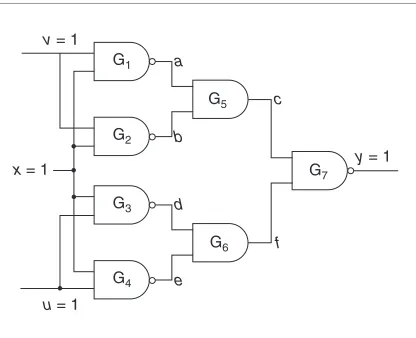
Consider the example in Figure 5, in which output value y= 1 of gate G7is not justified. Recursive learning
analyzes the justifications for each unjustified gate out-put value, trying to identify common necessary assign-ments. The gate justification analysis process continues recursively until a predefined depth limit is reached.
Assume that for our example the depth limit is 2. The possible justifications for assignment y= 1 are c= 0 and
f= 0. Hence, we start with depth 1 of the recursive-learn-ing procedure by considerrecursive-learn-ing c= 0, which does not imply additional assignments. Next, we go to depth 2 and consider the possible justifications for gate G5with output c= 0. In this case, the possible justifications are
a= 0 and b= 0. The first justification, a= 0, implies assignment x= 1 (due to v= 1). Because the second jus-tification, b= 0, also implies assignment x= 1, we can conclude that assignment c= 0 implies x= 1.
The other justification at depth 1 of the recursive-learning procedure is f= 0. Using the same reasoning we used previously, we can readily conclude that this assignment also implies x= 1. It is straightforward to b
f
y
c d
υ0 0
e = 0 υ0(y) = 1 0(y) = 1 ∅ υ0(e) = 1 0(e) = 0 {e}
a = 1 υ0(e) = 1 0(e) = 1 ∅
[image:4.612.226.546.67.169.2]ι ι ι
Figure 4. Justification example.
v = 1
a
b G1
G2
G5 c
f G7
u = 1
x = 1 y = 1
d
e G3
G4
G6
Figure 5. Recursive learning on combinational
[image:4.612.281.489.206.375.2]conclude that any justification for assignment y= 1 implies assignment x= 1. Hence, x= 1 is a necessary assignment, given assignment y= 1.
CNF formulas
We can apply similar reasoning to CNF formulas. We begin by observing that to justify gates (that is, to identify consistent assignments), we check the possi-ble justifications for common necessary assignments. For clause ωwith one or more literals assigned value 0, at least one unassigned literal must eventually be assigned value 1 if the formula is to be satisfiable. Hence, we assign value 1 to each unassigned literal in ωand analyze the results. Assignments that are implied by every such assignment are deemed necessary for the formula to be satisfiable.
For example, consider the CNF formula and assign-ments in Figure 6. Our objective is to analyze how we might satisfy ω3. For ω3to be satisfied, and because z=
1, we must either have w= 1 or y= 1. We consider each assignment separately.
■ Assignment w= 1 implies assignment x= 1, due to assignment u= 0 and due to ω1.
■ Similarly, assignment y= 1 implies assignment x= 1 due to ω2.
We can thus conclude that assignment x= 1 is nec-essary to satisfy the CNF formula. Moreover, we can con-clude by inspection that this is true only because z= 1 and u= 0. Thus, (z= 1) ∧(u= 0) →(x= 1); or, in clausal form, (z+u+x).
The most significant conclusion is that the recursive-learning procedure not only identifies necessary assign-ments but also can help identify new implicates of the CNF formula that we can add to the original formula as new clauses. Because this recursive-learning procedure identifies new clauses, it does not repeat the same rea-soning process at a later stage in the search to rederive the same necessary assignment. Moreover, it can facili-tate identification of other necessary assignments that would otherwise not be identifiable.
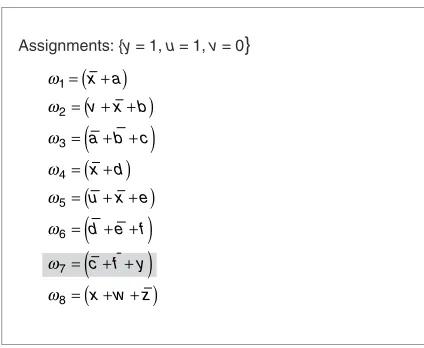
Figure 7 gives a more complete example of the depth-2 recursive-learning procedure on CNF formulas. We can initiate the recursive-learning process on ω7
because y= 1. Assignments c= 0 and f= 0 satisfy clause ω7.
The recursive-learning process for depth 1 considers each of these assignments separately. Assignment c= 0 implies no assignments. However, clause ω3now exhibits a new
literal with value 0. Hence, at depth 2 of the recursive-learning process, we analyze clause ω3. Assignmentsa=
0 or b= 0 can satisfy ω3. Considering each assignment
indi-vidually yields the implied assignment x= 0. For a= 0, we get x= 0 from clause ω1; for b= 0, we get the implied
assignment from ω2because v= 0.
We perform a similar analysis for f= 0. Because f= 0, clause ω6exhibits a literal with value 0. Hence, we analyze
ω6at depth 2 and find that assignments d= 0 and e= 0 can
satisfy it. Both d= 0 and e= 0 imply assignment x= 0. For
d= 0, we get x= 0 from clause ω4; for e= 0, we get x= 0 from
ω5because u= 1. Hence, (y= 1) ∧(v= 0) ∧(u= 1) →
(x = 0); or in clausal form, (y+v+u+x). As in the previ-ous example, the recursive-learning process identifies a new clause that implies assignment x= 0, and, during the subse-quent search, it can imply the assignment again.
Extended recursive learning on combinational circuits
When solving SAT on a CNF formula derived from a combinational circuit for which we have structural infor-mation (using the additional layer described earlier), we can improve the recursive-learning procedure’s
perfor-Boolean Satisfiability
Assignments {z= 1, u= 0}
ω ω ω
1 2 3
=
(
+ +)
=
(
+)
=
(
+ +)
u x w
x y
[image:5.612.121.333.217.391.2]w y z
Figure 6. Recursive learning on a CNF formula.
An analysis of the assignments shows us that
we need assignment x= 1 to satisfy the formula.
Assignments: {y= 1, u= 1, v= 0}
ω ω ω ω ω ω ω ω
1 2 3 4 5 6 7 8
=
(
+)
=
(
+ +)
=
(
+ +)
=
(
+)
=
(
+ +)
=
(
+ +)
=
(
+ +)
=
(
+ +)
x a
v x b
a b c
x d
u x e
d e f
c f y
x w z
Figure 7. Depth-2 recursive learning on a CNF
clauses that relate yto immediate fan-in nodes. This approach yields a significantly faster recursive-learning procedure, similar to the original procedure for circuits, and can also identify implicates of the CNF formula.2
SAT SOLVERShave dramatically improved during the
past few years. The most recent generation of SAT solvers uses well-established techniques—clause recording and nonchronological backtracking—but it is also based on search restart strategies,10new lazy-data structures,11new
variable-branching heuristics,11
and new recorded-clause-deletion policies.12Because these improvements have
been applied solely to SAT solvers operating on CNF for-mulas, they do not exploit the structural information of combinational circuits. In the near term, these improve-ments should be integrated in SAT solvers that exploit the structural information of combinational circuits. In the far term, we can expect to see adaptive algorithms that can be dynamically reconfigured depending on the search algorithm’s progression. ■
References
1. A. Saldanha and V. Singhal, “Solving Satisfiability in
CAD Problems,” Proc. Cadence Technical Conf., 1997,
pp. 191-195.
2. J.P. Marques-Silva and L. Guerra e Silva, “Solving
Satisfi-ability in Combinational Circuits with Backtrack Search and
Recursive Learning,” Proc. XII Symp. Integrated Circuits
and Systems Design,IEEE Press, 2000, pp. 192-195.
3. J.P. Marques-Silva and T. Glass, “Combinational
Equiv-alence Checking Using Satisfiability and Recursive
Learning,” Proc. Design, Automation and Test in Europe
(DATE 99), IEEE CS Press, 1999, pp. 145-149.
4. J.P. Marques-Silva and K.A. Sakallah, “Grasp: A New
Search Algorithm for Satisfiability,” Proc. Int’l Conf.
Com-puter-Aided Design(ICCAD 96), IEEE CS Press, 1996,
pp. 220-227.
5. R. Bayardo Jr. and R. Schrag, “Using CSP Look-Back
Techniques to Solve Real-World SAT Instances,” Proc.
Nat’l Conf. Artificial Intelligence, AAAI Press, 1997, pp.
203-208.
6. P. Tafertshofer, A. Ganz, and M. Henftling, “A
SAT-Based Implication Engine for Efficient ATPG,
Equivalence Checking, and Optimization of Netlists,”
Proc. Int’l Conf. Computer-Aided Design(ICCAD 97),
IEEE CS Press, pp. 648-657.
Kluwer Academic, 1997.
9. M. Abramovici, M.A. Breuer, and A.D. Friedman, Digital
Systems Testing and Testable Design,Computer
Science Press, 1990.
10. L. Baptista and J.P. Marques-Silva, “Using
Randomiza-tion and Learning to Solve Hard Real-World Instances of
Satisfiability,” Proc. Int’l Conf. Principles and Practice of
Constraint Programming, Lecture Notes in Computer
Science, vol. 1894, Springer, 2000, pp. 489-494.
11. M. Moskewicz et al., “Engineering an Efficient SAT
Solver,” Proc. Design Automation Conf.(DAC 01), ACM
Press, 2001, pp. 530-535.
12. E. Goldberg and Y. Novikov, “BerkMin: A Fast and Robust
SAT-Solver,” Proc. Design, Automation and Test in
Europe(DATE 02), IEEE CS Press, 2002, pp. 142-149.
João Marques-Silva is a professor in the Information Systems and Com-puter Science Department of the Technical University of Lisbon. His research interests include algorithms for Boolean satisfiability and optimization and their applications to design automation problems. Marques-Silva has a BS and MS in electrical and computer engi-neering from the Technical University of Lisbon, and a PhD in electrical engineering and computer science from the University of Michigan, Ann Arbor. He is a senior member of the IEEE and a member of the ACM.
Luís Guerra e Silva is a PhD can-didate at the Technical University of Lisbon, where he is also an assistant lecturer. His research interests focus on efficient data structures and algo-rithms for solving complex EDA problems. Guerra e Silva has a BSc in electrical and computer ing and an MSc in electrical and computer engineer-ing from the Technical University of Lisbon. He is a member of the IEEE.