Lay perceptions of Carbon Dioxide Utilisation technologies
in the United Kingdom and Germany: An exploratory
qualitative interview study
JONES, Christopher R., OLFE-KRAEUTLEIN, Barbara and KAKLAMANOU,
Daphne <http://orcid.org/0000-0002-7532-5841>
Available from Sheffield Hallam University Research Archive (SHURA) at:
http://shura.shu.ac.uk/16735/
This document is the author deposited version. You are advised to consult the
publisher's version if you wish to cite from it.
Published version
JONES, Christopher R., OLFE-KRAEUTLEIN, Barbara and KAKLAMANOU, Daphne
(2017). Lay perceptions of Carbon Dioxide Utilisation technologies in the United
Kingdom and Germany: An exploratory qualitative interview study. Energy Research
& Social Science, 34, 283-293.
Copyright and re-use policy
See
http://shura.shu.ac.uk/information.html
Sheffield Hallam University Research Archive
SUPPLEMENTARY MATERIAL
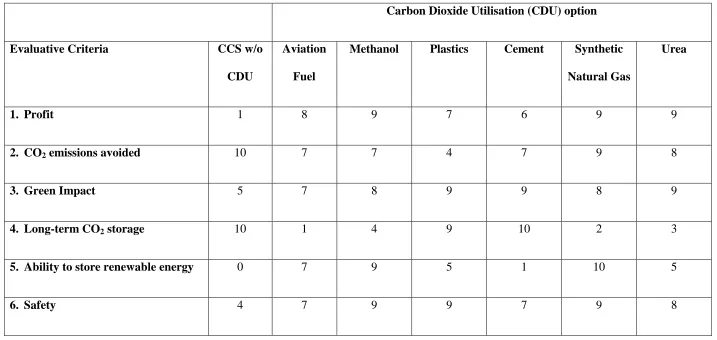
Table S1.
Expert ratings of Carbon Capture and Storage (CCS) and Carbon Dioxide Utilisation (CDU) options against key evaluative criteria
Carbon Dioxide Utilisation (CDU) option
Evaluative Criteria
CCS w/o
CDU
Aviation
Fuel
Methanol
Plastics
Cement
Synthetic
Natural Gas
Urea
1.
Profit
1
8
9
7
6
9
9
2.
CO
2emissions avoided
10
7
7
4
7
9
8
3.
Green Impact
5
7
8
9
9
8
9
4.
Long-term CO
2storage
10
1
4
9
10
2
3
5.
Ability to store renewable energy
0
7
9
5
1
10
5
7.
Ease of integrating technology
3
8
8
8
9
10
9
8.
Technology readiness
7
3
9
8
7
5
6
A group of >10 academic experts recruited via the CO2Chem network (www.co2chem.co.uk) were invited to evaluate CCS without CDU and 6 x CDU options against the
following evaluative criteria (September/October 2014). The evaluative criteria were selected and defined by academic experts in CDU based at the CDUUK
(www.sheffield.ac.uk/cduuk). In each case, a higher value (out of 10) is associated with better performance against that criterion. As with Jones et al. (2014), each of the
● Profit: An estimate of the income generation potential from the CDU option (e.g. from selling products). CCS does not generate income and increases the cost of
producing electricity, hence the score of 1.
● CO2 emissions avoided: An estimate of how much CO2 release is prevented by the technology. As CCS removes CO2 emissions from fossil fuel power generation, the potential savings are large, hence the score of 10.
● Green Impact: An estimate of how ‘environmentally friendly’ the technology option is. With CCS, although CO2 is removed, current capture agents have poor environmental credentials, hence the score of 5.
● Long term CO2 storage: An estimate of how long the captured CO2 is locked away for. With CCS, CO2 is stored permanently in geological formations, hence the
score of 10.
● Ability to store renewable energy: Some of the options are good potential energy stores, others are not. This figure is an estimate of each option’s ability to store
‘renewable’ energy. No renewable energy stored with CCS, hence the score of 0.
● Safety: An estimate of the safety risks associated with the technology; the higher the risk, the lower the score. Because there are risk factors in transporting
supercritical CO2 and possible unknown factors in long term storage, CCS scores 4 in this respect.
● Ease of integrating the technology: An estimate of how easy will it be to deploy the technology. CCS requires the construction of long pipelines from power plant
to the coast, with much disruption, hence the score of 3.
● Technology readiness: An estimate of how close to commercial scale deployment of the technology we are. Although some CCS pilot projects have been
Table S2.
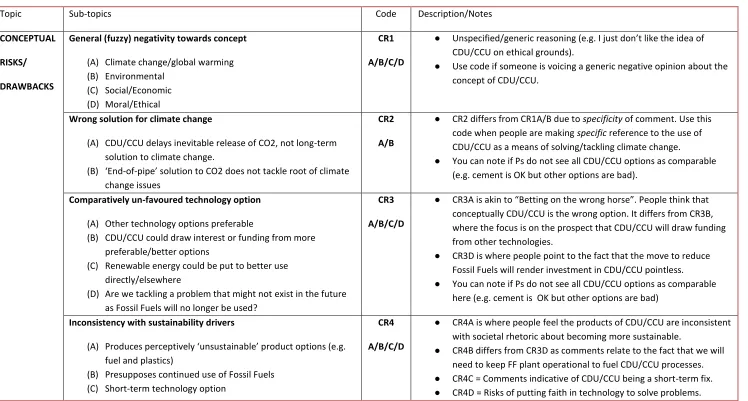
The full final coding manual for CDU interviews.
Topic Sub-topics Code Description/Notes
CONCEPTUAL
RISKS/
DRAWBACKS
General (fuzzy) negativity towards concept
(A) Climate change/global warming (B) Environmental
(C) Social/Economic (D) Moral/Ethical
CR1
A/B/C/D
● Unspecified/generic reasoning (e.g. I just don’t like the idea of CDU/CCU on ethical grounds).
● Use code if someone is voicing a generic negative opinion about the concept of CDU/CCU.
Wrong solution for climate change
(A) CDU/CCU delays inevitable release of CO2, not long-term solution to climate change.
(B) ‘End-of-pipe’ solution to CO2 does not tackle root of climate change issues
CR2
A/B
● CR2 differs from CR1A/B due to specificity of comment. Use this code when people are making specific reference to the use of CDU/CCU as a means of solving/tackling climate change.
● You can note if Ps do not see all CDU/CCU options as comparable (e.g. cement is OK but other options are bad).
Comparatively un-favoured technology option
(A) Other technology options preferable
(B) CDU/CCU could draw interest or funding from more preferable/better options
(C) Renewable energy could be put to better use directly/elsewhere
(D) Are we tackling a problem that might not exist in the future as Fossil Fuels will no longer be used?
CR3
A/B/C/D
● CR3A is akin to “Betting on the wrong horse”. People think that conceptually CDU/CCU is the wrong option. It differs from CR3B, where the focus is on the prospect that CDU/CCU will draw funding from other technologies.
● CR3D is where people point to the fact that the move to reduce Fossil Fuels will render investment in CDU/CCU pointless.
● You can note if Ps do not see all CDU/CCU options as comparable here (e.g. cement is OK but other options are bad)
Inconsistency with sustainability drivers
(A) Produces perceptively ‘unsustainable’ product options (e.g. fuel and plastics)
(B) Presupposes continued use of Fossil Fuels (C) Short-term technology option
CR4
A/B/C/D
● CR4A is where people feel the products of CDU/CCU are inconsistent with societal rhetoric about becoming more sustainable.
● CR4B differs from CR3D as comments relate to the fact that we will need to keep FF plant operational to fuel CDU/CCU processes.
● CR4C = Comments indicative of CDU/CCU being a short-term fix.
(D) Techno-salvation risk
Conceptual similarities drawn with Fracking (negative) CR5 ● Participants liken CDU/CCU to Fracking and note that this is a negative thing.
Rationale for CDU/CCU unclear
(A) Unclear who stands to benefit from CDU/CCU (e.g. is it being developed for economic/environmental reasons)
(B) Participant indicates lack of trust (or lack of sincerity) in developer/industries promoting CDU/CCU
CR6
A/B
● Comments relating to uncertainty in the reasons why CDU/CCU is being pursued (e.g. “who is it supposed to benefit and how?”).
● CR6A = specific reference to uncertainty over monetary or
environmental motives. CR6B = scepticism over motives of industry.
● CR6A/B differ from OT5 as comments made are not tied to specific question about Economic or Environmental benefits + are more about the perceived rationale rather than the perceived benefits.
CONCEPTUAL BENEFITS
General (fuzzy) positivity towards concept
(A) Climate change/global warming (B) Other Environment
(C) Social/Economic (D) Moral/Ethical
CB1
A/B/C/D
● Unspecified/generic reasoning (e.g. I just like the idea of CDU/CCU on ethical grounds).
● Use code if someone is voicing a generic positive opinion about the concept of CDU/CCU (e.g. “I like it” or “we need CDU”).
Holds specific benefits for tackling climate change
(A) Stop-gap technology option (i.e. could ‘buy time’ in tackling climate change)
(B) Will address climate change by saving CO2
CB2
A/B
● Specific mentions of benefits that CDU/CCU has for climate change.
● CB2A = references to CDU/CCU being a useful bridging technology - will help delay the negative effects of CO2.
● CB2B = specific references to reduction in CO2 release and the benefit this has for climate change.
Indicative of attempts to be more sustainable
(A) Recycle/use (waste) CO2 (move towards circular economy) (B) Replaces crude oil/petrol for use in transportation,
manufacture, etc.
(C) Will (conceptually) reduce raw resource consumption (D) Creates a new carbon resource (general use value)
CB3
A/B/C/D
● General references to CDU/CCU enhancing sustainability should be coded CB3.
● CB3A = should make direct reference to recycling or use of waste CO2.
● CB3C = industry will use less fresh/raw resource in manufacture.
● CB3D = similar to CB3C but is more about creating a new source of carbon.
Conceptually favoured technology
(A) Investment in CDU/CCU will spark innovation in use of CO2
(B) CDU represents a ‘fresh start’
(C) CDU/CCU is good if developed alongside other options (D) CDU/CCU is good use of renewable energy
A/B/C/D general innovation around CO2 rather than innovation of CDU/CCU.
● CB4C differs from CB6 as CB6 sees CDU/CCU as a ‘lesser of two evils’ while CB4C sees CDU as an important part of the solution.
Positive comparison with CCS (and other technology)
(A) Storage of CO2 seen as wasteful (landfill) (B) Storage of CO2 seen as dirty or dangerous
CB5
A/B
● Note: most comparisons are with CCS without CDU/CCU. References to Fracking should be coded as CB7.
Reluctant or caveated acceptance of CDU/CCU technology CB6 ● Not a full endorsement. Basically the belief that If we are going to use Fossil Fuels then we might as well have CDU/CCU attached.
Conceptual differences drawn with Fracking (positive) CB7 ● Participants draw positive distinctions between CDU/CCU and
Fracking and note that this is a positive thing.
TECHNO-ECONOMIC RISKS/
DRAWBACKS
Technical viability/potential for impact
(A) Minimal impact (i.e. will use minimal CO2 emissions) (B) High energy costs for conversion processes (technical
efficiencies are low/thermodynamics don’t add up) (C) We might run out of CO2 in future leaving CDU/CCU
inoperable
(D) CDU/CCU might create more CO2 than it uses (E) Will need international ‘buy in’ to have meaningful
impact/benefit
TR1
A/B/C/D /E
● CDU/CCU will either not work or will only have a minimal impact.
● TR1A = minimal CO2 captured - implication is that CDU/CCU is not worth the effort.
● TR1C differs from CR3D as the suggestion is more about the viability of CDU/CCU in a world where CO2 is not produced by industry rather than the fact that CDU will be solving a conceptual problem that doesn’t exist.
● TR1E = points to an equity and efficacy issue – why should we invest in this technology if others don’t? Our impact alone will be minimal.
Economic/Market viability
(A) High financial investment required to scale-up and bring CDU/CCU to market
(B) No suitable market for technology or product(s) -> Slow (no) return on financial investment
(C) CDU/CCU will have high operational and maintenance costs (D) Has to make economic sense for industry buy-in (CDU/CCU is
a potentially expensive source of carbon)
TR2
A/B/C/D /E
● Questions over whether CDU/CCU is economically feasible and whether industry will buy related technology and products?
● TR2A = relates to specific costs of bring technology to market.
● TR2B = speaks specifically about potential market and likelihood/speed on return on investment (if any).
● TR2C = speaks about the ‘up and running’ costs of CDU/CCU.
● TR2D = if CDU/CCU is not economic source of carbon then it will be a ‘difficult sell’ to industry.
(E) Presents unfavourable economic competition for Fossil Fuels price of Fossil Fuels and products derived from Fossil Fuels.
Low technology readiness
(A) Unproven commercial technology (B) Reliability risk with new technology
(C) Ease of scalability and timescales to meaningful introduction and impact
TR3
A/B/C/D
● References to CDU/CCU being at an early stage in commercialisation process, which presents risks in terms of economics/impact.
● TR3A = specific reference to the economic unknown.
● TR3B = specific reference to unreliability of technology.
● TR3C = risks around timescales needed to scale up CDU/CCU to have meaningful economic/environmental consequence.
TECHNO-ECONOMIC BENEFITS
Technical viability/potential for impact TB1 ● Participant points to the potential for large capture/impact potential
(e.g. “this could work and make use of a lot of CO2”).
Economic/Market viability
(A) Integration potential with current infrastructures and (diverse) markets
(B) Making use of waste CO2 creates revenue (C) Generates a cheap carbon feedstock for product
manufacture (benefit to industry) (D) PR or marketing angle for investors
(E) Opportunity to retail technology to developing nations
TB2
A/B/C/D /E
● References to belief that CDU/CCU could have meaningful markets, makes economic sense. TB2 differs from TB4 where CDU/CCU is seen to increase economic viability of CCS.
● TB2B = implication is that revenue can offset costs of process.
● TB2C = specifically we are looking at financial benefit to industry from CDU/CCU producing competitive source of carbon.
● TB2D = CDU/CCU presents a ‘good news’ story for investors, which could improve trust in brand or be used to promote product sales.
● TB2E = differs from TB2D as is looking at retail the technology of CDU/CCU to other nations due to our advanced knowledge.
Technical and economic innovation potential TB3 ● Investment now will improve efficiency/effectiveness and cost of
future CDU/CCU technology. Note: differs from CB4A as participants are talking about specific rather than general innovation.
Positive effect on other technology
(A) Increases economic viability of CCS (B) Will lead to investment in renewables
(C) Will benefit Fossil Fuel industry (e.g. reduce cost, increase longevity and helps them to hit emissions targets).
TB4
A/B/C
● TB4 covers positive techno-economic impacts of investment in CDU/CCU for other technologies.
● TB4B = thrust is that CDU/CCU will (indirectly) increase share of renewables in energy mix, which is a good thing.
SOCIETAL RISKS/
DRAWBACKS
Could inhibit necessary societal change
(A) delay consumer lifestyle/attitude change (B) delay business/industry practice change
SR1
A/B
● CDU/CCU could be used as an excuse not to change practices – suggestion is that if CO2 is being used then we (public/industry) can continue to produce it. Use SR1A/B to differentiate as necessary.
Public/environmental health and safety risks
(A) from chemicals used in process
(B) from storage aspect of process (Note: includes explosions/emissions from stored CO2)
(C) Explosions and emissions related to CDU/CCU process (D) Unknown risks from CDU/CCU products
SR2
A/B/C/D
● Code speaks about all health/safety risks from all aspects of process including the storage (CCS) process. Make sure to differentiate where people are talking about issues with storage vs. use.
● SR2C = specifically relates to explosions and emissions from ‘capture’ and ‘transportation’ aspect of process.
● SR2D = people believe chemicals in CDU/CCU products could have risks (e.g. negative health effects).
CDU/CCU will promote CCS technologies SR3 ● CCS is seen as negative option and thought that CDU/CCU makes
CCS more viable is bad (Note: This view wasn’t registered in the UK).
Communication consideration
(A) Level of public awareness/knowledge low -> mindless public endorsement of technology.
(B) Need for transparent communication + from trusted source (C) Potential for media amplification of risk
(D) Potential for differences in industry vs. public perceptions of rationale for CDU/CCU
SR4
A/B/C/D
● Noted issue with mindless endorsement (SR4A) is that it might not reflect actual opinion when people learn more.
● SR4C = Media amplification seen as problematic as this might sway people from a conceptually positive technology.
● SR4D = Differences in industry/public rationale could lead to miscommunication.
Siting/Deployment considerations
(A) General potential for local opposition to facilities (e.g. NIMBY) + will need to be sited in the right places (B) Need to secure regulatory/governmental approval
(C) Specific facility impacts: Unwelcome visual/noise impact from facilities, construction disruption, space required by facility, negative affect on house prices.
(D) Local siting will be a non-event/will be fine (+) (E) Need for appropriate public engagement around
SR5
A/B/C/D /E
● Issues/considerations relating to siting of CDU/CCU plant. Responses generally yielded in response to direct question.
● SR5A = discussion about own or others’ likelihood of rejection.
● SR5B = thrust is that regulatory approval is not assured.
● SR5D = differs from OT3 as reference specifically concerns the prospect of a local facility.
developments
Increased cost of products from CDU/CCU
(A) High cost of carbon will increase price of products for
consumers
(B) Environmental benefits will need to be obvious for public to pay more for CDU/CCU derived products
SR6
A/B
● SR6A = relates to TR2 but relates specifically to societal
consequences of use of CDU/CCU for the retail cost of products – who is going to pick up the bill?
● SR6B = public will only be willing to pay potentially inflated prices for CDU/CCU if environmental benefits are clear.
SOCIETAL BENEFITS
Could promote necessary societal change
(A) Promote consumer lifestyle/attitude change (B) Promote business/industry practice change
(C) Identifies UK/Germany as an innovator/leader -> potential to lead by example and change practices in other countries.
SB1
A/B/C
● Theme runs converse to SR1. Thrust is that CDU/CCU is a catalyst for change among the public (SB1A) or industry (SB1B).
● SB1C = thrust is that explicit/public investment in technology could promote other countries to change practices/invest in CDU/CCU.
Could create new employment opportunities (+)
(A) Skilled jobs only (-) (B) Not many jobs (-)
SB2
A/B
● General mentions of jobs/employment should be coded with SB2.
● Caveats on the employment opportunity should use A/B.
Will generate ‘useful’ and ‘necessary’ products
(A) Yields a sustainable source of carbon/presents substitution option for Fossil Fuel derived CO2
(B) Will produce products to plug the energy gap
SB3
A/B
● Most mentions are to the general usefulness of CDU/CCU in terms of producing necessary products (SB3).
● SB3A = specific mentions of CDU/CCU deriving a sustainable carbon feedstock for product manufacture.
● SB3B = participant specifically references CDU/CCU for filling an emerging energy gap.
Lower political and import dependencies SB4 ● Theme relates to reduced reliance on import crude oil for
chemical/energy industry and the Increased security of supply and economic certainty this will bring.
Non-disruptive technology option SB5 ● CDU/CCU will allow for incremental societal change or business as
usual approach to life, seen as positive.
OTHER CODES
Participant comments on interview procedure
(A) Has improved understanding of CDU/CCU (+) (B) Has stimulated desire to learn more (+)
(C) Specific lack of discussion of risks of CDU/CCU (-) (D) Participant wants more “facts and figures” (E) Has improved attitude to CDU/CCU (+) (F) Has worsened attitude to CDU/CCU (-)
OT1
A/B/C/D /E/F
● Theme relates to comments made by participant about what impact the interview has had on them and/or what they think the interview is lacking (e.g. discussion of risk).
● OT1D = participant is referencing their own lack of knowledge per se but is pointing to the need for more facts/information before they can make an informed judgement.
Participant knowledge factors
(A) Participant indicates they have lack of knowledge (general) (B) Participant indicates they have lack of knowledge (risks) (C) Participant confuses technical processes/terminology or
conflates CDU/CCU with other technology (e.g. CCS)
OT2
A/B/C
● Participant references the fact they know very little – uses this to caveat their responses.
● Where participant conflates CDU with other technology, ensure this is a mistake rather than participant talking about, e.g., fuels as an option from CDU/CCU.
CDU/CCU is of little personal consequence OT3 ● Ps think that CDU/CCU will not affect them -> wonder why they are
being interviewed. Note: differs from SR5D as OT3 is not talking about a specific facility but about CDU/CCU in general.
Economic vs. Environmental benefit for CDU/CCU
(A) Economic > environment benefit (B) Environment > economic benefit
(C) Neither economic or environment benefit
(D) Equal (indistinguishable) economic & environmental benefit
OT5
A/B/C/D
● Generally this theme should be used to code direct responses to the question as to whether CDU/CCU holds more environmental or economic benefits. It can be used elsewhere though.
● Specific references to differences in the likely motivators of public (environment) and industry (economic) support should be coded differently (e.g. TR2D, SR6B).
ADDITIONAL CONSIDERATIONS…
(1) MAKE A NOTE OF THE CDU/CCU OPTIONS PEOPLE FAVOUR/DISLIKE AND THE REASONS WHY.