SPORT SUPPLEMENTATION
Alexandаr Marinkov
*Department of rheumatology, UMHAT Kaspela, Bulgaria
Abstract
Keywords:
sport, supplementation, amino acids, food additives
Sport supplementation is essential for athletes performance and achievements. The well balanced and structured supplementation is a challenge for sport medicine because must be done a balance between potential benefits and potential risks (anti-doping rule violations and others). In this review are structured the most used categories sport supplementations. Nutritional supplements used in sport could be divided in some main categories like: amino acids, vitamins, proteins and antioxidants. Food supplements used in sport could be also divided in 3 other categories: pre-workout supplementation (incl. proteins, vitamins), supplementation during workout and post workout recovery supplementation (incl. vitamins, brand chained amino acids ).
Introduction
Food supplements are used by athletes worldwide to improve their performance and achieve better results. These products are targeted not only to athletes but also physically-active individuals. In the United States, the Dietary Supplement Health and Education Act has defined dietary supplements as something added to the diet, mainly vitamins, minerals, amino acids, herbs or botanicals, and metabolites/constituents/extracts, or combination of any of these ingredients. (1)In USA FDA regulates both finished dietary supplement products and dietary ingredients. FDA regulates dietary supplements under a different set of regulations than those covering "conventional" foods and drug products. According to the European Community Directive of 2002 ( Directive 2002/46/EC) and according to Bulgarian legislation, issued by the Ministry of Health 01.08.2005, food additives are defined as substances that contain concentrated nutrients or other elements with a nutritional or physiological effect, alone or in combination, distributed in certain dosage forms designed to enrich diet (2). Supplementation practices in sport vary between the different sport disciplines and individual needs of athletes.
Vitamins
Vitamins function in the human body as metabolic regulators, influencing a number of physiological processes important to exercise or sport performance. Vitamin deficiencies can certainly impair exercise performance (1).Vitamins are frequently taken by athletes on the supposition that they are experiencing a vitamin deficiency due to exercise and training regimes. Cotter (40) has suggested that there is little evidence to suggest that exercise would necessitate vitamin supplementation.
Vitamin C is reputed to aid in the wound-healing process, and vitamin E has been claimed to increase aerobic capacity. All these claims for ergogenic properties of vitamins have been discussed by Barone (41) but, in general, there is little evidence available to substantiate these claims. Vitamins, taken in excess, are toxic. This applies particularly to the fat- soluble vitamins (A, D, E and K) which are stored in the body and which can therefore accumulate. Even the water-soluble vitamins (B and C) can produce toxic effects when taken in excess (42). In general, a balanced diet will provide the necessary nutritional requirements of vitamins. Vitamin supplements are only of benefit where there is a clear deficiency, such as occurs with an exceptional nutritional intake (43). (39)B-complex vitamins are involved in processing carbohydrate and fats for energy production, an important consideration during exercise of varying intensity. Several B vitamins are also essential to help form haemoglobin in red blood cells, a major determinant of oxygen delivery to the muscles during aerobic endurance exercise (1)(39).
exercise training. (1) Very often these vitamins are used in combination with selenium or/and coenzyme Q10 (CoQ10). Even that many recent studies support the conclusion that vitamin C supplementation does not enhance physical performance it is widely used by athletes as and antioxidant agent. Antioxidants defence in the cell can temper the negative influence of free radicals and associated reactions (4)(5)(6)(7)(8). Vitamin E is the major lipid-soluble antioxidant in cell membranes. It protects against lipid peroxidation by acting directly with a variety of oxygen radicals, including singlet oxygen, lipid peroxide products, and the superoxide radical, to form a relatively innocuous tocopherol radical . Vitamin C can interact with the tocopherol radical to regenerate reduced tocopherol. Vitamin C is water soluble and can directly react with superoxide, hydroxyl radicals, and singlet oxygen (9). Beta-carotene, the major carotenoid precursor of vitamin A, is the most efficient “quencher” of singlet oxygen (4)(10). Daily intake of Vitamin E in sport is especially important because Vitamin E deficiency leads to serious damage to the body, especially the muscles. Antioxidant supplementation with Vitamin E is likely to provide many beneficial effects against exercise-induced oxidative tissue damage.(30)
Many studies have examined the effects of acute exercise on changes in amount of antioxidants in the blood and changes in indirect indicators of lipid peroxidation to provide information on oxidative stress induced by exercise (11– 22). Because aerobic exercise increases oxygen consumption, many studies have employed prolonged sub maximal exercise bouts (11–22). Even Antioxidant supplements have been considered as means for athletes to perform better, recover more quickly and allow them to train more strenuously more studies must be done to evaluate the real benefits about the improvement of sport performance because the chronic exercise increases antioxidant defences (23-28).
Amino acids and protein supplementation
Table 1. Protein supplementation
Protein Characteristic and benefits Products
Whey protein Whey protein is a fast-absorbing source of protein. It is very appropriate especially for post-workout intake.
Optimum Nutrition:Gold Standard 100% Whey;
MuscleTech:NITRO-TECH Whey Isolate Lean Musclebuilder;
GNC: pro performance amp amplified wheybolic extreme 60;
ON: OPTIMUM NUTRITION 100% WHEY; ALLMAX: ISOFLEX
Protein bars Protein bars are convenient and balanced sources of supporting protein.
MusclePharm:Combat Crunch Bars; Quest Nutrition: Quest Bars; Grenade:Carb Killa; SCI-MX Nutrition: PRO2GO Cookie.
Soy protein Soy protein is a low fat, low cholesterol and protein source.
Universal Nutrition: Advanced Soy Protein; MHP: Probolic-SR; MHP: Probolic-SR.
Egg protein Egg protein products are ilactose-free protein source. MHP: Paleo protein; USN: Muscle Fuel Mass; Reflex Nutrition: 100% Egg White Protein; Reflex Nutrition: 3D Protein.
Casein protein
Casein is a slow digesting protein source. The intake of casein protein is most appropriate before bed time.
JYM: Pro JYM;Optimum Nutrition: Gold Standard 100% Casein; Dymatize: Elite Casein; MuscleTech: Platinum 100% Casein.
Beef protein Beef protein is naturally rich of amino acids alanine, arginine, glutamic acid, glycine, proline, serves as a significant source of leucine, isoleucine, and valine. It is important to note that beef protein products are much saltier in taste than most other protein powders. This is due to the naturally-occurring sodium content.
Vegan protein
Appropriate for vegan and vegetarians. These products mainly contain: sprouted whole grain brown rice, pea hemp.
Vega: Protein & Greens;NOW: Pea Protein; Olympian Labs: Pea Protein; Reflex Nutrition: Vegan Protein.
L-carnitine
Studies in athletes have shown that carnitine supplementation may foster exercise performance (29). L-carnitine supplementation influence the lipid metabolism. Treatment with L-carnitine also has been shown to induce a significant post exercise decrease in plasma lactate, which is formed and used continuously under fully aerobic conditions. Data from preliminary studies have indicated that L-carnitine supplementation can attenuate the deleterious effects of hypoxic training and speed up recovery from exercise stress. Recent data have indicated that L-carnitine plays a decisive role in the prevention of cellular damage and favourably affects recovery from exercise stress. Uptake of L-carnitine by blood cells may induce at least three mechanisms: 1) stimulation of hematopoiesis, 2) a dose-dependent inhibition of collagen-induced platelet aggregation, and 3) the prevention of programmed cell death in immune cells.(29) L-carnitine supplementation has also a favorable effect on the functional status and fatigue in adults.(36)
Cha YS has investigated the effects of L-carnitine on obesity, diabetes, and as an ergogenic aid. Obesity is defined as abnormal or excessive fat accumulation that may impair health. (35)Obesity is a world-wide epidemic considered to be the fifth leading risk for global deaths. Obesity and its associated conditions such as insulin resistance, type 2 diabetes, dyslipidemia and steatosishepatis, termed as a metabolic syndrome, represent major challanges for basic science and clinical research.(35)
Cha YS has found that supplementation of L-carnitine and antioxidants improve lipid profiles and exercise ability in exercise-trained rats. Also, both exercise training and supplementation of carnitine and antioxidants improved lipid profiles and carnitine metabolism in humans, suggesting that carnitine and antioxidant supplementation may improve exercise performance.(33) Other recent researches demonstrate benefits of L-carnitine supplementation not only in sport but also in treatment of diabetes. L-carnitine constant infusion improves insulin sensitivity in insulin resistant diabetic patients; a significant effect on whole body insulin-mediated glucose uptake is also observed in normal subjects. In diabetics, glucose, taken up by the tissues, appears to be promptly utilized as fuel since glucose oxidation is increased during L-carnitine administration. The significantly reduced plasma levels of lactate suggest that this effect might be exerted through the activation of pyruvate dehydrogenase, whose activity is depressed in the insulin resistant status.(34) L-carnitine supplementation would give many benefits for physically active individuals and also for people with obesity.
Creatine supplementation
Because of the widespread use of creatine by athletes and promising results with regard to the clinical therapeutic potential of creatine in neuromuscular, neurological (32) and cardiovascular diseases interest in creatine supplementation has grown exponentially over recent years, mainly with respect to using the compound as an ergogenic aid (30).
and popular sports, and especially adolescents may regard the use of performance-enhancing substances as an easy way to gain self-esteem through improved body appearance and athletic performance. Although short-term supplementation of creatine has not been associated with major health risks, there are still existing open questions on safety and in particular the use of performance-enhancing supplements by adolescents is troubling because of the lacking safety data (44-49).
Pre-workout supplementation
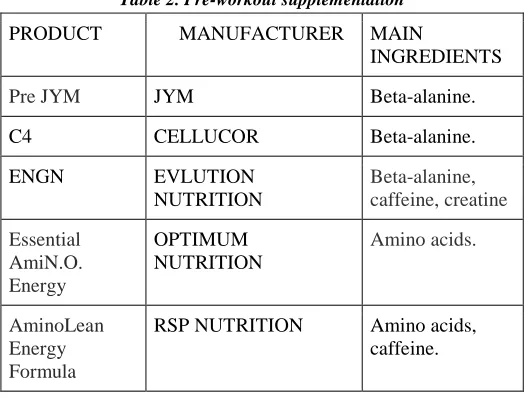
Supplementation before training is very important because it prepares athlete body for endurance exercises. Pre-work out supplementation enhance alertness, enhances energy levels, promotes better results.
Table 2. Pre-workout supplementation
Supplementation during workout
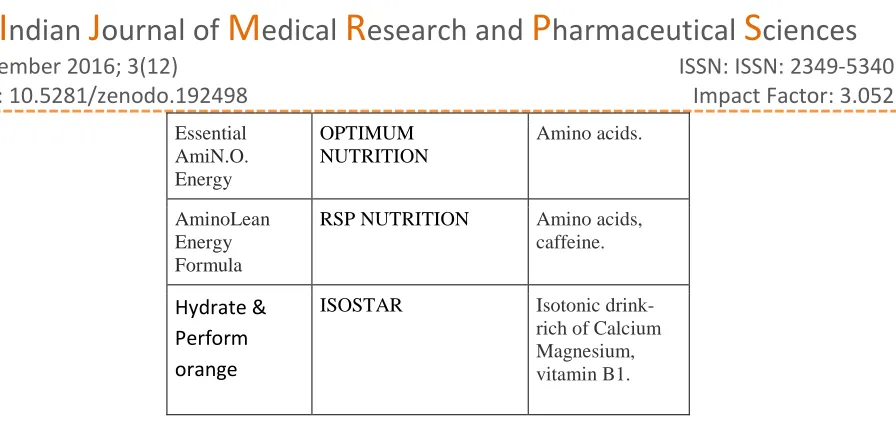
[image:5.612.175.438.230.429.2]The aim of the supplementation during intense training sessions is to support recovery. Prolonged muscular exercise is accompanied by significant hydro-mineral losses and, if the training session or competition lasts longer than an hour, the body needs to receive the elements necessary for good performance, namely: carbohydrates, electrolytes and good hydration. For exercise that lasts longer than an hour, the body must be provided with carbohydrates, as regularly and continuously as possible. Regular consumption of isotonic exercise drinks containing carbohydrate or energy gels every 15-20 minutes (drink systematically after absorption) will provide the hydration and energy and electrolyte content essential for optimum performance.(38) Isotonic drinks provide good hydration. These products could be consumed before exercise, during exercise for improvement of the performance and the endurance and after workout for recovery.
Table 3. Supplementation during exercises
PRODUCT MANUFACTURER MAIN
INGREDIENTS
Xtend SciVation Amino acids.
C4 CELLUCOR BCAAs
ENGN EVLUTION
NUTRITION
Beta-alanine, caffeine, creatine
PRODUCT MANUFACTURER MAIN
INGREDIENTS
Pre JYM JYM Beta-alanine.
C4 CELLUCOR Beta-alanine.
ENGN EVLUTION
NUTRITION
Beta-alanine, caffeine, creatine
Essential AmiN.O. Energy
OPTIMUM NUTRITION
Amino acids.
AminoLean Energy Formula
Essential AmiN.O. Energy
OPTIMUM NUTRITION
Amino acids.
AminoLean Energy Formula
RSP NUTRITION Amino acids, caffeine.
Hydrate &
Perform
orange
ISOSTAR Isotonic drink-
rich of Calcium Magnesium, vitamin B1.
Post workout recovery supplementation
[image:6.612.92.540.46.259.2]The post workout supplementation is very important for the recovery after exhausting training. The most workout recovery supplementation includes many different combinations like: branched chain amino acids, vitamins, electrolytes, glutamine and others. Branched chain amino acids (BCAAs) consist of three amino acids - leucine, valine, and isoleucine.
Table 4. Post workout recovery supplementation
PRODUCT MANUFACTURER MAIN INGREDIENTS
BCCA Power Labrada Nutrition Amino acids, glutamine,
electrolytes.
Essential Amino Energy Optimum Nutrition Amino acids.
Best BCAA BPI sports Amino acids.
Post JYM Active Matrix JYM Amino acids.
Antioxydant complec Isostar Vitamins C, Beta-carotene and E;
Zinc citrate; Selenium-rich yeast.
Hazelnut High Protein bar Isostar Milk proteins, soya lecithin,
Vitamins B1, B2, B6, C, PP and E
Most used nutritional supplements in sport include vitamins, minerals, carbohydrate, protein and various extracts from plant sources. Athlete diet before exercise or a competition is one of the key performance factors. Not balanced diet can cause hypoglycaemia, dehydration, digestive upsets and poor performance. Before endurance exercise the body must be prepared in order to have the energy and the necessary hydration. Sport supplementation is an important part of athletes life and carrier because it not only enriched the diet but also help them to perform better, achieve better results and feel better. Nutritional and supplementation strategy vary in different sport categories. Sport supplementation is very complicated and include different products before training, during training and also post-recovery supplementation.
References
1. M. Williams, “Dietary Supplements and Sports Performance: Introduction and Vitamins,” J Int Soc Sports Nutr. 2004; 1(2): 1–6
2. K. Ivanov, S. Ivanova, M. Georgieva, P. Atanasov, ”Production and regulatory analytical control of amino acids include in food additives,”PHARMACIA, vol. 61, No. 2/2014
3. C. Sen, “Antioxidants in exercise nutrition,” Sports Medicine. 2001; 31:891–908.
4. P. Clarkson,H. Thompson,”Antioxidants: what role do they play in physical activity and health,”Am J Clin Nutr August 2000, vol. 72 no. 2,pp. 637-646
5. L. Packer, “Oxidants, antioxidant nutrients and the athlete,”J Sports Sci 1997;15:353–63.
6. J Bieri,”Vitamin E,” In: Brown ML, ed. Present knowledge in nutrition. Washington, DC: International Life Sciences Institute, 1990, pp 117–21.
7. A. Goldfarb, “Antioxidants: role of supplementation to prevent exercise-induced oxidative stress,” Med Sci Sports Exerc 1993;25
8. L. Machlin , A. Bendich, “Free radical tissue damage: protective role of antioxidant nutrients,” FASEB J
1987;1:441–5
9. H. Sauberlich, “Ascorbic acid,” In: Brown ML, ed. Present knowledge in nutrition. Washington, DC: International Life Sciences Institute, 1990, pp.132–141.
10. J. Olson, “Vitamin A,” In: Brown ML, ed. Present knowledge in nutrition. Washington, DC: International Life Sciences Institute, 1990:96–107.
11. O. Aruoma, “Free radicals and antioxidant strategies in sport,” J Nutr Biochem, 1994;5, pp. 370–81 12. L. Ji, “Oxidative stress during exercise: implication of antioxidant nutrients,” Free Radic Biol Med
1995;18:1079–86
13. P. Tiidus, M. Houston, “Vitamin E status and response to exercise training,” Sports Med 1995;20:12–23. 14. P. Clarkson, “Antioxidants and physical performance,” Clin Rev Food Sci Nutr 1995;35:131–41
15. S. Maxwell, “Prospects for the use of antioxidant therapies,” Drugs 1995;49:345–61. 16. C. Sen, “Oxidants and antioxidants in exercise”, J Appl Physiol 1995;79:675–86.
17. J. Dekkers, L. Doornen, H. Kemper, “The role of antioxidant vitamins and enzymes in the prevention of exercise-induced muscle damage,” Sports Med 1996;21:213–38.
18. H. Alessio, “Exercise-induced oxidative stress,” Med Sci Sports Exerc 1993;25:218–24. 19. L. Packer, “Oxidants, antioxidant nutrients and the athlete,” J Sports Sci 1997;15:353–63
20. Ji LL, Leeuwenburgh C, Leichtweis S, et al. Oxidative stress and aging. Role of exercise and its influences on antioxidant systems. Ann N Y Acad Sci 1998;854:102–7.
21. Ashton T, Rowlands CC, Jones E, et al. Electron spin resonance spectroscopic detection of oxygen-centered radicals in human serum following exhaustive exercise. Eur J Appl Physiol 1998;77:498–502.
22. Kanter M. Free radicals, exercise and antioxidant supplementation. Proc Nutr Soc 1998;57:9–13. 23. Yagi K. Lipid peroxides and exercise. Med Sport Sci 1992;37:40–2.
24. Dernbach AR, Sherman WM, Simonsen JC, Flowers KM, Lamb DR. No evidence of oxidant stress during high-intensity rowing training. J Appl Physiol 1993;74
25. Ohno H, Yahata T, Sato Y, Yamamura K, Taniguchi N. Physical training and fasting erythrocyte activities of free radical scavenging enzyme systems in sedentary men. Eur J Appl Physiol 1988;57:173–6
27. Kanter MM, Lesmes GR, Kaminsky LA, La Ham-Saeger J, Nequin ND. Serum creatine kinase and lactate dehydrogenase changes following an eighty kilometer race. Eur J Appl Physiol 1988;57:60–3
28. Toskulkao C, Glinsukon T. Endurance exercise and muscle damage: relationship to lipid peroxidation and scavenging enzymes in short and long distance runners. Jpn J Phys Fitness Sports Med 1996
29. Karlic H, Lohninger A,”Supplementation of L-carnitine in athletes: does it make sense,”Nutrition. 2004 Jul-Aug;20(7-8):709-15.
30. St. Ivanova, K. Ivanov, St. Pankova, Br. Zlatkov, K. Stoychev,”Sport supplementation: beneficial effects of Vitamin E and creatine on exercise performance”, PHARMACIA, vol. 62, No. 2/2015
31. M e s a JLM, Ruiz JR, González-Gross MM, Sáinz AG, Garzón MJC. Oral creatine supple- mentation and skeletal muscle metabolism in physical exercise. Sports Med 2002; 32(14): 903-944.
32. Ferrante RJ, Andreassen OA, Jenkins BG, Dedeoglu A, Kuemmerle S, Kubilus JK, Kad- durah-Daouk R, Hersch SM, Beal MF. Neuropro- tective effects of creatine in a transgenic mouse model of Huntington’s disease. J Neurosci 2000; 20(12): 4389-4397.
33. YS Cha,”Effects of L-carnitine on obesity, diabetes, and as an ergogenic aid,”Asia Pac J Clin Nutr. 2008;17 Suppl 1:306-8.
34. Mingrone G1, Greco AV, Capristo E, Benedetti G, Giancaterini A, De Gaetano A, Gasbarrini G, L-carnitine improves glucose disposal in type 2 diabetic patients., J Am Coll Nutr. 1999 Feb;18(1):77-82.
35. R. Dimitrova, V. Petkova, M. Dimitrov, V. Madzharov, I. Nikolova, E. Petkova, K. Andreevska, D. Grekova, S. Gueurguiev , “Obesity-Relationship with Vascular Dysfunction,” Med Crave, Volume 1 Issue 1 - 2014 36. Badrasawi M1, Shahar S2, Zahara AM2, Nor Fadilah R3, Singh DK4.,“Efficacy of L-carnitine
supplementation on frailty status and its biomarkers, nutritional status, and physical and cognitive function among prefrail older adults: a double-blind, randomized, placebo-controlled clinical trial.”Clin Interv Aging.
2016 Nov 17;11:1675-1686. eCollection 2016
37. Pasiakos SM1, Lieberman HR, McLellan TM, Effects of protein supplements on muscle damage, soreness and recovery of muscle function and physical performance: a systematic review, Sports Med. 2014 May;44(5):655-70.
38. Internet source: https://www.isostar.com/ww-en/moments-performance-more-than-2h.html, reached 11.2016
39. D. Mottram,Drugs in sport,1996, Second edition,p.15
40. Cotter, R. (1988) Nutrition, fluid balance and physical performance, in Drugs, Athletes and Physical
Performance, (ed. J.A.Thomas), Plenum, New York, pp. 31–40.
41. Barone, S. (1988) Vitamins and athletes, in Drugs, Athletes and Physical Performance, (ed. J.A.Thomas), Plenum, New York, pp. 1–9.
42. Hecker, A.L. (1987) Nutrition and physical performance, in Drugs and Performance in Sports, (ed. R.H.Strauss), Saunders, Philadelphia, pp. 23–52.
43. Wadler, G.I. and Hainlain, B. (1989) Drugs and the Athlete, Davis, Philadelphia.
44. M. Schönfelder, “NUTRITIONAL SUPPLEMENTS – CREATINE”, BIOMEDICAL SIDE EFFECTS OF DOPING,2007,pp154-185
45. P. D. Balsom, K. Soderlund, and B. Ekblom . Creatine in humans with special reference to creatine supplementation. Sports Med. 18 (18): 268- 280, 1994.
46. M. E. Brosnan and J. T. Brosnan . Renal arginine metabolism. J. Nutr. 134 (134): 2791S-2795S, 2004. 47. P. H. Yu and Y. Deng . Potential cytotoxic effect of chronic administration of creatine, a nutrition supplement
to augment athletic performance. Med. Hypotheses 54 (54): 726-728, 2000.
48. A. M. Persky and G. A. Brazeau . Clinical pharmacology of the dietary supplement creatine monohydrate. Pharmacol. Rev. 53 (53): 161-176, 2001.
49. H. Kinemuchi, H. Sugimoto, T. Obata, N. Satoh, and S. Ueda . Selective inhibitors of membrane-bound semicarbazide-sensitive amine oxidase (SSAO) activity in mammalian tissues. Neurotoxicology 25 (25):