Missing Values Imputation Based on Iterative Learning
Huaxiong Li
School of Management and Engineering, Nanjing University, Nanjing, China Email: [email protected]
Received November 3, 2012; revised January 17, 2013; accepted January 27,2013
ABSTRACT
Databases for machine learning and data mining often have missing values. How to develop effective method for miss-ing values imputation is an important problem in the field of machine learnmiss-ing and data minmiss-ing. In this paper, several methods for dealing with missing values in incomplete data are reviewed, and a new method for missing values imputa-tion based on iterative learning is proposed. The proposed method is based on a basic assumpimputa-tion: There exist cause-effect connections among condition attribute values, and the missing values can be induced from known values. In the process of missing values imputation, a part of missing values are filled in at first and converted to known values, which are used for the next step of missing values imputation. The iterative learning process will go on until an incom-plete data is entirely converted to a comincom-plete data. The paper also presents an example to illustrate the framework of iterative learning for missing values imputation.
Keywords: Incomplete Data; Missing Values Imputation; Iterative Learning; Intension; Extension
1. Introduction
Many data mining and machine learning methods have been well developed based on the assumption that the attribute values of each object in the universe is known [1,2]. However, real-world data often contain missing values either because some values are lost or because the cost of acquiring them are too high. How to properly learning knowledge from such incomplete data has be- come a crucial problem in the field of machine learning and data mining. It is necessary to develop new methods that can be used to effectively learn rules from incom- plete data. Such problem has been widely faced in litera- ture [3-12].
The simplest method to solve this problem is to delete the objects with missing values, then use the rest of the objects as training set to the successive learning process. Such methods may result in the decrease of information for learning. Another similar method is to ignore the ob-jects with missing values in some certain phase of learn-ing. For example in algorithm C4.5 [3], cases with un-known values are ignored while computing the informa-tion content, and the informainforma-tion gain for an attribute X is then multiplied by the fraction of cases for which the value of X is known. Although ignoring missing values may be of efficiency when there are not so many missing values, it will be of invalidation when the number of missing values is very large.
Another important category to deal with missing val- ues focus on filling in missing values so that incomplete
to other binary relations such as similarity relation, tol- erance relation, dominance relation in order to deal with missing values [8-11]. Such extensions are based on cer-tain assumptions: missing values are considered equal to some known values. Thus they can be regarded as an-other kind method to fill in missing values.
There are still two fundamental important problems in these existing methods for filling in missing methods. One is the gradual use of the known values and the filled- in missing values in the whole process. Most methods fill in all missing values before learning, i.e., the filling-in process is one-off finished without considering the use of filled-in values for the next step of filling in other miss- ing values. After filling in some missing values in the universe, information will increase. It is a reasonable strategy to fill in other missing values by the utilization of the filled-in values since the filled-in values bring new available information, and this process can recur-sively continue until a certain terminate conditions are satisfied.
The other problem is the strategy of filling in missing values. In the existing methods, missing values imputa-tion and learning process are separately treated. There are many missing values imputation methods as well as many learning theories. The connection of these two category processes are not sufficiently discussed. In fact, we may take the missing values imputation problem as a special case of learning process. The missing values can be re- garded as a learning target, and the data with known val- ues present a train data sets. Therefore, we may establish the connections between the missing values imputation and learning process. Many learning theories can be in- troduce to missing values imputation, which presents a new view on missing values imputation. The objective of this paper is to propose a new framework for missing values imputation by introducing gradually iterative learn- ing approach.
2. Learning-Based Missing Values
Imputation
Traditionally, filling in missing values is usually consid- ered as a technique method to fix up the original data for rule induction. For an information table, condition attrib- utes and decision attributes are treated distinctly as dif- ferent kinds of attributes according to their different roles in the rule induction. It is assumed that there exist some certain relationship between the condition attribute val- ues and decision attribute values. Such relationship can be denoted as a rule:
if ( and and and ) then
, 1 c v
d
d v
1 2 m
2
c v cm v
where c i
1, 2,,m are condition attributes,
1, 2, ,
i
v i m d
1 1 1 c v
1
1 1
k k
c v
are values of condition attributes, and is decision attribute, d is the value of decision at- tribute. A main task of machine learning and data mining is to find out such rules that can properly express the relationship between condition attribute values and deci- sion attribute values. As incomplete data is concerned, rule induction is difficult to fulfill since some attribute values are missing. By filling in missing values with some certain approaches, rule induction may be easily fulfilled as incomplete data have been converted to com- plete data.
v
1 2 v
From another perspective, filling in missing values can also be concerned as a learning process if we treat miss- ing values as a special unknown decision output that need to learn from the known values. The goal of this kind of learning is to induce rules for filling in missing values. Suppose k is an attribute with missing values, we may consider filling in missing values of as a process of learning such a set of rules as:
c
k
c
if ( and c2 and and and
1 1
k k
c v1
2 1 1 c v
2
1 1
k k
c v
) and and cm vm 1 then , 2
2 v
1
k k
c v
if ( and c2 and and and
2 1
k k
c v1
1 1
) and and cm vm 2 then , 2
k k
c v if (c vs and 2 2
s
c v and and 1 1
s
k k
c v and
1 1
s
k k
c v ) and and cm vm s then
s
k k
c v . It is a reasonable assumption that there may exist some connections among condition attribute values. Such a viewpoint provide us a new learning-oriented understand- ing on filling in missing values. Many appropriate meth-ods of machine learning can be used. In next section, we will propose a gradual iterative learning method for fill-ing in missfill-ing values.
3. Iterative Learning for Missing Values
Imputation
missing values have been converted to known values since they have been filled in with some certain values, thus known values increase and add more usable infor- mation, which may be available for the next step of fill- ing in remained missing values. Based on the refined data, some missing values that can not be certainly filled in previously may get more confidence on some certain values. This reiteration will go on so that an incomplete data may be gradually converted to complete data.
Such iterative learning approach is similar to some other existing learning methods such as semi-supervised learning, a machine learning technique proposed by Shah- shahani and Landgrebe [13]. Semi-supervised learning focus on learning from both labeled and unlabeled data— a small amount of labeled data with a large amount of unlabeled data. It falls between unsupervised learning and supervised learning. Many machine learning rese-
archers have found that unlabeled data, when used in conjunction with a small amount of labeled data, can produce considerable improvement in learning accuracy. With iteratively labeling those unlabeled objects accord- ing to refined data, the performance of learning continu- ally increases.
By using iterative learning method, we propose a new learning approach of filling in missing values. The main idea can be described as follows. At the beginning of the learning process, some of missing values are filled in based on learning from existing known values, thus the number of known values increase and the remained missing values can be filled in by learning from the re- fined set of known values. This process will go on until a certain condition is satisfied.
A high-level algorithm for filling in missing values using iterative learning approach is proposed as follows:
Input: an information table with known values set and missing values set
T P
Q
Output: a refined information table T with known values set and missing values set
P Q
Set P P Q, Q;
Repeat the following operations Select a subset Q1 of Q;
Fill in Q1 based on learning from P
; Replace Q1 by filled-in values set Q1
;
1 Q Q Q P PQ
; 1
Until a termination condition is satisfied ;
Return
P Q,
In the high-level algorithm mentioned above, known values set and missing values set will be refined in each of many learning iterations. The key point of this algo-rithm is to decide the strategy of filling in missing values:
Select a subset 1 of Q ;
Fill in based on learning from ;
Q
1
Q P
Many methods of machine learning can be used. Here we adopt concept formation and learning as a solution.
4. Concept Formation in Incomplete
Information Table
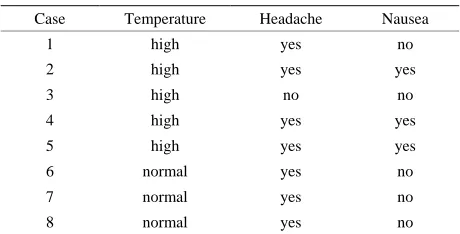
In general, a concept can be defined by a pair of inten-sion and exteninten-sion, where the inteninten-sion of a concept is given by a set of properties and the extension of a con-cept normally defined with respect to a particular set of examples [14-17]. Considering a complete information table such as Table 1 [14], we may express the concep-tion as this pattern.
Let At be a finite set of attributes or features. For each attribute , we associate it with a set of values or la-bels a. Let U be a set of universe whose elements are called objects. For each , there is a mapping
aAt V
aAt Ia
connecting elements of and elements of , and the value of an object
U Va
xU on an attribute aAt is denoted by Ia
x . Commonly in complete informationtable, where the attribute values of each object are known, it is assumed that the mapping Ia is single-valued.
For an incomplete information table, there exist objects whose attribute values are multiple-valued or unknown. In this case, the value of an object xU on an attribute aAt i.e. Ia
x can be expressed by *, namely
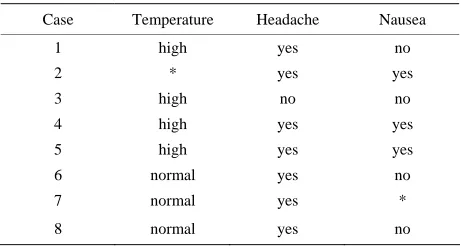
a [image:3.595.308.538.616.733.2]I x . An example of an incomplete table is presented in Table 2.
Table 1. An complete information table.
Table 2. Original incomplete information table.
Case Temperature Headache Nausea 1 high yes no
2 * yes yes
3 high no no
4 high * yes
5 high yes yes
6 normal * no
7 normal yes *
8 normal yes no
In this paper, we adopt the decision logic language used and studied by Pawlak to formally define intensions of concepts [14]. In an incomplete information system, an atomic formula is given by , where
, and it should be stressed that the unknown attribute value (null value) i.e. “*” is not included in a. Therefore, in an atomic formula, is illegal. For each atomic formula , an object
V av
a
, a
aAt vV
av x satisfies it if
aI x v, written xa
v. Otherwise, it does not
satisfy av or a and is written xa
,
v
.
From atomic formulas, we can construct other formulas by applying the logic connectives , , and . The satisfiability of any formula is defined as follows:
1) x iff not x,
2) x iff x and x , 3) x iff x or x , 4) x iff x ,
5) x . iff x and x
a v,. Traditionally, a basic formula can repre-sent a intension of a concept, and the extension of the concept can be represented by the elements which satisfy the formula, denoted by
m . When considering the missing attribute values, all elements with the value of the attribute is are not included. Namely, a m a v
,is only contains the elements whose value of attribute a exactly v. n I Table 2, for example:
Temperature,high 1, 3, 4, 5 ,
Headache,yes 1, 2, 5, 7,8 ,
m m
Moreover, following results can be got by applying the logic connectives:
Temperature,high Headache,yes 1, 5 ,
Temperature,high Headache,yes 1, 2, 3, 4, 5, 7,8 ,
Temperature,high 2, 6, 7,8 .
m m m
5. Iterative Imputation Using Concept
Formation
Let us take Table 2 as an example to describe the process of iterative learning for filling in missing values using concept formation. Suppose we’ll learn the rules for
filling in missing values of attribute at first. Training set used to learn such rules for filling in missing values of attribute is restricted to
Headache 6 I
Headache
1, 2, 3, 5, 7,8
. Then we list all related concepts:
Temperature,high 1, 3, 5 ,
Temperature,normal 7,8 ,
Headache,yes 1, 2, 5, 7,8 ,
Headache,no 3 ,
Nausea,yes 2, 5 , Nausea,no 1, 3,8 ,
m m m m m m
We can find
Temperature,normal
Headache,yesm m
and
Temperature,high Nausea,yes Headache,yes m m ,thus a set of rules is inducted as:
Temperature,normal Headache,yes ,
Temperature,high Nausea,yes Headache,yes ,
then we fill in IHeadache
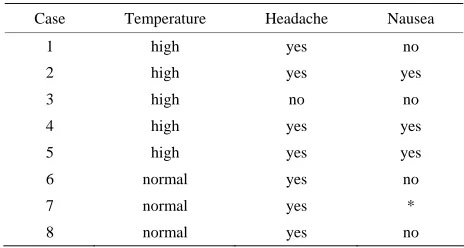
4 and with . Therefore information table has been converted to Table 3.
Headache 6
I yes
We’ll use the refined data to learn rule for filling in missing values of attribute in the next step. Training set for learning is restricted to
Temperature
1, 3, 4, 5, 6, 7,8
. By using the similar approach men-tioned above, we can find
Headache,yes Nausea,yes Temperature,high m m and the corresponding rule is:
Headache,yes
Nausea,yes
Temperature,high ,
then ITemperature
2 is filled in with . Therefore the information table is converted to Table 4.high
Similarly, INausea
7 can be filled in with on the basis ofno
ormal
Nausea,nm Headache,n m o
, i.e., [image:4.595.308.539.611.734.2]
Headache,normal
Nausea,no .
Table 3. Missing values imputation: Headache.
Case Temperature Headache Nausea
1 high yes no
2 * yes yes
3 high no no 4 high yes yes 5 high yes yes 6 normal yes no 7 normal yes *
Table 4. Missing values imputation: Temperature.
[image:5.595.56.287.609.732.2]Case Temperature Headache Nausea 1 high yes no 2 high yes yes 3 high no no 4 high yes yes 5 high yes yes 6 normal yes no 7 normal yes * 8 normal yes no
Table 5 presents the final repaired data. We may find that the incomplete data has been converted to a com- plete data after four-step filling in missing values based on iterative learning, then the complete information table can be used for traditional rule induction based on any exist learning methods.
Remark: In the process of iterative learning for miss- ing values imputation, the selection order of the missing values for imputation is a fundamental problem, which affects the final imputation result. In order to present a high quality imputation result, we should fill in the miss- ing values with the highest confidence in each phase of imputation, that is, we prefer to fill in the missing values associated with a higher confidence rule, which leads to a more reliable imputation result.
It is a basic assumption that there exist some certain relationship among the different attributes. Therefore, in the missing values imputation process, the iterative learn- ing method is used to discover the connection between the known values and the missing values. It should be noted that many machine learning approaches besides concept learning can also be used to discover the rela- tionship between the known values and missing values. In the future work, we will further study on the missing values select order for imputation and present detailed experimental analysis on the proposed method. In addi- tion, many other machine learning methods for iterative missing values imputation will be further investigated in the future work.
Table 5. Missing values imputation: Nausea.
Case Temperature Headache Nausea
1 high yes no 2 high yes yes 3 high no no 4 high yes yes 5 high yes yes 6 normal yes no 7 normal yes no 8 normal yes no
6. Conclusion
In this paper, several methods for dealing with missing values in incomplete data are reviewed, and a new me- thod for missing values imputation based on iterative learning is proposed. At the beginning of missing values imputation, there may be only few missing values that can be filled in with high confidence. After some missing values are filled in, they are converted to known values, then known values increase and more usable information is introduced, which may be available for the next step of missing values imputation. Based on the refined data, some missing values that can not be certainly filled in pre- viously may get more confidence on some certain values. This reiteration will go on so that an incomplete data may be gradually converted to complete data. The paper present a theoretic framework of missing values imputa-tion as well as a practical soluimputa-tion.
7. Acknowledgements
This research is supported by the National Natural Sci-ence Foundation of China (71201076), and the Natural Science Foundation of Jiangsu, China (BK2011564).
REFERENCES
[1] T. M. Mitchell, “Generalization as Search,” Artificial Intelligence, Vol. 18, No. 2, 1982, pp. 203-226.
doi:10.1016/0004-3702(82)90040-6
[2] T. M. Mitchell, “Machine Learning,” McGraw-Hill, New York, 1997.
[3] J. R. Quinlan, “C4.5: Programs for Machine Learning,” Morgan Kaufmann, San Mateo, 1993.
[4] P. Clark and T. Niblett, “The CN2 Induction Algorithm,”
Machine Learning, Vol. 3, No. 4, 1989, pp. 261-283. doi:10.1007/BF00116835
[5] J. W. Grzymala-Busse and W. J. Grzymala-Busse, “An Experimental Comparison of Three Rough Set Ap-proaches to Missing Attribute Values,” In: J. Peters, A. Skowron, I. Duntsch, J. Grzymala-Busse, E. Orlowska and L. Polkowski, Eds. LNCS Transactions on Rough Sets VI, Springer, Berlin, 2007, pp. 31-50.
[6] J. W. Grzymala-Busse, “On the Unknown Attribute Val-ues in Learning from Examples,” In: Z. Ras and M. Ze-mankova, Eds., Proceedings of 6th International Sympo-sium on Methodologies for Intelligent Systems, Springer, Berlin, 1991, pp. 368-377.
[7] Z. Ghahramani and M. I. Jordan, “Supervised Learning from Incomplete Data via an EM Approach,” In: J. D. Cowan, G. Tesauro and J. Alspector, Eds., Advances in Neural Information Processing Systems, Morgan Kauf-mann, San Mateo, 1994, pp. 120-127.
national Workshop on Rough Sets, Fuzzy Sets, Data Min- ing, and Granular-Soft Computing, Springer, Berlin, 1999, pp. 146-157.
[9] M. Kryszkiewicz, “Rough Set Approach to Incomplete Information Systems,” Information Sciences, Vol. 112, No. 1-4, 1998, pp. 39-49.
doi:10.1016/S0020-0255(98)10019-1
[10] M. Kryszkiewicz, “Rules in Incomplete Information Sys-tems,” Information Sciences, Vol. 113, No. 3-4, 1999, pp. 271-292. doi:10.1016/S0020-0255(98)10065-8
[11] J. Stefanowski and A. Tsoukiàs, “On the Extension of Rough Sets under Incomplete Information,” International Journal of Intelligent System, Vol. 16, No. 1, 2000, pp. 29-38.
[12] H. X. Li, Y. Y. Yao, X. Z. Zhou and B. Huang, “Two- Phase Rule Induction from Incomplete Data,” In: G. Wang, T. Li, J. Grzymala-Busse, D. Miao, A. Skowron and Y. Yao, Eds., Proceedings of 3rd International Confer-ence on Rough Sets and Knowledge Technology, Springer, Berlin, pp. 47-54.
[13] B. Shahshahani and D. Landgrebe, “The Effect of Unla-beled Samples in Reducing the Small Sample Size Prob-lem and Mitigating the Hughes Phenomenon,” IEEE
Transactions on Geoscience and Remote Sensing, Vol. 32, No. 5, 1994, pp. 1087-1095. doi:10.1109/36.312897
[14] Y. Y. Yao, “Concept Formation and Learning: A Cogni-tive Informatics PerspecCogni-tive,” In: C. Chan, W. Kinsner, Y. Wang and D. Miller, Eds., Proceedings of 3rd IEEE In-ternational Conference on Cognitive Informatics, IEEE CS Press, New York, 2004, pp. 42-51.
[15] Y. Y. Yao and N. Zhong, “An Analysis of Quantitative Measures Associated with Rules,” In: X. Wu, K. Rama-mohanarao and K. Korb, Eds., Proceedings of 2nd Pa-cific-Asia Conference on Knowledge Discovery and Data Mining, Springer, Berlin, 1999, pp. 479-488.
[16] Y. Zhao, Y. Y. Yao and J. T. Yao, “Level-Wise Con-struction of Decision Trees for Classification,” Interna-tional Journal of Software Engineering and Knowledge Engineering, Vol. 16, No. 1, 2006, pp. 103-123.
doi:10.1142/S0218194006002690