Numerical Solution of Troesch’s Problem by
Sinc-Collocation Method
Mohamed El-Gamel
Department of Mathematical Sciences, Faculty of Engineering, Mansoura University, Mansoura, Egypt Email: [email protected]
Received January 16, 2013; revised February 28, 2013; accepted March 5, 2013
Copyright © 2013 Mohamed El-Gamel. This is an open access article distributed under the Creative Commons Attribution License, which permits unrestricted use, distribution, and reproduction in any medium, provided the original work is properly cited.
ABSTRACT
A new algorithm is presented for solving Troesch’s problem. The numerical scheme based on the sinc-collocation tech-nique is deduced. The equation is reduced to systems of nonlinear algebraic equations. Some numerical experiments are made. Compared with the modified homotopy perturbation technique (MHP), the variational iteration method and the Adomian decomposition method. It is shown that the sinc-collocation method yields better results.
Keywords: Sinc Function; Collocation Method; Troesch’s Problem; Numerical Solution
1. Introduction
In this paper, we consider a two-point boundary value problem, Troesch’s problem [1-3], defined by
sinhu u (1)
0 0,
1u u 1 (2) where is a positive constant. This problem arises in an investigation of the confinement of a plasma column by radiation pressure [4] and also in the theory of gas porous electrodes [5,6]. This problem has been studied extensively. Troesch found its numerical solution in [7] using the shooting method, in [8] using the decomposi-tion technique, in [9-11] using the variadecomposi-tional iteradecomposi-tion method, in [12] using a combination of the multipoint shooting method with the continuation and perturbation technique, in [13] using the quasilinearization method, in [14] using the method of transformation groups, in [15] the invariant imbedding method, in [16] using the inverse shooting method, in [17] using the modified homotopy perturbation method, in [18] using sinc-Galerkin method, in [19] using B-spline method, in [20] using the differen-tial transform method and in [21] using chebychev col-location method.
The purpose of this paper is to introduce a novel ap-proach based on sinc function for the numerical solution of the class of nonlinear boundary value problems given in (1)-(2). Sinc approximation have become increasingly important in numerical analysis. Most commonly used techniques with sinc-collocation have been examined in
[22-24] and references therein. The error of the method converges to zero like
e k N
O , as , where N is the numerical of collocation points used, and where k is a positive constant independent of N.
N
The aim of this work is two folds. First we aim to in-vestigate the ODEs of a variety of distinct orders, linear or nonlinear, to show that sinc-collocation method can work as a unified method. Second we aim to confirm the power of the sinc-collocation method in handling scien-tific and engineering problems.
The remaining structure of this article is organized as follows: a brief introduction to the sinc function is pre-sented in Section 2. In Section 3, the sinc-collocation approach for the solution of Troesch’s problem is de-scribed. The results are compared with the exact solu-tions and some existing numerical solusolu-tions in Section 4. Finally, in Section 5, a conclusion is given that briefly summarizes the results.
2. Sinc Function
A general review of sinc function approximation is given in [25,26] and the recent papers [27-29]. Hence, only properties important to the present goals are outlined in this section.
If f x
is defined on the real line, then for the Whittaker cardinal expansion of f0 h
N
, , 2m k
k N
f x f S k h x m N
1
by
π , 0 1,
2 d
h
N
d π (3) where N is suitably chosen and depends on the as-ymptotic behavior of f x
. The basis functions onare then given by
a b,
, sinc
x kh S k h xh
and
x ln x a b x
(4)
The interpolation formula for f x
over
a b, takes the form
N k
,k N
f x f S k h x
,
(5) The n-th derivative of the function f at points
ekh
1 ekh kx a b can be approximated using a finite number of terms as
n
n N k
k N n jk k f x h f
(6) where d
,d k
n n
jk nS j h x x x
The quadrature formula of F x
is given by
d
b N
k
k N k
a
, F x F x x h
x
(7) We consider the following definitions and theorems in [26].Definition 1.
Let be a simply-connected domain in the complex plane having boundary . Let and denote two distinct points of and
D i
z x y b
D aD
denote a conformal map of onto , where denote the region
D Dd Dd
wC Iw: d d; 0
such that
a and
b . Let 1 de- note the inverse map, and let be defined by
z C z: u u, R
.
Given ,
h and a positive number
, 0,1, 2, h, let us set k kz z w kh k Λ, let us also by
e zz
.
Definition 2.
Let be the set of all analytic functions, for which there exists a constant,
such thatL D
C
2 , ,01 z
u z C z D
z
1.
Theorem 1. Let L
D1
C
, let be a positive integer, and be selected by the Formula (3) then there exist positive constant , independent of , such that
N h
N
π1
sup N , e d N
z k
k N
u z u S k h z C
.3. The Description of Sinc-Collocation
Scheme
First, the sinc function composed with various conformal mappings, S j h
, , are zero at the endpoints of the interval. Since the boundary conditions are nonhomoge-neous, then these conditions need be converted to homo-geneous ones via an interpolation by a known function. The nonhomogeneous boundary conditions in (2) can be transformed to homogeneous boundary conditions by the change of dependent variable . The new prob-lem with homogeneous boundary conditions is theny u x
sinh
y yx (8) subject to the boundary conditions
0
1y y 0 (9) To obtain its approximate solution of Equations (8) and (9), we expand sinh
y around yˆ
2 2
3 3
4 4
ˆ ˆ ˆ
sinh sinh cosh
ˆ sinh
ˆ 2!
ˆ cosh
ˆ 3!
ˆ sinh
ˆ 4!
y y y y
y y y y
y y y
y y
y
Particularly, if ˆ 0y , then
3 3 5 5sinh
3! 5! y y y y
and
2 2 4 4cosh 1
2! 4!
y y y
The Equation (8) becomes
1
2
j j j
y P x y P x y f x
(10)
1 3 2 4 3 5 4 6 5 sinh , cosh , sin , 2! cosh , 3! sinh , 4! cosh , 5!f x x
P x x
x P x x P x x P x x P x
The approximate solution for y x
is represented by the formula
N
, 2 1.m j j
k N
y x c S x m N
.
(11) We need the following lemma.
Lemma.
The following relation holds
N
,n n
k k N
y x c S k h x
(12) where N and are now dependent on both h y x
andn y .
Replacing the terms of (10) with the appropriate rep-resentation defined in (5), (6), and (12) and applying the collocation to it, we eventually obtain the following theorem.
Theorem 2.
If the assumed approximate solution of problem (10) and (9) is (11), then the discrete sinc-collocation system for the determination of the unknown coefficients is given by
2 0 1 2 2 , , 1, , .N
kj j
k kj j j k k k
J N j
P x c P x c f
h
k N N N
(13)The following notation will be necessary for writing down the system. Let be the diagonal
matrix
D g m m
1 , N N N g x g x D g g x (14)
and define the m m matrices I p (see [30]) for by
0 p 2
p p , , , , jk
I j k N N (15) whose kj-th entry is given by
0 2 2 2 1, , 0, , π , , 3 2 1 , . jk k j jk j k j k j k j k k j Let c be the m-vector with j-th component given by j
c by
, let n be the m-vector with j-th component given n
c
j
c , and 1 is an m-vector each of whose components is 1. In this notation the system in (13) takes the matrix form 1 1 2 j N N j N N j j j N N c c c c P c c
A (16)
where
, 2,3, , ,
j Pj j f P D D 1 and
2 0
12 P
h
A 1 I I D .
1 equa Now we have a nonlinear system of m2N - tion of the m unknown coefficients, namely,
jN
j N c
.
We can obtain the coefficient of the approximate solution by solving th em by Newton’s method. The solution c
cN, , cN
T gives the coef s inpproximate sinc-collocation solution is nonlinear syst
ficient
the a ym
x of
y x . Then, e solution of (1) is x the approximat N
j j J Nu c S x
m
Newton’s Method.
To solve the system of Equation (16), we express these equations as the simultaneous zeroing of a set of func-tions, where the number of functions to be zeroed is equal to the number of independent variables.
1 1 1, , , 0
, , , 0
, , , 0
N N N N
N N N N
F c c c
F c c c
F c c c
F c 1 N N N N
A very important metho
(17)
d for the solution of Equation (1 New
he gu 7) is ton’s method:
update vectors i i.e. 1 ( 8 varia- tion of
i c 1 1 1 N c a
i1 i ,
c c c
1 1 ,
i i i
N N N
i i i
N N N
i i i
c c c
c c c
N N
c c
such that F c
i1 0 . Using the multidimensionalextension ylor’s theorem to approximate the 1 )
of T
F c in the neigh
borhood of c i gives
2,
i i
i i i i
O c F c is the F c
F c c c (19)
Jacobian of the system of equa- tions:
where
iF c
11 1 1
1 ,
N N N
N N N
N N N
N N N
N N N
F F F
c c c
F F F
c c c
F F F
c c c
c c c
F c
c c c
(20) 1
N N N
c c c
Neglecting higher order terms and designating i J as the Jacobian evaluated at . We can rearrange - tion (19)
i (21)
tting that term to zero in the gives
i
c Equa
i i
i i F c c F c J c The goal of Newton iterations is to make
i i
0F c c , so se preceding equation
i i
iJ c F c (22) Equation (22) is a system of m linear equations in the m unknown c i. Each Newton iteration step involves evaluation of the vectorF i , the matrix i
J and the solution to Equation (22). A common numerical practice is to stop the Newton iteration whenever the distance between two iterates is less than a given tolerance, i.e. when
i1 i .
c c
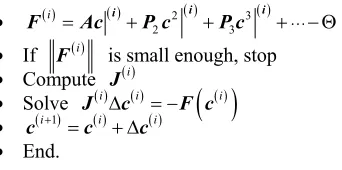
Algorithm.
Initia iz : l e 0
For c c 1, 2,Λ 0, i
2 3
2 3
i
Λ
i i
i
F Ac P c P c
If i
F is small enough, stop
Compute i
J
Solve i i
iJ c F c
i i i
1
c c c
End.
4. Numerical Examples
The closed form solution to this problem in terms of the Jacobian elliptic function has been given [3] as
2 1
0 1
2Sc 1 0
sinh
2 4
u
u x x u
(23)
where u
0 , the derivative of at 0, is given by the expressionu
0 2 1u m , with being the solu- tion of the transcendental equation
m
sinh
2 Sc
1 m m
where the Jacobian elliptic function Sc
m
[2,31] is defined by Sc
sincos
m
where and are re- lated by the integral
2 0
1 d
1 msin
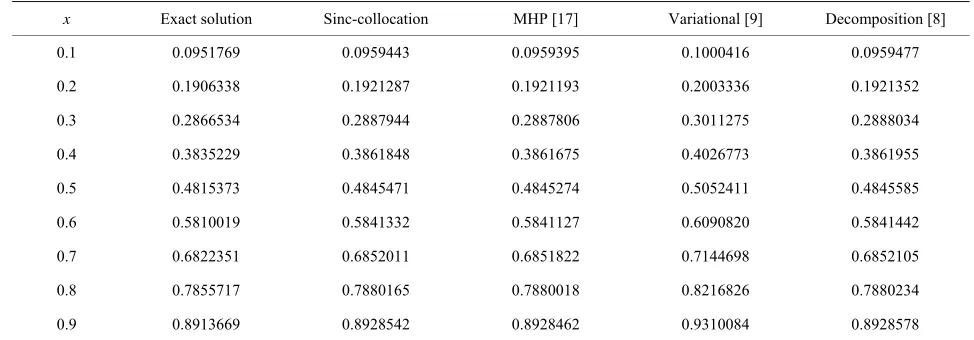
In Tables 1 and 2 the numerical solution obtained by sinc-collocation method is compared with the exact solu-tion derived from Equasolu-tion (23) and with the numerical solution obtained by the modified homotopy perturbation technique (MHP) [17], variation method [9] and decom-position method [8] for the case 0.5 and 1.0 respectively .
In Table 3, the numerical solution obtained by the sinc-collocation method for 5 is compared with the numerical approximation of the exact solutions given by a Fortran code called TWPBVP and the numerical solu-tion obtained by B-spline collocasolu-tion method [19].
5. Discussions
There are two main goals that we aimed for this work. The first is to employ the powerful sinc-collocation method to investigate nonlinear ordinary differential equations. The second is to show the power of this me- thod and its significant features. The two goals are achieved.
[image:4.595.310.481.86.171.2]Table 1. Numerical solutions of Troesch’s problem for the case μ = 0.5.
x Exact solution Sinc-collocation MHP [17] Variational [9] Decomposition [8]
0.1 0.0951769 0.0959443 0.0959395 0.1000416 0.0959477
0.2 0.1906338 0.1921287 0.1921193 0.2003336 0.1921352
0.3 0.2866534 0.2887944 0.2887806 0.3011275 0.2888034
0.4 0.3835229 0.3861848 0.3861675 0.4026773 0.3861955
0.5 0.4815373 0.4845471 0.4845274 0.5052411 0.4845585
0.6 0.5810019 0.5841332 0.5841127 0.6090820 0.5841442
0.7 0.6822351 0.6852011 0.6851822 0.7144698 0.6852105
0.8 0.7855717 0.7880165 0.7880018 0.8216826 0.7880234
[image:5.595.52.539.102.272.2]0.9 0.8913669 0.8928542 0.8928462 0.9310084 0.8928578
Table 2. Numerical solutions of Troesch’s problem for the case μ = 1.
x Exact solution Sinc-collocation MHP [17] Variational [9] Decomposition [8]
0.1 0.08179699 0.08466125 0.08438170 0.10016683 0.08492528
0.2 0.16453087 0.17017135 0.16962076 0.20133869 0.17067908
0.3 0.24916736 0.25739390 0.25659292 0.30454102 0.25810502
0.4 0.33673220 0.3472228 0.34621073 0.41084132 0.34807811
0.5 0.42834716 0.44059983 0.43944227 0.52137347 0.44152329
0.6 0.52527402 0.53853439 0.53733006 0.63736635 0.53943772
0.7 0.62897114 0.64212860 0.64101046 0.76017896 0.64291809
0.8 0.74116837 0.75260809 0.75173354 0.89134491 0.75319489
[image:5.595.55.538.301.471.2]0.9 0.86397002 0.87136251 0.87088353 1.03263022 0.87167571
Table 3. Numerical solutions of Troesch’s problem for the case μ = 5.
x Fortran code [19] B-spline [19] Sinc-collocation
0.0 0.000 0.000 0.000
0.2 0.01075342 0.01002027 0.00762552
0.4 0.03320051 0.03099793 0.03817903
0.8 0.25821664 0.24170496 0.23252435
0.9 0.45506034 0.42461830 0.44624551
1.0 1.0000 1.000 1.000
of the collocation procedure is its ease in application. The collocation method easily generalizes to problems having general boundary conditions.
REFERENCES
[1] M. Abramowitz and I. Stegun, “Handbook of Mathe- matical Functions,” Dover, New York, 1972.
[2] A. Erdelyi, W. Magnus, F. Oberhettinger and F. Tricomi, “Higher Transcendental Functions,” Vol. 2, McGraw-Hill, New York, 1953.
[3] S. Roberts and J. Shipman, “On the Closed form Solution of Troesch’s Problem,” Journal of Computational Physics,
Vol. 21, No. 3, 1976, pp. 291-304. doi:10.1016/0021-9991(76)90026-7
[4] E. Weibel, “On the Confinement of a Plasma by Magne- tostatic Fields,” Physics of Fluids, Vol. 2, No. 1, 1959, pp.
52-56. doi:10.1063/1.1724391
[5] D. Gidaspow and B. Baker, “A Model for Discharge of Storage Batteries,” Journal of the Electrochemical Soci- ety, Vol. 120, No. 8, 1973, pp. 1005-1010.
doi:10.1149/1.2403617
[6] V. Markin, A. Chernenko, Y. Chizmadehev and Y. Chirkov, “Aspects of the Theory of Gas Porous Elec- trodes,” In: V. S. Bagotskii and Y. B. Vasilev, Eds., Fuel Cells: Their Electrochemical Kinetics, Consultants Bu-
reau, New York, 1966, pp. 21-33.
[8] E. Deeba, S. Khuri and S. Xie, “An Algorithm for Solv- ing Boundary Value Problems,” Journal of Computa- tional Physics, Vol. 159, No. 2, 2000, pp. 125-138. doi:10.1006/jcph.2000.6452
[9] S. Chang, “A Variational Iteration Method for Solving Troesch’s Problem,” Journal of Computational and Ap- plied Mathematics, Vol. 234, No. 10, 2010, pp. 3043-
3047. doi:10.1016/j.cam.2010.04.018
[10] S. A. Khuri, “A Numerical Algorithm for Solving Troesch’s Problem,” International Journal of Computer Mathemat- ics, Vol. 80, No. 4, 2003, pp. 493-498.
doi:10.1080/0020716022000009228
[11] S. Momani, S. Abuasad and Z. Odibat, “Variational Itera- tion Method for Solving Nonlinear Boundary Value Prob- lems,” Applied Mathematics and Computation, Vol. 183,
No. 2, 2006, pp. 1351-1358. doi:10.1016/j.amc.2006.05.138
[12] S. Roberts and J. Shipman, “Solution of Troesch’s Two- Point Boundary Value Problem by a Combination of Techniques,” Journal of Computational Physics, Vol. 10, No. 2, 1972, pp. 232-241.
doi:10.1016/0021-9991(72)90063-0
[13] A. Miele, A. Agarwal and J. Tietze, “Solution of Two- Point Boundary-Value Problems with Jacobian Matrix Characterized by Large Positive Eigenvalues,” Journal of Computational Physics, Vol. 15, No. 2, 1974, pp. 117-
133. doi:10.1016/0021-9991(74)90080-1
[14] J. Chiou and T. Na, “On the Solution of Troesch’s Non- linear Two-Point Boundary Value Problem Using an Ini- tial Value Method,” Journal of Computational Physics, Vol. 19, No. 3, 1975, pp. 311-316.
doi:10.1016/0021-9991(75)90080-7
[15] M. Scott, “On the Conversion of Boundary-Value Prob- lems into Stable Initial-Value Problems via Several In- variant Imbedding Algorithms,” In: A. K. Aziz, Ed., Nu- merical Solutions of Boundary-Value Problems for Ordi- nary Differential Equations, Academic Press, New York, 1975, pp. 89-146.
[16] J. Snyman, “Continuous and Discontinuous Numerical Solutions to the Troesch Problem,” Journal of Compu- tational and Applied Mathematics, Vol. 5, No. 3, 1979,
pp. 171-175. doi:10.1016/0377-0427(79)90002-5
[17] X. Feng, L. Mei and G. He, “An Efficient Algorithm for Solving Troesch’s Problem,” Applied Mathematics and Computation, Vol. 189, No. 1, 2007, pp. 500-507. doi:10.1016/j.amc.2006.11.161
[18] M. Zarebnia and M. Sajjadian, “The Sinc-Galerkin Me- thod for Solving Troesch’s Problem,” Mathematical and Computer Modelling, Vol. 56, No. 9-10, 2012, pp. 218-
228. doi:10.1016/j.mcm.2011.11.071
[19] S. Khuri and A. Sayfy, “Troesch’s Problem: A B-Spline Collocation Approach,” Mathematical and Computer Mo-
delling, Vol. 54, No. 9-10, 2011, pp. 1907-1918. doi:10.1016/j.mcm.2011.04.030
[20] S. Chang and I. Chang, “A New Algorithm for Calculat- ing One-Dimensional Differential Transform of Non- linear Functions,” Applied Mathematics and Computation,
Vol. 195, No. 2, 2008, pp. 799-808. doi:10.1016/j.amc.2007.05.026
[21] M. El-Gamel and M. Sameeh, “A Chebychev Collocation Method for Solving Troesch’s Problem,” International Journal of Mathematics and Computer Applications Re- search, Vol. 3, No. 2, 2013, pp. 23-32.
[22] B. Bialecki, “Sinc-Collocation Methods for Two-Point Boundary Value Problems,” IMA Journal of Numerial Analysis, Vol. 11, No. 3, 1991, pp. 357-375.
doi:10.1093/imanum/11.3.357
[23] M. Muhammad, A. Nurmuhammada, M. Moria and M. Sugiharab, “Numerical Solution of Integral Equations by Means of the Sinc-Collocation Method Based on the Double Exponential Transformation,” Journal of Compu- tational and Applied Mathematics, Vol. 177, No. 2, 2005, pp. 269-286. doi:10.1016/j.cam.2004.09.019
[24] A. Mohsen and M. El-Gamel, “A Sinc-Collocation Me- thod for the Linear Fredholm Integro-Differential Equa- tions,” Zeitschrift für Angewandte Mathematik und Physik,
Vol. 58, No. 3, 2007, pp. 380-390. doi:10.1007/s00033-006-5124-5
[25] J. Lund and K. Bowers, “Sinc Methods for Quadrature and Differential Equations,” SIAM, Philadelphia, 1992. doi:10.1137/1.9781611971637
[26] F. Stenger, “Numerical Methods Based on Sinc and Analytic Functions,” Springer, New York, 1993. doi:10.1007/978-1-4612-2706-9
[27] A. Mohsen and M. El-Gamel, “On the Galerkin and Collocation Methods for Two-Point Boundary Value Problems Using Sinc Bases,” Computers & Mathematics with Applications,Vol. 56, No. 4, 2008, pp. 930-941. doi:10.1016/j.camwa.2008.01.023
[28] A. Mohsen and M. El-Gamel, “On the Numerical Solu- tion of Linear and Nonlinear Volterra Integral and In- tegro-Differential Equations,” Applied Mathematics and Computation, Vol. 217, No. 7, 2010, pp. 3330-3337. doi:10.1016/j.amc.2010.08.065
[29] M. El-Gamel, “Sinc-Collocation Method for Solving Linear and Nonlinear System of Second-Order Boundary Value Problems,” Applied Mathematics, Vol. 3, No 11,
2012, pp. 1627-1633. doi:10.4236/am.2012.311225 [30] V. Grenander and G. Szego, “Toeplitz Forms and Their
Applications,” 2nd Edition, Chelsea Publishing Co., Orlando, 1985.