doi:10.4236/wet.2011.21005 Published Online January 2011 (http://www.SciRP.org/journal/wet)
An Efficient Method to Reduce the Numerical
Dispersion in the HIE-FDTD Scheme
Juan Chen, Anxue Zhang
School of Electronic and Information Engineering, Xi’an Jiaotong University, Xi’an, China. Email: [email protected]
Received September 2nd, 2010; revised November 2nd, 2010; accepted November 18th, 2010.
ABSTRACT
A parameter optimized approach for reducing the numerical dispersion of the 3-D hybrid implicit-explicit fi-nite-difference time-domain (HIE-FDTD) is presented in this letter. By adding a parameter into the HIE-FDTD formu-las, the error of the numerical phase velocity can be controlled, causing the numerical dispersion to decrease signifi-cantly. The numerical stability and dispersion relation are presented analytically, and numerical experiments are given to substantiate the proposed method.
Keywords: HIE-FDTD, Numerical Dispersion, Weakly Conditionally Stability
1. Introduction
The finite-difference time-domain (FDTD) method [1] has been proven to be an effective means that provides accurate predictions of field behaviors for varieties of electromagnetic interaction problems. However, as it is based on an explicit finite-difference algorithm, the Courant–Friedrich–Levy (CFL) condition [2] must be satisfied when this method is used. Therefore, a maxi-mum time-step size is limited by minimaxi-mum cell size in a computational domain, which makes this method ineffi-ciency for the problems where fine scale dimensions are used.
To relax the Courant limit on the time step size of the FDTD method, a three–dimensional (3-D) hybrid im-plicit-explicit finite-difference time-domain (HIE-FDTD) method has been developed recently [3]. In this method, the CFL condition is not removed totally, but being weaker than that of the conventional FDTD method. The time step in this scheme is only determined by two space
discretizations, which is extremely useful for problems where a very fine mesh is needed in one direction. How-
ever, the numerical dispersion error of the HIE-FDTD scheme is larger than that of the conventional FDTD method.
In this letter, a simple and efficient approach for re-ducing the numerical dispersion of the 3-D HIE-FDTD method is proposed. Numerical results indicate that the numerical dispersion of the method can be notably re-duced when a proper parameter is introre-duced [4]. As a result, the usefulness and effectiveness of the HIE-FDTD method can be significantly enhanced. The numerical dispersion of the new algorithm is studied analytically and validated by a numerical simulation, and the results are compared with both the standard HIE-FDTD method and the conventional FDTD method.
2. Formulations
To reduce the numerical dispersion of the 3-D HIE- FDTD method, parameter N is introduced into the HIE-FDTD discretization. The modified algorithm is described as follows:
1 1
2 , 1, 2 , 1, 1 , 1, 1 , 1,
2 2 2 2 2
1 1 1 1 1
, , , ,
2 2 2 2
n n
n n
y y x x
n n
z z
E i j k E i j k H i j k H i j k
t z
H i j k H i j k
x
1
2
1 1
2 1, , 1 2 1, , 1 1 1, , 1 1, ,
2 2 2 2 2 2
1 1 1
1, , , ,
2 2 n n n n
y y x x
n n
z z
H i j k H i j k E i j k E i j k
t z
E i j k E i j k
x
(2)
1 1
1 2 2
1 1
1 1 1 1 1 1
, , , , , , , ,
2 2 2 2 2
1 1 1 1 1 1 1 1
, , , , , , , ,
2 2 2 2 2 2 2 2
n n
n n
x x y y
n n n n
z z z z
E i j k E i j k H i j k H i j k
t z
N
1 2
2
H i j k H i j k H i j k H i j k
y
(3) 1 1
1 2 2
1 1
1 1 1 1 1 1
, , , , , , , ,
2 2 2 2 2 2
1 1 1 1 1 1 1 1
, , , , , , , ,
2 2 2 2 2 2 2 2
n n
n n
z z y y
n n n n
x x x x
E i j k E i j k H i j k H i j k
t x
N
H i j k H i j k H i j k H i j k
y 1 2 (4) 1 1
1 2 2
1 1
1 1 1 1 1 1 1
, , , , 1, , , ,
2 2 2 2 2 2
1 1 1 1
, 1, , , , 1, , ,
2 2 2 2 2
n n
n n
z z y y
n n n n
x x x x
H i j k H i j k E i j k E i j k
t x
N
E i j k E i j k E i j k E i j k
y (5) 1 1
1 2 2
1 1
1 1 1 1 1 1 1
, , , , , , 1 , ,
2 2 2 2 2 2
1 1 1
, 1, , , , 1, , ,
2 2 2 2
n n
n n
x x y y
n n n n
z z z z
1 2
H i j k H i j k E i j k E i j k
t z
N
E i j k E i j k E i j k E i j k
y
(6)
n and t are the index and size of time-step, x, y and z are the spatial increments respectively in x,
and directions, i, , and denote the indices of spatial increments respectively in
y z j k
x, , and direc-tions,
y z
and are the permittivity and permeability of the surrounding media, respectively. When the value of parameter N is equal to 1, Equations (1)-(6) is the
formulations of standard HIE-FDTD method [3].
Obviously, updating of Excomponent, as shown in Equation (3), needs the unknown Hz component at the same time, thus the Excomponent has to be updated implicitly. Substituting Equation (5) into Equation (3), the equation forExfield is given as:
2 2
1 1 1
2 2
1 2
2
2 2
1 1 1
1 ( , , ) , 1, , 1,
2 2 2
2 4
1 1 1 1 1
, , , , , ,
2 2 2 2 2
1 1, , 2 2
n n n
x x x
n n n
x z z
n y
t t
E i j k E i j k E i j k
y y
tN
E i j k H i j k H i j k
y
t
E i j k
x y
N N
N 1 1 1
2 2 2
2 2 2 1 1 2 2 1 1
, , 1, , , ,
2 2
1 1 1
, 1, 2 , , , 1,
2 2 2
4
1 1 1 1
, , , ,
2 2 2 2
n n n
y y y
n n n
x x x
n n
y y
E i j k E i j k E i j k
t
E i j k E i j k E i j k
y N
t
H i j k H i j k
z 1 2
Similarly, updating of Ezcomponent needs the un-known Hx component at the same time-step.
Substitut-ing Equation (6) into Equation (4), we obtain the discrete equation forEzfield,
2 2
1 1 1
2 2 1 2 2 2 2 1 1
1 ( , , ) , 1, , 1,
2 2
2 4
1 1 1 1 1
, , , , , ,
2 2 2 2 2
1
, , 1
2 2
n n n
z z z
n n n
z x x
n y
t t
E i j k E i j k E i j k
y y
tN
E i j k H i j k H i j k
y
t
E i j k
z y
N N
N
1 2
1 1 1
2 2 2
2 2 1 1 2 2 2 1 1
, , , , 1 , ,
2 2
1 1 1
, 1, 2 , , , 1,
2 2 2
4
1 1 1 1
, , , ,
2 2 2 2
n n n
y y y
n n n
z z z
n n
y y
E i j k E i j k E i j k
t
E i j k E i j k E i j k
y
t
H i j k H i j k
x N 1 2
(8)
Therefore, the field components are updated by using Equations (1), (2), and (5)-(8). Components Ey and
y
H are explicitly updated first by using Equations (1)
and (2). Then, ExandEzcomponents are updated im-plicitly by solving the tridiagonal matrix equations by using Equations (7) and (8). After ExandEzare
ob-tained, components HzandHx are explicitly updated straightforward by using Equations (5) and (6).
3. Weakly Conditionally Stability
The relations between field components of Equations (1)- (6) can be represented in a matrix form as:
1 1 1 2 1 1 1 20 0 0
2 , ,
, ,
0 0 0
2
, ,
0 0 0 0 0
, ,
0 0 0
2 , ,
0 0 0
, , 2
0 0 0 0 0
z y n
x n z x y n y n x
y z n
z
n
y x
y N
a D D
E x y z
N E x y z
a D D
H x y z
b
H x y z
N
D b D
H x y z
N
D b D
E x y z
a
1 2 1 20 0 0 0
2 , ,
, ,
0 0 0 0
2
0 0 0 , ,
, ,
0 0 0 0
2 , ,
0 0 0 0
, , 2
0 0 0
y n x n z y n
z x y
n x y n z n y y z x N a D
E x y z
N E x y z
a D
D D b H x y z
N H x y z
D b
H x y z N
D b
E x y z
D D a
where
a t ,
b t ,
w D
w( )
repre-sents the first derivative operator with respect to . , ,
w x y z
w With no loss of generality, the field components can be written as follows:
, ,
, ,n n
p x y z p f x y z
(10)
, ,
exp( x y z )f x y z jk x jk y jk z (11)
whereE H, , px y z, , , j 1.kx ky kz are wave numbers. indicates growth factor. p are the amplitude of the field components, respectively.
In a discrete space, f x y z
, ,
can be denoted as:
, ,
exp( x y z )f m x l y p z jk m x jk l y jk p z
(12) Then:
1 1
, , , ,
2 2
, ,
x x
f m x l y p z f m x l y p z
D f f m x l y p z
x
(13)
1 1
, , , ,
2 2
, ,
y y
f m x l y p z f m x l y p z
D f f m x l y p z
y
(14)
1 1
, , , ,
2 2
, ,
z z
f m x l y p z f m x l y p z
D f f m x l y p z
z (15)
where,
sin 2
2
x
x
k x j
x ,
sin 2
2
y
y
k y j
y ,
sin 2
2
z
z
k z j
z
Substituting these represents into Equation (9), the matrix becomes:
1 2
1 2
0 0 1 0
2
0 1 0 0
2
0 0 0
0
0 1 0 0
2
1 0 0 0
2
0 0 0
z y n
Ex n Ez
x y
n
z x Hy
n Hx
y z n
Hz
n
y x
Ey
z x
N
a a
f
N f
a a
b b f
N f
b b
f N
b b
f
a a
(16)
For a nontrivial solution of (16), the determinant of the coefficient matrix in (16) should be zero. It can be ob-tained:
2
2
2 22 2 2 2
1 1 1 4 4
N ry rz rx
0(17) where:
2 2
2sin 2
x x
r c t k x x ,
2sin2
2
2
y y
r c t k y y ,
2 2
2sin 2
z z
r c t k z z , c1
is the speed of light in the medium.
By solving Equation (17), the growth factor is ob-tained
12 1
2
22 2
34 56 2
1 2 2 1 2 2 1
1
y x z y x z y
y
N r r r N r r r N r
N r
2
(19)
To satisfy the stability condition during field ad-vancement, the module of growth factor can’t be lar-ger than 1. It is evident that the module of 12 is unity.
For the values of 34 and 56 , when the condition
1
x z
r r is satisfied, 34 56 1 can be obtained.
The limitation for time-step size can be calculated as follows:
2 2
2 2
22 2 2
2
sin 2 sin 2
1
x z
c t k x c t k z c t c t
x z x z2
2
1 1 1
t c x z 2 (20)
This scheme is weakly conditionally stable. The time step is only determined by two space discretizations. The parameter N doesn’t affect the weakly conditionally sta-bility of the HIE-FDTD method.
4. Numerical Dispersion Analysis
We now study the numerical dispersion in the modified HIE-FDTD algorithm. Substitute ejtinto Equation (16), it can be obtained:
2 2 2
2 2
2
sin sin
sin sin
2 2
2 2
cos 2
y x
z k x k y
k z t
t N
c t z x y
(21)
For comparison, we take a look at the numerical dis- persion relation of the standard HIE-FDTD method.
2 2 2
2 2
sin sin
sin sin
2 2
2 2
cos 2
y x
z k x k y
k z t
t
c t z x y
(22)
Compared to the dispersion Equation (22) of the stan-dard HIE-FDTD method, it can be obtained that there is a factor added to the last term in the right-hand side of the numerical dispersion relations of Equation (21). When a proper value of parameter N is selected, the nu-merical dispersion of the HIE-FDTD method can be con-trolled, causing the numerical dispersion to decrease sig-nificantly, which is validated in next section.
2
N
5. Numerical Validation
Suppose that a wave propagating at angle and is in the spherical coordinate system. Then, kx ksin
cos ,
sin sin
y
k k , and kz kcos
. By substitut-ing them into dispersion relations (21), numerical phase velocity vp k of modified HIE-FDTD method can be solved numerically. To make the discussion simple and
easy, only the uniform cell
x y z
is consid-ered here. y is set to be/ 20, with the operating frequency.On the kxkzplane
0,ky ksin
sin 0
. It can be easily seen that the numerical dispersion of modified HIE-FDTD method is the same as that of stan-dard HIE-FDTD method. So we only consider the dis-persion performance comparison between the modified HIE-FDTD and standard HIE-FDTD method on other planes.0 20 40 60 80 0.996
0.997 0.998 0.999 1 1.001
Theta(degree)
N
or
m
al
iz
ed phas
e v
el
oc
it
y
[image:6.595.64.283.87.257.2]HIE-FDTD N=0.998 HIE-FDTD N=1.000 HIE-FDTD N=1.002 HIE-FDTD N=1.004 HIE-FDTD N=1.006 FDTD
Figure 1. When CFLN = 1, the normalized phase velocities with respect to angle for different parameter N (45°).
0 20 40 60 80
0.996 0.9965 0.997 0.9975 0.998 0.9985 0.999 0.9995 1 1.0005
Theta(degree)
N
or
m
al
iz
ed phas
e
v
el
oc
it
y
HIE-FDTD N=0.998 HIE-FDTD N=1.000 HIE-FDTD N=1.002 HIE-FDTD N=1.004 HIE-FDTD N=1.006 FDTD
Figure 2. When CFLN = 1.2, the normalized phase velocities with respect to angle for different parameter N (45°).
0 20 40 60 80
0.991 0.992 0.993 0.994 0.995 0.996 0.997 0.998 0.999 1
Theta(degree)
N
o
rm
al
iz
ed
p
has
e
v
e
loc
it
y
[image:6.595.310.534.87.257.2]HIE-FDTD N=0.998 HIE-FDTD N=1.000 HIE-FDTD N=1.002 HIE-FDTD N=1.004 HIE-FDTD N=1.006 FDTD
Figure 3. When CFLN = 1, the normalized phase velocities with respect to angle for different parameter N (90°).
0 20 40 60 80
0.99 0.992 0.994 0.996 0.998 1
Theta(degree)
N
orm
al
iz
ed
p
has
e
v
el
oc
it
y
[image:6.595.61.285.304.471.2]HIE-FDTD N=0.998 HIE-FDTD N=1.000 HIE-FDTD N=1.002 HIE-FDTD N=1.004 HIE-FDTD N=1.006 FDTD
Figure 4. When CFLN = 1.2, the normalized phase velocities with respect to angle for different parameter N (90°).
HIE-FDTD method. For comparison, the normalized phase velocity of conventional FDTD method is also plotted in these figures.
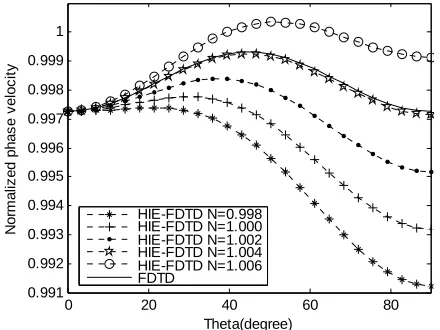
It can be seen from these figures that the numerical dispersion error of the standard HIE-FDTD (N=1.000) scheme is larger than that of the conventional FDTD method, especially when is close to 90°. When CFLN = 1.2, the dispersion error along the y axis ( 90°, = 90°) of standard HIE-FDTD method is almost 4 times as that of conventional FDTD method.
For the modified HIE-FDTD method, the dispersion error is reduced as the value of parameter N increase. Under the CFLN = 1, with N = 1.004, the normalized phase velocities of the modified HIE-FDTD is almost the same as that of the conventional FDTD method for both
45° and 90° planes. Apparently, the dispersion performance of HIE-FDTD method can be controlled by selecting parameter N.
However, when the value of N exceeds the value 1.004, the normalized phase velocities will exceed 1, which is not the performance we expect. So, select a proper value for parameter N is the key factor for reducing the disper-sion error of HIE-FDTD method. It can be easily decided by Equation (22) numerically.
6. Conclusions
[image:6.595.64.284.516.681.2]7. Acknowledgements
This work was supported by National Natural Science Foundations of China (No. 61001039 and 60501004), and also supported by the Research Fund for the Doctoral Program of Higher Education of China (20090201120030).
REFERENCES
[1] K. S. Yee, “Numerical Solution of Initial Boundary Value Problems Involving Maxwell’s Equations in Isotropic Media,” IEEE Transactions on Antennas and Propaga-tions, Vol. 14, No. 5, May 1966, pp. 302-307.
[2] A. Taflove, “Computational Electrodynamics,” Artech House, Norwood, 1995.
[3] J. Chen and J. Wang, “A 3-D Hybrid Implicit-Explicit FDTD Scheme with Weakly Conditional Stability,” Mi-crowave and Optical Technology Letters, Vol. 48, No. 3, March 2006, pp. 2291-2294. doi:10.1002/mop.21898 [4] M. Wang, Z. Wang and J. Chen, “A Parameter Optimized