Selection of Weighting Factors in Weighted
Clustering Algorithm in MANET
Khagendra Prasai, Subodh Ghimire
Abstract—There are different clustering algorithms in MANET for selection of clusterhead in a network. The se-lection of clusterhead has many advantages like increases the efficiency and stability of the network, larger life time, low energy consumption, aggregation of topology information, lower communication bandwidth, spatial reuse, routing efficiency and etc. The concept of clustering is implemented in different networks due to its growing advantage, but the method of formation of a cluster in MANET, showing the orientation of node movement and then selecting the clusterhead is field of interest. Weight based Clustering Algorithm (WCA) for the selection of clusterhead considers combined weight metric. The co-efficient used in weight calculations are w1, w2, w3 and w4, the sum of these co-efficient is 1. They are actually used to normalize the factors like node degree, transmission power, mobility and battery power. Any of these factors in a weight metric can be used for the election procedure of clusterhead. The co-efficient used in weight calculations are assumed as such that, the factor which has higher importance is given higher coefficient value. The weights related to metric has no predefined values initially, that means it lacks knowing the weights of all the nodes before clustering phenomenon occurs for the selection of clusterhead. Thus, primarily before starting clustering phenomenon for the selection of clusterhead, the selection of weights for all the nodes participating in a network is done by tuning the effect of weights in terms of throughput and end to end delay with variation of mobility. The combination of weights which gives the optimum value of throughput and end to end delay at ranges of mobility are selected and used for the selection of clusterhead.
Index Terms—Ad-hoc, clusterhead, metric, weights.
I. INTRODUCTION
A
d-hoc network states to network which has no cen-tralized administration and is easily deployable. The easily deployable nature is due to the fact as it attributes the property of self organization of nodes which performs the control over the network acting as a router itself. It works in a standalone fashion. Mobile Ad-hoc Network (MANET) consists of mobile nodes which can move freely and can communicate to other nodes by direct link or through intermediate nodes. Performance suffers as the number of nodes increases and the network becomes difficult to manage. Ad-hoc network can be characterized as, decentralized, Self configurable, Self deployed, Dynamic network topology.Wireless communication between the mobile users is be-coming more popular and famous these days. This is due to the recent technological advancement in laptops, computers and wireless data communication devices, such as wireless modems and wireless LANs. This leads to a high data rate
Manuscript received July 21, 2016;
Khagendra Prasai is with the Department of Electronics and Communi-cation Engineering, Kathmandu Engineering College, Kalimati, Kathmandu e-mail: ([email protected]).
Subodh Ghimire is with Department of Electrical and Electron-ics Engineering, Kathmandu University, Dhulikhel, Kabhre e-mail: ([email protected])
considering the optimal cost, which is the main reason of the growth of mobile computing devices.
There are different approaches for the communication process between the two hosts. The first approach is to send voice and data through existing cellular infrastructure. The major problem behind this is the occurrence of hand off. Another problem is the limitation of cellular infrastructure because of geographical variations. The second approach is to form an Ad-hoc network between all the users with a desire to communicate with each other. This means that the users in Ad-hoc network willing to participate in packet transmission must be assured of the transmission of the packet from source to destination. This form of network has limitations in transmission ranges of nodes and is typically small as compared to cellular network, which however does not guarantee the superiority of cellular approach over Ad-hoc network.
Ad-hoc network does not rely on any pre-established infrastructure so it can be deployed at any places at any instant of time. It is useful in disaster recovery where no communications exists. There are routing protocols which routes the packets from a defined source to a destination. As the network grows there subsists an overhead in packet transmission due to flooding. Thus, the network may be saturated due to a large number of packets in a queue to complete the route that makes the network flat. A better approach to these kinds of problem is to cluster the nodes in a suitable manner and make use appropriate routing algorithms. Clustering model increases the efficiency of the network with larger life time, low energy consumption, and averts the unnecessary use of network bandwidth.
A. Clustering in Ad-hoc network
With the recent growth in Ad-hoc network the use of different personal computing devices like mobile, laptops, touch pads etc. has been increasing and gaining popularity. The wireless Ad-hoc network has gained worldwide attention for the past few decades. A ubiquitous computing society is slowly being developed with a strong desire to stay connected with the outer world even on fly [1].
Clustering is the management of dynamic mobile nodes into various groups in a specified geographical region gov-erned by some set of rules and protocols. Increasing the networks capacity and reducing the overhead of routing using the clustering bring effectiveness in scalability with respect to the number of nodes and mobility.
The objective of clustering is to maintain a connected cluster. Nodes play different roles in clustering techniques. There are three types of nodes. They are defined as
follows:-1) Ordinary Nodes/ Cluster Member
• These are members of a cluster who do not have any neighboring mobile node that belong to a different cluster.
2) Clusterhead
• These are elected from the ordinary nodes which form the network backbone and also act as local coordinators to perform power control and rout-ing functions [3]. Although they don’t possess any special hardware, they represent dynamic and mobile behavior. Clusterhead exhibit some special features in comparison to other ordinary nodes. Nodes with higher degree of relative stability and greater power backup are elected as clusterheads. The primary task of clusterhead is to discover the routes for distant messages and forward inter cluster packets. Firstly, a packet originating from an ordinary node, is directed to its clusterhead. If the destination is in the same cluster, it is forwarded to the destination node. If it is in a different cluster, the clusterhead of the source node route the packet within the network to the clusterhead of the destination node [4].
3) Cluster Gateways
• These are ordinary nodes in a non-clustered state always located at the periphery of a cluster. Such types of nodes listen to transmissions from other nodes in different clusters. They act as routing de-vices because they help in transporting the packet from one cluster to another.
B. Goals of Clustering
Clustering algorithms are necessary and crucial for the design of the network. If the network has to be realized in a global structure with high mobility of nodes. The mobile nodes have to communicate with each other effectively, efficiently, and reliably without loss of connectivity, data or huge amounts of energy. Thus the design goals in MANET have to be considered.
1) Load Balancing
• As the clusterhead is the node which has the
responsibility of managing the routes, updating routing tables, intra routing, giving the node ID within the cluster, discover new routes and etc. The clusterhead has a tendency to keep the number of nodes in a balanced manner within the cluster so that the expected performance goals should not be compromised. Load balancing in MANET is the establishment of equally sized clusters offers energy savings and prolongs the network lifetime
rather than employing a subset of high rate clus-terheads that could expire too early. Even node distribution can also influence data delay [14]. 2) Clustering Formation
• The clustering concept offers amazing potential for MANET but their formation needs careful consideration as the variety of applications using clustering may require different priorities in the node arrangements, their size and ideal parameters for the style of configuration [15].
3) Real Time Operation
• The life time of the data is one of the
consid-erations to be made, it may be relevant to one application and possibly not to another. If we consider the practical applications like in mili-tary tracking and emergency applications the real time data are received [16]. Thus, while tailoring such applications different constrains of clustering scheme like delay, recovery time and packet losses etc, should be taken under considerations. 4) Maximizing Network Life time
• As clustering scheme is carried on with the
selec-tion of clusterhead, it is the integral part for com-munication taking place between the networks, also it plays a role for data aggregation thus clusterhead is resource rich as compared to other cluster member [17]. Hence, it becomes essential to reduce the energy consumption by making the cluster member near to the clusterhead or by using the load balancing technique as discussed earlier, which maximizes the life of the network.
5) Maintenance Mechanism
• There are several situations that might provoke
link failure in MANET, the physical mobility and nomadic nature of some devices, node death and interference. Clustering schemes need to have link recovery mechanism.
6) Quality of Service
• There has to be an overview of quality of service to determine the efficacy of MANET requirements regarding communication overhead. The mobility of node causes topology change (link /cluster additions or deletions) which may spread up to any level.
C. Weighted Clustering Algorithm (WCA)
According to [5], WCA considers a new approach of selection of clusterheads considering the combined weight metric. This approach takes several system parameters like node degree, transmission power, mobility and battery power. Depending on the system requirements and applications, any of these parameters in this metric can be used to elect clusterhead. Clusterhead election procedure, the procedure consists of the following steps:
• step 1.Find the neighbors of each node υ (i.e., nodes within its transmission range) which define its degree, dv, as
dv=|N(v)|=
X
v0∈V,v06=v
• Step 2. Compute thedegree-difference,∆v = dv -δv, for every node v.
• Step 3. For every node, compute the sum of the
distances,Dv, with all its neighbors, as
Dv =
X
v0∈N(v)
dist(v, v0) (2)
• Step 4. Compute the running average of the speed for every node till current time T . This gives a measure of mobility and is denoted by Mv, as
Mv =
1
T T
X
t=1
p
(Xt−Xt−1)2+ (Yt−Yt−1)2 (3)
where (Xt ,Yt) and (Xt−1 ,Yt−1) are the coordinates of the node v at time t andt−1, respectively.
• Step 5.Compute the cumulative time,Pv, during which a node v acts as a clusterhead. Pv implies how much battery power has been consumed which is assumed more for a clusterhead than an ordinary node.
• Step 6. Calculate the combined weight Wv for each node v, where
Wv=w1∗∆v+w2∗Dv+w3∗Mv+w4∗Pv (4)
where w1,w2,w3 and w4 are the weighing factors for the corresponding system parameters.
• Step 7. Choose that node with the smallest Wv as the clusterhead. All the neighbors of the chosen clusterhead are no longer allowed to participate in the election procedure.
• Step 8.Repeat steps 2 to 7 for the remaining nodes not yet selected as a clusterhead or assigned to a cluster.
Selects a clusterhead according to the number of nodes it can handle, mobility, transmission power and battery power [5].
Wv=w1∗∆v+w2∗Dv+w3∗Mv+w4∗Pv (5)
The node with the minimum weight is selected as a cluster-head. The weighting factors are chosen so that
w1+w2+w3+w4= 1 (6)
D. Lowest ID Cluster Algorithm
In this algorithm the node with the lowest identification is selected as the clusterhead [7]. The neighbour will have a higher identification as compared to the identification of clusterhead. A gateway node is the one which lies in between the range of two or more clusterheads. Hence, node with lower identification has high probability of becoming a clus-terhead. Each node is assigned a distinctid. Periodically, the node broadcasts the list of nodes that it can hear (including itself ). The Lowest ID scheme concerns only with the lowest node ids which are arbitrarily assigned numbers without considering any other qualifications of a node for election as a clusterhead. Since the node ids do not change with time, those with smalleridsare more likely to become clusterheads than nodes with larger ids. Thus, drawback of lowest ID algorithm is that certain nodes are prone to power drainage due to serving as clusterheads for longer periods of time.
E. Modified Weighted Clustering Algorithm (MWCA)
The Modified weighted clustering algorithm involves Weighted Clustering Algorithm (WCA) for cluster formation and Mobility Prediction for cluster maintenance. Referencing to [6], clustering is an effective technique for node man-agement in a MANET. Cluster formation involves election of a mobile node as clusterhead and it controls the other nodes in the newly formed cluster. The connections between nodes and the cluster head changes rapidly in a mobile Ad-hoc network. Thus cluster maintenance is also essential. Prediction of mobility based cluster maintenance involves the process of finding out the next position that a mobile node might take based on the previous locations it visited.
The following assumptions are made before clustering
1) The network topology is static during the execution of the clustering algorithm.
2) Each mobile node joins exactly one clusterhead. 3) The optimal number of nodes in the cluster is assumed
to be 8.
4) The co-efficient used in Weight calculations are as-sumed the following values,w1=0.7,w2=0.2,w3=0.05, w4=0.05. The sum of these co-efficient is 1. This is actually used to normalize the factors such as spreading degree, distance with its neighbors, mobility of the node, and power consumed used in the calculation of weight of a node. The factors spreading degree and distance with its neighbors are given more importance and assumed higher co-efficient values 0.7 and 0.2 respectively.
Formation of Cluster
Initially, each node broadcasts a beacon message to notify its presence to the neighbors. A beacon message contains the state of the node. Each node builds its neighbor list based on the beacon messages received. The clusterheads Election is based on the weight values [8], [9] of the nodes and the node having the lowest weight is chosen as clusterhead [10]. Each node computes its weight value based on the following algorithm:
• Step 1: The coefficients used in weight calculation are assumed the following values w1=0.7, w2=0.2, w3=0.05, w4=0.05.
• Step 2: Compute the difference between the optimal
cluster’s sizeαand the real number of neighbors R(V) as spreading degree,
∆sp= 1−(| −R(V)|/α) (7)
• Step 3: For every node the sum of the distances,Dv, with all its neighbors is calculated.
Dv=Xdist(v, v0) (8)
where v’∈N(v).
• Step 4: Calculate the average speed for every node
until the current time T. This gives the measure of the mobilityMv [11], [12] based on the X co-ordinate and Y co-ordinate i.e., position of the node v at all previous time instance t.
Because Cluster-Head has taken care of all the members of the cluster by continuously sending the signal.
• Step 6: The weight Wv for each node is calculated based on
W v= (w1∗∆sp)+(w2∗Dv)+(w3∗M v)+(w4∗P v)
(9) Where∆spis the spreading degree,Dv is the distance with its neighbors,Mv is the mobility of the node, and power consumed is represented by, Pv.
• Step 7: The node with the smallestWv is elected as a clusterhead. All the neighbors of the chosen clusterhead are no more allowed to participate in the election procedure.
• Step 8: All the above steps are repeated for remaining
nodes which is not yet elected as a clusterhead or assigned to a cluster.
II. PROPOSEDMETHOD
A. Selection of Weights
Referencing [6] the weighting factors actually used to normalize the factors such as spreading degree, distance with the neighbors, mobility of the nodes and power consumption by the individual nodes. The combination of individual factors can be appropriately chosen by tuning the weighting factors. The individual weights for individual nodes are given at an interval of 0.05 which varies from 0 to 1 for individual nodes, this is because the weighting factors summation is always equal to 1. The weights incorporated by these nodes should be initially determined rather than substitution according to the requirement of scenario. It has a drawback of not knowing the weights of all the nodes before starting clustering process and draining clusterheads rapidly. Different weights can be tuned at mobility with measurement of throughput and end to end delay and the effect of weighting factors is analyzed. Finally substitute the best suitable weights for selection of clusterhead.
B. Selection Steps
1) Step 1
• Initialize the weightsw1,w2,w3,w4which varies from 0 to 1 at interval of 0.05 for each node. set init - 0.05
set incr 0.05
for set mp 0 $mp<nn incr mp set w($mp) [expr $init + $incr] set incr [expr $incr + 0.05]
2) Step 2
• Calculate the weight of each node such that it’s
summation equals to 1.
This four depth loops runs and finds all possible combinations ofw1,w2,w3,w4 with sum = 1
if {w( w1i) + w( w2i) + w( w3i) + w( w4i) == 1}
Condition begins Compute the degree
Compute the degree difference Compute the sum of distances
Compute mobilityMv
Compute Time for which node remains clusterheadPv
Calculate Combined weightWv 3) Step 3
• Minimum weight?
– Yes, Clusterhead selected, selecting the mini-mum value ofWv
– No, Repeat all to select the Clusterhead with minimum value ofWv
4) Step 4
• Find the minimum weights of each node.
– Tune/iterate the values of weights 1 to N times – Determine best suitable weights by tuning in terms performance parameters i.e., throughput and end to end delay
5) Step 5
• Weight selected?
– Yes, Apply selected weights to compare different clustering algorithm
– No, Go to step 1
C. Simulation Scenario
The simulator to simulate the network model is NS-2 (Version 2.34). The channel type is wireless channel with MAC type 802.11 g.The network interface type also being wireless and the interface queue of network packets is Queue/Droptail. Two-ray-ground model is used for radio propagation, as it considers both indoor and outdoor prop-agation. Each wireless node is considered to have Omni directional antenna. For the simulation scenario, 400*400m2 area is taken into account. 50 to 100 nodes were considered for simulation as it optimizes the result considering the area chosen. The transmission agent being UDP with simulation time ranging from 0-150 s, the mobility model is random. Speed of each mobile node varies as 5, 10, 15, 20 m/s re-spectively for a CBR packet size of 512 bytes and maximum packets delivered is 10,000 packets in order to achieve the specific throughput of a model at an interval of 0.025 s with rate of 256 Kbps. The coverage radius is 250 m. Routing of packets from source to destination is used using source initiated AODV routing protocol. The operating frequency is 2.4 GHz for 802.11 g and channel bandwidth is 1 Mbps. The TX-RX antenna height is 1.5 m. The system loss is 0 dB, the transmitter and the receiver antenna gain is 0 dB. The parameters are assumed in such a way that they account to the scenario where a node moving at a speed of (0-5) m/s corresponds to a pedestrian walk, node moving at a speed of (15-20) m/s represents a vehicle moving in a highway. The measurement of throughput and end to end delay is considered in both the cases. The table shows the simulation parameters with its assumed value in the simulation.
III. SIMULATIONRESULTS
A. Variation of Weighting Factors on Throughput at different Mobility
TABLE I
SIMULATIONPARAMETERS
Parameter Value
Area 400*400m2
Mobile Nodes 50, 100 Simulation Time 0-150 s CBR, Packet size 512 Bytes
Interval, Rate 0.025 s, 256 Kbps Maximum Packets 10,000 Bytes
[image:5.595.62.278.64.355.2]Routing Protocol AODV Tx Power 0 to 1 Watt Coverage Radius 250 m Channel Bandwidth 1 Mbps Antenna Tx-Rx Height 1.5 m
Fig. 1. Effect of weighting factors on throughput at different mobility
Fig. 2. Effect of weighting factors on throughput at different mobility
that throughput is the amount of information carried between the nodes at a specific time; increase in mobility decreases the amount of throughput. Now as moved on from (0 to 5) m/s, the overall effect of throughput is more or less constant for all three different weights. But as moved on from (5 to 10) m/s, the effect of weights w1 = 0.1, w2 = 0.05, w3 = 0.45, w4 = 0.4 and w1 = 0.1, w2 = 0.05, w3 = 0.2, w4 = 0.65 on throughput is same as compared to w1 = 0.25, w2 = 0.05, w3 = 0.15, w4 = 0.55. Similarly, as on increasing the mobility from (10 to 20) m/s, i.e., at higher mobility the throughput with the corresponding weight w1 = 0.1, w2 = 0.05,w3= 0.45,w4= 0.4 is better as compared to remaining weights.
Fig.2, depicts the effect of weighting factors in throughput at different mobility. On increasing the mobility the amount of throughput gets decreased, this is because of the increment of randomness with the increment of the mobility of nodes. Now if the effects of throughput are observed on varying mobility on different weighting factors, and moving on from (0 to 5) m/s, it is seen that the throughput is almost constant
Fig. 3. Effect of weighting factors on end to end delay at different mobility
Fig. 4. Effect of weighting factors on end to end delay at different mobility
for all three different weighting factors, but as the mobility is increased from (5 to 15) m/s, the effect of throughput of weights w1 = 0.1, w2 = 0.05, w3 = 0.45, w4 = 0.4 lies between the remaining two weights, i.e., almost equal tow1 = 0.1,w2 = 0.05,w3 = 0.15,w4 = 0.7. Similarly, at higher mobility it is seen that the effectw1 = 0.1,w2 = 0.05,w3 = 0.45,w4 = 0.4 is comparatively better as compared to other weights.
B. Variation of Weighting Factors on End to End delay at different Mobility
From Fig.3, the effect of delay in mobility at different weighting factors is observed. On increasing the mobility, delay tends to get high. It can be depicted that the effect of delay is minimum with weightsw1 = 0.1,w2 = 0.05,w3 = 0.45,w4= 0.4 as compared to other weights. At a mobility of (0 to 5) m/s, delay is equal to 2 s and for mobility of (5 to 15) m/s, delay is almost constant and equal to 4 s . Similarly, at higher mobility, delay is equal to 6 s. Hence, at lower and upper values of mobility, delay is minimum compared to delays with weightsw1 = 0.25,w2 = 0.05,w3 = 0.15,w4 = 0.55 andw1= 0.1,w2 = 0.05,w3 = 0.2,w4 = 0.65.
[image:5.595.315.539.201.320.2] [image:5.595.61.280.384.505.2]Fig. 5. Throughput Vs mobility at data rate of 20 Kbps
Fig. 6. Connectivity for scalability with transmission range of 200 m
C. Throughput vs Mobility for 10 m/s
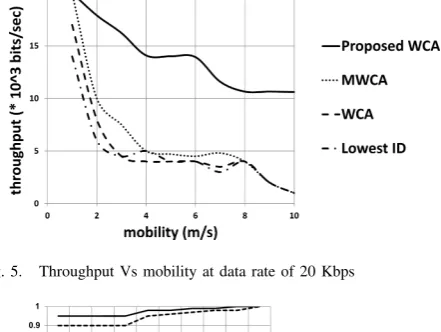
Fig.5, shows variation in throughput and maximum mo-bility of nodes are inversely related. Throughput is the amount of useful information transmitted between the nodes at specific time intervals. Basically, the throughput decreases when the mobility with which the node travels increases. In comparison with different clustering algorithms with data rate of 20 Kbps at mobility of (1-10) m/s, MWCA (Modified Weighted Clustering Algorithm), lowest ID, WCA (Weighted Clustering Algorithm) and proposed WCA with weightsw1 = 0.1, w2 = 0.05, w3 = 0.45,w4 = 0.4, the throughput is comparatively better. At a mobility of 1 m/s, MWCA and WCA (proposed) has equal throughput but as moved from 1 m/s to 10 m/s, the amount of throughput is high. Thus, the power utilization of the nodes is comparatively lower in case of proposed WCA.
D. Connectivity in Clusters
Fig.6, above depicts that increase in transmission range from 150 m to 200 m, it ensures better connectivity, i.e., 100% connectivity as compared to WCA (Weighted Cluster-ing Algorithm) and MWCA (Modified Weighted ClusterCluster-ing Algorithm). This is because the increase in transmission range decreases the average number of clusters and clusters become larger in size and more nodes can hear each other.
IV. CONCLUSION
The combined weight metric doesn’t have absolute values of weights according to system requirements. Initially, the values of weights are selected by measuring the throughput and end to end delay of a system at different values of weights varying the mobility. The selected values of weights for our system isw1= 0.1,w2= 0.05,w3= 0.45,w4= 0.4, which gives the optimum value of throughput and end to end
delay at these weights. The selected values of weights are incorporated in different clustering algorithms for determi-nation of clusterhead. In comparison, the output of the paper depicts that, for connectivity of clusters for transmission range of 150 m, MWCA (Modified Weighted Clustering) has 100% connectivity, but as we increase the transmission range from 150 m to 200 m with selected weights, the proposed WCA has better connectivity as compared to MWCA and WCA because connectivity ensures more nodes can hear each other at a given range. Also when comparing throughput at mobility of 10 m/s with data rate of 20 kbps, the proposed WCA has better throughput and the power utilization of each node is low as compared to MWCA and Lowest ID.
V. FUTURESCOPE
These selected values of individual weights can be op-timized using suitable optimization technique. The calcu-lated weights in this paper can be analyzed for differ-ent weighted clustering algorithm like MWCA(Modified Weighted Clustering algorithm), TRBC(Transmission Range based Clustering Algorithm), MPWCA (Mobility Prediction-based Weighted Clustering Algorithm), Lowest ID, Power aware clustering and etc in terms of different performance parameters .The comparative study of different clustering algorithm using these weights is possible. The simulation can be further carried out by considering different network parameters like: node density, area, transmission range and etc, other than considered in this dissertation. As MANET has a dynamic property, so there is always a unique sce-nario if a single parameter of node is changed. Setting up a scenario required by a system representing different simulation parameters can be used for further analysis. The performance of determination of weights has been considered using AODV routing protocol, it can further be analyzed using different routing protocols like: OLSR, OSPF, DSR, DSDV, RIP, etc.
REFERENCES
[1] Hao Wu Dongmei Zhao Minming Ni, Zhangdui Zhong. A new stable clustering scheme for highly mobile ad hoc networks. IEEE communications Society subject matter for publications in the WCNC 2010 proceedings, 2010.
[2] Ayman Bassam Nasoura Ismail Ghazi Shayeb, Abdel Rahman Hamza Hussein. A survey of clustering schemes for mobile ad-hoc network (manet). American Journal of Scientic Research ISSN 1450-223X Issue 20(2011), pp.135-151 Euro Journals Publishing, Inc, 2011. [3] Inoue S. Kakuda Y. Ohta, T. An adaptive multi-hop clustering scheme
for highly mobile ad hoc networks.Proceedings of Sixth Interna-tional Symposium on Autonomous Decentralized Systems(ISADS03). Italy,(pp. 293)., 2003.
[4] A Chen, Y. Liestman. A zonal algorithm for clustering ad-hoc net-works. International Journal of Foundations of Computer Science ; Vol. 14(2), (pp. 305322)., 2003.
[5] S. K. Das M. Chatterjee and D. Turgut. An on-demand weighted clustering algorithm (wca) for ad hoc networks. in proceedings of IEEE Globecom00, 2000.
[6] Kothai Pethaperumal S.Muthuramalingam, R.RajaRam and V.Karthiga Devi. A dynamic clustering algorithm for manets by modifying weighted clustering algorithm with mobility prediction. International Journal of Computer and Electrical Engineering, 2010.W
[7] M. Gerla and J. T. Tsai. Multiuser, mobile, multimedia radio network. Wireless Networks, Oct. 1995.
[8] S.K. Dhurandher and G.V. Singh. Weight-based adaptive clustering in wireless ad hoc networks. IEEE, 2005.
[10] Zhang .G.z. Yang .W.d. A weight-based clustering algorithm for mobile ad hoc network. Third Inter- national Conference on Wireless Communications., 2007.
[11] Basagni .S. (1999). Distributed clustering for ad hoc networks. In-ternational Symposium on Parallel Architectures, Algorithms and Networks, pp. 310- 315., 1999.
[12] Singh.G.V. (2006). Dhurandher.S.K. Power aware clustering technique in wireless ad hoc networks. International Symposium on Ad Hoc and Ubiquitous Computing, ISAUHC 06, 2006.
[13] Tsai .J. T. C. (1995) Gerla .M. Multi-cluster mobile multimedia radio network. ACM/Baltzer Wireless Networks Journal 95, 1995. [14] Sabu E. Srikanthan T. Gayathri, V. Size restricted cluster formation
and cluster maintenance technique for mobile ad hoc networks. In-ternational Journal of Network Management , Vol. 17, (pp. 171194)., 2007.
[15] Zhang Z. Yang, W. A weight- based clustering algorithm for mobile ad hoc network. Proceedings of 3rd International Conference on Wireless and Mobile Communications (ICWMC07), (pp. 3-8)., 2007. [16] Conti M. Liu J Chlamtac, I. Mobile ad hoc networking: Imperatives
and challenges. Elsevier Ad Hoc Networks Journal , Vol. 1, (pp. 13-64)., 2003.