AN EVALUATION OF THE IMPACT OF C&IT IN ENGINEERING EDUCATION H.C. Davis, S White, M Anslow, R Green and I Milne
Electronics and Computer Science, The University of Southampton
Abstract
The engineering industry is making increasing use of technology based training to support continuing professional development. This approach is in contrast to the typical learning experience of engineering undergraduates.
This paper reports and analyses the results of an investigation into current practice in the use of C&IT in engineering education, as reported by practicing academics, compared to the perceived needs of such experience by industry. This research was conducted in collaboration with the Learning and Teaching Support Network for Engineering1.
Data was elicited using questionnaires from engineering academics and industry; in addition a small number of personal interviews were conducted with appropriate industrial representatives. This paper reports the important findings of this study.
Introduction
Industry often blames academia for producing students within inappropriate skills, while academics often complain that industrialists confuse education with training2. We are probably all familiar with the arguments that can take place between educationalists and practitioners concerning the relative importance of mathematical skills versus practical skills and
theoretical understanding versus personal and
presentation skills; from an academic’s point of view it often seems that you hear a different viewpoint from every person one talks to. The professional bodies add a further voice to this debate3.
The use of Communications and Information Technology (C&IT) in learning and training is now, after rather a shaky start, becoming ubiquitous. So it seemed an appropriate moment to find out from the various stakeholders in engineering education whether things were going well or whether there were potential misunderstandings here too.
Those involved in educational development and learning technologies often cite many possible advantages to the use of C&IT in education and training45. An important advantage is clearly the flexibility of study in terms of time and place.
Deliverers see advantages in terms of saving travelling costs and staff time, as well as possible gains in IT skills by exposure to the technologies. More student centred arguments include:
1. Computer Aided Learning materials can provide flexibility in speed of progress to suit the pace and learning style of individual students.
2. The use of interactive and multimedia information delivery can reinforce learning.
3. Electronic communication allows collaborative learning with students and improved staff and student communication.
4. The Internet provides resources for research and makes students more responsible for their own learning.
5.
Courseware can provide instant feedback to studentsOn the other hand there is a view that much of the important part of education is social and involves a cognitive apprenticeship within which dialogue has a key role6. Papert7 recognised the potential for using computers to stimulate dialogue and engagement, however in many of the simple ways we have constructed IT environments for learning this is not achieved. This idea was explored to some extent by Laurillard8. Furthermore for many people there are many peripheral but important advantages to meeting face to face, and studying alone may be de-motivating. The purpose of this work was to
• Identify current practice in the use of C&IT in teaching undergraduate engineering courses and the current practice in the use of C&IT in professional training and development;
• Identify key skills required by stakeholders in engineering education and to determine the perceived effect of current practices of the use of C&IT in learning and teaching on the acquisition of these skills.
Methodology
From the objectives, three distinct stages emerged, namely,
• Investigation current needs of stakeholders • Investigation current practice in universities and
• Analysis the views and production of recommendations
The decision was made to look at the stakeholders’ needs first as this allowed the research team to get a feel for the issues involved in the project and paved the way for a much more structured approach to the subsequent investigation. This phase was carried out largely by reference to existing literature, but also by interviewing with a few representative individuals to ensure that our understanding of the issues was correct. These included industrial sponsors, university tutors and the LTSN Engineering who kindly acted as customer for this project.
To gauge the current practices of both universities and industry, two similar, yet individually tailored
questionnaires were produced. A questionnaire to gauge universities current practice was designed and
distributed first. Contributors were invited to use either an on-line web form or a printed questionnaire. Whilst awaiting returns for this, the industry questionnaire was prepared and distributed.
Semi-structured interviews, to back up the questionnaire results were deemed desirable. These ran at the same time as the results of the questionnaires were processed, thus enabling issues arising from initial analysis to be addressed.
The work described here was carried out by a fourth year Multi-disciplinary project team, as part of the final year of an MEng degree programme. In order to keep the size of the project manageable we confined our areas of investigation to Electronics and the Aeronautics and appreciate that results may be different in other fields of Engineering such as Civil or Naval Architecture.
We distributed 89 questionnaires to course leaders in every university that clearly advertised such appropriate degrees, and received 38 responses and we distributed 100 questionnaires to a range of companies known to employ graduate engineers, and we received 23 responses. Respondents were given the opportunity to complete either a paper or online questionnaire. Three interviews were carried out with industrial employers, and the LTSN Engineering were consulted. We are grateful to these communities for their time. Although the return rate was higher than our target (20%), clearly the numbers involved are small. Furthermore, we understand that the answers one can get form two people both commenting on, say, the same degree programme may be quite different. We do not make any claim that the results are statistically valid, but simply add our results as further information on the debate surrounding the university / industry interface.
Results and Findings
In this section we present the main findings that became apparent from the analysis of the questionnaire results. Space does not allow us to present the raw data, or indeed the details of the questionnaires used, which detail is available in the full MDP report that is available on-line9.
What stakeholders want from graduates. From the research performed in the investigation of the needs of stakeholders through a review of a range of professional requirements10,11, 12,13, 14 one clear message was
obtained. This is that engineers not only need to have a sound base of technical knowledge but also that they must possess key skills. The three main ones are, as follows:
• Communication, be it oral or written, is stressed in all three of the institutions training requirements and competency statements.
• Teamwork. Essential as no engineer works as an individual, but always as part of a larger group. • Lifelong learning - the self motivation necessary to
learn about, adapt to, and embrace new technology and ideas essential for the demands of this century.
IT against traditional methods. In both questionnaires produced, the universities and companies were asked to rate the effect on a range of key skills, when either traditional methods or IT methods were used. See Figures 1 and 2.
• Oral communication – Both groups suggested that this is adversely affected by IT methods as they are used now. It was suggested that traditional methods greatly help to develop this skill.
• Written communication – The respondents proposed that IT is moderately beneficial for this skill, whereas for traditional it is deemed to be very helpful.
• Teamwork - Industry deemed IT to be neither beneficial nor adverse to the development of this skill, whereas the universities felt that IT was not helpful in developing it. For traditional methods, both agreed that it was very beneficial to its development
Figure 1: From the University questionnaire, on a scale of –2 to +2, “To what extent, do you think, does the use of I.T. and traditional methods help to develop the following skills?”
Figure 2: From the Industry questionnaire, on a scale of –2 to +2, “To what extent, do you think, does the use of I.T. and traditional methods help to develop the following skills?”
Benefits of IT. From the questionnaire, reasons given for using IT included: its flexibility, both in terms of speed of progress and time of study, its ease of access to information and its ease of administration and updating. Other benefits were also found, including:
• Reduced workload for staff when the IT solution is implemented, however an increase at the beginning. • Flexible working methods will be required in the
future as the traditional working practices change. IT will be able to satisfy this need
• Interactive approaches, using a multimedia environment, can increase the student’s motivation and reinforce learning
Some of the reservations that academics felt about the use of IT in education are demonstrated in the following quotes taken from the questionnaires:
“I.T. is useful within a range of activities. It should not be seen as an end in its own right.”
“Students still need to be made to think, make connections across topics and analyse broadly. Spoon-feeding via IT does not help this, rather like calculations via calculators do not necessarily help numeracy.” “As a communications tool, the various IT systems are good. CAL is much less successful and should not be seen as an excuse for otherwise poor teaching. The most effective education is the ‘tutorial’. There is a tendency (and IT promotes it) for visual impact to dominate content.”
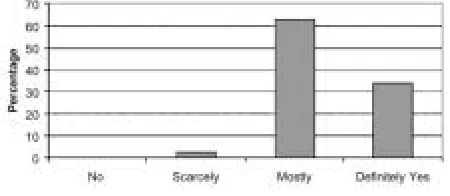
Perception Gap between universities and industry. The responses to the questionnaire confirms15 and highlights a possible gap between universities’ and industry’s thinking. See figures 3 and 4. The majority of universities indicated that they did almost always meet the skills requirement of industry, whereas a third of those polled in industry, thought that it was scarcely met. A possible reason suggested for this perception gap is due to the pressures of universities to design courses that would attract school leavers. These courses do not always meet the requirements of industry.
Figure 3: Industry Response to question “Where IT is used as part of University Education, do you believe that students develop the skills necessary to meet the requirements of industry”
Figure 4: University Response to question “Where IT is used as part of University Education, do you believe that students develop the skills necessary to meet the requirements of industry”
Conclusions and Further Work
From the project the following conclusions emerged:
[image:3.595.313.538.345.478.2] [image:3.595.314.539.556.654.2]communication, teamwork and self-management as well as sound technical ability and there appears a perception gap between the universities’ thinking of what industry wants and what industry actually wants.
2. It is suggested that IT methods, as currently used, are adverse for the development of two of the key skills required by the stakeholders. These two, being oral communication and teamwork.
3. IT methods are more flexible in terms of time and access to information and are easier to update and administrate. Many students also enjoy using them. The first conclusion is not unexpected. Perhaps the universities might ask the stakeholders for a little indulgence here; it is difficult to find acceptable substitutes for authentic experience when developing some skills and it is often the case that it is only when the student is working that they understand the relevance and importance of some skills that
universities have done their best to develop, within the limitations of their environment and the students’ ability to understand.
It is also perhaps not surprising that IT methods are seen to be detrimental to oral communications skills, but the view that it hinders teamwork deserves some comment. In the modern world teamwork increasing occurs within a virtual environment, and it seems likely that using IT exercises that require teamwork should enhance these skills. This is a challenge to the Learning
Technologists and teachers to develop such authentic exercises in a virtual environment, and to educate the educational community.
The significance of any time, any place learning becomes ever greater as pressures come from
government which are changing the shape of university learning. Widening access agendas lead universities to recruit non-traditional students who may have different working patterns, often part time. Financial (and social) pressures on students mean that they attend lectures less. And retention and widening access agendas dictate that a wide range of materials should be available to support students – increasingly delivered in an electronic format.
From the project, several open question remain: • What are the possibilities for using different C&IT
methods to develop the key skills that such methods are perceived to hinder?
• This report produced “anecdotal” evidence of a gap between universities' thinking of what industry want, and what industry actually requires. This are needs significantly more attention.
• Clearly universities and industry need to
communicate more. It would be worth looking at the sort of partnerships between the two which might be mutually beneficial.
• How essential is the 'traditional university experience' to the education of an engineer? Are there more effective methods of arriving at the required standards?
References
1
LTSN Engineering is one of 24 subject centres which support the development of learning and teaching in UK Higher Education http://www.ltsneng.ac.uk/ accessed October 2001.
2
S Waks and M Frank, 2000, “Engineering Curriculum versus Industry Needs – A Case Study”, IEEE Transactions on Education, 43 3 349-352 3 Standards and Routes to Chartership (SARTOR) 3rd Edition, Part 1 Section 4 – The Educational Base, Engineering Council 1997 Taken from the Engineering Council Web-site http://www.engc.org.uk accessed October 2001.
4
White, S. 1999 “Using IT for Teaching and
Learning” in "A Handbook for Teaching & Learning in Higher Education: Enhancing Academic Practice". Eds H. Fry, Ketteridge,S., Marshall, S. London 2000 Kogan Page, London
5 Warren A and Maier P, 2000, “Integrating Technology in Learning & Teaching” Kogan Page, London
6
Berryman, S E, 1993, “Designing Effective Learning Environments: Cognitive Apprenticeship Models”. New York: Institute on Education and the Economy
http://www.ilt.columbia.edu/k12/livetext/docs/berry1.ht ml accessed October 2001.
7 Papert S, 1980 “Mindstorms - Children, Computers and Powerful Ideas”, Harvester Press, Brighton, Sussex 8 Laurillard, D., 1993 “Rethinking University Teaching: a Framework for the Effective Use of Educational Technology”, Routledge, London. 9 The original full report can be found at
http://www.soton.ac.uk/~mdp3/reports.html accessed October 2001.
10 IEE, 2000, Training requirements for Corporate Membership of IEE, London
11 IMechE, 2000, “Summary of Training
Requirements”, Taken from Application form for the class of Member or Fellow, Notes for Applicants, IMechE, London
13
IMechE, 2000, “Competence and Commitment Statements for IEE, IMechE and IIE”. Taken from IMechE Professional Development Record, Section 9 (9/1 – 9/2) IMechE, London
14