D e v e l o p i n g a hybrid N P parser
A t r o V o u t i l a i n e n
Department of General Linguistics
P.O. Box 4
FIN-00014 University of Helsinki
Finland
avout ila@ling, helsinki, fi
Llufs P a d r 6
Dept. Llenguatges i Sistemes InformS, tics
Universitat Polit~cnica de Catalunya
C/Grail Capit~ s/n. 08034 Barcelona
Catalonia
p a d r o @ l s i , u p c . e sA b s t r a c t
We describe the use of energy function op- timisation in very shallow syntactic pars-
ing. The approach can use linguistic
rules and corpus-based statistics, so the strengths of both linguistic and statisti- cal approaches to NLP can be combined in a single framework. The rules are con- textual constraints for resolving syntactic ambiguities expressed as alternative tags, and the statistical language model consists of corpus-based n-grams of syntactic tags. The success of the hybrid syntactic dis- ambiguator is evaluated against a held-out benchmark corpus. Also the contributions of the linguistic and statistical language models to the hybrid model are estimated.
1
I n t r o d u c t i o n
The language models used by natural language an- alyzers are traditionally based on two approaches. In the linguistic approach, the model is based on hand-crafted rules derived from the linguist's gen- eral and/or corpus-based knowledge about the ob- ject language. In the data-driven approach, the model is automatically generated from annotated text corpora, and the model can be represented e.g. as n-grams (Garside et al., 1987), local rules (Hindle, 1989) or neural nets (Schmid, 1994).
Most hybrid approaches combine statistical infor- mation with automatically extracted rule-based in- formation (Brill, 1995; Daelemans et al., 1996). Rel- atively little attention has been paid to models where the statistical approach is combined with a truly lin- guistic model (i.e. one generated by a linguist). This paper reports one such approach: syntactic rules written by a linguist are combined with statistical information using the relaxation labelling algorithm.
80
Our application is very shallow parsing: identifi- cation of verbs, premodifiers, nominal and adverbial heads, and certain kinds of postmodifiers. We call this parser a noun phrase parser.
The input is English text morphologically tagged with a rule-based tagger called EngCG (Voutilainen et al., 1992; Karlsson et al., 1995). Syntactic word- tags are added as alternatives (e.g. each adjective gets a premodifier tag, postmodifier tag and a nomi- nal head tag as alternatives). The system should re- move contextually illegitimate tags and leave intact each word's most appropriate tag. In other words, the syntactic language model is applied by a disam- biguator.
The parser has a recall of 100% if all words retain
the correct morphological and syntactic reading; the
system's precision is 100% if the output contains no
illegitimate morphological or syntactic readings. In practice, some correct readings are discarded, and some ambiguities remain unresolved (i.e. some words retain two or more alternative analyses).
The system can use linguistic rules and corpus- based statistics. Notable about the system is that minimal human effort was needed for creating its language models (the linguistic consisting of syn- tactic disambiguation rules based on the Constraint Grammar framework (Karlsson, 1990; Karlsson et al., 1995); the corpus-based consisting of bigrams and trigrams):
Only one day was spent on writing the 107 syn- tactic disambiguation rules used by the linguis- tic parser.
syntactically ambiguous by adding the alterna- tive syntactic tags to the words, and (iii) re- solving most of these syntactic ambiguities by applying the parser with the 107 disambigua- tion rules.
T h e system was tested against a fresh sample of five texts (6,500 words). T h e system's recall and pre- cision was measured by comparing its o u t p u t to a manually disambiguated version of the text. To in- crease the objectivity of the evaluation, system out- puts and the benchmark corpus are made publicly accessible (see Section 6).
Also the relative contributions of the linguistic and statistical components are evaluated. T h e lin- guistic rules seldom discard the correct tag, i.e. they have a very high recall, but their problem is remain- ing ambiguity. T h e problems of the statistical com- ponents are the opposite: their recall is considerably lower, but more (if not all) ambiguities are resolved. When these components are used in a balanced way, the system's overall recall is 97.2% - that is, 97.2% of all words get the correct analysis - and its preci- sion is 96.1% - that is, of the readings returned by the system, 96.1% are correct.
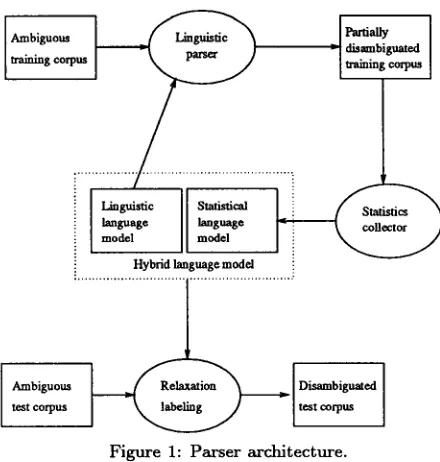
T h e system architecture is presented in Figure 1.
Ambiguous [
~
I Partially
"training
co ~
-
;
:, dis.~,
biguated
Hybrid language
model
Ambiguous ~
Di.~mbig~t
exl
test c°rpus I
~
I test c°rpus
Figure 1: Parser architecture.
T h e structure of the paper is the following. First, we describe our general framework, the relaxation labelling algorithm. Then we proceed to the appli- cation by outlining the grammatical representation used in our shallow syntax. After this, the disam- biguation rules and their development are described. Next in turn is a description of how the data-driven language model was generated. The evaluation of
81
the system is then presented: first the preparation of the benchmark corpus is described, then the re- sults of the tests are given. T h e paper ends with some concluding remarks.
2
The Relaxation Labelling
Algorithm
Since we are dealing with a set of constraints and want to find a solution which optimally satisfies them M1, we can use a standard Constraint Satis- faction algorithm to solve that problem.
Constraint Satisfaction Problems are naturally modelled as Consistent Labeling Problems (Larrosa
and Meseguer, 1995). An algorithm t h a t solves
CLPs is Relaxation Labelling.
It has been applied to part-of-speech tagging (Padr6, 1996) showing that it can yield as good re- sults as a HMM tagger when using the same in- formation. In addition, it can deal with any kind of constraints, thus the model can be improved by adding any other constraints available, either statistics, hand-written or automatically extracted (Mhrquez and Rodrfguez, 1995; Samuelsson et al., 1996).
Relaxation labelling is a generic name for a family of iterative algorithms which perform function opti- misation, based on local information. See (Torras, 1989) for a summary.
Given a set of variables, a set of possible labels for each variable, and a set of compatibility constraints between those labels, the algorithm finds a combina- tion of weights for the labels that maximises "global consistency" (see below).
Let V = {vl, v 2 , . . . , v,~} be a set of variables. Let tl = {til ti2, , . . . , t m i ) i be the set of possible labels for variable vi.
Let C S be a set of constraints between the labels
of the variables. Each constraint C E C S states a
"compatibility value" Cr for a combination of pairs variable-label. Any number of variables m a y be in- volved in a constraint.
The aim of the algorithm is to find a weighted labelling I such that "global consistency" is max- imised. Maximising "global consistency" is defined
as maximising ~ j p~. x Sij , Vvi, where p~. is the
weight for label j in variable vi and Sij the support
received by the same combination. T h e support for
the pair variable-label expresses how compatible that
pair is with the labels of neighbouring variables, ac- cording to the constraint set.
[image:2.612.91.311.394.625.2]The support is defined as the sum of the influence of every constraint on a label.
Sij = ~ Inf(r)
rER~j
where:
R~j is the set of constraints on label j for variable i, i.e. the constraints formed by any combination of variable--label pairs t h a t includes the pair (vi, tj).
r l f d
Inf(r) = Cr x Pk,(m) x . . . x Pkd(m), is the prod- uct of the current weights 2 for the labels appearing
in the constraint except
(vi,tj)
(representinghow
applicable
the constraint is in the current context) multiplied by Cr which is the constraint compatibil-ity value (stating
how compatible
the pair is with thecontext).
Briefly, what the algorithm does is:
1. Start with a random weight assignment.
2. Compute the support value for each label of each variable. (How compatible it is with the current weights for the labels of the other vari- ables.)
3. Increase the weights of the labels more compat- ible with the context (support greater than 0) and decrease those of the less compatible labels (support less t h a n 0) 3 , using the updating func- tion:
p~.(rn) x (1 + Sij)
pj(m + 1) =
× (1 + S,k) k = l
where - l ~ S i j _ ~ + l
4. If a stopping/convergence criterion 4 is satisfied, stop, otherwise go to to step 2.
3 G r a m m a t i c a l r e p r e s e n t a t i o n
The input of our parser is morphologically analyzed and disambiguated text enriched with alternative syntactic tags, e.g.
"<others>"
"other" PRON N0M PL @>N @NH
2p~(m)
is the weight assigned to label k for variable r at time m.SNegative values for support indicate
incompatibility.
4The usual criterion is to stop when there are no more changes, although more sophisticated heuristic proce- dures are also used to stop relaxation processes (Eklundh and Rosenfeld, 1978; Richards et al. , 1981).
"<moved>"
"move" <SV> <SV0> V PAST VFIN @V "<away>"
"away" ADV ADVL @>A @AH "<from>"
"from" PREP @DUMMY
"<tradit ional>"
"traditional" A ABS @>N @N< @NH
"<jazz>"
"jazz" <-Indef> N NOM SG @>N @NH
"<practice>"
"practice" N N0M SG @>N @NH
"practice" <SV0> V PRES -SG3 VFIN @V
Every indented line represents a morphological reading; the sample shows that some morphological ambiguities are not resolved by the rule-based mor- phological disambiguator, known as the EngCG tag- ger (Voutilainen et al., 1992; Karlsson et al., 1995).
Our syntactic tags start with the "@" sign. A word is syntactically ambiguous if it has more than
one syntactic tags (e.g.
practice
above has three al-ternative syntactic tags). Syntactic tags are added to the morphological analysis with a simple lookup module. The syntactic parser's main task is dis- ambiguating (rather than adding new information to the input sentence): contextuMly illegitimate al- ternatives should be discarded, while legitimate tags should be retained (note t h a t also morphological am- biguities m a y be resolved as a side effect).
Next we describe the syntactic tags:
• @>N represents premodifiers and determiners.
• @N< represents a restricted range of postmod- ifiers and the determiner "enough" following its nominal head.
• @NH represents nominal heads (nouns, adjec- tives, pronouns, numerals, ING-forms and non- finite ED-forms).
• @>A represents those adverbs t h a t premodify (intensify) adjectives (including adjectival ING- forms and non-finite ED-forms), adverbs and various kinds of quantifiers (certain determin- ers, pronouns and numerals).
• @AH represents adverbs t h a t function as head of an adverbial phrase.
• @A< represents the postmodifying adverb "enough".
• @V represents verbs and auxiliaries (incl. the infinitive marker "to").
• @>CC represents words introducing a coordi- nation (" either", "neither", " b o t h " ).
• @CC represents coordinating conjunctions.
* @CS represents subordinating conjunctions.
. @DUMMY represents all prepositions, i.e. the parser does not address the a t t a c h m e n t of prepositional phrases.
4 S y n t a c t i c r u l e s
4.1 R u l e f o r m a l i s m
The rules follow the Constraint G r a m m a r formal- ism, and they were applied using the recent parser-
compiler CG-2 (Tapanainen, 1996). The parser
reads a sentence at a time and discards those ambiguity-forming readings that are disallowed by a constraint.
Next we describe some basic features of the rule formalism. The rule
R~.HOV~. (©>hi)
(,ic <<< OR (©V) OR (~CS) BARRIER (@NH));
removes the premodifier tag @>N from an ambigu- ous reading if somewhere to the right (*1) there is an unambiguous (C) occurrence of a member of the set < < < (sentence boundary symbols) or the verb tag @V or the subordinating conjunction tag @CS, and there are no intervening tags for nominal heads (@NH).
This is a partial rule about coordination:
REMOVE (©>N)
(NOT 0 (DET) OR (NUM) OR (A)) ( l c ( c c ) )
(2C (DET)) ;
It removes the premodifier tag if all three context- conditions are satisfied:
• the word to be disambiguated (0) is not a de-
terminer, numeral or adjective,
• the first word to the right (1) is an unambiguous
coordinating conjunction, and
• the second word to the right is an unambiguous determiner.
In addition to REMOVing, also S E L E C T i n g a read- ing is possible: when all context-conditions are sat- isfied, all readings but the one the rule was expressly about are discarded.
T h e rules can refer to words and tags directly or by means of predefined sets. T h e y can refer not only
to any fixed context positions; also reference to con- textual patterns is possible. T h e rules never discard a last reading, so every word retains at least one analysis. On the other hand, an ambiguity remains unresolved if there are no rules for that particular type of ambiguity.
4.2 G r a m m a r d e v e l o p m e n t
A day was spent on writing 107 constraints; a b o u t 15,000 words of the parser's o u t p u t were proofread during the process. T h e routine was the following:
1. The current g r a m m a r (containing e.g. 2 rules) is applied to the ambiguous input in a 'trace' mode in which the parser also indicates, which rule discarded which analysis,
2. T h e g r a m m a r i a n observes remaining ambigui- ties and proposes new rules for disambiguating them, and
3. He also tries to identify misanalyses (cases where the correct tag is discarded) and, using the trace information, corrects the faulty rule
This routine is useful if the development time is very restricted, and only the most c o m m o n ambigu- ity types have to be resolved with reasonable suc- cess. However, if the g r a m m a r should be of a very high quality (extremely few mispredictions, high de- gree of ambiguity resolution), a large test corpus, formally similar to the input except for the manually added extra information about the correct analysis, should be used. This kind of test corpus would en- able the automatic identification of mispredictions as well as counting of various performance statistics for the rules. However, manually disambiguating a test corpus of a few hundred thousand words would probably require a h u m a n effort of at least a month.
4.3 S a m p l e o u t p u t
T h e following is genuine o u t p u t of the linguistic (CG-2) parser using the 107 syntactic disambigua- tion rules. T h e traces starting with "S:" indicate the line on which the applied rule is in the g r a m m a r file. One syntactic (and morphological) ambiguity
remains unresolved: until remains ambiguous due to
preposition and subordinating conjunction readings.
" < a a c h e n > " S : 4 6
" a a c h e n " <*> <Proper> hl hiOM SG ~1~ "<remained>"
"remain" < S V C / N > < S V C / A > V P A S T V F I N @V "<a>"
"a" < I n d e f > D E T C E N T R A L A R T SG @ > N " < f r e e > " S:316, 49
"free" A ABS @>N
"<imperial>" S:49, 57 "imperial" A ABS @>N "<city>" S:46
"city" N N0M SG @NH "<until>"
"until" PREP @DUMMY "until" <**CLB> CS @CS "<occupied>" S: 116, 345, 46
"occupy" <SVO> PCP2 @V "<by>"
"by" PREP ~DUMMY
"<france>" S :46
"france" <*> <Proper> N N0M SG @NH "<in>"
"in" PREP @DUMMY "<1794>" S:121, 49
"1794" <1900> NUM CARD @NH
,,<$.>,,
5
Hybrid language m o d e l
To solve shallow parsing with the relaxation labelling a l g o r i t h m we model each word in the sentence as a variable, a n d each of its possible readings as a label for t h a t variable. We start with a uniform weight distribution.
We will use the algorithm to select the right syn- tactic t a g for every word. Each iteration will in- crease the weight for the tag which is currently m o s t c o m p a t i b l e with the context and decrease the weights for the others.
Since constraints are used to decide how compat-
ible a tag is with its context, they have to assess the c o m p a t i b i l i t y of a c o m b i n a t i o n of readings. We a d a p t C G constraints described above.
T h e R E M O V E constraints express total incom-
patibility 5 and S E L E C T constraints express total c o m p a t i b i l i t y (actually, they express incompatibility of all other possibilities).
T h e c o m p a t i b i l i t y value for these should be at least as strong as the strongest value for a statisti- cally obtained constraint (see below). This produces a value of a b o u t -4-10.
B u t because we want the linguistic p a r t of the model to be m o r e i m p o r t a n t t h a n the statistical p a r t and because a given label will receive the influence
SWe model compatibility values using mutual infor- mation (Cover and Thomas, 1991), which enables us
to use negative numbers to state incompatibility. See
(PadrS, 1996) for a performance comparison between M.I. and other measures when applying relaxation la- belling to NLP.
84
of a b o u t two b i g r a m s and three t r i g r a m s 6, a sin- gle linguistic constraint m i g h t have to override five statistical constraints. So we will m a k e the c o m p a t - ibility values six times stronger, t h a t is, =h60.
Since in our i m p l e m e n t a t i o n of the C G parser (Tapanainen, 1996) constraints tend to be applied in a certain order - e.g. S E L E C T constraints are
usually applied before R E M O V E constraints - we
adjust the compatibility values to get a similar ef- fect: if the value for S E L E C T constraints is +60,
the value for R E M O V E constraints will be lower
in absolute value, (i.e. - 5 0 ) . W i t h this we ensure t h a t two contradictory constraints (if there are any) do not cancel each other. T h e S E L E C T constraint will win, as if it h a d been applied before.
This enables using any Constraint G r a m m a r with this a l g o r i t h m although we are applying it m o r e flex- ibly: we do not decide whether a constraint is ap- plied or not. It is always applied with an influence (perhaps zero) t h a t depends on the weights of the labels.
I f the algorithm should a p p l y the constraints in a m o r e strict way, we can introduce an influence threshold under which a constraint does not have enough influence, i.e. is not applied.
We can add m o r e information to our model in the f o r m of statistically derived constraints. Here we use b i g r a m s and t r i g r a m s as constraints.
T h e 218,000-word corpus of journalese f r o m which these constraints were extracted was analysed using the following modules:
* E n g C G morphological tagger
• Module for introducing syntactic ambiguities
• T h e NP d i s a m b i g u a t o r using the 107 rules writ- ten in a day
No h u m a n effort was spent on creating this train- ing corpus. T h e training corpus is p a r t l y ambigu- ous, so the b i / t r i g r a m i n f o r m a t i o n acquired will be
slightly noisy, but accurate enough to provide an al-
most supervised statistical model.
For instance, the following constraints have been statistically extracted f r o m b i / t r i g r a m occurrences in the training corpus.
- 0 . 4 1 5 3 7 1 (@Y)
(1 ( e > N ) ) ;
4. 28089 (©>A)
( - 1 (~>A)) (1 (¢AH)) ;
T h e compatibility value is the mutual informa- tion, computed from the probabilities estimated from a training corpus. We do not need to assign the compatibility values here, since we can estimate them from the corpus.
T h e compatibility values assigned to the hand- written constraints express the strength of these con- straints compared to the statistical ones. Modifying those values means changing the relative weights of the linguistic and statistical parts of the model.
6 P r e p a r a t i o n o f t h e b e n c h m a r k c o r p u s
For evaluating the systems, five roughly equal-sized benchmark corpora not used in the development of our parsers and taggers were prepared. The texts, totaling 6,500 words, were copied from the Guten- berg e-text archive, and they represent present-day American English. One text is from an article about AIDS; another concerns brainwashing techniques; the third describes guerilla warfare tactics; the fourth addresses the assassination of J. F. Kennedy; the last is an extract from a speech by Noam Chom- sky.
T h e texts were first analysed by a recent version of the morphological analyser and rule-based dis- ambiguator EngCG, then the syntactic ambiguities were added with a simple lookup module. T h e am- biguous text was then manually disambiguated. T h e disambiguated texts were also proofread afterwards. Usually, this practice resulted in one analysis per word. However, there were two types of exception:
1. The input did not contain the desired alterna- tive (due to a morphological disambiguation er- ror). In these cases, no reading was marked as correct. Two such words were found in the corpora; they detract from the performance fig- ures.
2. T h e input contained more than one analyses all of which seemed equally legitimate, even when semantic and textual criteria were consulted. In these cases, all the equal alternatives were marked as correct. The benchmark corpus con- tains 18 words (mainly ING-forms and nonfinite ED-forms) with two correct syntactic analyses.
T h e number of multiple analyses could proba- bly be made even smaller by specifying the gram- matical representation (usage principles of the syn-
8 5
tactic tags) in more detail, in particular incorpo- rating some analysis conventions for certain appar- ent borderline cases (for a discussion of specify- ing a parser's linguistic task, see (Voutilainen and J~rvinen, 1995)).
To improve the objectivity of the evaluation, the benchmark corpus (as well as parser outputs) have been made available from the following URLs: http://www.ling.helsinki.fi/-avoutila/anlp97.html h t t p : / / w w w - l s i . u p c . e s / - l l u i s p / a n l p 9 7 . h t m l
7 E x p e r i m e n t s a n d r e s u l t s
We tested linguistic, statistical and hybrid language models, using the CG-2 parser (Tapanainen, 1996) and the relaxation labelling algorithm described in Section 2.
The statistical models were obtained from a train- ing corpus of 218,000 words of journalese, syntac- tically annotated using the linguistic parser (see above).
Although the linguistic CG-2 parser does not dis- ambiguate completely, it seems to have an almost perfect recall (cf. Table 1 below), and the noise in- troduced by the remaining ambiguity is assumed to be sufficiently lower than the signal, following the idea used in (Yarowsky, 1992).
T h e collected statistics were bigram and trigram
o c c u r r e n c e s .
The algorithms and models were tested against a hand-disambiguated benchmark corpus of over 6,500 words.
We measure the performance of the different mod- els in terms of recall and precision. Recall is the percentage of words t h a t get the correct tag among the tags proposed by the system. Precision is the percentage of tags proposed by the system that are correct.
C
C G - 2 p a r s e r R e l . L a b e l l i n g p r e c . - r e c a l l p r e c . - r e c a l l 9 0 . 8 % - 99.7% 9 3 . 3 % - 98.4%
Table 1: Results obtained with the linguistic model.
R e l . L a b e l l i n g p r e c . - r e c a l l
B 87.4% - 88.0%
T 87.6% - 88.4%
B T 8 8 . 1 % - 88.8%
[image:6.612.384.501.634.698.2]R e l .
Labelling
p r e c . - r e c a l l
B C 9 6 . 0 % - 97.0%
T C 9 5 . 9 % - 97.0%
B T C 9 6 . 1 % - 97.2%
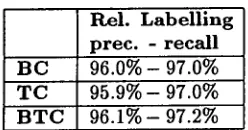
Table 3: Results obtained with hybrid models.
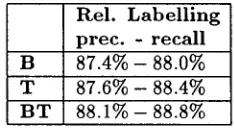
Precision and recall results (computed on all words except punctuation marks, which are unam- biguous) are given in tables 1, 2 and 3. Models are coded as follows: B stands for bigrams, T for tri- grams and C for hand-written constraints. All com- binations of information types are tested. Since the CG-2 parser handles only Constraint Grammars, we cannot test this algorithm with statistical models.
These results suggest the following conclusions:
• Using the same language model (107 rules), the relaxation algorithm disambiguates more than the CG-2 parser. This is due to the weighted rule application, and results in more misanaly- ses and less remaining ambiguity.
• T h e statistical models are clearly worse than the linguistic one. This could be due to the noise in the training corpus, but it is more likely caused by the difficulty of the task: we are dealing here with shallow syntactic parsing, which is prob- ably more difficult to capture in a statistical model t h a n e.g. POS tagging.
• T h e hybrid models produce less ambiguous re- sults t h a n the other models. T h e number of errors is much lower than was the case with the statistical models, and somewhat higher than was the case with the linguistic model. T h e gain in precision seems to be enough to compensate for the loss in recall 7.
• T h e r e does not seem to be much difference be- tween BC and T C hybrid models. T h e reason is probably t h a t the job is mainly done by the lin- guistic part of the model - which has a higher relative weight - and that the statistical part only helps to disambiguate cases where the lin- guistic model doesn't make a prediction. T h e B T C hybrid model is slightly better than the other two.
• T h e small difference between the hybrid models suggest t h a t some reasonable statistics provide enough disambiguation, and that not very so- phisticated information is needed.
7This obviously depends on the flexibility of one's requirements.
8 6
8
D i s c u s s i o n
In this paper we have presented a m e t h o d for com- bining linguistic hand-crafted rules with statistical information, and we applied it to a shallow parsing task.
Results show t h a t adding statistical information results in an increase in the disambiguation ratio, getting a higher precision. T h e price is a decrease in recall. Nevertheless, the risk can be controlled since more or less statistical information can be used depending on the precision/recall tradeoff one wants to achieve.
We also used this technique to build a shallow parser with minimal h u m a n effort:
• 107 disambiguation rules were written in a day.
• These rules were used to analyze a training cor- pus, with a very high recall and a reasonable precision.
• This slightly ambiguous training corpus is used for collecting bigram and t r i g r a m occurrences. T h e noise introduced by the remaining ambigu- ity is assumed not to distort the resulting statis- tics too much.
• T h e hand-written constraints and the statistics are combined using a relaxation algorithm to analyze the test corpus, rising the precision to 96.1% and lowering the recall only to 97.2%.
Finally, a reservation must be made: what we have not investigated in this paper is how much of the extra work done with the statistical module could have been done equally well or even better by spend- ing e.g. another day writing a further collection of heuristic rules. As suggested e.g. by Tapanainen and Voutilainen (1994) and Chanod and Tapanainen (1995), hand-coded heuristics m a y be a worthwhile addition to 'strictly' grammar-based rules.
Acknowledgements
We wish to thank T i m o J/irvinen, Pasi Tapanalnen and two ANLP'97 referees for useful comments on earlier versions of this paper.
[image:7.612.147.271.80.145.2]R e f e r e n c e s
E. Brill. 1995. Unsupervised Learning of Disam- biguation Rules for Part-of-speech Tagging. In
Proceedings of 3rd Workshop on Very Large Cor- pora, Massachusetts.
J.-P. Chanod and P. Tapanainen 1995. Tagging French: comparing a statistical and a constraint-
based method. In Proc. EACL'95. ACL, Dublin.
T.M. Cover and J.A. Thomas (Editors) 1991. Ele-
ments of information theory. John Wiley & Sons.
J. Eklundh and A. Rosenfeld. 1978. Convergence Properties of Relaxation Labelling. Technical Re- port no. 701. Computer Science Center. Univer- sity of Maryland.
W. Daelemans, J. Zavrel, P. Berck and S. Gillis. 1996. MTB: A Memory-Based Part-of-Speech
Tagger Generator. In Proceedings of ~th Work-
shop on Very Large Corpora. Copenhagen, Den- mark.
R. Garside, G. Leech and G. Sampson (Editors)
1987. The Computational Analysis of English.
London and New York: Longman.
D. Hindle. 1989. Acquiring disambiguation rules
from text. In Proc. A CL'89.
F. Karlsson 1990. Constraint Grammar as a Frame- work for Parsing Running Text. In H. Karlgren
(ed.), Papers presented to the 13th International
Conference on Computational Linguistics, Vol. 3.
Helsinki. 168-173.
F. Karlsson, A. Voutilainen, J. HeikkilK and
A. Anttila. (Editors) 1995. Constraint Grammar:
A Language-Independent System for Parsing Un- restricted Text. Mouton de Gruyter, Berlin and New York.
C. Samuelsson, P. Tapanainen and A. Voutilainen.
1996. Inducing Constraint Grammars. In Pro-
ceedings of the 3rd International Colloquium on Grammatical Inference.
H. Schmid 1994. Part-of-speech tagging with neu-
ral networks. In Proceedings of 15th International
Conference on Computational Linguistics, Kyoto, Japan.
P. Tapanainen 1996. The Constraint Grammar
Parser CG-2. Department of General Linguistics, University of Helsinki.
P. Tapanainen and A. Voutilainen 1994. Tagging
accurately - Don't guess if you know. In Pro-
ceedings of the 4th Conference on Applied Natural Language Processing, A CL. Stuttgart.
C. Torras. 1989. Relaxation and Neural Learning:
Points of Convergence and Divergence. Journal of
Parallel and Distributed Computing, 6:217-244
A. Voutilainen, J. HeikkilK and A. Anttila 1992.
Constraint Grammar of English. A Performance- Oriented Introduction. Publications 21, De- partment of General Linguistics, University of Helsinki.
A. Voutilainen and T. JErvinen. 1995. Specifying a shallow grammatical representation for parsing
purposes. In Proceedings of the 7th meeting of the
European Association for Computational Linguis- tics. 210-214.
D. Yarowsky. 1992. Word-sense disambiguations us- ing statistical models of Roget's categories trained
on large corpora. In Proceedings of 14th Interna-
tional Conference on Computational Linguistics.
Nantes, France.
J. Larrosa and P. Meseguer. 1995. An Optimization- based Heuristic for Maximal Constraint Satisfac-
tion. In Proceedings of International Conference
on Principles and Practice of Constraint Program- ming.
L. Mhrquez and H. Rodriguez. 1995. Towards
Learning a Constraint Grammar from Annotated Corpora Using Decision Trees. ESPRIT BRA- 7315 Acquilex II, Working Paper.
L. Padr6. 1996. POS Tagging Using Relaxation
Labelling. In Proceedings of 16th International
Conference on Computational Linguistics, Copen- hagen, Denmark.
J. Richards, D. Landgrebe and P. Swain. 1981. On
the accuracy of pixel relaxation labelling. In IEEE
Transactions on System, Man and Cybernetics.
Vol. SMC-11