Attention-free encoder decoder for morphological processing
Stefan Daniel Dumitrescu and Tiberiu Boros
Research Institute for Artificial Intelligence “Mihai Dr˘ag˘anescu” Romanian Academy
13 September, no. 13, Bucharest, Romania [email protected],[email protected]
Abstract
We present RACAI’s Entry for the CoNLL-SIGMORPHON 2018 shared task on univer-sal morphological reinflection. The system is based on an attention-free encoder-decoder neural architecture with a bidirectional LSTM for encoding the input sequence and a uni-directional LSTM for decoding and produc-ing the output. Instead of directly applyproduc-ing a sequence-to-sequence model at character-level we use a dynamic algorithm to align the input and output sequences. Based on these align-ments we produce a series of special symbols which are similar to those of a finite-state-transducer (FST).
1 Introduction
Languages with rich morphology convey mor-phological attributes such as gender, case, num-ber, obliqueness through character/grapheme vari-ations applied to the dictionary form of the word (lemma). It is often the case where these variations are obtained by suffixing the word rather than al-tering random characters, but this does not hold for all languages or irregular word forms. Sill, the variations inside the lemma are usually small, re-quiring the system just to replace an average of 2.3 letters for the irregular word forms.
In our approach we exploit this property and employ an encoder-decoder sequence-to-sequence model that doesn’t require an attention mecha-nism. This mitigates attention issues such as peating or skipping character sequences and re-duces the need for models with high representa-tional capacity.
We exploit the property that alignments be-tween the input and output character sequences are monotonic: for example wordform men and lemmaman share two letters (alignments) in the same order, without inversions. The standard attention mechanism is well-suited for machine
learning tasks; however, when it comes to mono-tonic alignments it sometimes fails to achieve sat-isfactory results, in most cases due to the fact that repeated characters or character sequences in the input sequence confuse the attention mechanism making it generate loops or skip characters.
There are several proposed methods that try to solve this task with attention mechanisms such as guided attention (Tachibana et al.,2017), location-sensitive attention (Chorowski et al., 2015) and other variations. Still, given the particularities of morphological reinflection, we argue that there is no need for an explicit attention mechanism. In-stead we train the decoder to focus on a single input symbol at each time-step and “self-attend” by shifting the input cursor with one position at a time. This method, though developed indepen-dently, closely resembles that of Makarov et al.
(2017).
In our previous experiments we used this ar-chitecture to perform lemmatization (the opposite task of morphological reinflection) and we ob-tained state-of-the-art results.
In what follows, we will present the attention-free encoder-decoder architecture (Section2), we show our experimental results (Section3) and fi-nally we draw conclusions (Section4).
2 Attention-free encoder-decoder
The architecture of our neural network is fairly simple. We use an encoder that “sees” the se-quence in both directions and a decoder which is conditioned to produce the output sequence using focused encoder states (see below for details) concatenated with trainable embeddings computed on morphological attributes.
As mentioned before, the classical attention mechanism is not well suited for tasks where the alignments between the input and output
quences are monotonic. Instead, connectionist temporal classification (CTC) (Graves et al.,2006) provides better results in these cases. However, CTC requires that the number of input time-steps is much higher than the number of output labels. This renders CTC unsuitable for morphological reinflection as the number of output labels is al-most always greater than the number of input char-acters.
Instead, we propose a simpler algorithm that reduces the model complexity and computational load. Our method requires preexisting alignments between the input and output sequences. These alignments are easy to obtain by exploiting a ba-sic property of morphological reinflection, which also holds for lemmatization: regardless of the language and irregularity of the word-form, the lemma and the inflected word form share many symbols.
This implies a high likelihood of aligning iden-tical input and output symbols and does not re-quire Expectation Maximization (EM) for com-puting alignment probabilities. With this in mind, we propose the following algorithm that:
1. Computes an alignment matrix using dy-namic programming;
2. Reads the two sequences in reverse and uses the previously computed matrix, favoring di-agonal alignments over other alignments;
3. Generates alignment pairs, whenever the in-put and outin-put symbols are identical.
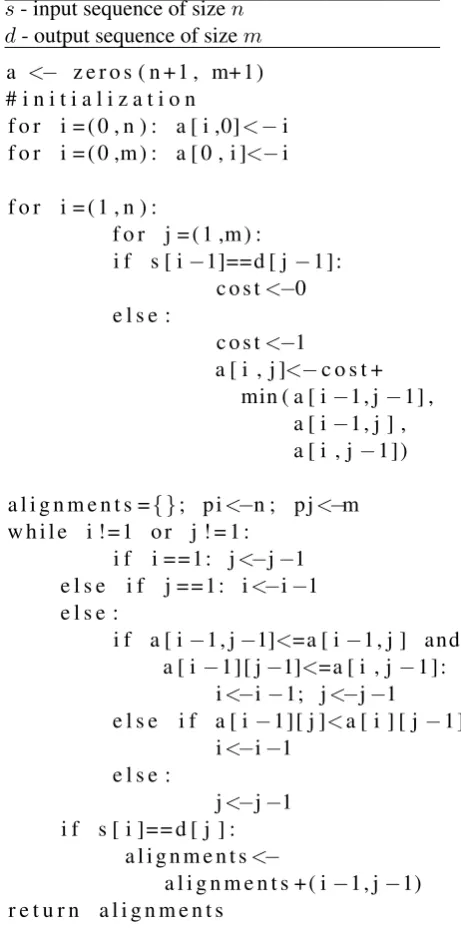
Figure1describes our approach step-by-step. The algorithm is a slightly modified dynamic algorithm in the sense that (a) it favors diago-nal alignments (to cope with repeating consecu-tive letters) and (b) it only considers an alignment pair(i, j)if the characters from the source (s) and
destination (d) at the two indexes are identical (i.e.
si=dj).
Next, we use the produced alignments to gener-ate the training data for our attention-free encoder-decoder model. For our algorithm to work, we need the decoder to keep track of the focused-on character in the input sequence. This is achieved by simulating a FST using neural networks. Given the input sequence s, the decoder must produce
an output sequenced0 which is composed of three
specialized labels and arbitrary characters in the vocabulary. The output symbols are:
s- input sequence of sizen d- output sequence of sizem
a <− z e r o s ( n +1 , m+1) # i n i t i a l i z a t i o n
f o r i = ( 0 , n ) : a [ i ,0]<−i
f o r i = ( 0 ,m) : a [ 0 , i ]<−i
f o r i = ( 1 , n ) :
f o r j = ( 1 ,m) :
i f s [ i−1]==d [ j−1]: c o s t<−0
e l s e :
c o s t<−1
a [ i , j ]<−c o s t +
min ( a [ i−1, j−1] , a [ i−1, j ] , a [ i , j −1])
a l i g n m e n t s ={}; pi<−n ; pj<−m w h i l e i !=1 o r j ! = 1 :
i f i ==1: j<−j−1
e l s e i f j ==1: i<−i−1 e l s e :
i f a [ i−1, j−1]<=a [ i−1, j ] and
a [ i−1][ j−1]<=a [ i , j−1]: i<−i−1; j<−j−1
e l s e i f a [ i−1][ j ]<a [ i ] [ j −1]:
i<−i−1 e l s e :
j<−j−1
i f s [ i ]== d [ j ] : a l i g n m e n t s<−
a l i g n m e n t s +( i−1, j−1) r e t u r n a l i g n m e n t s
Figure 1: Alignment algorithm
• Special symbol INC : This means that the current focus-index of the input sequence must be incremented by 1;
• Special Symbol COPY: The character at the current focus-index must be “copied” in order to compose the final sequence;
• Special Symbol EOS : The output se-quence is complete and the algorithm stops;
• Any arbitrary character in the
vocabu-lary: This means that the final sequence must be obtained by adding this character.
[image:2.595.305.536.63.529.2]0 and the final sequence to the void string (“”) and we follow the instructions of the decoder output in order to construct the final sequence. During training, it is highly important to do sanity checks on the current focus-index to avoid index out-of-bounds exceptions during the first training epochs when the model has not yet converged. Once the loss is small enough, we found that the model rarely generates these exceptions. However, it is still recommended to keep these checks in place.
To obtain the output sequence d0 on which we
train our network we use afixed-oracle algorithm
that is summarized as:
1. Take every symbol in the output sequence and check if it aligns with a symbol in the in-put sequence (based on thealignments
pro-duced by the algorithm in Figure1);
2. If the output symbol does not align with any character, instruct the decoder to generate it (the case of the arbitrary character in the vo-cabulary);
3. If the output symbol aligns, instruct the de-coder to generate INC symbols until the focus-index would reach the corresponding input character, and then generate an COPY symbol;
4. When the sequence is completely generated, instruct the decoder to generate an EOS symbol.
Because English reinflection is fairly simple, we chose an entry from the Romanian dataset for which we present a step-by-step example.
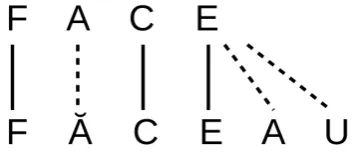
Assume the lemma is “face” (en. “to do”) and is has to be reinflected for the morphological descriptionV;IND;PST;3;PL;IPFV. The decoder has to generate word form “f˘aceau” (en. “they were doing”). This means that the inflected form is obtained by replacing the character ‘a’ with the character ‘˘a’ and by adding the suffix “au”.
Figure2shows the alignments obtained via dy-namic programming between the characters of the lemma (up) and the characters of the word form (down). The dashed lines correspond to align-ments where the characters in the source and desti-nation are not identical. The final alignments pairs are (according to the straight lines): (0,0), (2,2) and (3,3).
Based on these alignments, the FST sym-bols generated by the fixed-oracle algorithm are:
[image:3.595.324.504.211.294.2]COPY , ‘ ˘A’, INC , INC , COPY , INC , COPY , ‘A’, ‘U’, EOS . Notice that after copy-ing the first symbol (‘F’) to the output, the oracle immediately generates the vocabulary item ‘ ˘A’, because it is not aligned with any symbol in the source lemma. However, the next (3rd) symbol in the destination string is aligned with a character in the source string and the index is incremented with two INC commands. The rest of the sequence is generated in a similar fashion.
Figure 2: Alignment example
Note 1: Fixed-oracle training is known to pro-duce suboptimal results, when compared with dynamic-oracle training. However, we did not have time to experiment with the later mentioned training method and leave this for future work.
3 Training details and experimental results
For our implementation is based on DyNET ( Neu-big et al.,2017), which is a dynamic computation graph network framework. That means that we do not require any padding when we prepare mini-batches.
We evaluated our approach on the data provided during the SIGMORPHON 2018 Shared Task on morphological reinflection (Cotterell et al.,2018). During the evaluation campaign, each language was provided with 3 datasets of different sizes (high, medium and low). Because, neural ap-proaches traditionally require more training data to generalize better, we only built models for the “high” datasets, which were composed of 10K training examples for each language.
Language Acc. Acc.* Language Acc. Acc.* Language Acc. Acc.*
adyghe 92.00 97.90 irish 81.80 86.90 sanskrit 76.60 94.10
albanian 95.60 97.10 italian 90.00 91.10 serbo-croatian 88.00 90.70
arabic 88.50 90.00 kabardian 92.00 94.00 slovak 88.80 92.60
armenian 0.00 93.90 khaling 44.70 45.40 slovene 93.40 94.10
asturian 95.40 97.00 kurmanji 90.40 92.10 sorani 86.80 89.00
azeri 90.00 99.00 ladin 86.00 90.00 spanish 72.70 75.00
bashkir 0.00 98.10 latin 16.20 16.20 swahili 98.00 99.00
basque 86.80 96.40 latvian 92.90 97.40 swedish 85.20 92.10
belarusian 3.80 5.10 lithuanian 65.20 66.20 tatar 95.00 97.00
bengali 99.00 99.00 livonian 87.00 97.00 turkish 79.30 80.20
breton 0.00 82.00 lower-sorbian 93.70 96.30 ukrainian 90.50 94.80
bulgarian 77.80 79.90 macedonian 91.90 94.60 urdu 43.50 44.30
catalan 89.40 89.70 maltese 4.00 91.00 uzbek 0.00 36.00
classical-syriac 87.00 98.00 middle-french 96.70 96.30 venetian 98.50 98.70
crimean-tatar 94.00 96.00 navajo 79.00 84.00 votic 0.00 73.00
czech 90.20 92.50 neapolitan 0.00 40.00 welsh 92.00 92.00
danish 91.80 94.90 northern-sami 90.70 93.10 west-frisian 0.00 93.00
estonian 93.80 97.00 nor-bokmaal 88.90 92.50 yiddish 92.00 99.00
faroese 76.30 88.80 nor-nynorsk 79.40 93.10 zulu 73.30 74.40
finnish 87.20 92.20 occitan 83.00 83.00 dutch 92.20 94.80
friulian 78.00 79.00 old-armenian 80.40 82.30 english 93.80 95.10
galician 89.90 91.10 old-church-slv. 9.00 74.00 french 84.30 89.80
georgian 97.80 98.40 old-french 0.00 00.00 german 37.40 42.50
greek 81.10 85.90 old-saxon 54.50 54.80 kannada 99.00 98.00
haida 96.00 93.00 pashto 84.00 89.00 north-frisian 15.00 69.00
hebrew 85.70 87.20 persian 95.60 97.70 old-english 28.20 30.00
hindi 89.40 90.60 portuguese 84.00 84.50 polish 87.80 90.40
hungarian 79.50 86.50 quechua 96.80 98.30 russian 86.80 91.40
[image:4.595.73.524.66.472.2]icelandic 80.60 89.90 romanian 82.00 88.00 Average 72.49 83.77
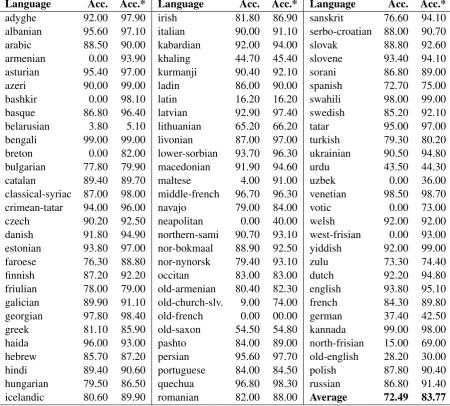
Table 1: Accuracy figures for all languages in the SIGMORPHON Shared Task 2018
For all languages we used a two-layer encoder with 200 LSTM cells (in each direction - total 400 cells per layer) and a two-layer decoder of 200 uni-directional cells. Each character in the vocabulary is embedded as a 100-dimensional vector. We also use a 100-dimensional embedding size for each unique morphological descriptor.
Table 1 summarizes the testset results for all languages in the SIGMORPHON Challenge 2018. During the official evaluation campaign, our sys-tem was affected by a bug which caused all weights belonging to non-recurrent cells to be con-stant (not trainable during backprop). This issue had a strong negative impact on the results. Af-ter this, we retrained our models and we include the unofficial results in the same table, under the “Acc.*” column. For almost all languages, af-ter correcting the bug, the accuracy strongly
in-creased; for Welsh we observed no increase, and only for 2 languages did we observe a less than 1 point decrease (probably due to weight initial-ization compounded by small models where the LSTMs overcame the fixed random weights of the dense layers). Overall, we observed a strong re-sult increase, from an average of 72.49 to 83.77. For example, for West Frisian where initially the model would not converge (0.00), we now obtain 93.00; similarly, for Armenian, we have gone from 0.00 to 93.9.
4 Conclusions
sim-pler models. This is mainly (a) because our model introduces the COPY operation and re-duces the representational load of the encoder-decoder model and (b) and because we keep track of the focus-index externally.
Also, we reduce the computational complexity of the model by completely removing calculation involved in the soft attention mechanism (n∗m
matrix multiplications, wherenis the size of the
input sequence and m the size of the output
se-quence).
Moreover, the fact that the decoder does not re-quire taking the previous output and embedding it as input for the next step, demonstrates that there is far less representational overhead involved in generating the output sequence.
As a side note, in our previous experiments with lemmatization, we observed that using this model yields a 2-5% absolute increase in accuracy over the standard soft-attention sequence-to-sequence model.
Acknowledgments
The research presented here is funded by the Romanian Government through the Executive Agency for Higher Education, Research, De-velopment and Innovation Funding (UEFISCDI), programme “Experimental demonstration project (PED) PED-2016”, project ID: PN-III-P2-2.1-PED-2016-1974, contract number 229PED.
References
Jan K Chorowski, Dzmitry Bahdanau, Dmitriy Serdyuk, Kyunghyun Cho, and Yoshua Bengio. 2015. Attention-based models for speech
recogni-tion. InAdvances in neural information processing systems, pages 577–585.
Ryan Cotterell, Christo Kirov, John Sylak-Glassman, G´eraldine Walther, Ekaterina Vylomova, Arya D. McCarthy, Katharina Kann, Sebastian Mielke, Gar-rett Nicolai, Miikka Silfverberg, David Yarowsky, Jason Eisner, and Mans Hulden. 2018. The CoNLL– SIGMORPHON 2018 shared task: Universal mor-phological reinflection. In Proceedings of the CoNLL–SIGMORPHON 2018 Shared Task: Univer-sal Morphological Reinflection, Brussels, Belgium. Association for Computational Linguistics.
Alex Graves, Santiago Fern´andez, Faustino Gomez, and J¨urgen Schmidhuber. 2006. Connectionist temporal classification: labelling unsegmented se-quence data with recurrent neural networks. In Pro-ceedings of the 23rd international conference on Machine learning, pages 369–376. ACM.
Diederik P Kingma and Jimmy Ba. 2014. Adam: A method for stochastic optimization. arXiv preprint arXiv:1412.6980.
Peter Makarov, Tatiana Ruzsics, and Simon Clematide. 2017. Align and copy: Uzh at sigmorphon 2017 shared task for morphological reinflection. In
Proceedings of the CoNLL SIGMORPHON 2017 Shared Task: Universal Morphological Reinflection, pages 49–57, Vancouver. Association for Computa-tional Linguistics.
Graham Neubig, Chris Dyer, Yoav Goldberg, Austin Matthews, Waleed Ammar, Antonios Anastasopou-los, Miguel Ballesteros, David Chiang, Daniel Clothiaux, Trevor Cohn, et al. 2017. Dynet: The dynamic neural network toolkit. arXiv preprint arXiv:1701.03980.