University of Warwick institutional repository: http://go.warwick.ac.uk/wrap
This paper is made available online in accordance with publisher policies. Please scroll down to view the document itself. Please refer to the repository record for this item and our policy information available from the repository home page for further information.
To see the final version of this paper please visit the publisher’s website. Access to the published version may require a subscription.
Author(s): David I. Woodward and Pam A. Thomas
Article Title: Ferroelectricity in the xAg2Nb4O11–(1−x)Na2Nb4O11 solid solution
Year of publication: 2011
Link to published article: http://dx.doi.org/10.1063/1.3573791
Publisher statement: Copyright 2011 American Institute of Physics. This article may be downloaded for personal use only. Any other use requires prior permission of the author and the American Institute of Physics. The following article has been submitted to/accepted by Applied Physics Letters. After it is published, it will be found at
1
Ferroelectricity in the xAg
2Nb
4O
11– (1-x)Na
2Nb
4O
11solid solution
David I. Woodward and Pam A. Thomas
Department of Physics, University of Warwick, Gibbet Hill Road, Coventry, CV4 7AL, UK
Abstract
Compositions in the (AgxNa1-x)2Nb4O11 solid solution have been prepared by a conventional solid state method. Composites containing Ag2Nb4O11 have been shown to be ferroelectric and the Curie temperature shown to decrease from 149 °C at x = 1 to 62 °C at x = 0.7. Room-temperature compositions with x ≤ 0.7 are monoclinic, while those with x ≥ 0.8 are rhombohedral with structures consistent with the relevant end-members. At x = 0.75, the structure was mainly rhombohedral but with coexistence of the monoclinic structure, indicating the proximity of a phase boundary.
Text:
The Ag2O–Nb2O5 binary system is rich in phases, with at least 5 discrete phases known to form.1–3 Of these, AgNbO3 perovskite is the most widely studied, principally for its potential role in lead-free piezoelectrics,4 for its dielectric properties5 and unusual phase transitions.6 This leaves a large number of related materials whose structures and properties are largely unknown. Ag2Nb4O11 is one such material known to form as a secondary phase when making AgNbO3 due to Ag+ loss,6 while the related Ag2(Nb0.5Ta0.5)4O11 is a prominent secondary phase when forming Ag(Nb0.5Ta0.5)O3 thin films.7 Single phase Ag2Nb4O11 and Na2Nb4O11 have recently been made and studied.8 The structure of Na2Nb4O11 was originally refined in the centrosymmetric space group C2/c9 but a model with the non-centrosymmetric space group Cc has also been proposed.8 Recently, Ag2Nb4O11 was found to have a structure similar to the mineral natrotantite, Na2Ta4O11 (R3c)10,11 but the demonstrated absence of a centre of symmetry results in space group R3c and the possibility of a ferroelectric structure.12 In this work, the results of forming a solid solution between Ag2Nb4O11 and Na2Nb4O11 are explored using x-ray diffraction (XRD) and second harmonic generation (SHG).
2
directed at powder samples and the resulting second harmonic was filtered and its intensity measured by a photomultiplier and recorded by an oscilloscope. Samples were heated and cooled at 30 °/h and did not show signs of having decomposed while exposed to the laser.
All powders were white but, with the exception of x = 0, turned purple when exposed to sufficiently intense sunlight, x-rays or laser, presumably due to reduction of Ag+ to Ag metal as with silver halides. XRD (figure 1a) showed for all compositions except x = 1 the presence of a small amount of secondary phase indicated by the appearance of a peak at ~ 22.5 °2. This is the strongest peak corresponding to the presence of the ferroelectric tungsten bronze-structured material Na13Nb35O94,14.15 and attempts to remove this phase by adding excess Na2CO3 to the batches or by varying the reaction temperature had no significant effect. No evidence of Ag metal was observed. Movement of the peaks to higher 2 with decreasing x indicates reduction in volume, as expected, given that the Na+ ion is smaller than the Ag+ ion.16 XRD showed that all compositions with x ≤ 0.7 had structures consistent with monoclinic Na2Nb4O11 and compositions with x ≥ 0.75 had structures consistent with rhombohedral Ag2Nb4O11, although the data for x = 0.75 show a small proportion of the monoclinic phase in coexistence with the rhombohedral phase, which implies the existence of a phase boundary between the two structural variants at x ≈ 0.75. The monoclinic and rhombohedral structures are related by the identities:
R M [110]
] 100
[ (1)
R M [110]
] 010
[ (2)
R M [111]
] 001
[ 31 (3)
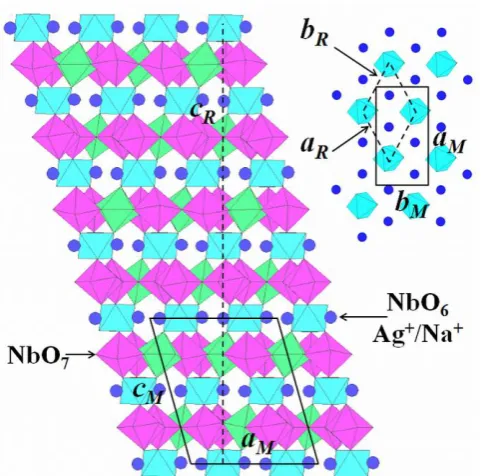
(where the rhombohedral cell is described on the hexagonal setting). The splitting of the {030}R peak to {60 2 }M and { 3 31}M peaks is shown in figure 1b as an illustration of the distortion encountered as a function of composition. It can be seen that the monoclinic peak splitting remains largely constant for x ≤ 0.75 suggesting that, unlike a perovskite, the natrotantite structure has limited means to improve the accommodation of ions that are not of ideal size. The fact that the structure contains planes of edge-sharing NbO7 polyhedra means that there cannot be a simple in-plane tilting mechanism to effect small reductions in volume. The relationship between the rhombohedral and monoclinic structures is illustrated in figure 2.
Prior to poling, the Ag2Nb4O11 composites did not have a measurable d33, but after poling, a reproducible d33 of of 3.4 (2) pC N-1 was obtained. This value could be reversed by reversing the direction of the electric field, but decayed slowly over time, indicating a significant conductivity within the composite. The ability to switch the polarization of this composite proves that the material is ferroelectric. By contrast, the Na2Nb4O11 composites gave a d33 value of zero both before and after poling. This shows that the resin is not responsible for piezoelectricity, that the Na13Nb35O94 secondary phase is not present in sufficiently large quantities to have a measurable effect on the overall piezoelectricity of the composite and that Na2Nb4O11 does not appear to be ferroelectric and is thus more likely to be the centrosymmetric space group C2/c than the non-centrosymmetric space group Cc.
3
second harmonic encountered at ~ 40 °C may indicate that it goes through a phase transition to the rhombohedral R3c structure slightly above room temperature, before going through another phase transition to R3c at ~ 62 °C. Compositions x < 0.7 had a weak second harmonic signal that did not display any obvious phase transitions. The additional evidence of small amounts of a ferroelectric secondary phase makes it impossible to reach any conclusions about the existence of ferroelectricity or even pyroelectricity across the monoclinic phase field.
In conclusion, powders have been made in the (AgxNa1–x)2Nb4O11 solid solution. Those with compositions x ≤ 0.7 have been shown to be monoclinic, consistent with the Na2Nb4O11 structure, which appears non-polar. Those with compositions x ≥ 0.8 have been shown to be rhombohedral R3c, consistent with the Ag2Nb4O11 structure. At x = 0.75, the structure was predominantly R3c, with some coexistence of the monoclinic phase, indicating the proximity of a phase transition to this composition. An Ag2Nb4O11 composite was poled and shown to be piezoelectric, reversible by an external field, proving that this material is ferroelectric and SHG showed that ferroelectricity is encountered in samples with compositions x ≥ 0.7. A phase transition sequence monoclinic – R3c – R3c over the range 20 – 62 °C is postulated for x = 0.7.
Acknowledgements:
DIW thanks Mr. Ian Portman for his support in making composites. The x-ray diffractometer used in this research was obtained through Birmingham Science City: Hydrogen Energy project, with support from Advantage West Midlands (AWM).
References:
1
H. Brusset, H. Gillier-Pandraud, and J-P Belle, Bull. Soc. Chim. France 7, 2276 (1967). 2
P Rozier, and O. Szajwaj, J. Solid State Chem. 181, 228 (2008). 3
L. P. Cook, W. Wong-Ng, and Z. Yang, Ceram. Trans. 169, 195 (2005). 4
D. Fu, M. Endo, H. Taniguchi, T. Taniyama, and M. Itoh, Appl. Phys. Lett. 90, 252907 (2007).
5
M. Valant, D. Suvorov, and A. Meden, J. Am. Ceram. Soc. 82, 81 (1999). 6
I. Levin, V. Krayzman, J. C. Woicik, J. Karapetrova, T. Proffen, M. G. Tucker, and I. M. Reaney, Phys. Rev. B 79, 104113 (2009).
7
M. B. Telli, S. Trolier-McKinstry, D. I. Woodward, and I. M. Reaney, J. Sol-Gel Sci. Techn.
42, 407 (2007). 8
N. Maso, and A. R. West, J. Mater. Chem. 20, 2082 (2010). 9
L. Jahnberg, J. Solid State Chem. 1, 454 (1970). 10
R. Mattes, and J. Schaper, Rev. Chim. Miner. 22, 817 (1985). 11
T. S. Ercit, F. C. Hawthorne, and P. Cerny, Bull. Miner. 108, 541 (1985). 12
N. Maso, D. I. Woodward, P. A. Thomas, A. Várez, and A. R. West, J. Mater. Chem. 21, 2715 (2011).
13
M. J. Carr, J. Electron Micr. Tech. 2, 439 (1985). 14
D. C. Craig, and N. C. Stephenson, J. Solid State Chem. 3, 89 (1971).
15S. C. Abrahams, C. D. Brandle, G. W. Berkstresser, H. M. O’Bryan, H. E. Bair, P. K.
Gallagher, and W. D. Drotning, J. Appl. Phys. 65, 1797 (1989). 16
R. D. Shannon, and C. T. Prewitt, Acta Crystallogr., Sect B: Struct. Crystallogr. Cryst. Chem. B25, 925 (1969).
4
Table I: TCs for (AgxNa1–x)2Nb4O11 compositions obtained from SHG. The reproducibility of the temperatures is ± 5 °C.
Composition, x TC (°C)
1 149
0.9 121
0.8 86
0.75 81
0.7 62
Figures:
5
Figure 2: Illustration of the natrotantite crystal structure indicating the relationship between the monoclinic cell (bold lines) and the rhombohedral cell (dashed lines). Alternate layers of NbO7 polyhedra and NbO6 polyhedra with Na+/Ag+ positions are indicated.
[image:6.595.178.420.71.309.2] [image:6.595.179.420.371.688.2]