Syntactic Category Learning as Iterative Prototype-Driven Clustering
Jordan Kodner University of Pennsylvania
Department of Linguistics
Department of Computer and Information Science [email protected]
Abstract
We lay out a model for minimally supervised syntactic category acquisition which com-bines psychologically plausible concepts from standard NLP part-of-speech tagging applica-tions with simple cognitively motivated dis-tributional statistics. The model assumes a small set of seed words (Haghighi and Klein, 2006), an approach with motivation in (Pinker, 1984)’s semantic bootstrapping hypothesis, and repeatedly constructs hierarchical ag-glomerative clusterings over a growing lexi-con. Clustering is performed on the basis of word-adjacent syntactic frames alone (Mintz, 2003) with no reference to word-internal fea-tures, which has been shown to yield qualita-tively coherent POS clusters (Redington et al., 1998). A prototype-driven labeling process based on tree-distance yields results compara-ble to unsupervised algorithms based on com-plex statistical optimization while maintaining its cognitive underpinnings.
1 Introduction
Supervised part-of-speech (POS) tagging is one of statistical NLP’s classic problems (Meteer et al., 1991), but its reliance on large POS-annotated cor-pora makes it impractical to extend to new domains and unsuitable for low-resource languages with-out pre-existing annotation. Unsupervised tagging presents an interesting alternative because it does not require labelled training data, but it is a more dif-ficult problem, and typical performance is substan-tially lower. The fundamental problem of training without examples aside, unsupervised tagging algo-rithms induce some number of clusters which must
be mapped onto a desired tag set. This mapping need not be one-to-one, so error may be introduced going from algorithm output to final results.
Within NLP, unsupervised POS tagging is typi-cally approached as a statistical optimization prob-lem, though implementations vary widely. Brown et al. (1992) and Clark (2003) induce clusters via class-based n-gram models, the latter including mor-phological information. While these perform rea-sonably well, more recent approaches have instead been centered around HMMs. Goldwater and Grif-fiths (2007) and Johnson (2007) both place Dirichlet priors over the multinomial parameters of roughly typical HMM POS taggers. Berg-Kirkpatrick et al. (2010) define a feature-based HMM instead which allows the inclusion of discriminative orthographic information.1 Haghighi and Klein (2006) implement a model based on Markov random fields (MRFs), an undirected generalization of HMMs.
Haghighi & Klein (H&K) also differs from the above models in that it is minimally supervised with prototypes. In their implementation, three words per tag are defined as prototypes or seeds and la-belled with their correct tags, and the MRF sorts out which prototypes unknown words are most similar to. They choose the most frequent words per tag imposing the requirement that each seed must only support a single tag, so given the 45-tag Penn Tree-bank tag set, this yields 135 seeds, a tiny fraction of the tens of thousands of types in the Wall Street Journal corpus. Their MRF is trained on both distri-butional features and orthographic features
follow-1See Christodoulopoulos et al. (2010) for a fuller summary
of such models.
ing Smith and Eisner (2005). This achieves impres-sive results on English, but their reliance on ortho-graphic features curtails the model’s performance on Chinese.
H&K’s and the other computational models above are engineered primarily with performance in mind rather than cognitive plausibility. The complex opti-mization models in particular are slow, taking tens of hours to complete, while the simpler n-gram based models run in tens of minutes (Christodoulopoulos et al., 2010). But fundamentally, they are all tools which take advantage of statistical, especially distri-butional information.
For well over half a century now, it has been understood that children make use of distributional cues in the process of syntactic category (roughly POS) assignment as well. For example, Brown (1957)’s classic study found that children recognize a nonce word “sib” as a noun when if it is intro-duced to them in a sentence like “This is a sib,” but prefer to label it as a verb if it is introduced in “It is sibbing.” Along similar lines, Shi and Melanc¸on (2010) present nonce words to year-old children and watch whether they then tend to focus on an im-age depicting an object or an action. They find that children presented with “the mige” prefer to look at the object image over the action image, consistent with them understanding that the word should be a noun. These experiments demonstrate that learners make use of distributional information (e.g., “a/the ”) even with limited exposure. Studies of child-directed corpora suggest the presence of distribu-tional cues as well in a more naturalistic setting (Maratsos, 1979; Redington et al., 1998).
Children’s sensitivity to such distributional infor-mation has been operationalized through the notion of frequent frames, single-word contexts on either side of an item (Mintz, 2003). Experimental evi-dence demonstrates that children who are exposed to items within the same frame, (e.g, “the is”) treat those items as members of the same class. How-ever, the large number classes induced from frequent frames do not provide a clean one-to-one mapping to syntactic categories (Chemla et al., 2009). Syn-tactic frames can be seen as a purely structural cue, but semantic information play a role as well. As described by thesemantic bootstrappinghypothesis (Pinker, 1984), children have innate rules for
map-ping real-world semantic onto syntactic categories. For example, actions should be verbs, objects should be nouns, and so on. These then serve as anchors in the input to provide early distributional context. The validity of semantic bootstrapping’s claims of innateness and the exact nature and number of syn-tactic classes are not critical for the present work, rather it is sufficient that bootstrapping guides chil-dren to some kind of categorization. Experimental work has long confirmed that semantic bootstrap-ping basic prediction holds and that children really do associate actions and concrete objects with verbs and nouns (Gleitman et al., 2005; Pinker, 1984; Ron-dal et al., 1987).
We develop a computational implementation for semantic bootstrapping in syntactic frames which draws inspiration from hierarchical clustering and from Haghighi and Klein (2006)’s prototype-driven model for POS tagging. Since we know that chil-dren do not wait patiently to build up large vocabu-laries replete with distributional information before attempting to assign syntactic categories, our algo-rithm runs iteratively on the lexicon as it grows, revising category assignments as more evidence comes in. Additionally, we discard all word-internal morphological and phonological information to test the distributional cues on their own. The rest of this paper is organized as follows: section 2 introduces the iterative prototype-driven clustering model for tagging along with the basic insights behind it. Sec-tion 3 discusses the problem of evaluaSec-tion for un-supervised POS tagging, provides results for child-directed English under various conditions, compara-tive results across nine other languages, and a com-parison with H&K on English and Chinese. Section 4 reviews the model’s cognitive plausibility and dis-cusses possible extensions to the algorithm.
2 The Model
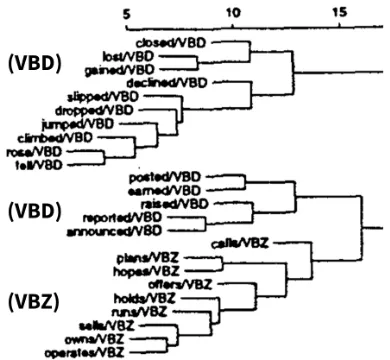
Figure 1: Example of the cutting problem from Parkes et al., (1998) with additional markup for readability
literature as well (Redington et al., 1998).
Parkes et al. (1998) provide a straightforward implementation for simple agglomerative clustering without orthographic input that serves to highlight the benefits and drawbacks of the approach. For each of the 400 most frequent words in the Wall Street Journal corpus, Parkes et al. tabulate the fre-quencies of left and right-context types. Using sym-metricized KL-divergence (KL(p||q) +KL(q||p)) as
a distance metric, they perform agglomerative clus-tering on those 400 types and note the qualitative pu-rity of the resulting clusters. The immediately obvi-ous problem is that there is no perfect mapping from clusters to tags. Figure 1 demonstrates this. Here, there are two pureVBD(past tense verb) clusters, but they cannot be joined without including a cluster of VBZ(present tense verb). Any simple cutting algo-rithm fails by either incorrectly postulating twoVBD classes (VBD1,VBD2, VBZ), or postulating a mixed
VBD/VBZclass. This is a general problem, indepen-dent of the choice of tag set, so while the WSJVBD andVBZshould probably be collapsed into a single V class from a cognitive point of view, that alone does not solve it.
The simple counts over single-word contexts which Parkes et al. (1998) employ are equivalent to the syntactic frames described in the acquisition lit-erature. So while the Parkes et al. study is neither presented as nor performs as a tagging algorithm, it holds promise from a cognitive perspective and
pro-vides clusters similar to those in the cognitive liter-ature. The next two sections describe a prototype-driven labeling algorithm built on top of these clus-ters. The algorithm is described in two parts, first the inner loop basic algorithm which operates on a vocabulary of fixed size, then the outer loop, an iter-ative extension that operates on a growing lexicon.
2.1 Prototype-Driven labeling
Prototype-driven labeling operates over the trees created by hierarchical clustering and makes up the inner loop of the category labeling algorithm. Two vectors, one each of immediate left and right con-text type counts, are tabulated for the topkmost
fre-quent words in a corpus. Next, these k types are grouped by agglomerative clustering. This is slow (O(k2log(k)) in a na¨ıve implementation, but that
can be mitigated with incremental clustering or other approaches. KL-divergence over the concatenated left and right context vectors serves as the distance metric. KL is not symmetric, so for each pair of vec-torsvandw, the sum of the KL-divergence between vandwandwandvis used as in Equation 1, where aandbare two words, andvandware their corre-sponding context vectors.2
d(a, b) =KL(v||w) +KL(w||v) (1)
=X
i
vilog
vi
wi
+wilog
wi
vi
In agglomerative clustering, it is necessary to de-fine alinkage criterion that allows the constructed subtrees to be compared to each other along with individual words. The distance between the sub-trees here is taken as the average distances between their members. This only performs slightly better than taking the minimum distance between any two members of the subtrees, and it can be updated on the fly as new members are added to the tree. Equa-tion 2 gives a formal descripEqua-tion of the average dis-tance criterion. Clustering greedily joins whatever pair of words or subtrees has the smallest distance between them at each step. As a result, the final tree
2This is symmetric and is equivalent to
can be thought of as a rank ordering of word similar-ities. There is no need to track the actual vector val-ues of individual leaves once they have been joined into subtrees.
D(A, B) = 1 |A||B|
X
a∈A
X
b∈B
d(a, b) (2)
Before beginning the category labeling process, seed words are labelled in the tree to simulate se-mantic bootstrapping. This can be done by pick-ing the three most frequent words per actual label as in H&K, or seeds can be chosen by contextual saliency. For a set of n tags, there is a maximum
of 3n seeds in the tree. But if k is small, the
ac-tual number will usually be smaller. It is easy to see why when looking at the WSJ corpus and tag set, but the same is true of smaller cognitively-motivated tag sets as well. The three seeds with theFW “foreign word” tag areperestroika,de, and kanji.3 None of these is in the top thousand most frequent words, so fork= 1000, there must be fewer than3nseeds.
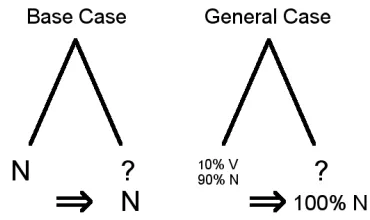
Once the seeds are assigned, the labeling can pro-ceed for the remaining words. This can be equiva-lently implemented during the join steps of erative clustering itself or on the completed agglom-erative tree. Initially, the leaves of the tree are treated as labelled if they are seeds and unlabelled other-wise. Iterating over joins in the order that they oc-cur from the leaves upward, if an unlabelled subtree is joined with a labelled one, each of its leaves is assigned the most common label from the labelled subtree. This is easiest to explain by example. In the simplest case, a seed is joined with an unlabelled word, and that word is assigned the same label as the seed (Figure 2 (left)). In the general case, when a labelled subtree (containing ≥ 1 seed) is joined
with an unlabelled subtree, every word in the unla-belled subtree is assigned the most common label from the labelled subtree. For example, if a subtree that is 90% nouns and 10% verbs is joined with an unlabelled tree, every word in the unlabelled tree is tagged as a noun (Figure 2 (right)). This approach provides a solution to the cutting problem: it is not an issue if multiple clusters map to the same part-of-speech because what matters is the clusters’
[image:4.612.333.518.73.183.2]proxim-3The frequentFWwords effectively date this corpus.
Figure 2:Visual depiction of assignment. (Left) leaves. (Right) subtrees.
ity to the seeds, not to each other. Referring back to the Parkes et al. example in Figure 1, the model will label the tree perfectly as long as each small cluster is centered around a seed.
2.2 Iterative Prototype-Driven labeling
The basic prototype-driven labeling algorithm oper-ates on a hierarchical clustering of fixed sizek. The
labeling step itself is fast, but for large k,
comput-ing the pairwise distance function becomes becomes slow. It also runs afoul of experimental evidence on category learning. Children do not wait patiently to build a large vocabulary complete with distribu-tional information before even attempting to assign syntactic categories. Rather, they assign what they can when they can, potentially revising their assign-ments as they go along (Pinker, 1984; Gleitman et al., 2005).
An iterative extension to the labeling algorithm solves both the practical and empirical problems. Instead of running once on a fixed large k, the
algorithm is run multiple times on a sequence of lexicons with monotonically increasing sizesK = (k0, k1, . . . , km)where each lexicon contains the top
ki most frequent types in the corpus of study. This is meant to approximate which words a learner is statistically most likely to have heard early in devel-opment. The algorithm begins by labeling a small
ki, which is always quick to compute. Then it has working hypotheses for the first ki words while it re-evaluates those words and learns new words up to ki+1. While not purely online (Hewitt, 2017),
once a partial tree has been built, it becomes unnec-essary to compute pairwise distance between every new vocabulary item and existing item. Once it is discovered which seeds are close to a new word, it is sufficient to only compute distances between the new words and those words which are close to its nearest seeds to achieve a kind of clustering. This dovetails nicely with some efficient agglomerative clustering implementations, e.g., (McCallum et al., 2000)’s canopies.
The algorithm attempts classification on frequent words multiple times, so it has the opportunity to use evidence from early classification to inform later at-tempts before picking its best guess in the end. To accomplish this, a confidencevalue is set for each subtree assignment operation. This is defined as the purity of the assigning tree, so a subtree that is 100% adjectives assigns members of an unlabelled subtree with a confidence of 1.0, while a 40% ad-jective, 30% noun, 30% verb subtree only assigns with a confidence of 0.4. Intuitively, a pure sub-tree is likely to represent an actual category cluster, while an impure tree is either a higher-level cluster-ing of category clusters or garbage. Then at the end of each iteration, all words assigned with a confi-dence above some fixed threshold are added to the seed set and become prototypes for the next itera-tion. All other words are reassigned in subsequent it-erations until they become prototypes themselves or the experiment finishes. At the end, all words which were never added to the prototype set are assigned the highest confidence label that they encountered during any iteration.
This iterative extension greatly improves perfor-mance because it expands the seed set as the size of the trees increase. This guarantees that the ra-tio of seeds to non-seeds is always relatively high, which improves assignment performance as long as the augmented seed set remains high accuracy. The ratio of seeds to non-seeds is always high for small
k, but without this process, the ratio is prohibitively
low at largek. Cognitively, this corresponds to the
fact that children build up a lexicon of known words as they are available to them as evidence when cate-gorizing words learned later.
3 Evaluation and Results
In this section, the iterative prototype-driven label-ing model is evaluated on corpora from a wide range of languages. First, we discuss results on the English Brown (Harvard) corpus within the CHILDES cor-pus of child-directed speech (MacWhinney, 2000), since this serves as an in-domain application. Per-formance is compared on a range of tag sets, seed set sizes, and seed selection procedures. Next, we test on a range of languages from the Universal De-pendency Treebank (McDonald et al., 2013) in order to gain insight into how language specific factors in-fluence results while keeping extra-linguistic factors constant to the extent possible. Finally, we run on the WSJ portion of the Penn Treebank (Marcus et al., 1993) and on the Penn Chinese Treebank (Xue et al., 2005) in order to compare against H&K’s prototype-driven model and ground this work in the wider field.
3.1 Evaluation Metrics
Evaluation for supervised POS tagging is straight-forward. Sentences from a test corpus are labelled, then for each token, the proposed label is compared to the human annotated label. The simplest of such metrics isone-to-one token accuracy. On the other hand, the problem of evaluation is more complicated for unsupervised algorithms. Results are broadly not comparable across experiments because a wide of evaluation metrics are employed.4
Token-based metrics are an excellent option when the task is to automatically annotate running text with part-of-speech tags, but they have undesirable traits when applied to syntactic category learning. If syntactic category learning is analogous to label-ing types in a dictionary or lexicon, then labellabel-ing sequences of text just obfuscates results. Type fre-quencies are not uniform across a corpus, so token-based metrics weight assignments to frequent types higher than assignments to infrequent types. For example, an algorithm which labels the pronoun “you” incorrectly will be punished more severely than one which labels the pronoun “whomever” in-correctly simply because “you” is more common than “whomever” in most corpora. This is partic-ularly problematic because word frequencies follow
a distribution where just a few types are hundreds of times more frequent than most others. Mislabel-ing any pronoun is hundreds of times more damag-ing than labeldamag-ing almost any noun from our daily lives (like “table” or “bug”) incorrectly. Mislabel-ing any common noun is much more damagMislabel-ing than mislabeling a rare noun, and noun frequencies can be highly corpus specific. This makes it difficult to gauge the relative performance of different models.
A one-to-many type accuracy is a better choice for scoring syntactic category learning because each item is weighted the same for scoring. In natural lan-guage, types can potentially support multiple labels, so a one-to-many metric is needed to account for this. For example, “bat” could be a noun or a verb, so an algorithm which classifies it as either should be correct. Themany-to-oneaccuracy used in some unsupervised models does not make sense here be-cause the model does not output clusters which need to be mapped. The algorithm never demarcates clus-ters and instead assigns labels to individual items.
The difference between token and type-based metrics becomes clear when calculating the base-lines for our model. Scoring by type accuracy, the baseline is arrived at by scoring the initial seeds as correct and marking everything else wrong. This typically yields a score of under 10%, often under 1%, and corresponds directly to the proportion of types which are selected as seeds. However, this tends to correspond to a>50% token accuracy
be-cause seeds are drawn from the most frequent types. A final type score of, say, 70% is more meaningful than a final token score of 70% because the improve-ment over the baseline is greater.
3.2 Experiments on English CHILDES
The CHILDES corpus contains transcriptions of nat-uralistic child-directed speech. The English subset studied here consists of all caregiver text extracted from Adam, Eve, and Sarah of the Harvard (Brown) corpus, yielding 8,307 types and 588,888 tokens. The tag set used in the Brown corpus consists of 55 idiosyncratic tags, and this is tested along with a mapping that reduces these to an 8-tag (+SKIP5) set (DT,IN,JJ,NN,PRP,RB,VB,SKIP). Table 1 reports
5Tags which do not correspond to any of the 8 are mapped
toSKIPand not scored.
k # Seeds Baseline % Type Acc.
100 58 58.0 94.0
1000 100 10.0 81.2
[image:6.612.328.524.71.121.2]8307 130 1.6 62.8
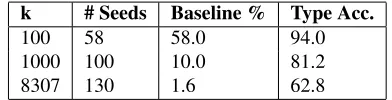
Table 1:CHILDES type accuracy by tree size. Baseline indi-cates the contribution from the seeds alone. Accuracy presented as percents
the impact of k on performance and indicates the
best achieved type accuracy results training on the full Brown tag set then mapping to the reduced set (Brown-to-Reduced) for scoring for finalk = 100,
k = 1000, andk = 8307.6 As expected, percent
correct decreases for higher k because infrequent
words which occur only once or twice in the cor-pus provide weaker distributional information than frequent words do. The number of seeds used never reaches 55*3 because some tags do not appear in the topkwords. This is the same as the WSJ corpus
FW-problem described earlier.
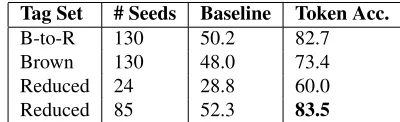
To determine what impact the choice of tag set and number of seeds have on the results, the exper-iment was run and evaluated directly on the Brown tag set as well as the reduced tag set. Reduced tag set experiments were run with 3 seeds per tag and 11 per tag. The Brown-to-reduced tests smooth out the difference between related tags when comput-ing accuracy scores. The difference between B-to-R and straight Brown in Table 2 implies that the model struggles to differentiate some of the Brown tags. This could be because some of the more eccentric Brown tags do not actually distinguish distribution-ally coherent classes. The difference between the 3-seed and 11-3-seed results indicates that performance largely depends on the number of seeds. Note, how-ever, that the baseline is still quite low even with 11 seeds per tag.
The point of syntactic frames is that they are avail-able as primary evidence early on, and nobody who works on them would argue that they are the only source of evidence, so it is unsurprising that perfor-mance declines using frames alone for large k. If
syntactic frames are indeed useful, then we would expect their application on early vocabulary to carry benefits downstream, and this this is what Table 3
6k sequence K = (100,500,900,1000,2000,4000,
k Tag Set # Seeds Baseline Type Acc.
1000 B-to-R 100 10.0 81.2
1000 Brown 100 10.0 70.3 1000 Reduced 24 2.4 51.8 1000 Reduced 85 8.5 80.6 8307 B-to-R 130 1.6 62.8
8307 Brown 130 1.6 44.0
[image:7.612.73.297.70.183.2]8307 Reduced 24 0.3 25.3 8307 Reduced 85 1.0 53.3
Table 2:CHILDES type accuracy by tag set and seed set size
Tag Set # Seeds Basic Acc. Iter. Acc.
B-to-R 130 44.2 62.8
Brown 130 27.7 44.0
Reduced 24 9.3 25.3
Reduced 85 44.0 53.3
Table 3: Comparison between CHILDES basic and iterative prototype-driven labeling performance
shows. It compares the results of iterative applica-tion fromk = 100tok = 8307used for the
previ-ous experiments to a single non-iterative application
k = 8307. The iterative results are 9 to 18 points
higher, demonstrating that syntactic frames applied to early vocabulary set up better performance later. The iterative application of the algorithm which ex-pands the seed set as the lexicon grows is critical to model performance.
Up to this point, seeds have been selected post hoc by corpus frequency, which cannot possibly be how children use semantic bootstrapping. To correct for this, a set of 82 lower frequency but high saliency seed words was selected for comparison based on studies of salience in child-directed speech (Carlson et al., 2014). Tables 5 lays out the result achieved with salient seeds on the reduced tag set, which can be compared to the 11 frequent seed results from Ta-ble 2. The type accuracy is lower and roughly what is to be expected given the size of the seed set even though the seeds themsleves are of lower frequency on average.
Tag Set # Seeds Baseline Token Acc.
B-to-R 130 50.2 82.7
Brown 130 48.0 73.4
[image:7.612.335.516.71.108.2]Reduced 24 28.8 60.0 Reduced 85 52.3 83.5
Table 4:CHILDES one-to-one token accuracy performance
k # Seeds Baseline Type Acc.
1000 74 7.4 73.4
[image:7.612.329.525.130.255.2]8307 82 1.0 49.5
Table 5:CHILDES type accuracy with salient seeds
Language # Seeds k=1,000 k=10,000
French 28 77.92 62.07
German 30 79.04 26.52
Indonesian 30 75.84 65.21 Italian 26 54.26 37.08 Japanese 24 47.78 48.31
Korean 26 33.47 39.19
Portuguese 28 65.40 49.44 Spanish 29 63.41 46.14 Swedish 37 51.10 33.96
Table 6:UTB type accuracy by language
3.3 Experiments on Other Languages
The CHILDES results suggest that information from syntactic frames is useful for assigning syntactic cat-egories from English child-directed speech. In or-der to compare performance across other languages as well, we apply the algorithm to nine languages from the Universal Dependency Treebank: German, Spanish, French, Indonesian, Italian, Japanese, Ko-rean, Brazilian Portuguese, and Swedish. These cor-pora share a 10-tag tag set (excluding punctuation and non-word tags) and were compiled for the same task, which means that different performances re-flect differences in the languages themselves to the extent possible. In order to more closely align these experiments to syntactic category learning, no seeds were provided for the punctuation ( , MAD, MID, PAD) or non-word (X) tags, and punctuation and non-words were not scored.7
Performance varies substantially across lan-guages. Atk= 1000, type accuracy ranges from the
low 30s (Korean), to the high 70s (German, French, Indonesian), and at k = 10000 from the mid 20s
(German) to the 60s (French, Indonesian). Much of this variation can be explained linguistically with the important caveat that extra-linguistic factors in the corpora must still be at play.
Languages with complicated inflection are at a
7Each language was tested with conf idence = 0.3,
0.5, 0.7, 0.9, and 1.0. Only the best confidence for each language is reported. The same k sequence K = (100,500,900,1000,2000,5000,9000,10000)was used each
[image:7.612.85.286.211.270.2] [image:7.612.83.283.646.707.2]disadvantage because the distributional context in-formation of their roots is spread across inflectional forms, and without reference to word-internal fea-tures, it is impossible to group these forms by root to pool that information. For example, while all the distributional information for English BLUE is collected in the contexts for the word “blue,” Ger-man spreads its distributional information across the contexts for its six inflected forms, “blau,” “blauer,” “blauen,” “blauem,” “blaue,” and “blaues,” and our algorithm has no way to combine them.
Another way to think about this is to compare to-ken/type ratios between languages, which are equiv-alent to how many syntactic frames on average con-tribute to the context vectors for each type. A low ratio indicates that the typical context vector is sparser because it accounts for information from fewer frames. Languages with complex inflection naturally have more types and a lower token/type ra-tio.
The particularly poor performance for Korean and Japanese is at least partially due to the UTB cor-pus tokenization which attaches phrase final syntac-tic clisyntac-tics to the preceding word as opposed to stan-dalone tokens. This is in line with the traditional conception of “word” boundaries in these languages (calledbunsetsuin Japanese andeojeolin Korean), but is not an obviously correct choice from a cogni-tive standpoint, and would be equivalent to not seg-menting the possessive’sclitic in English. As shown in Table 7, bunsetsu tokenization creates multiple words forAPPLEandPEARand two example clitics, each with disjoint right contexts, while standalone tokenization would yield one word each for APPLE and PEAR with both clitics as right contexts. This technical choice effectively renders the clitics as in-flections like in German rather than as useful syn-tactic context information. Also, it is unclear why Korean and Japanese perform better at high kthan
lowkat the reported confidences.8
Languages with freer word order are also at a dis-advantage because the entire premise of syntactic frames assumes that the syntax forces categories to appear adjacent to certain other categories. A freer word order means more violations of this
assump-8This only happens for Japanese and Korean, and only at c= 0.7,0.9for both.
Tokenization Text Strings Right Frames
Bunsetsu ringo-ga X ringo-ga:{X} ringo-wo Y ringo-wo:{Y} nashi-ga Z nashi-ga:{Z} nashi-wo W nashi-wo:{W} Standalone ringo ga X ringo:{ga, wo}
ringo wo Y nashi:{ga, wo} nashi ga Z ga:{X, Z} nashi wo W wo:{Y, W} Table 7: Right frames forapple-NOM X,apple-ACC Y, pear-NOM Z, andpear-ACC W
tion relative to the number of frames attested, which manifests as more uniform and less discriminable context vectors.
3.4 Comparison with Haghighi & Klein
In order to ground the performance of this algorithm in the broader research context, we compare results with Haghighi and Klein (2006) since it is similarly semi-supervised. The H&K PROTO model repre-sents the fairest comparison because they were cal-culated on atypically small datasets, fractions of the English Wall Street Journal and Mandarin Chinese Treebank. They report one-to-one token accuracy, so we follow suit.
The WSJ dataset contains 16,839 types across 193,000 tokens9, capitalization removed.10 The model takes 3 seeds for each of the 45 tags in the Penn Treebank tag set. Table 8 presents WSJ type accuracy at k = 1000 and k = 10000. The
1000-type model takes about five minutes to train, while the 10,000-type model takes just over eight hours under a na¨ıve clustering implementation. The performance is overall worse than for CHILDES, likely because the type diversity is much higher than what would be expected in child-directed speech. CHILDES has a token/type ratio of 71.4, and the WSJ’s ratio is almost three times lower at 27.8.
The CTB dataset contains 8,842 types across only 60,000 tokens and is annotated with a 33-tag set sim-ilar to the Penn Treebank tag set. Table 8 compares the Chinese type results to English. The WSJ model outperforms the CTB model, which, among factors like corpus size, is probably related to the number of seeds present and the token/type ratio.
Corpus k # Seeds Baseline Type Acc.
WSJ 1000 95 9.5 57.9
WSJ 10000 95 1.0 30.2
CTB 1000 74 7.4 50.4
[image:9.612.76.297.72.133.2]CTB 8842 74 0.8 27.5
Table 8:Wall Street Journal and Chinese Treebank Type Accu-racy
Model # Seeds Base Top k All All+
k=1000 95 40.5 74.3 54.7 60.2 k=10000 95 40.5 63.2 60.9 61.4 H&K06 135 41.3 - 68.8
-Table 9:Wall Street Journal token accuracy and comparison
The CTB model was trained on all types, but the WSJ model was only trained up to k = 10000
(accounting for 96.46% of tokens) because of time considerations, which makes token accuracy less straightforward to compute. Three numbers are pro-vided:Top konly scores words appearing in the top
k by frequency, All scores the top k as before and
marks all other tokens incorrect, and All+ instead assigns tokens outside the top k the type of their
nearest seed by symmetricized KL-distance. Table 9 compares WSJ results with H&K. Overall perfor-mance is lower but still above 60.
Table 10 compares against H&K’s CTB results. Here, the iterative prototype-driven labeling model is clearly superior. Even thek= 1000Allscore is 8
points higher than H&K’s MRF model, and the best
k= 10000All+score is over 15 points higher. That large discrepancy is due to H&K’s reliance on or-thographic features. Since suffix n-grams are mean-ingless in Chinese, they were forced to discard them from their model. It seems that the reason why H&K outperformed our model by over 7 points on English was that their model made reference to the word-internal features which ours discards. Chinese repre-sents a more level playing field which demonstrates how our model makes good use of sparse distribu-tional information.
Model # Seeds Base Top k All All+
k=1000 74 29.5 62.80 46.9 50.4
k=8841 74 29.5 - 54.1
-H&K06 99 34.4 - 39.0
-Table 10:Chinese Treebank token accuracy and comparison
4 Discussion and Future Work
The minimally supervised iterative prototype-driven labeling algorithm laid out in this paper leverages only simple distributional statistics over adjacent word-forms to perform syntactic category labeling. Nevertheless it achieves English and Chinese re-sults comparable to and surpassing the more com-plex H&K model respectively, and similar perfor-mance on French and Indonesian, though it struggles on other languages.
The most glaring deficiency in the model is that it lacks any notion of word-internal features. Throw-ing away this critical information prevents it from identifying and utilizing affixes as cues for syntac-tic categories and from pooling evidence from word-forms that share common roots. One promising av-enue of research therefore, is determining how to cleanly incorporate morphological information into the clustering algorithm. This will be helpful for languages like Japanese under bunsetsu tokeniza-tion or German, and absolutely critical for language families with complex agglutinative or polysynthetic morphology like Turkic, Eskimo-Aleut, or Bantu.
Perhaps less obviously, the model is missing out on an important generalization by only training on lexical syntactic frames. Children are not only sen-sitive to the specific lexical items surrounding a word, but also the syntactic category of those items (Reeder et al., 2013). For example, a word preceded by a determiner and followed by a noun (DT N) is almost certainly an adjective, regardless of which determiner and which noun it is, so even though the adjectives in “the shiny ball” and “a scary cube” have different lexical contexts, they share the same category context. Relevant to our algorithm, cate-gory contexts reveal distributional similarities that are hidden by lexical contexts alone.
Acknowledgments
[image:9.612.77.295.177.226.2] [image:9.612.79.293.658.707.2]References
Taylor Berg-Kirkpatrick, Alexandre Bouchard-Cˆot´e, John DeNero, and Dan Klein. 2010. Painless unsu-pervised learning with features. InHuman Language Technologies: The 2010 Annual Conference of the North American Chapter of the Association for Com-putational Linguistics, pages 582–590. Association for Computational Linguistics.
Peter F Brown, Peter V Desouza, Robert L Mercer, Vin-cent J Della Pietra, and Jenifer C Lai. 1992. Class-based n-gram models of natural language. Computa-tional linguistics, 18(4):467–479.
Roger W Brown. 1957. Linguistic determinism and the part of speech. The Journal of Abnormal and Social Psychology, 55(1):1.
Matthew T Carlson, Morgan Sonderegger, and Max Bane. 2014. How children explore the phonological network in child-directed speech: A survival analysis of childrens first word productions. Journal of mem-ory and language, 75:159–180.
Emmanuel Chemla, Toben H Mintz, Savita Bernal, and Anne Christophe. 2009. Categorizing words using frequent frames: what cross-linguistic analyses reveal about distributional acquisition strategies. Develop-mental science, 12(3):396–406.
Christos Christodoulopoulos, Sharon Goldwater, and Mark Steedman. 2010. Two decades of unsupervised pos induction: How far have we come? In Proceed-ings of the 2010 Conference on Empirical Methods in Natural Language Processing, pages 575–584. Asso-ciation for Computational Linguistics.
Alexander Clark. 2003. Combining distributional and morphological information for part of speech induc-tion. In Proceedings of the tenth conference on Eu-ropean chapter of the Association for Computational Linguistics-Volume 1, pages 59–66. Association for Computational Linguistics.
Lila R Gleitman, Kimberly Cassidy, Rebecca Nappa, Anna Papafragou, and John C Trueswell. 2005. Hard words. Language Learning and Development, 1(1):23–64.
Sharon Goldwater and Tom Griffiths. 2007. A fully bayesian approach to unsupervised part-of-speech tag-ging. In Annual meeting-association for computa-tional linguistics, volume 45, page 744.
Isaac David Guedalia, Mickey London, and Michael Wer-man. 1999. An on-line agglomerative clustering method for nonstationary data. Neural computation, 11(2):521–540.
Aria Haghighi and Dan Klein. 2006. Prototype-driven learning for sequence models. In Proceedings of the main conference on Human Language Technol-ogy Conference of the North American Chapter of the
Association of Computational Linguistics, pages 320– 327. Association for Computational Linguistics. Yang Charles Hewitt, John. 2017. Bootstrapping for
syn-tactic categories. InCognitive Science Society, Lon-don, UK.
Mark Johnson. 2007. Why doesn’t em find good hmm pos-taggers? InEMNLP-CoNLL, pages 296–305. Brian MacWhinney. 2000. The CHILDES project: The
database, volume 2. Psychology Press.
Michael Maratsos. 1979. How to get from words to sen-tences. Perspectives in Psycholinguistics.
Mitchell P Marcus, Mary Ann Marcinkiewicz, and Beat-rice Santorini. 1993. Building a large annotated cor-pus of english: The penn treebank. Computational lin-guistics, 19(2):313–330.
Andrew McCallum, Kamal Nigam, and Lyle H Ungar. 2000. Efficient clustering of high-dimensional data sets with application to reference matching. In Pro-ceedings of the sixth ACM SIGKDD international con-ference on Knowledge discovery and data mining, pages 169–178. ACM.
Ryan T McDonald, Joakim Nivre, Yvonne Quirmbach-Brundage, Yoav Goldberg, Dipanjan Das, Kuzman Ganchev, Keith B Hall, Slav Petrov, Hao Zhang, Oscar T¨ackstr¨om, et al. 2013. Universal dependency annota-tion for multilingual parsing. InACL (2), pages 92–97. Marie Meteer, Richard Schwartz, and Ralph Weischedel. 1991. Studies in part of speech labelling. In Pro-ceedings of the workshop on Speech and Natural Lan-guage, pages 331–336. Association for Computational Linguistics.
Toben H Mintz. 2003. Frequent frames as a cue for grammatical categories in child directed speech. Cog-nition, 90(1):91–117.
Cornelia Parkes, Alexander Malek, Er M Malek, and Mitchell Marcus. 1998. Towards unsupervised ex-traction of verb paradigms from large corpora. Steven Pinker. 1984. Language learnability and
lan-guage development.
Martin Redington, Nick Chater, and Steven Finch. 1998. Distributional information: A powerful cue for acquiring syntactic categories. Cognitive science, 22(4):425–469.
Patricia A Reeder, Elissa L Newport, and Richard N Aslin. 2013. From shared contexts to syntactic cate-gories: The role of distributional information in learn-ing llearn-inguistic form-classes. Cognitive psychology, 66(1):30–54.
Rushen Shi and Andr´eane Melanc¸on. 2010. Syntac-tic categorization in french-learning infants. Infancy, 15(5):517–533.
Noah A Smith and Jason Eisner. 2005. Contrastive esti-mation: Training log-linear models on unlabeled data. InProceedings of the 43rd Annual Meeting on Associ-ation for ComputAssoci-ational Linguistics, pages 354–362. Association for Computational Linguistics.