ParsPer: A Dependency Parser for Persian
Mojgan Seraji
Uppsala University Department of Linguistics
and Philology, Sweden [email protected]
Bernd Bohnet
Google in London [email protected]
Joakim Nivre
Uppsala University Department of Linguistics
and Philology, Sweden [email protected]
Abstract
We present a dependency parser for Per-sian, calledParsPer, developed using the graph-based parser in the Mate Tools. The parser is trained on the entire Uppsala Persian Dependency Treebankwith a spe-cific configuration that was selected by MaltParser as the best performing parsing representation. The treebank’s syntactic annotation scheme is based on Stanford Typed Dependencies with extensions for Persian. The results of the ParsPer evalua-tion revealed a best labeled accuracy over 82% with an unlabeled accuracy close to 87%. The parser is freely available and re-leased as an open source tool for parsing Persian.
1 Introduction
Data-driven dependency parsing is a modern ap-proach that has been successfully applied to develop dependency parsers for different lan-guages (Böhmová et al., 2003; Haverinen et al., 2010; Kromann, 2003; Foth et al., 2014; Vincze et al., 2010). The approach relies solely on a syntactically annotated dataset (treebank). How-ever, achieving the best results by this method re-lies partly on parsing algorithms and selecting the best feature settings. As data-driven dependency parsers induce the syntactic structure backbone in a treebank, they are further, to a great extent, de-pendent on the representation setup for part-of-speech and dependency labels. These representa-tions are always built upon an already tokenized text. In other words, different tokenizations re-quire different part-of-speech and dependency an-notations, which in turn impact the quality of pars-ing analysis.
Processing and analysis of a language like Per-sian pose a variety of challenges on various
lev-els, from orthography to syntactic structure (Ser-aji, 2015). Persian orthography does not follow a consistent standardization. The most challeng-ing cases concern the handlchalleng-ing of fixed expres-sions and various types of clitics. Different varia-tions of writing such cases as attached or detached forms (either delimited with whitespace or zero-width non-joiner)1 pose challenges for
tokeniza-tion which in turn impacts the quality of mor-phological and syntactic analysis. Furthermore, the prevalence of multi-word compound verbs, functioning as a single verb in the form of so called complex predicates or light verb construc-tions (LVC), is another remarkable feature in the Persian syntactic structure. The situation for auto-matic analysis of Persian is further complicated by its high degree of free word order.
Therefore, in preparing the treebank data for Persian many difficult decisions had to be made concerning handling fixed expressions and differ-ent types of clitics such as pronominal and copula clitics (Seraji, 2015). Fixed expressions in Per-sian are sometimes written as one single token and sometimes as several tokens. The same happens for different types of clitics. They are sometimes segmented and sometimes unsegmented from the head words. Since the treebank data is taken from the large and open source Uppsala Persian Cor-pus (UPC),2 it was impossible to manually
sepa-rate fixed expressions and clitics from head words in a consistent way in a large corpus like the UPC, containing 2,703,265 tokens. On the other hand, to automatically handle such cases was also
impossi-1The width non-joiner (ZWNJ), also known as
zero-space or pseudo-zero-space, is a non-printing character used as a boundary inside a word that keeps different affixes and/or clitics unjoined next to the head words.
2For a more detailed description of the Uppsala
Persian Corpus related to the tokenization and mor-phological annotation see Seraji (2015, Chapter 3). The corpus is open source and freely available at http://stp.lingfil.uu.se/∼mojgan/UPC.html
ble since the process could result in many incorrect conversions by impacting orthographically similar words or endings with different part-of-speech cat-egories.
Hence, to avoid introducing errors in the cor-pus, fixed expressions are handled as distinct to-kens, as long as they were not written as attached forms, and clitics are not separated from the head words but analyzed with special labels at the syn-tactic level instead. Therefore, in the annotation scheme of the Uppsala Persian Dependency Tree-bank, apart from 48 dependency labels for basic relations there are 48 complex dependency labels to cover syntactic relations for words containing unsegmented clitics.
Fine-grained annotated data in treebanks nor-mally provides a more complete grammatical analysis which in turn enhances the quality of parsing results. However, complex annotation may not always be beneficial and can impair auto-matic analysis (Mille et al., 2012; Jelínek, 2014). In this paper, we present different empirical stud-ies where we systematically simplify the annota-tion schemes for part-of-speech tags and depen-dency relations within the treebank.
This paper is organized as follows: Section 2 briefly presents the Uppsala Persian Dependency Treebank. Section 3 introduces the experimental design. In Section 4, ParsPer is presented and eval-uated. Finally, Section 5 concludes the paper.
2 The Uppsala Persian Dependency Treebank
The Uppsala Persian Dependency Treebank (UPDT)3 (Seraji et al., 2013; Seraji, 2015)4 is a
dependency-based syntactically annotated corpus of contemporary Persian with annotation scheme based on dependency structure. The treebank con-sists of 6000 annotated and validated sentences, 151,671 tokens, and 15,692 word types with an average sentence length of 25 words. The data is extracted from the open source part-of-speech annotated and validated Uppsala Persian Corpus (UPC) with different genres, containing newspa-per articles and texts on various topics such as cul-ture, technology, fiction, and art.
3The treebank is freely available and can be downloaded
from http://stp.lingfil.uu.se/∼mojgan/UPDT.html
4For the updated version and a more comprehensive
description of the Uppsala Persian Dependency Treebank
guidelines see Seraji (2015, Chapter 5).
The treebank’s syntactic annotation scheme is based on Stanford Typed Dependencies (STD) (de Marneffe and Manning, 2008) with extensions for Persian. This version of STD has a total of 96 dependency relations of which 48 (including 10 new additions to define the syntactic relations in Persian that could not be covered by the primary scheme developed for English) are used for indi-cating basic relations. The remaining 48 labels are complex, and are used to assign syntactic re-lations to words containing unsegmented clitics. The treebank is open source and freely available in CoNLL-format.5
3 Experimental Design
We carry out two types of experiments, experi-ments with different parsing representations (we define these as basic experiments henceforth) and experiments with different dependency parsers. For the experiments, the treebank is sequentially split into 10 parts, of which segments 1–8 are used for training (80%), 9 for development (10%), and 10 for test (10%). In the basic experiments, we train MaltParser on the training set and test on the development set. In the latter experiments, we train different parsers on the joint training and de-velopment sets (90%) and test on the test set.
We perform the basic experiments under four different conditions. We first experiment with all features and labels that already exist in the tree-bank. The results achieved by this experiment will be used as the baseline results. We then experi-ment with different relation sets by removing or merging various feature distinctions in the part-of-speech tagset and the syntactic annotation scheme. The experiments are designed as indicators to see if the conversions help or do not help the parser. In order to get a realistic picture of the parser per-formance, all these experiments will be performed using automatically generated part-of-speech tags. All the above experiments will be carried out using MaltParser (Nivre et al., 2006). After dis-covering the best label set for both part-of-speech tags and dependency relations, we will experi-ment with other parsers such as MSTParser (Mc-Donald et al., 2005), MateParsers (Bohnet, 2010; Bohnet and Nivre, 2012; Bohnet and Kuhn, 2012), and TurboParser (Martins et al., 2010) to find a state-of-the-art parser for Persian. We evaluate the parsers by experimenting with various feature
tings when optional parameter settings for opti-mization are available and given by the parsers. However, only results for final settings are pre-sented.
The selected state-of-the-art parser for Persian will be calledParsPer. For evaluation of ParsPer we first perform a parsing experiment on the tree-bank data. We then make an independent pars-ing evaluation by applypars-ing the parser on out-of-domain text and present the final results.
3.1 Basic Experiments with MaltParser
To evaluate the overall performance of the parser, we tune parameters to acquire the highest possi-ble results. Thus, we experiment with different algorithms and feature settings to optimize Malt-Parser. To accomplish the optimization process, we apply MaltOptimizer (Ballesteros and Nivre, 2012). Parser accuracy is evaluated on automati-cally generated part-of-speech tags.
In order to generate automatic part-of-speech tags, we used the Persian part-of-speech tagger,
TagPer (Seraji, 2015). However, for the tree-bank experiments we retrained the tagger to ex-clude the treebank data to avoid data overlap. The tagging evaluation performed by the new TagPer revealed an overall accuracy of 97.17%, when trained on 90% of the UPC and evaluated on the remaining 10%. The four different experi-ments include (1) an overall parsing evaluation on full treebank annotation (baseline), (2) an experi-ment without morphological features in the part-of-speech tagset, (3) an experiment without fine-grained LVC labels, and (4) an experiment without complex labels.
3.1.1 Baseline: Full Treebank Annotation
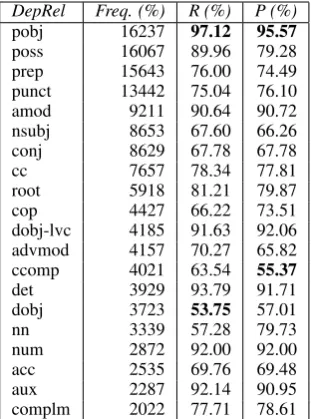
In this parsing evaluation we trained MaltParser on the UPDT with full part-of-speech tags and all existing dependency relations. The experiment re-sulted in a labeled attachment score of 78.84% and an unlabeled attachment score of 83.07%. The re-sults will be used as the baseline for subsequent experiments. Labeled recall and precision for the 20 most frequently dependency relations are pre-sented in Table 1.
The results vary greatly across the relation types, with recall ranging from 53.75% for direct object (dobj) to 97.12% for object of a preposition (pobj), and precision varying between 55.37% for clausal complement (ccomp) to 95.57% for object of a preposition (pobj). As indicated in Table 1
DepRel Freq. (%) R (%) P (%)
pobj 16237 97.12 95.57
poss 16067 89.96 79.28
prep 15643 76.00 74.49
punct 13442 75.04 76.10
amod 9211 90.64 90.72
nsubj 8653 67.60 66.26
conj 8629 67.78 67.78
cc 7657 78.34 77.81
root 5918 81.21 79.87
cop 4427 66.22 73.51
dobj-lvc 4185 91.63 92.06
advmod 4157 70.27 65.82
ccomp 4021 63.54 55.37
det 3929 93.79 91.71
dobj 3723 53.75 57.01
nn 3339 57.28 79.73
num 2872 92.00 92.00
acc 2535 69.76 69.48
aux 2287 92.14 90.95
[image:3.595.339.495.62.272.2]complm 2022 77.71 78.61
Table 1: Labeled recall and precision on the devel-opment set for the 20 most frequent dependency types in the UPDT, whenMaltParseris trained on the full treebank annotation. DepRel = Depen-dency Relations, Freq. = Frequency, R = Recall, P = Precision.
the results for labeled recall and precision for core arguments such as nominal subject (nsubj) and di-rect object (dobj) are slightly low. This can be ex-plained by the fact that, despite the SOV structure in Persian, subjects and objects may shift order in a sentence. As Persian is a pro-drop language, an object might be placed at the beginning of a sen-tence (with or without the accusative marker r¯a) and the subject might either be positioned next or be completely omitted in the sentence but in-stead be inflected as a personal ending on the verb. There are further cases when subject and object are both omitted but appear as personal endings on the verb, as Persian, syntactically, contains a vast amount of dropped subjects and objects. In all cases, it is hard for the system to identify the correct subject and object in the sentence, which may lead to the dependency relations nsubj and
noun compounds (and proper names). However, this difference is not marked in the part-of-speech annotation. Moreover, the number of occurrences of the labelpossin the training data is higher than the labelnn, therefore, it is easier for the parser to identify the structure as the dependency relation
possthannn.
3.1.2 Coarse-Grained Part-of-Speech Tags
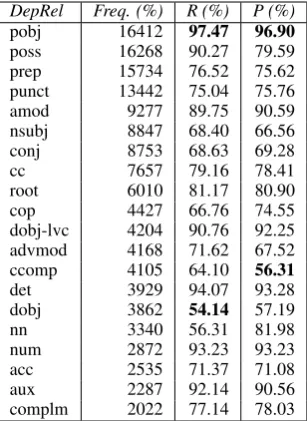
The second empirical study was performed in or-der to select the best part-of-speech encoding set for parsing. In this experiment, we merged all morphological features with their main categories. In this way, feature distinctions that existed for ad-jective, adverb, noun, and verb were all discarded. For instance, ADJ_CMPR, ADJ_INO, ADJ_SUP, and ADJ_VOC were merged with ADJ, and so forth. Hence, we ran MaltParser on UPDT with 15 auto part-of-speech tags instead of 31. Parsing evaluation revealed the scores of 79.24% for la-beled attachment and 83.45% for unlala-beled attach-ment. Comparing the results to the ones obtained by the baseline experiment shows that MaltParser performs better on coarse-grained part-of-speech tags. Table 2 shows the results for labeled recall and precision for the 20 most frequent dependency labels in the UPDT. Again, object of a preposition (pobj) shows the best results with 97.07% for re-call and 95.72% for precision, and direct object (dobj) shows the lowest recall and precision, with 52.55% and 55.56%, respectively.
Comparing the recall and precision results of the 20 most frequent dependency labels to the baseline, we see an improvement in many depen-dency relations. The highest improvement is indi-cated by the relation clause complement (ccomp) with 3.75% enhancement for recall and 6.3% for precision. The dependency relation clause com-plement (ccomp), in the treebank, is assigned for complements that are presented by verbs, nouns, or adjectives. Using coarse-grained part-of-speech tags for verbs, nouns, and adjectives leads to higher results. This further assists the relation complementizer (complm) that always introduces a clausal complement (ccomp) achieving 2.29% higher recall and 3.74% higher precision. To follow up the tables, copula (cop) is also one of the dependency relations that shows good im-provements specifically for precision, resulting in 1.61% higher recall and 4.82% higher precision. As comparison goes on, results show an improve-ment for most of the dependency labels. However,
DepRel Freq. (%) R (%) P (%)
pobj 16237 97.07 95.72
poss 16067 90.18 79.43
prep 15643 76.85 75.57
punct 13442 76.07 76.80
amod 9211 88.69 90.37
nsubj 8653 68.62 64.55
conj 8629 68.85 68.28
cc 7657 78.88 78.14
root 5918 81.38 80.17
cop 4427 67.83 78.33
dobj-lvc 4185 90.23 91.94
advmod 4157 73.31 66.16
ccomp 4021 67.29 61.67
det 3929 94.35 92.78
dobj 3723 52.55 55.56
nn 3339 57.04 82.46
num 2872 92.92 91.79
acc 2535 69.35 70.20
aux 2287 92.14 89.41
[image:4.595.339.495.61.272.2]complm 2022 80.00 82.35
Table 2: Labeled recall and precision on the devel-opment set for the 20 most frequent dependency types in the UPDT, whenMaltParseris trained on the UPDT with coarse-grained auto part-of-speech tags. DepRel = Dependency Relations, Freq. = Frequency, R = Recall, P = Precision.
coarse-grained part-of-speech tags have a nega-tive impact on some dependency labels. This is more or less visible in the dependency relations object of a preposition (pobj), adjectival modi-fier (amod), nominal subject (nsubj), direct object in light verb construction (dobj-lvc), direct object (dobj), noun compound modifier (nn), and auxil-iary (aux) which may due to the lack of various distinctions of nouns, adjectives, and verbs. For instance, plural nouns never appear in complex predicates and as seen in the tables direct object in light verb construction (dobj-lvc) has a drop with 1.40% and 0.12% for recall and precision, respec-tively.
3.1.3 Coarse-Grained LVC Relations
We carried out this experiment by converting all variations of light verb constructions such as
DepRel Freq. (%) R (%) P (%)
pobj 16237 97.45 95.89
poss 16067 89.91 79.65
prep 15643 75.04 73.88
punct 13442 76.22 76.72
amod 9211 89.90 90.32
nsubj 8653 70.30 66.92
conj 8629 67.66 67.90
cc 7657 78.88 78.14
root 5918 82.05 81.23
cop 4427 68.10 78.64
lvc 5427 85.92 90.54
advmod 4157 72.64 68.04
ccomp 4021 64.08 57.18
det 3929 94.07 92.76
dobj 3723 55.26 56.79
nn 3339 58.01 83.28
num 2872 92.92 92.07
acc 2535 70.97 70.97
aux 2287 92.58 92.17
[image:5.595.106.259.60.274.2]complm 2022 80.57 81.50
Table 3: Labeled recall and precision on the devel-opment set for the 20 most frequent dependency types in the UPDT, whenMaltParseris trained on the treebank with fine-grained auto part-of-speech tags only one light verb construction. DepRel = Dependency Relations, Freq. = Frequency, R = Recall, P = Precision.
differing in this regard can only be evaluated un-labeled. Thus, the unlabeled attachment score that measures the number of tokens with correct head can directly be compared with the baseline. This accordingly means that removing the LVC distinc-tions from the treebank helps the parser to obtain higher accuracy. As shown in Table 3, the highest recall and precision scores are shown by object of a preposition (pobj), with 97.45% and 95.89% re-spectively. The lowest recall and precision scores are shown by direct object (dobj) with 55.26% and 56.79%, respectively.
Compared to the baseline results, recall and precision have decreased for the dependency re-lations prepositional modifier (prep) and adjecti-val modifier (amod). This can probably be ex-plained by the fact that merging LVC variations makes it harder for the system to select, for in-stance, a preposition as a prepositional modifier (prep) or an lvc, as well as an adjectival modi-fier (amod) or an lvc. A striking finding from the results is the outcome achieved by the con-version of different light verb constructions tolvc, resulting in 85.92% for recall and 90.54% for cision. Moreover Table 4 shows recall and pre-cision for different types of LVC relations from the baseline experiment when we applied the
fine-grained annotated treebank as well as recall and precision of the dependency labellvcfrom Exper-iment 3 when we tested the treebank with fine-grained part-of-speech tags and merged LVC re-lations. The entries in the table further present information about frequency of acomp-lvc, dobj-lvc, nsubj-lvc, and prep-lvc in Experiment 16 as
well as the frequency of the label lvc in Experi-ment 3. As presented in Table 4, results for call and precision are lower than the baseline re-sults for direct object in light verb construction (dobj-lvc) but higher than the results obtained by the adjectival complement in light verb construc-tion (acomp-lvc) and the preposiconstruc-tional modifier in light verb construction (prep-lvc). However, we should be reminded that the label lvc covers all types of LVC relations and, as mentioned earlier, it is harder for the system to select a proper label to tokens that sometimes participate in LVC relations and sometimes participate in similar relations to LVC labels such as prepositions that occasionally appear either as the dependency relations preposi-tional modifier (prep) or as the preposipreposi-tional mod-ifier in light verb construction (prep-lvc). On the other hand, recall and/or precision for the core ar-guments nominal subject (nsubj) and direct object (dobj) are improved. In other words, recall is im-proved by 2.7% and 1.51% for nominal subject (nsubj) and direct object (dobj), respectively. The dependency relation root is further improved by 0.84% for recall and 1.36% for precision. Thus, this merging might be a disadvantage for the rela-tion preposirela-tional modifier (prep) but favors other relations for instance the nominal subject (nsubj). Although providing recall and precision for each and every LVC distinction on a label-by-label ba-sis is most informative, because the labellvc cov-ers all types of the LVC variations, we cannot di-rectly compare the results of each with the results obtained by the dependency relationlvcin Exper-iment 3, unless we calculate an overall recall and precision score for all the LVC types in Experi-ment 1. The results of such statistical calculations revealed an overall recall and precision of 85.55% and 89.16%. Hence, the overall results show that having various types of LVC distinctions in the treebank do not contribute to higher parsing per-formance.
6Given the low frequency of the LVC relations
DepRel Freq. R (%) P (%)
acomp-lvc 681 80.56 78.38 dobj-lvc 4185 91.63 92.06
nsubj-lvc 7 – –
prep-lvc 554 46.88 78.95
[image:6.595.340.494.62.273.2]lvc 5427 85.92 90.54
Table 4: Recall and precision for LVC relations with fine-grained predicted part-of-speech tags in Experiments 1 and 3. DepRel = Dependency Re-lations, Freq. = Frequency, R = Recall, P = Preci-sion.
3.1.4 No Complex Relations
We additionally experimented with modifying all complex syntactic relations that were used for complex unsegmented word forms (words con-taining unsegmented clitics). In this experiment, all complex dependency relations, containing 48 labels, were merged with basic Persian STD lations, containing 48 labels. The evaluation re-vealed a labeled attachment score of 79.63% and an unlabeled attachment score of 83.42%. As noted earlier, the results from labeled attachment score do not allow a direct comparison with the ones presented for baseline as the two experiments use different label sets. Hence, the comparison evaluation is considered for the unlabeled attach-ment score that shows an improveattach-ment in pars-ing performance when simplifypars-ing the complex dependency relations. This improvement is un-derstandable as some complex relations7 such as ccomp\cpobj, ccomp\nsubj, and so forth, occur only once in the treebank and it is almost impos-sible for a data-driven machine to learn such rare cases from the given data.
As presented in Table 5, there are variations in recall, ranging from 54.14% for direct object (dobj) to 97.47% for object of a preposition (pobj), and in precision, varying between 56.31% for clausal complement (ccomp) to 96.90% for object of a preposition (pobj). Compared to the base-line, recall and precision for the dependency rela-tions adjectival modifier (amod) and complemen-tizer (complm) have dropped in the figures. The relations root and noun compound modifier (nn) as well as punctuation (punct) and auxiliary (aux) further show a decline in recall and precision re-spectively. This can probably be explained by the way it has been annotated for the complex labels.
7Complex relations in the treebank are marked by
back-slash (\) if they precede the segment carrying the main func-tion and a forward slash (/) if they follow it.
DepRel Freq. (%) R (%) P (%)
pobj 16412 97.47 96.90
poss 16268 90.27 79.59
prep 15734 76.52 75.62
punct 13442 75.04 75.76
amod 9277 89.75 90.59
nsubj 8847 68.40 66.56
conj 8753 68.63 69.28
cc 7657 79.16 78.41
root 6010 81.17 80.90
cop 4427 66.76 74.55
dobj-lvc 4204 90.76 92.25
advmod 4168 71.62 67.52
ccomp 4105 64.10 56.31
det 3929 94.07 93.28
dobj 3862 54.14 57.19
nn 3340 56.31 81.98
num 2872 93.23 93.23
acc 2535 71.37 71.08
aux 2287 92.14 90.56
[image:6.595.107.257.62.125.2]complm 2022 77.14 78.03
Table 5: Labeled recall and precision on the devel-opment set for the 20 most frequent dependency types in the UPDT, whenMaltParseris trained on the treebank with fine-grained auto part-of-speech tags and only basic dependency relations. DepRel = Dependency Relations, Freq. = Frequency, R = Recall, P = Precision.
Removing the information provided by the these relations makes it harder for the parser to achieve high results when assigning these labels. How-ever, the parser shows higher scores for the re-maining dependency relations.
3.1.5 Best Parsing Representation
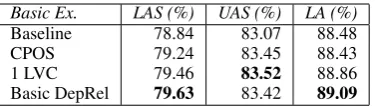
In the recently presented experiments we system-atically simplified the annotation schemes for part-of-speech tags and dependency labels. Table 6 presents a summary of the 4 basic experiments we performed. Although the results in the table are presented with labeled and unlabeled attachment score as well as label accuracy score, figures ob-tained as labeled attachment in Experiments 3 and 4 are not comparable with the one presented in the baseline results, as each performed study uses dif-ferent dependency relation sets. To conclude the four experiments:
Basic Ex. LAS (%) UAS (%) LA (%)
Baseline 78.84 83.07 88.48
CPOS 79.24 83.45 88.43
1 LVC 79.46 83.52 88.86
[image:7.595.89.277.61.114.2]Basic DepRel 79.63 83.42 89.09
Table 6: Labeled and unlabeled attachment scores, and label accuracy in the model selection resulted from 4 empirical studies when MaltParser was trained on UPDT with different simplifications of annotation schemes in predicted part-of-speech tagset and dependency relations. Basic Ex. = Ba-sic Experiments, Baseline = Experiment with a fine-grained annotated treebank, CPOS = Experi-ment with coarser-grained part-of-speech tags and fine-grained dependency relations, 1LVC = Ex-periment with fine-grained part-of-speech tags and dependency relations free from distinctive features in light verb construction, and Basic DepRel = Ex-periment with fine-grained part-of-speech tags and merely basic dependency relations.
• The studies additionally show that simplify-ing the representation of light verb construc-tions helps the parser to perform better with-out loss of important information. In other words, by using coarse LVC, the results be-come less specific and less informative only with respect to the LVC construction, and show better parsing performance. Further-more, the lvc specification at the end can mostly be recovered from the part-of-speech tags in the output.
• Using merely basic relations might provide a marginal improvement but this is not a suf-ficient justification to remove them, because by eliminating the complex labels we lose es-sential information that cannot be recovered by the tagger and this affects the quality of parsing analysis. Applying the treebank with complex relations provides a richer grammat-ical analysis that boost the quality of parsing results.
These results provided us with a valuable insight about how different morphosyntactic parameters in data influence the parsing analysis. The stud-ies also brought us to the point of how we can select the best configuration for further experi-ments. In other words, we will use a representa-tion with coarse-grained part-of-speech tags, sin-gle LVC representation, and fine-grained
depen-dency relations containing both basic and complex labels (96 labels).
3.2 Experiments with Different Parsers
This part is designed for estimating the perfor-mance of different parsers on the best performing data representations selected by MaltParser in the baseline experiments. Hence, we set up the data with the best achieved parameters which are using the automatically generated coarse-grained part-of-speech tags with a single LVC label and the fine-grained dependency relations consisting of 96 basic and complex labels. The treebank is further organized with a different split than in the basic experiments. In other words, we train the parser on the joint training and development sets (90%) and test on the test set (10%). We will experiment with MaltParser (Nivre et al., 2006), MSTParser (Mc-Donald et al., 2005), MateParsers (Bohnet, 2010; Bohnet and Nivre, 2012), and TurboParser (Mar-tins et al., 2010).
For evaluating MaltParser, we used Nivre’s al-gorithms as the algorithms were the best pars-ing algorithms offered by MaltOptimizer durpars-ing the previous experiments. The parser resulted in scores of 79.40% and 83.47% for labeled and un-labeled attachment, respectively.
For evaluating MSTParser, we used the second-order model with projective parsing as this setting had presented the highest results in the earlier pa-rameter tuning experiments. The parser presented the results of 77.79% for labeled and 83.45% for unlabeled attachment scores.
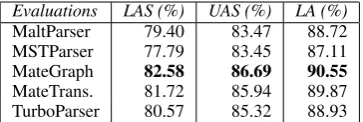
For experimenting with MateParsers, we trained the graph-based and transition-based parsers on the UPDT with the best parameters selected. The results of Mate experiments showed that the graph-based parser outperformed the transition-based parser, resulting in 82.58% for labeled and 86.69% for unlabeled attachment scores.
un-Evaluations LAS (%) UAS (%) LA (%)
MaltParser 79.40 83.47 88.72
MSTParser 77.79 83.45 87.11
MateGraph 82.58 86.69 90.55
[image:8.595.91.273.62.123.2]MateTrans. 81.72 85.94 89.87 TurboParser 80.57 85.32 88.93
Table 7: Best results given by different parsers when trained on UPDT with auto part-of-speech tags, 1LVC, CompRel in the model assessment. MateGraph. = Mate graph-based, MateTrans. = Mate transition-based
labeled attachment scores.
As shown in Table 7 the graph-based parser in the Mate tools achieves the highest results for Per-sian. The developed parser will be treated as the state-of-the-art parser for the language and will be called ParsPer. The parser will undergo further evaluations which will be presented more in detail in the next section.
4 Dependency Parser for Persian: ParsPer
As results of the previous experiments showed, the graph-based MateParser outperformed Malt-Parser, MSTMalt-Parser, and TurboParser obtaining scores of 82.58% and 86.69% for labeled and un-labeled attachment. This means that we need to train the graph-based MateParser, this time, on the entire UPDT with the selected configuration. The developed parser is calledParsPer.8 It is released
as a freely available tool for parsing of Persian and is open source under GNU General Public Li-cense. The parser will further be evaluated in the next subsection.
4.1 The Evaluation of the ParsPer
To evaluate the performance of the ParsPer we made an independent parsing evaluation by run-ning the parser on out-of-domain text. For this, we used texts from the web-based journal
www.hamshahri.com. We downloaded multiple texts based on different genres and then randomly picked 100 sentences containing 2778 tokens with an average sentence length of 28 tokens to develop a test set. As our experiment involved some man-ual work we opted for a small-sized sample to make the evaluation task more feasible. We first created a gold file by manually normalizing the internal word boundaries and character sets and
8http://stp.lingfil.uu.se/
∼mojgan/parsper-mate.html
then segmenting the text into sentence and token levels. We then manually annotated the file with part-of-speech and dependency information using the same part-of-speech and dependency scheme that ParsPer was built on to be served as gold.
In this task we performed three different parsing evaluations. First we applied the parser on the au-tomatically normalized, tokenized and tagged text. This is the main experiment in the ParsPer evalu-ation that also indicates the performance of auto-matic processing of Persian texts at various levels. Next, we performed two more experiments with the 100 randomly selected sentences in order to analyze the results in a more nuanced way, by ex-perimenting on the sentences when they are man-ually normalized and tokenized but automatically tagged and then, when they are manually normal-ized, tokennormal-ized, and tagged.
To create our test set for our first experiment, we automatically normalized the 100 sentences us-ing the Persian normalizerPrePer,9 segmented it
withSeTPer,10and tagged withTagPer.11 A
com-prehensive description of the tools PrePer, SeT-Per, andTagPerare given in Seraji (2015, Chapter 4). Then we parsed the automatically tokenized and tagged text with ParsPer. Since the sentences were automatically tokenized, contained 10 tokens fewer than the gold file (the number of tokens in the gold file were 2788).12 Therefore we could not
directly present labeled and unlabeled attachment scores. However, instead, we present labeled re-call and precision as well as unlabeled rere-call and precision. The parsing evaluation revealed a la-beled recall and precision of 73.52% and 73.79%, and an unlabeled recall and precision of 81.99% and 82.28%, respectively. As could be expected, the results for labeled recall and precision are low. This is due to the fact that apart from incorrect to-kens in the automatically tokenized file there are incorrect part-of-speech tags made by the tagger TagPer that have had a negative impact on the re-sults.
Subsequently, we automatically parsed the manually normalized, tokenized, but automati-cally tagged text and compared the parsing results with the manually parsed gold text. By this
ex-9http://stp.lingfil.uu.se/∼mojgan/preper.html 10http://stp.lingfil.uu.se/
∼mojgan/setper.html
11http://stp.lingfil.uu.se/
∼mojgan/tagper.html
12In addition to the 10 fewer tokens, there were two more
Evaluations LR(%) LP(%) UR(%) UP(%)
AS+AT+AP 73.52 73.79 81.99 82.28
MS+AT+AP 78.50 78.50 86.27 86.27
[image:9.595.190.408.62.104.2]MS+MT+AP 78.76 78.76 86.12 86.12
Table 8: The evaluation of theParsPerwhen tested on 100 randomly selected sentences from the web-based journalHamshahri. LR = Labeled Recall, LP = Labeled Precision, UR = Unlabeled Recall, UP = Unlabeled Precision, AS = Automatically Segmented, AT = Automatically Tagged, AP = Automatically Parsed, MS = Manually Segmented, and MT = Manually Tagged.
periment, we wanted to isolate the impact of tag-ging errors. The evaluation resulted in labeled and unlabeled attachment scores (recall and precision) of 78.50% and 86.27% on the test set with 100 sentences and 2788 tokens. As the results indi-cate, the unlabeled attachment score is close to the unlabeled attachment score obtained by the parser when evaluated on in-domain text. Furthermore, the unlabeled attachment score is 7.77% higher than the labeled attachment score. This may partly be due to fact that the structural variation for the head nodes is lower than the variation for labels. Moreover, we have a firm structure for the head nodes in the syntactic annotation when invariably choosing content words as head position. This solid structure in turn makes it easier for the parser to learn that after repeatedly seeing it. Hence, the parser assigns the head nodes more accurately than the combinations of head and label. This does not mean that it does not exist a consistent structure for the dependency relations. What we mean is that the number of occurrence of certain cases for dependency relations may not be as many as the number of repeated cases for head structures. This might be perceived as a sparseness by the parser which can directly affect the labeled attachment score. Moreover, the syntactic (non)complexity in the data can have a direct impact on the parser per-formance.
Finally, we automatically parsed the manually normalized, tokenized, and tagged text and com-pared the parsing with the manually parsed gold file. The evaluation resulted in a straightfor-ward labeled and unlabeled attachment scores of 78.76% and 86.12% on the test set with 100 sen-tences and 2788 tokens. The same kind of pattern as in the previous experiment was further found here. In other words, we see nearly similar gap of 7.36% between the labeled and unlabeled attach-ment scores. Table 8 shows results from different evaluations of the ParsPer.
The comparison of Experiments 1, 2, and 3
shows that tokenization is a greater problem than tagging for syntactic parsing. Whereas a perfectly tokenized text with tagging errors degrades pars-ing results by less than 1%, errors in tokenization may decrease parsing accuracy as much as 5%. To some extent, this is probably due to additional tagging errors caused by tokenization errors. It is nevertheless clear that tokenization errors disrupt the syntactic structure more than tagging errors do. Adding variations of writing styles (as mentioned earlier) on top of this triggers variations in the tok-enization process, which in turn leads to the parser being unable to realize similar sentences with dif-ferent tokenizations. However, this normally hap-pens when the parser is not familiar with the to-kens (or the order of how toto-kens are represented) in the sentence, which is due to the fact that the structure is not prevalent enough in the training data.
It might be possible to improve the parsing per-formance by adding to or modifying the part-of-speech tag set as well as eliminating or modifying some structures in the syntactic annotation scheme that are not properly favor the parser. Moreover, one can use joint segmentation and tagging sim-ilar to that made for Chinese (Zhang and Clark, 2010). However, this matter will remain for our future research.
5 Conclusion
References
Ballesteros, Miguel and Joakim Nivre (2012). “MaltOptimizer: A System for MaltParser Op-timization”. In:Proceedings of the 8th Interna-tional Conference on Language Resources and Evaluation (LREC), pp. 833–841.
Böhmová, Alena, Jan Hajiˇc, Eva Hajiˇcocá, and Barbora Hladká (2003). “The Prague de-pendency treebank”. In: Treebanks. Springer Netherlands, pp. 103–127.
Bohnet, Bernd (2010). “Top Accuracy and Fast Dependency Parsing is not a Contradiction”. In:
Coling ’10, pp. 89–97.
Bohnet, Bernd and Jonas Kuhn (2012). “The Best of Both Worlds: A Graph-based Completion Model for Transition-Based Parsers”. In:EACL ’12, pp. 77–87.
Bohnet, Bernd and Joakim Nivre (2012). “A Transition-Based System for Joint Part-of-Speech Tagging and Labeled Non-Projective Dependency Parsing”. In:EMNLP-CoNLL ’12, pp. 1455–1465.
de Marneffe, Marie-Catherine and Christopher D. Manning (2008). “The Stanford Typed De-pendencies Representation”. In: COLING’08, pp. 1–8.
Foth, Kilian, Arne Köhn, Niels Beuck, and Wolf-gang Menzel (2014). “Because size does matter: The Hamburg dependency treebank”. In:LREC ’14, pp. 2326–2333.
Haverinen, Katri, Timo Viljanen, Veronika Laip-pala, Samuel Kohonen, Filip Ginter, and Tapio Salakoski (2010). “Treebanking Finnish”. In:
TLT ’10, pp. 79–90.
Jelínek, Tomáš (2014). “Improvements to Depen-dency Parsing Using Automatic Simplification of Data”. In:LREC’14, pp. 73–77.
Kromann, Matthias T. (2003). “The Danish De-pendency Treebank and the DTAG Treebank Tool”. In: TLT ’03. Brown University Press, pp. 217–220.
Martins, André F. T., Noah A. Smith, Eric P. Xing, Pedro M. Q. Aguiar, and Mário A. T. Figueiredo (2010). “Turbo Parsers: Dependency Parsing by Approximate Variational Inference”. In:EMNLP ’10, pp. 34–44.
McDonald, Ryan, Fernando Pereira, Kiril Rib-arov, and Jan Hajiˇc (2005). “Non-Projective De-pendency Parsing Using Spanning Tree Algo-rithms”. In:HLT-EMNLP ’05, pp. 523–530.
Mille, Simon, Alicia Burga, Gabriela Ferraro, and Leo Wanner (2012). “How Does the Granular-ity of an Annotation Scheme Influence Depen-dency Parsing Performance?” In:COLING ’12, pp. 839–852.
Nivre, Joakim, Johan Hall, and Jens Nilsson (2006). “MaltParser: A Data-Driven Parser-Generator for Dependency Parsing”. In:LREC ’06, pp. 2216–2219.
Seraji, Mojgan (2015). “Morphosyntactic Corpora and Tools for Persian”. PhD Thesis. Studia Lin-guistica Upsaliensia 16.
Seraji, Mojgan, Carina Jahani, Beáta Megyesi, and Joakim Nivre (2013). The Uppsala Per-sian Dependency Treebank Annotation Guide-lines. Technical Report. Department of Linguis-tics and Philology, Uppsala.
Vincze, Veronika, Dóra Szauter, Attila Almási, György Móra, Zoltán Alexin, and János Csirik (2010). “Hungarian Dependency Treebank”. In:
LREC ’10, pp. 1855–1862.