Semi-supervised Feature Transformation for Dependency Parsing
Wenliang Chen†, Min Zhang†∗, and Yue Zhang‡
†School of Computer Science and Technology, Soochow University, China ‡Singapore University of Technology and Design, Singapore
{wlchen, mzhang}@suda.edu.cn
Abstract
In current dependency parsing models, con-ventional features (i.e. base features) defined over surface words and part-of-speech tags in a relatively high-dimensional feature space may suffer from the data sparseness problem and thus exhibit less discriminative power on unseen data. In this paper, we propose a novel semi-supervised approach to address-ing the problem by transformaddress-ing the base tures into high-level features (i.e. meta fea-tures) with the help of a large amount of au-tomatically parsed data. The meta features are used together with base features in our final parser. Our studies indicate that our proposed approach is very effective in processing un-seen data and features. Experiments on Chi-nese and English data sets show that the fi-nal parser achieves the best-reported accuracy on the Chinese data and comparable accuracy with the best known parsers on the English data.
1 Introduction
In recent years, supervised learning models have achieved lots of progress in the dependency pars-ing task, as can be found in the CoNLL shared tasks (Buchholz and Marsi, 2006; Nivre et al., 2007). The supervised models take annotated data as training data, utilize features defined over surface words, part-of-speech tags, and dependency trees, and learn the preference of features via adjusting feature weights.
∗Corresponding author
In the supervised learning scenarios, many previ-ous studies explore rich feature representation that leads to significant improvements. McDonald and Pereira (2006) and Carreras (2007) define order features over two adjacent arcs in second-order graph-based models. Koo and Collins (2010) use third-order features in a third-order graph-based model. Bohnet (2010) considers information of more surrounding words for the graph-based mod-els, while Zhang and Nivre (2011) define a set of rich features including the word valency and the third-order context features for transition-based models. All these models utilize richer and more complex feature representations and achieve better performance than the earlier models that utilize the simpler features (McDonald et al., 2005; Yamada and Matsumoto, 2003; Nivre and Scholz, 2004). However, the richer feature representations result in a high-dimensional feature space. Features in such a space may suffer from the data sparseness problem and thus have less discriminative power on unseen data. If input sentences contain unknown features that are not included in training data, the parsers can usually give lower accuracy.
Several methods have been proposed to alleviate this problem by using large amounts of unannotated data, ranging from self-training and co-training (Mc-Closky et al., 2006; Sagae and Tsujii, 2007) to more complex methods that collect statistical information from unannotated sentences and use them as addi-tional features (Koo et al., 2008; Chen et al., 2009).
In this paper, we propose an alternative approach to semi-supervised dependency parsing via feature transformation (Ando and Zhang, 2005). More
specifically, we transform base features to a higher-level space. The base features defined over surface words, part-of-speech tags, and dependency trees are high dimensional and have been explored in the above previous studies. The higher-level features, which we call meta features, are low dimensional, and newly defined in this paper. The key idea be-hind is that we build connections between known and unknown base features via the meta features. From another viewpoint, we can also interpret the meta features as a way of doing feature smoothing.
Our feature transfer method is simpler than that of Ando and Zhang (2005), which is based on splitting the original problem into multiple auxiliary prob-lems. In our approach, the base features are grouped and each group relates to a meta feature. In the first step, we use a baseline parser to parse a large amount of unannotated sentences. Then we collect the base features from the parse trees. The collected features are transformed into predefined discrete values via a transformation function. Based on the transformed values, we define a set of meta features. Finally, the meta features are incorporated directly into parsing models.
To demonstrate the effectiveness of the proposed approach, we apply it to the graph-based parsing models (McDonald and Nivre, 2007). We conduct experiments on the standard data split of the Penn English Treebank (Marcus et al., 1993) and the Chi-nese Treebank Version 5.1 (Xue et al., 2005). The results indicate that the approach significantly im-proves the accuracy. In summary, we make the fol-lowing contributions:
• We define a simple yet useful transformation function to transform base features to meta fea-tures automatically. The meta feafea-tures build connections between known and unknown base features, and relieve the data sparseness prob-lem.
• Compared to the base features, the number of meta features is remarkably small.
• We build semi-supervised dependency parsers that achieve the best accuracy on the Chinese data and comparable accuracy with the best known systems on the English data.
The rest of this paper is organized as follows. Sec-tion 2 introduces the graph-based parsing model.
Section 3 describes the meta features and meta parser. Section 4 describes the experiment settings and reports the experimental results on English and Chinese data sets. Section 5 discusses related work. Finally, in Section 6 we summarize the proposed ap-proach.
2 Baseline parser
In this section, we introduce a graph-based pars-ing model proposed by McDonald et al. (2005) and build a baseline parser.
2.1 Graph-based parsing model
Given an input sentence, dependency parsing is to build a dependency tree. We define X as the set of possible input sentences, Y as the set of possible dependency trees, and D = (x1, y1), ...,(xi, yi), ...,(xn, yn) as a training set of
npairs ofxi ∈ X andyi ∈ Y. A sentence is de-noted byx = (w0, w1, ..., wi, ..., wm), wherew0 is ROOT and does not depend on any other word and
wirefers to a word.
In the graph-based model, we define ordered pair
(wi, wj)∈yas a dependency relation in treeyfrom word wi to word wj (wi is the head andwj is the dependent),Gx as a graph that consists of a set of nodes Vx = {w0, w1, ..., wi, ..., wm} and a set of arcs (edges)Ex = {(wi, wj)|i ̸= j, wi ∈ Vx, wj ∈
(Vx−{w0})}. The parsing model of McDonald et al. (2005) is to search for the maximum spanning tree (MST) in graph Gx. We denote Y(Gx) as the set of all the subgraphs ofGxthat are valid dependency trees (McDonald and Nivre, 2007) for sentencex.
We define the score of a dependency tree y ∈ Y(Gx)to be the sum of the subgraph scores,
score(x, y) =∑
g∈y
score(x, g) (1)
wheregis a spanning subgraph ofy, which can be a single arc or adjacent arcs. In this paper we assume the dependency tree to be a spanning projective tree. The model scores each subgraph using a linear rep-resentation. Then scoring functionscore(x, g)is,
The maximum spanning tree is the highest scoring tree in Y(Gx). The task of decoding algorithms in the parsing model for an input sentencexis to find
y∗, where
y∗ = arg max
y∈Y(Gx)
score(x, y)
= arg max
y∈Y(Gx)
∑
g∈y
score(x, g)
= arg max
y∈Y(Gx)
∑
g∈y
f(x, g)·w (3)
In our system, we use the decoding algorithm proposed by Carreras (2007), which is a second-order CKY-style algorithm (Eisner, 1996) and fea-ture weightsware learned during training using the Margin Infused Relaxed Algorithm (MIRA) (Cram-mer and Singer, 2003; McDonald et al., 2005).
2.2 Base features
Previous studies have defined different sets of fea-tures for the graph-based parsing models, such as the first-order features defined in McDonald et al. (2005), the second-order parent-siblings features de-fined in McDonald and Pereira (2006), and the second-order parent-child-grandchild features de-fined in Carreras (2007). Bohnet (2010) explorers a richer set of features than the above sets. We fur-ther extend the features defined by Bohnet (2010) by introducing more lexical features as the base fea-tures. The base feature templates are listed in Table 1, where h, drefer to the head, the dependent re-spectively, c refers to d’s sibling or child, b refers to the word betweenhandd,+1(−1) refers to the next (previous) word, w and p refer to the surface word and part-of-speech tag respectively,[wp]refers to the surface word or part-of-speech tag,d(h, d)is the direction of the dependency relation betweenh
andd, andd(h, d, c)is the directions of the relation amongh, d, andc. We generate the base features based on the above templates.
2.3 Baseline parser
We train a parser with the base features as the Base-line parser. We define fb(x, g)as the base features andwb as the corresponding weights. The scoring function becomes,
score(x, g) =fb(x, g)·wb (4)
3 Meta features
In this section, we propose a semi-supervised ap-proach to transform the features in the base feature space (FB) to features in a higher-level space (FM) with the following properties:
• The features inFM are able to build connec-tions between known and unknown features in
FBand therefore should be highly informative.
• The transformation should be learnable based on a labeled training set and an automatically parsed data set, and automatically computable for the test sentences.
The features in FM are referred to as meta fea-tures. In order to perform the feature transformation, we choose to define a simple yet effective mapping function. Based on the mapped values, we define feature templates for generating the meta features. Finally, we build a new parser with the base and meta features.
3.1 Template-based mapping function
We define a template-based function for mapping the base features to predefined discrete values. We first put the base features into several groups and then perform mapping.
We have a set of base feature templatesTB. For each template Ti ∈ TB, we can generate a set of base featuresFifrom dependency trees in the parsed data, which is automatically parsed by the Baseline parser. We collect the features and count their fre-quencies. The collected features are sorted in de-creasing order of frequencies. The mapping function for a base featurefbofFiis defined as follows,
Φ(fb) =
Hi ifR(fb)≤TOP10
Mi if TOP10< R(fb)≤TOP30
Li if TOP30< R(fb)
Oi Others
(a) First-order standard
h[wp], d[wp], d(h,d) h[wp], d(h,d) dw, dp, d(h,d) d[wp], d(h,d)
hw, hp, dw, dp, d(h,d) hp, hw, dp, d(h,d) hw, dw, dp, d(h,d) hw, hp, d[wp], d(h,d)
(b) First-order Linear
hp, bp, dp, d(h,d)
hp, h+1p, d−1p, dp, d(h,d) h−1p, hp, d−1p, dp, d(h,d) hp, h+1p, dp, d+1p, d(h,d) h−1p, hp, dp, d+1p, d(h,d)
(c) Second-order standard
hp, dp, cp, d(h,d,c) hw, dw, cw, d(h,d,c) hp, c[wp], d(h,d,c) dp, c[wp], d(h,d,c) hw, c[wp], d(h,d,c) dw, c[wp], d(h,d,c)
(d) Second-order Linear
h[wp], h+1[wp], c[wp], d(h,d,c) h−1[wp], h[wp], c[wp], d(h,d,c) h[wp], c−1[wp], c[wp], d(h,d,c) h[wp], c[wp], c+1[wp], d(h,d,c)
h−1[wp], h[wp], c−1[wp], c[wp], d(h,d,c) h[wp], h+1[wp], c−1[wp], c[wp], d(h,d,c) h−1[wp], h[wp], c[wp], c+1[wp], d(h,d,c) h[wp], h+1[wp], c[wp], c+1[wp], d(h,d,c) d[wp], d+1[wp], c[wp], d(h,d,c)
d−1[wp], d[wp], c[wp], d(h,d,c) d[wp], c−1[wp], c[wp], d(h,d,c) d[wp], c[wp], c+1[wp], d(h,d,c)
d[wp], d+1[wp], c−1[wp], c[wp], d(h,d,c) d[wp], d+1[wp], c[wp], c+1[wp], d(h,d,c) d−1[wp], d[wp], c−1[wp], c[wp], d(h,d,c) d−1[wp], d[wp], c[wp], c+1[wp], d(h,d,c)
Table 1: Base feature templates
total, we have4×N(TB)possible values for all the base features, whereN(TB)refers to the number of the base feature templates, which is usually small. We can obtain the mapped values of all the collected features via the mapping function.
3.2 Meta feature templates
Based on the mapped values, we define meta fea-ture templates in FM for dependency parsing. The meta feature templates are listed in Table 2, where
fb is a base feature of FB, hp refers to the part-of-speech tag of the head andhw refers to the sur-face word of the head. Of the table, the first tem-plate uses the mapped value only, the second and third templates combine the value with the head in-formation. The number of the meta features is rel-atively small. It has 4×N(TB) for the first type,
4 ×N(TB) ×N(P OS) for the second type, and
4×N(TB)×N(W ORD)for the third one, where
N(P OS) refers to the number of part-of-speech tags, N(W ORD) refers to the number of words. We remove any feature related to the surface form if the word is not one of the Top-N most frequent words in the training data. We used N=1000 for the experiments for this paper. This method can reduce the size of the feature sets. The empirical statistics of the feature sizes at Section 4.2.2 shows that the
size of meta features is only 1.2% of base features.
[Φ(fb)]
[Φ(fb)], hp
[Φ(fb)], hw
Table 2: Meta feature templates
3.3 Generating meta features
We use an example to demonstrate how to gener-ate the meta features based on the meta feature tem-plates in practice. Suppose that we have sentence “I ate the meat with a fork.” and want to generate the meta features for the relation among “ate”, “meat”, and “with”, where “ate” is the head, “meat” is the dependent, and “with” is the closest left sibling of “meat”. Figure 1 shows the example.
We demonstrate the generating procedure using template Tk = “hw, dw, cw, d(h, d, c)” (the second template of Table 1-(c) ), which contains the sur-face forms of the head, the dependent, its sibling, and the directions of the dependencies among h,
Accord-I ate the meat with a fork I!!!!ate!!!!the!!!!meat!!!!with!!!!a!!!!fork!!!!.
Tk:!hw,!dw,!cw,!d(h,d,c)
Fb:!ate,!meat,!with,!RIGHTSIB
"(fb)=Mk
[image:5.612.101.276.54.226.2][Mk];![Mk],!VV;![Mk],!ate
Figure 1: An example of generating meta features
ing to the mapping function, we obtain the mapped valueMk. Finally, we have the three meta features “[Mk]”, “[Mk], V V”, and “[Mk], ate”, whereV V is the part-of-speech tag of word “ate”. In this way, we can generate all the meta features for the graph-based model.
3.4 Meta parser
We combine the base features with the meta features by a new scoring function,
score(x, g) =fb(x, g)·wb+fm(x, g)·wm (5) where fb(x, g) refers to the base features, fm(x, g) refers to the meta features, and wb and wm are their corresponding weights respectively. The fea-ture weights are learned during training using MIRA (Crammer and Singer, 2003; McDonald et al., 2005). Note thatwbis also retrained here.
We use the same decoding algorithm in the new parser as in the Baseline parser. The new parser is referred to as the meta parser.
4 Experiments
We evaluated the effect of the meta features for the graph-based parsers on English and Chinese data.
4.1 Experimental settings
In our experiments, we used the Penn Treebank (PTB) (Marcus et al., 1993) for English and the Chinese Treebank version 5.1 (CTB5) (Xue et al., 2005) for Chinese. The tool “Penn2Malt”1was used
1
http://w3.msi.vxu.se/˜nivre/research/Penn2Malt.html
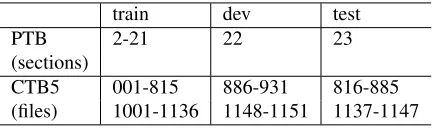
to convert the data into dependency structures with the English head rules of Yamada and Matsumoto (2003) and the Chinese head rules of Zhang and Clark (2008). We followed the standard data splits as shown in Table 3. Following the work of Koo et al. (2008), we used a tagger trained on training data to provide part-of-speech (POS) tags for the devel-opment and test sets, and used 10-way jackknifing to generate part-of-speech tags for the training set. We used the MXPOST (Ratnaparkhi, 1996) tagger for English and the CRF-based tagger for Chinese. We used gold standard segmentation in the CTB5. The data partition of Chinese were chosen to match pre-vious work (Duan et al., 2007; Li et al., 2011; Hatori et al., 2011).
train dev test
PTB 2-21 22 23
(sections)
CTB5 001-815 886-931 816-885 (files) 1001-1136 1148-1151 1137-1147
Table 3: Standard data splits
For the unannotated data in English, we used the BLLIP WSJ corpus (Charniak et al., 2000) contain-ing about 43 million words.2 We used the MXPOST tagger trained on the training data to assign part-of-speech tags and used the Baseline parser to process the sentences of the Brown corpus. For the unanno-tated data in Chinese, we used the Xinhua portion of Chinese Gigaword3 Version 2.0 (LDC2009T14) (Huang, 2009), which has approximately 311 mil-lion words. We used the MMA system (Kruengkrai et al., 2009) trained on the training data to perform word segmentation and POS tagging and used the Baseline parser to parse the sentences in the Giga-word data.
In collecting the base features, we removed the features which occur only once in the English data and less than four times in the Chinese data. The feature occurrences of one time and four times are based on the development data performance.
We measured the parser quality by the unlabeled attachment score (UAS), i.e., the percentage of
to-2
We ensured that the text used for building the meta features did not include the sentences of the Penn Treebank.
3We excluded the sentences of the CTB data from the
[image:5.612.319.535.275.339.2]kens (excluding all punctuation tokens) with the cor-rect HEAD. We also reported the scores on complete dependency trees evaluation (COMP).
4.2 Feature selection on development sets We evaluated the parsers with different settings on the development sets to select the meta features.
4.2.1 Different models vs meta features
In this section, we investigated the effect of dif-ferent types of meta features for the models trained on different sizes of training data on English.
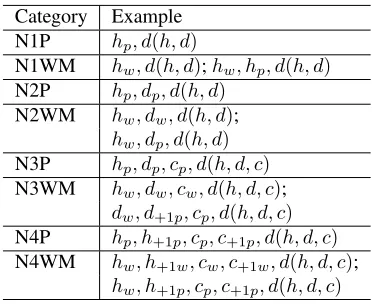
There are too many base feature templates to test one by one. We divided the templates into several categories. Of Table 1, some templates are only lated to part-of-speech tags (P), some are only re-lated to surface words (W), and the others contain both part-of-speech tags and surfaces (M). Table 4 shows the categories, where numbers[1−4]refer to the numbers of words involved in templates. For ex-ample, the templates of N3WM are related to three words and contain the templates of W and M. Based on different categories of base templates, we have different sets of meta features.4
Category Example N1P hp, d(h, d)
N1WM hw, d(h, d);hw, hp, d(h, d)
N2P hp, dp, d(h, d)
N2WM hw, dw, d(h, d);
hw, dp, d(h, d)
N3P hp, dp, cp, d(h, d, c)
N3WM hw, dw, cw, d(h, d, c);
dw, d+1p, cp, d(h, d, c)
N4P hp, h+1p, cp, c+1p, d(h, d, c)
N4WM hw, h+1w, cw, c+1w, d(h, d, c);
[image:6.612.332.520.142.297.2]hw, h+1p, cp, c+1p, d(h, d, c)
Table 4: Categories of base feature templates We randomly selected 1% and 10% of the sen-tences respectively from the training data. We trained the POS taggers and Baseline parsers on these small training data and used them to process the unannotated data. Then, we generated the meta features based on the newly auto-parsed data. The
4We also tested the settings of dividing WM into two
sub-types: W and M. The results showed that both two sub-types provided positive results. To simplify, we merged W and M into one category WM.
meta parsers were trained on the different subsets of the training data with different sets of meta fea-tures. Finally, we have three meta parsers: MP1, MP10, MPFULL, which were trained on 1%, 10% and 100% of the training data.
MP1 MP10 MPFULL Baseline 82.22 89.50 93.01 +N1P 82.42 89.48 93.08 +N1WM 82.80 89.42 93.19 +N2P 81.29 89.01 93.02 +N2WM 82.69 90.10 93.23 +N3P 83.32 89.73 93.05 +N3WM 84.47 90.75 93.80 +N4P 82.73 89.48 93.01 +N4WM 84.07 90.42 93.67 OURS 85.11 91.14 93.91
Table 5: Effect of different categories of meta features Table 5 shows the results, where we add each cat-egory of Table 4 individually. From the table, we found that the meta features that are only related to part-of-speech tags did not always help, while the ones related to the surface words were very helpful. We also found that MP1 provided the largest relative improvement among the three settings. These sug-gested that the more sparse the base features were, the more effective the corresponding meta features were. Thus, we built the final parsers by adding the meta features of N1WM, N2WM, N3WM, and N4WM. The results showed that OURS achieved better performance than the systems with individual sets of meta features.
4.2.2 Different meta feature types
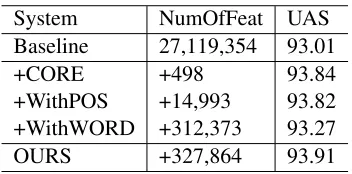
[image:6.612.92.278.392.544.2]System NumOfFeat UAS Baseline 27,119,354 93.01
+CORE +498 93.84
[image:7.612.98.274.58.145.2]+WithPOS +14,993 93.82 +WithWORD +312,373 93.27 OURS +327,864 93.91
Table 6: Numbers of meta features
4.3 Main results on test sets
We then evaluated the meta parsers on the English and Chinese test sets.
4.3.1 English
The results are shown in Table 7, where Meta-Parser refers to the meta parser. We found that the meta parser outperformed the baseline with an ab-solute improvement of 1.01 points (UAS). The im-provement was significant in McNemar’s Test (p
<10−7).
UAS COMP Baseline 92.76 48.05 MetaParser 93.77 51.36
Table 7: Main results on English
4.3.2 Chinese
UAS COMP Baseline 81.01 29.71 MetaParser 83.08 32.21
Table 8: Main results on Chinese
The results are shown in Table 8. As in the ex-periment on English, the meta parser outperformed the baseline. We obtained an absolute improvement of 2.07 points (UAS). The improvement was signif-icant in McNemar’s Test (p<10−8 ).
In summary, Tables 7 and 8 convincingly show the effectiveness of our proposed approach.
4.4 Different sizes of unannotated data
Here, we considered the improvement relative to the sizes of the unannotated data used to generate the meta features. We randomly selected the 0.1%, 1%, and 10% of the sentences from the full data. Table
[image:7.612.350.502.58.158.2]English Chinese Baseline 92.76 81.01 TrainData 91.93 80.40 P0.1 92.82 81.58 P1 93.14 82.23 P10 93.48 82.81 FULL 93.77 83.08
Table 9: Effect of different sizes of auto-parsed data
9 shows the results, where P0.1, P1, and P10 corre-spond to 0.1%, 1%, and 10% respectively. From the table, we found that the parsers obtained more ben-efits as we used more raw sentences. We also tried generating the meta features from the training data only, shown as TrainData in Table 9. However, the results shows that the parsers performed worse than the baselines. This is not surprising because only the known base features are included in the training data.
4.5 Comparison with previous work 4.5.1 English
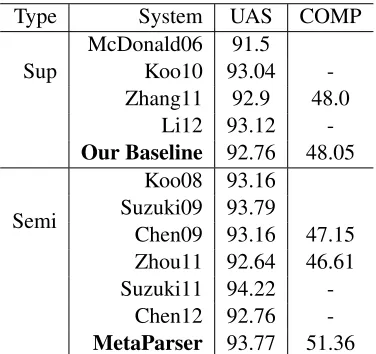
Table 10 shows the performance of the previ-ous systems that were compared, where ald06 refers to the second-order parser of McDon-ald and Pereira (2006), Koo10 refers to the third-order parser with model1 of Koo and Collins (2010), Zhang11 refers to the parser of Zhang and Nivre (2011), Li12 refers to the unlabeled parser of Li et al. (2012), Koo08 refers to the parser of Koo et al. (2008), Suzuki09 refers to the parser of Suzuki et al. (2009), Chen09 refers to the parser of Chen et al. (2009), Zhou11 refers to the parser of Zhou et al. (2011), Suzuki11 refers to the parser of Suzuki et al. (2011), and Chen12 refers to the parser of Chen et al. (2012).
Type System UAS COMP
Sup
McDonald06 91.5 Koo10 93.04 -Zhang11 92.9 48.0
Li12 93.12 -Our Baseline 92.76 48.05
Semi
Koo08 93.16 Suzuki09 93.79
Chen09 93.16 47.15 Zhou11 92.64 46.61 Suzuki11 94.22
[image:8.612.92.280.59.236.2]-Chen12 92.76 -MetaParser 93.77 51.36 Table 10: Relevant results for English. Sup denotes the supervised parsers, Semi denotes the parsers with semi-supervised methods.
[image:8.612.331.522.223.360.2]4.5.2 Chinese
Table 11 shows the comparative results, where Li11 refers to the parser of Li et al. (2011), Hatori11 refers to the parser of Hatori et al. (2011), and Li12 refers to the unlabeled parser of Li et al. (2012). The reported scores on this data were produced by the supervised learning methods and our Baseline (su-pervised) parser provided the comparable accuracy. We found that the score of our meta parser for this data was the best reported so far and significantly higher than the previous scores. Note that we used the auto-assigned POS tags in the test set to match the above previous studies.
System UAS COMP Li11 80.79 29.11 Hatori11 81.33 29.90
Li12 81.21 -Our Baseline 81.01 29.71
[image:8.612.109.264.487.576.2]MetaParser 83.08 32.21 Table 11: Relevant results for Chinese 4.6 Analysis
Here, we analyzed the effect of the meta features on the data sparseness problem.
We first checked the effect of unknown features on the parsing accuracy. We calculated the number of unknown features in each sentence and computed the average number per word. The average
num-bers were used to eliminate the influence of varied sentence sizes. We sorted the test sentences in in-creasing orders of these average numbers, and di-vided equally into five bins. BIN 1 is assigned the sentences with the smallest numbers and BIN 5 is with the largest ones. Figure 2 shows the average accuracy scores of the Baseline parsers against to the bins. From the figure, we found that for both two languages the Baseline parsers performed worse while the sentences contained more unknown fea-tures.
70 75 80 85 90 95 100
1 2 3 4 5
Accuracy
BIN
English Chinese
Figure 2: Accuracies relative to numbers of unknown fea-tures (average per word) by Baseline parsers
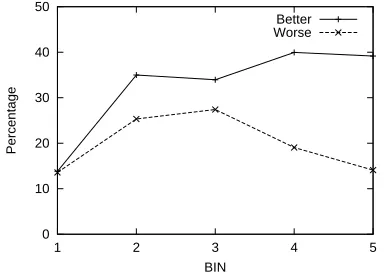
Then, we investigated the effect of the meta fea-tures. We calculated the average number of ac-tive meta featuresper word that were transformed from the unknown features for each sentence. We sorted the sentences in increasing order of the av-erage numbers of active meta features and divided them into five bins. BIN 1 is assigned the sen-tences with the smallest numbers and BIN 5 is with the largest ones. Figures 3 and 4 show the results, where “Better” is for the sentences where the meta parsers provided better results than the baselines and “Worse” is for those where the meta parsers pro-vided worse results. We found that the gap between “Better” and “Worse” became larger while the sen-tences contain more active meta features for the un-known features. The gap means performance im-provement. This indicates that the meta features are very effective in processing the unknown features.
5 Related work
0 10 20 30 40 50
1 2 3 4 5
Percentage
BIN
[image:9.612.93.282.63.201.2]Better Worse
Figure 3: Improvement relative to numbers of active meta features on English (average per word)
0 10 20 30 40 50
1 2 3 4 5
Percentage
BIN
Better Worse
Figure 4: Improvement relative to numbers of active meta features on Chinese (average per word)
Several previous studies relevant to our approach have been conducted.
Koo et al. (2008) used a word clusters trained on a large amount of unannotated data and designed a set of new features based on the clusters for dependency parsing models. Chen et al. (2009) extracted sub-tree structures from a large amount of data and rep-resented them as the additional features to improve dependency parsing. Suzuki et al. (2009) extended a Semi-supervised Structured Conditional Model (SS-SCM) of Suzuki and Isozaki (2008) to the depen-dency parsing problem and combined their method with the word clustering feature representation of Koo et al. (2008). Chen et al. (2012) proposed an ap-proach to representing high-order features for graph-based dependency parsing models using a depen-dency language model and beam search. In future work, we may consider to combine their methods with ours to improve performance.
Several previous studies used co-training/self-training methods. McClosky et al. (2006) presented a self-training method combined with a reranking al-gorithm for constituency parsing. Sagae and Tsujii (2007) applied the standard co-training method for dependency parsing. In their approaches, some au-tomatically parsed sentences were selected as new training data, which was used together with the orig-inal labeled data to retrain a new parser. We are able to use their approaches on top of the output of our parsers.
With regard to feature transformation, the work of Ando and Zhang (2005) is similar in spirit to our work. They studied semi-supervised text chunking by using a large projection matrix to map sparse base features into a small number of high level features. Their project matrix was trained by transforming the original problem into a large number of auxiliary problems, obtaining training data for the auxiliary problems by automatically labeling raw data and us-ing alternatus-ing structure optimization to estimate the matrix across all auxiliary tasks. In comparison with their approach, our method is simpler in the sense that we do not request any intermediate step of split-ting the prediction problem, and obtain meta fea-tures directly from self-annotated data. The training of our meta feature values is highly efficient, requir-ing the collection of simple statistics over base fea-tures from huge amount of data. Hence our method can potentially be useful to other tasks also.
6 Conclusion
[image:9.612.91.284.257.393.2]part-of-speech tagging and Chinese word segmentation, in future work.
Acknowledgments
This study was started when Wenliang Chen and Min Zhang were members of the Department of Human Language Technology, Institute for Info-comm Research, Singapore. Wenliang Chen was funded partially by the National Science Founda-tion of China (61203314) and Yue Zhang was sup-ported by MOE grant 2012-T2-2-163. We would also thank the anonymous reviewers for their de-tailed comments, which have helped us to improve the quality of this work.
References
R.K. Ando and T. Zhang. 2005. A high-performance semi-supervised learning method for text chunking.
ACL.
Bernd Bohnet. 2010. Top accuracy and fast dependency parsing is not a contradiction. InProceedings of the 23rd International Conference on Computational Lin-guistics (Coling 2010), pages 89–97, Beijing, China, August. Coling 2010 Organizing Committee.
S. Buchholz and E. Marsi. 2006. CoNLL-X shared task on multilingual dependency parsing. InProc. of CoNLL-X. SIGNLL.
Xavier Carreras. 2007. Experiments with a higher-order projective dependency parser. InProceedings of the CoNLL Shared Task Session of EMNLP-CoNLL 2007, pages 957–961, Prague, Czech Republic, June. Asso-ciation for Computational Linguistics.
Eugene Charniak, Don Blaheta, Niyu Ge, Keith Hall, John Hale, and Mark Johnson. 2000. BLLIP 1987-89 WSJ Corpus Release 1, LDC2000T43. Linguistic Data Consortium.
Wenliang Chen, Jun’ichi Kazama, Kiyotaka Uchimoto, and Kentaro Torisawa. 2009. Improving dependency parsing with subtrees from auto-parsed data. In Pro-ceedings of EMNLP 2009, pages 570–579, Singapore, August.
Wenliang Chen, Min Zhang, and Haizhou Li. 2012. Uti-lizing dependency language models for graph-based dependency parsing models. In Proceedings of ACL 2012, Korea, July.
Koby Crammer and Yoram Singer. 2003. Ultraconser-vative online algorithms for multiclass problems. J. Mach. Learn. Res., 3:951–991.
Xiangyu Duan, Jun Zhao, and Bo Xu. 2007. Probabilis-tic models for action-based chinese dependency pars-ing. In Proceedings of ECML/ECPPKDD, Warsaw, Poland.
J. Eisner. 1996. Three new probabilistic models for de-pendency parsing: An exploration. InProceedings of COLING1996, pages 340–345.
Jun Hatori, Takuya Matsuzaki, Yusuke Miyao, and Jun’ichi Tsujii. 2011. Incremental joint pos tag-ging and dependency parsing in chinese. In Proceed-ings of 5th International Joint Conference on Natu-ral Language Processing, pages 1216–1224, Chiang Mai, Thailand, November. Asian Federation of Natu-ral Language Processing.
Chu-Ren Huang. 2009. Tagged Chinese Gigaword Ver-sion 2.0, LDC2009T14. Linguistic Data Consortium. Terry Koo and Michael Collins. 2010. Efficient
third-order dependency parsers. In Proceedings of ACL 2010, pages 1–11, Uppsala, Sweden, July. Association for Computational Linguistics.
T. Koo, X. Carreras, and M. Collins. 2008. Simple semi-supervised dependency parsing. InProceedings of ACL-08: HLT, Columbus, Ohio, June.
Canasai Kruengkrai, Kiyotaka Uchimoto, Jun’ichi Kazama, Yiou Wang, Kentaro Torisawa, and Hitoshi Isahara. 2009. An error-driven word-character hybrid model for joint Chinese word segmentation and POS tagging. InProceedings of ACL-IJCNLP2009, pages 513–521, Suntec, Singapore, August. Association for Computational Linguistics.
Zhenghua Li, Min Zhang, Wanxiang Che, Ting Liu, Wen-liang Chen, and Haizhou Li. 2011. Joint models for chinese pos tagging and dependency parsing. In Pro-ceedings of EMNLP 2011, UK, July.
Zhenghua Li, Min Zhang, Wanxiang Che, and Ting Liu. 2012. A separately passive-aggressive training algo-rithm for joint pos tagging and dependency parsing. In Proceedings of the 24rd International Conference on Computational Linguistics (Coling 2012), Mumbai, India. Coling 2012 Organizing Committee.
Mitchell P. Marcus, Beatrice Santorini, and Mary Ann Marcinkiewicz. 1993. Building a large annotated cor-pus of English: the Penn Treebank. Computational Linguisticss, 19(2):313–330.
D. McClosky, E. Charniak, and M. Johnson. 2006. Reranking and self-training for parser adaptation. In
Proceedings of Coling-ACL, pages 337–344.
R. McDonald and J. Nivre. 2007. Characterizing the errors of data-driven dependency parsing models. In
Proceedings of EMNLP-CoNLL, pages 122–131. Ryan McDonald and Fernando Pereira. 2006.
Ryan McDonald, Koby Crammer, and Fernando Pereira. 2005. Online large-margin training of dependency parsers. In Proceedings of ACL 2005, pages 91–98. Association for Computational Linguistics.
Joakim Nivre and Mario Scholz. 2004. Determinis-tic dependency parsing of English text. In Proc. of the 20th Intern. Conf. on Computational Linguistics (COLING), pages 64–70.
J. Nivre, J. Hall, S. K¨ubler, R. McDonald, J. Nilsson, S. Riedel, and D. Yuret. 2007. The CoNLL 2007 shared task on dependency parsing. In Proceedings of the CoNLL Shared Task Session of EMNLP-CoNLL 2007, pages 915–932.
Adwait Ratnaparkhi. 1996. A maximum entropy model for part-of-speech tagging. InProceedings of EMNLP 1996, pages 133–142.
K. Sagae and J. Tsujii. 2007. Dependency parsing and domain adaptation with LR models and parser ensem-bles. InProceedings of the CoNLL Shared Task Ses-sion of EMNLP-CoNLL 2007, pages 1044–1050. Jun Suzuki and Hideki Isozaki. 2008. Semi-supervised
sequential labeling and segmentation using Giga-word scale unlabeled data. InProceedings of ACL-08: HLT, pages 665–673, Columbus, Ohio, June. Association for Computational Linguistics.
Jun Suzuki, Hideki Isozaki, Xavier Carreras, and Michael Collins. 2009. An empirical study of semi-supervised structured conditional models for dependency parsing. InProceedings of EMNLP2009, pages 551–560, Sin-gapore, August. Association for Computational Lin-guistics.
Jun Suzuki, Hideki Isozaki, and Masaaki Nagata. 2011. Learning condensed feature representations from large unsupervised data sets for supervised learning. In Pro-ceedings of the 49th Annual Meeting of the Associa-tion for ComputaAssocia-tional Linguistics: Human Language Technologies, pages 636–641, Portland, Oregon, USA, June. Association for Computational Linguistics. Nianwen Xue, Fei Xia, Fu dong Chiou, and Martha
Palmer. 2005. Building a Large Annotated Chinese Corpus: the Penn Chinese Treebank. Journal of Natu-ral Language Engineering, 11(2):207–238.
Hiroyasu Yamada and Yuji Matsumoto. 2003. Statistical dependency analysis with support vector machines. In
Proceedings of IWPT 2003, pages 195–206.
Y. Zhang and S. Clark. 2008. A tale of two parsers: In-vestigating and combining graph-based and transition-based dependency parsing. InProceedings of EMNLP 2008, pages 562–571, Honolulu, Hawaii, October. Yue Zhang and Joakim Nivre. 2011. Transition-based
dependency parsing with rich non-local features. In
Proceedings of ACL-HLT2011, pages 188–193, Port-land, Oregon, USA, June. Association for Computa-tional Linguistics.