Proceedings of the 3rd Workshop on EVENTS at the NAACL-HLT 2015, pages 108–116,
Interoperability of cross-lingual and cross-document event detection
Piek Vossen
VU University Amsterdam De Boelelaan 1105
Amsterdam, 1081HV, Netherlands
Egoitz Laparra, Itziar Aldabe and German Rigau
The University of the Basque Country Donostia-San Sebasti´an, Spain
[email protected] [email protected]
Abstract
We describe a system for event extraction across documents and languages. We devel-oped a framework for the interoperable se-mantic interpretation of mentions of events, participants, locations and time, as well as the relations between them. Furthermore, we use a common RDF model to represent in-stances of events and normalised entities and dates. We convert multiple mentions of the same event in English, Spanish and Dutch to a single representation. We thus resolve cross-document event and entity coreference within a language but also across languages. We tested our system on a Wikinews corpus of 120 English articles that have been manually translated to Spanish and Dutch. We report on the cross-lingual cross-document event and entity extraction comparing the Spanish and Dutch output with respect to English.
1 Introduction
News reports on events in the world. Applying event extraction to many different news articles provides an interesting perspective on event-coreference, as-suming that different sources in different languages report on the same events. These texts may partially provide the same and partly different information on these events. To deal with cross-document event coreference, it is necessary to make a formal differ-ence between the mentions of an event in text and its representation as single event instance. Ideally, we want to be able to match event descriptions within a text, across texts and across languages into a sin-gle representation. The fact that different sources
provide different information opens new perspec-tives to study the role of these sources in reporting on what happened in the world. When we consider news written in different languages this perspective becomes more complex but also more interesting.
For such a cross-document and cross-lingual per-spective it is essential to define a semantically inter-operable approach that can handle the large variation of event expressions within and across languages. In this paper, we report on a system to derive in-teroperable event representations across documents and across languages. In particular, we focus on En-glish, Spanish and Dutch. Firstly, we developed Nat-ural Language Processing (NLP) pipelines for inter-preting mentions of events and event components in text in a uniform way and, secondly, we developed a method to derive instance representations for these interpretations in RDF that is agnostic for the lin-guistic forms of expression. We report on the eval-uation of the systems on a publicly available corpus of English Wikinews articles that has been translated to Spanish and Dutch. We show the capability of our framework and system to perform cross-lingual event extraction from multiple documents, which is, to our knowledge, the first in its kind.
This paper is further structured as follows. In tion 2, we describe relevant related work and in sec-tion 3, we describe our approach to aggregate event information across different mentions in RDF. In section 4, we explain the interoperability of the NLP pipelines in the three languages. The conversion of the NLP output to RDF is then explained in section 5. Finally, we present the evaluation results in sec-tion 6 and we conclude in secsec-tion 7.
2 Related work
In Unstructured Information Management Architec-ture (UIMA) (Ferrucci and Lally, 2004) interoper-ability is provided by platform independent data rep-resentations and interfaces. Information is repre-sented in the Common Analysis Structure (CAS). In CAS, annotations are defined as typed objects. For each type, a set of features is defined and an is-a relation with its supertype from which features are inherited. The Subject of Analysis (Sofa) method is used to allow for multiple annotations of the same object. UIMA uses a layered stand-off representa-tion for the annotarepresenta-tions of text. A similar approach is followed in the OntoNotes project (Pradhan et al., 2007). In OntoNotes multiple layers of annotation defined in a relational database are combined to ar-rive at semantic interpretations. Both approaches focus on the generic annotation of text. Howewer, they do not specifically focus on the representation of events and they do not present events according to an RDF model independently of the text as a natural way of cross-document event representation.
The idea of using Linked Data and RDF to rep-resent linguistic annotations for achieving interop-erability among linguistic resources has been dis-cussed previously (Chiarcos et al., 2012). Follow-ing Linked Data and RDF principles provides a way to address conceptual interoperability among resources, i.e. the ability of heterogeneous NLP resources and tools to talk and understand each other. (Ide et al., 2003) explicitly mention RDF as a possible format to provide semantic coher-ence in representations. The NLP2RDF initiative collects a number of efforts for representing NLP related information in RDF, including notable ef-forts such as Ontologies for Linguistic Annotation (OLiA) (Chiarcos, 2008). FRED (Presutti et al., 2012) also produces automatically RDF/OWL and linked data from natural language sentences, but its output is currently limited to English. Still, to our knowledge, there are relatively few implementations of RDF-compatible annotation formats that are ac-tively used or produced by NLP modules. Notable exceptions are the NLP Interchange Format (NIF) (Hellmann et al., 2013), which is tightly linked to OLiA, UIMA Clerezza, and the conversion of GrAF to RDF by (Cassidy, 2010). NIF has the
disadvan-tage that it is not easy to integrate its representations in NLP tools, as shown by user evaluations (Hell-mann et al., 2013). Because linguistic annotations are linked to strings it is furthermore not practical for representing hierarchical structures. (Fokkens et al., 2014) presents a more detailed discussion of the formal representations of linguistic annotations.
Besides the formal representation of NLP output, our work relates to the representation of events and cross-document and cross-lingual event coreference. Cross-document event coreference so far has been addressed as a task, in which event markables are related to each other as coreference sets (Bejan and Harabagiu, 2010; Lee et al., 2012). For instance, the ECB corpus represents events and coreference relations using inline annotations in text and cross-document identifiers with offset references. Repre-sentation and evaluation of cross-document event-coreference is often done using scorers that use the CONLL-2011 format for expressing coreference (Pradhan et al., 2011). This format also exploits a simple token representation and identifiers. To the best of our knowledge, nobody really addressed the semantic representation of events as instances, exploiting interoperable semantic representations of event instances and entity instances according to Se-mantic Web practices.
3 The representation of event mentions and instances
Events can be defined as situations in the world in which certain entities participate, where this partic-ipation relation is bound in time and place. In text, we make reference to these events in many different ways. Each time we refer to an event in text, the expression through which we make reference can be seen as a mention of the event that we consider to be an instance of a mental representation or real-world event. Typically, there is a coreference relation be-tween different mentions of the same event instance. In many cases, mentions that refer to events are partial, i.e. not all the details about an event are given within a single sentence. For example, the next sentences from a Wikinews1 article make
ref-erence to a singleflightbut the details are given in 1http://en.wikinews.org/wiki/A380_makes_
different expressions:
A380 makes maiden flight to US. March 19, 2007. The Airbus A380, the world’s largest passenger plane, was set to land in the United States of Amer-ica on Monday after a test flight. One of the A380s is flying from Frankfurt to Chicago via New York; the airplane will be carrying about 500 people.
The main event is thetest flightwhich is mentioned in the title, at the end of the first sentence and re-ferred to again in the second sentence asflying. The
carrying is a subevent of the main event, whereas one could argue whetherlandingis a subevent or a following event. The date of the event is given in the first sentence (Monday), which refers to March 19, 2007, the flight route is given in the second sentence and passengers are mentioned in the last clause:500 peoplethrough the implicit relation between carry-ingandflying.
Depending if carrying andlanding are different events, we have in this example 5 mentions of 3 unique events. To aggregate the information for theflightevent, we need to resolve coreference and combine the information from each coreferential mention into a single representation for the instance. To connect the mentions to the instance represen-tation, we use the Grounded Annotation Frame-work (GAF) (Fokkens et al., 2013). Within GAF, instances are represented according to the Simple Event Model (SEM) (van Hage et al., 2011) using a unique URI and relations to actors, places and time. Furthermore, we use thegaf:denotedBy relation to point to the offset mentions of the event in the text. When applied to the above example, the event in-stance for theflightwould be represented as follows, where we abstract from the specific roles of the ac-tors and places:
:ev17Flight
rdfs:label "maiden flight", "test flight", "flying" ; gaf:denotedBy
wikinews:A380_makes_maiden_flight_to_US#char=19,25, wikinews:A380_makes_maiden_flight_to_US#char=174,180, wikinews:A380_makes_maiden_flight_to_US#char=202,208; sem:hasTime wikinews:20070319;
sem:hasActor dbp:Airbus_A380, wikinews:500_people; sem:hasPlace dbp:United_States, dbp:Frankfurt, dbp:Chicago,
dbp:New_York.
Each of the actors, places and points in time is rep-resented as an entity instance as well, with pointers to the mentions in the text. Below, we show the rep-resentation ofAirbusas an example with 2 mentions in the same document:
dbp:Airbus
rdfs:label "Airbus A380", "A380" ; gaf:denotedBy
wikinews:A380_makes_maiden_flight_to_US#char=415,421, wikinews:A380_makes_maiden_flight_to_US#char=1132,1138. In this example, the actors, places and time points are aggregated from different mentions in a single representation. If another text is processed, we may detect more mentions of the same event and the same entities. In principle, this will lead to the same in-stance representation for the event where we only need to extend the gaf:denotedBy relations to the new mentions and if it happens aggregate more rela-tions to other entities.
A380 commercial route proving. 19-28 March 2007. Watch the A380 as it makes its first landings in the United States as part of a 12-day commercial route proving mission in 2007, performed in con-junction with Lufthansa. Follow the aircraft as it flies to New York, Chicago and Washington, D.C., as well as Hong Kong, Frankfurt and Munich.
This message partially overlaps with the previous one but also describes more stops on the route of the airplane. Establishing coreference across the two flights and the A380 results in a single event instance combining the data and pointing to different men-tions across the two articles:
:ev17Flight
rdfs:label "maiden flight", "test flight", "flying", "flies" ; gaf:denotedBy
wikinews:A380_makes_maiden_flight_to_US#char=19,25, wikinews:A380_makes_maiden_flight_to_US#char=174,180, wikinews:A380_makes_maiden_flight_to_US#char=202,208, http://www.airbus.com/newsevents/events/mention#char=242,247; sem:hasTime wikinews:20070319;
sem:hasActor dbp:Airbus_A380, wikinews:500_people; sem:hasPlace dbp:United_States, dbp:Frankfurt,
dbp:Chicago, dbp:New_York, dbp:Washington_D.C., dbp:Hong_Kong; dbp:Munich.
Obviously, many similar events are reported which, however, do not refer to the same event instance. Consider the next news item2that reports on another maiden flightof the Airbus A380 in 2008:
Qantas A380 arrives in LA after maiden flight. Oc-tober 21, 2008. The first flight of an Airbus A380 by Qantas touched down in Los Angeles today, in-augurating the Australian carrier’s service using the world’s biggest commercial jet.
This flight involves a similar participant, Airbus A380 and a different location: Los Angeles. The 2http://www.theage.com.au/articles/2008/
main and only distinguishing feature is the date that makes it a different event from the previous exam-ple. Hence, it will get a different instance represen-tation:
:ev18Flight
rdfs:label "maiden flight", "flight"; gaf:denotedBy
http://www.theage.com.au/articles/2008/10/21/ 1224351190665.html#char=33,46,
http://www.theage.com.au/articles/2008/10/21/ 1224351190665.html#char=72,78;
sem:hasTime wikinews:20081021; sem:hasActor dbp:Airbus_A380;
sem:hasPlace dbp:United_States, dbp:Los_Angeles.
The above model allows us to combine the informa-tion across different meninforma-tions within and across doc-uments of the same language. However, the model is also agnostic of the language in which the infor-mation is expressed. Likewise, we can use the same model to represent the information from texts in dif-ferent languages. In order to achieve that, the pro-cessing of text across these languages needs to be semantically interoperable. Since we defined events as combinations of actions (or relations and prop-erties), actors, places and time, we also need to achieve an interoperable interpretation of these el-ements across languages. This will be discussed in the next section.
4 The interoperable interpretation of event and entity mentions across languages Detecting mentions of events, entities and time ex-pressions in text in several languages requires the combination of various Natural Language Process-ing modules. Our framework and system obtains in-teroperable representations of the interpretation of events, the entities that play a role within these events as well as the time expressions associated to the events. The output of the language specific pipelines is represented in the Natural Language Processing Format (NAF) (Fokkens et al., 2014). NAF is a standoff layered format for many different annotations, such as tokens, entities, semantic role (SR) structures and time expressions, where the el-ements in the layers point to spans of terms. In the next examples, we show in NAF entities, a SR struc-ture with a predicate and several of its roles, and a time expression for an English text. Each of the ele-ments has a span element pointing to term identifiers that mark words and phrases in the text. We see in the first structure that the expressionUnited Statesis detected as a named entity of the type LOCATION
and is disambiguated to a DBpedia entry.3 The SR
element consists of a predicate and roles, where the predicate has references to various FrameNet frames (Baker et al., 1998) and WordNet synsets (Fellbaum, 1998) along with the predicate information included in the Predicate Matrix (Lacalle et al., 2014). The roles have a PropBank role (Palmer et al., 2005) and possibly one or more FrameNet elements.4 Finally,
the time expressionMondayhas been normalised by reference to a particular date.
<entity id="e3" type="LOCATION"> <!--United States-->
<span><target id="t28"/><target id="t29"/></span> <externalReferences>
<externalRef confidence="0.94"
reference="http://dbpedia.org/resource/United_States reftype="en" resource="spotlight_v1"/>
</externalReferences> </entity>
<predicate id="pr5"> <!--flying--> <externalReferences>
<externalRef reference="fn:Bringing", "fn:Motion", "fn:Operate_vehicle", "fn:Ride_vehicle",
"fn:Self_motion", "wn:ili-30-01451842-v", <externalRef reference="wn:ili-30-01847845-v", "wn:ili-30-01840238-v", "wn:ili-30-02140965-v"/> </externalReferences>
<span><target id="t44"/></span> <role id="rl14" semRole="A1">
<!--One of the A380s--> <externalReferences>
<externalRef reference="fn:Bringing@Theme", "fn:Motion@Theme", "fn:Operate_vehicle@Vehicle", "fn:Ride_vehicle@Theme", "fn:Self_motion@Self_mover"/> </externalReferences>
<span><target head="yes" id="t39"/><target id="t40"/> <target id="t41"/><target id="t42"/></span> </role>
<role id="rl15" semRole="AM-DIR"> <!--from Frankfurt--> <span><target head="yes" id="t45"/><target id="t46"/></span> </role>
<role id="rl16" semRole="AM-DIR"> <!--to Chicago-->
<span><target head="yes" id="t47"/><target id="t48"/></span> </role>
<role id="rl17" semRole="AM-MNR"> <!--via New York--> <span><target head="yes" id="t49"/><target id="t50"/> <target id="t51"/></span>
</role> </predicate>
<timex3 id="tmx2" type="DATE" value="2007-03-19"> <!--Monday-->
<span><target id="w33"/></span> </timex3>
The English text from the first example above has been translated to Spanish and Dutch. The transla-tions are shown in the next examples:
El A380 hace su vuelo inaugural a los EEUU. 19 de marzo del 2007. El Airbus A380, el mayor avi´on de pasajeros del mundo, aterriz´o el lunes en los Esta-dos UniEsta-dos de Am´erica, tras un vuelo de prueba. Uno de los A380s volar´a de Francfort a Chicago pasando por Nueva York; el avi´on llevar´a unas 500 personas.
3We show here only the top-ranked DBpedia URI. The
soft-ware also adds links to alternative DBpedia URIs
4We abbreviated the externelRef representation here and in
Eerste vlucht van A380 naar V.S. 19-Mar-07. De Airbus A380, het grootste passagiersvliegtuig ter wereld, maakte zich maandag op om na een testvlucht te landen in de Verenigde Staten van Amerika . Een van de A380-machines vliegt van Frankfurt naar Chicago via New York en vervoert ongeveer 500 mensen.
Processing the translations through the Spanish and Dutch pipelines results in the following NAF ele-ments, which are interoperable with the English out-put:
<entity id="e2" type="ORGANIZATION"> <!--EEUU--> <span><target id="t9"/> </span>
<externalReferences>
<externalRef confidence="0.99"
reference="http://es.dbpedia.org/resource/Estados_Unidos" reftype="es" resource="spotlight_v1">
<externalRef confidence="0.99"
reference="http://dbpedia.org/resource/United_States" reftype="en" resource="wikipedia-db-esEn"/>
</externalRef> </externalReferences> </entity>
<predicate id="pr3"><!--volar´a--> <externalReferences>
<externalRef reference="fn:Bringing,"fn:Motion",
"fn:Operate_vehicle", "fn:Ride_vehicle", "fn:Self_motion"/> <externalRef reference="wn:ili-30-01451842-v",
"wn:ili-30-01847845-v", "wn:ili-30-01840238-v", "wn:ili-30-02140965-v"/>
</externalReferences>
<span> <target id="t49"/> </span>
<role id="rl8" semRole="arg0"> <!--Uno de los A380s--> <externalReferences>
<externalRef reference="fn:Bringing@Agent", "fn:Motion@Theme", "fn:Operate_vehicle@Driver", "fn:Ride_vehicle@Theme", "fn:Self_motion@Source", "fn:Bringing@Theme",
"fn:Operate_vehicle@Vehicle", "fn:Self_motion@Self_mover", "fn:Ride_vehicle@Vehicle", "fn:Operate_vehicle@Source"/> </externalReferences>
<span> <target head="yes" id="t45"/> <target id="t46"/> <target id="t47"/> <target id="t48"/> </span> </role>
<role id="rl9" semRole="arg3"> <!--de Francfort-->
<span><target head="yes" id="t50"/><target id="t51"/></span> </role>
<role id="rl10" semRole="arg4"> <!--a Chicago-->
<span> <target head="yes" id="t52"/><target id="t53"/></span> </role>
<role id="rl11" semRole="argM"> <!--pasando por Nueva York--> <span> <target head="yes" id="t54"/>
<target id="t55"/><target id="t56"/><target id="t57"/></span> </role>
</predicate>
<timex3 id="tx3" type="DATE" value="2007-03-19"> <!--el lunes--> <span><target id="w30"/><target id="w31"/></span>
</timex3>
<entity id="e2" type="LOCATION"> <!--Verenigde Staten van Amerika-->
<span> <target id="t_29"/><target id="t_30"/> <target id="t_31"/><target id="t_32"/></span> <externalReferences>
<externalRef confidence="1.0"
reference="http://nl.dbpedia.org/resource/Verenigde_Staten" reftype="nl" resource="spotlight_v1">
<externalRef confidence="1.0"
reference="http://dbpedia.org/resource/United_States" reftype="en" resource="wikipedia-db-nlEn"/>
</externalRef> </externalReferences> </entity>
<predicate id="pr17"> <!--vliegt--> <externalReferences>
<externalRef confidence="0.95" reference="fn:Motion",
"fn:Ride_vehicle", "fn:Self_motion", "fn:Operate_vehicle", "fn:Bringing"/>
<externalRef reference="wn:ili-30-01451842-v"/> </externalReferences>
<span><target id="t_38"/></span>
<role id="r26" semRole="AM-DIR"> <!--naar Chicago-->
<span><target head="yes" id="t_41"/><target id="t_42"/></span> </role>
<role id="r28" semRole="AM-DIR"> <!--via New York--> <span><target head="yes" id="t_43"/> <target id="t_44"/>
<target id="t_45"/></span> </role>
<role id="r54" semRole="A3"> <!--van Frankfurt-->
<span><target head="yes" id="t_39"/><target id="t_40"/> </span> </role>
<role id="r77" semRole="A0"> <!--Een van de A380-machines--> <externalReferences>
<externalRef reference="fn:Motion@Theme",
"fn:Ride_vehicle@Theme", "fn:Ride_vehicle@Vehicle", "fn:Self_motion@Source", "fn:Operate_vehicle@Driver", "fn:Bringing@Agent"/>
</externalReferences>
<span><target head="yes" id="t_34"/><target id="t_35"/> <target id="t_36"/><target id="t_37"/></span> </role>
</predicate>
<timex3 id="tmx5" type="DATE" value="2007-03-19"> <!--maandag-->
<span> <target id="w20"/> </span> </timex3>
First of all, note that the entity in Spanish and Dutch has been linked to the language-specific DBpedia URI but also to the cross-lingual and equivalent URI in English. In the SR layer, we see that predicates in Spanish and Dutch are matched with FrameNet frames and Wordnet synsets just as for the English SR structure. We can thus derive a similar SR struc-ture across the three languages in the same way as we can map the DBpedia entity referenced to by the named entity expressions.5 Finally, we can see that
the time expressions detected have been normalised in the same way.
A similar output is generated for the all 120 news articles in the Wikinews corpus across different doc-uments and languages.6 In the next section, we
explain how this output is converted into a unified RDF-SEM structure.
5 Event coreference across mentions The NAF representations explained in the previ-ous sections represent the lingual and cross-document interoperable interpretation of entity, predicate and time mentions in text. In this section, we explain how we convert them to an RDF format using the SEM/GAF model. As explained in section 5Note that the English and Spanish predicate is aligned to
multiple synsets, whereas the Dutch predicate only got a single synset assigned. This difference is the result of the different ways in which the SR modules have been implemented.
6On-line demos of the pipelines are available athttp://
3, different mentions of the same instance are repre-sented only once. For entities and time expressions this is automatically achieved by the normalisation to DBpedia URIs and dates. When converting each mention of an entity or time expression to RDF, we create an URI on the basis of its normalised value. Within the RDF model, these data structures are au-tomatically merged and the references to the men-tions are combined, both for cross-document refer-ences and the cross-language referrefer-ences.
Obviously, for events this is more difficult. We follow an approach that takes the compositionally of events as a starting point (Quine, 1985). The compositionality principle dictates that events are not just defined by the action but also by the time, place and participants. For that, we use an algo-rithm that compares events for all these properties (Cybulska and Vossen, 2015). Currently, we com-pare first the events on the basis of the lemma of the predicates, the FrameNet frames and the Word-net synsets.7 From a cross-lingual perspective, it
only makes sense to compare events according to language-neutral classes in FrameNet and WordNet. The second important element is the reference. We relate all event mentions to time-expressions in the text, where we first consider the references in the same sentence, next the surround-ing sentences (2 before, 1 after the current one) and finally the publication date of the news article. We then only compare events anchored to the same tem-poral reference.
Finally, note that the entity layer and the role layer are only indirectly aligned through their span refer-ences. Since the layers are generated by different software modules, we need to determine the expres-sion in a role that is attributed to an entity in the entity layer. We match the output of the layers by intersecting the spans by calculating the Dice coef-ficient of the content words in each entity mention with the role mention. If the overlap is more than 75%, we assign the role to the entity. To be able to represent matching events through a shared URI across languages, we create an artificial URI from the set of WordNet synsets that were associated with the predicates in the SR from which they are de-7In fact, the Predicate Matrix provides many other mappings
that could be used, such as PropBank, NomBank, VerbNet or SUMO
rived. If predicates from different languages have been matched with intersecting synsets, we consider the actions to be similar. Note that this can be loos-ened to other similarity measures. In addition to event similarity, time and participants need to match in the same way as described for the cross-document case described before.
Below, we show the result of applying our cross-lingual and cross-document event extraction module to the Airbus A380 article in the three languages. Our current program creates twoflyingevents from the first sentences. The first event is represented by a series of five WordNet synsets all related to fly-ing. We see a series of RDF subclass relations for this event to various FrameNet frames. We also see labels in Spanishvolar, Englishflyand Dutch: ver-lopenandvliegen.8 Next, we see mentions from all
three language texts and finally the aggregated re-lations. Some of these are detected as places and some as actors. Furthermore, we see some entities not matched to DBpedia for various reasons, such as
Chicago via New YorkandLos Angeles LAX com-ing from the Dutch processcom-ing. We can also observe that some places are detected as actors in the SR, with roles such as A3 or A4 instead of AM-DIR or AM-LOC. The same event was detected across the three languages and the relations have been merged in a single representation. The basis for the final merging is the fact that the events share WordNet references, all of them bound to the same point in time and also share at least one actor and place. wn:ili-30-01451842-v;ili-30-01847845-v;ili-30-01840238-v; ili-30-02140965-v;ili-30-01941093-v
a sem:Event, fn:Bringing, fn:Motion, fn:Operate_vehicle, fn:Ride_vehicle, fn:Self_motion;
rdfs:label "volar", "fly", "verlopen", "vliegen" ; gaf:denotedBy
wikinews:english_mention#char=202,208>, wikinews:english_mention##char=577,580>, wikinews:dutch_mention##char=1034,1042>, wikinews:dutch_mention#char=643,650>, wikinews:dutch_mention#char=499,505>, wikinews:dutch_mention#char=224,230>, wikinews:spanish_mention#char=218,224>, wikinews:spanish_mention#char=577,583> ; sem:hasTime nwrtime:20070391;
sem:hasPlace
dbp:Frankfurt_Airport, dbp:Chicago , dbp:Los_Angeles_International_Airport, nwr:airbus/entities/Chicago_via_New_York; sem:hasActor
dbp:Airbus_A380, nwr:airbus/entities/Los_Angeles_LAX , dbp:Frankfurt, nwr:airbus/entities/A380-machines.
The English pipeline generated an additionalflying
event that was not matched. Although there is a
8verlopenis the result of an error by the word-sense
match for the WordNet references and the time an-choring is the same, none of the actors and places match with the previous event.
wn:ili-30-01451842-v;ili-30-01847845-v;ili-30-01840238-v; ili-30-02140965-v
a sem:Event, fn:Bringing, fn:Motion, fn:Operate_vehicle, fn:Ride_vehicle, fn:Self_motion;
rdfs:label "flight" ; gaf:denotedBy
wikinews:english_mention##char=19,25, wikinews:english_mention##char=174,180, wikinews:english_mention##char=566,572; sem:hasTime nwrtime:20070391;
sem:hasActor dbp:United_States_dollar, dbp:Qantas .
The complete system for processing text in English, Spanish and Dutch, as well the cross-document and cross-language coreference are avail-able under an open source license and accessible through GitHub.9 In the next section, we provide
an initial evaluation of the cross-lingual processing.
6 Evaluation on the cross-lingual Wiki news corpus
We created an evaluation corpus from English Wikinews articles. We selected four different top-icsAirbus,Apple, GM-Chrysler-Fordand thestock market. For each topic, we selected 30 articles spread over a period of five years. The English cor-pus was manually annotated for various layers, in-cluding entities, events, time-expressions, event re-lations, and coreference relations. We translated the corpora also to Spanish and Dutch, where the sen-tences have been aligned.10 The cross-lingual
cor-pora allow for two types of evaluation: 1) we can evaluate the quality of the NLP modules in each lan-guage on each corpus, 2) we can apply the RDF-SEM extraction to the NAF output of each corpus independently and compare these structures. Cur-rently, we report on the second evaluation. In the near future, we also plan to evaluate against the an-notations in each language and across languages.
Since the corpora are manually translated, we ex-pect that the same content is expressed in the three languages. Thus, if our cross-lingual NLP process-ing is fully interoperable and generates the same quality across the languages, we expect to obtain ex-actly the same events across the different languages. As such the translated corpus provides an excellent
9http://github.com/newsreader
10Currently, the translated corpora is being annotated
accord-ing to similar guidelines and cross-document coreference rela-tions are added.
benchmark dataset for evaluating event extraction across languages. For the evaluation, we applied the pipelines for English, Spanish and Dutch to all 120 articles in each language. Next, we extracted the RDF representations from the NAF files in each topic. Since the final RDF representation is agnos-tic with respect to its textual realisation in the differ-ent languages, we can directly compare the extracted representations. In Table 1, we show the results av-eraged over the four different topics, where we com-pare the output from the Spanish and Dutch systems to the English output as a reference.11
English Spanish Dutch
I M I M O C I M O C
[image:7.612.313.542.246.285.2]entities 318 4101 204 2209 1469 34.88 187 1313 1030 24.46 events 590 2402 323 1036 610 26.04 651 1545 281 11.88 triples 665 866 220 276 60 7.07 619 689 25 2.93
Table 1: Cross-lingual coverage of Spanish and Dutch RDF data compared to English.
Table 1 provides figures for the DBpedia entities, the events represented as WordNet synsets and triples where entities are related to the events either as ac-tors or as places. For each language, we present the number of instances (I, unique URIs in the data) and the number of mentions (M) in triples. For Span-ish and Dutch, we provide the overlap (O) and the micro-averaged coverage (C) of the English men-tions. For entities, we can see that the mentions de-tected for Spanish is 34.88% of the English ones, while for Dutch this is 24.46%. We also see that de-tecting events and triples (which are combinations of events, entities and a SEM relation) is more difficult. Spanish coverage of the English events is 26.04% for events and only 7.07% coverage for full triples. In general, the Dutch system is performing less com-pared to Spanish. Obvious explanations for this be-haviour are the different performance of the Spanish and Dutch pipelines, and the different coverage of the resources (both DBpedias and wordnets). As ex-pected, the drop for the events and triples is bigger compared to entities. Detecting events correctly is more complex and challenging than disambiguating DBpedia references. Also recall that the comparison of events and triples is based on WordNet equiva-lences.
11Note that output that does not match with English is not
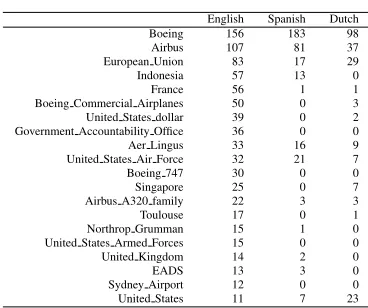
English Spanish Dutch Boeing 156 183 98
Airbus 107 81 37
European Union 83 17 29
Indonesia 57 13 0
France 56 1 1
Boeing Commercial Airplanes 50 0 3 United States dollar 39 0 2 Government Accountability Office 36 0 0
Aer Lingus 33 16 9
United States Air Force 32 21 7
Boeing 747 30 0 0
Singapore 25 0 7
Airbus A320 family 22 3 3
Toulouse 17 0 1
Northrop Grumman 15 1 0 United States Armed Forces 15 0 0 United Kingdom 14 2 0
EADS 13 3 0
[image:8.612.92.276.66.220.2]Sydney Airport 12 0 0 United States 11 7 23
Table 2: Entities most frequent in English data
We also inspected the results for the Airbus cor-pus by looking at the entities and events that are most frequently mentioned in the English output. Table 2 shows the top-frequent entities with the cor-responding counts for Spanish and Dutch. We in-spected obvious entities such asIndonesia, France
and Toulouse. It turns out that the NLP mod-ules did detect these entities: Indonesia (8 Span-ish and 9 Dutch mentions),France(13 Spanish and 11 Dutch mentions), Toulouse (6 Spanish and 4 Dutch mentions) but that they were not linked to events and therefore not represented. This points to a difference and probably lower coverage of the semantic role module to connect entities to events in a uniform way. Another case is represented by United States, United States Air Force(s), and
United States dollar. The latter have high frequen-cies in English but none in Spanish and Dutch, while the former has even higher frequencies in Dutch. In this case, the English system makes a systematic mistake by not always resolving expressions such asUS to the right URI but to the dollar, while the other systems do not make this mistake because their expressions are very distinct: Estados Unidos de Am´erica and de Verenigde Staten van Amerika. A final type of difference is illustrated byBoeing ver-sus Boeing 747. Where the English module tends to prefer more specific entities, the other fall back to the more generic ones. Such metonymic mismatches are less of a problem.
Regarding events, the Dutch events are often linked to other meanings in WordNet that may also apply (e.g. fly72 English, 34 Spanish and 8 Dutch but alsobuy10 English, 17 Spanish and 16 Dutch).
Furthermore whereas the English and Spanish mod-ule often provide more than one synset, the Dutch system only gives one, lowering the chances to in-tersect. In a future version, sets of closely related synsets will be generated for Dutch as well to solve the fine-grained sense matching problem. Another option is to fall back on more general event classes in the PredicateMatrix (e.g. VerbNet, FrameNet, etc.). Most of the other differences relate to small differences acorss systems and poor coverage of se-mantic resources in Spanish and Dutch.
7 Conclusions
We described a system for the cross-document and cross-lingual event and entity extraction that is unique in its kind. We use GAF to make a clear distinction between mentions and instances, where mentions of events and entities are interpreted ac-cording to an interoperable RDF framework that uses URIs, WordNet and FrameNet concepts, nor-malised time expressions and nornor-malised relations between entities and events. We developed NLP pipelines in English, Spanish and Dutch that pro-cess text according to the shared framework. In ad-dition, we developed software to convert the output of the NLP modules to the RDF representation of in-stances. We showed that we can represent the accu-mulated information from different articles and even across languages. We described the first evaluation results for our system.
Acknowledgements
We thank the anonymous reviewers for the feed-back. This work was supported by the European Union’s 7th Framework Programme via the News-Reader (ICT-316404) project and by the SKATER Spanish project (TIN2012-38584-C06-02) with Eu-ropean Regional Development Fund support.
References
Collin F. Baker, Charles J. Fillmore, and John B. Lowe. 1998. The Berkeley FrameNet project. In Pro-ceedings of COLING-ACL’98, pages 86–90, Montreal, Canada.
Cosmin Adrian Bejan and Sanda Harabagiu. 2010. Un-supervised event coreference resolution with rich lin-guistic features. InProceedings of the ACL’2010, Up-psala, Sweden.
Steve Cassidy. 2010. An RDF realisation of LAF in the DADA annotation server. InProceedings of ISA-5, Hong Kong.
Christian Chiarcos, Sebastian Nordhoff, and Sebastian Hellmann. 2012. Linked Data in Linguistics. Repre-senting and Connecting Language Data and Language Metadata. Springer, Heidelberg.
Christian Chiarcos. 2008. An ontology of linguistic an-notations.LDV Forum, 23(1):1–16.
Agata Cybulska and Piek Vossen. 2015. ”Bag of Events” Approach to Event Coreference Resolution. Super-vised Classification of Event Templates. In Interna-tional Journal of ComputaInterna-tional Linguistics and Ap-plications (IJCLA). (to appear).
Christiane Fellbaum, editor. 1998. WordNet: An Elec-tronic Lexical Database. Cambridge, MA: MIT Press. David Ferrucci and Adam Lally. 2004. UIMA: an ar-chitectural approach to unstructured information pro-cessing in the corporate research environment. Natu-ral Language Engineering, 10(3-4):327–348.
Antske Fokkens, Marieke van Erp, Piek Vossen, Sara Tonelli, Willem Robert van Hage, Luciano Serafini, Rachele Sprugnoli, and Jesper Hoeksema. 2013. GAF: A grounded annotation framework for events. InProceedings of the first Workshop on Events: Def-inition, Dectection, Coreference and Representation, Atlanta, USA.
Antske Fokkens, Aitor Soroa, Zuhaitz Beloki, Niels Ock-eloen, German Rigau, Willem Robert van Hage, and Piek Vossen. 2014. NAF and GAF: Linking linguis-tic annotations. InProceedings 10th Joint ISO-ACL SIGSEM Workshop on Interoperable Semantic Anno-tation, pages 9–16.
Sebastian Hellmann, Jens Lehmann, S¨oren Auer, and Martin Br¨ummer. 2013. Integrating NLP using Linked Data. InProceedings of the ISWC’2013. Nancy Ide, Laurent Romary, and Eric Villemonte de La
Clergerie. 2003. International standard for a lin-guistic annotation framework. In Proceedings of the HLT-NAACL 2003 Workshop on Software Engineer-ing and Architecture of Language Technology Systems (SEALTS). Association for Computational Linguistics. Maddalen Lopez De Lacalle, Egoitz Laparra, and Ger-man Rigau. 2014. Predicate matrix: extending sem-link through wordnet mappings. In Proceedings of LREC’2014, pages 26–31, Reykjavik, Iceland. Heeyoung Lee, Marta Recasens, Angel Chang, Mihai
Surdeanu, and Dan Jurafsky. 2012. Joint entity and event coreference resolution across documents. In
Proceedings of EMNLP-CoNLL’2012.
Martha Palmer, Dan Gildea, and Paul Kingsbury. 2005. The proposition bank: A corpus annotated with se-mantic roles. Computational Linguistics, 31(1). Sameer Pradhan, Eduard Hovy, Mitchell Marcus, Martha
Palmer, Lance Ramshaw, and Ralph Weischedel. 2007. Ontonotes: A unified relational semantic rep-resentation. International Journal of Semantic Com-puting, 1(4):405–419.
Sameer Pradhan, Lance Ramshaw, Mitchell Marcus, Martha Palmer, Ralph Weischedel, and Nianwen Xue. 2011. Conll-2011 shared task: Modeling unre-stricted coreference in ontonotes. In Proceedings of CoNLL’2011, pages 1–27.
Valentina Presutti, Francesco Draicchio, and Aldo Gangemi. 2012. Knowledge extraction based on dis-course representation theory and linguistic frames. In
Knowledge Engineering and Knowledge Management, pages 114–129. Springer.
Willard V. Quine. 1985. Events and reification. In Ac-tions and Events: Perspectives on the Philosophy of Davidson, pages 162–171. Blackwell.