Mass Perception of Objects in Collision Events from a Developmental Perspective
Nilihan E.M. Sanal, BSc, MSc
This dissertation is submitted for the degree of Doctor of Philosophy Lancaster University
“It is with children that we have the best chance of studying the development of logical knowledge, mathematical knowledge, physical knowledge, and so forth”
Declaration
This thesis has not been submitted in support of an application for another degree at this or any other university. It is the result of my own work and includes nothing that is the outcome of work done in collaboration except where specifically indicated. Some of the ideas in this thesis were the product of discussion with my supervisors Prof. Gavin Bremner and Dr. Peter Walker.
Excerpts of this thesis have been published in the following conference manuscripts.
Sanal, N., Walker, P., & Bremner, J.G. (2018). Brightness-mass matchings in collision events, IMRF, Toronto, Canada.
Sanal, N., Walker, P., & Bremner, J.G. (2017). Size-mass relationship in young infants’ perception of causal events, Postgraduate research conference, Lancaster, United Kingdom.
Nilihan E.M. Sanal, BSc, MSc
Abstract
Around 5.5 to 6.5 months of age, humans first start to perceive the relationship between size and mass in simple collision events by attending to the size of the agent object (Kotovsky &
Baillargeon, 1998). Infants of this age perceive a greater displacement after collision with a large object and a lesser displacement with a small object. The results are based on infants’ looking time responses to a large and small object propelling a patient object to one distance, the endpoint of the screen. It is unknown how infants and adults would perceive the same events if a large and small object propelled a patient object to size appropriate (congruent) and size inappropriate (incongruent) distances. Furthermore, uncertainty remains about how infants and adults perceive object brightness and sound pitch, and their mass cues in collision events. It is documented that adults judge dark coloured objects and lower pitch sounds to be heavier in weight than bright coloured objects and higher pitch sounds (Walker, Francis, & Walker, 2010; Walker, Walker, & Francis, 2012). Similarly, infants around 10 months of age associate low pitch sounds with dark coloured objects, and high pitch sounds with bright coloured objects (Haryu, & Kajikawa, 2012). Moreover, it is unknown at what point in development humans start to perceive and process the differences between size of an agent object and a patient object. Specifically, the perception of the collision between an agent object that is constant in size and a patient object that varies in size. To these means, this thesis presents a series of experiments that examine adults’ reasoning and infants’ perception of object size of both agent and patient object, object brightness and sound pitch objects emit during collision and their mass cues in the collision events.
such as object size and object brightness. However, adults fail to consider sound pitch during collision as a cue for mass in the collision events.
Chapter 4 investigates the 6-to-7-month old infants’ perception of object size and object brightness separately and together and their cues to mass in 3D computer-generated collision events. Results in Chapter 4 indicate that these experiments fail to provide evidence that infants perceive mass cues of object properties size, brightness, and size and brightness in collision events.
Chapter 5 concerns the 10-to-11-month old infants’ perception of object size of agent object and patient object and their cues to mass in 3D computer-generated collision events. Results in Chapter 5 indicate that these experiments fail to provide evidence that infants use mass cues of object size of agent and patient object in collision events.
Acknowledgements
The experimental chapters described in this thesis would not have been possible without the support of the Leverhulme Trust Grant and Lancaster University Babylab.
The experimental setup would not have been complete without Gavin Bremner, Peter Walker, and Barrie Usherwood. Thank you especially to Gavin and Peter, who gave me valuable feedback through the making of the computer-generated collision events, and were always around to check each version outside of meeting hours.
Thank you to all staff and parents that are part of the Babylab community. The experimental chapters would not be possible without their help.
To Gavin Bremner and Peter Walker. Thank you for giving me such a great opportunity and for your enormous support and valuable help. A special thank you to Gavin for encouraging me, providing me with insightful and detailed feedback, and for making every opportunity possible. I am so grateful to Peter’s reminders and constructive criticism, and for always challenging and encouraging me to strive to do better.
This PhD would not be as enjoyable without my fellow PhD colleagues, thank you for helping out and giving both academic and emotional support when needed. Thank you to all my friends, your encouragement throughout my PhD was motivating.
Thank you to my entire family. I am so grateful to have such a lovely family, thank you for your patience with me. I want to thank my sisters, Ceren and Özden, and my fiancé,
Table of Contents
List of Figures ... 14
Chapter 1 - General Introduction and Literature Review ... 16
1.1 General introduction ... 16
1.2 Collision events ... 18
1.2.1 The perception of causality in collision events ... 18
1.2.2 The methodology of the collision events ... 20
1.3 Humans’ perception of object properties and their cues to mass in dynamic events ... 23
1.3.1 Object properties that cue mass ... 23
1.3.2 Perception of object properties that cue mass in dynamic events ... 31
1.4 Human perception of physical properties of objects... 34
1.4.1 Visual perception of objects and their physical properties ... 34
1.4.3 Auditory and visual perception of objects and their physical properties ... 37
1.5 Human perception of dynamic events ... 39
1.5.1 Human perception of computer generated dynamic events ... 39
1.5.2 Demonstration of human perception of dynamic events ... 40
Chapter 2 - General methods ... 46
2.1 Ethical procedures and considerations ... 46
2.2 Experimental set-up ... 47
2.3 Visual stimuli ... 47
2.4 Auditory stimuli... 49
2.6 Data analyses ... 51
Chapter 3 - Adults ‘reasoning about object properties and their cues to mass in collision events ... 52
Abstract ... 52
3.1 Introduction ... 53
Experiment 1: Object size as a cue to mass in collision events ... 56
3.2 Experiment 1: Method ... 56
3.2.1 Participants ... 56
3.2.2 Materials and apparatus ... 57
3.2.3 Procedure ... 58
3.3 Experiment 1: Results ... 59
3.3.1 Real-life based likeliness of test events... 60
3.3.2 Reference related likeliness of test events... 61
3.4 Experiment 1: Explanation of findings ... 63
Experiment 2: Object brightness as a cue to mass in collision events ... 63
3.5 Experiment 2: Method ... 64
3.5.1 Participants ... 64
3.5.2 Materials and apparatus ... 64
3.5.3 Procedure ... 65
3.6 Experiment 2: Results ... 66
3.6.1 Real-life based likeliness of test events... 66
3.6.2 Reference related likeliness of test events... 68
Experiment 3: Pitch as a cue to mass in collision events ... 70
3.8 Experiment 3: Method ... 70
3.8.1 Participants ... 70
3.8.2 Materials and apparatus ... 70
3.8.3 Procedure ... 72
3.9 Experiment 3: Results ... 73
3.9.1 Real-life based likeliness of test events... 73
3.9.2 Reference related likeliness of test events... 75
3.10 Experiment 3: Explanation of findings ... 76
3.11 Chapter 3 discussion ... 76
Limitations ... 78
Conclusion ... 78
Chapter 4 – Young infants’ perception of object properties and their cues in collision events79 Abstract ... 79
4.1 Introduction ... 80
Experiment 4: Infants’ perception of object size in collision events... 83
Experiment 4: Method ... 84
4.2.1 Participants ... 84
4.2.2 Materials and apparatus ... 84
4.2.3 Procedure ... 84
4.3 Experiment 4: Results ... 85
4.3.1 Test events ... 85
4.3.3 Post-collision looking time for test events ... 87
4.3.4 Total looking time for test events of non-habituated infants ... 88
4.3.5 Total looking time for test events ... 90
4.4 Experiment 4: Explanation of findings ... 90
Experiment 5: Infants’ perception of object brightness in collision events ... 91
4.5 Experiment 5: Methods ... 91
4.5.1 Participants ... 91
4.5.2 Materials and apparatus ... 92
4.5.3 Procedure ... 92
4.6 Experiment 5: Results ... 92
4.6.1 Test events ... 92
4.6.2 Total looking time for test events ... 94
4.6.3 Post-collision looking time for test events ... 94
4.7 Experiment 5: Explanation of findings ... 95
Experiment 6: Infants’ perception of object size and brightness in collision events .... 96
4.8 Experiment 6: Methods ... 96
4.8.1 Participants ... 96
4.8.2 Materials and apparatus ... 97
4.8.3 Procedure ... 98
4.9 Experiment 6: Results ... 98
4.9.1 Test events ... 98
4.9.2 Total looking time for test events ... 100
4.9.3 Post-collision looking time for test events ... 101
4.11 Analysis of all three experiments ... 102
4.11.1. Total looking time for test events for experiments 4,5 and 6 ... 102
4.12 Chapter 4 discussion ... 104
Limitations ... 107
Conclusion ... 107
Chapter 5 – Infants use of object size as a cue to mass in collision events ... 108
Abstract ... 108
5.1 Introduction ... 109
Experiment 7: Infants’ use of size of agent object in collision events... 111
5.2 Experiment 7: Methods ... 112
5.2.1 Participants ... 112
5.2.2 Materials and apparatus ... 112
5.2.3 Procedure ... 112
5.3 Experiment 7: Results ... 112
5.3.1 Test events ... 113
5.3.2 Total looking time for test events ... 114
5.3.3 Post-collision looking time for test events ... 115
5.4 Experiment 7: Explanation of findings ... 116
Experiment 8: Infants’ perception of size of patient object in collision events ... 116
5.5 Experiment 8: Methods ... 117
5.5.1 Participants ... 117
5.5.2 Materials and apparatus ... 117
5.6 Experiment 8: Results ... 119
5.6.1 Test events ... 119
5.6.2 Total looking time for test events ... 121
5.6.3 Post-collision looking time for test events ... 122
5.7 Experiment 8: Explanation of findings ... 123
5.8 Chapter 5 discussion ... 123
Limitations ... 126
Conclusion ... 127
Chapter 6 – Discussion... 128
6.1 Summary findings ... 128
6.2 Explanation of findings ... 129
6.3 Future directions and theoretical implications ... 136
6.4 Concluding remarks ... 140
List of Figures
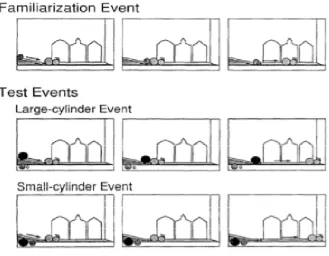
Fig 1.1. The original experiment by Kotovsky and Baillargeon (1994;1998)………..21
Fig 3.1. This collision event involving the medium ball served as reference event……….57
Fig 3.2. From top to bottom: Top: (A) Large ball congruent, (B) Large ball incongruent, Bottom: (C Small ball congruent, (D) Small ball incongruent event……….58
Fig 3.3. Real-life based likeliness mean ratings of small and large ball congruent and incongruent test events. Data are presented as mean ratings of likeliness and standard error of mean………..60
Fig 3.4. Reference relatedlikeliness mean ratings of small and large ball congruent and incongruent test events. Data are presented as mean ratings of likeliness and standard error of mean………..62
Fig 3.5. From top to bottom: Top: (A) Dark ball congruent, (B) Dark ball incongruent, Bottom: (C) Bright ball congruent, (D) Bright ball incongruent event………....65
Fig 3.6. Real-life based likeliness mean ratings of bright and dark ball congruent and incongruent test events. Data are presented as mean ratings of likeliness and standard error of mean………..67
Fig 3.7. Reference relatedlikeliness mean ratings of bright and dark ball congruent and incongruent test events. Data are presented as mean ratings of likeliness and standard error of mean………..68
Fig 3.8. From top to bottom: Top: (A) Low pitch congruent, (B) Low pitch incongruent, Bottom: (C) High pitch congruent, (D) High pitch incongruent event………..72
Fig 3.9. Real-life based likeliness mean ratings of high and low pitch congruent and incongruent test events. Data are presented as mean ratings of likeliness and standard error of mean………..74
Fig 3.10. Reference relatedlikeliness mean ratings of high and low pitch congruent and incongruent test events. Data are presented as mean ratings of likeliness and standard error of mean………..75
Fig 4.1. Raw mean total looking time for large and small ball congruent and incongruent test events. Data are presented as mean looking time and standard error of mean………..86
Fig 4.3. Raw mean total looking time for large and small ball congruent and incongruent test events. Data are presented as mean looking time and standard error of mean………..89
Fig 4.4. Raw mean total looking time for dark and bright ball congruent and incongruent test events. Data are presented as mean looking time and standard error of mean………...93
Fig 4.5. Raw mean post-collision looking time for dark and bright ball congruent and incongruent test events. Data are presented as mean looking time and standard error of mean………...93
Fig 4.6. From top to bottom: Top: (A) Large dark congruent, (B) Large dark incongruent, Bottom: (C) Small bright congruent, (D) Small bright incongruent event………...97
Fig 4.7. Raw mean total looking time for large dark and small bright ball congruent and incongruent test events. Data are presented as mean looking time and standard error of mean………...99
Fig 4.8. Raw mean post-collision looking time for large dark and small bright ball congruent and
incongruent test events. Data are presented as mean looking time and standard error of mean…………..99
Fig 4.9. Log transformed mean total looking time for congruent and incongruent test events based on more mass and less mass cues of ball. Data are presented as mean looking time and standard error of mean………103
Fig 5.1.Raw mean total looking time for large and small ball congruent and incongruent test events. Data are presented as mean looking time and standard error of mean………113
Fig 5.2. Raw mean post-collision looking time for large and small ball congruent and incongruent test events. Data are presented as mean looking time and standard error of mean………...114
Fig 5.3. From top to bottom: Top: (A) Large cube congruent, (B) Large cube incongruent, Bottom: (C) Small cube congruent, (D) Small cube incongruent event……….118
Fig 5.4.Raw mean total looking time for large and small cube congruent and incongruent test events. Data are presented as mean looking time and standard error of mean………...120
Chapter 1 - General Introduction and Literature Review
1.1 General introduction
Inferences about how objects of certain properties behave in relation to one another or alone in the collision events cannot happen in isolation of mass estimates of the object
(Woodworth, 1921). The momentums in the collision events are a product of mass and velocity (Vicovaro & Burigana, 2014; 2016). In the study of Schiff and Detwiler (1979) mentioned earlier, adults anticipated a large object to propel a patient object further than a small object, because adults expected the large object to have greater mass than the small object. Object sizes in collision events cue for mass (Schiff & Detwiler, 1979). Consequently, objects of greater masses exert more force on other objects and thus displace them further than objects of lower masses (Kotovsky, & Baillargeon, 1994; 1998; Vicovaro, & Burigana, 2014). Similarly, in the study of Vicovaro and Burigana (2014) mentioned earlier, adults judged collisions between objects of different sizes and material properties such as polystyrene, wood and iron to be natural and unnatural based on the pre-collision velocity of the object A and post-collision motion of the object B which is dependent on the masses of both objects A and B. In sum, object properties and their mass cues are important in understanding the outcomes of collision events. Yet, object properties involved in collision events are understudied.
In recent years, object brightness and pitch of sound emitted by objects have been
and how infants perceive object brightness and pitch sound, and their cues to mass in collision events.
The aim of the research reported in this thesis is to examine adults’ reasoning and infants’ perception of the collision events based on object brightness and pitch sound, and their cues to mass. In this chapter, an overview of the collision events and humans’ perception of object properties and their cues to mass in dynamic events. Subsequently, the literature review will address the topic of humans’ perception of objects and their physical properties, and
adults’reasoning and infants’ perception of these objects in dynamic events.
1.2 Collision events
1.2.1 The perception of causality in collision events
Michotte held a nativist view on causal perception although he never conducted developmental experiments (Newman, Choi, Wynn & Scholl, 2008). Nativists’ claim that humans are born with physical reasoning mechanisms that aids their further reasoning (e.g. Baillargeon, 2002). Kotovsky and Baillargeon (1998) demonstrated that 5.5 to 6 month old infants reason about object sizes and the magnitude of the force exerted by these objects on a stationary toy-bug. This inference could be driven by infants’ recognition of violation rather than their actual reasoning about collision events. Empiricists on the other hand claim that humans learn through experience with the world (e.g. Hohenberger et al., 2012). For example,
Hohenberger et al (2012) found 10-month-old infants to make successful matchings between size of an agent ball and propelled distance of a patient ball but not 6 month old infants. We have chosen to investigate both 6-to-7-month old and 10- to-11-month old infants. These age ranges suggest that infants have some experience with the objects around themselves. Object brightness and pitch sound that is of interest for this thesis can be experienced in the world. For example, most materials in the world become darker in colour and heavier when wet (Walker, 2012). Similarly, animals that produce a low pitch sound are usually bigger in size, thus heavier in weight (Walker, 2012). Exposure or experience to events that involve these associations might be enough to create these links between brightness and weight, and between pitch sound and weight. However, perceiving the relationship between these object properties and mass in collision events is a more complex matter.
this preference is of random nature. At the age of 2.5 months, infants start to expect that a patient object will move after a collision with an agent object, but not after a delay between the collision of the two objects (Baillargeon, 1995; Kotovsky & Baillargeon, 1994). This inference could be driven by infants’ recognition of violation rather than their actual expectation about collision events. The perception of object properties and outcomes involved in causal events happens at a later age (Kotovsky & Baillargeon, 1998). Infants between 5.5 to 7 months of age consider object size in collision events (Kotovsky & Baillargeon, 1998). Kotovsky and Baillargeon (1994) first tested infants of 10.5-to-11.5 months of age on this paradigm. For testing adults’ reasoning and infants’ perception of object brightness and sound pitch in collision events, the methodology employed by Kotovsky and Baillargeon (1994) has been adopted with some alterations. The methodology of the present experiments in this thesis will be discussed next.
1.2.2 The methodology of the collision events
setting. Infants in the previously mentioned experiments demonstrated this perception by looking longer at the event that violated their expectation; the event in which the small ball propelled a patient object to the endpoint of the screen (Kotovsky, & Baillargeon, 1998; Hohenberger et al., 2012). These results were based on infants’ total looking times for the test events. These findings suggest infants perceive the object size and its cues to mass in 3D real-life and 2D computer animated collision events, however there are methodological limitations with the original experiment by Kotovsky and Baillargeon (1994).
Fig 1.1. The original experiment by Kotovsky and Baillargeon (1994;1998).
In the original experiment by Kotovsky and Baillargeon (1994), infants were habituated to the condition in which a mid-size blue cylinder rolled down a ramp and either propelled a
to the endpoint of the screen. Kotovsky and Baillargeon (1994) found infants looked longer at the small-size cylinder test event compared to the large-size cylinder test event when habituated to the mid-point condition. This led the authors to conclude that infants perceive object size and its cues to mass in physical causal events (Kotovsky & Baillargeon, 1994). Specifically, that infants attend to the size of the agent object and perceive displacement of the patient object depending on the size of the agent object in these simple collision events. Infants perceive a greater
displacement following a collision with a large object and a lesser displacement after collision with a small object. However, in the aforementioned experiment, infants were given two cues (size and colour) to distinguish between objects. The findings of this experiment can therefore not be solely attributed to size. Furthermore, in the test events the large and small size cylinder propel the toy bug to only one distance, to the endpoint of the screen. This means that infants were not presented with other distance options to compare between sizes. For these reasons, the collision events by Kotovsky and Baillargeon (1994) were modified.
Our alternative method modified these aforementioned limitations by using same
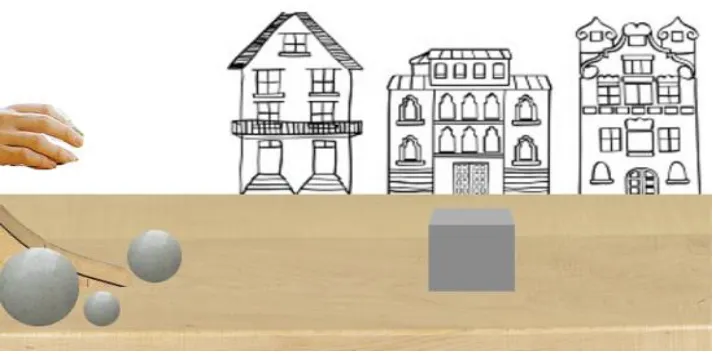
coloured agent objects and including another distance option to compare between the sizes. This distance option was before the midpoint of the screen (shorter distance). Furthermore, the other modifications we made to the original experiment were; infants were habituated to the midpoint condition only, billiard balls were used instead of cylinders as only the diameter of the cylinders were noticeable in the original experiment, and the colourful toy bug was swapped to a grey cube to neutralise the events. We used 3D computer generated collision events as opposed to 3D real-life collision events for standardising purposes. In the 3D real-real-life collision events there is room for human error across events and participants. This human error is eliminated in the 3D
colleagues (2012) in that the balls used in our experiments were 3D pictures and set in motion by a hand which acted like an agent, balls had same grey colour, and two more test events were included (before midpoint of the screen for large and small ball). Furthermore, an impact sound was presented during collision. These changes were implemented with the aim of controlling for variables such as colour and to investigate complex momentum relationships by having both small and large size billiard balls propel a patient object to two different distances; before the midpoint and to the endpoint of the screen. This alternative method to the size-distance
experiment by Kotovsky and Baillargeon (1994) was thus employed with adults and infants prior to experiments investigating object brightness and sound pitch.
The object properties brightness and pitch were examined using the same 3D computer generated collision events. However, object brightness was assessed by changing the surface brightness of the balls (white, grey and black) but keeping the balls the same mid-size. The sound-pitch was assessed by varying the impact sound during collision between low and high pitch but keeping the balls same mid-size and same grey colour. The impact sound during
collision was identical for all objects in all experiments expect the test events for this experiment examining sound pitch.
1.3 Humans’ perception of object properties and their cues to mass in dynamic events
1.3.1 Object properties that cue mass
1917; Payne, 1958; 1961; Ross & Di Lollo, 1970; Stevens & Rubin, 1970; Anderson & Anderson, 1970; Cross & Rotkin, 1975).
These object properties cue for weight when motor actions might be involved due to the application of gravity (Hast, 2018). Similarly, they cue for mass when the amount of matter is concerned for example in visual perception of objects (Todd & Warren, 1982). However, the relationship between weight and mass is in synchrony with one another under constant gravity (Woodworth, 1921; Payne, 1958; Ross, 1969; Ross & Di Lollo, 1970; Stevens & Rubin, 1970). For example, objects of heavier weights are also greater in mass and objects of lighter weights are also lesser in mass (Woodworth, 1921). Size cues for mass, with the principle in mind that larger objects are usually perceived to be heavier in weight than smaller objects (Woodworth, 1921). Object colour in turn, has an effect as luminance cues weight; darker objects are perceived to be heavier in weight thus greater in mass than brighter objects (Payne, 1958). Density is influential in that denser materials (e.g. steel and marble) are generally perceived to be of greater mass and thus heavier in weight than less dense materials e.g. wood (Ross, 1969; Ross & Di Lollo, 1970; Stevens & Rubin, 1970).
object, and propel it further than smaller objects (Kotovsky, & Baillargeon, 1998). Uncertainty remains whether adults reason about and infants perceive object brightness and sound pitch and their cues to mass in the collision events in a similar way to how they associate them to weight (Walker, 2012; Haryu & Kajikawa, 2012).
The object properties brightness and pitch cue weight in adults, as evidenced by findings that adults judge darker objects and low pitch sounds to be heavier in weight than brighter objects and high pitch sounds (Walker, 2012). Similarly, infants make brightness and pitch associations (Haryu, & Kajikawa, 2012). For example, infants around 10 months of age match darker objects with low pitch sounds and brighter objects with higher pitch sounds (Haryu, & Kajikawa, 2012). These pairings infants make cue for weight independently in adults (Walker, 2012). For example, the associations between dark objects and low pitch sounds cue for heavy weight in adults
(Walker, 2012). Similarly, the associations between bright objects and high pitch sounds cue for light weight in adults (Walker, 2012).
sounds and dark grey patches of colour with quieter sounds (Bond, & Stevens, 1969; Stevens, & Marks, 1965).Cross-sensory perception is not specifically limited to object brightness, and pitch and sound but thought to occur between various object properties (Maurer, Pathman, &
Mondloch, 2006; Walker, Francis, & Walker, 2010; Ozturk, Krehm, & Vouloumanos, 2013). For example, the bouba/kiki effect is classified as a cross-sensory perception (Kohler, 1929). Adults associate the words bouba and kiki with certain shapes (Kohler, 1929). The “kiki” word is associated with angular shapes and “bouba” with curved shapes (Kohler, 1929). Furthermore, adults make cross-sensory associations between /a/and/i/ speech sounds and objects size. Adults associate the speech sound “mal” with objects of large size, and the “mil” speech sound with objects of small size (Sapir, 1929).
There is accumulated evidence to suggest that adults make associations between smaller, sharper, brighter, spatially higher visual images with high-frequency sounds (Gallace, & Spence, 2006). Similarly, adults make associations between high-pitch tones with sharp, thin, and
speedily ascending visual stimuli (Gallece, & Spence, 2006; Parise, & Spence, 2009; Hubbard, 1996; Evans, & Treisman, 2009; Rusconi et al., 2006; Occelli, Spence, & Zampini, 2009; Collier, & Hubbard, 2004). Some of the associations between these cross-sensory pairs suggest a pairing based on similarity in weight and mass, but indirectly. For example, dark colours (heavy
Cross-sensory associations influence decision making in adults (Cytowic, 1989; Marks, 1987; Gallace, & Spence, 2006; Klapetek, Ngo, & Spence, 2012). Adults prefer events,
situations, and object that match their cross-sensory associations (Cytowic, 1989). This is
demonstrated by their slow response times to visual stimuli when they are paired with a distractor auditory stimuli that do not match the visual stimuli in terms of cross-sensory associations
(Marks, 1987). For example, adults would be slow and less accurate when presented with a bright stimulus that is paired with a distractor auditory stimulus that is low in pitch. Similarly, adults would be slow in their response times to visual stimuli when the elevation of the visual stimulus is mismatched with pitch (Klapetek, Ngo, & Spence, 2012). For example, individuals would respond slower to a visual stimulus that is high in space when it is accompanied by a low pitch sound or low in space when accompanied by a high pitch sound (Klapetek, Ngo, & Spence, 2012). Similarly, participants find it harder to put the visual stimulus into a category in the
high pitch sounds, and dark coloured stimuli when paired with low pitch sounds (Hubbard, 1996; Marks, 1987).
Despite the knowledge that these cross-sensory associations persist in most cultures, it still remains unknown why they exist and what purpose they serve (Martino, & Marks, 2001; Eitan, & Timmers, 2010). For example, some cross-sensory associations cannot be explained by a specific environmental context (Spector, & Maurer, 2008). Particular shapes are not commonly displayed in particular colours, certain coloured objects or surfaces do not generally elicit specific pitch sounds (Spector, & Maurer, 2008). However, the associations related to weight can be explained by the associations humans form in the natural world (Mondloch & Maurer, 2004). For example, correspondences between object brightness and weight in humans exist in the natural world, because most materials in the world such as wood, soil, and sand become darker in colour and heavier when wet and this might be enough to create the associations (Walker, 2012).
Similarly, associations between a pitch and weight may exist because animals that produce a low pitch sound are usually bigger in size, thus heavier in weight (Walker, 2012). The other cross-sensory correspondences such as shape and pitch sounds etc. challenges the idea that common exposure to these matchings of these cues explain the existence and purpose of these associations (Spector & Maurer, 2008). These cross-sensory habits cannot therefore be explained with the learning processes for these associations.
and see sounds involuntarily and automatically (Rogowska, 2011). However, synaesthethic individuals differ between each other as there are various kinds of synaesthesia (Cytowic, 2002; Harrison & Baron-Cohen, 1997; Hochel & Milan, 2008). For example, some synaesthetes hear musical sounds when seeing colours, whereas others feel scents when seeing colours.
Synaesthesia is similar to cross-sensory mappings in that similar and identical neural processes are behind both processes (Bien, Ten Oever, Goebel, & Sack, 2012). For this recognition, it has been suggested that cross-sensory correspondences and synaesthesia may lie on opposite ends of a synesthetic continuum (Bien, Ten Oever, Goebel, & Sack, 2012). Furthermore, there is
evidence suggesting when visual perception emerges from sound in synaesthethic individuals, it is a case of cross-sensory processing (Ward, & Mattingley, 2006). Other researchers claim that cross-sensory mappings are innate residuals of unsuccessful differentiation of the senses (Maurer, 1997; Maurer, & Mondloch, 2005; Simner, 2012). These researchers further suggest that as newborns we are born with undifferentiated senses, a term called neonatal synaesthesia and after exposure to the world we learn to differentiate between senses (Maurer, 1997; Maurer, &
Mondloch, 2005).
associate the word “kiki” with angular shapes and “baluba” with round shapes (Ozturk, Krehm, & Vouloumanos, 2013). Infants of 4 months of age also make appropriate associations between vocals and body size (Pietraszewski, Wertz, Bryant, & Wynn, 2017). Larger body sizes (heavier in weight) are associated with lower pitch vocals and smaller body sizes (lighter in weight) are associated with higher pitch vocals. When 6 months of age, infants associate pitch and object size (Fernandez-Prieto, Navarra, & Pons, 2015). These findings are indirectly in line with pitch and weight associations found with adults (Walker, 2012). Infants perceive object brightness and pitch associations at 10 months of age (Haryu, & Kajikawa, 2012). Darker balls are associated with lower pitch sounds, and brighter balls are associated with higher pitch sounds. However, infants are inconsistent with the matchings between pitch sounds and size (Haryu, & Kajikawa, 2012). For example, infants in the study by Haryu and Kajikawa (2012) did not always match high frequency sounds with small objects, and low frequency sounds with large objects. Both object properties were presented with animations consisting of bouncing balls in colours (white and black) and sizes (small and large) with congruent or incongruent pitch sounds (high or low pitch).
Taken together, the aforementioned investigations demonstrate that infants make object brightness and pitch associations much later than shape, size, and sound and pitch associations (Haryu, & Kajikawa, 2012; Ozturk, Krehm, & Vouloumanos, 2013). The congruent and
incongruent associations for pitch sound and object brightness are in line with appropriate weight matchings for both properties (Haryu, & Kajikawa, 2012). For example, darker colours are matched with low pitch sounds (heavy weight), and lighter colours with high pitch sounds (light weight). Uncertainty remains whether infants associate the object properties brightness and pitch based on assumed weight like adults, and when this emerges in humans first. The weight
because these associations do not exist in the natural world. For example, darker coloured animals do not make lower pitch sounds.
Pre-schooled children do however consider object brightness in their assessment of object weight (Plack, & Shick, 1976). Children in this study were presented with six blocks of colours; red, blue, and yellow in varied hues (light and dark). Altogether the set consisted of light red, dark red, light blue, dark blue, light yellow and dark yellow. The children were asked to judge the weight of these six blocks and darker colours were judged to be heavier than lighter colours (Plack, & Shick, 1976). Although both young and older children of the study judged lighter colours to be lighter in weight and darker colours to be heavier in weight, the explanation of the findings for each age group differed. For example, older children of the study based the weight on the visual dimension (colours), whereas the younger children based it on the verbal cue of weight (Plack, & Shick, 1976). This remains the only study on children's perception of colour and weight.
On account of the object properties brightness and pitch in both adults and infants, it remains unclear how these object properties will cue mass independently in infants and cue mass similarly to weight in adults in the context of dynamic collision events.
1.3.2 Perception of object properties that cue mass in dynamic events
of the sizes and material properties of objects A and B (Vicovaro & Burigana, 2014). Larger objects and objects of material properties iron are expected to have higher masses compared to objects of material properties wood that are expected to have larger masses than polystyrene and smaller objects (Vicovaro & Burigana, 2014). Collision outcomes that regarded these
expectations and displayed appropriate velocity ratios (pre-collision and post-collision velocity) were judged to be natural and collision outcomes that disregarded these expectations and
displayed inappropriate velocity ratios were judged to be unnatural (Vicovaro & Burigana, 2014). Adults also demonstrate successful matchings between size of agent object and propelled distance of patient object in collision events (Schiff, & Detwiler, 1979). Adults consider object size in two-dimensional information in momentum relationships (Schiff, &Detwiler, 1979). Judgements of collision events depends on the size of the agent and the patient object. Larger masses are thought to exert more force, therefore push an object further in collision events (Schiff, & Detwiler, 1979). Uncertainty remains about how other object properties such as object brightness and pitch that cue weight in adults are perceived in collision events. Thus, this gap remains to be explored within this thesis. A similar gap in knowledge exists in the infant literature. Apart from infants' successful link between object size and mass in collision events found by Kotovsky and Baillargeon (1998), object properties such as brightness and pitch have not been demonstrated in infants in the context of dynamic events. Nevertheless, infants
demonstrate some consideration of visual and auditory object properties in momentums (Kotovsky, & Baillargeon, 1998; Bahrick, Netto, & Hernandez-Keif, 1998; Bahrick, 1988; Pickens, & Bahrick, 1995; 1997; Allen, Walker, Symonds, & Marcell, 1977; Pickens, 1994; Walker- Andrews, & Lennon, 1985).
propelled distance of patient object based on both size and sound cues presented during collision. Thus, infants' perception of object interactions is dependent on both visual and auditory
information presented at the same time (Kotovsky, & Baillargeon, 1998). Visual and auditory information in dynamic events are rarely separated, because they remain unified in the
multimodal world we live in (Bahrick, 1983). For example, a bouncing ball that elicits a sound every instance it contacts a surface is distinguished as an unitary event by infants (Bahrick, 1988). It is also known that infants, like adults, devote perceptual attention to objects that are moving and eliciting sounds and possess the skills to make successful discrimination between sounds based on visual stimuli (Bahrick, Netto, & Hernandez-Keif, 1998; Pickens, & Bahrick, 1995; 1997; Allen, Walker, Symonds, & Marcell, 1977; Pickens, 1994; Walker- Andrews, & Lennon, 1985). For example, infants as old as 7 months of age use tempo dissimilarities when discriminating rhythmic changes in moving objects (Pickens, & Bahrick, 1995; 1997).
Furthermore, infants are successful in noticing rhythmic patterns across auditory stimuli when paired with visual display (Allen, Walker, Symonds, & Marcell, 1977). For example, infants associate objects that are approaching and receding with an increase and decrease in auditory magnitude (Pickens, 1994; Walker- Andrews, & Lennon, 1985).
Taken together, the relationship between sound and visual stimuli in infants' perception of dynamic events is integral for perceiving the entire event. However, dynamic event outcomes between objects of varying physical properties are mostly assumed in relation to mass
sound pitch during collision. The perception of physical properties of objects will thus be discussed next.
1.4 Human perception of physical properties of objects
1.4.1 Visual perception of objects and their physical properties
Humans are born with functioning oculomotor (eye movement) processes (Prechtl & Nijhuis, 1983). Already when newborn, they perceive differences between shapes (e.g. Triangles, circles, crosses and squares) and various line orientations (Slater, Morison, & Rose, 1983; Slater, Morison, & Somers, 1988). For example, newborn infants demonstrate preference for a novel shape (demonstrated by longer looking time) when paired with a familiar shape they have seen previously. Longer looking time for novel shape compared to familiar shape suggests that infants can distinguish between shapes they have seen and not seen previously (Slater, Morison, & Rose, 1983). Similarly, neonates show preference for novel line orientations, indicated by their longer looking time for these stimuli compared to looking time for a line orientation seen previously (Slater, Morison, & Somers, 1988).
(Johnson, & Aslin, 1995). For example, infants demonstrate longer looking time at two rod pieces (broken rod) compared to a complete rod after watching a rod motion behind a box and be occluded by the box. The longer looking time in this case suggest violation of the expectation, indicating that the expected is the complete rod. This suggests that infants perceive that a full rod is behind the box, although the occlusion of the box makes the rod look like a broken rod
(Johnson, & Aslin, 1995).
Research up to this point in time suggests that infants until about 2 months of age are successful in recognising and distinguishing between physical properties of objects. However, it is thought that from about 3 months of age infants start to have a well-developed perception of physical properties of objects (Oakes & Cohen, 1990; Bremner, 2010; Baillargeon, & Graber, 1987). For the visual object property of interest to our research question, the perception of object brightness starts from about 4 months of age by infants' successful perception of colour and shape (Bushnell, & Roder, 1985). Around 4 months of age, infants perceive both colour and form (Bushnell, & Roder, 1985). For example, infants display a longer looking time at a novel combination of colour and shape compared to the familiar colour and shape combination previously seen. Longer looking time in this example indicate infants' ability to distinguish between novel and familiar colour and shape combinations (Bushnell, & Roder,1985). This response to colour and form in infants later demonstrate their use of colour at 11.5 months of age and shape to individuate objects in occlusion events at 4.5 months of age (Wilcox, 1999).
property being examined or remained same. Infants distinguished between the object properties as indicated by their longer looking time for the trials in which change of the object property took place compared to trials in which the object property remained constant. However, the findings were mixed, infants were successful in distinguishing size and shape at 4.5 months, colour at 11.5 months, and pattern at 7.5 months of age (Wilcox, 1999).
1.4.2 Auditory perception and tracking location of sound
Humans are born with intact auditory processes (Winkler et al., 2009; Stefanics et al., 2009; Butterworth, & Castillo, 1976). Newborns can detect beat in rhythm in music, differentiate between pitch intervals, and direct eye gaze and the head to the location of sound (Winkler et al., 2009; Stefanics et al., 2009; Butterworth, & Castillo, 1976). For example, neonates demonstrate discriminative brain responses when infrequent beat in rhythm is detected (Winkler et al., 2009). This finding suggests that infants can detect the beat in rhythm in music by the brain as newborn (Winkler et al., 2009). Similarly, newborns discriminate between pitch intervals by their brain responses during infrequent rhythm as compared to frequent stand pitch sounds (Stefanics et al., 2009). This study marks the age in which pitch sound can be detected in infants. However, it can only be concluded from Stefanics et al., (2009) that infants discriminate between pitch intervals in their brains and not whether they attend to the location of this sound. Further support for this is presented by Butterworth and Castillo (1976). In their two experiments, they demonstrated that newborn infants can direct eye gaze and head, and track location of sound. In sum, it can be argued that detection of pitch and eye gaze to source happens very shortly after birth (Stefanics et al., 2009; Butterworth, & Castillo, 1976). However, this thesis concerns both pitch sound and visual objects. Next section will discuss human’s auditory and visual perception of an event. 1.4.3 Auditory and visual perception of objects and their physical properties
Three weeks after birth, infants respond to sound loudness that matches visual stimuli
being presented (Lewkowicz, & Turkewitz, 1980). For example, infants of 3 weeks of age
demonstrate a cardiac response to sound loudness and visual stimuli that were similar in intensity
(Lewkowicz, & Turkewitz, 1980). Infants pair high intensity visual stimuli with auditory stimuli
intensity (Lewkowicz, & Turkewitz, 1980). Later, around 3 months of age, infants match vocal
sounds with body sizes (Pietraszewki, Werts, Bryant, & Wynn, 2017). For example, infants
match larger organisms with low frequency sounds, and smaller organisms with high frequency
sounds (Pietraszewki, Werts, Bryant, & Wynn, 2017). This has been evidenced by their longer
looking time on visual and frequency sounds that do not match (Pietraszewki, Werts, Bryant, &
Wynn, 2017). For example, infants look longer at matchings; larger organisms with higher
frequency sounds, and smaller organisms with low frequency sounds (Pietraszewki, Werts,
Bryant, & Wynn, 2017). Longer looking time in this experiment suggest that inconsistent relations violate infants’ expectation. It is consistent with infants matching of lower/higher
frequency sounds with smaller/larger organisms. Thus, this suggests a form of perception exists
in infants that is similar to adults.
In line with our aim to study pitch as an object property in visual collision events, we will
therefore examine the collision pitch sound that takes place during collision between the agent
and the patient object. All visual stimuli will remain the same in all aspects of their visual
properties for all events, but the collision pitch sound during collision will either be high or low
pitch in the test events. The objects involved in collision events will be in movement. Thus, a
successful pairing of visual and auditory information does not necessary mean that infants can
pair these when they are in movement. Past research demonstrates that infants develop the skill to
understand objects and object movements based on visual and auditory information from about 4
months of age (Spelke, 1979; Spelke, Born, & Chu, 1983). For example, infants of 4 months of
age responded to the visual object and sound relationship when the object changed direction
regardless of the impact with the surface (Spelke, Born, & Chu, 1983). This suggests that infants
can track movement of objects based on an accompanying sound (Spelke, Born, & Chu, 1983).
object hitting a surface (Bahrick, 1983; 1987; 1988; 1992). For example, infants look longer at
the test trials when the soundtrack of an object hitting a surface do not match the material
properties of the object among the two objects viewed (Bahrick, 1983; 1987).
Taken together, past literature suggests that infants are successful in matchings between visual and auditory information (Spelke, 1979; Spelke, Born, & Chu, 1983; Bahrick, 1983;1987; 1988;1992). Furthermore, they make pairings between a visual object in movement and
accompanying sound (Spelke, Born, & Chu, 1983; Bahrick, 1983; 1987). Thus, for the purposes of this thesis, we can conclude that objects and their interactions can be tracked by infants as
young as 3 months of age. This is concluded based on infants' ability to track visual objects
matched with sound. Furthermore, infants possess the ability to make successful matchings
between visual and auditory stimuli based on similarities as demonstrated from the empirical
literature on visual and auditory information. However, it is unclear how infants would integrate
this knowledge to perceive dynamic events when the physical properties of the objects and their
cues to mass are assessed. Thus, the next section will address how humans perceive information
in dynamic events.
1.5 Human perception of dynamic events
1.5.1 Human perception of computer generated dynamic events
agent object propels a patient object to the same distance. This finding is interesting, as infants around 5.5 to 6.5 months of age perceive the relationship between size and distance in 3D real-life collision events but not in computer animated collision events (Kotovsky, & Baillargeon, 1998; Hohenberger et al., 2012).
Hohenberger and colleagues (2012) replicated the experimental findings of Kotovsky and Baillargeon (1998) with 10-to 1- month-olds, but not with 6 to 7 month olds. In Hohenberger et al.'s (2012) experiment, a hand did not set the objects in motion. Without amendments herein,
Hohenberger and colleagues (2012) replicated the experimental findings of Kotovsky and
Baillargeon (1998) with 10-to-11-month olds despite the nature of their collision events. For that
reason, in the present thesis, the computer generated collision events have been created with
pictures of 3D real-life objects and a hand has been used to set the billiard balls in motion. The
motion patterns have been adjusted using Animate C.C but follow a pattern consistent with
real-life expectations.
1.5.2 Demonstration of human perception of dynamic events
(Hohenberger et al., 2012) adopted this method in studying infants’ perception of collision events.
Violation of expectation was a method first adopted by Baillargeon, Spelke and
Wasserman in 1985, to test infants’ so called “understanding” of object permanence. Experiments using this method can for example examine infants’ perception of solid objects and these objects’ movements through space occupied by another solid object (Baillargeon, Spelke, & Wasserman, 1985).Infants’ display of surprise when a solid object passes the space that another solid object occupies is claimed to indicate a perception of object permanence (Baillargeon, Spelke, &
In some experiments using violation of expectation as the measure, infants are either habituated or familiarised to events. The habituation or familiarisation events are performed to inform the infants about numerous features of the test events. Once the habituation phase is completed, infants next watch test events; possible and impossible test events. Longer looking time devoted to the impossible events compared to possible events suggest that (1) infants’ perception are in line with the perceived outcome; (2) infants perceive the violation of the impossible event; and (3) infants display surprise as a response to this violation (Wang, Baillargeon, & Bruckner, 2004). Thus, increased looking time has been the generally applied indicator for violation of expectation in infants (Fantz, 1967).
Despite the common usage of the violation of expectation method, it presents a few limitations (e.g. Cohen, & Marks, 2002; Haith, 1998; Munakata, 2000; Dunn, & Bremner, 2017). The limitations are the method’s failure to replicate original findings, and misrepresentation of theoretic framework (Munkata, 2000). The failure to replicate original findings might stem from methodological differences across experiments. For example, in the original experiments, a 3D real-life block might have been used. In other experiments, a 2D block or a computer-generated block might have been used. The results might then differ across experiments based on varied reasons such as infants’ failure to perceive the 2D or computer-generated events as compellingly impossible compared to manipulated 3D real-life block or the lack of time permitted to encode the information from the events on the display (Munkata, 2000). Infants might still be familiar with the concept being tested despite their failure to perceive impossible events in 2D or
1.6 Research objectives of the thesis
This thesis aims to examine adults' reasoning and infants' perception of object properties such as size, brightness, pitch, and their mass cues in collision events. The literature review to this point has explained the methodology of the experiments and how the experiments outlined in this thesis attempt to explain the gap in the literature for both adults and infants. For these
purposes, the literature review has been conducted on collision events, object properties and their cues to mass in dynamic events, human perception of objects and their physical properties, and human perception of dynamic events. This thesis seeks to explain how adults reason and infants perceive object properties and their cues to mass in collision events.
More specifically, Chapter 3 addresses adults’ reasoning about object size, object brightness, sound pitch, and their mass cues in collision events. Participants were shown these collision events and then asked to rate the events on a scale from 1 (not very likely) to 10 (very likely). Higher rating is indicative that the outcomes of the collision events are likely.
We hypothesised that adults would rate the congruent events higher than the incongruent events. Adults would rate the events in which a large ball, dark ball and a mid-size ball accompanied low pitch sound propel a patient object to endpoint of the screen higher than when the patient object is propelled to before the midpoint of the screen. Similarly, adults would rate the events in which a small ball, bright ball and a mid-size ball accompanied high pitch sound propel a patient object to before the midpoint of the screen higher than when the patient object is propelled to the endpoint of the screen. Building on previous findings with adults, sound pitch was not further assessed with infants.
of expectation paradigm. We hypothesised that infants would look longer at incongruent events compared to congruent events. Infants would look longer at the events in which the large ball, dark ball and large dark ball propel a patient object to before the midpoint of the screen compared to when the patient object is propelled to the endpoint of the screen. Similarly, infants would look longer at the events in which the small ball, bright ball and small bright ball propel a patient object to the endpoint of the screen compared to when the patient object is propelled to before the midpoint of the screen. Building on previous findings with infants of 6 to 7 month of age, an older age group (10-11 months) was examined on object size in collision events.
Chapter 5 examines 10-to-11-month old infants’ perception of object size of the agent and the patient object separately, and their cues to mass in collision events. Infants viewed collision events and looking times were assessed according to the violation of expectation paradigm. We hypothesised that infants would look longer at incongruent events compared to congruent events. Infants would look longer at the events in which the large ball propels a patient object to before the midpoint of the screen compared to endpoint of the screen. Similarly, infants would look longer at the events in which the small ball propels a patient object to endpoint of the screen compared to before midpoint of the screen. However, infants would look longer at the events in which a mid-size ball propels a large patient object to endpoint of the screen compared to before midpoint of the screen. Similarly, infants would look longer at the events in which a mid-size ball propels a small patient object to before the midpoint of the screen compared to endpoint of the screen.
Chapter 2 - General methods
This section outlines the methods used for adult and infant testing. Adults and infants were assessed differently on the computer generated collision events. Rating scales were used to assess adults and looking times were recorded to assess infants. The computer generated collision events were similar across experiments, but the object properties of the billiard balls differed across experiments. Adult participants were tested on object size, object brightness and sound pitch. Younger infants (6 to 7 months old) were assessed on object size, object brightness, and object size+brightness. Older infants (10 to 11 month olds) were examined on the object size of the agent and patient objects.
2.1 Ethical procedures and considerations
All experiments followed the APA principles and guidelines for research involving human subjects, and all procedures, participant information sheets, participant consent forms, and debriefed forms, were approved by the Lancaster University Research Ethics Committee (see Appendix A and Appendix B). In line with this, all data gathered were reduced to numbers and presented so as not to provide information about any adults’ or infants’ identity. Video recordings of infants were stored on an encrypted hard-drive in the Babylab, so data did not leave the
building. Furthermore, participation was entirely voluntary and the participants had the right to withdraw from the study and withdraw the data up to two weeks after the participation.
participation. Adult participants were approached at campus and received refreshments for their participation.
Finally, inclusion criteria were applied. These included, by self-report: (1) normal or corrected-to-normal eyesight; (2) No form of synaesthesia; (3) No colour blindness. The inclusion criteria for infants included: (1) No form of visual impairments; (2)
successful habituation; (3) watching test events after collision takes place. 2.2 Experimental set-up
Infants watched the events on a screen (789x400 px). Participants were seated 80 cm from the screen on their parent’s lap.The events were at the eye level of the infants and at a 75° angle from the infants’ midline. The events were presented on a 49x39 cm screen surrounded by a
black cloth with 10 cm width on a black card (49x117 cm). There were two black cards on either side of the screen measuring 49x117 cm each, these were situated to attenuate light reflection and other distractions. Habit2000 software (Cohen, & Chaput, 2000) was used to time presentation and to record looking times input by the experimenter. A camera, situated through a small circular opening on the black-card surrounding the screen was used to record looking behaviour. Each session was recorded so the data could be re-coded by a second observer. Adults watched the events on a Macbook air 33.78 cm screen with headphones in, and verbally assessed the collision events by rating the test events on a scale from 1 (very unlikely) to 10 (very likely). 2.3 Visual stimuli
(W=148 px, H=95 px), a cube (W=95 px, H=95 px), a hand (W=95 px, H=76 px), and three billiard balls with different physical properties depending on experiment.
The patient object was propelled to midpoint during habituation events. In the test events, the patient object was propelled to before the midpoint (shorter distance) or endpoint (longer distance) of screen. In the habituation events, the patient object was propelled by a billiard ball of physical properties that cued mid-mass. In the test events, the patient object was either propelled by a billiard ball of physical properties that cued greater mass (Object A1) or lesser mass (Object A2). Participants were randomly assigned to a group before the experiment and watched the events in following order:
Group one: Object A1 (congruent –incongruent) – Object A2 (incongruent-congruent) Group two: Object A2 (incongruent –congruent) – Object A1 (congruent- incongruent) Group three: Object A1 (incongruent –congruent) – Object A2 (congruent-incongruent) Group four: Object A2 (congruent –incongruent) – Object A1 (incongruent-congruent)
and propelled the cube that was in front of the first house either to the end of the first house or to the last house (for 1-2 s). Again these events continued 1s after movement ended to allow
participants the time to perceive the event in its entirety. In total, the events in which the cube propelled to the first and second house lasted 6 s (240 frames, 48 frames/s), and the events in which the cube propelled to the last house lasted 7 s (288 frames, 48 frames/s). The cube travelled 1,5 cm/s from the start of the first house till the end of the first house (shorter condition). The cube travelled 1,25 cm/s from the start of the first house till the middle of the second house (midpoint condition). The cube travelled 1,17 cm/s from the start of the first house till the middle of the third house (endpoint condition).
2.4 Auditory stimuli
The auditory stimulus was the natural sound of a billiard ball hitting a wooden cube. The Audition C.C (2016), Adobe Systems was used to amplify the sound. This stimulus was used for all habituation, reference, and test events for all experiments apart from the experiment
examining sound pitch with the adults. The stimulus had a duration of 0.33 s, average acoustic amplitude of 81.90 dB and an average auditory frequency of 196.50 Hz. For the pitch-mass experiment, this stimulus was changed in frequency to produce high and low pitch sounds. For these purposes, Audition C.C (2016), Adobe Systems was used, the two separate sound clips had a duration of 0.33 s. Low-pitch sound had an average acoustic amplitude of 80.43 dB and an average auditory frequency of 208.08 Hz. High-pitch sound had an average acoustic amplitude of 81.9 dB and an average auditory frequency of 571.29 Hz.
2.5 Procedure
habituation events. The habituation events were viewed until successful habituation. Infants are considered habituated to an event when their looking time has reduced to a criterion level (for instance, that the mean looking time for last three trials is less than half of the mean looking time for the first three trials) (Cohen, & Gelber, 1975). This criterion level was applied to our
habituation trials. Infants were successfully habituated when the mean looking time for the last three trials were less than the half of the mean looking time for the first three trials.
One habituation trial was presented in a loop for a maximum of 60 s. The duration of the habituation trial was infant dependent, but the trial ended when the infant looked away for 2 cumulative seconds. A rattle was presented after the end of each habituation trial to direct infants’ attention back to the screen. Next, infants were presented with the four test events in that specific order depending on group they were assigned to. Infants saw each test event in a loop for a maximum of 60 s. The duration of the test event was again infant dependent, but the event ended when the infants looked away for 2 cumulative seconds. A rattle was presented after the end of each test event to direct infants’ attention back to the screen.
2.6 Data analyses
Chapter 3 - Adults ‘reasoning about object properties and their cues to mass in collision
events
Abstract
Past research suggests that adults make cross-sensory associations between object brightness, the sound pitch objects emit and object weight (Walker, 2012). Adults judge darker objects to be heavier in weight than bright coloured objects and lower pitch sounds to be heaver in weight than higher pitch sounds (Walker, Francis, & Walker, 2010; Walker, Walker, & Francis, 2012). It is unknown whether these matchings are present and cue for mass similarly in collision events. To study object brightness and sound pitch in collision events, an alternative version to Kotovsky and Baillargeon’s (1998) methodology was adopted. To validate the alternative collision events, object size was examined with adults prior to object brightness and sound pitch. For these means, the present experiments examined the matchings between object size and mass, object brightness and mass, and sound pitch and mass in collision events in adults by using 3D computer-generated collision events. The results of Chapter 3 revealed that adults sometimes based their mass
3.1 Introduction
Collision events contribute more in regards to perception than merely being seen as collisions between objects (Runeson, 1977; 1983). Michotte (1963) demonstrated this through a succession of experimental studies on collision events showing that the perceptual properties of the setting but not the physical properties of the objects (e.g. shape and colour etc.) involved in the collisions were influential in the perception of the launching effect. In his experiments, Michotte (1963) demonstrated the perception of launching effect was unaffected by physical properties of object A (agent object) or object B (patient object to be collided with). For example, launching effect was still perceived when shadows of object A and B were cast on the screen. Similarly, the launching effect was perceived when the object A was a wooden spherical object and object B was a bright coloured spherical object cast on a screen (Michotte, 1963). Michotte (1963) supported the idea that the perception of the launching effect is visual and unaltered by the physical properties of objects that indirectly indicate mass with his experiment findings.
and the post-collision motion of object B which is determined by the masses of objects A and B (Vicovaro & Burigana, 2014). Larger objects and objects made out of iron are expected to have higher masses compared to objects of wood that are expected to have larger masses than
polystyrene and smaller objects (Vicovaro & Burigana, 2014). Collision outcomes that regarded these expectations and displayed appropriate velocity ratios (pre-collision and post-collision velocity) were judged to be natural and collision outcomes that disregarded these expectations and displayed inappropriate velocity ratios were judged to be unnatural (Vicovaro & Burigana, 2014).
In recent years, it has been documented that object brightness and sound pitch the object emits cue for weight in adults (Walker, 2012; Walker, Walker, & Francis, 2012). Adults judge brighter objects and higher pitch sounds to be lighter in weight, and darker objects and lower pitch sounds to be heavier in weight (Walker, 2012). Uncertainty remains about if these object properties cue for mass in collision events. We thus aim to examine object brightness and sound pitch in adults’ judgment of collision events. Object brightness and sound pitch involves objects of identical dimensions. Past research has considered identical object dimensions to examine object material properties in collision events (Vicovaro & Burigana,2014; 2016). For example, Vicovaro and Burigana (2016) examined material properties wood and plasticine in collision events with identical object dimensions. To examine object brightness and sound pitch in collision events we adopted our alternative method to Kotovsky and Baillargeon’s (1998)
experiment that examined object size in collision events. An experiment investigating object size in collision events was performed first to validate the alternative method we suggested to
Kotovsky and Baillargeon’s (1998) collision event experiment.
weight in adults. Furthermore, the findings from these experiments will attempt to demonstrate how adults process perceptual information in collision events, as ambiguity remains concerning this subject. Some researchers claim information coming from various origins can be integrated by the cognitive system (e.g. Anderson, 1983). In contrast, others suggest the cognitive system is limited for integrating information from various origins thus individuals would base judgements of collision events on the salient characteristic of the event (Proffitt & Gilden, 1989). The object properties size and brightness are salient visual cues in the experiments testing these properties. However, sound pitch is examined with a visual object that is identical in object brightness and size across test events. The sound pitch during collisions varies and is indicative of mass cues in line with adults’ sound pitch and weight associations in the cross-sensory literature mentioned earlier (Walker, 2012). It is therefore vital that adults possess the ability to integrate auditory and visual information during the viewings of the collision events. Warren, Kim and Husney (1987) demonstrated that adults are successful in integrating auditory and visual information for object elasticity during collision events. The findings of this experiment support the view that
information from various modalities, visual and auditory information in this case is redundant (Warren, Kim, & Husney, 1987).