© 2019, IRJET | Impact Factor value: 7.34 | ISO 9001:2008 Certified Journal
| Page 1388
Detection and Recognition of Text for Dusty Image using Long Short
Term Memory
Minakshi Maske
1, Shubhada Thakare
21
P.G. Scholar, Dept. of Electronics Engineering, GCOE, Amravati
2
Assitant Professor, Dept. of Electronics Engineering, GCOE, Amravati
---***---Abstract -Now-a-days dusty images are more common dueto dust weather. Some problems like blurring, low definition, low contrast and lost or weakened features exist in the text region of dusty images which greatly affects to understanding the information from images. Text contained within these images can have a valuable information and hence the text recognition in these images has becomes one of the important topic of intelligent information processing. Due to weakened text feature in dusty images traditional algorithm cannot be apply for text recognition. To recognize the text from dusty image, new method is introduce which has two modules. First, the dusty image is enhance by enhancement algorithm and the non-text and text regions are divide by the maximally stable extremal regions (MSER). The geometric property is used for removing non-text region from images. Then text are detected and recognized in these images by Long Short Term Memory (LSTM) which is difficult but important task. The problem has been analyze and propose a coherent framework for automated text recognition in dusty image.
Key Words: Dusty Images, Enhancement Algorithm, Detection and Recognition of text
1. INTRODUCTION
Now-a-days with the rapid growth of technology there are many camera based applications are available. Everyone is easily capture image, but the main problem in computer vision community is difficult for reading text presented in those images. Since from many years, the detection and recognition of text play valuable job in human life and in future it becomes part of so many computer applications.
Dust exists in many places, such as dirty roads, cement plants, disaster relief situations etc. According to dusty weather visibility, blowing sand, floating dust and dust storms occurs in many regions of world. Dust will be affected on scattering of light which is produced by reflection of light incident on the dust particles. Hence it causes severe degradation of images. Problems like noise, blur, contrast loss, small dynamic range, poor visibility but also serious deviation and distortion of color image. The color is changed by the attenuation of different wavelengths. In these images, many useful information in the form of text have been covered. It hinders the application of machine vision of reliance on image text
recognition in dust environment. Therefore, enhance the image obtained from unconditional weather is unavoidable task.
The OCR technique are limited to scanned documents. Natural scene images and dusty images are much more complex and challenging than document images. Hence, traditional document analysis techniques generally unable to work well for text in natural scene images and dusty images.
B. Epshtein, E. Ofek, Y. Wexler in 2010 developed SWT approach [5]. This work proposed a new image operator SWT to recover the character stroke from edge map and provide the efficient technique to extract text components from complex scenes. The text is separates from other components of scene by its closely constant stroke width. The proposed SWT image operator used for finding the stroke width value for each pixel and give its use for text detection in scene images. . By using SWT the detected area can coexist text and non-text regions. So SWT is not good performs for text detection of dusty images.
© 2019, IRJET | Impact Factor value: 7.34 | ISO 9001:2008 Certified Journal
| Page 1389
for text recognition in the natural scene image whichappear with perspective distorted [13]. Perspective distorted images is distracted the human readers. Perspective distortion is avoided by correct the orientation of scene image and for this Hough Transform is used. SVM classifier is used to filter non-text components. Md. Rabiul Islam, Md. Kawsar Azam, Chayan Mondal, and Abu Syed Md. Jannatul Islam in 2016 proposed enhanced MSER algorithm where MSER is filtered with canny edge and stroke width configuration [14]. Natural image contains some region which act as maximal but actually not. So there is used of preprocessing, geometry filtering, masking to detect text region from image. OCR technique with clustering by Guassian Mixture Model (GMM) is operated on detected text region for recognition the actual text of scene image. The proposed method have some limitations. When image having low quality, low resolution, blur image, strong noise, small letter then most of character candidates of text correspond as character and sometimes the non-character are recognized as text area. Kakade Snehal Satwashil, Prof. Dr. V. R. Pawar in 2017 proposed approach based on SVM classifier [15]. This method is not applicable on multi linguistic script. Savita Choudhary, Sanjay Chichadwani, Nikhil Kumar Singh in 2018 proposed a new methodology for text detection using MSER and for text recognition using Neural Network [17]. This paper proposed an efficient and improvised approach involves two tasks: first is text region extraction and second is character recognition by using CNN.
Hao liu, Shengze Jia, Ce Li, Dong Zhang in 2018 proposed new method to detect text from dusty image [20]. They utilized CLAHE algorithm to enhance contrast, color cast and text features of the dusty image to get clear result image. Then the text and the non-text region in enhanced image are separated by MSER which is reduced the computation complexity. Next step is used convolution Neural Network (CNN) for chooses the text region and by using Run Length Smoothing Algorithm (RLSA) text lines are obtained. Finally, boundary is smoothed and the non-text regions are removed by Guassian smoothing and area filter. The dusty image having text regions always blurred. Hence this network can achieves better detection result in the enhanced images.
2. SYSTEM METHODOLGY
On the basis of research in enhancement algorithm, detection and recognition of text algorithm, the proposed system for detection and recognition of text for dusty image consist of two module. First preprocessing and enhancement algorithm apply on dusty image and then text regions are detected and characters are recognized in these image. The proposed system overview block diagram shown in fig. 1.
2.1 Input Dusty Image
Detecting and recognizing text in the dusty images captured in dusty weather is challenging due to the variety and complexity of text’s appearance, poor visibility, low definition, interference factor. In these images, many useful information in the form of text have been covered. and image enhancement to improves information in the image.
2.2 Preprocessing
Image noise is an unwanted part of capture image that unclear the desired information. So there is need of preprocessing for removing noise from these images. The median filter is nonlinear method used for removing noise from images because it preserves edges while removing noise. First all pixel values are sorted and then replace pixels being consider with middle pixel value. Hence median is calculated.
2.3 Color Space Conversion
Lab color space expresses color as three value, L for lightness or luminance, a for green to red and b for yellow to blue components of the color dimension. Lab color space work includes spectrum of all colors and colors outside the perception of human.
2.4 Image enhancement
Image enhancement is a well-known image preprocessing technique is used for improving appearance of image and make it suitable for human visual perception or subsequent machine learning. CLAHE is an adaptive contrast enhancement method. CLAHE is advance of adaptive histogram equalization, where for contextual region of pixel, histogram is calculated. Zuierveld et al proposed CLAHE which consist of two key parameters: block size (N) and clip limit (CL). These parameters are utilized for control image quality.
Input Image
Preprocessing
Color Space Conversion
© 2019, IRJET | Impact Factor value: 7.34 | ISO 9001:2008 Certified Journal
| Page 1390
Fig -1: System Overview Block Diagram2.5 Maximally Stable Extremal Regions (MSER)
MSER detects the objects which filled with different colors. But extra background pixels are included in many regions. Those are removed in the false region removal process. MSER algorithm used for detecting Candidate Text Region within image and plots its result. Most of text regions from image are detected by MSER but it also detects some other non-text region. Geometric Properties are apply on these image which uses important properties to remove non text regions from image. The MSER algorithm chooses alomost all text regions and many other regions which is stable in image which are not text.
3. EXPERIMENTAL RESULTS
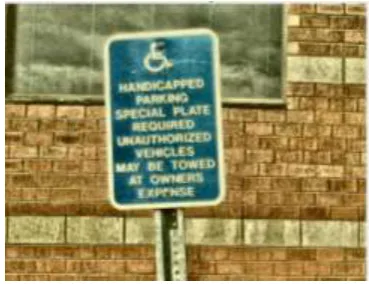
In the experiments, MATLAB R2018b is used as the programming tool. All images that use are selected from the Internet. Randomly select five dusty images with text areas from the Internet. The first step of the work is to improve clarity of text regions. This is done by preprocessing and image enhancement algorithm. Fig. 2 is input dusty image, fig. 3 is filtered image after applying the median filter. This removes noise from images.
Fig -2: Input dusty image
Fig -3: Filtered image
Fig. 4 is enhanced images after applying CLAHE enhancement algorithm. The text region in enhanced images is obviously clearer than dusty images.
Fig -4: Enhanced image
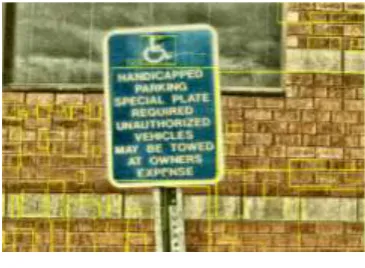
Only using deep learning algorithm to detect and recognize the text of dusty images can reduce the detection and recognition accuracy. So our method mixs enhancement, text feature MSER and deep learning algorithm that obtain a better results for dust image text detection and recognition. MSER is search for text region which is basically a stable region and segment it with different region and show it by different color as shown in fig. 5. MSER is define the region having similar kind of properties. False region removal removed the remaining region having non uniformity and uniformity region is define as shown in fig. 6.
Fig -5: MSER regions MSER
False Region Removal
Trained Model
[image:3.595.63.558.46.250.2] [image:3.595.340.525.304.446.2] [image:3.595.72.252.575.714.2]© 2019, IRJET | Impact Factor value: 7.34 | ISO 9001:2008 Certified Journal
| Page 1391
Fig -6: After removing non region based on geometricproperties
Bounding box is evaluated using regionprops. It findout co-ordinate of bounding box and using insertshap instruction detected region is find. Detected region is showing by overlap the specific coordinate on input image. The detection of text output is shown in fig. 7.
Fig -7: Detected text
The text are recognized from the dusty image as shown in fig. 8. This is done by using trained network which is trained using long short term memory and save as a network. while recognition of text from dusty image, this network is uses.
Fig -8: Recognize of text
The script of the text in the training images and test images is English. The dataset have 62 classes consisting of 10 digits and 52 English characters with both upper and lower cases. The LSTM classifier is trained using the training set which contains 27000 text images. Trained the character classifiers with varying number of features, then tested this classifier on the test set which contain 3700 text images. The classification accuracy on test set is 91.62%.
[image:4.595.55.260.56.234.2]Fig -9: Training Progress
Table -1: Accuracy of text recognition with enhancement and without enhancement
Sr.
no. Images Accuracy (%) with enhancement
Accuracy (%) without
enhancement
1 Image1 87.80 69.87
2 Image2 62.16 55.26
3 Image3 89.06 89.06
4 Image4 70.37 59.25
5 Image5 100 94.11
Chart -1: Comparison of accuracy
[image:4.595.319.548.206.385.2] [image:4.595.69.252.343.477.2] [image:4.595.311.556.430.687.2]© 2019, IRJET | Impact Factor value: 7.34 | ISO 9001:2008 Certified Journal
| Page 1392
much better performance than only use text recognitionwithout enhancement algorithm for dusty image.
The comparison of accuracy between text recognition with enhancement algorithm and text recognition without enhancement algorithm is represented in fig. 10 in the form of graph. From the above graph, it has been observed that the average percentage of accuracy text recognition with enhancement algorithm is more than accuracy text recognition without enhancement algorithm.
3. CONCLUSIONS
The solution for standard challenges in scene text analysis for dusty image is proposed. The problem of text detection and recognition for dusty images is address which can be used for many applications such as content-based image retrieval, sign translation and navigation aid for the visually impaired and robots, driverless car. The various detection and recognition of text techniques are reviewed. The effort of researchers, considerable progress had made in natural scene image detection and recognition of text in recent past years. Aiming at the problems that text regions in dusty images always exit some problem such as blur, text features weakened or lost, low definition, low resolution low contrast. There is need of dusty image is enhanced by enhancement algorithm and then text are detected and recognized in the enhanced image. The text and non-text regions are divided by the maximally stable extremal regions. The geometric property is used to remove non-text regions from images which greatly reduces the computational cost. Then text are detected and recognized in these images by using Long Short Term Memory (LSTM). As an overview of the results of the previous chapters, It can be conclude that 81.87% text character recognize in dusty images. The LSTM character classifier provide accuracy of around 91.52% on individual characters.
The research presented in this dissertation motivates a diversity of future research project, most of which are about improving the performance of text detection and recognition for dusty image by adding new methods or optimizing the existing methods. The proposed approach are capable of detecting and recognizing English text for dusty image with sufficient accuracy. The recognition of multi linguistic script for dusty image will be considered in future work.
REFERENCES
[1] Christian Bartz Haojin Yang Christoph Meinel, “STN-OCR: A single Neural Network for Text Detection and Text Recognition”, arXiv:1707.08831v1 [cs.CV], 27 Jul 2017.
[2] Jharna Majumdar, Santhosh Kumar K L, “Modified CLAHE: An Adaptive Algorithm for Contrast Enhancement of Aerial, Medical and Underwater Image”, International
Journal of Computer Engineering and Technology (IJCET), Volume 5, Issue 11, November (2014), pp. 32-47, 2014.
[3] Madallah Alruwaili, Lalit Gupta, “A Statistical Adaptive Algorithm for Dust Image Enhancement and Restoration”, 2015 IEEE International Conference on Electro/Information Technology (EIT), 2015.
[4] Ting Yan, Liejun Wang , Jiaxing Wang, “Method to Enhance Degraded Image in Dust Environment”, Journal of Software, vol. 9, no. 10, October 2014.
[5] B. Epshtein, E. Ofek, Y. Wexler, “Detecting Text in Natural Scenes with Stroke Width Transform”, Computer Vision and Pattern Recognition, San. Francisco. CA. USA, pp.2963-2970, August, 2010.
[6] Cong Yao, Xiang Bai, Wenyu Liu, Yi Ma, Zhuowen Tu, “Detecting Texts of Arbitrary Orientations in Natural Images”, In Proceedings of the 2012 Conference on Computer Vision and Pattern Recognition, pp. 1083–1090.
[7] Leo Breiman, “Random Forests”, Machine Learning, 45(1), pp. 5–32, 2001.
[8] Adam Coates, Blake Carpenter, Carl Case, Sanjeev Satheesh, Bipin Suresh, Tao Wang, David J. Wu, Andrew Y. Ng, “Text detection and character recognition in scene Images with unsupervised feature learning”, 2011 International Conference on Document Analysis and Recognition.
[9] Lukas Neumann, Jiri Matas, “On Combining Multiple Segmentations in Scene Text Recognition”, 12th International Conference on Document Analysis and Recognition, 2013.
[10] O. Akbani, A. Gokrani, M. Quresh, Furqan M. Khan, Sadaf I. Behlim, Tahir Q. Syed, “Character Recognition in Natural Scene Images”, 2015 International Conference on Information and Communication Technologies (ICICT).
[11] Xiaolong Liu, Tong Lu, “Natural Scene Character Recognition using Markov Random Field”, 2015 13th International Conference on Document Analysis and Recognition (ICDAR).
[12] Xiaoming Huang, Tao Shen, Run Wang, Chenqiang Gao, “Text Detection and Recognition in Natural Scene Images”, 2015 International Conference on Estimation, Detection and Information Fusion (ICEDIF 2015).
© 2019, IRJET | Impact Factor value: 7.34 | ISO 9001:2008 Certified Journal
| Page 1393
[14] Md. Rabiul Islam, Chayan Mondal, Md. Kawsar Azam,Abu Syed Md. Jannatul Islam, “Text Detection and Recognition Using Enhanced MSER Detection and a Novel OCR Technique”, 2016 5th International Conference on Informatics, Electronics and Vision (ICIEV).
[15] Kakade Snehal Satwashil, Prof. Dr. V. R. Pawar, “Integrated Natural Scene Text Localization and Recognition”, International Conference on Electronics,
Communication and Aerospace Technology ICECA 2017.
[16] Rituraj Soni, Bijendra Kumar, Satish Chand, “Text Detection and Localization in Natural Scene Images Using MSER and Fast Guided Filter”, 2017 Fourth International Conference on Image Information Processing (ICIIP), 2017.
[17] Savita Choudhary, Nikhil Kumar Singh, Sanjay Chichadwani, “Text Detection and Recognition from Scene Images using MSER and CNN”, 2018 Second International Conference on Advances in Electronics, Computer and Communications (ICAECC-2018).
[18] Zhong Zhang, Hong Wang, Shuang Liu, Baihua Xiao, “Deep Contextual Stroke Pooling for Scene Character Recognition”, IEEE Access, 2018.
[19] Hao Liu, Ce Li, Shengze Jia, Dong Zhang,“Text Detection for Dust Image Based on Deep Learning”, The 33rd Youth Academic Annual Conference of Chinese Association of Automation (YAR) May 1820, 2018, Nanjing, China.
[20] Kwang In Kim, Keechul Jung, Jin Hyung Kim, “Texture-Based Approach for Text Detection in Images Using Support Vector Machines and Continuously Adaptive Mean Shift Algorithm”, IEEE Transactions on Pattern Analysis and Machine Intelligence, vol. 25, no. 12, December 2003.
[21] Lukas Neumann, Jiri Matas, “A method for text localization and recognition in real-world images”, 10th Asian conference on computer vision, New Zealand, 2010.
[22]https://www.scribd.com/document/256219525/Arti ficial-Neural-Network-Wikipedia-The-Free-Encyclopedia
[23] Ani1 K. Jain, Jianchang Mao, K.M. Mohiuddin, “Artificial Neural Network: A Tutorial”, IEEE Computer, Volume 29 , Issue 3 , Mar 1996.
[24]https://in.mathworks.com/discovery/deep-learning.html
[25]https://www.analyticsvidhya.com/blog/2017/12/fun damentals-of-deep-learning-introduction-to-lstm
[26] Jin Dai, Zu Wang, Xianjing Zhao, Shuai Shao, “Scene Text Detection Based on Enhanced Multi-channels MSER and a Fast Text Grouping Process”, 2018 the 3rd IEEE
International Conference on Cloud Computing and Big Data Analysis.
[27] Kethineni Venkateswarlu, Sreerama Murthy Velaga, “Text Detection On Scene Images Using MSER”, International Journal of Research in Computer and Communication Technology, Vol 4,Issue7 , July 2015.
[28] Geetanjali Adlinge, Shashikala Kashid, Tejasvini Shinde, Virendrakumar Dhotre, “Text Extraction from image using MSER approach”, International Research Journal of Engineering and Technology (IRJET), Vol. 03, Issue 05, May 2016.