© 2016, IRJET | Impact Factor value: 4.45 | ISO 9001:2008 Certified Journal | Page 2889
Development of Cross Layer Protocol to Enhance Wireless Sensor
Network’s Performance
Arun.R
11
PG Student, Dept. of Telecomm. Engineering, R.V. College of Engineering, Bangalore-59, Karnataka, India
---***---Abstract -
Main constraint for any WSN (Wireless sensornetwork) is Energy. Many research work is dedicated towards energy awareness and communication reliability of WSNs to enhance Network lifespan. This is two way problem of enhancing network efficiency and improving network quality. Dealing with both the problems is a challenging task. Research shows the solution to these problems can be achieved by using either of the two layers protocol, that is data link layer or network layer protocol. The work here is mainly focused in the development of cross layer protocol, so as to enhance WSN’s performance. The algorithm used here is greedy algorithm that enables each sensor to choose different transmission paths using our algorithm that is optimized greedy algorithm. Multiple Simulation has been done using MATLAB tool and several results has been obtained, Which clearly shows that the complex problem of obtaining higher efficiency and reliability of WSN is resolved using the cross layer protocol developed using optimized Greedy algorithm.
Keywords—Wireless sensor networks, Energy, power consumption, MATLAB, AODV, AOMDV, Node
deployment Algorithm, Greedy algorithm.
1. INTRODUCTION
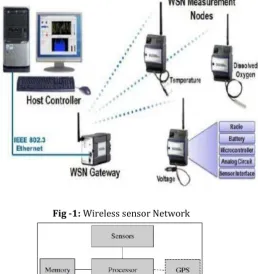
A Wireless sensor system fig.1 is a collection of nodes composed into an agreeable system. These nodes are made up of a typical antenna i.e. RF device, microcontrollers, Microprocessors, powered with battery and consists of different type of memories and sensors. These nodes are built in such a way that they are operated in a very convenient and systematic manner. Required number of nodes are aligned according to the requirement. These type of structures will alter the way of our life.
Wireless sensor networks is growing in such a way that in coming period of time the world will be revived by its pace and will take internet by storm and will transform the internet. This new development is invigorating with endless potential for different beneficial zones including biological, restorative, military, transportation, redirection, crisis organization, nation resistance, and sharp spaces.
Since a wireless sensor system fig.2 is an appropriated continuous framework, a characteristic inquiry is what number of arrangements from disseminated and constant frameworks can be utilized as a part of these new frameworks? Since a wireless sensor system is a dispersed
[image:1.595.312.571.388.663.2]ongoing framework a characteristic inquiry is, what number of arrangements from appropriated and continuous frameworks can be utilized as a part of these new frameworks? Lamentably, almost no earlier work can be connected and new arrangements are important in every aspect of the framework. The principle reason is that the arrangement of suppositions fundamental past work has changed drastically. Most past circulated frameworks research has accepted that the frameworks are wired, have boundless force, are not constant, have client interfaces, for example, screens and mice, have an altered arrangement of assets, treat every hub in the framework as essential and are area autonomous
Fig -1: Wireless sensor Network
© 2016, IRJET | Impact Factor value: 4.45 | ISO 9001:2008 Certified Journal | Page 2890
2. DESIGN OF THE ALGORITHM
[image:2.595.316.555.216.423.2]Configuration is a standout amongst the most vital periods of programming advancement. The arrangement is an innovative methodology in which a system affiliation is developed that will satisfy the utilitarian and non-down to earth structure requirements. Colossal Systems are constantly are decayed into sub-structures that give some related course of action of organizations. Sub-structures that give some related game plan of organizations. The output of the design process is shown in the below figure 3.
Fig -3: Design of the algorithm process
2.1 NODE DEPLOYMENT ALORITHM
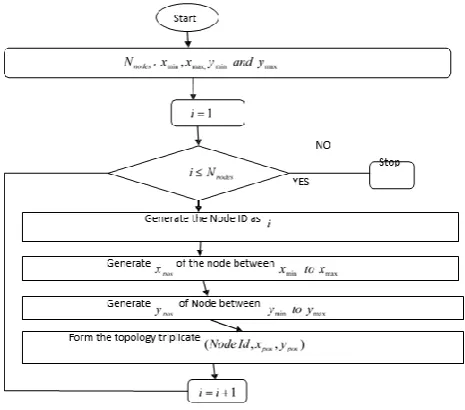
Random Topology Distribution algorithm is responsible for deploying the nodes randomly in the given area for the limits xmin , xmax , ymin & ymax .This algorithm is responsible for distributing the nodes randomly in the network in a given area is shown in figure 4.
Fig -4: Node deployment algorithm
2. 2 AODV ALGORITHM
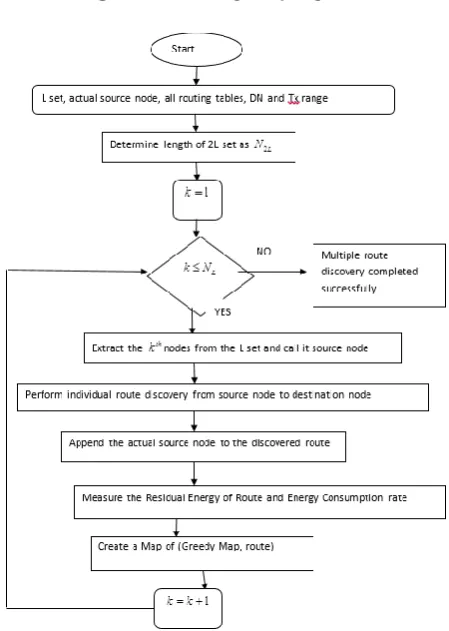
AODV algorithm finds multiple routes from the source node to the destination node. The number of routes that are discovered will be equal to the number of nodes within the transmission range. On each of the route the AODV algorithm
will find the overall energy consumed. The routes are sorted in the ascending order of the overall energy consumption and the route with lowest energy consumption acts like the best route.
[image:2.595.43.284.225.363.2]The flowchart for AODV algorithm can be divided into multiple route discovery and individual route discovery as shown in figure 5 and figure 6.
Fig -5: AODV Multiple route discovery
[image:2.595.44.277.479.684.2] [image:2.595.326.553.479.743.2]© 2016, IRJET | Impact Factor value: 4.45 | ISO 9001:2008 Certified Journal | Page 2891
2. 3 AOMDV ALGORITHM
AOMDV (Ad-hoc on-demand multipath distance vector) is a proactive steering convention.
[image:3.595.318.543.274.590.2]AOMDV algorithm as shown in fig 7 is to enhance dynamic system sustenance for the above basic issues, and it is a delineation for the vitality control component by proposing Synchronous Mindful Vitality Steering Convention (AOMDV).The adjustment of this convention is to for all intents and purposes address on correspondence vitality for each bundle, in light of its restriction that can deal with force sparing and minimum use without excluding any parcel confinements and spreads the adaptability, Data transmission and memory impediment requirements.
Fig -7: AOMDV Algorithm
2. 4 GREEDY ALGORITHM
Greedy routing algorithm is a novel cross-layer framework including a multipath routing protocol.
By distributing the sensed data to multiple paths, the energy consumption of each sensor node can be balanced to prolong network lifetime. The greedy algorithm shown in fig 8 and fig 9 is of assigning data chunks to different paths. The employment of Reed- Solomon code also ensures the communication reliability to avoid packet retransmission. The mechanism of optimal link-disjoint paths for availability .The paths generated by our protocol have disjoint nodes to balance the energy consumption. In addition, we also avoid using the long paths because each packet relay causes energy consumption.
Fig -8: Individual greedy Algorithm
Fig -9: Multipath greedy Algorithm
3. PROPOSED METHODOLOGY
[image:3.595.56.287.275.451.2]© 2016, IRJET | Impact Factor value: 4.45 | ISO 9001:2008 Certified Journal | Page 2892
Fig-10: Proposed Methodology4. RESULTS AND ANALYSIS
Functional requirements are given in figure 11.
[image:4.595.333.537.330.515.2]Fig 11-: Functional requirements
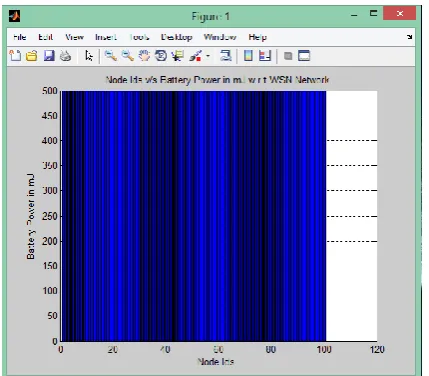
[image:4.595.55.270.495.683.2]Fig- 11: Node IDs v/s battery power in mJ w.r.t WSN network
Fig- 12: Random node positions in Wireless Sensor Networks
Fig-13: Number of routes v/s Energy consumption rate
[image:4.595.322.547.547.746.2]© 2016, IRJET | Impact Factor value: 4.45 | ISO 9001:2008 Certified Journal | Page 2893
Fig- 15: Example of one of the best route discovered fromsource node to destination node.
Fig- 16:
Route discovery time in ms
Fig-17: Number of Hops
Fig18: Energy consumed in mj
Fig- 19: Number of alive nodes
© 2016, IRJET | Impact Factor value: 4.45 | ISO 9001:2008 Certified Journal | Page 2894
Fig-21:Residual energy of nodes
Fig-22: Routing overhead
5. CONCLUSION
The main objective of this paper is to Study the Wireless Sensor Networks, Use of Node Deployment Algorithm to place the nodes in the given area, to apply Routing Table Formation algorithm to form routing tables for various nodes in the network, design & Simulation of AODV algorithm which is used to find the route from source hub to destination hub with respect to overall distance reduction, design & Simulation of AOMDV algorithm which is used to find the route from source node to destination node with respect to overall energy reduction, design & Simulation of Greedy algorithm which is used to find the route from source node to destination node with respect to overall energy reduction with improved data rates and Comparison of AODV, AOMDV and Greedy algorithm with respect to following parameters: a) End to End Delay b) Number of Hops c) Energy Consumption d) Number of Alive Nodes e) Number of Dead Nodes. In future work, we will jointly consider TDMA
schedule to enhance overall energy efficiency of a Wireless sensor network.
6. ACKNOWLEDGMENT
I express my sincere and foremost thanks and gratitude to my guide Dr.K. Sreelakshmi, Professor, Department of Telecommunication, R.V College of Engineering, for her able support and guide through the tenure of this project work.
REFERENCES
[1]Kuei-Ying Lin and Pi-Chung Wang. Tzung-Pei Hong “A Greedy Algorithm in WSNs for Maximum Network Lifetime and Communication Reliability” Proceedings of 2015 IEEE 12th International Conference on Networking, Sensing and Control Howard Civil Service International House, Taipei, Taiwan, April 9-11, 2015.
[2] Shio Kumar Singh 1, M P Singh 2, and D K Singh “Routing Protocols in Wireless Sensor Networks –A Survey” International Journal of Computer Science & Engineering Survey (IJCSES) Vol.1, No.2, November 2010. [3] A.L. Olsen. “Genetic Algorithms and the Knapsack Problem: A Study of Penalty Functions”.Master’s thesis, University of North Carolina at Charlotte, 1993.
[4] A.L. Olsen.” Penalty functions and the knapsack problem”. In Proceedings of the First IEEE Conference on Evolutionary Computation, Orlando, Florida, June 1994. IEEE Press. pp. 554-558.
[5] Alwan, H.; Agarwal, A. “A Survey on Fault Tolerant Routing Techniques in Wireless Sensor Networks”. In Proceedings of the 3th International Conference on S ensor Technologies and Applications (Senosrcomm ’09),Athens, Greece, 18–23 June 2009; pp. 366–371
[6] Bagula, A.; Mazandu, K. “Energy Constrained Multipath Routing in Wireless Sensor Networks”. In Proceeding of the 5th International Conference on Ubiquitous Intelligence and Computing, Oslo, Norway, 23–25 June 2008; pp. 453–467.
[7] Dezfouli, B.; Radi, M.; AbdRazak, S. “A Cross-Layer Approach for Minimizing Interference and Latency of Medium Access in Wireless Sensor Networks”. Int. J. Comput. Netw. Commun. 2010, 2, 126–142.
[8] Nifi Gupta; Chander Prabha “Energy efficient MAC-protocol with adaptive transmission power scale for WSN” International Journal of Emerging Research in Management &Technology ISSN: 2278-9359 (Volume-3, Issue-7).
[9]. ftp.ni.com/pub/devzone/pdf/tut_7142.pdf.
BIOGRAPHY
Arun.R is a PG student in Telecom Department, RVCE Bangalore. His area of interests includes Wireless communications,RF& Microwaves And Ad-hoc networks.