© 2017, IRJET | Impact Factor value: 5.181 | ISO 9001:2008 Certified Journal | Page 322
SEISMIC VULNERABILITY OF PLAN IRREGULAR RC BUILDINGS WITH
SOIL-STRUCTURE INTERACTION”
Dhanalakshmi P
1,Ramesh B M
2, Dr K Manjunatha
3Manu Priya
41,4
Post Graduate Student, S J B I T, Bengaluru, Karnataka
2Assistant Professor, S J B I T, Bengaluru, Karnataka
3
Professor, Dept. of studies in Civil Engineering, UBDTCE, Karnataka
---***---Abstract
-
In this paper we have made an attempt to study
the soil structure interaction effect of different soil on structural behaviour of building supported on isolated footings when subjected to seismic load. During, dynamic loading the consideration of actual support flexibility reduces the overall stiffness of the structure and brings out changes in time period of the structure. Hence the change in time period may alter the seismic response of the structure considerably and therefore it is necessary to study dynamic soil structure interaction. The main aim of the present study is to analyse the building that is supported on isolated footing for different soil conditions and compare the results of roof displacement, time period and base shear for all the conditions of the soil. The analysis of the soil structure is done using SAP 2000 version 19.1.0 analysis package.Key Words:Soil structure interaction, time period, base shear, fixed condition, horizonal irregularities
1.INTRODUCTION
The scarcity of land compels engineers to construct buildings at locations with less favorable geotechnical conditions in seismically active regions. Numerous midrise buildings have been built in earthquake prone areas employing different types of foundations. In the selection of the foundation type for the mid-rise buildings, several options such as shallow foundation, pile foundation, or pile-raft foundation, might be considered by design engineers to carry both gravity and earthquake loads. However, different types of foundations behave differently during the earthquake considering the soil-structure interaction (SSI) that may influence the seismic behavior of the superstructure.
1.1 Soil Structure Interaction
The process in which the response of the soil influences the motion of the structure and the motion of the structure influences the response of the soil is termed as soil-structure interaction (SSI). The effect of SSI, however, becomes prominent for heavy structures resting on relatively soft soils for example nuclear power plants, high-rise buildings and elevated-highways on soft soil.
Since 1960‟s, soil-structure interaction (SSI) has been recognized as an important factor that may significantly affect the relative building response, the motion of base and motion of surrounding soil.
Fig-1.
Soil Structure Interaction model1.2 Effect of SSI on structural response
Many design codes have suggested that the effect of SSI can reasonably be neglected for the seismic analysis of structures. This myth about SSI apparently stems from the false perception that SSI reduces the overall seismic response of a structure, and hence, leads to improved safety margins. Most of the design codes use oversimplified design spectra, which attain constant acceleration up to a certain period, and thereafter decreases monotonically with period. Considering soil-structure interaction makes a soil-structure more flexible and thus, increasing the natural period of the structure compared to the corresponding rigidly supported structure.
2. STUDY METHODOLOGY
© 2017, IRJET | Impact Factor value: 5.181 | ISO 9001:2008 Certified Journal | Page 323 Table -1: Soil elastic constants
Soil Type weight of Unit soil(γ)
Modulus of elasticity
(kN/m2)
Poisson’s Ratio (µ)
Hard soil 18 65000 0.3
Medium
soil 16 35000 0.4
Soft soil 16 15000 0.4
2.1 Idealization of Elastic Continuum
Soil Structure Interaction (SSI) is also carried out by finite element method (FEM) by assuming elastic continuum below the foundation level. The boundary is considered beyond the region where structural loading has no effect, this assumed to be a lateral offset of width of the building on all four sides and depth equal to 1.5 times the width of the building. The three dimensional finite element models of soil foundation frame system of width 42m, length 48m and height 16m and each soil block is 2mx3mx1m is considered and is modelled using SAP 2000.
a. The soil and foundation were modelled using eight-node hexahedral elements called brick element.
b. Each node has three degrees of freedom that is translation ux in x, translation uy in y direction and translation uz in z direction. c. The soil characteristics are assumed and the
footings are made of concrete and have square cross section of 2mx3m.
d. Bottom of the soil is restrained in all directions.
[image:2.595.314.550.344.495.2]
Fig-2. 3D Elastic continuum model
2.2 Frame structure
The beams and columns are modeled as frame element with 2 nodes. The elements has 6 DOF at each node. Rotation about X, Y, Z axis and Translation in X, Y, Z direction.
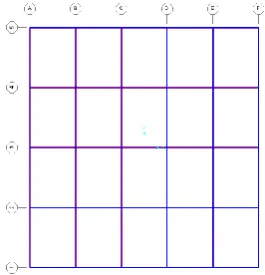
[image:2.595.48.277.464.668.2]a. Frame has been modelled by using Frame element. b. The frame considered is irregular one which is widely used in constructions with 3-storeys,5 bays in X-direction and 4 bays in Y-Direction with beam size 0.3mX0.5m, column size 0.3mX0.5m and storey height equal to 3m and it is modelled as elastic material.
Table -2: Frame and footing constants
Characteristic strength of
concrete ( M30 ) 30 N/mm2
Young’s Modulus ( Es ) 27.386 x10⁶kN/m2 Poisson’s Ratio ( μ ) 0.2
Weight per unit Volume ( w ) 25kN/m3
Shear modulus ( G ) 11.41x10⁶ kN/m2
Table-3:Details of footing frame system
Concrete Frame Columns = 0.3m x 0.5m Beams = 0.3m x 0.5m
Isolated footing Footing depth= 1m Cross section = 2m x 3m
No of storeys G+2
Storey height 3m
Number of bays 5 bay x 4bay
Bay width 4m x 5m
2.3 Plan configurations
The layout of the plan having 5x4 bays of equal length of 5m fig-1. The buildings considered are reinforced concrete ordinary moment resisting frame building of three storeys with different irregularities. The storey height is kept uniform of 3m for all kind of building models which are as below.
[image:2.595.365.498.603.741.2]© 2017, IRJET | Impact Factor value: 5.181 | ISO 9001:2008 Certified Journal | Page 324 Model-D1 [T-Shape Diaphragm discontinuity]
Model-D2 [Rectangular Diaphragm discontinuity]
Model-L1 [Re-entrant corners L-shape (40%)]
Model-L2 [Re-entrant corners L-shape (60%)]
Model-L3 [Re-entrant corners L-shape (80%)]
Model-P1 [Re-entrant corners in Plus (+)-shape (20%)]
Model-P2 [Re-entrant corners in Plus (+)-shape (40%)]
© 2017, IRJET | Impact Factor value: 5.181 | ISO 9001:2008 Certified Journal | Page 325 Model-P2 [Re-entrant corners in T-shape (80%)]
3. Analysis Methods
A response spectrum is simply a plot of the peak or steady-state response (displacement, velocity or acceleration) of a series of oscillators of varying natural frequency that are forced into motion by the same base vibration or shock. The resulting plot can then be used to pick off the response of any linear system, given its natural frequency of oscillation.
If the input used in calculating a response spectrum is steady-state periodic, then the steady-state result is recorded. Damping must be present, or else the response will be infinite. For transient input (such as seismic ground motion), the peak response is reported. Some level of damping is generally assumed, but a value will be obtained even with no damping.
3.1 Response spectrum data
Response spectrum given as per IS 1893:2000 is used for the analysis
a. Seismic zone factor (z) =0.36 b. Seismic zone= zone V
c. Damping=5%
d. Importance factor (I) =1 e. Response reduction(R) =3
4. Parametric Study
The dynamic analysis is carried out by response
spectrum method. The analysis of the models is
carried out by
SAP 2000
.
The response of the
horizontally irregular building with fixed base (i.e
without SSI) is compared with the flexible base (with
SSI) and with 3 different types of soil conditions
subjected to dynamic loads is determined in terms of
base shear and time period by performing Response
spectrum analysis using
SAP 2000
. Effects of SSI on
different
parameters
is
studied
i.e,
Roof
displacement, Time period and Base shear.
4.1 Roof Displacement.
The Roof Displacement values in both X and Y directions are plotted below. The Roof displacement values vary more towards Y-direction compared to X- direction in all the models since the number of bays in X direction is more compared to Y-direction. In rigid base condition, the roof displacement is more in Regular building (R), (L3) and (T2) compared to the other models in both X and Y direction. Chart-1 and Chart-2 represents the graph showing the roof displacement of different models with the fixed base condition and other soil conditions
Chart-1: Roof displacement for different soils in X direction of different models
Chart-2: Roof displacement for different soils in Y direction of different models
The Roof displacement is more for the elastic continuum models for Hard, Medium and Soft soils when compared to fixed base since the displacement in fixed base is considered only from the fixed bottom of the structure. Where as in case of elastic continuum models displacement is considered from the bottom of the soil model.
0
10
20
30
40
R D1D2 L1 L2 L3 P1 P2 T1 T2
Di
sp
la
ce
men
t
(mm
)
Models
Roof Displacement in X Direction
Fixed
Hard
medium
Soft
0
50
R D1D2 L1 L2 L3 P1 P2 T1 T2
Di
sp
la
ce
men
t
(mm
)
Models
Roof Displacement in Y Direction
FIxed
Hard
Medium
© 2017, IRJET | Impact Factor value: 5.181 | ISO 9001:2008 Certified Journal | Page 326 4.2 Time Period.
The Time period values of the structure for fixed, hard soil, medium soil and soft soil are tabulated and plotted below for all the models considered. The Time period values is maximum for regular plan in fixed end condition. It is less for D2 Model, but the values of time period does not vary much for different models. Chart-3 gives the values of time period for different models for fixed end condition and other soil conditions.
Chart- 3: Time period for different building frames for varying soil conditions
4.3 Base shear.
The Base shear for fixed condition is shown in chart-4 and for hard, medium and soft soils is shown in chart- 5, 6, and 7 respectively. The variation of base shear in X and Y directions in very less when compared to the variation of base shear for different soil conditions which can be seen in chart-8.
Chart- 4: Base shear for fixed condition in X and Y direction for different models
Chart- 5: Base shear for Hard soil in X and Y direction for different models
Chart- 6: Base shear for Medium soil in X and Y direction for different models
Chart- 7: Base shear for Soft soil in X and Y direction for different models.
0 1 2
R D1 D2 L1 L2 L3 P1 P2 T1 T2
Tim e Peri o d (Se c) Models
Time Period for different soils and
models
Fixed Hard Medium Soft 0 500 1000R D1 D2 L1 L2 L3 P1 P2 T1 T2
Bas e Sh ear (k N ) Models
Fixed Base
Fixed Base Fixed Base
70000 75000 80000 85000
R D1 D2 L1 L2 L3 P1 P2 T1 T2
Bas e Sh ear (k N ) Models
Hard Soil
Hard Soil Hard Soil
50000 50500 51000 51500 52000 52500
R D1 D2 L1 L2 L3 P1 P2 T1 T2
Bas e Sh ear (k N ) Models
Medium Soil
Medium Soil Medium Soil
33800 34000 34200 34400 34600 34800
R D1 D2 L1 L2 L3 P1 P2 T1 T2
Bas e Sh ear (k N ) Models
Soft Soil
© 2017, IRJET | Impact Factor value: 5.181 | ISO 9001:2008 Certified Journal | Page 327 Chart- 8: Base shear for different building frames for
varying soil conditions.
The Base shear values is maximum for the hard soil condition in Y- direction .This shows that the base shear depends on the time period and the even on the number of bays. Maximum base shear can be found in the elastic continuum models as the base shear is dependent on the height of the structure. This also shows the importance of soil and structure interaction in modelling and analysis.
5. CONCLUSIONS
1. The horizontal roof displacement of irregular structures and regular building is more in Y- Direction when compared to the X-direction as the number of bays in Y direction is 4 and in X direction it is 5, This shows that the stiffness in X-direction reduces the roof displacement.
2. Summary of Roof displacement for different building frames of varying soil conditions shows that roof displacement is Minimum in Fixed soil Condition and Maximum in flexible soil Condition. This shows that the structures considering soil structure interaction gives the accurate values.
3. There is not much variation in the Time period for fixed base condition. Whereas In the flexible soil condition, time period is more in Structures with soft soils when compared with rigid base structures. 4. Since the time period is more for structures on soft
soils, the analysis must be done in FEM method to know the accurate values before designing.
5. Summary of Time Period conditions for different building frames for varying soil conditions shows that Time Period is Minimum in Fixed soil Condition and Maximum in Soft soil Condition.
6. Base Shear for different building frames in varying soil conditions shows that Base shear is minimum in fixed soil condition and maximum in Hard soil condition. This proves that the buildings analysed with the fixed end condition does not provide the accurate values, which will be considering for further design ,hence
FEM models gives the exact field condition for the analysis.
7. From this study, we can conclude that the building frames has to be analysed based on the type of soil, and the interaction of soil and structure by knowing the displacements ,time period and base shear.
REFERENCES
[1] Anuradha and Dr. H.M.Somasekharaiah, “Soil
Structure Interaction Effect on the Dynamic Behavior of Irregular R.C. Frame with Isolated Footings” ,International Journal for scientific Research and development,ISSN 2321-0613, Vol. 3,Issue 04, 2015.
[2] Bal Krishna maheshwari and Hiroyuki watanabe,
“Nonlinear dynamic analysis of pile foundation: effect of Separation at soil-pile interface” 12 WCEE- World Conference on Earth quake Engineering
[3] Bhojegowda V T, Mr. K G Subramanya, “Soil Structure
Interaction of Framed Structure Supported on Different Types of Foundation” International Research Journal of Engineering and Technology, e-ISSN 2395-0056,p-ISSN 2395-0072, Vol. 2,Issue 05,Aug -2015.
[4] Chinmayi H K, Jayalekshmi B R, “Soil Structure
Interaction Effects on Seismic response of a 16 storey RC framed building with shear wall” American Journal of Engineering Research, eISSN:2320-0847, pISSN:2320-0936, Vol.2 pp-53-58, 2013
[5] Dezi.F, Carbonari.S and Leoni “Kinematic interaction
in pile foundations” 14WCEE-World Conference on Earthquake Engineering.
[6] Dr.Halkude.S.A, M.G.Kalyanshetti, S.H.Kalyani, “Soil
Structure Interaction Effect on Seismic Response of R.C. Frames with Isolated Footing” International Journal of Engineering Research and Technology, ISSN 2278-0181, Vol. 3, Issue 01,Jan -2014.
[7] Hamid Reza Tabatabaiefar & Ali Massumi, “A
simplified method to determine seismic responses of reinforced concrete moment resisting building frames under influence of soil–structure interaction.”
[8] JagadishponrajNadar, Hement S Chore, P.A.Dode, “ Soil
Structure Interaction of Tall Buildings” International Journal Of Computer Applications- 0975-8887, International Conference on Quality Up-gradation in Engineering,Science and Technology ICQUEST2015.
[9] Jun-Seong Choi, Jong-Seh Lee, Chung-Bang Yun –
“Identification of the Soil-Structure Interaction system Using Earthquake Response Data” Journal of Engineering Mechanics, ISSN 0733-9399, Vol.130, No 7, July 2004.
0 10000 20000 30000 40000 50000 60000 70000 80000
R D 1 D 2 L 1 L 2 L 3 P 1 P 2 T 1 T 2
© 2017, IRJET | Impact Factor value: 5.181 | ISO 9001:2008 Certified Journal | Page 328
[10] Kuladeepu M N, G Narayana, B K Narendra, “Soil
Structure Interaction Effect on Dynamic Behavior of 3D Building Frames with Raft Footing,International Journal of Research in Engineering and Technology” eISSN 2319-1163, pISSN 2321-7308, Vol. 4, Issue 07,July -2015
[11] Kraus & D. Dzakic, “Soil-structure interaction effects
on seismic behaviour of reinforced concrete frames” 50 SE-EEE 1963-2013.
[12] Nirav M. Katarmal, Hemal J.Shah , “Seismic Response
of RC Irregular Frame with Soil Structure Interaction” International journal of Scientific Development and Research, ISSN 2455-2631,Vol.1,Issue 4, April 2016
[13] Pandey A.D, Prabhat Kumar, Sharad Sharma –
International Journal of Civil and Structural Engineering,ISSN 0976-4399, Vol.2, No2, 2011.
[14] Ravikumar. C M, Babu Narayan K S, Sujith B V, Venkat