© 2018, IRJET | Impact Factor value: 6.171 | ISO 9001:2008 Certified Journal | Page 2997
STABILIZATION OF SANDY SOIL WITH USE OF BITUMEN EMULSION
Prof. Rajesh Jain
1, Tarun Namdeo
21Associate Professor, Jabalpur Engineering College, Jabalpur 2ME Scholar, Jabalpur Engineering College, Jabalpur.
---
Abstract: Soil is considered to be most basic constructionmaterial that has good shear strength due to the cohesion and internal friction among the soil solid particles. But due to much heavy loads coming from bridges, building etc, even soil having good shear strength can fail resulting in subsequent failure of the structures due to differential settlement. The most important and effective part of a road pavement is subgrade soil, its strength and stability. If strength of soil is poor, then stabilization is normally needed. In the present study, an attempt has been made to improve the properties of the soil by adding bitumen emulsion with sand, the use of the emulsion is for improving the strength of soil expressed in terms of Marshall Stability values which may prove to be economical and give better results. The main objective is to study the behavior and effect of bitumen emulsion on sand by Marshall Stability of mix design. The specimen was prepared with different grading of sand such as coarse, medium and fine sand with bituminous emulsion.
In the present investigation the Marshall
properties of bituminous mix using bitumen emulsion have been studied and compared with sand emulsion mix whose desirable value are mentioned in MORTH recommendation specification. The various specimens were made with varying percentages of bitumen emulsion as 8%, 9%, and 10% with sand and evaluate the Marshall Stability load value or flow value. In the present investigation the Marshall properties of coarse sand and medium sand are studied and result are obtained which are compared with MORTH recommendation specification.
Key Words: Stabilization, Sandy Soil, Emulsion, Marshall Stability
1. Introduction
A commonly used pavement structure in India is the flexible pavement type, whereby a bituminous mix or surface treatment is placed over a base course made of granular materials. Other flexible pavement types being used consist of base courses made of bituminous mixes or penetration macadam [Ministry of Works, 1999]. Sand mix with bitumen emulsion is used as base coarse construction, as filler in various courses and as a seal coat in surface dressing. The Bituminous mixes used in the construction of the surfacing and base course layers are hot-mixed, hot laid and compacted and are normally referred to as “Hot-Mixes”, or Bituminous concrete, or Asphalt Concrete. [9]
The processes involved in producing the hot mixes consume enormous energy such as electricity, fuel oils and or firewood. This is one of the causes of high construction costs on one hand, and on the other hand the heating processes cause some environmental pollution in form of dust and poisonous fumes, and sometimes fire accidents occur to workmen and the surroundings. One possible approach to overcome the disadvantages associated with bituminous hot mixes is to use Bitumen Emulsion cold-mixes (BEMIX).
The main object and scope of the study is
1. To prepare and test specimen of sand and emulsion mix to evaluate the Marshall Stability load value and flow value.
2. Comparing the Marshall properties of sand emulsion mix and semi dense bituminous concrete mix.
Bitumen Emulsion-cold Mixes can be produced and constructed without application of heat, and therefore are economical. Environmental pollution in form of poisonous fumes and dust, and risk of fire accidents to workmen and surrounding are eliminated, as no heating process is involved.
The main ingredients of Bitumen Emulsion Cold paving mixtures are Bitumen emulsion binder and mineral aggregates, which are mixed without application of heat, either as plant-mix or as mixed-in-place.
2. Material
2.1 Granular material: Sand is naturally occurring granular material composed of finely divided rock and mineral particles. It is defined by size, being finer than gravel and coarser than silt. Sand can also refer to a textural class of soil or soil type; i.e., a soil containing more than 85 percent sand-sized particles by mass.
© 2018, IRJET | Impact Factor value: 6.171 | ISO 9001:2008 Certified Journal | Page 2998 Granular material used in this experimental study is
obtained from the Narmada river of Jabalpur region which is well graded sand found out by sieve analysis which is extracted from the Colon ghat near Shahpura dist. Jabalpur
In the current study, three types of sand (course grained, medium grained and fine grained), and locally blended bitumen emulsions of Grade SS-2 were used to make mix designs as follows:
і) Course grained sand
This consisted of coarse grained soil which is mixed with bitumen emulsion of Grade SS-2 with its different percentages. This mixture was proposed for use in base course construction.
ii) Medium grained sand
This consisted of Medium grained soil which is mixed with bitumen emulsion of Grade SS-2 with its different percentages. This mixture had been proposed for use as filler in various courses.
iii) Fine grained sand
This consisted of Fine grained soil which is mixed with bitumen emulsion of Grade SS-2 with its different percentages. This mixture had been proposed for use in surface course or used as a seal coat in surface dressing.
2.2 Bitumen emulsion: Bitumen emulsion is a two-phase system consisting of bitumen, water and one or more additives which assist in its formation, stabilization and in modifying its properties. The bitumen is dispersed throughout the water phase in the form of discrete
globules, typically 0.1 to 50 pm in diameter which are held in suspension by electro-static charge stabilized by an emulsifier. Depending on the composition of raw materials, which go into bitumen emulsion, these may include bitumen, water, emulsifier, acid or caustic, polymers, salts, solvents, additives, and emulsion stabilizers.
3. Methodology:
In this study the natural sand were used for testing under various types like coarse sand size ranges from 4.75mm to 2mm, Medium sand size ranges from 2mm to 0.425mm and Fine sand size from 0.425mm to 0.075mm. The bituminous emulsions are used for preparing the specimen is slow setting type 2(SS-2). The sand was tested for specific gravity, sieve size analysis and Marshall Stability.
3.1 Mix design procedure
The dry sand of weight 1200g is taken and mixed with different percentage of bitumen emulsion (8%, 9%, and 10%).
The sample was then mixed thoroughly and left for 10-15min. at room temperature.
After mixing the sample the mould was prepared in a Marshall mould.
Each side of the mould specimen was compacted with 75 blows by Marshall Compaction hammer. After 3 days the Marshall Stability properties of
the sample is determined.
[image:2.595.135.461.547.639.2]4. Specification of Bitumen Emulsion
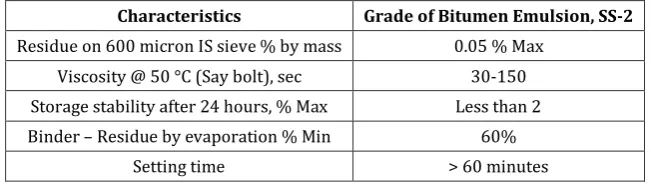
Table-1: Specification of bitumen emulsion of Grade SS-2 as per IS 8887: 2004
Characteristics Grade of Bitumen Emulsion, SS-2
Residue on 600 micron IS sieve % by mass 0.05 % Max
Viscosity @ 50 °C (Say bolt), sec 30-150
Storage stability after 24 hours, % Max Less than 2
Binder – Residue by evaporation % Min 60%
Setting time > 60 minutes
5. Characterization of Soil
Table-2: Specific gravity of soil which was determined in laboratory
Type of Soil Specific gravity
Coarse grained soil 2.63
Medium grained soil 2.84
© 2018, IRJET | Impact Factor value: 6.171 | ISO 9001:2008 Certified Journal | Page 2999 Table-3: Requirements for sand asphalt base course as per MoRTH (Table 500-15)
Parameter Requirement
Minimum stability (KN at 60°C) 2.0
Minimum flow (mm) 2
Compaction level (Number of blows) 2×75
Percent air voids 3-5
Percent voids in mineral aggregate (VMA) 16 min.
Percent voids filled with bitumen (VFB) 65-75
6. Grain Size Distribution (Sieve Analysis)
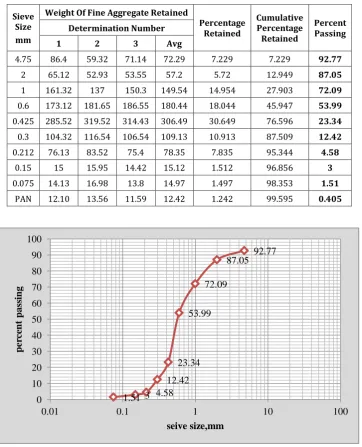
Table- 3: Sieve analysis of soil sample with Grain size distribution graph
Sieve Size mm
Weight Of Fine Aggregate Retained
Percentage Retained
Cumulative Percentage Retained
Percent Passing Determination Number
1 2 3 Avg
4.75 86.4 59.32 71.14 72.29 7.229 7.229 92.77
2 65.12 52.93 53.55 57.2 5.72 12.949 87.05
1 161.32 137 150.3 149.54 14.954 27.903 72.09
0.6 173.12 181.65 186.55 180.44 18.044 45.947 53.99
0.425 285.52 319.52 314.43 306.49 30.649 76.596 23.34
0.3 104.32 116.54 106.54 109.13 10.913 87.509 12.42
0.212 76.13 83.52 75.4 78.35 7.835 95.344 4.58
0.15 15 15.95 14.42 15.12 1.512 96.856 3
0.075 14.13 16.98 13.8 14.97 1.497 98.353 1.51
PAN 12.10 13.56 11.59 12.42 1.242 99.595 0.405
Graph 1: - Percentage Passing and Sieve Size 92.77 87.05
72.09
53.99
23.34
12.42 4.58 3 1.51 0
10 20 30 40 50 60 70 80 90 100
0.01 0.1 1 10 100
per
ce
nt
pas
sin
g
[image:3.595.118.481.295.743.2]© 2018, IRJET | Impact Factor value: 6.171 | ISO 9001:2008 Certified Journal | Page 3000 7. Result and Discussion
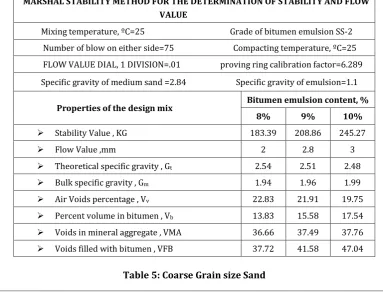
The obtained results of Marshall Parameters are shown in tables 4 & 5 and graphs 1to 8.
Table4: Medium Grain size Sand
MARSHAL STABILITY METHOD FOR THE DETERMINATION OF STABILITY AND FLOW VALUE
Mixing temperature, ºC=25 Grade of bitumen emulsion SS-2 Number of blow on either side=75 Compacting temperature, ºC=25 FLOW VALUE DIAL, 1 DIVISION=.01 proving ring calibration factor=6.289 Specific gravity of medium sand =2.84 Specific gravity of emulsion=1.1
Properties of the design mix Bitumen emulsion content, %
8% 9% 10%
Stability Value , KG 183.39 208.86 245.27
Flow Value ,mm 2 2.8 3
Theoretical specific gravity , Gt 2.54 2.51 2.48
Bulk specific gravity , Gm 1.94 1.96 1.99
Air Voids percentage , Vv 22.83 21.91 19.75
Percent volume in bitumen , Vb 13.83 15.58 17.54
Voids in mineral aggregate , VMA 36.66 37.49 37.76
[image:4.595.103.487.175.467.2] Voids filled with bitumen , VFB 37.72 41.58 47.04
Table 5: Coarse Grain size Sand
MARSHAL STABILITY METHOD FOR THE DETERMINATION OF STABILITY AND FLOW VALUE
Mixing Temperature, ºc=25 Grade Of Bitumen Emulsion SS-2
Number Of Blow On Either Side=75 Compacting Temperature, ºc=25 Flow Value Dial, 1 Division=.01 Proving Ring Calibration Factor=6.289
Specific Gravity Of Coarse Sand =2.63 Specific Gravity Of Emulsion=1.1
Properties Bitumen emulsion content, %
8% 9% 10%
Stability Value , KG 331.12 306.59 284.53
Flow Value ,mm 4.35 5.30 7.4
Theoretical specific gravity , Gt 2.38 2.36 2.33
Bulk specific gravity , Gm 2.04 2.06 2.07
Air Voids percentage , Vv 14.28 12.71 11.16
Percent volume in bitumen , Vb 14.38 16.15 17.96
Voids in mineral aggregate , VMA 28.66 28.86 29.12
© 2018, IRJET | Impact Factor value: 6.171 | ISO 9001:2008 Certified Journal | Page 3001 Variations of Marshall Parameters for fine grain size sandy
soil are shown in Graph 2, 3, 4 and 5.
Graph:-2 Marshall Stability value and Bitumen Emulsion Content %
Graph:-3 flow value And Bitumen Emulsion Content%
Graph:-4 VMA% and Bitumen Emulsion Content%
Graph:-5 Air Voids% and Bitumen Emulsion Content%
Variations of Marshall Parameters for Medium grain size sandy soil are shown in Graph 6, 7, 8 and 9.
Graph:-6 Marshall Stability value and Bitumen Emulsion Content %
© 2018, IRJET | Impact Factor value: 6.171 | ISO 9001:2008 Certified Journal | Page 3002 Graph:-8 VMA% and Bitumen Emulsion Content%
Graph:-9 air voids% and Bitumen Emulsion Content%
8. Discussion
A.MEDIUM GRAINED SOIL
Marshal stability value (kg) at 8% is found to be 183.39kg which increases to 245.27kg at 10% which is maximum.
Flow value (mm) at 8% is 2mm and is increases to 3mm at 10% bitumen emulsion.
Voids in mineral aggregate (VMA) is 36.66 at 8% bitumen emulsion which get increases to 37.76 at 10% bitumen emulsion.
The percentage of air voids are maximum at 8% which is 22.83 and is reduces to 19.75 at 10% bitumen emulsion.
Theoretical specific gravity, Gt at 8% bitumen emulsion is 2.54 which reduce to 2.48 at 10% bitumen emulsion.
Bulk specific gravity, Gmis 1.94 at 8% bitumen emulsion and is increases to 1.99 at 10% bitumen emulsion.
B.COARSE GRAINED SOIL
Marshal stability value (kg) at 8% is found to be 331.12kg which reduces to 284.53kg at 10% bitumen emulsion.
Flow value (mm) at 8% is 4.35mm and is increases to 7.4mm at 10% bitumen emulsion.
Voids in mineral aggregate (VMA) is 28.66 at 8% bitumen emulsion which get increases to 29.12 at 10% bitumen emulsion.
9. Conclusion:
From the above study following conclusions are drawn based on performance of the bituminous emulsion mix:
From the limited study it is observed that initial stability of the mix is dependent on optimum total liquid content (OTLC) of the compacted of roads with very qualified pavements and improved longevity and pavement performance. The study on the use of sands mix with emulsion, after obtaining optimum Bitumen Emulsion Content of the mix has also increased stability and durability when compared with SS2. By using different type of mixes of sands increased the stability of roads thus the road can be withstand heavy traffic load and shows better service life. Use of good quality materials in road construction is becoming increasingly expensive in India due to its high demand & scarcity in nature.
On the following of test results it was concluded that the sand materials may be effectively used with bituminous emulsion.
Effect on Marshall value: As per MORTH specification the Marshall stability value is 200kg which is minimum and the obtained Marshall stability value in coarse grained sand at 8% bitumen emulsion found to be 331.12kg which gradually reduces to 284.53 at 10% bitumen emulsion. In Medium grained sand the Marshall Stability value obtained at 10% is 245.27kg which is higher than 8% bitumen emulsion.
© 2018, IRJET | Impact Factor value: 6.171 | ISO 9001:2008 Certified Journal | Page 3003 the air void percentage is 22.83% at 8% bitumen
emulsion which decreases to 19.75% at 10% bitumen emulsion.
Voids in mineral aggregate:-As per MORTH specification the minimum percent void in mineral aggregate is 16%. In coarse grained sand at different percentage (8%, 9%, 10%) the percentage of mineral aggregate values is reduced when compared with Medium grained sand at same percentage.
Voids filled with bitumen:As per MORTH specification the percent void filled with bitumen is 65-75%.In coarse grained sand the voids filled with bitumen at different percentage (8%, 9%, 10%) is increased when compared with Medium grained sand at same percentage.
Flow value: As per MORTH specification the minimum flow value is 2mm.In coarse grained sand the flow value is 4.35mm at 8% emulsion which increases to 7.4mm at 10% bitumen emulsion. In Medium grained sand the flow value at 8% bitumen emulsion is 2mm which increases to 3mm at 10%bitumen emulsion.
10. References:
1. A. Hodgkin son. A.T. Visser (2004), University of Pretoria and Concor Roads (Pty) Ltd, The role of fillers and cementitious binders when recycling with foamed bitumen or bitumen emulsion.
2. Chauhan. (2010) “A laboratory study on effect of test conditions on subgrade strength”. Unpublished M.Tech Thesis, N.I.T Rourkela.
3. Punmia B.C., Jain A.K, Jain A.K (2004), “Soil Mechanics and Foundation”, Laxmi Publications, New Delhi 16th edition.
4. Punmia B.C, “Soil testing manual”, 15th edition, Lakshmi publications, New Delhi.
5. THANAYA I. N. A. and ZOOROB S. E. Improved mix design procedure for cold asphalt mixes. Proceedings of 5th Malaysia Road Conference (MRC), 7–9 October 2002, Kuala Lumpur, 2002.
6. Tom V. Mathew, (2009), Entitled “Pavement materials: Soil Lecture notes in Transportation Systems Engineering”.
7. Tomar and Mallick. (2011), “a study on variation of test conditions on CBR determination” Unpublished M.Tech Thesis, N.I.T Rourkela.
8. Muthen K M. 1998. Foamed asphalt mix design procedure. Report No CR-98/077. CSIR Transported Pretoria 2002.