Journal of Chemical and Pharmaceutical Research, 2015, 7(9):197-203
Research Article
ISSN : 0975-7384
CODEN(USA) : JCPRC5
Nd (III) complexes with schiff base ligands:
Synthesis, characterization and antimicrobial studies
Shilpa P. Idhol
Department of Chemistry, Siddhant College of Engineering, Pune, Maharashtra, India
_____________________________________________________________________________________________
ABSTRACT
The synthesis of Nd (III) complexes derived from Schiff base ligands. Obtained by the condensation of 1 napthylamine with different aldehydes viz. 4 hydroxy benzaldehyde ,4 methoxy benzaldehyde, 3 nitro benzaldehyde,4 chloro benzaldehyde were synthesized in alcoholic medium. The prepared Schiff bases and their Nd (III) complexes were characterized on the basis of elemental analysis, IR, 1HNMR, Mass spectral studies. The compounds have been screened for Antimicrobial activity against the organisms Escherichia coli, Salmonella typhi, Staphylococcus aureus, and Basillus subtilis. The antifungal Activities of complexes were tested using fungal species such as Aspergillus Niger and Pencillium Crysogenum. Some complexes showed good antibacterial activities against the tested bacteria therefore, the possible use of the Complexes as antibiotic can be suggested.
Keywords: Synthesis, Neodymium (III) Nitrate, Schiff base, physicochemical studies, Antimicrobial Activity. _____________________________________________________________________________________________
INTRODUCTION
Schiff bases have often been used as chelating ligands in coordination Chemistry[1] Many Schiff bases and their complexes have been widely studied because of their industrial And biological applications[2-3]. Schiff base compounds (–RC=N–) are usually formed by the condensation of a primary amine with an active carbonyl [4]. The chemistry of the carbon-nitrogen double bond plays a vital role in the progress of chemistry science [5].Schiff base metal complexes have played a key role in the development of coordination chemistry, resulting in an enormous number of publications, ranging from pure synthetic work to modern physicochemical and biochemically relevant studies of metal complexes [6].. Lanthanide Schiff base complexes have various applications in agriculture and medicine [7-8]. The Schiff base complexes having a wide range of applications in analytical Chemistry [9]. The Schiff base complexes are highly remarkable class of compounds having a wide range of applications in antibacterial [10], antifungal [11], antitumor [12] and anti-inflammatory [13] activities and they possess considerable physiological activities [14]. Some of Schiff base complexes are used as model molecules for biological oxygen carrier system [15]. Schiff’s bases complexes continues to attract many researchers because of their wide application in food industry [16], dye industry [17].
EXPERIMENTAL SECTION
Synthesis of Schiff base:
The following Schiff base ligands obtained and characterized. a.1-(4-methoxy benzylidene) napthyl amine (MBNA) (Fig. 1) b.1-(4-hydroxy benzylidene) napthyl amine (HBNA) (Fig. 2) c.1-(4-chloro benzylidene) napthyl amine (CBNA) (Fig. 3) d.1-(3-nitro benzylidene) napthyl amine (NBNA) (Fig. 4)
(L
1) 3
CH
Ethanol
4-5hrs NH
2
Fig.1 1-(4-methoxy benzylidene) napthyl amine (MBNA)
(L2)
2
Ethanol
4-5 hrs.
Fig.2 1-(4-hydroxy benzylidene) napthyl amine (HBNA)
(L3)
2
Ethanol
4-5 hrs.
Fig.3 1-(4-chloro benzylidene) napthyl amine (CBNA)
(L4)
2
2 2
Ethanol
4-5hrs
Synthesis of Schiff base ligands:
The Schiff base ligands were prepared by equimolar mixture of aldehyde derivatives (0.01mol) and 1 napthyl amine (0.01mol) in ethanol for 4-5 hr. The reaction mixture was poured in ice cold water, On cooling the obtained crystalline precipitates were filtered, washed with ethanol and recrystallized from absolute ethanol and dried. They are light colored crystalline solids, stable at normal condition and soluble in DMSO, DMF; partially soluble in benzene and water.
Synthesis of Neodymium (III) complexes:
Neodymium (III) complexes were prepared by the following method:
To a hot solution of Schiff base (0.01 mole in 40ml of ethanol), 0.01 mole of metal salt dissolved in 25ml of ethanol was added drop wise. The contents were refluxed for four hours. The precipitated complex was further digested for one hour. The complex formed was filtered and washed with alcohol and followed by petroleum ether. It was dried in vacuum desiccators over calcium chloride.
RESULTS AND DISCUSSION
Physical Properties
All the complexes are stable at room temperature and are non-hygroscopic. On heating,
They decompose at high temperatures. The complexes are insoluble in water but are soluble in DMSO.
TABLE 1: ELEMENTAL ANALYSIS OF SCHIFF BASE Nd (III) COMPLEXES
Compound Molecular Formula
Molecular weight
Cal.(Exp.)%
C H N
[Nd(L1)(NO3)(H2O)]NO3 C18H17N3O8Nd 523 41.30(41.33) 3.25(3.26) 8.03(8.10)
[Nd(L2)(NO3)(H2O)]NO3 C17H15N3O8Nd 528 38.63(38.65) 2.84(2.86) 7.95(7.99)
[Nd(L3)(NO3)(H2O)]NO3 C17H14N3O7ClNd 508 40.15(40.18) 2.75(2.77) 8.26(8.28)
[Nd(L4)(NO3)(H2O)]NO3 C17H14N4O9Nd 538 37.91(37.97) 2.60(2.63) 10.40(10.43)
IR Spectra:
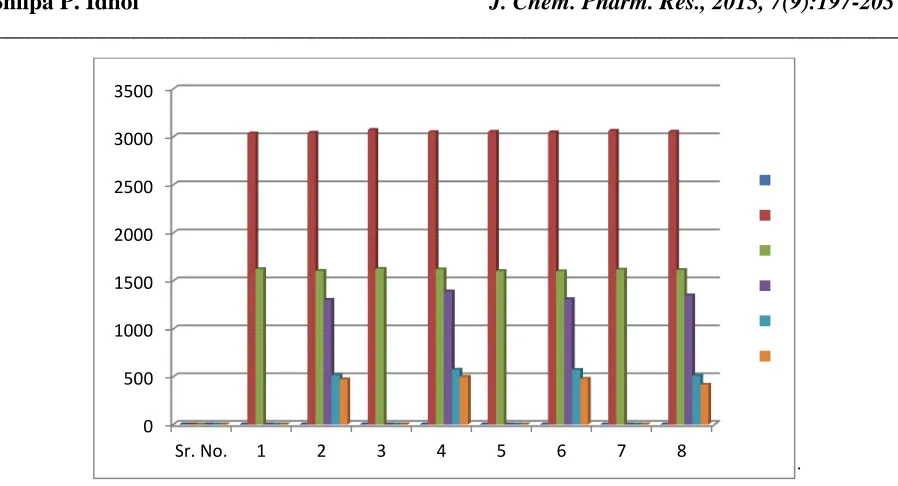
The characteristic bands of the Schiff base and the complexes are given in Table 2. The ligand and complexes shows a strong band at 1600-1640 cm-1 characteristic of ν (C==N) stretching vibration [18].In nitrate complexes, presence
of uncoordinated nitrate ion is confirmed by a very strong band between1300-1390cm-1 [19].The appearance of two strong bands at 530-510 cm-1 and at 480-440 cm-1 are assignable to ν(M-N) and ν(M-O) vibrations respectively
[20-21].
TABLE 2: IR SPECTRAL DATA OF SCHIFF BASE AND NEODYMIUM (III) COMPLEXES
Sr. No. Compound (Ar-H) (CH=N) (-NO3) (M–N) (M–O)
1 L1 3034 1622 - - -
2 [Nd(L1)(NO3)(H2O)]NO3 3042 1604 1302 517 473
3 L2 3072 1625 - - -
4 [Nd(L2)(NO3)(H2O)]NO3 3049 1620 1390 573 499
5 L3 3052 1602 - - -
6 [Nd(L3)(NO3)(H2O)]NO3 3047 1600 1309 571 478
7 L4 3063 1617 - - -
.
1
HNMR Spectra:
[image:4.595.75.524.77.320.2]The 1H NMR spectrum of the Schiff bases and its Nd(III) complexes taken in DMSO exhibits resonance at 8.2-8.8 ppm due to the azomethine proton. The sharp multiplet signals of the phenyl protons are found in the region 7.1-7.8 ppm. The methyl protons of the ligand are observed as a sharp peak at 3.3 ppm.1HNMR spectra of ligands and complexes are presented in Table 3.
TABLE 3: 1HNMR SPECTRA DATA OF SCHIFF BASE AND NEODYMIUM (III) COMPLEXES
Sr. No. Compound (CH=N) (Ar-H) (-CH3)
1 L1 8.30 7.76 3.36
2 [Nd(L1)(NO3)(H2O)]NO3 8.62 7.3-7.7 3.39
3 L2 8.29 7.53 -
4 [Nd(L2)(NO3)(H2O)]NO3 8.23 7.2-7.6 -
5 L3 8.31 7.81 -
6 [Nd(L3)(NO3)(H2O)]NO3 8.55 7.1-7.5 -
7 L4 8.41 7.80 -
8 [Nd(L4)(NO3)(H2O)]NO3 8.81 7.3-7.7 -
.
0 500 1000 1500 2000 2500 3000 3500
Sr. No. 1 2 3 4 5 6 7 8
0 1 2 3 4 5 6 7 8 9
Mass spectra:
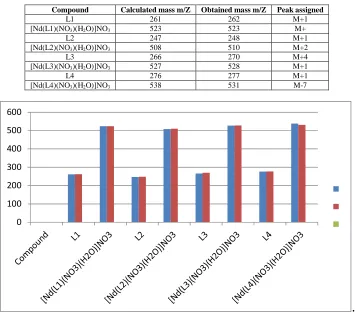
[image:5.595.121.476.184.496.2]The mass spectral data of Schiff base ligand and its metal complexes are given in Table 4. The mass spectrum of ligand L1, L2, L4 gives a peak at m/Z 262,248and 277 and are assigned as [M+1] peak. The mass spectrum of ligand L3 gives a peak at m/Z 270 and is assigned for [M+4] peak. All Nd(III) complexes gives molecular ion peaks at 523,508,528 and 531 m/Z respectively and are assigned as [M+], [M+2], [M+1], [M-7] peak respectively.
TABLE 4: MASS SPECTRA DATA OF SCHIFF BASE AND NEODYMIUM (III) COMPLEXES
Compound Calculated mass m/Z Obtained mass m/Z Peak assigned
L1 261 262 M+1
[Nd(L1)(NO3)(H2O)]NO3 523 523 M+
L2 247 248 M+1
[Nd(L2)(NO3)(H2O)]NO3 508 510 M+2
L3 266 270 M+4
[Nd(L3)(NO3)(H2O)]NO3 527 528 M+1
L4 276 277 M+1
[Nd(L4)(NO3)(H2O)]NO3 538 531 M-7
.
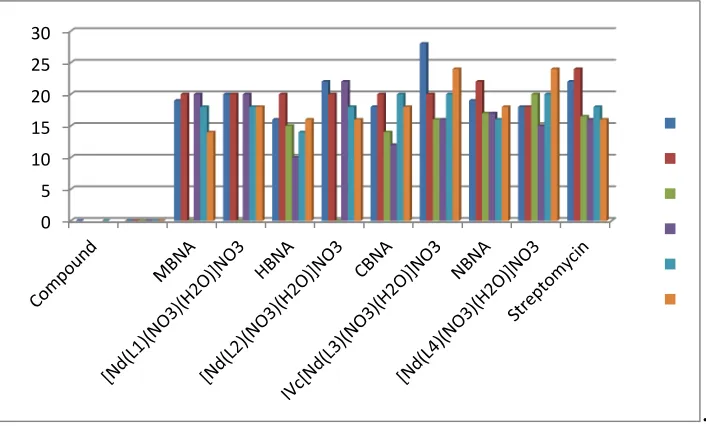
TABLE 5: ANTIMICROBIAL ACTIVITY TESTS OF SCHIFF BASES AND THEIR NEODYMIUM (III) COMPLEXES
Compound Antibacterial Antifungal E. coli S. aureus B. subtilis S. typhi A. niger P.Crysogenum
MBNA 19 20 R 20 18 14
[Nd(L1)(NO3)(H2O)]NO3 20 20 R 20 18 18
HBNA 16 20 15 10 14 16
[Nd(L2)(NO3)(H2O)]NO3 22 20 R 22 18 16
CBNA 18 20 14 12 20 18
IVc[Nd(L3)(NO3)(H2O)]NO3 28 20 16 16 20 24
NBNA 19 22 17 17 16 18
[Nd(L4)(NO3)(H2O)]NO3 18 18 20 15 20 24
Streptomycin 22 24 16.5 16 18 16
(Diameter of inhibition zone in mm)
Antimicrobial activity:
The Schiff base and their corresponding metal complexes were screened in vitro for their antibacterial activity against two Gram-negative (Escherichia coli and Salmonella typhi) and two Gram-positive (Bacillus subtilis and Staphylococcus aureus) bacterial strains and antifungal activity against organisms A.niger and P.Crysogenum using agar well diffusion method using Streptomycin as standard. The results of antibacterial studies are presented in
[image:5.595.142.452.525.652.2]Table 4. A comparative study of the ligand and their metal complexes indicates that most of the metal complexes exhibit higher antimicrobial activity than that of the free ligand. Hence complexation increases antimicrobial activity
.
In Table 5-
R : Resistant (10.0 mm and below) S : Sensitive (10.0 mm and above) Slightly sensitive : (10.0 mm above to 15.0 mm) Moderately sensitive : (15.0 mm above to 20.0 mm) Highly sensitive : (20.0 mm above
CONCLUSION
In this paper, the synthesis of novel Schiff base ligand and its Nd (III) metal complexes derived from condensation of 1napthyl amine with different aldehydes have been described. The biological activity of ligand is lower than the metal complexes. This means than metal chelation is significantly effective than the antimicrobial behavior of the organic ligand and metal complexes.
Acknowledgments
I am grateful to Department of Chemistry Siddhant College of Engineering, Pune, (MS) for providing instrumental facilities. I am also thankful to Dr. Y. S. Patil H.O.D. Department of Microbiology, Shri D. M. Burungle Science and Arts College, Shegaon for their kind help in carrying antimicrobial activities. I am also thankful to the Sophisticated Analytical Instrument Facility (SAIF), Chandigarh for providing IR, 1H NMR, Mass Spectra of synthesised compounds.
REFERENCES
[1] VB Badwaik; RD Deshmukh; AS Aswar, Journal of Coordination Chemistry, 2009, 62(12), 2037–2047. [2] S Arulmurugan; PH Kavitha; RP Venkatraman, A Review. Rasayan J Chem , 2010, 3(3),
385–410.
[3] S Yamada, Coord chem. Rev., 1999, 537, 190-192. [4] S Singh; S Das, R Dhakare, E-J chem., 2009, 6(1), 99-105.
[5] L Aida El-Ansary, Nora S. Abdel-Kader, International Journal of Inorganic Chemistry,
2012, Article ID 901415, 1- 13 .
[6] B Singh; TB Singh, Indian J Chemistry, 1999, A38, 1286. [7] HS Mayadeo; Nalgoikar, J Inst Chem (India), 1988, 60, 139.
[8] L Dreth; S Sitram; F Madalsso; JC Bandoli; J Palocci, J Inorg Nucl Chem , 1980, 42, 1060.
[image:6.595.122.475.139.352.2][9] T Mangamamba; MC Ganorkar; G Swarnabala, International Journal of Inorganic Chemistry, 2014, Article ID 736538, 22.
[10] AS Kabeer; MA Baseer; NA Mote, Asian. J. Chem., 2001, 13(2), 496–500.
[11] K Rajasekar; T Ramachandramoorthy; S Balasubramaniyan, Research Journal of Chemical Sciences, 2013, 3(3), 48-5.
[12] SB Desai; PB Desai; KR Desai, Hetrocycl. Commun, 2001, 7(1), 83–90.
[13] HC Zahid; SI Mohammad; SI Hummara; TS Claudiu, Journal of Enzyme Inhibition and Medicinal Chemistry,
2002, 17(2), 87.
[14] M Prasad; Alex; KK Aravindakshan, E-Journal of Chemistry, 2009, 6(2), 449-458 [15] PR Palet; BT Thaker; S Zele, Indian J. Chem. 1999, A38, 563.
[16] V Mutalk; MA Phaniband, J. Chem. Pharm. Res, 2011, 3(2), 313 .
[17] J Joseph; BH Mehta, Russian Journal of Coordination Chemistry, 2007, 33(2), 124. [18] Ashish Kumar; Surya Mani Upadhyay; Rishipal Singh, ICRTET, 2012, 249-255. [19] Seema Varghese; MK Muraleedharan Nair, RJPBCS, 2010, 1(2) , 347-353. [20] T Zafiropoulos; J Plakatouras; S P Perlepes, Polyhedron., 1991, 10 (20), 2405.