DYNAMIC ESTIMATION OF BDP IN MANETS FOR EFFECTIVE
NEXT NODE SELECTION
N. Snehalatha1 and Paul Rodrigues2
1School of Computing, SRM University, Chennai, Tamil Nadu, India
2Department of Computer Science Engineering, College of CS, KKU, Abha, Saudi Arabia
: [email protected]
ABSTRACT
The main objective of this paper is to the dynamic estimation of Bandwidth Delay Product for all nodes in the neighbour list, consecutively to enhance communication in MANETs. This is achieved by using variable bit rate routing in IEEE 802.11 networks. Energy and BDP together contribute to the routing efficiency progress in mobile networks; therefore, we investigate on the feasibility of designing a mechanism to do the same in MANETs. A bandwidth delay product based routing (BDPR) is proposed for TCP communication in MANETs. Generally, BDP should be kept low enough so that there are less chances of packet loss pertaining to the size of the queue. However, this metric is not used as a primary measure to ensure that there is higher throughput for a path. Therefore, this paper gives a novel attempt in using the Bandwidth of a node and energy of a node in combination with the BDP of the path to provide greater throughput. The performance is analyzed using simulations in the network simulator to understand the percentage improvement of the same.
Keywords: MANET, bandwidth, residual energy, queue, TCP, network simulator.
1. INTRODUCTION
Wireless Mobile Ad hoc Networks have evolved into a profound technology applied in every possible field to promote communication among wireless devices like laptops, PDA’s, palmtops, etc. Their familiarity has rapidly multiplied due to the increasing advancements each day. The nodes in the network are free to move around the topology area. In this endeavour, there are many ways in which a connection between two nodes can possibly fail. Some of the consequences can include link failure due to coverage issues, low bandwidth, high interference, and more so.
Generally there are two major transport protocols used with the IEEE 802.11 standards in communication
with all the nodes, namely, the User Datagram Protocol (UDP) and the Transfer Control Protocol (TCP) (Postel, 1980). These protocols are well designed to communicate the data to the upper layers from the lower layers of the network. For efficient queue management, the variable bit rate protocols are used extensively. In this case, the window size of the frames being sent can vary dynamically, thus allowing in the maximum number of packets being sent at the current bandwidth. The greater utilization of the channel is also possible through the variable bit rate in contrast with the Constant Bit Rate (CBR) protocols.
Figure-1. Communication in a MANET.
D S
Transmission Ranges
Nodes in a MANET
Source Node
Every node in a MANET (Figure-1) is exposed to a number of the other nodes that may or may not be a part of its own network. These wireless signals are continuously interfering with each other thereby hindering the utilization of the channel bandwidth. Therefore a routing protocol requires the considerable estimates to be measured to ensure high data transmission performance in the MANETs.
The main contributions of this paper are:
The usage of the Bandwidth Delay Product is analysed for the MANETs
The bandwidth and residual energies are estimated for a node dynamically
A novel metric called Maximum Efficiency Path (MEP) is derived and designed for routing in MANETs.
The organization of the paper is thus: section 1 gives an introduction about the paper, section 2 describes the problem; section 3 gives an insight about the available literature and section 4 describes the proposed method. The performance of the protocol is evaluated in section 5 and section 6 concludes the analysis.
2. PROBLEM DESCRIPTION
Bandwidth-delay product (BDP) is a well-known concept in measuring the capacity of a ‘network pipe’ (Chen et al., 2004); (Peterso et al, 2000) and (Stevens et al, 1994). When applied to the context of the TCP protocol, the number of outstanding (i.e. in-flight or unacknowledged) data packets cannot exceed the TCP flow’s share of BDP:
BDP (bits) = available_bandwidth (bits/s)×round_trip_time(s) (1)
The technique only models the BDP for a TCP connection model but does not show how the communication should take place in a MANET with dynamic estimation of the same. In this paper, we attempt to use the BDP for every node to evaluate its contribution to QoS of the communication.
3. RELATED WORKS
There are many protocols that have evolved as a by product of research extensions of the MANET communications. Especially, the changing dynamics in MANETs caused a number of protocols to come in to existence. Some of the protocols in the recent literature are discussed here.
Wireless nodes generally use User Datagram Protocol (UDP) for communication and it is quite easy to send the data without the reception of any acknowledgement. The Transfer Control Protocol (TCP) operates around a Window with a specific size that is capable of growing or reducing its window size to its maximum possible level.
A Dynamic Bandwidth Allocation protocol is a design for the estimation and allocation of Bandwidth using TDMA technique. Here, hidden and exposed terminal problems are taken into account and the reuse of the slots are the main designs proposed. The single-hop neighbour of each node is used for isolating this list. The RREQ and RREP messages are exchanged as part of the protocol in general. Additionally, the Slot Inhibition Policy (SIP) and the Slot Decision Policies (SDP) are used for allocating a link.
The Q-AOMDV (Wu et al, 2010) protocol is an enhancement over the AOMDV (Marina and Das, 2002) protocol that operates on the IEEE 802.11 standard. This protocol performs bandwidth and delay estimation dynamically and also estimates other QoS metrics like hop count and end-to-end delay along with bandwidth.
A typical QoS based protocol was proposed for Hybrid Wireless Mesh Networks (Li and Shen, 2014), where both infrastructure and infrastructure less networks are combined together for operation. The guaranteed neighbour selection algorithm designed meets the required delay constraints and adjusts segment size as per the mobility of the node to reduce transmission time. This consequently increases the transmission throughput and provides high mobility resilience.
Proactive Source Routing (PSR) protocol was designed for MANETs that uses DV routing from the DSDV protocol and Link Source (LS) routing (Wang et al., 2014). The Route updating, neighbourhood trimming and streamlined differential update mechanisms are exclusively designed as part of the PSR protocol. This protocol can operate with UDP and TCP protocols with varying densities and velocities. Although this mechanism reduced the delays and the overhead generated in the network, the communication among the mobile nodes do not focus on the Bandwidth and which is not reflected on the bandwidth.
Biradar and Manvi (2012) have utilized bandwidth delay product in MANETs proposing a ring mesh multicast strategy. This clearly makes it evident that the BDP metric has a direct impact on the QoS of a network. Consequently, the reliability of the network is also considered for the network. However, this protocol is only designed for multicasting MANETs.
the help of the same weight factor, because these two methods define the consumed bandwidth differently.
“Listen” mode-accounts for RTS, CTS, ACK, retransmission, routing packets, and transmitted packets.
“Hello” mode-counts the transmitted packets only.
Therefore the method uses the following equation (2) for estimation of the weight factor.
(
HDR HDR)
RTS
CTS
Data
MAC
IP
ACK
WeightFactor
Data
(2)
This factor is dynamically estimated to form routes from a source to a destination for a quickly changing topology. All these metrics add to the performance of a node individually that assist in the route formation.
4. DESIGN OF BDP-ROUTING
The main objective of the proposing mechanism (BDP-Routing) is to utilize individual node performance along with the combined path metrics to effectively perform routing in a dynamically changing MANET. The first step towards the design of a novel protocol for MANETs is to understand the vital metrics to decide whether to consider individual node metrics or the path metrics. In this paper, we present the combination of both to for successful transmission of data.
To derive an efficient node selection methodology first the relations between bandwidth and energy for a node are comprehended. BDP is also used along with the node’s bandwidth and node energy in a MANET. The bandwidth is directly proportional to a node’s individual capability as in expression (3). In contrast, energy consumption is inversely proportional to the capability of a node as in expression (4)
( )
( )
Capabilit n
y
BW
n
(3)( )
1
(n)
Capabi ty n
En
li
(4)Since energy consumption of a node is inversely proportional, we consider the residual energy of a node eR(n) for the estimation of the node’s capability.
1
of Pa
Capabilit
P
y
th
BD
(5)The Bandwidth delay Product (BDP) for a general IEEE 802.11 System is given in the equation (6) defined by 0 0 max
4
m m N M fow rev n md
d
BDP
d
(6)Where,
m
fow
d
andm
rev
d
are the forward and reverse per hop delays along the forward and reverse paths. If the BDP from a source to destination via other routes is higher is higher, generally the nodes in a particular path, it means that there are many packets that are not acknowledged. Although the metric dynamically estimates the number of packets in transit in a particular path, it does not add to an individual node’s capability estimation. Therefore, along with BDP it is required to estimate each node’s performance.Utilizing the equations (3), (4) and (5) it can be formed that the maximum efficiency of a path (MEP) is measured as the collaboration of the three metrics into a single estimate,
CAPABILITY CAPABILITY
MEP
BW
EN
BDP
(7)The BWCAPABILITY indicates the current rate at
which the node is able to communicate among their one hop neighbour as given in equation (8).
0 n N fow n CAPABIL ITY
BW
BW
N
(8)Similarly the ENCAPABILITY of a node is also
estimated from its immediate one hop neighbours as in equation (9), where M is the total number of hops via which the reply message arrives to the source node.
0
.
m M rev m CAPABILITYeR
EN
In En
(9)0 0 0 0
max
.
.
4
n m m m
N M N M
fow rev fow rev
n m n m
BW
eR
d
d
MEP
Avg BW
In En
d
(10)
The node therefore takes the nodes involved in the MEP from the source to destination to achieve maximum throughput.
The strategy by which the method works is illustrated in the Figure-2 below. The figure shows that both the hop estimate and the path estimates are performed together and MEP is used to select the path until the data reaches the destination.
The working procedure of the BDPR is thus: first a RREQ message is sent from a source to all the nodes (this is flooding). As the RREQ propagates through the
nodes that receive the estimate the bandwidth of themselves and keep them ready within their internal memory. Then the nodes that send the RREP messages propagate through the nodes that are available. And on its way back, the BDP of the entire path is estimated and reported to the source. The source selects the path that has the greatest MEP value and sends the data via the same. Therefore it is possible to select a path that is both energy efficient and with high bandwidth, thereby achieving high throughput.
Figure-2. Flow of the BDPR using the MEP estimate. START
Send a RREQ message to neighbours from a source
Receive the RREP messages from all neighbours along with the eR(n) values
Estimate the MEP values for
all paths
Use the appropriate path using MEP and send data until the data reaches the destination
STOP
Estimate the Bandwidth of the nodesduring RREQ propagation
A source wants to send data to the destination
5. PERFORMANCE OF BDPR AND QOS-B
The performance of the BDPR and the QoS-B mechanisms are evaluated using the network simulator tool. The NS-2 tool uses C++ at its back end and OTCL at its front end. This tool is exclusively used for research in various wired and wireless scenarios. The simulation parameters used for communication in the MANET to assess both BDPR and QoS-B protocols are given in the Table-1 below:
Table-1. Simulation parameters of RS-OR.
Parameter Value
Simulator NS2(Ver. 2.28) Simulation Time 100s Number of nodes 50
Routing scheme PTRR Traffic model TCP and UDP Simulation Area 600×600m Transmission range 250m
Mobility model Random way mobility model Mobility speed 5m/s
During the design of the protocol we use UDP as the first protocol and the BDP value as 1 to obtain the throughput, delay and packets lost during the communication.
5.1 Throughput metric for UDP
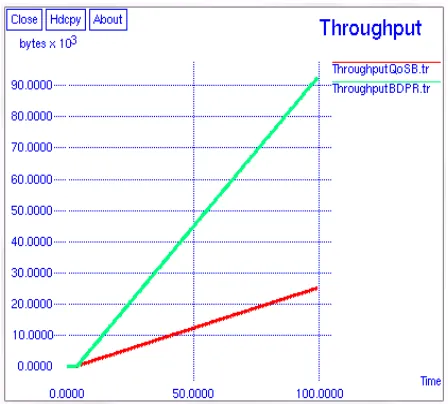
Figure-3. Throughputs of QoSB and BDPR protocols with UDP.
The total delivered packets in a network at the current simulation time is estimated as throughput for QoSB and BDPR protocols. The obtained throughput in bytes is plotted for the existing and the proposed system in
Figure-3. This figure shows that the throughput of the BDPR mechanism is greater than that of the QoSB protocol.
5.2 Average delay metric for UDP
Figure-4. Delays of QoSB and BDPR protocols with UDP.
Similar to throughput the delay of protocol is also estimated for each node. The total delay of all the paths is first measured and then dynamically averaged to be plotted. Figure-4 shows that average delay of BDPR is comparatively less than the QoSB system. This is due to the selection of high bandwidth paths.
5.3 Packet loss metric for UDP
The total packets sent from the source do not completely deliver at the destination due to the varying medium metrics. The total packets lost due to the vulnerability of the medium, queuing and other delays are estimated as the packets lost in the system.
The Figure-5 shows that the total packets lost in the BDPR mechanism is lower than the QoSB mechanism similar to that of the average delay metric. This metric clearly corresponds to the throughout and the delay graphs in Figures 3 and 4. These metrics prove the efficiency of the BDPR over the QoS-B routing, which makes it more usable for critical applications.
5.4 Throughput metric for TCP
The actual throughput with the effective BDP estimation and the MEP correspondingly was obtained when the TCP routing was introduced. Although the mechanism works ideally for UDP when BDP is set as 1, TCP gives the accurate reading for the mechanism.
[image:6.612.317.541.87.280.2]The figure 6 shows that the throughput is greater for that of the BDPR mechanism when compared to that of the TCP mechanism. This is due to the path check performed by the MEP mechanism and the dynamic estimation of the BDP values.
Figure-6. Throughput of QoSB and BDPR protocols with TCP.
5.5 Packet size Metric for TCP:
Figure-7. Packet Sizes of QoSB and BDPR protocols with TCP.
An interesting metric in the TCP routing is to observe how the size of the packet is dynamically varied with respect to the receiving window of the sinks. The figure 7 shows that the packet size for BDPR is greater than that of the QoSB mechanism when compared TCP is used. This is due to the dynamic estimation of the BDP values and the accommodation of greater packet sizes that the BDPR is able to give greater throughput as well.
6. CONCLUSIONS
A Bandwidth Delay Product is an individual metric used for communication in Variable bit rate protocols. This metric is used to know if a path is good enough for transmission or not. We have derived a metric called Maximum efficiency path using the per hop bandwidth and the per hop residual energy. This metric has efficiently performed dynamic estimation thus improving the throughput of the system. Performance using the network simulator shows the greater throughput, lower packet loss and lower delay. This has efficiently worked with the UDP and TCP methods with slight modifications. In future, a protocol that can be compatible with both TCP and UDP for MANET communications could be designed using simulators.
REFERENCES
Postel J. 1980. Search RFCs.
Chen K., Xue Y., Shah S. H. and Nahrstedt K. 2004. Understanding bandwidth-delay product in mobile ad hoc networks. Computer Communications. 27(10): 923-934.
Peterson L.L., Davie B.S. 2000. Computer Networks, Morgan Kaufmann, San Francisco, CA.
[image:6.612.74.298.304.506.2]Keshav S. 1997. An Engineering Approach to Computer Networking, Addison-Wesley, Reading, MA.
Fu Z. Zerfos, P. Luo, H. Lu, S. Zhang, L. Gerla, M. 2003. The impact of multihop wireless channel on TCP throughput and loss, in: Proceedings of the 22nd Annual Joint Conference of the IEEE Computer and Communications Societies (InfoCom 2003), San Francisco, California, USA.
Wu C. Zhang F. and Yang H. 2010. A Novel QoS Multipath Path Routing in MANET. JDCTA: International Journal of Digital Content Technology and its Applications. 4(3): 132-136.
Marina M. K. and Das S. R. 2002. Ad hoc on-demand multipath distance vector routing. ACM SIGMOBILE Mobile Computing and Communications Review. 6(3): 92-93
Li Z. and Shen H. 2014. A QoS-oriented distributed routing protocol for hybrid wireless networks. IEEE Transactions on Mobile Computing. 13(3): 693-708.
Wang Z., Chen Y. and Li C. 2014. PSR: A lightweight proactive source routing protocol for mobile ad hoc networks. IEEE Transactions on Vehicular Technology. 63(2): 859-868.
Biradar R. C. and Manvi S. S. 2012. Ring mesh based multicast routing scheme in MANET using bandwidth delay product. Wireless Personal Communications. 66(1): 117-146.
Gopinath S. and Nagarajan N. 2015. Energy based reliable multicast routing protocol for packet forwarding in MANET. Journal of applied research and technology. 13(3): 374-381.