Combined Economic and Emissions Dispatch with Valve
Point Effect using a Novel Moth Flame Optimization and
Bat Hybrid Algorithm
Wilbert Ruta*, Michael Saulo**, Nicodemus Abungu Odero** Shaibu Ali Juma **
* Department of Electrical Engineering, Pan African University Institute for Basic Sciences, Technology and Innovation, Kenya. Department of Electrical and Electronics Engineering, Mbeya University of Science and Technology, Tanzania
** Department of Electrical and Electronic Engineering, Technical University of Mombasa, Kenya.
** Department of Electrical and Electronic, Machakos University, Kenya.
** Department of Electrical Engineering, Pan African University Institute for Basic Sciences, Technology and Innovation, Kenya.
DOI: 10.29322/IJSRP.9.03.2019.p8728 http://dx.doi.org/10.29322/IJSRP.9.03.2019.p8728
Abstract- This paper presents the application of a novel Moth
flame optimization and Bat hybrid algorithm (MFO_BAT) in the area of combined economic and emissions dispatch with the consideration of valve point effect. Combined economic and emissions dispatch is a crucial area due to rise of environmental pollution caused by greenhouse gases from thermal power plants and other human activities. Also, the cost of generation of electric power by using thermal power plant is at elevated level due to high expenses incurred on fuels. In this paper the valve point effect is considered whereby modern steam generators are incorporated with this technology for increasing the efficiency. Furthermore, three primary emissions from thermal power plants which are COx, NOx and SOx are considered. The six units and ten units test systems are used for implementing the study. The results of a novel Moth Flame Optimization and Bat hybrid algorithm are compared with other methods reported in the literature and found to be promising.
Index Terms- Bat Algorithm, Economic Dispatch, Emissions
Dispatch, Moth Flame Optimization, Multi-Objective Optimization
I. INTRODUCTION
raditional economic dispatch used to depends on the fuel cost whereby the power output of each generating unit was determined with the purpose of minimizing the expenses incurred on fuel used for generating electric power [1]. With the increase of electric energy generation by using fuels, the amount of pollutants gases from thermal power plants have been increasing year after year as a result thermal electric generation is accounted as one among the major contributors of air pollution globally [2]. After the issue of emissions from thermal power plants became more sensitive, nowadays the economic dispatch is no longer depending on fuel cost only but also the factor of emissions is considered, thus gave rise to the study of combined economic and emissions dispatch whereby the cost of electric power generation depends on both fuel expenses and the amount of
emissions from thermal power plants as recommended by Clean Air Act Amendments (CAAA) of 1990[3].With the concern of increasing the efficiency of thermal power plants, nowadays the fact of valve point effects technology is taken into account which results into adopting the ripple form cost function and further modification of the economic dispatch objective function [4]. For finding the best compromise solution between the economic dispatch and emissions dispatch, max-max price penalty factor method has proven to be more effective in converting the multi-objective optimization problem into a single multi-objective optimization problem [5].
The combined economic and emissions dispatch have been solved by using different kinds of methods. Among these methods are conventional methods which are Liner Programming [6], Interval Gradient (IG) method[7], Newton Raphson (NR) method[8] etc. These methods are weak when dealing with non-convex objective functions since they tend to suffer from local convergence (premature convergence). On the other hand, artificial intelligence methods have been also used in solving the optimization problems of combined economic and emissions dispatch. These methods includes Biogeography-Based Optimization (BBO) [9], Genetic Algorithm[10], hybrid Artificial Bee Colony and Simulated Annealing Algorithm (ABC_SA) [11], Particle Swarm Optimization[12] etc. Using the stochastic approach for facilitating the random search of the search space, the artificial intelligence methods are very effective in finding the optimal solution for both convex and non-convex objective functions however still they are not effective in finding the precisely global optimal solution.
For improving the quality of solutions, this paper presents the application of Moth Flame Optimization and Bat hybrid algorithm in the area of combined economic and emissions dispatch when considering the valve point effect and both three primary emissions from thermal power plants which are COx,
NOx and SOx,. The novel Moth Flame Optimization and Bat hybrid algorithm is developed from two recent algorithm which are Moth Flame Optimization and Bat Algorithms. Based on their strength, the Moth Flame Optimization is used for exploration whereby the Bat algorithm is used for exploitation. The results of the novel Moth Flame Optimization and Bat hybrid algorithm are compared with other methods’ results reported in the literature which are Biogeography-Based Optimization (BBO) and hybrid Artificial Bee Colony and Simulated Annealing Algorithm (ABC_SA) and found to be promising.
The organization of this paper is as follows, Section II presents the formulation of combined economic and emissions dispatch objective function with the consideration of valve point effect and both three primary emissions from thermal power plants, also the hybridization of Moth Flame Optimization and Bat algorithms is presented under this section. Section III presents the test systems and section IV presents the results and discussion while the conclusion of this paper is presented under section V.
II. PROBLEM FORMULATION
The formulation of combined economic and emissions dispatch objective function with the valve point effect is achieved by converting the multi-objective optimization problem into a single objective function by using the max-max price penalty factor. Mathematically it is as follows;
1
( ) ($ / )
NG
i
Minimize Total cost A hB hr
=
=
∑
+ (1)Where A, B and h are economic dispatch objective function, emission dispatch objective function and price penalty factor defined by equation (2), (3) and (4).
2 min
sin( ( )) ($ / )
i i i i i i i i i
A a P= +b P c+ +e f P −P hr (2)
2
exp( ) ( / )
i i i i i i i i
B=αP +βP+ +γ η d×P Kg hr (3)
2
(max) (max) (min) (max) 2
(max) (max) (max)
sin( ( ))
($ / )
exp( )
i i i i i i i i i i
i i i i i i i i
a P b P c e f P P
h Kg
P P d P
α β γ η
+ + + −
=
+ + + × (4)
Where ai,bi, ciare fuel cost coefficient of ith unit,⍺i,βi , γi are coefficient of emissions of the ith generating unit, e and f are fuel cost coefficient of valve point effect while d and η are the emission coefficient of valve point effect. Pi is generated power by ith unit and NG is the total number of generating units.
Considering three primary emissions from thermal power plants which are COx, NOx and SOx, the objective function is formulated as follows;
1
( cos ) NG f N N S S C C ($ / )
i
minimize Total t F h E h E h E hr
=
=∑ + + + (5)
Whereby Ff, EN, ES and EC are fuel cost, NOX emissions, SOX emissions and COX emissions objective functions given by equation (6), (7), (8) and (9) respectively
2
($ / ) f i i i i i
F =a P +b P+c hr
(6)
2
( ) ( ) ( )
N i N i i N i i N
E
=
α
P
+
β
P
+
γ
(Kg/hr)
(7)
2
( ) ( ) ( )
(
/
)
S i S i i S i i S
E
=
α
P
+
β
P
+
γ
Kg hr
(8)
2
( ) ( ) ( )
(
/
)
C i C i i C i i C
E
=
α
P
+
β
P
+
γ
Kg hr
(9)
Where
⍺i(N), βi(N)and γi(N) are coefficients of NOX emission of the ith
generating unit
⍺i(S), βi(S) and γi(S) are coefficients of SOX emission of the ith generating unit
⍺i(C), βi(C) and γi(C) are coefficients of COX emission of the ith generating unit
The price penalty factors hN, hS and hC of NOX emissions, SOX emissions and COX emissions are given by equation (10), (11) and (12) respectively.
2
(max) (max) ( )
( ) (max) ( ) (max) ( ) 2
i i i i i i N
i N i i N i i N a P b P c
h ($/Kg)
P P
α
β
γ
+ +
=
+ + (10)
2
(max) (max) ( )
( ) (max) ( ) (max) ( )
($ / ) 2
i i i i i i S
i S i i S i i S a P b P c
h Kg
P P
α β γ
+ +
=
+ +
(11)
2
(max) (max) ( )
( ) (max) ( ) (max) ( )
($ / ) 2
i i i i i
i C
i C i i C i i C
a P b P c
h Kg
P P
α
β
γ
+ +
=
+ +
(12)
The optimization problems in this paper are subjected to two system constraints which are equality constraints and inequality constraints as given in (13) and (15).
1
NG
PG PD PL
i∑
= +
= (13)
Whereby PG, PD and PL are total generation, power demand and losses of the system
Using Kron’s formula [13], total losses of the system (PL) are given in (14).
1 1 1
NG NG NG
PL P B Pi ij j Bio iP Boo i∑ ∑j i∑
= + +
= = = (MW) (14)
Where B, Bio and Boo are loss coefficients matrices and Pi is the generated power by unit ith.
Pi(min) ≤Pi≤Pi(max) (15)
Given that Pi is the power generated by unit ith
ALGORITHMS
The development of Moth Flame Optimization and Bat hybrid algorithm through combining MFO and Bat algorithm is presented under this sub-section.
Moth Flame Optimization
Moth Flame Optimization is the bio-inspired algorithm which was developed by Seyedali Mirjali in 2015 [14], by nature the moths normally navigate at a certain angle with reference to the moon position at night. Based on moths’ behaviors, in this algorithm the moths’ navigations are assumed to be in transverse movement around the flame which is the best solution.
In this algorithm, each moth navigates around its flame while searching for a solution and due to this property the Moth Flame Optimization becomes the most effective algorithm in exploration of the search space. The Moths’ positions updating is achieved by using equation (16) while the distance between the moth and flame (D) is computed by using equation (17) [14].
(16)
(17)
Where
b is a constant of defining the shape of logarithmic spiral t is random number in [-1, 1]
l is current number of iterations
N is a maximum number of flames
Fjis a position of jth flame Mi is a position of ith moth
The number of flames is normally updated iteratively by removing the flame with the poor solution; thus is attained by using equation (18).
( ) N l
Flame number round N l T
− =
− ×
(18)Where
T is a maximum number of iterations
l is current number of iterations
N is a maximum number of flames
Bat Algorithm
The bat algorithm is the population based algorithm which is inspired from the behavior of micro bats. The micro bat uses the reflected sound (echo) for locating their prey as well as the précised location of the concerned prey. This algorithm was developed by Xin sheng Yang in 2010 based on the echolocation mechanism of micro bat [16].
In this algorithm, the solution of optimization is represented by the bat position where by the fitness computation is achieved through bats’ positions implementation in the given objective function. The solution of Bat algorithm which is the bat position is obtained through frequency and velocity parameters as shown in equation (19-21).
fi = fmin+(fmax−fmin)β (19)
1
( *)
t t t
vi =vi− + xi −x f i (20)
xti =xit−1+vit (21)
Where f, v and x are frequency, velocity and position of bat respectively
Using (22) and (23), the Loudness (A) and pulse rate (r) of bat algorithm are normally updated iteratively as follows;
1
t t
Ai+ =αAi (22)
1 0
[1 exp( )]
t
ri+ =ri − −γt (23)
With the condition that 0 <
α
< 1 andγ
> 0Hybridization of Moth Flame Optimization and Bat Algorithms
Bat algorithm is the very effective algorithm in exploiting the possible best solution of optimization problem but vulnerable to local stagnation, at the same time Moth Flame Optimization is a strong algorithm in terms of exploration of the search space but limited to exploitation capability [17]. This paper addresses the discussed strength and weakness of the concerned algorithms through hybridizing the strengths of Moth Flame Optimization and that of Bat Algorithm which are exploration and exploitation respectively, thus results into the development of the novel Moth Flame Optimization and Bat hybrid algorithm.
Through adjusting the values of loudness and pulse rate, the Bat algorithm is tuned into exploitation mode [18] while Moth Flame Optimization is tuned into full exploration mode through adjusting the value of “b” in (16) [17].
Moth Flame Optimization and Bat Algorithm Hybridization Steps Based on Combined Economic and Emissions Dispatch
Step 1: Define the load demand and generators’ power limits
(maximum and minimum).
Step 2: Define the objective function and equality constraints
based on power balance.
Step 3: Define the generators’ power in terms of moths’ and
bats’ positions.
Step 4: Define the dimensions of searching agents with reference
to the number of generating units.
Step 5: State the population
Di=Fj−Mi
(
)
( )
, cos 2
Step 6: Define the frequency (maximum and minimum), loudness and pulse rate of bats.
Step 7: Initialize the frequency and velocity of bats
Step 8: Initialize the moths’ positions based on generators’ limits
(maximum and minimum).
Step 9: While taking into account the equality constraints,
compute the power losses and evaluate the fitness of the objective function ( combined economic and emissions dispatch) using Moth position.
Step 10: Select the global best value based on minimization
based optimization problem.
Step 11: Set iteration to 1
Step 12: Update number of flames using (18).
Step 13: If the number of iteration is equal to 1, perform the
sorting of moths’ positions and assign them as sorted population (Fj).
Step 14: If the number of iteration is greater than 1, perform the
sorting of moths’ positions based on the previous iteration and current iteration and assign them as sorted population (Fj).
Step 15: Calculate “a” using equation (24)
-1
(-1
)
a
current iteration
Maximum iteration
=
+
×
(24)Step 16: Calculate “t” by using equation (25)
( -1) 1
t= a ×rand + (25)
Step 17: Compute the distance of month with reference to the
corresponding flame using equation (17)
Step 18: Update moths’ positions by using equation (16) .
Step 19: Check the inequality constraints by using generator
power limits for bringing back the moths which are outside the search space.
Step 20: Updating frequencies and velocites of bats by using
equation (26) and (27) respectively
min
(
max min)
f
i
=
f
+
f
−
f
β
(26)1
*
( _ )
t t t
i i i i
v =v− + Moth position −x f (27)
Step 21: Update the bats positions by using equation (28).
1 _
t t t
xi =Moth positioni− +vi (28)
Step 22: Generate the best position of bat if the random number
is greater than the pulse rate.
Step 23: By using the generators’ power limits, bring back the
bats which are outside the search space.
Step 24: Calculate the power losses and then evaluate the
objective function by using bats positions while satisfying the equality constraints.
Step 25: Update local best values.
Step 26: Update the global best fitness and global best position
Step 27: Repeat step 12-26 until the maximum iteration is
attained.
Step 28: Display the global best fitness of the objective function
(total cost/fuel cost/emissions) and global best position ( power generated in each unit).
III. TEST SYSTEM
This study is implemented in MATLAB 2016 using ten units test system and six units test system with the load demand of 2000MW and 1800MW respectively. The population used is 40 while tuning parameters for the case of Moth Flame Optimization and Bat hybrid algorithm (MFO_BAT) are set at
b=5 for Moth Flame Optimization part while for the part of Bat algorithm A = 0.9 and r = 0.001.
The dispatch coefficients (Economic and emissions) and transmission losses coefficients matrix were taken from [11] for the case of ten units test system while the valve point effect is considered and from [9] for the case of six units test system with the consideration of both COx, NOx and SOx emissions.
IV. RESULTS AND DISCUSSION
[image:4.612.317.573.449.722.2]This section discusses the results obtained from the application of the developed Moth Flame Optimization and Bat hybrid algorithm in combined economic and emissions dispatch optimization problem. The obtained results are compared with the results of parents’ algorithms which are Moth Flame Optimization and Bat Algorithm based on the same kind of optimization problem and loading conditions. Further validation of the results is done by comparing the results of MFO_BAT with other results reported in the literature.
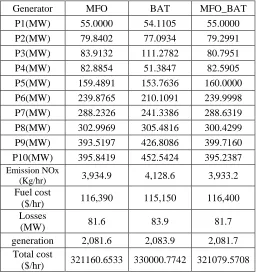
Table 4.1: Combined economic and emissions dispatch with valve-point effect solution at a load of 2000MW
Generator MFO BAT MFO_BAT
P1(MW) 55.0000 54.1105 55.0000
P2(MW) 79.8402 77.0934 79.2991
P3(MW) 83.9132 111.2782 80.7951
P4(MW) 82.8854 51.3847 82.5905
P5(MW) 159.4891 153.7636 160.0000
P6(MW) 239.8765 210.1091 239.9998
P7(MW) 288.2326 241.3386 288.6319
P8(MW) 302.9969 305.4816 300.4299
P9(MW) 393.5197 426.8086 399.7160
P10(MW) 395.8419 452.5424 395.2387
Emission NOx
(Kg/hr) 3,934.9 4,128.6 3,933.2
Fuel cost
($/hr) 116,390 115,150 116,400
Losses
(MW) 81.6 83.9 81.7
generation 2,081.6 2,083.9 2,081.7
Total cost
Table 4.1 presents the results of combined economic and emissions dispatch with the valve point effect at a load of 2000MW. The utilized test system is the ten units test system while the results produced by MFO_BAT are compared with the results of MFO and Bat algorithms. Focusing on the total cost of generation, the cost found by implementing MFO_BAT in combined economic and emissions dispatch with valve point effect is 81.0825 $/hr and 8921.2034 $/hr lower than MFO and BAT respectively. The NOx emissions produced when employing the MFO_BAT is 1.7 Kg/hr lower than MFO emissions and 195.4 Kg/hr lower than the emissions produced when using Bat algorithm.
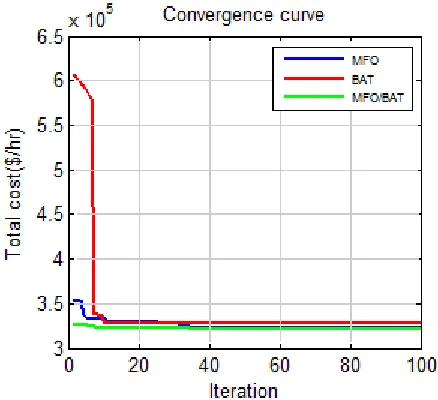
[image:5.612.322.568.97.471.2]Figure 4.1 shows the convergence curve of the optimization problem of the combined economic and emissions dispatch with the valve point effect. The red curve presents the optimization by using the BAT algorithm while the blue and green curves present the optimization by using MFO and MFO_BAT respectively.
Figure 4.1: Convergence curve of combined economic and emissions dispatch with valve point effect at a load of 2000MW
Making the study more realistic, three primary emissions from thermal power plants which are NOx, COx and SOx are considered. The six units test system with sufficient information on the coefficients of emissions under consideration is used to achieve the objective at a load demand of 1800 MW. As presented in Table 4.2, the total generation cost when using MFO_BAT is 388.4194 $/hr and 139.0782 $ lower than MFO and BAT total generation cost. For the case of emissions, the NOx emissions produced when using MFO_BAT are 2.3 Kg/hr and 2.7 Kg/hr lower than the emissions found when using MFO and BAT respectively while the SOx emissions produced when using MFO_BAT are 179 Kg/hr higher than that of MFO and 123 Kg/hr lower than the emissions produced by BAT algorithm. The COx emissions produced by MFO_BAT algorithm are 2611 Kg/hr lower than MFO emissions but 67 Kg/hr higher than the emission produced by the BAT algorithm. The convergence curve of this optimization problem is presented in Figure 4.2.
Table 4.2: Combined economic and emissions dispatch solution considering COX, NOX and SOX emissions at a load of 1800MW
Generator MFO BAT MFO-BAT
P1 (MW) 249.7788 279.6535 270.3457
P2 (MW) 293.0410 307.2588 300.0209
P3 (MW) 600.0000 546.4570 539.3338
P4 (MW) 133.7144 144.5592 140.1550
P5 (MW) 439.3485 444.3207 451.0824
P6 (MW) 228.6593 221.4659 244.3550
Total cost
($/hr) 81312.0483 81062.7071 80923.6289 Emission
NOx (Kg/hr) 2417.6 2412.6 2415.3
Emission
SOx (Kg/hr) 13327 13629 13506
Emission
COx (Kg/hr) 71378 68700 68767
Fuel
cost($/hr) 18959 18907 18932
Losses (MW) 144.5 143.7 145.3
Total generation
(MW)
1944.5 1943.7 1945.3
Figure 4.2: Convergence curve of combined economic and emissions dispatch solution considering COX, NOX and SOX
emissions at a load of 1800MW.
0 100 200 300 400 500 600 700 800 900 1000
Iteration
8 8.1 8.2 8.3 8.4 8.5 8.6 8.7
Total cost($/hr)
104 Convergence curve
MFO
BAT
[image:5.612.56.275.276.476.2]Table 4.3: Results validation of combined economic and emissions dispatch with valve point effect at a load of 2000MW
Generating unit ABC_SA
[11] MFO_BAT
P1(MW) 55.00 55.0000
P2(MW) 70.32 79.2991
P3(MW) 81.18 80.7951
P4(MW) 96.47 82.5905
P5(MW) 159.72 160.0000
P6(MW) 155.92 239.9998
P7(MW) 229.31 288.6319
P8(MW) 337.57 300.4299
P9(MW) 431.34 399.7160
P10(MW) 467.57 395.2387
Total generation (MW) 2,084.45 2,081.7
Losses (MW) 84.45 81.7
Fuel cost ( $/hr) 113510 116,400
Emission(kg/hr) 4169 3,933.2
Total cost( $/hr) 330210 321079.5708
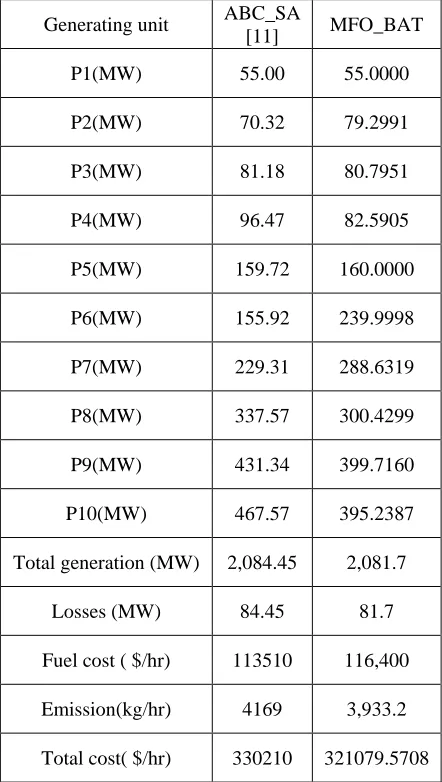
[image:6.612.320.567.102.388.2]The results validation is done by comparing the results produced by the developed method with those reported in the literature. As it shown in Table 4.3, the results of MFO_BAT is compared with the results of hybrid Artificial Bee Colony and Simulated Annealing algorithm (ABC_SA) reported in [11]. When using the MFO_BAT, the total cost found was 9,130.4292 $/hr lower than the cost which was found by ABC_SA while the emissions produced by MFO_BAT was 235.8 Kg/hr lower than that of ABC_SA
Table 4.4 presents the results validation of the application of MFO_BAT algorithm to a test system which consists of COX, NOX and SOX emissions. For the case of the total cost, the total generation cost found when using MFO_BAT was 1.33 $/hr lower than that of BBO. The emissions produced by MFO_BAT were 0.83 Kg/hr of NOX and 50.33Kg/hr of COX lower than that of BBO but 14.07 Kg/hr of SOX higher than that produced by BBO.
Table 4.4: Results validation of combined economic and emissions dispatch considering COX, NOX and SOX emissions at
a load of 1800MW
Generator BBO
[9] MFO_BAT
P1 (MW) 270.398419 270.3457
P2(MW) 299.351832 300.0209
P3(MW) 538.382133 539.3338
P4(MW) 139.632475 140.1550
P5(MW) 452.562062 451.0824
P6(MW) 245.197113 244.3550
Total cost ($/hr) 80,924.967912 80923.6289 Emission NOx
(Kg/hr) 2416.130219 2415.3
Emission SOx
(Kg/hr) 13,491.924811 13506
Emission COx
(Kg/hr) 68,817.333954 68,767
Fuel cost($/hr) 18,934.704952 18932
Losses (MW) 145.524034 145.3
Total generation
(MW) 1945.524034 1945.3
V. CONCLUSION
This paper has presented the development of a novel Moth Flame Optimization and Bat hybrid algorithm through hybridizing two recent algorithms which are Moth Flame Optimization and Bat algorithm. The developed MFO_BAT algorithm was used to solve the combined economic and emissions dispatch for finding the better solution. The method was implemented in ten units test system and six units test system with COx, NOx and SOx emissions. The results obtained when using MFO_BAT were validated by using other results from literature and found to be promising in terms of the main objective which is the reduction of electric power generation cost and emissions from thermal power plants.
As part of future work, the developed Moth Flame Optimization and Bat hybrid algorithm can be used for solving multi-objective optimization problem having more than two objective functions for realizing its usefulness in complex problems.
REFERENCES
[1] J. Zhu, Optimization of power system operation, Second Edt. Hoboken,New Jersey: John Wiley & Sons, Inc, 2015.
[2] International EnergyAgency, “Power generation from coal,” Paris, 2010.
[3] J. Gunda and P. Acharjee, “Multi Objective Economic Dispatch Using Pareto Frontier Differential Evolution,” Int. J. Eng. Sci. Technol., vol. 3, no. 10, pp. 7389–7396, 2011.
with valve-point loading effect by using catfish PSO algorithm,” Res. Artic., vol. 8, no. 3, pp. 290–296, 2014.
[5] R. Chellappan, “Economc and Emission Load Dispatch using Cuckoo Search Algorithm,” no. 2, pp. 1–7, 2017.
[6] A. Ashfaq and A. Z. Khan, “Optimization of Economic Load Dispatch problem by Linear Programming modified Methodology,” 2nd Int. Conf. Emerg. Trends Eng. Technol. (ICETET’2014), May 30-31, 2014 London (United Kingdom), 2014.
[7] S. Ray, “Economic Load Dispatch Solution using Interval Gradient Method,” Adv. Res. Electr. Electron. Eng., vol. 1, no. 4, pp. 55–58, 2014.
[8] J. S. Dhillon, S. C. Parti, and D. P. Kothari, “Stochastic economic emission load dispatch,” Electr. Power Syst. Res., vol. 26, no. 3, pp. 179–186, 1993.
[9] P. Taylor, A. Bhattacharya, and P. K. Chattopadhyay, “Electric Power Components and Systems Application of Biogeography-based Optimization for Solving Multi-objective Economic Emission Load Dispatch Problems Application of Biogeography-based Optimization for Solving Multi-objective Economic Emission Load Dispatch Problems,” no. December 2012, pp. 37–41, 2010.
[10] E. Engineering and E. Engineering, “An Application of Environmental Economic Dispatch Using Genetic Algorithm,” vol. 6, no. 1, pp. 1–4, 2016.
[11] S. Arunachalam, R. Saranya, and N. Sangeetha, “Hybrid Artificial Bee Colony Algorithm and Simulated Annealing Algorithm for Combined Economic and Emission Dispatch Including Valve Point Effect,” pp. 354–365, 2013.
[12] A. S. R. M Vijay Karthik, “Particle Swarm Optimization to solve Economic Dispatch considering Generator Constraints M Vijay Karthik , 2 , Dr A Srinivasula Reddy F P ,” IJES, pp. 94–100, 2014. [13] S. K. Soni and V. Bhuria, “Multi-objective Emission constrained
Economic Power Dispatch Using Differential Evolution Algorithm,” vol. 2, no. 1, pp. 120–125, 2012.
[14] S. Mirjalili, “Moth-Flame Optimization Algorithm : A Novel Nature -inspired Heuristic Paradigm,” Knowledge-Based Syst., no. July, 2015. [15] O. Bozorg-haddad, Advanced optimization by Nature-Inpired
algorithms. Gateway East: Spring Nature, 2017.
[16] A. Latif and P. Palensky, “Economic Dispatch Using Modified Bat Algorithm,” Algorithms mdpi, no. July, 2014.
[17] W. Ruta, M. Saulo, and N. O. Abungu, “Emission Constrained Economic Dispatch Using Moth Flame Optimization and Bat Hybrid
Algorithm,” vol. 11, no. 5, pp. 827–843, 2018.
[18] X. Yang, Nature-Inspired Optimization Algorithms, First. London: Elsevier Inc., 2014.
AUTHORS
First Author –Wilbert Ruta (MSc), Department of Electrical
Engineering, Pan African University Institute for Basic Sciences, Technology and Innovation, Nairobi, Kenya.
Department of Electrical and Electronics Engineering, Mbeya University of Science and Technology, Mbeya, Tanzania Email: [email protected]
Second Author – Michael Saulo (PhD), Department of
Electrical and Electronic Engineering, Technical University of Mombasa, Mombasa, Kenya
Email: [email protected]
Third Author – Nicodemus Abungu Odero (PhD), Department
of Electrical and Electronic Engineering, Machakos University, Machakos,Kenya.
Email: [email protected]
Fourth Author – Shaibu Ali Juma(Msc) - Department of
Electrical Engineering, Pan African University Institute for Basic Sciences, Technology and Innovation, Nairobi, Kenya.
Email: [email protected]
Correspondence Author – Wilbert Ruta
Email:[email protected]