
282
LOW-COMPLEXITY HEVC INTRA-MODE DECISION USING
MODES REDUCTION
AHMAD A. MAZHAR
1Department of Computer Science, Saudi Electronic University, KSA
E-mail: [email protected], [email protected]
ABSTRACT
Digital video technology has witnessed many important improvements in the last decade. Increasing video quality to be high resolutions is one of the most important developments in the field of video processing. Modern video sequences with higher resolutions led to larger consuming of storage capacity and transmission capability. Video compression became essential concern to avoid the impact of dealing with this huge amount of data. Devising efficient coding techniques came with high complexity and computation time. The High Efficiency Video Coding (HEVC) is one of the most popular encoding standards. It was designed for high-resolution video sequences. However, HEVC suffers from high encoding complexity. This paper proposes a fast intra prediction technique by reducing the number of comparisons in RDO process. In HEVC intra prediction, there are many candidates that may contain similar contents to the neighboring blocks. The content information and the direction of the most similar neighboring blocks are exploited to minimize the number of candidate blocks to speed up the encoding process.
Keywords: HEVC, Intra Prediction, Mode Decision, RDO, Video Coding.
1. INTRODUCTION
As video data needs large storage capacity and consumes network bandwidth. Video compression is an efficient technique of reducing this large amount of data in order to transmit or store it with
minimum resource consumption. Video
compression is achieved by removing the redundant information within the same frame and in successive frames. Exploiting both the spatial and temporal correlations in video compressions attained higher compression efficiency. The benefits of temporal correlations may be increased in video sequences with higher frame rates. However, spatial correlations can exploit the similarity between pixels in one frame.
Several compression techniques have been developed by international standards. The High Efficiency Video Coding (HEVC) is considered one of the most recent compression techniques with improved capability of compressing high definition video sequences [1]. HEVC provides many improved features compared to the prior standards, high flexible coding structure is one of the most important features that was not exist in the Advanced Video Coding (H.264) [2]. HEVC adopted flexible Coding Unit (CU) that increased
coding efficiency and bitrate reduction. However, numerous number of computations need to be ran and that led to more computations and higher complexity. The new codec adopts three block forms: Large Coding Unit (LCU) where each LCU can be divided into four CUs. The CU can be recursively further divided into smaller CUs. The process of dividing CUs provides the quadtree which is useful for INTER and INTRA prediction. Prediction Unit (PU) is the second form which is used only for the leaf of the quadtree structure, the CU. Transform Unit (TU) is the third form which is used for transform and entropy coding [3].
283 This paper will devise a new intra prediction technique to speed up the HEVC encoding time. The proposed idea decreases the number of directions that need to be checked. In addition, candidate modes in the selected direction are not all the best modes. Thus, decreasing the number of modes to be checked will significantly affect the overall encoding time.
2. LITERATURE REVIEW
Two proposed algorithms have been recorded in the HM test model [7, 8]. Both algorithms have been used as optional configurations to speed up the HEVC by early termination and blocks checking skip. In [9], a fast inter HEVC technique was proposed to speed up the encoding process and achieved around 53% saving of the encoding time. The huge number of directions in intra prediction is also a time consuming process and requires more attention. An adaptive mode decision algorithm was proposed in [10]. The algorithm filtered out unnecessary coding blocks and reduced the redundant candidates based on its texture direction. In [11], an angular prediction modes technique was proposed to reduce intra prediction computational time. A low energy intra prediction is also proposed to reduce energy consumption.
Many algorithms were proposed in the literature. However, these algorithms either have not achieved significant speeding of the encoding time or have not guaranteed the loss of fidelity. HEVC is still suffering from the high encoding complexity and there is a chance to speed it up without compromising the compression efficiency.
The process of reducing the number of candidates that need to be checked by the Rate Distortion Optimization (RDO) is very useful and significant to reduce the overall encoding time. One consideration is to exploit the information about the neighboring blocks of the current block. Although many proposed algorithms have achieved reduction on the HEVC encoding time, there are still many ideas can be implemented to reduce computational time more with negligible loss of performance or fidelity.
3. INTRA PREDICTION IN HEVC
Intra prediction is the process of eliminating the redundant components or pixels within one frame. In H.264, only nine prediction modes were used for the 4×4 luma blocks. As an advanced video coding, HEVC adopts up to 34 prediction directions to find the most suitable prediction blocks. This led to a significant
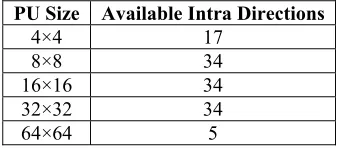
[image:2.612.333.504.214.288.2]improvement on the compression efficiency in intra prediction and in overall HEVC performance [12]. HEVC provides PUs with different dimensions and several directions for each PU size as shown in Table 1. The HEVC intra prediction directions are designed to allow 33 angular modes and two flat modes. Figure 1 illustrates these possible angular directions.
Table 1: Number of Intra Predictions for each PU
PU Size Available Intra Directions
4×4 17
8×8 34
16×16 34
32×32 34
64×64 5
[image:2.612.318.526.470.623.2]As it can be noticed from Figure1, considering all directions for each PU will increase the number of predictions and affect hugely the computational complexity. The HEVC encoder uses RDO and presents combination of mode decision to decide which mode to select. However, the directions of intra prediction can exploit the neighboring information to predict the preferable direction against other ones. An extensive study with the analysis of the neighboring blocks can provide useful details to the encoder so less number of directions need to be checked. This consideration can be effective and can significantly speed up the intra prediction process.
Figure 1: Directions of Intra Prediction
4. PROPOSED INTRA-PREDICTION ALGORITHM
284 resolutions and frame rates. The (LCIP) algorithm is compared to the HM 15.0 as one of the most recent HEVC test models. Then, the (LCIP) algorithm is combined with an efficient fast inter prediction technique that was proposed in [9] to speed up the HEVC more significantly. The combined algorithm is tested and evaluated with same video sequences to make a fair comparison with HM 15.0 and a state-in-the-art algorithm.
The intra mode selection process is a very consuming process in HEVC. The huge number of directions that have been added in HEVC have increased the encoding time significantly compared to the H.264 encoder. In addition, larger block sizes that have not been used in previous encoders need to be checked which increase complexity more and more. The benefit of using such improvements of larger blocks in the new HEVC encoder can be exploited without compromising the encoding time hugely.
Two main considerations on the intra prediction have been taken into account in order to speed up the HEVC encoder. The huge number of prediction directions and the variety of block sizes. Both of these intra prediction factors affect the encoding process dramatically. The main assumption of the proposed (LCIP) algorithm is that a natural picture normally contains similar
contents. This similarity is increased in the neighboring pixels where it is decreased in farther ones. Figure 2 shows the current block (Cu) and the neighboring blocks (A, B and C) in only three directions as a sample. A statistical study was conducted and the results of these study was used to examine this assumption. The detailed obtained results are presented in Table 2. Three video sequences were tested, Cactus, BQTerrace and ParkScene. The selected CUs for each video sequence are recorded. Table 2 shows that the likelihood of nearer blocks A, B and C are higher than farther ones. A+1 indicates block that neighboring A block, A+2 indicates block neighboring A+1 block, and so on.
That means, A, A+1, A+2, A+3 and A+4 represent CUs in on direction, A in Figure 2. B and C represent the two other directions. From the obtained results and shown in Table 2, it can be noticed that neighboring blocks are the most likely CUs to have the highest similarity to the current block. For example, A got higher possibility to be the best CU than farther CUs, A+1, A+2, A+3 and A+4. The same observation is for B and C blocks. Thus, checking farther blocks in intra prediction with such low probability of similarity would be considered time consuming in the most cases.
Table 2 Cu and neighboring blocks likelihood %
Seq. Block and Direction
A A+1 A+2 A+3 A+4 B B+1 B+2 B+3 B+4 C C+1 C+2 C+3 C+4
Cac. 17 11.4 7.2 4 2.6 31.3 22.7 17.9 11.1 3.5 16.6 10.3 7.1 3.9 1.8
BQ. 22.3 16.8 11.5 6.4 5.1 33.6 23.4 12.4 8.5 4.7 33.4 27.2 16 11.4 6.9 Par. 38.4 25.1 17.5 11.6 7.8 26.2 21.5 7.1 3.4 1.7 28.9 21.4 11.2 7.8 2.3
Figure 2. Neighboring blocks of Cu block
On the other hand, no guarantee that a direction will always give much similar CUs than others for different video sequences. The content of a frame is not predictable and so all directions have the probability to contain the most similar CUs. For Cactus sequence, B got the highest similarity compared to A and C. However, A was chosen higher in ParkScene. One significant consideration from the statistics in Table 2 can lead to a faster intra prediction technique. Once a neighboring block is selected as the CU with the highest similarity, the farther CUs at the same direction are still having higher
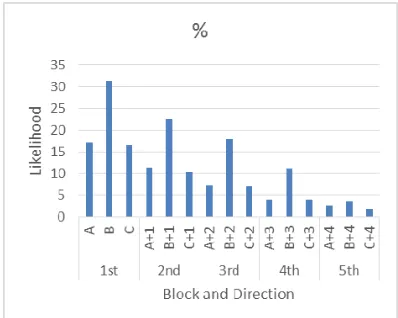
similarity than farther blocks on other directions. That means, when A had higher similarity to the current block than B and C in ParkScene, A+1 had higher similarity than B+1 and C+1, and so on. This observation assures that, in most cases, checking farther blocks is a time consuming process with no clear effect on compression performance. Figure 3 shows the likelihood of mode selection in Cactus sequence. As it can be seen, B had the highest similarity for the first matching compared to A and C in the other two directions. In addition, B+1 got higher similarity than A+1 and C+1. This is correct for all the five CUs in the three tested directions. The same observation is correct for A as well. A gave higher similarity than C, also A+1 gave higher similarity than C+1 and so on. This observation was the major motivation to design the new
B A
285 (LCIP) technique by predicting the best prediction direction especially with the huge number of directions in the HEVC encoding.
[image:4.612.323.524.173.372.2]The second effective factor on the intra prediction complexity is the number of different CUs sizes. HEVC adopts five different CU sizes from 4×4 up to 64×64. Low texture frames contains many homogenous areas. HEVC uses LCU to compress these large areas. However, checking all possible modes in the full search can be a consuming process and will increase the computational time dramatically.
Figure 3. Likelihood of Cactus sequence
[image:4.612.89.288.242.401.2]To evaluate this assumption, a statistical study was conducted for three different video sequences. Table 3 shows the likelihood of mode selection for the video sequences: Cactus, ParkScene and BQTerrace. The selected video sequences have dissimilar components and variety types of textures.
Table 3 Mode selection likelihood %
Sequence Mode
64×64 32×32 16×16 8×8 4×4
Cactus 71.4 14.5 9.3 2.6 2.2
ParkScene 63.2 24.7 8.8 2.1 1.2
BQTerrace 68.5 26.2 4.9 0.3 0.1
As shown in Figure 4, the LCU was used the most one in the HEVC encoder for the three video sequences. The smaller CUs were chosen many times, but the probability of choosing it is noticeably less. The probability is decreased by going to smaller CUs. Unfortunately, checking smaller coding units means higher computational time.
The effect of choosing an intra mode is significant. The decision should be taken carefully for two main reasons: firstly, choosing large modes would save encoding time slightly
but also may decrease the overall encoding efficiency. Secondly, small modes can provide higher encoding efficiency but with higher encoding complexity. For these reasons, a smarter way of mode selection is needed in this occasion.
Figure 4. Likelihood of Cactus sequence
According to the obtained results in Table 3 and Figure 4, the proposed fast intra prediction algorithm would eliminate checking these small modes to speed up the encoding process with insignificant encoding performance degradation. The algorithm assumes that once 32×32 and 16×16 modes are tested and obtained identical or even similar RDO to the 64×64, the process should be terminated and no further division is required. This acts as an early
termination with negligible effect on
compression efficiency. The intra modes are divided into four groups: G1{64×64}, G2{32×32 and 16×16 }, G3{8×8}, G4{4×4}. The proposed algorithm executes as follows:
1. If the frame is an Inter frame, go to step
8.
2. Compute the RD of G1 for the
neighboring block in each prediction direction.
3. Choose the direction with the best RD.
4. Compute the RD of G2 for the
neighboring block in the selected direction.
5. If RD of G1 is not better than or similar
[image:4.612.86.294.513.580.2]286
6. Select the G1 mode as the best intra
mode. Then go to step 9.
7. Compute the RD of G3 and G4 to find
the best candidate. Go to step 9.
8. Use the full inter search.
9. Check next CU if needed.
The proposed fast intra prediction algorithm was implemented, tested and compared to the HM 15.0 model. After verifying the effective performance improvement of the proposed algorithm, the intra prediction algorithm was combined with an efficient inter prediction technique to present perceptible complexity reduction of the HEVC encoding time. The detailed experiments and results analysis are presented in the next section.
5. EXPERIMENTAL RESULTS
To verify the performance of the proposed intra prediction algorithm, the reference software HM 15.0 was selected as test model [1]. The testing configurations are shown in Table 4 and as recommended by (JCT-VC) [13]. Four Quantization Parameters (QP) with values: 22, 27, 32 and 37 were selected. The intra (Main-Low-delay) was chosen for the implementation testing.
As the HEVC is designed for high definition (HD) and ultra high definition (UHD), six of the most popular HD and UHD sequences were selected to evaluate the proposed intra prediction algorithm: Traffic, PeopleOnStreet and Nebuta are 2560×1600 resolution, where Cactus, BQTerrace and ParkScene are 1920×1080 resolution. These configurations and video sequences were selected for two reasons: firstly, it is recommended by JCT-VC [13], secondly, to get fair comparative study by being similar to the parameters chosen by the state-in-the-art [14]. The experiments were ran on a core i7 intel processor and 4 GB random access memory. The proposed intra prediction algorithm was implemented and tested as the first stage. Then, idea in [14] was implemented and tested under the same software, hardware and configuration parameters. Both algorithms were compared to the full HEVC encoding using HM 15.0 model. The obtained results are shown in Table 5. The Bjontegaard metrics [15] were used to evaluate the performance of the proposed (LCIP) algorithm and the algorithm in [14].
Table 4 Experiments Configurations
Intra Main/Low-delay P
GOP 1
Search range 64
QP values 22, 27, 32 and 37
Frame count 500
Table 5 Proposed (LCIP) algorithm vs. HM 15.0 and [14]
Sequence ΔBD-BR (LCIP) [14]
(%) ΔTS (%) ΔBD-BR (%) ΔTS (%)
Traffic 1.56 -34.1 0.51 -31.1
PeopleOnStreet 0.93 -32.8 0.78 -32.1
Nebuta 1.04 -32.9 0.62 -30.9
Cactus 1.67 -36.5 0.05 -31.5
BQTerrace 1.24 -35.4 0.24 -30.8
ParkScene 1.49 -33.7 0.22 -31.1
Average 1.32 -34.2 0.40 -31.2
287 Figure 5. Proposed intra algorithm vs. [14]
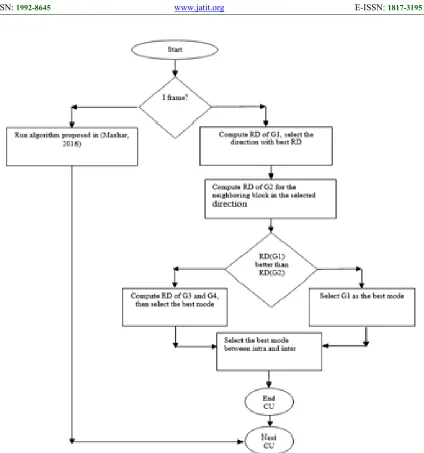
As shown in Table 7, the proposed combined algorithm outperforms the HM 15.0 and the fast method in [16]. The proposed algorithm shows in average 60.3% saving of the encoding time compared to 46.9% of [16]. The increase of BD-BR is negligible as it is less than 1.5%. The (LCIP) was able to get up to 63.2% compared to HM 15.0. The reliability of the proposed algorithm is an important consideration as it is reliable for the different frame resolutions that have been used in the experiments. The proposed algorithm reduces the encoding time with no significant penalty in PSNR loss or bit- rate increase. The flowchart of the combined algorithm is shown in Figure 6.
Table 6 Inter frame testing configurations GOP structure Low-delay and Random-access
Max CU size 64×64
QP 22, 27, 32 and 37
Frame count 300
Search range 64
Sequence type IPPP Frame/second 30
The average time saving of the proposed intra prediction algorithm compared to the idea in [14] is shown in Figure 5. The proposed algorithm outperforms [14] for the six different video sequences. As the algorithm in [14] shows almost steady state for the different sequences. The proposed algorithm has different effects on the sequences. The reason refers to the differences between the content of these sequences, as sequences with low frame component homogeneity contains many spatial components and pixels variety. Accordingly, smaller modes would be more suitable which means more CU partitioning and more encoding time consuming. As a result, this affects poorer on the (LCIP) speeding up.
For completeness, the proposed intra prediction algorithm was combined with the fast inter prediction technique in [9]. The combined algorithm was implemented and compared to the HM 15.0 model and to a state-in-the-art method [16]. The chosen parameters and configurations of the inter frame testing are shown in Table 6. In addition, the intra parameters are the same as in Table 4 where the test sequences were the same as in Table 5. This variety of sequences ensures the suitability of the algorithm for different HD and UHD video sequence types.
The proposed combined algorithm was implemented in HM 15.0 test model to evaluate the performance achieved. The implementation results with Bjontegaard metrics are shown in Table 7.
Table 7 Proposed combined algorithm vs. HM 15.0 and [16]
Sequence
Proposed Combined Algorithm [16]
ΔBD-BR
(%) ΔTS (%) ΔBD-BR (%) ΔTS (%)
Traffic 2.34 -61.4 0.33 -54.1
PeopleOnStreet 1.83 -63.2 0.37 -34.6
Nebuta 1.12 -62.1 0.51 -46.8
Cactus 2.04 -56.8 0.57 -47.4
BQTerrace 1.93 -58.3 0.44 -50.7
ParkScene 2.18 -60.4 0.31 -48.1
288
Figure 6. The flowchart of the proposed combined algorithm
The full proposed algorithm executes as follows:
1. If the frame is an Inter frame, go to step
8.
2. Compute the RD of G1 for the
neighboring block in each prediction direction.
3. Choose the direction with the best RD.
4. Compute the RD of G2 for the
neighboring block in the selected direction.
5. If RD of G1 is not better than or similar
to RD of G2, go to step 7.
6. Select the G1 mode as the best intra
mode. Then go to step 12.
7. Compute the RD of G3 and G4. Go to
step 11.
8. Compute RD of 64,32 and 16.
9. If RD of 64 and 32 are better than 16,
go to step 10, Otherwise continue splitting CUs.
10. Compute the RD of the candidates for
289 to step 11. Otherwise, continue checking all reference frames.
11. Among all candidates that were
checked, select the candidate that provides the smallest RD cost.
12. Check next CU if needed.
[image:8.612.91.290.219.413.2]The overall performance of the combined proposed algorithm compared to [16] is illustrated in Figure 7.
Figure 7. Proposed combined algorithm vs. [16]
As shown in Figure 7, the algorithm shows higher speeding up for all video sequences. The minimum improvement gained is 56.8% for the Cactus sequence where the best achievement is 63.2% for PeopleOnStreet. However, the minimum time saving is still valuable especially with the negligible loss of PSNR. In addition, the proposed algorithm outperforms [16] for all selected sequences that contain different components and different resolutions.
The proposed algorithm has shown many significant findings, the fast encoding process with negligible loss of PSNR is the most important one. In addition, the huge number of directions in intra prediction with different modes in each direction can be a consumable process. This can be exploited smartly to influence on the compression efficiency positively. Modes and directions can be predicted in early stages so several non-effective and consumable steps can be avoided. Implementing such proposed technique makes the HEVC encoder most applicable especially on systems with limited resources.
6. CONCLUSION
In this paper, a fast HEVC (LCIP) technique was presented. The proposed algorithm reduced the number of blocks to be encoded and the number of directions to be examined. The algorithm showed efficient saving time for HD and UHD frame resolutions. Experiment results also confirmed the reliability of the proposed algorithm with different QP values and testing configurations. On average, the proposed intra prediction algorithm was able to save 34.2% of the encoding time compared to the HM 15.0 with negligible BD-BR increase. As a second stage of the research, the proposed intra prediction algorithm was combined with an efficient inter prediction technique to speed up the encoding process more efficiently. The combined algorithm was implemented and tested to evaluate its performance. The proposed combined algorithm was able to significantly reduce the HM 15.0 encoding time 60.3% on average with negligible BD-BR increase. The proposed algorithm improved the overall HEVC encoding time with no significant effect on the performance. The proposed algorithm is expected to be useful as a low space complexity algorithm of HEVC.
As a future direction, more
investigations are needed on how to choose a threshold of PSNR. The threshold can be chosen depending on the available capabilities of a system desires to run HEVC encoding.
REFRENCES:
[1] B. Bross, W. J. Han, J. R. Ohm, G. J. Sullivan, Y. K. Wang, T. Wiegand, “High Efficiency Video Coding (Hevc) Text
Specification Draft 10”, Document Jctvc-
L1003, Jct-Vc. [Online]. Available: Http://Phenix.Int-Evry.Fr/Jct/Index. Php.
2013.
[2] T. Wiegand, J. R. Ohm, G. J. Sullivan, W.J. Han, “Special Section On The Joint Call For Proposals On High Efficiency Video
Coding (HEVC) Standardization”, Ieee
Trans. On Circuits And Systems For Video
Technology, Vol.20, No.12, 2010,
pp.1661-1666.
[3] JCT-VC, “WD1: Working Draft 1 of
High-Efficiency Video Coding”, JCTVC-C403,
JCT-VC Meeting, Guangzhou, October
290 [4] M. de-F. Lopez, D. O. Quiros, Jose C, P.
Alcolado and F. D-de-Marıa, “An improved fast mode decision algorithm for intra-prediction in H.264/AVC video
coding”, Signal Processing: Image
Communication 25, Elsevier 2010, pp.709–
716.
[5] Y.H. Huang, T.S. Ou and H. H. Chen, “Fast Decision of Block Size, Prediction Mode, and Intra Block for H.264 Intra
Prediction”, IEEE Transactions on Circuits
and Systems for Video Technology, Vol.
20, No. 8, 20110, pp.1122-1132.
[6] Y. Kuo, J. Yang and J. Chen, “An efficient mode decision algorithm for H.264/AVC intra prediction”, Multimedia Tools Appl,
Springer Science+Business Media New
York, Springer 2013.
[7] J. Yang, J. Kim, K. Won, H. Lee, and B. Jeon, “Early SKIP detection for HEVC”,
Document JCTVCG543, JCT-VC. [Online]
Available:http://phenix.intevry.fr/jct/index. php.
[8] K. Choi and E. S. Jang, “Coding tree pruning
based CU early termination”, Document
JCTVC-F092, JCT-VC, [Online]
Available:http://phenix.intevry.fr/jct/index. php.
[9] A. A. Mazhar, “An efficient fast HEVC
encoding technique”, Journal of
Theoretical and Applied Information
Technology, Vol. 90, No. 2, 2016, pp.
40-46.
[10] L. Xianng, L. Yinbo, W. Peicheng, L. Chin-Feng and C. Han-Chien, “An Adaptive Mode Decision Algorithm Based on Video Texture Characteristics for HEVC Intra
Prediction”, IEEE Transactions on Circuits
and Systems for Video Technology. Vol.
27, Issue 8, 2017, pp. 1737-1748.
[11] H. Azgin, E. Kalali and I. Hamzaoglu, “A
computation and energy reduction
technique for HEVC intra prediction”, Vol. 63, Issue 1, 2017, pp. 36-43.
[12] M. P. Sharabayko, O. G. Ponomarev, I. R. Chernyak, “Intra Compression Efficiency
in VP9 and HEVC”, Applied Mathematical
Sciences. Vol. 7. No. 137, 2013, pp. 6803–
6824.
[13] JCT-VC, “Common Test Conditions and
Software Reference Configurations”,
JCTVC-L1100, ITU-T SG16 WP3 and ISO/IEC JTC1/SC29/WG11, 12th Meeting:
Geneva, CH 14 – 23 January 2013.
[14] L. Weihang, Y. Daiqin, C. Zhenzhong, “A fast mode decision algorithm for HEVC
intra prediction”, Visual Communications
and Image Processing (VCIP 2016),
Chengdu, China, IEEE 2016.
[15] G. Bjontegaard, “Calcuation of average PSNR differences between RDcurves”,
Doc. VCEG M33 ITU-T Q6/16, Austin,
TX, USA, 2-4 April 2001.
[16] S. Jung, H. W. Park, “A Fast Mode Decision Method in HEVC Using Adaptive
Ordering of Modes”, IEEE Transactions on
Circuits and Systems for Video
Technology, Vol. 26, Issue. 10, 2016, pp.
![Figure 7. Proposed combined algorithm vs. [16]](https://thumb-us.123doks.com/thumbv2/123dok_us/8904936.956380/8.612.91.290.219.413/figure-proposed-combined-algorithm-vs.webp)
