ISSN Online: 2327-5227 ISSN Print: 2327-5219
Differential Evolution for Urban Transit Routing
Problem
Ahmed Tarajo Buba
1, Lai Soon Lee
1,2*1Department of Mathematics, Faculty of Science, Universiti Putra Malaysia, Selangor, Malaysia
2Laboratory of Computational Statistics and Operations Research, Institute for Mathematical Research, Universiti Putra Malaysia, Selangor, Malaysia
Abstract
The urban transit routing problem (UTRP) involves the construction of route sets on existing road networks to cater for the transit demand efficiently. This is an NP-hard problem, where the generation of candidate route sets can lead to a number of po-tential routes being discarded on the grounds of infeasibility. This paper presents a new repair mechanism to complement the existing terminal repair and the make- small-change operators in dealing with the infeasibility of the candidate route set. When solving the UTRP, the general aim is to determine a set of transit route net-works that achieves a minimum total cost for both the passenger and the operator. With this in mind, we propose a differential evolution (DE) algorithm for solving the UTRP with a specific objective of minimizing the average travel time of all served passengers. Computational experiments are performed on the basis of benchmark Mandl’s Swiss network. Computational results from the proposed repair mechanism are comparable with the existing repair mechanisms. Furthermore, the combined repair mechanisms of all three operators produced very promising results. In addi-tion, the proposed DE algorithm outperformed most of the published results in the literature.
Keywords
Urban Transit, Routing, Network, Repair Mechanism, Differential Evolution
1. Introduction
In recent years, the rapid growth of population and urbanization of large cities with its attendant consequences such as increase in travel demand, traffic congestion, energy consumption, noise level, and air pollution have been a major source of concern to the
How to cite this paper: Buba, A.T. and Lee, L.S. (2016) Differential Evolution for Urban Transit Routing Problem. Journal of Com-puter and Communications, 4, 11-25. http://dx.doi.org/10.4236/jcc.2016.414002
Received: September 5, 2016 Accepted: November 8, 2016 Published: November 11, 2016
Copyright © 2016 by authors and Scientific Research Publishing Inc. This work is licensed under the Creative Commons Attribution International License (CC BY 4.0).
http://creativecommons.org/licenses/by/4.0/
urban transportation planners and practitioners, particularly in developing and emerg-ing countries. A reliable option to handle some of these problems is to make use of the public transit systems in the urban areas. The public transit systems which include bus-es, trams, trains and underground or metro services aim to satisfy the travel demand of urban commuters safely, affordably, and efficiently. Although achieving a highly attrac-tive public transit usage is a very complex issue, however, designing an operationally and economically efficient public transit network can be a significant attribute. Fur-thermore, the urban area’s social, economic, and physical structure can be enhanced through the construction of efficient public transit networks.
In a general sense, designing bus network is commonly characterized by mutually conflicting factors across different planning horizons. For instance, higher level of ser-vice in terms of shorter waiting time, faster travel time, and minimum number of transfers is provided to the transit users in the presence of more routes and buses needed. In other words, the network topology has a direct impact on the costs of the users, benefits of the transit operators, and the relevant social costs. In bus transit sys-tem, the literature identifies five stages for designing a public transportation system [1]: route network design, frequency setting, timetable design, fleet assignment and crew assignment. Most previous approaches have attempted to handle these stages sequen-tially in the real systems, because each stage is NP-hard in its own and this creates sev-eral sources of complexity. At the same time, these decisions are made for different planning horizons, whether the context of the planning is strategic, tactical or opera-tional.
The urban transit routing problem (UTRP) which corresponds to the first stage of the bus planning process involves the construction of transit routes on an existing road network based on the travel demand and corresponding link travel times subject to given constraints and requirements such that the routes optimize the desired objec-tive(s) defined by the stakeholders (including users, operators, and society). It represents the single very strategic planning step in the urban bus planning process that seeks to balance the competing objectives of minimizing both passenger and operator costs ([1] [2]).
The rest of the paper is organized as follows: Section 2 presents a brief literature re-view of the solution approaches for UTRP. The mathematical formulation of UTRP is given in Section 3. The details of the proposed repair mechanism and the DE algorithm are described in Section 4 and 5 respectively. Computational results and discussions are presented in Section 6. Finally, conclusions and the directions for future research are provided in Section 7.
2. Literature Review
A search in the literature provides various heuristic and metaheuristic algorithms for the optimization of UTRP. A heuristic algorithm to find the optimal route sets is first proposed by [7]. The methodology consists of two major stages including the genera-tion of feasible candidate route sets, and the selecgenera-tion of the optimal route set. The Swiss network used in [7] has since become the only publicly available benchmark da-taset for UTRP.
Reference [1] introduced a model for tackling the routing and scheduling together. The methodology consists of two-level routines for constructing the initial candidate route set and testing the candidate route set. The user’s viewpoint is considered at the first level, while both users and operators point of view is considered at the second lev-el. A hybrid solution approach for the network design problem by incorporating the knowledge of experts and optimization techniques is presented in [8]. The AI-based approach is composed of three main components including route generation algorithm, analysis procedure, and route improvement algorithm. Experiments were conducted to evaluate the performance of the route generation algorithm.
Over the past decade, genetic algorithm (GA) has gain significant success in deter-mining near optimal solutions for the UTRP ([2] [9]-[12]). A GA is proposed by [2] in designing efficient and optimal sets of routes from initial candidate route sets based on a given road network and data on travel demand. A GA to tackle the UTRP giving priority to the passenger cost is presented in [9]. The computational results on the benchmark Mandl’s Swiss network outperforms most approaches in the literature. Reference [10] developed two models of GA to address the problem. The aim is to op-timize the size of passengers satisfied, the overall travel time of served passengers, and the total number of transfers. The GA with elitism produced some competitive results, while the GA with increasing population outperforms all previous results in the litera-ture. However, their results cannot be used as a direct comparison with others as the constraints on the maximum number of nodes (i.e. 8 nodes) in a route is relaxed as compared to other approaches in the literature.
optimal route sets. Experiments are conducted on benchmark Mandl’s Swiss network confirming that the BCO approach can produced high quality solutions. The particle swarm optimization (PSO) algorithm developed in [14] and [15] for solving the prob-lem gives proper emphasis on both candidate solution representations and evaluation approach. The aim is optimize the coverage index subject to operator cost at the upper level. The methodology consists of two main elements: a candidate route construction module, and a discrete PSO algorithm to determine the optimal route set.
A number of studies employed multiobjective models to solve the UTRP and the corresponding vehicle frequencies setting simultaneously ([16]-[23]). Reference [16]
proposed a GA for solving the problem through fixed and variable string length coding. Based on some descriptors considered in the study, the fixed string length coding produced better results compared to the variable length coding. The GA proposed by
[17] optimized the location of bus route and its corresponding headway. The proposed GA is found to converge efficientlyto optimum as confirmed by the solution from exhaustive search algorithm. A new approach to evaluate the fitness function values in GA for optimization of bus network is given in [18]. The aim is to develop a heuristic that determines the best bus route network of which both demand and transport offer are satisfied. An experiment is conducted and the model is tested on a realistic network. The GA developed by [19] tackled the bi-objective UTRP in optimizing the user and operator costs. The proposed GA introduces an adding-node mechanism to correct an infeasible solution. The genetic operators include effective route crossover and identical- point mutation. The computational results of the proposed GA tested on benchmark Mandl’s Swiss network outperformed the previous best pulished results in most cases.
Reference [20] proposed a SA to solve the UTRP by considering the level of distribu-tion node. The methodology comprised of initializadistribu-tion, transit trips assignment, and a SA algorithm that selects the optimum solution. To evaluate the quality of the solution obtained by the proposed SA, a GA solution is utilized as the benchmark. A tabu search (TS) is developed in [21] to optimize the problem. The methodology consists of three major components: initialization, demand assignment, and TS algorithm that deter-mine the optimum. Computational results obtained outperform the GA which is used as the benchmark as in [20]. The TS employed in [22] analyzed an urban transportation problem in northern Spain. The aim is to optimize the level of service. The methodolo-gy consists of line design and assignment of buses such that a local search and TS strat-egies are modified alternatively at the two decision levels. The result obtained is far bet-ter than the existing tools used by transport authorities.
3. Mathematical Formulation
ve-hicle travel time, waiting time, transfer time, and transfer penalties. Based on the stu-dies by [3] and [19], minimizing the passengers’ cost is often considered as the most significant objective in bus network design with inelastic demand.
In this study, the UTRP is defined as follows: given a road network represented by the graph, G = (N, A), where N is the set of nodes representing the demand points (bus stops) and A is the set of edges (links) representing the street segments. Let λijdenote
the shortest journey time of any pair of nodes (i, j) of route set R, calculated based on the Dijkstra’s algorithm [24], n is the number of nodes of the route set R, dijrepresents
the travel demand between nodes i and j. The proxy for passenger cost for a route set R
is the mean journey time over all passengers [3]. The objective of the UTRP is to find a set of route network that achieves the minimum cost Equation (1) while meeting all the requirements and constraints of (1)-(8):
, 1
, 1 min
n ij ij i j
n ij i j
d z
d
λ
==
=
∑
∑
(1)subject to the following constraints:
1) Each route should have a minimum and a maximum length (a minimum length to ensure connectivity of the route network while a maximum length to aid bus schedule adherence).
2) There must be exactly number of routes in a route set R predefined by the transit operator due to resource limitation.
3) The transit graph must be connected, so that there should be a path connecting any two nodes where any passenger using the route network can travel between any two nodes.
4) Each route in the route set is free from repeated nodes. Hence, no cycles or back-tracks should be allowed in the individual routes.
5) All nodes must be included in the route set to form a complete route set.
6) The demand, travel time, and distance matrices are symmetrical along the same route.
7) The demand level is inelastic throughout the period of the study and passenger choice of routes is based on the shortest travel time.
8) The policy headway is not considered, it is assumed there are adequate vehicles and capacity.
4. Sub-Route Reversal Repair Mechanism
every node presents in the original transit network is included. In most cases, a repair mechanism is employed to reduce the infeasibility of the candidate route sets. The re-pair mechanisms currently available in the literature are the terminal rere-pair [3] and make-small-change [4]. However, there are still far from being efficient. With the aim to improve the quality of the initial candidate route sets in terms of the feasibility, a new repair mechanism, called sub-route reversal repair mechanism is proposed to comple-ment the existing repair mechanisms comple-mentioned above. The steps of the proposed re-pair mechanism in dealing with an infeasible route set are as follows:
STEP 1: Compile a list of the missing nodes, Ň = {ň1, ň2 , ..., ňm} from the constructed infeasible route set, Ř = {ř1, ř2, ..., řs}.
STEP 2: The first route from Ř is selected as the current route, ři (i = 1).
STEP 3: The first node from Ň is selected as the current missing node, ňj (j = 1).
STEP 4: IF, ři contains a neighbor (i.e. two nodes are directly connected) of ňj, go to STEP 5, ELSE, go to STEP 6.
STEP 5: Identify the neighborx, of ňj in ři. The route ři is divided into two sub-routes, s1 and s2 for two cases:
Case 1:
the neighbor x is located at the end of s1. Reverse the sequence of nodes in s1 so the x becomes the first node. The new route is built from the reversed s1 by appending the nodes from s2 (if feasible) continuously until the neighborhood relation is exhausted or the maximum number (i.e. 8) of nodes for a route is satisfied. This new route is labeled as ři1.
Case 2:
the neighbor x is located at the beginning of s2. Reverse the sequence of nodes in s2 so the x is located at the end of the node sequence in this reversed s2 sub-route. The new route is built from the reversed s2 by appending the nodes from s1 (if feasible) continuously until the neighborhood relation is exhausted or the maximum number (i.e. 8) of nodes for a route is satisfied. This new route is labeled as ři2.
The new ři* = max {ři1, ři2}. Breaking ties arbitrarily. Update Ň by removing the ňj from the list. Update ři in Ř with the new route ři*. Go to STEP 2.
STEP 6: IF, the current route, ři is not the last route of Ř, set i = i + 1, go to STEP 4. ELSE, go to STEP 7.
STEP 7: The missing node, ňj could not be inserted in Ř. Hence, the Ř is infeasible. STOP.
The steps are repeated until all missing nodes are inserted into the route set (i.e. the infeasibility is repaired), or when the STEP 7 is invoked (i.e. infeasible).
5. Differential Evolution
In this section, the classic DE and the proposed DE framework for solving the UTRP are discussed. The DE is a variant of GA that is originally introduced by [25] for global optimization problems over continuous space. The DE algorithm utilizes three major operators similar to GAs including the mutation, crossover and selection operators. However, DE depends heavily on mutation as a primary search mechanism to distin-guish it from the GA. The mutation operator of DE involves the computation of weighted differences of randomly sampled pairs of solutions in the population such that the ex-ploration of the search space is favored at the initial stage of the evolution process. Subsequently, exploitation of the search space is favored as evolution advances as a re-sult of mutation operator. Therefore, during the implementation, the DE adapts the search step automatically through the mutation to achieve the best value. The DE algo-rithm utilizes a uniform crossover that can select child vector from one parent more often than the other to construct trial vectors. The crossover operator efficiently ex-changes information between successful combinations, whereby the most promising area of the search space is located for an optimum.
In the DE algorithm, a mutant vector is created for each target vector in the popu-lation. Then the crossover operator is carried out between the mutated population and the target population in order to give rise to a population of trial vectors. Next, the selection operator is introduced for the comparison of the target and trial popula-tion based on the fitness value. Finally, better vectors constitute the members of the population for the next generation. Through repeated cycles of the evolutionary op-erators the DE directs the population towards the neighborhood of the global opti-mum.
Proposed Differential Evolution Algorithm Framework
While employing the DE algorithm framework, it is likely that infeasible vectors will be generated due to the evolutionary operators (mutation and crossover). Some studies in the literature considered such vectors to be rejected and the whole initialization proce-dure together with feasibility checks is repeated to construct a feasible solution to re-place it ([3] [19] and [26]). In this paper, we employed the combined repair mechan-isms as described in Section 4 to deal with the infeasibility. The steps of the proposed DE framework for solving the UTRP are structured as follows:
STEP 1:
The DE algorithm starts with a population of Np solution vectors initially generated based on the construction algorithm [3] by incorporating the combined repair mechanisms to increase the number of feasible vectors.
STEP 2:
Continued
STEP 3:
To increase the diversity of the Target and Noisy Random vectors, the uniform route crossover [27] is introduced. In this work, a pair of Trial vectors, Ui, G is generated through selecting the vector component values either from the Target vector, Xi, G or the Noisy Random vector, Vi, G using a 0/1 crossover mask where each sub-route in the Trial vector is constructed by copying the corresponding sub-route either from the Target or the Noisy Random vector. In the case where the resulted Trial vector(s), Ui, G is/are infeasible, the combined repair mechanism is introduced.
STEP 4: After the crossover, the objective function values corresponding to the Trial vectors, Ui, G are evaluated and compared with that of the Target vector, Xi, G.
STEP 5: An elitism selection strategy is employed, where the best vector with the lowest fitness value between the Target vector, Xi, G and the Trial vectors, Ui, G will be selected for the next generation. Repeat STEP 2 - STEP 4 for i = 2, …Np to complete one generation.
STEP 2 - STEP 5 are repeated until the termination criterion (e.g., maximum genera-tion, execution time, etc.) is met. The framework of the proposed DE for solving the UTRP is shown in Algorithm 1.
6. Computational Experiments and Discussion
6.1. Benchmark Data and Experimental Design
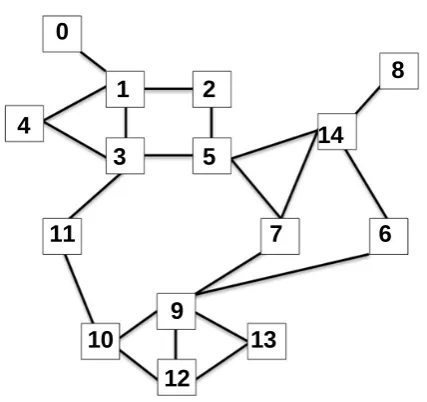
The proposed DE algorithm is utilized to design the best transit route network of Mandl’s Swiss network [7] (see Figure 1) which is the benchmark network for demon-strating the effectiveness and efficiency of an algorithm. This network consists of 15 demand points (nodes) within a 33 minutes shortest travel time between the two farthest nodes and 21 links, with a total travel demand of 15570 units daily. Many variations
Algorithm 1. DE for UTRP.
Generate Np candidate route set based on heuristic in [3] with combined repair mechanism for i: = 1 to Np
fitness evaluation (Equation (1)) end for
for n: = 1 to G for i: = 1 to Np
set Target vector = Xi, n
select randomly a vector (except the selected Target vector, Xi, n) in the population apply identical point mutation to generate a Noisy Random vector, Vi,n (repair if infeasible) apply uniform crossover between Xi, n and Vi, n to generate a pair Trial vectors, Ui, n (repair if infeasible)
fitness evaluation of Ui, n (Equation (1)) elitism selection
if Trial vector fitness ≤Target vector fitness new_population [i] = Trial vector, Ui, n else
new_population [i] = Target vector, Xi, n end for
Np = new_population end for
Figure 1. Mandl’s Swiss road network.
of the UTRP (i.e. different objectives) are solved by [2] [4] [9] [10] [13] [14], and [28]. The performance parameters together with their solutions will be used as the bench-mark results to validate the proposed DE algorithm.
The proposed algorithm is coded in Python programming language and executed on a 1.60 GHz Intel Core™ i 5 - 4200 CPU with 4.00 GB of RAM. The performance of the proposed DE algorithm is evaluated using the following parameters adopted by many researchers in the literature ([4] [7] [9] [13] [14] and [28]):
• do—the percentage of demand satisfied without any transfers, • d1—the percentage of demand satisfied with one transfer, • d2—the percentage of demand satisfied with two transfers, • dun—the percentage of demand unsatisfied,
• ATT—average travel time in minutes per transit user.
The travel time includes vehicle travel time, waiting time, transfer time, and transfer penalties. Based on the literature, the transfer penalty is fixed at 5 minutes per passen-ger. The minimum and maximum of nodes in a route is also fixed at 2 and 8 nodes re-spectively. We performed comparison in four scenarios: 4, 6, 7 and 8 routes in each route set. The best values of the parameters are computed.
6.2. Computational Experiments of Repair Mechanisms
To investigate the efficiency of the proposed sub-route reversal repair mechanism in dealing with the infeasible candidate route set, we compared it with the terminal repair
[3], make-small-change [4], and the combined repair mechanism. We performed the experiments on benchmark Mandl’s Swiss network by generating a population of 500 infeasible candidate route sets using the heuristic proposed in [3] in all four cases with route set sizes of 4, 6, 7, and 8 routes respectively. For each case, 10 runs are recorded to obtain the descriptors for each repair mechanism as shown in Table 1. The descriptors represent the average, minimum, and maximum number of infeasible candidate route
1
0
4
3
11
10
2
5
9
12
14
7
13
6
8
1
0
4
3
11
10
2
5
9
12
14
7
13
Table 1. The comparison of infeasible route sets repaired by the repair mechanisms.
Case Number of Routes Repair Mechanism Average Minimum Maximum CPU Time (sec)
I 4
Terminal Repair 47 34 68 0.013
Make-Small-Change 53 39 69 0.052
Sub-Route Reversal 56 47 68 0.040
Combined Repair 139 126 157 0.001
II 6
Terminal Repair 149 133 170 0.029
Make-Small-Change 206 193 220 0.490
Sub-Route Reversal 169 157 181 0.032
Combined Repair 292 277 306 0.002
III 7
Terminal Repair 201 184 219 0.029
Make-Small-Change 293 267 317 0.066
Sub-Route Reversal 223 210 234 0.025
Combined Repair 352 335 377 0.001
IV 8
Terminal Repair 231 207 250 0.020
Make-Small-Change 356 319 376 0.042
Sub-Route Reversal 265 242 284 0.025
Combined Repair 379 347 399 0.012
sets that were repaired by the corresponding repair mechanism. It can be seen in Table 1 that the results from the proposed sub-route reversal repair mechanism is performed better than the terminal repair in all cases but only slightly better than the make-small- change in one of the cases. Although the make-small-change repaired more infeasible route sets than the proposed repair mechanism, but its average CPU time is the highest in all cases.
The results obtained through the combined repair mechanism for all cases are very promising. The mechanism significantly outperformed all other repair mechanisms in terms of the number of infeasible route sets repaired and with the fastest CPU time. Therefore, it is only logical to implement the combined repair mechanism in both the heuristic [3] and the proposed DE algorithm when dealing with the infeasible route sets.
6.3. Comparative Results of Differential Evolution
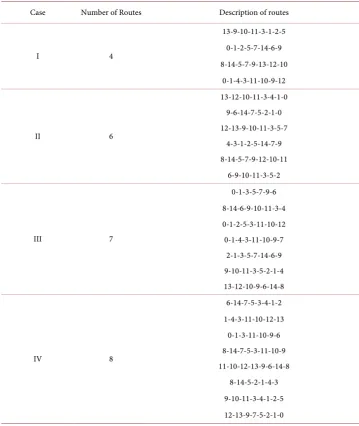
performed for 10 runs and the best result is reported in Table 2, column 12. The pre-vious best solutions found in the literature are reported in column 3 to column 11. The best route sets for all cases found by the proposed DE algorithm are also presented in
Table 3.
[image:11.595.195.553.327.672.2]It is important to note that, some of the approaches in the literature utilize the same formulation for the modeling of the UTRP and attempt to optimize the equivalent ob-jective function. For instance, [10] proposed two algorithms (GAWE and GAWIP) to handle the UTRP in a similar manner as in [13] but by relaxing the constraint on route length (max. 8 nodes) in their approach to achieve the best results so far (see Table 2, column 10 and 11). However, [14] confirmed computationally that if the number of nodes per route is set to a value greater than 8, the percentage transfer demands satis-fied directly (do) is increased. On the other hand, as the number of nodes per route is increased, the number of transfer demands satisfied with one transfer or with two transfers is decreased. However, in practice, increasing the length of route alone is not enough to improve the quality of transport services.
Table 2. Comparison results (best route sets) of Mandl’s Swiss network.
Number of
routes Parameters 1 2 3 4 5 6 7 8* 9* 10
4
do 69.94 n/a 86.86 93.26 92.42 92.10 91.84 96.14 95.83 94.28 d1 29.93 n/a 12.00 6.74 6.81 7.19 7.64 3.47 3.60 5.72 d2 0.13 n/a 1.14 0.00 0.77 0.71 0.52 0.39 0.57 0.00 dun 0.00 n/a 0.00 0.00 0.00 0.00 0.00 0.00 0.00 0.00 ATT 12.90 n/a 11.90 11.37 10.51 10.51 10.64 10.49 10.35 10.36
6
do n/a 78.61 86.04 91.52 95.57 95.63 96.21 98.39 98.91 98.01 d1 n/a 21.39 13.96 8.48 4.43 4.37 3.47 1.61 1.09 1.99 d2 n/a 0.00 0.00 0.00 0.00 0.00 0.32 0.00 0.00 0.00 dun n/a 0.00 0.00 0.00 0.00 0.00 0.00 0.00 0.00 0.00 ATT n/a 11.86 10.30 10.48 10.28 10.23 10.23 10.14 10.10 10.01
7
do n/a 80.99 89.15 93.32 96.60 98.52 97.17 99.17 99.55 98.07 d1 n/a 19.01 10.85 6.36 3.40 1.48 2.83 0.83 0.45 1.93 d2 n/a 0.00 0.00 0.32 0.00 0.00 0.00 0.00 0.00 0.00 dun n/a 0.00 0.00 0.00 0.00 0.00 0.00 0.00 0.00 0.00 ATT n/a 12.50 10.15 10.42 10.25 10.15 10.16 10.07 10.07 10.21
8
do n/a 79.97 90.38 94.54 97.50 98.97 97.75 99.87 99.87 98.59 d1 n/a 20.03 9.62 5.46 2.50 1.03 2.25 0.13 0.13 1.41 d2 n/a 0.00 0.00 0.00 0.00 0.00 0.00 0.00 0.00 0.00 dun n/a 0.00 0.00 0.00 0.00 0.00 0.00 0.00 0.00 0.00 ATT n/a 11.86 10.46 10.36 10.17 10.09 10.13 10.03 10.04 10.01
Table 3. Best route sets generated from Mandl’s Swiss network by the proposed DE algorithm.
Case Number of Routes Description of routes
I 4
13-9-10-11-3-1-2-5 0-1-2-5-7-14-6-9 8-14-5-7-9-13-12-10
0-1-4-3-11-10-9-12
II 6
13-12-10-11-3-4-1-0 9-6-14-7-5-2-1-0 12-13-9-10-11-3-5-7
4-3-1-2-5-14-7-9 8-14-5-7-9-12-10-11
6-9-10-11-3-5-2
III 7
0-1-3-5-7-9-6 8-14-6-9-10-11-3-4 0-1-2-5-3-11-10-12 0-1-4-3-11-10-9-7
2-1-3-5-7-14-6-9 9-10-11-3-5-2-1-4 13-12-10-9-6-14-8
IV 8
6-14-7-5-3-4-1-2 1-4-3-11-10-12-13
0-1-3-11-10-9-6 8-14-7-5-3-11-10-9 11-10-12-13-9-6-14-8
8-14-5-2-1-4-3 9-10-11-3-4-1-2-5 12-13-9-7-5-2-1-0
The quality of a route set is assessed by considering the parameters mentioned in Section 6.1. In Table 2, the proposed DE algorithm performed the best for 4 and 6 routes while in 7 and 8 routes, the DE algorithm is ranked second after [13]. However, the best ATT recorded by the DE algorithm is better than [13] in the case of 8 routes. Note that the results achieved by [10] should not be used as a direct comparison since the constraints on the maximum number of nodes (i.e. 8 nodes) in a route is relaxed as compared to other approaches in Table 2.
7. Conclusion
In this paper, a sub-route repair mechanism that complements the terminal repair and make-small-change repair mechanisms in dealing with the infeasible route sets is pro-posed. To further enhance the efficiency, a combined repair mechanism is developed where all three repair mechanisms: terminal repair, make-small-change and sub-route reversal, are implemented in a sequential order. The combined repair mechanism sig-nificantly outperformed all other repair mechanisms with the fastest CPU time. In ad-dition, a new DE algorithm that constructs efficient route networks for UTRP has been developed. Computational experiments performed on the benchmark Mandl’s Swiss network show that the proposed DE algorithm is competitive to the other approaches published in the literature. In real sense, the efficiency of the urban transport system depends not solely on the topology of the transit route network, but also on the operat-ing frequency of the routes. Consequently, the application of the proposed model to handle the UTRP and the operating frequency simultaneously, as well as improving the effectiveness of the sub-route reversal repair mechanism will be the focus of the future work.
References
[1] Ceder, A. and Wilson, N.H.M. (1986) Bus Network Design. Transportation Research Part B: Methodological, 20, 331-344. http://dx.doi.org/10.1016/0191-2615(86)90047-0
[2] Chakroborty, P. and Wivedi, T. (2002) Optimal Route Network Design for Transit Systems Using Genetic Algorithms. Engineering Optimization, 34, 83-100.
http://dx.doi.org/10.1080/03052150210909
[3] Mumford, C.L. (2013) New Heuristic and Evolutionary Operators for the Multi-Objective Urban Transit Routing Problem. 2013 IEEE Congress on Evolutionary Computation, Can-cun, Mexico, 20-23 June 2013, 939-946. http://dx.doi.org/10.1109/CEC.2013.6557668
[4] Fan, L. and Mumford, C.L. (2010) A Metaheuristic Approach to the Urban Transit Routing Problem. Journal of Heuristics, 16, 353-372. http://dx.doi.org/10.1007/s10732-008-9089-8
[5] Vasan, A. and Simonovic, S.P. (2010) Optimization of Water Distribution Network Using Differential Evolution. Journal of Water Resources Planning and Management, 136, 279- 287. http://dx.doi.org/10.1061/(ASCE)0733-9496(2010)136:2(279)
[6] Das, S. and Suganthan, P.N. (2011) Differential Evolution: A Survey of the State-of-the-Art.
IEEE Transactions on Evolutionary Computation, 15, 4-31.
http://dx.doi.org/10.1109/TEVC.2010.2059031
[7] Mandl, C.E. (1980) Evaluation and Optimization of Urban Public Transportation Net-works. European Journal of Operational Research, 5, 396-404.
http://dx.doi.org/10.1016/0377-2217(80)90126-5
[8] Baaj, M.H. and Mahmassani, H.S. (1995) Hybrid Route Generation Heuristic Algorithm for the Design of Transit Networks. Transportation Research Part C: Emerging Technologies, 3, 31-50. http://dx.doi.org/10.1016/0968-090X(94)00011-S
[9] Chew, J.S.C. (2012) Genetic Algorithms for Urban Transit Routing Problems. M.Sc. Thesis, Universiti Putra Malayisia, Malaysia.
30-45. http://dx.doi.org/10.1016/j.trc.2014.05.002
[11] Ngamchai, S. and Lovell, D.J. (2003) Optimal Time Transfer in Bus Transit Route Network Design Using a Genetic Algorithm. Journal of Transportation Engineering, 129, 510-521.
http://dx.doi.org/10.1061/(ASCE)0733-947X(2003)129:5(510)
[12] Tom, V. and Mohan, S. (2003) Transit Route Network Design Using Frequency Coded Ge-netic Algorithm. Journal of Transportation Engineering, 129, 186-195.
http://dx.doi.org/10.1061/(ASCE)0733-947X(2003)129:2(186)
[13] Nikolić, M. and Teodorović, D. (2013) Transit Network Design by Bee Colony Optimiza-tion. Expert Systems with Applications, 40, 5945-5955.
http://dx.doi.org/10.1016/j.eswa.2013.05.002
[14] Kechagiopoulos, P.N. and Beligiannis, G.N. (2014) Solving the Urban Transit Routing Problem Using a Particle Swarm Optimization Based Algorithm. Applied Soft Computing, 21, 654-676. http://dx.doi.org/10.1016/j.asoc.2014.04.005
[15] Bagherian, M., Massah, S. and Kermanshahi, S. (2013) A Swarm Based Method for Solving Transit Network Design Problem. Proceedings of the 36th Australasian Transport Research Forum (ATRF), Brisbane, Australia, 2-4 October 2013.
http://atrf.info/papers/2013/2013_bagherian_massah_kermanshahi.pdf
[16] Pattnaik, S., Mohan, S. and Tom, V. (1998) Urban Bus Transit Route Network Design Us-ing Genetic Algorithm. Journal of Transportation Engineering, 124, 368-375.
http://dx.doi.org/10.1061/(ASCE)0733-947X(1998)124:4(368)
[17] Chien, S., Yang, Z. and Hou, E. (2001) Genetic Algorithm Approach for Transit Route Planning and Design. Journal of Transportation Engineering, 127, 200-207.
http://dx.doi.org/10.1061/(ASCE)0733-947X(2001)127:3(200)
[18] Bielli, M., Caramia, M. and Carotenuto, P. (2002) Genetic Algorithms in Bus Network Op-timization. Transportation Research Part C: Emerging Technologies, 10, 19-34.
http://dx.doi.org/10.1016/S0968-090X(00)00048-6
[19] Chew, J.S.C., Lee, L.S. and Seow, H.V. (2013) Genetic Algorithm for Biobjective Urban Transit Routing Problem. Journal of Applied Mathematics, 2013, Article ID: 698645.
http://dx.doi.org/10.1155/2013/698645
[20] Fan, W. and Machemehl, R.B. (2006) Using a Simulated Annealing Algorithm to Solve the Transit Route Network Design Problem. Journal of Transportation Engineering, 132, 122- 132. http://dx.doi.org/10.1061/(ASCE)0733-947X(2006)132:2(122)
[21] Fan, W. and Machemehl, R.B. (2008) Tabu Search Strategies for the Public Transportation Network Optimizations with Variable Transit Demand. Computer-Aided Civil and Infra-structure Engineering, 23, 502-520. http://dx.doi.org/10.1111/j.1467-8667.2008.00556.x
[22] Pacheco, J., Alvarez, A., Casado, S. and González-Velarde, J.L. (2009) A Tabu Search Ap-proach to an Urban Transport Problem in Northern Spain. Computers & Operations Re-search, 36, 967-979. http://dx.doi.org/10.1016/j.cor.2007.12.002
[23] Mauttone, A. and Urquhart, M.E. (2009) A Multi-objective Metaheuristic Approach for the Transit Network Design Problem. Public Transport, 1, 253-273.
http://dx.doi.org/10.1007/s12469-010-0016-7
[24] Dijkstra, E.W. (1959) A Note on Two Problems in Connexion with Graphs. Numerische Mathematik, 1, 269-271. http://dx.doi.org/10.1007/BF01386390
[25] Storn, R. and Price, K. (1995) Differential Evolution—A Simple and Efficient Adaptive Scheme for Global Optimization over Continuous Spaces. International Computer Science Institute, Berkeley, CA, Technical Report TR-95-012.
Setting Multi-Objective Optimization by Alternating Objective Genetic Algorithm. Trans-portation Research Part B: Methodological, 81, 355-376.
http://dx.doi.org/10.1016/j.trb.2015.06.014
[27] Beasley, D., Bull, D.R. and Martin, R.R. (1993) An Overview of Genetic Algorithms: Part 2, Research Topics. University Computing, 15, 170-181.
http://orca-mwe.cf.ac.uk/64433/1/ga_overview2.pdf
[28] Baaj, M.H. and Mahmassani, H.S. (1991) An AI-Based Approach for Transit Route System Planning and Design. Journal of Advanced Transportation, 25, 187-209.
http://dx.doi.org/10.1002/atr.5670250205
Submit or recommend next manuscript to SCIRP and we will provide best service for you:
Accepting pre-submission inquiries through Email, Facebook, LinkedIn, Twitter, etc. A wide selection of journals (inclusive of 9 subjects, more than 200 journals)
Providing 24-hour high-quality service User-friendly online submission system Fair and swift peer-review system
Efficient typesetting and proofreading procedure
Display of the result of downloads and visits, as well as the number of cited articles Maximum dissemination of your research work
Submit your manuscript at: http://papersubmission.scirp.org/