Quantum Monte Carlo, density functional theory, and pair potential studies of solid neon
N. D. Drummond and R. J. Needs
TCM Group, Cavendish Laboratory, University of Cambridge, J. J. Thomson Avenue, Cambridge CB3 0HE, United Kingdom 共Received 17 October 2005; revised manuscript received 1 December 2005; published 19 January 2006兲
We report quantum Monte Carlo 共QMC兲, plane-wave density-functional theory 共DFT兲, and interatomic pair-potential calculations of the zero-temperature equation of state共EOS兲of solid neon. We find that the DFT EOS depends strongly on the choice of exchange-correlation functional, whereas the QMC EOS is extremely close to both the experimental EOS and the EOS obtained using the best semiempirical pair potential in the literature. This suggests that QMC is able to give an accurate treatment of van der Waals forces in real materials, unlike DFT. We calculate the QMC EOS up to very high densities, beyond the range of values for which experimental data are currently available. At high densities the QMC EOS is more accurate than the pair-potential EOS. We generate a different pair potential for neon by a direct evaluation of the QMC energy as a function of the separation of an isolated pair of neon atoms. The resulting pair potential reproduces the EOS more accurately than the equivalent potential generated using the coupled-cluster CCSD共T兲method.
DOI:10.1103/PhysRevB.73.024107 PACS number共s兲: 64.30.⫹t, 71.10.⫺w
I. INTRODUCTION
One of the most important goals of ab initio computa-tional electronic-structure theory is the development of accu-rate methods for describing interatomic bonding. Quantum Monte Carlo共QMC兲techniques are useful in this regard, as they can provide a highly accurate description of electron correlation effects. Although QMC methods are computa-tionally expensive, they can be applied to systems that are large enough to model condensed matter.
In this study we have considered solid neon, in which the bonding arises from the competition between short-range re-pulsion and the van der Waals attraction between the atoms. High-quality experimental measurements of the equation of state共EOS兲exist, which can be used as reference data. Fur-thermore, various neon pair potentials have been developed using experimental and theoretical data, which can also be used for comparison purposes. Solid neon is therefore an ideal system in which to test the descriptions of van der Waals bonding and short-range repulsion offered by various theoretical methods.
We have calculated theoretical EOS’s for crystalline neon using the QMC and density-functional theory共DFT兲ab ini-tio electronic-structure methods as well as various inter-atomic pair potentials. Standard DFT methods do not de-scribe van der Waals bonding accurately, but they might be expected to work quite well at high densities, where the short-range repulsion dominates. The high-pressure proper-ties of neon are of some experimental interest, because neon is often used as a pressure-conducting medium in diamond-anvil-cell experiments.1 We have therefore extended the
range of our QMC EOS for neon to very high pressures
共about 400 GPa兲.
The zero-point energy 共ZPE兲 of the lattice-vibration modes makes a small but important contribution to the total energy of solid neon. We have therefore studied the lattice dynamics of solid neon within the quasiharmonic-phonon ap-proximation and within the Einstein apap-proximation, using DFT methods and pair potentials.
For some time there has been considerable interest in de-veloping neon pair potentials in order to test the accuracy of
theoretical methods for calculating the properties of materials.2 We have performed a direct calculation of the neon pair potential using QMC. We compare the accuracy of the EOS predicted by this pair potential with the results ob-tained using other pair potentials, including one obob-tained from coupled-cluster CCSD共T兲calculations.3
Detailed information about our computational methodolo-gies is given in Sec. II and DFT calculations of the phase stability and band gap of solid neon are reported in Sec. III. The calculation of a neon pair potential using QMC is de-scribed in Sec. IV. The lattice dynamics of solid neon are studied in Sec. V. We compare the EOS’s obtained using different methods in Sec. VI. Finally, we draw our conclu-sions in Sec. VII.
Hartree atomic units共a.u.兲are used throughout, in which the Dirac constant, the magnitude of the electronic charge, the electronic mass, and 4 times the permittivity of free space are unity:ប=兩e兩=me= 4⑀0= 1.
II. METHODOLOGY
A. DFT calculations
1. DFT total-energy calculations
Our DFT calculations were performed using theCASTEP plane-wave-basis code.4 The local-density approximation 共LDA兲 and Perdew-Burke-Ernzerhof 共PBE兲 generalized-gradient-approximation5 exchange-correlation functionals were used. The Ne8+ ionic cores were repre-sented by ultrasoft pseudopotentials.4The EOS calculations
were performed using a 4⫻4⫻4 Monkhorst-Pack k-point mesh and a plane-wave cutoff energy of 200 a.u., for which the DFT energies have converged to about 7 significant fig-ures. The self-consistent-field calculations were judged to have converged when the fractional change in the energy was less than 10−11. The DFT band-gap calculations reported in
from its equilibrium position was 2.12% of the nearest-neighbor distance in each case, which ensures that anhar-monic effects are negligible. The force-constant calculations were carried out in both 2⫻2⫻2 and 3⫻3⫻3 supercells of the primitive unit cell, and the difference in the resulting ZPE’s was found to be negligible. The dispersion curves shown in Sec. V were produced using a 3⫻3⫻3 supercell, while the ZPE’s that were combined with the static-lattice EOS’s were calculated in a 2⫻2⫻2 supercell.
3. DFT orbital-generation calculations
DFT-LDA calculations were performed in order to gener-ate orbitals for the trial wave functions used in the QMC calculations. The QMC calculations made use of relativistic Hartree-Fock neon pseudopotentials,8,9 and these were also
used in the DFT orbital-generation calculations. The Hartree-Fock pseudopotentials are much harder than the ultrasoft pseudopotentials. Plane-wave cutoffs in excess of 250 a.u. were used in each orbital-generation calculation, so the DFT energy was converged to around 10−3 a.u. This cutoff is
very large by the normal standards of DFT calculations, but there is evidence that using large basis sets reduces the vari-ance of the energy in QMC calculations.10
B. QMC calculations
1. VMC and DMC methods
In the variational quantum Monte Carlo共VMC兲method, expectation values are calculated using an approximate trial wave function, the integrals being performed by a Monte Carlo technique. In diffusion quantum Monte Carlo11,12 共DMC兲the imaginary-time Schrödinger equation is used to evolve an ensemble of electronic configurations toward the ground state. The fermionic symmetry is maintained by the fixed-node approximation,13 in which the nodal surface of
the wave function is constrained to equal that of a trial wave function. Furthermore, the use of nonlocal pseudopotentials to represent the Ne8+cores necessitates the use of the locality
approximation,14which leads to errors that are second order
in the quality of the trial wave function.15
Our QMC calculations were performed using theCASINO code.16The trial wave functions were of Slater-Jastrow form,
with the orbitals in the Slater wave function being taken from DFT calculations and the free parameters in the Jastrow factor being optimized by minimizing the unreweighted
vari-ditions. The electrostatic energy of each electron configura-tion was calculated using the Ewald method.22 The QMC
energy per atom obtained in a finite cell differs from the energy per atom of the infinite crystal due tosingle-particle
finite-size effects andCoulombfinite-size effects. The former result from the fact that the allowedk points for the Bloch orbitals form a discrete lattice, so that the single-particle en-ergy components change when the size of the simulation supercell is changed. The latter, which are the more impor-tant in insulators, are caused by the interaction of the charged particles with their periodic images. At any given instant, each electron feels itself to be part of an infinite crystal of electrons.23,24The resulting bias is negative, and is generally
believed to fall off as 1 /N, whereNis the number of atoms in the simulation cell.11,25–27
In order to eliminate the finite-size bias, simulations were carried out in supercells consisting of 3⫻3⫻3 and 4⫻4 ⫻4 primitive unit cells. The error in the DFT results arising from the use of a 3⫻3⫻3 k-point mesh is small 共about 0.0001 a.u.兲, so we conclude that single-particle finite-size effects are negligible. The assumed form of the Coulomb finite-size bias was therefore used to extrapolate the results to infinite system size. The static-lattice energy per atom in the infinite-system limit is given by
E⬁SL共V兲=EN SL共
V兲+b共V兲
N , 共1兲
where EN SL共
V兲 is the Vinet fit 共see Sec. II D兲 to the DMC static-lattice energy-volume data obtained in a set ofN-atom simulation supercells, V is the primitive-cell volume, and
b共V兲 is a parameter determined by fitting. Since we only have energy-volume data for two different system sizes, N
andM, we may eliminateb共V兲and write
E⬁SL共V兲=NEN
SL共
V兲−MEM SL共
V兲
N−M . 共2兲
The pressure due to the static-lattice energy at infinite system size is given by
p⬁SL共V兲 ⬅−dE⬁
SL
dV = NpN
SL共
V兲−MpM SL共
V兲
N−M , 共3兲
wherepNSL共V兲⬅−dENSL/dVis the static-lattice pressure in an
N-atom simulation supercell.
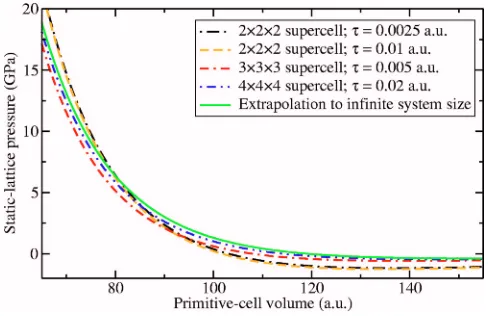
simula-tion supercell are shown in Figs. 1 and 2. Vinet EOS’s are fitted to the data. The corresponding pressure-volume data are shown in Figs. 3 and 4. It can be seen that the DMC pressure-volume curves converge steadily with system size, and that the DMC pressure extrapolated to infinite system size using Eq. 共3兲 is close to the pressure of the 4⫻4⫻4 supercell. This implies that the error introduced by the ex-trapolation is small, because the exex-trapolation is itself a small correction.
3. Time-step bias
The fixed-node DMC Green’s function is only exact in the limit of a zero time step; the use of a nonzero time step biases the DMC energy. An example of the bias in the DMC energy of a pseudoneon crystal is shown in Fig. 5. On the other hand, as shown by the 2⫻2⫻2 supercell results in Figs. 3 and 4, the pressure is very insensitive to the time step. We used time steps of 0.005 and 0.02 a.u. in our production calculations for the 3⫻3⫻3 and 4⫻4⫻4 supercells, re-spectively. A time step of 0.002 a.u. was used in the DMC pair-potential calculations. The target population was at least
320 configurations in each case, while a target population of 1000 configurations was used for the pair-potential-generation calculations.
C. Pair-potential calculations
1. Forms of neon pair potential
We have used the following forms of pair potential:共i兲the HFD-B potential proposed by Aziz and Chen28 with the
pa-rameter values given by Aziz and Slaman;29,30共ii兲the form
of potential proposed for helium by Koronaet al.,31
contain-ing the parameter values determined by Cybulski and Toczyłowski3 using all-electron double-excitation
coupled-cluster theory with a noniterative perturbational treatment of triple excitations 关CCSD共T兲兴 and an av5z⫹ Gaussian basis set; and 共iii兲 a fit of the potential of Korona et al.31 to our
DMC energy data, as described in Sec. IV. We believe the HFD-B pair potential to be the most accurate neon pair po-tential in the literature to date.
2. Static-lattice energy-volume curve using pair potentials
[image:3.612.315.559.56.214.2]Let the pair potential between two neon atoms at Rand R
⬘
be共兩R−R⬘
兩兲. LetA be a large radius. We evaluate the static-lattice energy per atom as [image:3.612.52.294.57.212.2]FIG. 1.共Color online兲Low-density static-lattice DMC energy of FCC neon as a function of volume, evaluated in simulation super-cells consisting ofn⫻n⫻nprimitive unit cells using different time steps.
FIG. 2. 共Color online兲 The same as Fig. 1, but at higher densities.
[image:3.612.53.297.539.706.2]FIG. 3. 共Color online兲 Low-density static-lattice pressure ob-tained by fitting Vinet EOS’s to the DMC energies obob-tained in simulation supercells consisting ofn⫻n⫻nprimitive unit cells and at different time steps. The pressure extrapolated to infinite system size is also shown.
[image:3.612.314.559.556.706.2]ESL⬇1
2
冉
0⬍兺
兩R兩⬍A共兩R兩兲+NNe
V
冕
A⬁
4r2共r兲dr
冊
, 共4兲 where the兵R其 are the lattice sites andNNe/Vis the number density of neon atoms. This expression becomes exact asAgoes to infinity. The integral in Eq.共4兲 was evaluated ana-lytically for each pair potential, while the sum was evaluated by brute force.Awas increased untilESLconverged.
3. Force-constant calculations using pair potentials
Pair potentials were used to generate force-constant data for a quasiharmonic6 calculation of the ZPE of neon. The
method of finite displacements7 was used to generate the force constants in a finite supercell subject to periodic boundary conditions. It was ensured that the force constants were highly converged with respect to the size of the dis-placements and the number of periodic images of the neon atoms that contributed to the force constants. Following the evaluation of the force constants, the calculation of the ZPE proceeded, as described in Sec. II A 2.
D. EOS models
LetE共V兲be the total energy of a neon crystal as a func-tion of primitive-cell volume V. It has previously been noticed32that a Vinet EOS of the form
E共V兲= − 4B0V0
共B0
⬘
− 1兲2再
1 − 32共B0
⬘
− 1兲冋
1 −冉
V V0
冊
1/3
册
冎
⫻exp
再
32共B0
⬘
− 1兲冋
1 −冉
V V0
冊
1/3
册
冎
+C, 共5兲where the zero-pressure volumeV0, bulk modulusB0,
pres-sure derivative of the bulk modulusB0
⬘
, and integration con-stantCare fitting parameters, gives a better fit than a third-order Birch-Murnaghan EOS,E共V兲= − 9
16B0
冉
共4 −B0⬘
兲V03
V2−共14 − 3B0
⬘
兲 V07/3 V4/3+共16 − 3B0
⬘
兲V05/3
V2/3
冊
+C, 共6兲to DFT results for solid neon. In some cases the Vinet EOS gives a lower2value when fitted to our DMC data than the
Birch–Murnaghan EOS; in others it gives a higher2value.
For example, using DMC data obtained in simulation cells consisting of 2⫻2⫻2 primitive cells and a time step of 0.01 a.u., the Vinet and Birch-Murnaghan EOS models give 2values of 10.0914 and 35.3561, respectively, whereas at a
time step of 0.0025 a.u. the EOS models give 2 values of
20.6609 and 4.8967, respectively. The resulting pressure-volume curves are essentially indistinguishable in each case, however. To be consistent, we have fitted Vinet EOS’s to all of our theoretical data.
III. DFT STUDY OF PHASE STABILITY AND BAND GAP
A. Phase transitions in solid neon
We have compared the DFT energies of face-centered cu-bic 共FCC兲 and hexagonal close-packed 共HCP兲 phases of solid neon. For HCP neon the lattice-parameter ratioc/awas optimized, but the optimal ratio always turned out to be
冑8 / 3, which is the ratio appropriate for an ideal HCP lattice.
The DFT energy difference between the FCC and HCP phases is typically less than 0.0005 a.u.: too small for us reliably to identify any phase transition. Experimentally, Hemley et al.33 have found that solid neon adopts the FCCphase up to pressures of at least 110 GPa at 300 K. We have therefore used the FCC lattice in all of our calculations, apart from those described in this section.
B. Band gap of solid neon
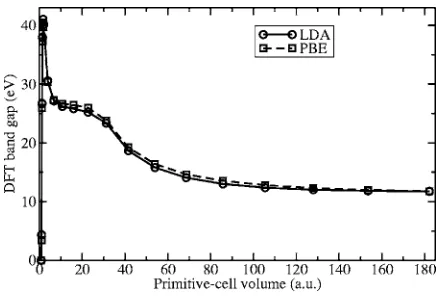
[image:4.612.327.550.54.203.2]The band gap of solid neon, calculated using DFT, is shown in Fig. 6. The band gap is large at the equilibrium volume, and increases significantly when the material is compressed. The DFT calculations predict that neon is still an insulator when it is compressed to a primitive-cell volume FIG. 5. DMC energy of solid neon plotted against time step for
a simulation supercell consisting of 3⫻3⫻3 FCC primitive unit cells. The primitive-cell volume is 85.75 a.u. 960 configurations were used in the DMC simulations.
[image:4.612.51.297.57.205.2]of 2 a.u., corresponding to a pressure of about 366 TPa. The use of the ultrasoft neon pseudopotential共with a core radius of 0.9 a.u.兲probably causes the DFT results to become un-reliable at such high densities; nevertheless, our results indi-cate that the metalization pressure of neon is of the order of hundreds of TPa. Hemley et al.33 concluded that neon
re-mains a wide-gap insulator over the range of pressures that they studied using diamond-anvil cells 共up to 110.4 GPa兲, while Hawkeet al.34 used a magnetic-flux compression
de-vice to show that solid neon remains an insulator up to at least 500 GPa.
The DFT-LDA and DFT-PBE band gaps at the experimen-tal equilibrium primitive-cell volume 共150 a.u.兲 are 11.85 and 12.04 eV, respectively, compared with the experimen-tally determined value of 21.51 eV.35As usual, DFT substan-tially underestimates the band gap. The GW band gap of 20.04 eV, calculated by Galamić-Mulaomerovićand Patter-son, is relatively accurate.36 The DMC method can also be
used to perform highly accurate band-gap calculations,37,38
although we have not done this for neon.
IV. DMC-CALCULATED PAIR POTENTIAL FOR NEON
The difference between the DMC pair potential, evaluated as the fixed-nucleus total energy of a neon dimer, and the HFD-B potential is shown in Fig. 7. The DMC energy data have been offset by a constant that was determined by fitting the data to a pair-potential model.39We have used the form
of potential proposed by Koronaet al. for helium,31 which
can be written as
共r兲=Aexp共−␣r+r2兲+
兺
n=3 8
f2n共r,b兲
C2n
r2n, 共7兲
wherer is the separation of the neon atoms. The dispersion coefficientsC2n are taken from Cybulski and Toczyłowski3 共C6= 6.281 74, C8= 90.0503, C10= 1679.45, C12= 4.189 67
⫻104, C
14= 1.362 98⫻106, and C16= 5.629 06⫻107兲 and
f2n共r,b兲 is the damping function proposed by Tang and
Toennies,40
f2n共r,b兲= 1 − exp共−br兲
兺
k=0 2n
共br兲k
k! . 共8兲
A,␣,, andb are adjustable parameters, which were deter-mined by a 2 fit to the DMC data, as was the constant
offset. The fitted parameter values 共in a.u.兲 are A
= 84.956 788, ␣= 2.068 326 6, = −0.117 676 73, and b
= 2.689 986 8. The difference of the resulting pair potential with the HFD-B potential is shown in Fig. 7, as is the corre-sponding curve for the CCSD共T兲 data. It can be seen that over a wide range of separations the DMC pair potential lies closer to the HFD-B pair potential than the CCSD共T兲 -generated pair potential.
V. LATTICE DYNAMICS AND ZERO-POINT ENERGY
By comparing the results obtained using a Lennard-Jones potential in the harmonic approximation with the VMC41
re-sults obtained using the same potential by Hansen,42Pollock
et al.43 have demonstrated that the harmonic approximation
is valid for solid neon at high pressures. We consider two methods for calculating the ZPE: 共i兲 the ZPE of quasihar-monic phonons can be evaluated in a supercell of several primitive cells, or共ii兲 the ZPE can be computed within the Einstein approximation by evaluating the quadratic potential felt by each atom as it is displaced from its equilibrium po-sition with all the other atoms held fixed.
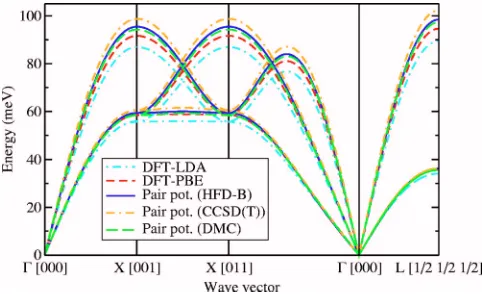
Examples of phonon dispersion curves at two different densities are shown in Figs. 8 and 9. Inelastic neutron-scattering data44are also shown in Fig. 9. At high density the
[image:5.612.316.557.56.203.2]DFT-LDA and DFT-PBE dispersion curves are in good agreement, but at low density the DFT-LDA phonon frequen-cies are significantly lower than the DFT-PBE frequenfrequen-cies. FIG. 7. 共Color online兲 Neon pair potential, calculated using
DMC. The statistical error bars on the DMC results are smaller than the symbols. A fit of the form of pair potential proposed by Korona et al. 共Ref. 31兲 to the DMC data is also shown, as is the pair potential generated by Cybulski and Toczyłowski using CCSD共T兲 theory共Ref. 3兲. All are plotted relative to the HFD-B pair potential of Aziz and Slaman共Ref. 29兲.
[image:5.612.52.295.57.210.2]Unstable 共imaginary兲 phonon modes start to occur at a primitive-cell volume of about 133 a.u. in the LDA. By con-trast, there are no unstable phonon modes, even at a primitive-cell volume of 182.25 a.u., when the PBE func-tional is used. The DFT and pair-potential results are in agreement at high densities, indicating that the DFT results are accurate in this regime. Overall, the DFT-PBE dispersion curves appear to be more accurate 共that is, closer to the HFD-B and experimental results兲than the DFT-LDA disper-sion curves.
The pressure arising from the ZPE of solid neon as cal-culated using different methods is plotted relative to the HFD-B results in Fig. 10. Within DFT, the Einstein approxi-mation is excellent. It can be seen that the difference be-tween the LDA and PBE results is appreciable at low
densi-ties, but that the difference between the Einstein and quasiharmonic zero-point pressures is more significant at high densities. As expected from an examination of the dis-persion curves, the HFD-B zero-point pressure is closer to the DFT-PBE results than the DFT-LDA ones; nevertheless, all the zero-point-pressure results are in good agreement.
The DFT quasiharmonic zero-point pressures have been added to the corresponding static-lattice pressures to give the final EOS’s. The DFT-PBE quasiharmonic zero-point pres-sure has been added to the DMC static-lattice prespres-sure to give the final DMC EOS. For the pair potentials, the quasi-harmonic zero-point pressure calculated using each pair po-tential has been added to the corresponding static-lattice pressure in order to obtain the final EOS.
VI. ZERO-TEMPERATURE EOS OF NEON
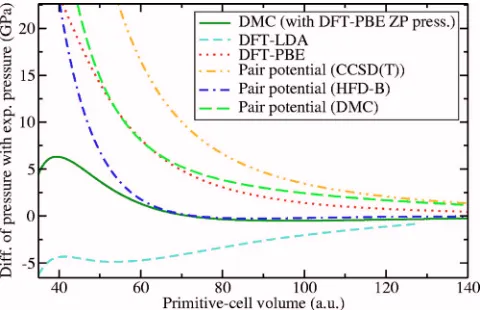
[image:6.612.328.548.56.198.2]Zero-temperature EOS’s for solid neon, calculated using DFT-LDA, DFT-PBE, DMC关extrapolated to infinite system size using Eq.共3兲兴, and pair potentials are shown in Fig. 11, and the differences of the theoretical EOS’s with the experi-mental EOS are plotted in Fig. 12.共The low-density experi-mental pressure-volume data of Andersonet al.45 shown in
Fig. 11 were obtained at 4.2 K, while the high-density ex-FIG. 9.共Color online兲The same as Fig. 8, but with a
[image:6.612.55.293.57.204.2]primitive-cell volume of 149.068 94 a.u.共close to the experimental equilib-rium density兲. Experimental data from Ref. 44 are also shown. The imaginary frequencies of unstable modes are plotted as negative numbers. The Einstein frequencies evaluated using DFT-PBE, the HFD-B pair potential, the CCSD共T兲 pair potential, and the DMC pair potential are 5.378 53 meV, 4.078 95 meV, 6.739 75 meV, and 6.061 13 meV, respectively. The quasiharmonic ZPE evaluated us-ing the HFD-B potential is 0.000 216 603 a.u.
FIG. 10. 共Color online兲 Difference of zero-point pressure of FCC neon calculated using various methods and the HFD-B result for the zero-point pressure.共The noise is due to the fact that Monte Carlo methods were used to sample the first Brillouin zone when calculating the zero-point energy, and the resulting curve was dif-ferentiated numerically to obtain the zero-point pressure.兲
FIG. 11.共Color online兲EOS of FCC neon, obtained by experi-ment and various theoretical techniques.
[image:6.612.53.294.508.662.2] [image:6.612.317.557.538.693.2]perimental data of Hemleyet al.33 were obtained at 300 K.
Hemleyet al.reduced their pressure-volume data to the zero-temperature isotherm using a Mie-Grüneisen model and fit-ted their results to a third-order Birch-Murnaghan EOS, with the zero-pressure primitive-cell volume and bulk modulus being the values obtained by Anderson et al.The resulting EOS46is valid at both low and high densities and is regarded
as being the definitive experimental EOS.兲 The parameter values for a Vinet fit共Eq. 共5兲兲to our DMC data 共including the DFT-PBE ZPE兲 are V0= 128.525 97 a.u., B0
= 2.753 931 9 GPa, andB0
⬘
= 7.651 074 4.At low densities the DFT-LDA and DFT-PBE EOS’s dif-fer markedly. The strong dependence of the DFT results on the choice of exchange-correlation functional implies that the description of van der Waals bonding within DFT is unreli-able, as one would expect, given the local nature of the ap-proximations to the exchange-correlation functional. DMC produces a considerably more accurate EOS than DFT, sug-gesting that DMC is capable of giving a proper description of van der Waals bonding. The HFD-B pair potential29gives
an EOS of similar accuracy to the DMC EOS at low to intermediate densities. At higher densities, the EOS calcu-lated using DMC is better than any of the pair-potential EOS’s. Although the difference between the DMC and ex-perimental pressures is significant at high densities, it should be emphasized that the fractional error remains small.
The pair potential calculated using CCSD共T兲 theory3
gives a poorer EOS than the DMC-generated pair potential. On the other hand, the EOS obtained using the DMC pair potential is significantly poorer than the HFD-B EOS. Taken together with the fact that the direct DMC EOS is excellent, this suggests that many-body interactions play a significant role in solid neon, and that such interactions are included to some extent in the HFD-B potential.
VII. CONCLUSIONS
We have performed DMC calculations of the energy of FCC solid neon as a function of the lattice constant and the energy of the neon dimer as a function of atomic separation. Other calculations using DFT methods and pair potentials have been performed to evaluate the ZPE and for comparison purposes.
We have calculated the phonon dispersion curves of solid neon using the DFT-LDA and DFT-PBE methods, the
HFD-B pair potential, and CCSD共T兲- and DMC-derived pair potentials. We believe the results obtained with the HFD-B pair potential are likely to be the most accurate. DFT-PBE gives more accurate dispersion curves than DFT-LDA, for which the phonon frequencies are too low. The dispersion curves obtained with the DMC pair potential are more accu-rate than those obtained using either DFT or the CCSD共T兲 pair potential. We have calculated the ZPE of solid neon using the DFT-LDA and DFT-PBE methods, and the HFD-B, CCSD共T兲, and DMC pair potentials, within the quasihar-monic approximation. At low pressures, the ZPE depends on the calculation method used, but the contribution to the EOS is small, while at high pressures the dependence on the cal-culation method is relatively weak, although the contribution of the ZPE to the EOS is significant. The Einstein model gives ZPE’s in very good agreement with the quasiharmonic values over the pressure range considered.
We have calculated the zero-temperature EOS of solid neon using the DFT and DMC methods, including correc-tions for the ZPE. We have shown that the DFT results de-pend strongly on the choice of exchange-correlation func-tional, while the DMC results are close to the experimental EOS. We therefore have evidence that DMC gives a better description of van der Waals bonding in real materials than DFT. At high pressures the DMC EOS is closer to the ex-perimental results than the EOS obtained using the HFD-B pair potential. However, the statistical errors of about 0.0002 a.u. in the DMC energy data for solid neon are too large to determine an accurate value for the lattice constant of the solid. We have shown that the neon pair potential determined by DMC calculations gives a more accurate EOS than the pair potential determined by CCSD共T兲calculations, although the DMC pair-potential results are not as accurate as those obtained using the semiempirical HFD-B potential. Overall, our results demonstrate the accuracy and reliability of the DMC method and the high quality of the neon pseudo-potentials that we have used.
ACKNOWLEDGMENTS
Financial support has been provided by the Engineering and Physical Sciences Research Council 共EPSRC兲, UK. Computing resources have been provided by the Cambridge-Cranfield High Performance Computing Facility. We thank J. R. Trail for providing the relativistic Hartree-Fock pseudo-potential used in this work.
1E. Gregoryanz, R. J. Hemley, H.-K. Mao, and P. Gillet, Phys.
Rev. Lett. 84, 3117共2000兲; J. Li, H.-K. Mao, Y. Fei, E. Grego-ryanz, M. Eremets, and C. S. Zha, Phys. Chem. Miner. 29, 166 共2002兲; S. D. Jacobsen, H. Spetzler, H. J. Reichmann, and J. R. Smyth, Proc. Natl. Acad. Sci. U.S.A. 101, 5867 共2004兲; J.-F. Lin, V. V. Struzhkin, S. D. Jacobsen, M. Y. Hu, P. Chow, J. Kung, H. Liu, H.-K. Mao, and R. J. Hemley, Nature 436, 377 共2005兲.
2Rare Gas Solids, edited by M. L. Klein and J. A. Venables共
Aca-demic, New York, 1977兲.
3S. M. Cybulski and R. R. Toczyłowski, J. Chem. Phys. 111,
10520共1999兲.
4M. D. Segall, P. J. D. Lindan, M. J. Probert, C. J. Pickard, P. J.
Hasnip, S. J. Clark, and M. C. Payne, J. Phys.: Condens. Matter 14, 2717共2002兲.
5J. P. Perdew, K. Burke, and M. Ernzerhof, Phys. Rev. Lett. 77,
3865共1996兲.
3467共1991兲.
16R. J. Needs, M. D. Towler, N. D. Drummond, and P. Lopez Rios,
CASINO Version 2.0 User Manual 共University of Cambridge, Cambridge, 2005兲.
17C. J. Umrigar, K. G. Wilson, and J. W. Wilkins, Phys. Rev. Lett.
60, 1719共1988兲.
18N. D. Drummond and R. J. Needs, Phys. Rev. B 72, 085124
共2005兲.
19D. Alfè and M. J. Gillan, Phys. Rev. B 70, 161101共R兲 共2004兲. 20A. J. Williamson, R. Q. Hood, and J. C. Grossman, Phys. Rev.
Lett. 87, 246406共2001兲.
21N. D. Drummond, M. D. Towler, and R. J. Needs, Phys. Rev. B
70, 235119共2004兲.
22P. P. Ewald, Ann. Phys. 64, 253共1921兲. 23D. Ceperley, Phys. Rev. B 18, 3126共1978兲.
24P. R. C. Kent, R. Q. Hood, A. J. Williamson, R. J. Needs, W. M.
C. Foulkes, and G. Rajagopal, Phys. Rev. B 59, 1917共1999兲.
25F. H. Zong, C. Lin, and D. M. Ceperley, Phys. Rev. E 66, 036703
共2002兲.
26D. M. Ceperley and B. J. Alder, Phys. Rev. B 36, 2092共1987兲. 27G. Rajagopal, R. J. Needs, A. James, S. D. Kenny, and W. M. C.
Foulkes, Phys. Rev. B 51, 10591共1995兲.
28R. A. Aziz and H. H. Chen, J. Chem. Phys. 67, 5719共1977兲. 29R. A. Aziz and M. J. Slaman, Chem. Phys. 130, 187共1989兲. 30The short-range modifications to the HFD-B potential proposed
by Aziz and Slaman are irrelevant in this work, because the
195103共2005兲.
37A. J. Williamson, R. Q. Hood, R. J. Needs, and G. Rajagopal,
Phys. Rev. B 57, 12140共1998兲.
38M. D. Towler, R. Q. Hood, and R. J. Needs, Phys. Rev. B 62,
2330共2000兲.
39We have determined the constant offset to the energy data during
the fitting procedure instead of subtracting the energy of two isolated neon atoms in order to improve the accuracy of the fit. The node error in a neon dimer is larger than the fixed-node error in an isolated neon atom. Therefore a direct evalua-tion of the absolute value of the pair potential is a共slight兲 sys-tematic overestimate.
40K. T. Tang and J. P. Toennies, J. Chem. Phys. 80, 3726共1984兲. 41While Hansen 共Ref. 42兲used the VMC method to calculate the
ground-state of theatoms, interacting with Lennard-Jones poten-tials, we use the VMC method to calculate the ground state of theelectronswithin the Born-Oppenheimer approximation.
42J.-P. Hansen, Phys. Rev. 172, 919共1968兲.
43E. L. Pollock, T. A. Bruce, G. V. Chester, and J. A. Krumhansl,
Phys. Rev. B 5, 4180共1972兲.
44J. Skalyo Jr., V. J. Minkiewicz, G. Shirane, and W. B. Daniels,
Phys. Rev. B 6, 4766共1972兲.
45M. S. Anderson, R. Q. Fugate, and C. A. Swenson, J. Low Temp.
Phys. 10, 345共1973兲.
46The experimental EOS, taken from Ref. 33, is given by Eq.共6兲