
IMPLEMENTATION OF STRONGER AES BY USING
DYNAMIC S-BOX DEPENDENT OF MASTER KEY
1
SLIMAN ARRAG, 2ABDELLATIF HAMDOUN, 3ABDERRAHIM TRAGHA, AND 4SALAH EDDINE KHAMLICH
1,2 and 4
Laboratory of treatment of information Universite Hassan II Mohammedia, Casablanca, Morocco 3
Laboratory of Information Technology and Modeling, Universite Hassan II Mohammedia, Casablanca,
Morocco
E-mail: [email protected], [email protected],[email protected],
4
ABSTRACT
In this paper we propose and we show a new approach of nonlinear transformation algorithm for AES SBox to enhance the complexity of the SBox structure,we making AES stronger by using Dynamic Sbox,with look up table Sbox and Key expansion as modified when we change the initial key, that effectively providing a high resistance against differential cryptanalysis and especially the linear cryptanalysis. The structure of the AES S-box has been expanded and modified to be accordance with the proposed algorithm and to obtain good nonlinearity of the Sbox. This has been done without changing the basic operations of AES.The proposed modifications of the Advanced Encryption and a modified Sbox are implemented in Cyclone II Dvice by using VHDL language.
Keywords: AES, Dynamic S-box, Master key, FPGA, Vhdl.
1. INTRODUCTION
The evolution of information technology and in particular the increase in the speed of processing devices has necessitated the need to reconsider the cryptographic algorithms used. The National Institute of Standards and Technology of the United States (NIST) in cooperation with industry and cryptographic communities [1] have worked together to create a new cryptographic standard. The primary objective was a federal standard (Federal Information Processing Standard FIPS) to establish that specifies a cryptographic algorithm with the ability to improved protect sensitive information from the government. It was expected that the algorithm can be used both in the governmental structures of the United States and in the analysis of companies and private full sectors.After (mathematics, cryptography, statistics, engineering, etc.) of the algorithms, NIST [8] announced that the new standard uses the Rijndael algorithm and since 2001, it is the foundation of the new encryption standard AES.
In this paper we presente the design and hardware implementation of the AES (Advanced Encryption Security) in Cyclonne II, as using Xilinx
ISE synthesis tool and Qaurtus II v9 for great simulated and synthesized. The architectural design has been described code in VHDL language. The AES has for the moment not been broken but the cryptanalysis of Rijndael (AES) has not stopped, for that we used a new approach allows us to obtain competitive performance. This approach will be studied its effect on the AES focusing on the S-Boxes wich look up table Sbox and Key expansion as modified when we change the initial key. Literatures [4], [10], [11], [12], [13], [18], [20], [21], [22], [25] describe design and implementation of AES and AES modified treatment in the FPGA.
2. AES RIJNDAEL ALGORITHM
special rules according GF (28) (or Galois field finite field). Linear transformation ensures better diffusion (spread of bits in the structure) over several turns.Finally, an XOR between the matrix and other matrix allows to obtain an intermediate matrix. These operations are repeated several times and define a "turn." For a 128, 192 or 256, AES requires respectively 10, 12 or 14 rounds.
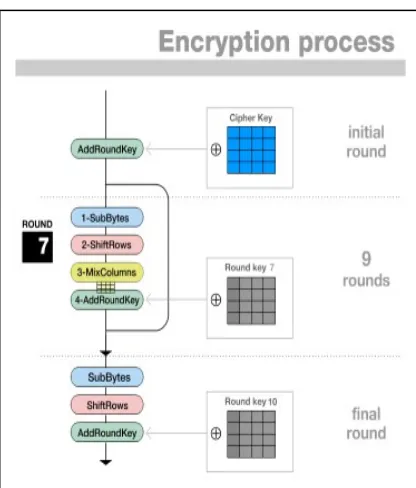
The following diagram describes briefly the progress of encryption Fig 1:
Figure. 1: Structure Of The AES Algorithm.
Three main criteria have been met in its design: -Resistance against all known attacks. -Speed code on the widest variety of platforms possible.
-Simplicity in design.
Rijndael (1998) was strongly influenced by his predecessor, Square algorithm (1997).Crypton and Twofish algorithms also use transactions Square. Rijndael is pronounced "Raindal".
•BYTE_SUB (Byte Substitution) is a nonlinear
[image:2.612.297.577.110.344.2]function operating independently on each block from a table called substitution.
[image:2.612.82.290.224.468.2]Figure 2: Structure Of The Subbyte
Table 1: Look Up Table Of S-BOX.
•SHIFT_ROW is a function operating lags
(typically it takes into 4 pieces of 4 bytes and operates left shifts of 0, 1, 2 and 3 bytes for the tracks 1, 2, 3 and 4 respectively).
Figure 3: Structure Of The Shiftrows
•MIX_COL is a function which converts each
input byte into a linear combination of input bytes and can be mathematically expressed by a product
[image:2.612.315.550.415.490.2]marticiel on the Galois field (28) [15].
Figure 4: Structure Of The Mixcolumn
63 7c 77 7b f2 6b 6f c5 30 01 67 2b fe d7 ab 76
ca 82 c9 7d fa 59 47 f0 ad d4 a2 af 9c a4 72 c0
b7 fd 93 26 36 3f f7 cc 34 a5 e5 f1 71 d8 31 15
04 c7 23 c3 18 96 05 9a 07 12 80 e2 eb 27 b2 75
09 83 2c 1a 1b 6e 5a a0 52 3b d6 b3 29 e3 2f 84
53 d1 00 ed 20 fc b1 5b 6a cb be 39 4a 4c 58 cf
d0 ef aa fb 43 4d 33 85 45 f9 02 7f 50 3c 9f a8
51 a3 40 8f 92 9d 38 f5 bc b6 da 21 10 ff f3 d2
cd 0c 13 ec 5f 97 44 17 c4 a7 7e 3d 64 5d 19 73
60 81 4f dc 22 2a 90 88 46 ee b8 14 de 5e 0b db
e0 32 3a 0a 49 06 24 5c c2 d3 ac 62 91 95 e4 79
e7 c8 37 6d 8d d5 4e a9 6c 56 f4 ea 65 7a ae 08
ba 78 25 2e 1c a6 b4 c6 e8 dd 74 1f 4b bd 8b 8a
70 3e b5 66 48 03 f6 0e 61 35 57 b9 86 c1 1d 9e
e1 f8 98 11 69 d9 8e 94 9b 1e 87 e9 ce 55 28 df
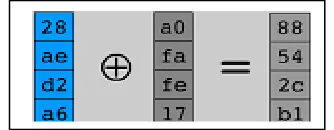
[image:2.612.318.561.584.699.2]•The Add RoundKey operation is a simple bit by bit XOR operation between the data and the roundkey (by using initial key or Key expansion).
The circled ⊕ means exclusive OR operation
(XOR).
Ki is the ith subkey calculated by an algorithm from
the master key K.
•Key Expansion operation: The algorithm for
[image:3.612.326.493.119.184.2]generating the 10 turns of the round key is as follows: The fourth column of the i-1 key is rotated such that each element is moved one row.
Figure 5:Rotated The Last Row
It then places the result by way of an algorithm forwards Sub-Box that replaces all eight bits of the
[image:3.612.318.527.242.319.2]matrix with a corresponding 8-bit value of S-Box. (See figure 7 below for SubByte inverse).
Figure 6:Subbyte The Row By Using Sbox Look Up Table
[image:3.612.117.249.248.313.2]To generate the first column of the i-th key, this result is XOR-ed with the first column of the first i-key and a constant (row constant or Rcon) which depends on i.
Figure 7:Look Up Table Of The Rcon
Figure 8:Operation Xor Between First Row Of Key And Last Row After The Modefication And First Row Of Rcon
The second column is generated by XOR-ing the
first column of the i-th key in the second column of the first key-i.
Figure 9:XOR-Ing Between Modified Row And Second Row Of Master Key
This iteration continues for the other two columns to generate the key to ith.
Figure 10: Example Key Extension
In addition, this process continues iteratively to generate all 10 keys As a final note, all these keys are stored in a static manner once they have been calculated first as th key generated is necessary for the tower (10-i) th decryption.
•Decryption is the process of applying the reverse
operations in the reverse order and with subkeys also in reverse order.
2.1 Attacks
The AES has for the moment not been broken and the exhaustive search ("brute force") is the only solution. Rijndael was designed so as to make conventional methods such as linear and differential analysis very difficult[17], [19].
3. DEFINING THE PROBLEM
One of the main functions used in AES is the "Substitution of bytes (SubBytes)". This function performs a non-linear substitution, which is performed independently on each input byte. The matrix which gives the relationship between the input and output bytes, called (S-BOX) in the AES algorithm is invertible.
Each matrix must meet the following criteria:
balance, non-linearity, completeness, strict
avalanche criterion, low Table XOR ,order
diffusion, Invertability, the static criteria
[image:3.612.150.231.385.448.2] [image:3.612.85.298.518.672.2]output data), the dynamic criteria (Dynamic independence between the data input and output, the independence between dynamic the input and output of data, dynamic independence between the output and output data), specific criteria (Entire S-BOX and non-contradiction). These criteria are defined and described in detail in [9], [14], [23]. Requirements defined so that each S-BOX must meet are determined by the need to be stable algorithm for linear cryptanalysis and differential at a time.
Therefore, to meet the requirements set forth above, new substitution matrices must be found, which should be applied in the algorithm parameters or function key values and at the same time, these S-boxes must have characteristics same or higher than those used in the AES standard.
4. PROPOSITION FOR GENERATING NEW S-BOX DEPENDING OF MASTER KEY
Having the substitution matrix used in AES core as a basis, it is necessary to identify other
same matrices with the same or better
characteristic. The principal SBOX (showing in figure ), used in the cryptographic operation is regarded as a base..
Based on the S-BOX suggested in AES (SBOX AES) and depending on key used to encrypt the new plaintext substitution matrices are compted (SBOXxor) by the following process:
•First of all select one byte from master key
(initial key) Key[i];
•Computting new SBOXxor, where each cell is
equal to XOR with selected byte,
SBOXxor[x,y]=SBOXAES[x,y] ⊕ Key[i];
•A substitution matrix newly calculated is used
for plaintext encryption.
Decryption process will the following approach is used:
•Selecte same byte from key - Key[i];
•Computing new SBOXxor, where each cell is
equal to XOR with selecte byte,
SBOXxor[x,y]=SBOXAES[x,y] ⊕ Key[i];
•Computing inverse matrices by using
SBOXxor, SBOXxor INV=INV (SBOXxor) (structure of the SBOXxor inv showing in the figure);
•A recalculation inverse S-BOX is used to decrypt
the plaintext.
By using the above described method 256 substitution matrices have been obtained. One of
them SBOXAES ⊕ 0hex is equal to original SBOX
suggered in AES core. Some of them are depicted in Table 1 and Table 2 , respectively, SBOX computed by XOR with byte equal to 24hex and 6F hex.
Table 2: SBOX24 (S-BOX ⊕ 24hex).
Table 3: SBOX6F (SBOX ⊕ 6Fhex).
47 58 53 5F D6 4F 4B E1 14 25 43 0F DA F3 8F 52
EE A6 ED 59 DE 7D 63 D4 89 F0 86 8B B8 80 56 E4
93 D9 B7 02 12 1B D3 E8 10 81 C1 D5 55 FC 15 31
20 E3 07 E7 3C B2 21 BE 23 36 A4 C6 CF 03 96 51
2D A7 08 3E 3F 4A 7E 84 76 1F F2 97 0D C7 0B A0
77 F5 24 C9 04 D8 95 7F 4E EF 9A 1D 6E 68 7C EB
F4 CB 8E DF 67 69 17 A1 61 DD 26 5B 74 18 BB 8C
75 87 64 AB B6 B9 1C D1 98 92 FE 05 34 DB D7 F6
E9 28 37 C8 7B B3 60 33 E0 83 5A 19 40 79 3D 57
44 A5 6B F8 06 0E B4 AC 62 CA 9C 30 FA 7A 2F FF
C4 16 1E 2E 6D 22 00 78 E6 F7 88 46 B5 B1 C0 5D
C3 EC 13 49 A9 F1 6A 8D 48 72 D0 CE 41 5E 8A 2C
9E 5C 01 0A 38 82 90 E2 CC F9 50 3B 6F 99 AF AE
54 1A 91 42 6C 27 D2 2A 45 11 73 9D A2 E5 39 BA
C5 DC BC 35 4D FD AA B0 BF 3A A3 CD EA 71 0C FB
A8 85 AD 29 9B C2 66 4C 65 BD 09 2B 94 70 9F 32
0C 13 18 14 9D 04 00 AA 5F 6E 08 44 91 B8 C4 19
A5 ED A6 12 95 36 28 9F C2 BB CD C0 F3 CB 1D AF
D8 92 FC 49 59 50 98 A3 5B CA 8A 9E 1E B7 5E 7A
6B A8 4C AC 77 F9 6A F5 68 7D EF 8D 84 48 DD 1A
66 EC 43 75 74 01 35 CF 3D 54 B9 DC 46 8C 40 EB
3C BE 6F 82 4F 93 DE 34 05 A4 D1 56 25 23 37 A0
BF 80 C5 94 2C 22 5C EA 2A 96 6D 10 3F 53 F0 C7
3E CC 2F E0 FD F2 57 9A D3 D9 B5 4E 7F 90 9C BD
A2 63 7C 83 30 F8 2B 78 AB C8 11 52 0B 32 76 1C
0F EE 20 B3 4D 45 FF E7 29 81 D7 7B B1 31 64 B4
8F 5D 55 65 26 69 4B 33 AD BC C3 0D FE FA 8B 16
88 A7 58 02 E2 BA 21 C6 03 39 9B 85 0A 15 C1 67
D5 17 4A 41 73 C9 DB A9 87 B2 1B 70 24 D2 E4 E5
1F 51 DA 09 27 6C 99 61 0E 5A 38 D6 E9 AE 72 F1
8E 97 F7 7E 06 B6 E1 FB F4 71 E8 86 A1 3A 47 B0
Note: in the table 1 we considered 24 hex first one
byte on master key, and same idea for 6F hex .
4.1 New algorithm using the SBOX depending on the AES key
[image:5.612.102.286.248.398.2]Now, with Sbox dependent initial key, AES will be much stronger. [24] We now present how the property above of Sbox can be used to master the function key by using one of the two cases (we can also use other cases) depending on the level of the security requirement. In case the demand moderate level of security Case 1 can be used. For more high security requirements case 2 may be adopted.
Figure 11:Our Suggestion For Dynamic Sbox Depending Of Initial Key
Case 1:
Here the various round keys are produceded using a expansion key algorithm which is similar to that in AES core key extension algorithm. The round keys thus produceded will used for find a value that is used to change the static Sbox.
The similar round keys are used for Add RoundKey step as well. Supposed for a particular round j, if the round key value is :
X"6172726167736C696D616E5F6D697469", eqyivalent “arragsliman_miti” in code ascii.
The first byte 61(Hex) is used to XOR-ing the Sbox (change the sbox by using XOR operation between each byte of fixe Sbox(showing in Table 1) and the first byte of the master key). The resulting SBOXxor [eache byte,61 hex] is used during the Subbyte operation.
Case 2:
Here different round keys are generated using a key expansion algorithm which is similar to that of AES key expansion algorithm. The round keys thus
generated will used for finding a value that is used to rotate the S-box.
The same round keys are used for AddRoundKey stage as well. Suppose for a particular round j, if the round key value is :
X"6172726167736C696D616E5F6D697469".
Here XOR operation of all the bytes is taken.
35(Hex)=61⊕72⊕72⊕61⊕67⊕73⊕6C⊕69⊕6D⊕6
1⊕6E⊕5F⊕6D⊕69⊕74⊕69.
The resulting byte value 35(Hex) is used to XOR-ing the Sbox (change the sbox by usXOR-ing XOR operation between each byte of fixe Sbox(showing in Table 1) and the 35 (hex) ). The resulting Sbox is used during the Sub Bytes operation.
On the basis of the surveyed substitution matrices and depending on the particular value of the encryption key used in Advanced encryption standard the following algorithm is offered:
Encryption:
•Chose a key initial for AES;
•The first byte of the Key master is selected
Key[1];
•Computing new SBOXkey[1] =
SBOXAES⊕Key[1] (showing in figure 11);
•Continue according to the algorithm set out in
AES by using new calculated S-BOXkey[1].
Decryption:
•Chose a key initial for AES;
•The first byte of the Key is selected Key[1];
•Computing new SBOXkey[1] =
SBOXAES⊕Key[1];
•Computing inverse SBOXkey[1]INV=INV
(SBOXkey[1])=INV (SBOXAES⊕Key[1]);
•Continue as described in the AES algorithm with
set out in AES by using new computed SBOXkey[1]INV.
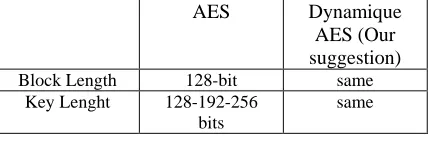
Table 4 : Comparaison Between AES Core And Our Suggestion.
AES Dynamique
AES (Our suggestion) Block Length 128-bit same
Key Lenght 128-192-256 bits
[image:5.612.310.524.669.741.2]Number of Rounds
For key length 128-bit. 10 Rounds
same
Rounf Function
Composed of 4 transformations, namely: -ByteSub using SBOX -Shift Row -Mix Column -AddRoundKey.
For last round Mix Column is
eliminated
Composed of 4 transformations, namely: -ByteSub using SBOXxor key -Shift Row -Mix Column -AddRoundKey.
For last round Mix Column is
eliminated SBOX Fixed initial Key
Dependent Key Expansion Use the master
key and static SBOX
Use the master key and Dynamic SBOXxor key
5. IMPLEMENTATION OF MODIFIED PIPELINED AES IN FPGA
[image:6.612.82.549.75.429.2]Implementation uses the VHDL programming language that nowadays is commonly a language used very established for FPGA [16]. The drawing & the software of the simulation is Quartus II v9.1.
Figure 12: Cryptage AES 128 Pipeline
Figure 13: Decryptage AES 128 Pipeline
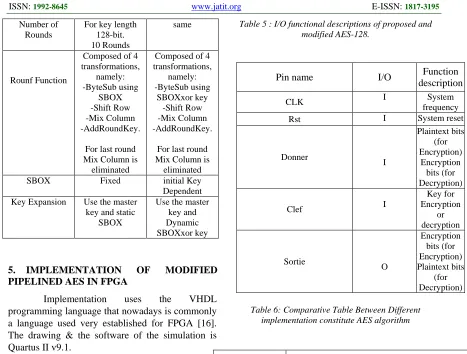
Table 5 : I/O functional descriptions of proposed and modified AES-128.
Table 6: Comparative Table Between Different implementation constitute AES algorithm
Note: in this different implementation we use two optimization:
•Architectural optimization by using pipelined
architecture of AES-128 [12], [13].
•Algoritmic optimization by using modified
structure of mixcolumn block (Properties of the binary calculation) [26], [27].
Depending on comparative table we can notice that the first architectural of the Crypt_aes_pip implementation in. occupied more than (13552 units) of the unit when the second Decry_aes_pip require implementing approximately in. (15827 units) in total capacity of the device, on the other
Pin name I/O Function
description
CLK I System
frequency Rst I System reset
Donner I Plaintext bits (for Encryption) Encryption bits (for Decryption)
Clef I
Key for Encryption or decryption Sortie O Encryption bits (for Encryption) Plaintext bits (for Decryption)
Implementation FPGA Device
Total pins Total logic elements Peak virtual memory Megabyte Total registers Total memory bits
Crypt_aes_pip 386 13552 232 2432 327680 Decry_aes_pip 386 15827 242 2432 327680 Crypt_aes_pip_
SBOXxor key[i]
386 57366 496 3840 0
Decrypt_aes_pip_ SBOXxor key[i]
386 19471 379 2560 327680
[image:6.612.293.572.425.567.2] [image:6.612.88.275.579.701.2]the third architecture, Crypt_aes_pip_SBOXxor key[i], need (57366 tranches) of the device, and last implementation,Decrypt_aes_pip_SBOXxor key[i], occupied (19471 logic elements).
The first conclusion here ,the advantage in our new implementation is the SBOX and key expansion is now dependent on entire initial key ( first byte of master key( case 1) or Xor-ing between each byte of initial key (case 2)).
But the disadvantage is that it consumes little extra time and more logic elements.
Second Conclusion we find our new implemention
(crypt_aes_pip_SBOXxor key[i] &
Derypt_aes_pip_SBOXxor key[i]) is more
efficacious than architecture of the first and second implementation showing in table 5, the occupying number of resources of the device.
6. SIMULATION & INTERPRETATION
[image:7.612.304.552.189.285.2]The schemas descripted of the simulation the processes for the setting in implementation crypt_aes_pip_SBOXxor key[i] (AES-128 based to change the static sbox by using XOR operation between each byte of fixe Sbox (showing in Tble 1and the first byte of the master key (case1) or (case2) ) are presented below, in Figure (15). The overall length of the encryption process is (126 S), otherwise the simulation of decrypt_aes_pip_SBOXxor key[i] ( change the sbox by using XOR operation between each byte of fixe Sbox(showing in Table 1) and the first byte of the initial key (case1) or by using case2 when we Xor-ing each byte of masetr key), presented following, in figure (16).encryption is the time to ( 40 s) and some decoding (s).
Figure 14 :Compile The Circuit
Ciphering :( figure15 )
Plaintext: hamdoun_&_tragha
Key: arragsliman_miti
[image:7.612.307.553.440.531.2]cyphertext:,A![208]2[237]<W[160]Xl[218][225][1 9]|[30]
Figure 15:Simulation Of Crypt_Aes_Pip_Sboxxor Key[I]
Deciphering :( figure 16)
plaintext :,A![208]2[237]<W[160]Xl[218][225][19 ]|[30]
Key: arraglsiman_miti
Cyphertext: hamdoun_&_tragha
Figure 16:Simulation Of Decrypt_Aes_Pip_Sboxxor Key[I]
Note: during our implementation and simulation we used two different software,the first is altered UP Simulator and the second is Quartus II v9.1.
7. CONCLUSION
[image:7.612.88.298.532.689.2]each for encryption. It will not lead to a deterioration of the stability of the AES linear cryptanalysis and differential. An algorithm for the use of these matrices is proposed, as it is based on a preselected byte of the key used, and depending on the result in XOR operation, one of the S-BOX 256 is selected.
Second conclusion, we find the changes proposed (Sbox dependent of initial key) in our paper although consumes little extra time and more logic elements, but can be implemented without changing the block size keys ( 128, 192 or 256). Even if the original AES algorithm is very secure, These proposed changes in the treatment of the algorithm will encrypt the information by performing high diffusion and confusion. It also increases the complexity of the AES algorithm several times,so AES will be much stronger.
8. POSSIBLE FUTURE WORK
From our perspective is to do:
•Implementation and simulation the other optimize
structure and description based on that same principle of AES algorithm to encrypt and decrypt data such as images and sounds.
• Study of FPGA components and choosing the
most suitable architectures for the implementation of encryption algorithms.
•A combination between the AES algorithm and
genetic algorithm to increase the security.
•Implementation of the AES pipeline architecture
to optimize the encryption and decryption time and number of clock cycles.
•New instructions ensure a faster and more
affordable encryption of data, as well as better security.
REFRENCES:
[1] NIST, Advanced Encryption Standard (AES),
Springfield,VA, Nov. 2001
[2] Simon Singh : Histoire des codes secrets. De
l’Egypte des pharaons à l’ordinateur quantique. Paru chez J.-C. Lattès, Paris, 1999.
[3] Stallings W. “Cryptography and Network
Security: Principles and Practices.”4th ed. Pearson Education, Inc. pp. 63-173. 2006.
[4] Bhupathi Kakarlapudi and Nitin Alabur,” FPGA
Implementations of S-box vs. T-box iterative architectures of AES”.
[5] Olivier Frider ETR6 « Advanced Encryption
System », école d’ingénieurs du Canton de Vaud, Mai 2004.
[6] Ashwini M. D, Mangesh S. D and Devendra N.
K “,FPGA Implementation of AES Encryption and Decryption”, Proceeding of International Conference On Control, Automation, Communication And Energy Conservation -2009.
[7] Daemen J. and Rijmen V., “Rijndael: The
Advanced Encryption Standard”. Dr. Dobb’s Journal, March 2001.
[8] NIST, “DRAFT NIST Special Publication
800-131, Recommendation for the Transitioning of Cryptographic Algorithms and Key Sizes”, Federal Information Processing Standards Publication (FIPS PUB) 197, National Institute of Standards and Technology (NIST), January, 2010.
[9] Nikolai Stoianov, AES S-BOX generator:
analysis of requirements, International Science Conference 2009” Communication and information systems”, Shoumen, Bulgaria,2010.
[10]Qin H., Nonmember, SASAO T. and IGUCHI
Y.,Members ,“A Design of AES Encryption Circuit with 128 bit keys using Look-UP Table Ring on FPGA”,IEICE TRANS. INF. & SYST.,VOL.E89-D,NO.3 MARCH 2006.
[11]Rahman T., Pan S. and Zhang Q., “Design of a
High Throughput 128-bit (Rijndael Block Cipher)”, Proceeding of International Multiconferrence of Engineers and computer scientists 2010 Vol II IMECS 2010, March 17- 19,2010, Hongkong.
[12]Hodjat A. and Varbauwhede I.,“A 21.54 Gbits
Fully Pipelined AES Processor on FPGA”,
IEEE Symposim on Field-Programmable
Custom Computing Machines,April 2004.
[13]Jarvinen et al, “A fully pipelined memoryless
17.8 Gbps AES-128 encrypter”,International Symposium on Field Programmable Gate arrays,pp.207-215.2003.
[14]INDECT Consortium, D8.2: Evaluation of
Components, June, 2010, http://www.indect-project.eu/files/deliverables/public/deliverable 8.2.
[15]Rijndael mix column, available at:
http://en.wikipedia.org/wiki/Rijndael_mix_col umns
[16]Mroczkowski P., “Implementation of the block
cipher Rijndael using Altera FPGA”, May 2000.
[17]Eli Biham and Nathan Keller, Cryptanalysis of
Of The Third Advanced Encryption Standard Conference. NIST, April 2000.
[18] Zambreno J., Nguyen D. and Choudhary A.,
“Exploring Area/Delay Tradeoffs in an AES FPGA Implementation”,FPL 2004, LNCS 3203, pp. 575–585, 2004.
[19]T. Jacobsen and L. R. Knudsen, The
Interpolation Attack on Block Ciphers, Fast Software Encryption, LNCS 1267, E. Biham, Ed., Springer – Verlag, 1997, pp. 28 – 40.
[20]Kenny D., “Energy Efficiency Analysis and
Implementation of AES on an FPGA”, University of Waterloo,2008.
[21]X.Ji-peng ,Z.Xue-cheng, G.Xu, “Ultra-low
power S boxes architecture for AES”, The journal of China Universities of post and telecommunications.vol.15,issue1,March 2008.
[22] M.Priya Zach, K.Rahimunnisa and K.Suresh
Kumar, “Compact AES Architecture Using Efficient S-Box Implementation”, IEEE International Conference on Computational Intelligence and Computing Research, 1373-1376, 2011.
[23]Nikolai Stoianov, One Approach of Using
Key-Dependent S-BOXes in AES, MCSS 2011, CCIS 149, pp. 331–337, 2011. Springer-Verlag Berlin Heidelberg, 2011.
[24]William Stallings, Cryptography and Network
Security, Third Edition, Pearson Education, 2003.
[25]Edwin NC Mui,” Practical Implementation of
Rijndael S-Box Using Combinational Logic”.
[26]A. Sliman, H. Abdellatif, T.Abderrahim, K.
Salah eddine. “Implementation of The Encryption algorithm AES under VHDL language In FPGA, by using different architecture of mixcolumn”. Call of paper WOTIC'11 13-15 Octobre, ENSEM de Casablanca.
[27]A. Sliman, H. Abdellatif, T.Abderrahim, K.
Salah eddine, “Implementation of The
![Figure 15:Simulation Of Crypt_Aes_Pip_Sboxxor Key[I]](https://thumb-us.123doks.com/thumbv2/123dok_us/8914949.961283/7.612.88.298.532.689/figure-simulation-of-crypt-aes-pip-sboxxor-key.webp)
