Scholarly Research Journal for Interdisciplinary Studies, Online ISSN 2278-8808, SJIF 2016 = 6.17, www.srjis.com UGC Approved Sr. No.45269, SEPT-OCT 2017, VOL- 4/36
Copyright © 2017, Scholarly Research Journal for Interdisciplinary Studies GENDER MATTERS: STRESSING THE DIFFERENCE
Giselle Ann D’souza, Ph. D.
St. Teresa’s Institute of Education, Mumbai
The present era is characterized by technological modernization. But along with the blessings of a "push button" existence and the good fortune of instant gratification, comes the rather unwanted by-product, stress. Today, school performance has become the yardstick of self-worth. This has resulted in a whole generation of youth for whom stress has become a way of life. It is interesting to note that genders respond differently to stress. Adolescent girls today are struggling more than ever to live up to enormous, unprecedented expectations to excel. Trying desperately to shine academically, juggle hectic extracurricular activities, become popular, look great, and get into elite colleges, teenage girls feel compelled to hide their distress from their teachers and families and often become disconnected from their true selves in the process. The present descriptive research aimed to study gender differences in achievement stress, examination stress and social stress in students of standard X. The sample comprised of 1092 students. The study revealed a significant gender difference in all the three dimensions of stress. This research could have important implications in helping girls cope with stress effectively and thereby enhance their self-worth as well as their capabilities in terms of educational and career prospects.
Keywords: Achievement Stress (AS), Examination Stress (ES), Social Stress (SS).
INTRODUCTION
Stress is an inescapable part of modern life and is indeed woven into the fabric of life.
Matching stride with progress and subscribing to the new age mantra of "bigger is better",
people have begun to have bigger dreams and chase even bigger ambitions. Stress has come
to be their inevitable companion in this struggle for one-upmanship. Parents have started to
yoke their dreams and desires onto the tender shoulders of their children. Stress has emerged
as an ego threatening condition in all domains and more so in the academic domain. Each
year, stress continues to take its toll on the students of standard X and their parents too.
Students committing suicides are not uncommon. Psychiatrists say a rising number of
students suffer from traumatic disorders related to the fear of examinations (D‟souza, 2012).
The adolescent period is considered to be difficult and critical because of the numerous
qualitative shifts that take place. It is often referred to as “an age of crisis and transition”.
Indeed, adolescence has frequently been described with words like “re-organization,” “realignment,” “redefinition,” “disequillibration,” and “flux” (Hollenstein, 2007). Coping
Dr. Giselle Ann D’souza
(Pg. 8116-8121) 8117
Copyright © 2017, Scholarly Research Journal for Interdisciplinary Studies
to prevailing norms and practices, contradictory peer expectations, the newly felt desire to
free oneself from family restrictions, the lure of drugs, adjusting to cognitive changes, dealing
with moral dilemmas, planning for a future vocation and sexuality make the environment
increasingly complex and expose these youth to a wide array of stresses and challenges. This
period has been metaphorically identified as “starting the engines without a skilled driver”
(Steinberg, 2009).
The present educational system in India especially the examination procedures, aggravate the
stress problem in the students of Higher Secondary Schools. Public examinations in India
have played and continue to play a dominant role in determining the functional content and
method of instruction. The fear of failure sends panic waves through these students.
Research studies have suggested that that girls and boys experience distinctly different patterns
of stress during adolescence which may leave girls more vulnerable to depression. The present
research endeavoured to determine the gender differences in stress with respect to three
dimensions, namely, Achievement, Examination and Social Stress. Such an attempt would
serve to throw light on existing differences if any and provide adolescent girls and boys of
standard X with constructive suggestions on how best to deal with stress, set achievable
academic targets and realistic vocational aspirations, so that they can concentrate on doing
well at school and thus make their lives rewarding and productive.
OPERATIONAL DEFINITION OF THE TERMS
The following terms were defined to clarify their use in the context of this study:
1. ACHIEVEMENT STRESS: „Achievement Stress‟ is defined as the pressure
experienced by the students of standard X to perform in keeping with the unrealistic
expectations of significant others like parents, teachers and peers.
2. EXAMINATION STRESS: ‘Examination Stress’ indicates the tension, fear and anxiety
experienced by students of standard X arising from on-going, completed or upcoming
assignments, examinations and tests.
3. SOCIAL STRESS: ‘Social Stress’ refers to a student‟s sense of insecurity arising from
his/her relationships, being rejected by others or not being popular and cared for.
AIM OF THE STUDY
To study gender differences in achievement stress, examination stress and social stress in
Dr. Giselle Ann D’souza
(Pg. 8116-8121) 8118
Copyright © 2017, Scholarly Research Journal for Interdisciplinary Studies OBJECTIVES OF THE STUDY
The specific objective of the study was:
To ascertain gender differences in the following variables:
a. Achievement Stress
b. Examination Stress
c. Social Stress
in students of standard X.
HYPOTHESIS OF THE STUDY
The following null hypothesis was formulated for the study:
There is no significant gender difference in the following variables:
a. Achievement Stress
b. Examination Stress
c. Social Stress
in students of standard X.
METHODOLOGY OF THE STUDY
The present investigation was a descriptive research of the comparative type and aimed
to study gender differences in achievement stress, examination stress and social stress in
students of standard X. Twenty secondary schools of Greater Mumbai with English as the
medium of instruction and affiliated to the S.S.C. Board were selected by for the purpose of
study. The sample comprised of 585 male and 507 female students of standard X. The stress
rating scale was used to measure the 3 dimensions of stress and had an internal consistency of
0.9242 and test-retest reliability of 0.8310.
Data Analysis:
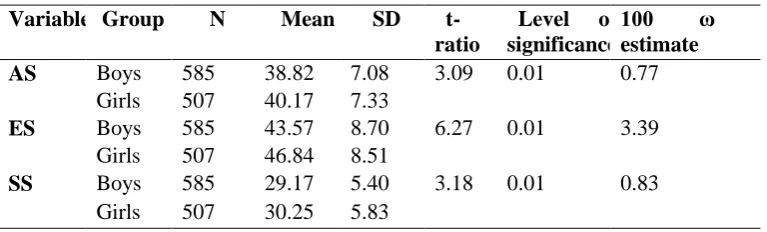
The Student‟s t-test was used to compute the gender differences in the selected variables. Table
[image:3.595.108.492.629.745.2]1 shows the relevant statistics of the same.
Table 1 Relevant Statistics of the Selected Variables
Variable Group N Mean SD
t-ratio
Level of
significance
100 ω 2
estimate
AS Boys 585 38.82 7.08 3.09 0.01 0.77
Girls 507 40.17 7.33
ES Boys 585 43.57 8.70 6.27 0.01 3.39
Girls 507 46.84 8.51
SS Boys 585 29.17 5.40 3.18 0.01 0.83
Girls 507 30.25 5.83
Dr. Giselle Ann D’souza
(Pg. 8116-8121) 8119
Copyright © 2017, Scholarly Research Journal for Interdisciplinary Studies for df = 584 and 506, t at 0.05 level = 1.96
Similarly, for df = 584 and 506, t at 0.01 level = 2.59
Interpretation of ‘t’: The obtained t-ratios for AS, ES and SS are 3.09, 6.27 and 3.18
respectively which are greater than 2.59. Thus, „t‟ is significant for AS, ES and SS at 0.01
level. The null hypotheses for these mentioned variables are, therefore, rejected. Further, it
must be noted that the mean scores of all the variables are higher in girls than in boys, with
examination stress being the highest.
Discussion: An analysis of the results pertaining to the null hypothesis, indicate that there is
significant gender difference in AS, ES and SS. This observation is in keeping with the
findings of studies which have shown that majority of girls report feeling “too much” pressure
to get good grades and succeed. On entering high school they experience a sharp increase in
stress, because they are told “everything counts now for college.” They “usually” or “always”
worry about getting into the “right” college (Sandler, 2005). Research has also revealed that
women are about twice as likely as men to suffer from stress. This two-to-one difference
persists across racial, ethnic, and economic divides. Many factors have been implicated,
including biological, psychological, and social factors ranging from parents whose style is
restrictive rather than supportive and open to emotional expression, low self-esteem, difficulty
in assertiveness to over concern with appearance and notions of popularity (Nolen and Girgus,
1994).
With respect to achievement stress, girls are more conscientious and hence also more
concerned about pleasing adults (teachers and parents), which might make them want to
achieve higher grades. In contrast, boys are less concerned about pleasing adults, but are
motivated by competition. In general, girls are known to exhibit far more school-related stress
than do boys. They believe that to be successful, they have to be extraordinary in every area of
their lives: academic, social, extra-curricular and appearance. Compared to girls, boys feel less
connected, are less likely to feel successful and have fewer worries about academic
performance. Although all teens report being burdened by too much homework and tests, girls
are 55% more likely than boys to say that they pressure themselves to get good grades and do
well in school.
From the point of view of examination stress, girls appear to approach exams as a way of
emphasising their capabilities. Consequently, they view their exam results and the related
Dr. Giselle Ann D’souza
(Pg. 8116-8121) 8120
Copyright © 2017, Scholarly Research Journal for Interdisciplinary Studies
suffer more stress than boys. Females being more nervous by nature are more stressed than
males as examinations represent to them physical danger, pain and academic failure (Sharma
and Sud 1990).
Adolescent girls are more likely to experience stress in their relations with parents and friends,
whereas adolescent boys' stress is more likely to emerge from trouble in school or other factors
outside their relationships with others. This is because adolescent girls as compared to boys,
attach more importance to their relationships as a source of emotional support and perhaps,
personal identity. Hence interpersonal stress may be more salient and may act as a stronger
threat to their well-being, thus leading to higher levels of social stress in girls. Heightened
worries about appearance/body image, clothing choices, and make-up further exacerbate the
daily stress of teen girls. Besides, in a country like India, with a tradition bound society, a
premium is put on the male child from conception onwards and the family does everything
possible at all times to give the best to a male child. Less is given and much is expected of the
female to prove her worth. Females are discriminated on the basis of personal and social
expectations, multiple assigned roles and responsibilities in families and communities. Roles
that are considered demeaning, laborious and time consuming for males are adopted as
appropriate for females. The tendency to repress and ignore a female is found to be quite high
in India, which is predominantly a traditional and patriarchal society. The reason for girls
having reported higher levels of stress in this study as compared to boys could also be
attributed to the fact that females can overtly talk about their emotions and easily identify them
without being labelled weak (Greenglass, 1995). On the other hand, boys are told to face the
reality with confidence and courage and avoid indulging in emotional expressions that
characterize femininity (Eisler and Blalock 1991). This suggests the active role of different
socialisation practices used for males and females from young by parents, teachers and
significant others in the community.
CONCLUSION
The findings of this study suggest that if constructive guidance relating to stress
management is provided to girls, educators could serve to reduce their anxiety, build their
resiliency, and enable them to become more successful. Educational professionals need to
have an honest peek into the secret struggles of teen girls today and obtain insights into what
they say they most need from their teachers and administrators to alleviate their stress and
Dr. Giselle Ann D’souza
(Pg. 8116-8121) 8121
Copyright © 2017, Scholarly Research Journal for Interdisciplinary Studies
academic landscape, society has not given them due credit. The opportunities available to
them to match their academic feats are not proportionate. School counselors can be
instrumental in helping girls expand their awareness of career options and make realistic
assessments about how their own abilities and interests connect to occupational requirements.
In doing so it can be ensured that their potential is tapped to the fullest, leading to a bright
and promising future.
REFERENCES
Brooks, G.J. and Warren, M.P. (1989.) Biological and Social Contributions to Negative Affect in Young Adolescent Girls. Child Development, 60, 40-55.
D’souza, G. (2012). Stressed but Not Out! Helping Students Realize the Power of Self. New Delhi: APH Publishers.
Eisler, R.M. and Blalock, J. A. (1991). Masculine Gender Role Stress: Implications for the Assessment of Men. Clinical Psychology Review, 11, 45-60.
Garett, H.E. (1985). Statistics In Psychology And Education. Bombay. Vakils, Feffers and Simons Ltd. Greenglass, E.R. (1995). Gender, Work Stress and Coping: Theoretical Implications. Journal of
Social Behaviour and Personality, 10, (6), 121-134.
Hollenstein, T. (2007). State Space Grids: Analyzing Dynamics across Development. International Journal of Behavioral Development, 31, 384-396.
Nolen, H.S. and Girgus, J.S (1994).The Emergence of Gender Differences in Depression during Adolescence. Psychology Bulletin, 115, 424-443.
Sandler, R.C. (2005). Stressed-Out Girls: Helping Them Thrive in the Age of Pressure, New Delhi: Penguin Books India Pvt. Ltd.
Sharma, S., and Sud, A. (1990). Examination Stress and Test Anxiety: A Cross-cultural Perspective. Psychology and Developing Societies, 2(2), 183-201.
Singhal, S. (2004). Stress in Education- Indian Experience. New Delhi: Rawat Publications.