“
The study of human values on creative development of teacher trainees in
relation to their Academic achievement
”
Minakshi Biswal
Asst. professor, Vasanta college for education,
Rajghat, Varanasi.
Distortion of values is partially due to imbalance between ancient values and explosion of knowledge in war field technology. Atomic weapons, bio-weapons, explosives, missiles etc., are threatening the whole man-kind. Developed countries possess all types of dreadful modern weapons and trying to boss over developing and underdeveloped countries. Todays, the entire mankind is living in the shade of fearful atmosphere. Man’s very existence is at stake and hence he is indulging himself in all wicked activities. As value crisis is rampant in our society, there is a need of value integration society. This could be possible only through incorporation of values in education system which in turn directs value oriented teachers. This is a study deals with the effect of academic achievement and creative development of the progressive teachers on their attitude towards human values. It is found that creative development and academic achievement have a positive effect on the attitude towards human values.
Key Words: Values, Academic Achievement, Creative Development, Student Teachers.
Backdrop:
Today teachers complain about increasing disciplinary problems in schools. One
teacher says, “I am appalled to see the mindless behaviour of the adolescents in school. Their
mentality seems so different from us.” The public criticizes the youth whom we produce at
schools as insensitive to the problems of society, selfish, narrow-minded, lacking in
intellectual depth and susceptible to the violent and corrupt social pressures. Education
throughout the world has failed; it has produced mounting destruction and misery. The cause
of all these could be the teacher because brick and mortar do not make a school efficient and
useful, nor are books in the library or appliances in the laboratory so essential. Teachers only
make the school or mar it. So, it is necessary for teachers under training to be thoroughly
exposed to values in their colleges of education. It presupposes that the teacher education also
have a serious commitment to human values in life. Only then can they inspire the future
teachers. As per Sri Sathya Sai Baba, “Good teachers + Good students= Good nation”.
Teachers are the main instruments to inculcate values through different subject
contents. The teacher should understand the values inherent in content and should know the
skills needed to inculcate those values among learners which would be possible through
teacher education programmes. But the products of the present day teacher education
programmes are not adequately equipped to foster value education in schools. It is a hard
reality that our teacher education is isolated from the mainstream of universal life. It is even
isolated from the schools for which the teachers are trained. There is a difference between the
practice teaching and real teaching. This may be due to the serious lacunae in our teacher
education programmes. It has ignored the holistic human values that make a total man. The
Education Commission (1966) begins the report with the sentence “ The destiny of India is
now being shaped in her classrooms.” , the National Commission on Teachers(1985) and the
report of working groups for modernization of pre-service teacher education curriculum
(1987) emphasized on the value orientation of teachers. According to the report, value
education has assumed a special significance in order to enable the child to reconcile the
service programme which is transacted and seldom used in practice. At the same time, there
is a lot that is required in practice but not covered in the training programme. Also, the
NPE(1986) calls for a substantial improvement in the conditions of work and the quality of
teachers’ education.
As per NCTE Curriculum frame work for teacher education (1996-97), “ It is
generally agreed that cognition is the basic to violation which by implication would mean that
prospective teachers are expected to understand critical issues regarding values- concepts,
types and problems involved in imbibing the values. It is also expected of them to be well
versed with the values enshrined in our constitution and the values that have cultural contexts
and can be derived from our heritage. In the process of capacity building of intending
teachers, what is important is to ensure that they become capable of understanding the
importance of value education, interpreting values in the contemporary contexts and evolving
strategies of imbibing these among their students.”
Rationale
Every individual is unique. This uniqueness of the individual is one of the most
fundamental characteristics of life. At all periods of human history attempts have been made
to observe and describe differences between individuals and among various groups of
individuals. Like gender, Socio-Economic background also has an important effect on
Psychological variables of a person. A number of studies have demonstrated consistent
differences between the value pattern, achievement and creativity of individuals belonging to
different Socio-Economic Status. (Singh Prabha & Soni, Rashmi (1999), Bajpai Sunil (1997),
Mckoe and Sheriff (1948), B. Ramadevi (1962), Goel, Swami Pyari (2002), Madhu Asthana,
Alka (2004), and Jagadish V.P. Singh 2003, Hartshorne and May (1928), Brown (1967),
Leaner (1937), Hyman (1953), Melvin C. Kohn (1959), Agarwal (1959), Musgrave (1968)
and Reisman (1964), Manrea Craft (1968), Betteleheim (1969), Rokeach and Parker (1970),
Tapper (1971), De Soura (1973), Rokeach (1971), Sharma (1975), Wright and Wright (1976),
Kestelove (1971), Wernimont & Fitzpatrik (1972), Knapp, Brimmmer and White (1959),
Noll and Noll (1962), Bhusan (1977), Shantha (1977), Abbas (1979), Roy (1980), Indramani
(1981), Garg (1983), Singh (1983), Annamma (1984), Lewis (1984), Fali Kowski (1984),
Ashok Kumar (1982), Dadu Pratibha (1992), Bhargava (1986), Oad (1986), Ratnakumari
(1987), Verma & Gupta (1990), Jyothi Joshi and Leena Poornachand (1994) and Sandhya
(1999).
Statement of the study :
On the basis of analysis of rationale of the different studies the researcher rightly felt
the need of the present study entitled
“The study of human values on creative development of teacher trainees in relation to
their academic achievement”
Objectives :
The main objectives of this study are framed as follows :
To determine the cognitive levels of the teacher trainees of B.Ed. course in Varanasi
of Uttar Pradesh.
To determine the creative levels of the teacher trainees of B.Ed. course in Varanasi of
Uttar Pradesh
To analyse the impact of human values on creative development of the teacher
trainees in relation to their Academic achievement.
Hypothesis :
The hypotheses of the study are formulated on the basis of the trend of the related
studies collected and reviewed priorly. As many of the related studies could not able to
succeed to unfold the relationship between cognitive development, and human values of the
participants, those were exposed to the different studies. Hence as per the trend the present
statement are hypothesized as:
1. There is no significant difference in human values among the groups of teachers
trainees categorized on the basis of Academic Achievement and creative
development.
Choice of tasks :
The study purposes to analyse the effect of Human values on cognitive and creative
development of teacher trainee. Accordingly, the tasks have been selected, some of which are
modified versions of tasks used in cross-cultural investigations to suit to the eco-cultural
setting of the subject population. The following considerations guided the selection of tasks.
i. The task of attitude scale of Human value was used in this study to assess the
components of Human values. It was constructed and standardized by the
Researcher.
ii. A task of academic achievement of student teacher was used in this study to
asses their level of academic success. This was constructed and standardized
by the researcher.
iii. A task of creativity assessment of teacher trainee was used in this study to
determine their creativity in preparing lesson plans. This was designed by the
researcher.
Sample :
The samples is the representative number of the whole population from which it is
being drawn. it exhibits the real, homogeneous and identical characteristics of the population.
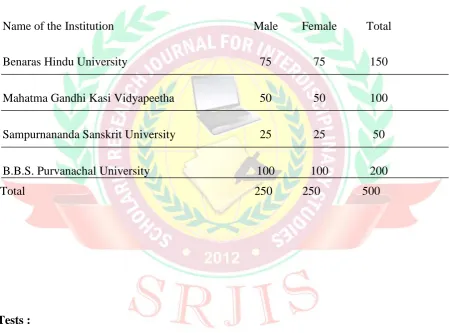
In this study, 500 trainees of four different Universities were selected as the participants. The
sample consisted of 500 teacher trainees i.e. 50% of the real strength drawn from the
constituent colleges of the four Universities in Varanasi City. They were selected by
The mean age of participants selected was 26 years having nearly homogeoneous
socio-demographic background. 250 males and 250 females were selected from different
[image:7.595.75.526.245.578.2]streams. The sample distribution has been presented as.
Table - 2
Sampling Distribution
Name of the Institution Male Female Total
Benaras Hindu University 75 75 150
Mahatma Gandhi Kasi Vidyapeetha 50 50 100
Sampurnananda Sanskrit University 25 25 50
B.B.S. Purvanachal University 100 100 200
Total 250 250 500
Tests :
The following tools (tests) were used for collection of data for investigation.
1. Attitude Scale for Human Values (ASH)
Procedure
:-The trainees selected from different college of the four Universities were given
appropriate assignment. In the first day of test administration “Attitude for Human Values”
were administered within a controlled condition and conducive atmosphere. The student
teachers were asked to write lesson plan on decided topics, as they were from different
streams. Those lesson plans were checked and scoring was done.
On the second day of the test administration, only Academic Achievement of Student
teachers was administered. The answer sheets were scored as per instruction given in the test
manual.
Thus whole tests were administered in different institutions successfully. The scores
were used for tabulation and statistical analysis for drawing conclusion.
Table-5.4a
Creative Development wise Distribution of Mean performance in Human Values of
the Participants having different levels of Academic Achievement
High Human Values Average Human
Values
Low Human Values
M1= 247.54
S.D.=13.48
M2= 238.5
S.D.=0.5
M3= 0
S.D.=0
Average
Creative
Development 0
N4=0
M4= 0
S.D.=0
52429
N5=267
M5= 196.36
S.D.=36.79
946
N6=8
M6= 118.25
S.D.=5.77
Lower Creative
Development 0
N7=0
M7= 0
S.D.=0
472
N8=3
M8= 157.19
S.D.=0
12426
N9=100
M9= 124.26
S.D.=25.44
Table-5.4b
Higher Creative
Development
247.54 238.5 0 T1=486.04
M1=162.01
Development M2=104.87
Lower Creative
Development
0 157.33 124.26 T3=281.59
M3=93.8
Total Mean T11=247.54
M11=82.5
T22=592.19
M22=197.39
T33=242.51
M33=80.83
T=1082.24
M=360.68
Table-5.4c
Summary of ANOVA of 3 Creative Development X 3 Academic Achievement level
of the participants
SSv Df SSv MSv F
SSc 2 84167.54 42083.77 14.80**
SSR 2 106292.07 53146.035 18.693**
SSInt 4 880928.02 220232.01 77.462**
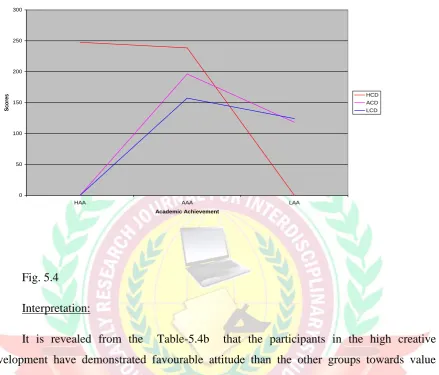
Graph of Academic Achievement and Creative Development
0 50 100 150 200 250 300
HAA AAA LAA
Academic Achievement
S
c
o
re
s HCD
[image:11.595.86.526.93.468.2]ACD LCD
Fig. 5.4
Interpretation:
It is revealed from the Table-5.4b that the participants in the high creative
development have demonstrated favourable attitude than the other groups towards value
education categorized on the basis of different levels of their academic achievement as
evident from their mean scores. The mean score of the participants belonging to High,
average and low creative development are presented as 162.01, 104.87 and 93.8 respectively.
Hence it is clearly indicated that the participants of high creative development have shown
favourable attitude towards value education than the other two groups.
[The Standard Deviation Scores of the boys having higher human values is 15.10
whereas the girls’ score is 11.68. From this it can be concluded that girls are more consistent
than the boys. The Standard Deviation Scores of the boys having average human values is
28.19 whereas the girls’ score is 43.43. From this it can be concluded that boys are more
consistent than the girls. The Standard Deviation Scores of the boys having lower human
values is 26.39 whereas the girls’ score is 22.41. From this it can be concluded that girls are
It is revealed from the Table-5.4c, that the F-ratio of Academic achievement is found
to be significant at 0.01 level [F (2,491) = 14.802, p < 0.01]. Hence the attitude towards
Value education of the participants categorized on the basis of different levels of their
academic achievement differs significantly to each other. It is clearly revealed that the
Academic achievement is found to have significant impact on the attitude towards value
education.
The F-ratio for the creative development variable is calculated 18.693 which are
found to be significant at 0.01 levels. [F (2,491) =18.693, p<0.01]. Hence the participants of
different creative development differ significantly in their attitude towards value education. It
is clearly revealed the creative development has significant impact on attitude towards value
education.
The calculated F value for the interaction of Academic achievement and creative
development variables is 77.462, which is found to be significant at 0.01 level,
[F(2,491)=77.462, p<0.01]. The interaction of both the variables i.e. Academic achievement
and creative development influence significantly the attitude towards value education of the
participants as it is evident from the Table-5.4b, Fig-5.4
It is necessary to discuss that the Hypothesis “there is no significant difference between
the human values among the groups of the teacher-trainees of the B.Ed. course categorized
on the basis of creative development and academic achievement” is hereby rejected. That
means human value are found to have significant effect on Academic Achievement and
Creativity. This could be due to proper schooling and proper grooming at home. Few studies
support the above result (Santham, Krishnan, S. (1990), Saxena, (1981), Setia, P.(1987),
Sharma, S.K. (1986), Singh.V (1989), Vasesi, R (1985),Venkataraman D. (1989), K. Pandey
Ahluwalia,S.P., Manual for Teacher Attitude Inventory, National Psychological Corporation,
Agra. .
Allport, G.W., Hand Book of Social Psychology ,1935.
Aurobindo,Sri., On Education, Pondicherry, Sri Aurobindo Ashram, 1966.
Broudy, H.S.,Building a Philosophy of Education, New Delhi, Prentice Hall Of India(Pvt.)
Limited,1965.
Buch, M. B., Survey of educational research, Vol. III, IV and V.
Charless W.W., and Waples, D., “The Common-wealth Teacher Training Study”, Chicago:
University of Chicago Press,1929.
BChomye, Donald dale, Ph.D. University of Alberts (1996)., Dissertation Abstracts
International, Jan-1997, Vol.57, No.-7, Michigan, U.S.A.
Coleman, J.C., Determinants of Development, Self as third Determinant, Psychology of
effective behaviour, 1969.
Crane, A.P., The Development of Moral values in children, British Journal of Educational
Psychology,1958.
Graves, Sharon Stottsberry, Ph.D, Ohio University(1996)., Dissertation Abstracts
International, Jan-1997, Vol.57, No.-7, Michigan, U.S.A.
Gokak, V.K., Sai Chandan, Sri Sathya Sai Books and Publication, 1985.
Gupta, N.L., Value Education, Theory and Practice, Ajmer: Krishna Brothers, 1986.
Hart, J.W., “Teachers and Teaching”, New York: Macmillan, 1936.
Husen T, And T. Neville Postlethwaite, International Encyclopedia of Education, Vol. I.
Joshi, Kireet., Working Group for the Review of Teachers’ Training Programmes and
Inculcation of Ethical and Social Values in Education. Recommendation of the High level
Kapani, Madhu, Education in Human Values-Concept and Practical Implication.Ph.D.,
Sri Sathya Sai Institute of Higher Learning,1990.
Karim, S, and Dixit, A.K., Manual for teaching Aptitude Test, Agra Psychological Battery,
Research Cell, Agra,1986.
Kumar, P., and Mutha, D.N., Manual for Teacher Effectiveness Scale, Agra Psychological
Research Cell, Agra,1986.
Lakshmi, “Innovation in Education”, Sterling Publisher Private Ltd., New
Delhi.
Malathy, “Value pattern of Student Teachers’”, University of Madras,
Unpublished Thesis.1987.
McMillan, Dugald, Ph.d., Michigan state Universiy,1996(1996)., Dissertation Abstracts
International, March-1997, Vol.57, No.-9, Michigan, U.S.A.
Morris, C., and Jones, L.V., “Value Scales and Dimensions”, Journal of abnormal and Social
Psychology, Vol.5.
N.C.T.E., Discussion Document, Curriculum Erame Work for Teacher Education, N.C.T.E.,
New Delhi, 1996-97.
Radhakrishnan, S., The present Crisis of Faith, New Delhi: An orient Paper Back, 1965.
Riesmann, “Refered in “Emerging value pattern of Teachers and New Trends of Education in
India”. Kulshrestha, S.P., New Delhi: Light and Life.
Rogers, C.R., Client Centered Therapy: Its current practice, Implication and theory,
Houghton, Mifflin, Boston, 1951.
Saraf Somanath, Sai Vandan. Sri Sathya Sai Books and Pubications,1990.
Sicuro, Cited in “Emerging value pattern of Teachers and New trends in Education in India’.
Sternberg, “The relation of Interest, Values and Personality to the major field of study in
College”, Journal of Educational Research.
Thilak, K., “Value pattern of Higher secondary Students”, M.Phil. Thesis, Madras University.
Whyte., Cited in “Emerging value pattern of Teachers and New trends in Education in India’.
Kulshrestha, S.P., New Delhi: Light and Life.
Yassin Sankar, Education, Human values and Ethics, Canadian Scholars’ Press, Toronto,
1992.
Journals:
Bajpai, Sunil, (1997) Indian journal of educational research, vol. 16 (2)
Chandrakemar, P.S. and Arockia Samy, S. (1994) Journal of community guidance &
research, vol ii (7)
Goel, Swami Pyari,(2002), Indian educational abstracts., Jan. 2003.
Jagdish, V.P. Singh (2003), Journal of Value Education.
Indian Journal of Psychometry & education values No. 33(1)
Madhu Asthana, Alka (2004). Journal of community guidance and research vol-21 No.-3 Nov. 2004, 227- 232
Ranu, Sarbajit Kaur, (1995), Indian education abstracts, Jan-2003.