ISSN: 1992-8645 www.jatit.org E-ISSN: 1817-3195
504
FINANCIAL AND PERFORMANCE TRANSPARENCY
ON THE LOCAL GOVERNMENT WEBSITES
IN INDONESIA
1
DWI MARTANI1, DEBBY FITRIASARI2,ANNISA3
Department of Accounting, Faculty of Economics, Universitas Indonesia, Indonesia
Email: 1 [email protected] , 2 [email protected] , 3 [email protected]
ABSTRACT
E-government in Indonesia started since the issuance of Presidential Instruction Number 3 Year 2003. Local Governments are expected to provide relevant information related to their finance and performance to the public through the media that is easily accessible in order to meet the principles of accountability and transparency. This study has two objectives, that are 1) to analyze the development of the implementation of Presidential Instruction Number 3 Year 2003 with a focus on the transparency of financial and performance information and 2) to analyze the factors that affect the transparency level of financial and performance information in local government websites. To achieve these two objectives, we calculate the level of financial and performance information transparencies based on checklist and analyze the results descriptively then perform multiple regressions to test the influence of economic factors and characteristics of local government on the level of financial and performance information transparency at local government’s websites in Indonesia. Observation was conducted in mid-May 2013 until the end of July 2013. There are 429 of the total 491 government websites were successfully accessed and analyzed further. Based on the checklist made, the transparency level of financial and performance information just reached 15%. The most frequently disclosed information related to financial and performance information is in the form of news and Local Governments in Figures. Whereas the disclosure of main financial and performance informations that are in the form of regional budgets (APBD), financial statements, and performance reports are still below 10%. From the regression test of the 403 local governments, it confirms that size, level of dependency on the central government, and the local government society welfare have positive influence on the financial and performance information transparency level of Indonesia local government level.
Keywords: E-Government, Financial Information, Local Government Website, Performance Report,
Transparency.
1. INTRODUCTION
Law Number 17 Year 2003 concerning State Finance requires the central government and local governments to make financial reports as a form of accountability for the national and regional budgets. The financial statements must be audited by the Supreme Audit Agency (BPK) to asses the validity and reliability of the information related to the management and responsibility of the state finance. With the passage of these two processes, it is expected that the accountability of the financial performance can be more accountable.
Accordance to the Code of Good Public Governance (GPG), in addition to accountability, transparency is also one of the principles that must be met for the realization of GPG (KNKG,
2010). Thus, one of the steps in realizing GPG is that the government should provide public information that can be accessed easily by the stakeholders, both the central government, society, and other parties. The principle of transparency is also in line with Law No. 14 year 2008 concerning Public Information (Freedom of Information Law or UU KIP) where one of the information that must be provided and published periodically by the Government as a public entity is the information on the financial statements.
ISSN: 1992-8645 www.jatit.org E-ISSN: 1817-3195
disseminating information to the public. In addition, the use of the website and information technology is also an application of e-government that will play an important role to the performance of the government in the future (Moon, 2002).
Research related to the government website as the application of e-government has been widely done abroad. In the United States, e-government started in 1995 with only about 8.7% of local government at that time used the website, but the figure rose to over 90% in just over 5 years (Holden et al., 2003). Besides United States, research on the development of e-governance is conducted in South Korea (Kim and Kim, 2003), India (Rupanagunta, 2006), Sri Lanka (Karunasena and Deng, 2011), Bhutan (Miyata, 2011), Spain (Navarro et al., 2012), and China (Yuan et al., 2012).
In Indonesia , the development of website used by local governments in Indonesia began with the issuance of Presidential Instruction Number 6 year 2001 (Presidential Decree No. 6/2001) concerning Development and Utilization of Telematics (Information and Communication Technology) in Indonesia, which is clarified by Presidential Instruction Number 3 year 2003 (Presidential Decree Number 3 Year 2003) concerning the National Policy and Strategy of E-Government Development. During the 3 years since the enactment of Decree Number 6/2001, only 182 of the 385 local governments (regency, city, and province) which has a website and of those only 150 websites that can be accessed (Rose, 2004). Hermana and Silfianti (2011) evaluated the 181 local government websites with a focus on features, promotions, and general information. Furthermore, in early 2010, Puspita and Martani (2012) observed local governments websites and found 168 local government websites (regencies, cities, and provinces) can be accessed, while Medina (2012) conducted observations in late 2010 and successfully analyzed 257 second-level (Pemerintah Tingkat II) local government websites. Recent literature Hermana et al. (2012) in June 2011 successfully accessed and analyzed 424 local government websites. These studies indicate that there is an increasing trend in the number of government websites that can be accessed by the public. Thus, the government tends to be more serious in the development of their e-government.
However, on the other hand, the development of e-government on local
government website looks not optimal if it is associated with the transparency of financial information. Rose (2004) found that most of the government websites in Indonesia has not provided detailed information about their individual tax payment and financial information as well as local government budgets. Recent literature Hermana et al. (2012) also found that the results are not much different with Rose (2004) that the disclosure of financial information in local government websites is not as good as the completeness of feature and local government services. Therefore, the first objective of this study is to analyze how the development of e-government in Indonesia 10 years after the issuance of Presidential Instruction Number 3 Year 2003, focusing on accountability and financial transparency as well as performance aspects. The addition of a focus on the performance aspect is considered based on Government Regulation Number 3 Year 2007, the local governments have an obligation to provide information related to the government administration to the people and the central government. In addition, local governments are also required to report the performance of government accountability (LAKIP) in accordance with Government Regulation Number 8 Year 2006.
Furthermore, the second objective of this study is to examine the influence of several economic factors and characteristics on the level of the transparency of government financial information and performance in local government websites. This second objective continues the research conducted by Laswad et al. (2005), Styles and Tennyson (2007), Serrano et al, (2008) and several studies in Indonesia as Sinaga (2011), Puspita and Martani (2012) and Medina (2012). Laswad et al. (2005) was first conducted a study to examine the factors associated with the level of financial information disclosure in the local government websites in New Zealand and found that leverage, press visibility, wealth levels and types of government administration affect the level of financial information disclosure in government websites. Puspita and Martani (2012) continued the research of Laswad et al. (2005), while Medina (2012) continued the research of Styles and Tennyson (2007).
2. LITERATURE REVIEW
ISSN: 1992-8645 www.jatit.org E-ISSN: 1817-3195
506 Jensen and Meckling (1976) explained that there is a divergence of interests between the principal and the agent, so that agent does not always follow the interest of the principal. This agency relationship also occurs in a government, the people as the principal and the government as the agent. The government can make policies that only benefit for governments and authorities and disregard people’s interests and welfare. Therefore, in order to reduce conflicts, it is necessary for principal to monitor what is done by agents. Financial statements and performance reports to the public is a form of monitoring tools to reduce agency cost. Disclosure of financial statements and explanation of performance by local governments directly to the public via internet can be used as a tool to reduce agency cost.
Signaling theory explains that the government as a party that is given responsibility by the people have a desire to show a good signal to the society. Government gives signal to the society in the form of providing a high quality financial statement and performance report, a more complete disclosure, or further details on the website. The local government can also pack the information of the financial achievements and performance in greater detail to show that the government has been carrying out the mandate given by the people.
There are three regulations that contain government obligation to provide financial information and performance to the website or electronic media. The first is the Government Regulation (Peraturan Pemerintah) number 56 year 2005 concerning Regional Financial Information System. Second, the Government Regulation number 3 year 2007 concerning Local Government Activity Report to the Government, Local Head Accountability Report To the Local Legislative Council, and Information of the Local Government Activity Report to the Society (Laporan Penyelenggaraan Pemerintahan Daerah Pada Pemerintah, Laporan Keterangan Pertanggungjawaban Kepala Daerah Kepada Dewan Perwakilan Rakyat Daerah, Dan
Informasi Laporan Penyelenggaraan
Pemerintahan Daerah Kepada Masyarakat). The third is the Minister of Home Affairs Regulation number 7A year 2007 concerning Procedures for Submission of Information and Public Comments or Suggestions for the Local Government Reports. These three regulations are in line with the Law concerning Public
Information Openness which states that one of the information that must be provided and published periodically by the Government is information regarding the financial statements, although the regulation does not specify the medium used is in the form of a website.
2.2 Good Public Governance and
E–Government
In accordance with the Code of Good Public Governance (GPG) which is issued by the National Committee on Governance Policy (KNKG) in 2010, there are five principles of GPG that is democracy, transparency, accountability, culture of law, and fairness. The basic principle of transparency is disclosure element content and the availability of adequate information (through the information and documentation system) and easily accessible to stakeholders about the formulation pattern and content of legislation and public policy and budget formulation and implementation by state agencies. Transparency is required in order that public and business community can oversee the implementation of the state objectively. Moreover, the basic principles of accountability contains elements of explication within the organization functions and how to account for them. To that end, every state officials have to perform their duties honestly and measurable in accordance with laws and regulations and to avoid abuse of power. One of the principal guidelines for the implementation of accountability is the accountability report must be submitted on a regular basis in accordance with the regulations.
ISSN: 1992-8645 www.jatit.org E-ISSN: 1817-3195
improving public services effectively and efficiently.
2.3 Previous Research on Disclosure of
Financial Information in Local Government Websites and Influential Factors
Laswad et al. (2005) conducted research on voluntary disclosure of financial information by the local government in New Zealand and identified factors associated with the level of disclosure. Results of Laswad et al. (2005) proved that leverage, press visibility, wealth levels, and types of terrain affect the level of disclosure of financial information in government websites. Furthermore, Styles and Tennyson (2007), in addition to research on the availability of financial information, they also examined the level of accessibility of 300 local government financial statements in America and the factors that influence it. The results Styles and Tennyson (2007) indicate that the size and the level of regional wealth effect on the availability of financial information in government websites. While Serrano et al. (2008) conducted a study similar to Laswad et al. (2005) of the 92 local governments in Spain with the results of the research supporting Laswad et al. (2005).
In Indonesia, Sinaga (2011) and Puspita and Martani (2012) continued the Laswad et al. (2005) research to the local governments of Indonesia. Samples that were used by Puspita and Martani (2012) are 108 local governments in Indonesia with a focus not only on financial information but also other general information. Results from Puspita and Martani (2012) suggested that there are still few government websites publish financial information and the factors that affect the level of disclosure is size of the local government and local government dependence on the central government. Medina (2012) continued the research Styles and Tennyson (2007) with a sample of 257 local governments level two (Daerah Tingkat II) and found that only 35 (16%) local governments that publish their financial information in their website and the website of Cimahi city has the highest level of availability and accessibility on the financial information. While the factors that proved to affect the level of financial information disclosure besed on Medina (2012) study is the size, level of independence, and complexity of the government. Recent study conducted Hermana et al. (2012) of the 424 local
government websites in June 2011 found that the average level of financial disclosure in the government website only reaches 19 %.
3. RESEARCH METHOD
3.1 Stages of Research
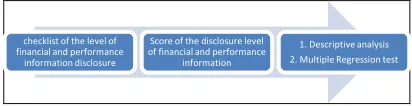
The focus of this study is on the level of local government financial and performance information disclosure in their website. To measure the disclosure level, the first step according to Figure 1 is made with reference checklist of Perez et al. (2005) and Garcia-Sanchez et al. (2013). Checklist consists of five sections of the indicator groups: budgeting and financial news, budgeting information, financial statement information, performance reporting/infomation and Local Government in Figures .
[image:4.612.322.528.427.480.2]Once the checklist is created, observation is conducted on each of the local government website to assess the availability of information according to the checklist. If there is an information, it will be given a score of 1 and if there is not, it will be given a value of 0. Disclosure level value is obtained by dividing the total value obtained by each local government with the total checklist items (17 items).
Figure 1: Research Stages
Afterwards, the data of disclosure level obtained by the checklist is analyzed descriptively to see the level of financial and performance disclosure on local government websites in general and in each indicator group. Descriptive analysis will answer the first objective of this study that is the development of the implementation of Presidential Instruction Number 3 Year 2003 concerning e-government, with a focus on accountability and transparency of local government finance and performance.
Next, according to the second research objective, quantitative analysis using multiple regression test to prove the influence of some local government characteristics on the level of financial and performance disclosure in local government websites.
checklist of the level of financial and performance
information disclosure
Score of the disclosure level of financial and performance
information
ISSN: 1992-8645 www.jatit.org E-ISSN: 1817-3195
508
3.2 Research Framework Model and
Operational Definition of Variables
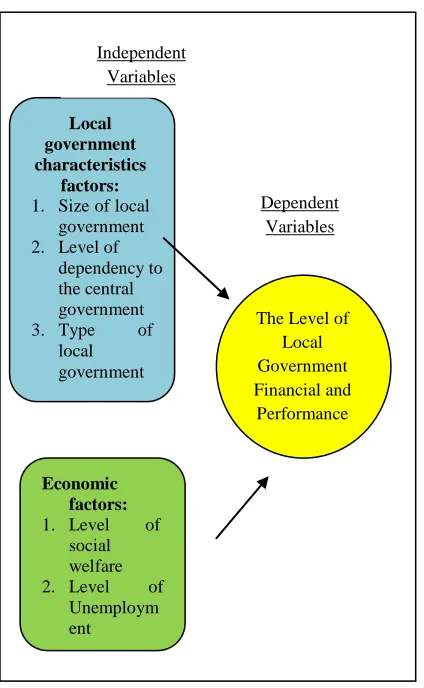
[image:5.612.86.298.252.596.2]Related to the second research objective, Figure 2 presents the research framework and characteristics of the local government variable used. While, the operational definition of each of the variable is shown in Table 1.
Figure 2: Research Framework
Regression model used is:
DISCt= β0+ β1SIZEi+ β2DEPENDi +
β3TYPEi +β4WEALTHi + β5TPTi + ε
Table 1. Operational Definition of Research Variable
No Var Desc Measurement
1 DISC Level of local government
Checklist observation
financial and performance information disclosure
2 SIZE Size of local government
Ln of local government expenditure
+
3 DEPE
ND
Level of dependency to the central government
Total of general general allocation fund (DAU)/ total income
+
4 TYPE Type of local government
1= city and 0=
regency +
5 WEA
LTH
Level of social welfare
Ln of Regional GDP per capita
+
6 TPT
Level of Unemployme nt
Level of open unemploymen t
-
Financial data is obtained from the Audit Board of Indonesia (BPK), while economic data is obtained from Statistic Central Board (BPS) welfare indicators in 2011.
3.3 Hypothesis Development
3.1.1 Size of the Government
The results on the effect of government size on the level of financial information disclosure through the local government websites give inconsistent results. Laswad et al. (2005) found no effect, while Styles and Tennyson (2007), Serrano et al. (2008), Medina (2012) and Garcia-Sanchez et al. (2013) found a positive effect of government size on the level of disclosure. Styles and Tennyson (2007) also stated that the huge size government will implement many activities and programs for the community that will also spend more fund. Considering previous studies, the first hypothesis is as follows.
H1: The size of the local government has a positive correlation to the level of financial and performance disclosure on local government websites
3.1.2 Level of dependence on government
Robbins and Austin (1986) explained that intergovernmental revenue indicates the level of local government dependency. In Indonesia, the central government provides funds in the form of the General Allocation Fund (DAU) to all of the local governments with a varying amount. By the allocation of these funds, the central government will monitor all of the programs and activities conducted by local governments and the level of management
Local government characteristics
factors: 1. Size of local
government 2. Level of
dependency to the central government 3. Type of
local government
Independent Variables
Economic factors: 1. Level of
social welfare
2. Level of Unemploym ent
The Level of Local Government Financial and
Performance Dependent
ISSN: 1992-8645 www.jatit.org E-ISSN: 1817-3195
achievement with the allocation of General Allocation Fund. Thus, the pressure on the local governments to provide information related to the use of funds, and their financial and performance will be also greater. This is evidenced by Puspita and Martani (2012) who found that the bigger the government DAU received the higher level of information disclosure on its website. Based on the analysis above, the second hypothesis is as follows.
H2: The level of dependency on local government has a positive correlation on the level of financial and performance disclosure on local government websites
3.1.3 Type of Local Government
There are differences in the characteristics between city and regency governments. City government usually has a population with a social and educational backgrounds are more diverse than the regency so this causes a more complex problem for the city government. Therefore, city government should be able to accommodate all the needs of the population in the form of providing services and informations needed by the society.
Moreover, the fact that the level of urbanization have a correlation with the use and access to the internet, Laswad et al. (2005) have hypothesized that form of city government will have higher level of financial information disclosure than in the form of regency. Although Laswad et al. (2005) did not succeed to prove the hypothesis, however, Medina (2012) was able to prove this hypothesis in the study with a sample of second level government (pemerintah tingkat II) websites in Indonesia. Therefore, the third hypothesis is as follows.
H3: Local government in the form of city will have a higher level of disclosure than local government in the form of regency
3.1.4 The Social Welfare
One of the social welfare indicator is the income per capita of the region. Styles and Tennyson (2007) stated that the higher per capita income of a region, the higher the political monitoring by the public and the higher demand for information as a tool to measure the performance of local government. Styles and Tennyson (2007) and Serrano et al. (2008) proved that the higher per capita income of the region the higher the level of disclosure of information in government websites. However,
the same result could not be proved by Medina (2012) as Medina (2012) use the total income of the region (instead of income per capita). Therefore, based on the results of previous studies that use income per capita, the fourth hypothesis is as follows.
H4: The level of social welfare has a positive correlation on the level of financial and performance disclosure on local government websites
3.1.5 Unemployment Rate
Hameed (2005) and Piotrowski and Van Ryzin (2007) in Garcia-Sanchez et al. (2013) stated that economic conditions (including the level of education and employment rate) is positively related to the transparency of the public sector, especially related to financial and fiscal information. This is supported by studies of Guillamon et al. (2011) who found a negative relationship between the level of disclosure with the unemployment rate (Garcia-Sanchez et al., 2013). However, different results found by Navarro et al. (2011) in Garcia-Sanchez et al. (2013) where the local government with a high unemployment rate appears to have a higher level of disclosure because of the greater demand for social information to the society. While Garcia-Sanchez et al. (2013) was not able to prove the effect of unemployment rates on the level of disclosure in Spain. Taking into account those different results of studies, the fifth hypothesis of this study are as follows:
H5: The unemployment rate have a correlation to the level of financial and performance disclosure on the local government websites
4. DISCUSSION
4.1 Descriptive Analysis of Levels of
Financial and Performance Disclosure in Local Government Websites
ISSN: 1992-8645 www.jatit.org E-ISSN: 1817-3195
510 Based on the checklists in Appendix 1, the index of average government financial and
performance transparency/disclosure by 15%1 is
gained. This average index is slightly lower than the index generated by Hermana et al. (2012) which is equal to 19 %. This is likely due to the differences between in the checklists used in the research. For example, checklists Hermana et al. (2012) include the availability of local regulations in the website as one of the indicator where this document is the most frequently disclosed in the local government websites (53.6%), while this study did not include it as an indicator. In addition, of the total 429 local governments that are observed, 40% of them or 202 local governments do not provide or disclose relevant financial and performance information at all. This low average index of financial and performance disclosure shows that during the 10 years of the implementation of e-government in Indonesia, the local governments still have not prioritized the disclosure of financial information in their websites. This is probably due to the local government still focuses on providing minimal information in accordance with the Guide of Local Government Web Sites Implementation issued by the Ministry of Communication and Information in 2003 as well as providing services features in accordance with the research conducted by Rose (2004) and Hermana et al. (2012).
Furthermore, based on Figure 3 it can be seen that the indicator of highlight news related to financial information and the indicator of government financial information in finance figures/statistics are the most frequent indicators disclosed by many local government websites. From these results it can be concluded that the government would prefer giving financial information in general and treated it as a statistical data in rather than budgets and financial reports independently. This fact is certainly not in line with Government Regulation (PP) Number 65 Year 2005 Article 13b which requires financial informations, such as budgets and financial statements, presented in the official local government website.
1
This average rate of disclosure does not consider websites that can be accessed but the level of disclosure is 0% (no financial or
performance information is available in
[image:7.612.313.530.72.380.2]accordance to checklists presented in its website)
Figure 3. Percentage of the Government Websites Presenting Information per Group Indicator
If per type of information items observed, Table 2 shows the most information disclosed by the local governments in their website. Twenty-five percents (25%) of local government websites provide news about the use of budget and 22.4% provide news about the budget process. This is reasonable because the news concerning on the use of budget could be a media campaign for the local governments related to the successful implementation of their program or the budget they do. News related to the audit reports are also displayed by some government websites, both government which received an unqualified opinion (WTP) and who received a qualified opinion (WDP). Some government websites that display news related to audit reports with WDP provides an explanation of the audit follow-up memo. While the news related to financial statements are underrepresented in government websites, only 7% of the local governments reported the their financial statements.
38.5 %
14.7 % 6.5 % 6.5 %
15.2 %
Highlight (berita tentang keuangan) paling tidak tahun 2012
APBD
Laporan Keuangan
Laporan Kinerja
Pemda Dalam Angka terkait info/statistik keuangan (paling tidak tahun 2011)
ISSN: 1992-8645 www.jatit.org E-ISSN: 1817-3195
Table 2. Percentage of the Local
Government Websites Disclose per Item Information
No > 20%
LG 10-20% LG < 10% LG
1 Budget using news
Audit results news
Financial Statements news 2 Budget
process news
Local
Government in Figures (at least in 2011)
Budget Realization Report 2011/2010
3 Initial Budget
(APBD) 2013/2012
Balance Sheet 2011/2010
4 Budget
(APBD) Adjustment 2012/2011
5 Statement of
Cash Flow 2011/2010
LAKIP
2011/2010
7 ILPPD
2011/2010
8 LPPD
2011/2010
9 Notes to the
Financial Statements 2011/2010
10 Initial budget
(APBD) in gov. affairs 2013/2012
11 Budget
(APBD) realization/ quartal 2012/2011
12 Budget
(APBD) amendment detailed/ gov affairs 2012/2011
For financial and performance information, from Table 2 it can be seen that the type of information that most presented in government websites are initial budget. Whereas information in the form of financial statements and performance reports, the percentage of local government websites serving those reports are still very low that is less than 10 %. These results are consistent with Medina (2012) who observe 257 local government websites and found that from 35 websites that present financial
information at the end of 2011, only six local government websites that do not provide information about the local budget (APBD). Furthermore, this study found that from the four financial statements, the most frequently presented report is the budget realization report, following by balance sheet, statement of cash flow, and the last is notes of the financial statements. While for the performance report, the most frequentlyly presented report is Government Agency Performance Accountability Report (LAKIP), then ILPPD, and the last is Local Government Management Report (LPPD). Financial information in local government websites are mostly presented as an attachment, not in the government pages directly (face).
This observation indicates that the local government is more likely to provide information in the form of its local budget than any other financial information. This may be due to the information and news related to the use and the budget process are considered more easily to be understood by the society and they can demonstrate the performance of local government directly rather than information in the form of financial statements and performance report that are more intended for the purposes of reporting to the central government. Furthermore, based on Figure 2 and Table 2 above, it can be concluded that the level of preparedness of local government in implementing e-government in accordance to Presidential Instruction Number 3 Year 2003 specifically for the presentation of financial information and performance reports are still in the stage or level 1 which is preparations. It is also supported by the observation that in some websites there are separate menus and/or links to obtain performance and financial information or documents, but the separate menus and/or the link does not provide information or documents as desired. The availability of separate menu and/or the link is an indicator that the local governments have considered financial and performance information as the information that needs to be displayed in their website, although the documents are not available.
ISSN: 1992-8645 www.jatit.org E-ISSN: 1817-3195
512 compared with the disclosure of which is outside the island of Java that is 7 %. This result is in line with Hermana et al. (2012). One of the cause of this condition is the lack of competent human resources in finance and information systems in local governments outside Java. Therefore, it is necessary to conduct trains that can stimulate understanding of the importance of financial and performance information transparency as well as improving the competence of local governments
staff. Furthermore, of the eleven local
governments with the highest score, seven of them are city governments while the remaining four are regency governments. If it is seen from the average rate of disclosures on the overall website observed, local governments in the form of city have an average rate of disclosure by 12% compared to the disclosure rate of the regency by 7%. These results are consistent with Laswad et al., (2005) and Medina (2012) where the local government with the type of city have more numerous and diverse residents so that the demands on informations disclosed in local government websites are greater.
When it is seen from individual local government achievements, the local government of Tangerang City has the highest index with a value of 64.7%. There are eleven informations presented by Tangerang City of total 17 items in the checklist of this study. Detailed informations that is presented by the City of Tangerang are informations about financial news, all types of financial reports and all kinds of local government in figures. Furthermore, it can be seen that most of the undisplayed information is information about the performance report. There are seven websites that do not include any type of performance reporting, either in the form of Local Government Agency Performance Accountability Report (LAKIP), Local Government Management Report (LPPD), and ILPPD. Even City of Tangerang which has the highest disclosure score, also does not provide performance reports on its website. The reason City of Tangerang does not provide the performance report in its website is not because its performance is not good. This is evidenced by the value of EKPPD (Performance Evaluation of Regional Government) in 2011, the City of Tangerang is a city government that has the highest value of EKPPD. Thus, the possible reason that local governments ignore the performance report in the their website is that performance reports and Local Government Management Report (LPPD) are the reports to
the central government so that local governments do not (yet) feel they have an obligation to provide the report to the public widely. Likewise for ILPPD, based on the Minister of Home Affairs Regulation Number 7A Year 2007, a report to be delivered by government to the socity could be through printed or electronic media. Thus, because it is not required, then the government choose the other media in the spreading of the ILPPD report.
4.2 Analysis of Factors Affecting Financial
and Performance Disclosure Levels in Local Government Websites
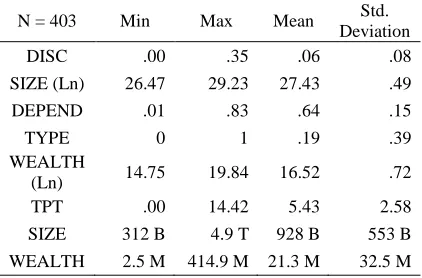
Of 429 government websites that are accessible, there are 4 local governments for which the data is incomplete and there are 22 local governments have outlier data so that there is a total of 403 local governments become the sample to answer the second purpose of this study.
[image:9.612.318.529.553.692.2]Table 3 presents the descriptive statistics of the 403 government websites sample to be tested using multiple regression. The highest level of disclosure is obtained by City of Depok (West Java) with an average rate of disclosure of the sample is 0,08. There are 198 samples which have a value of level of disclosure is 0. Regency of Kutai Kertanegara (East Kalimantan) has the largest total expenditure and the least percentage of total General Allocation Fund (DAU) spending. While the city with the highest value of GDP per capita is City of Bontang (East Kalimantan). Regency of Tolikara (Papua) has the lowest unemployment rate. Sample of this study consisted of 75 city governments and 328 regency governments.
Table 3. Descriptive Statistics Sample
N = 403 Min Max Mean Std.
Deviation
DISC .00 .35 .06 .08
SIZE (Ln) 26.47 29.23 27.43 .49
DEPEND .01 .83 .64 .15
TYPE 0 1 .19 .39
WEALTH
(Ln) 14.75 19.84 16.52 .72
TPT .00 14.42 5.43 2.58
SIZE 312 B 4.9 T 928 B 553 B
WEALTH 2.5 M 414.9 M 21.3 M 32.5 M
ISSN: 1992-8645 www.jatit.org E-ISSN: 1817-3195
DEPEND = total General Allocation Fund (DAU)/total revenue, TYPE = dummy variable, 1 for city and 0 for regency, WEALTH = value of Ln of Gross Regional Domestic Product (GDP) per capita, TPT = Unemployment rate
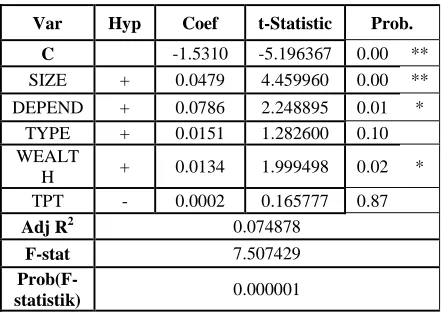
[image:10.612.79.300.272.428.2]Prior the regression test, classical assumption test is performed first. As a result, there is problem of heteroscedasticity although there is nomulticollinearity problem. Heteroscedasticity problem is solved by using a program in EViews 7 and regression test results can be seen in Table 4.
Table 4. Regression Test Results Summary
Var Hyp Coef t-Statistic Prob.
C -1.5310 -5.196367 0.00 **
SIZE + 0.0479 4.459960 0.00 **
DEPEND + 0.0786 2.248895 0.01 *
TYPE + 0.0151 1.282600 0.10
WEALT
H + 0.0134 1.999498 0.02 *
TPT - 0.0002 0.165777 0.87
Adj R2 0.074878
F-stat 7.507429
Prob(F-statistik) 0.000001
Sources: Data Eviews Sports
** Significant at α = 1%, * Significant at α = 5%
Based on Table 4 above, three hypotheses that are proven are hypothesis 1, 2, and 4. Size of government variable, the level of dependency to the central government variable, and social welfare variable are proven having positive correlation to the level of financial and performance disclosure on local government websites. While hypotheses 3 and 5 are not proven, that are types of local government variable and levels of unemployment variable do not have correlation to the level of financial and performance disclosure on local government websites.
Although this study use a different proxy with the previous studies to measure the size of government variable but the result supports those previous studies ( Styles and Tennyson, 2007; Serrano et al., 2008; Medina, 2012; and Garcia-Sanchez et al., 2013). Variable of the size of local government that is proxied by total expenditure show that the greater the total expenditure of a local government, the more programs and activities undertaken so that more informations related to the use of these funds are
presented in the local government websites. From the previous descriptive analysis results (Table 2), the news about the use of budget is the most frequently presented information by the locall governments in their websites.
For the second hypothesis, the results of the regression test proved that there is positive correlation between the level of dependency on the central government with the level of disclosure as the result of Puspita and Martani (2012) . The greater the degree of dependency makes local governments disclose more informations related to their finance and performance as a form of accountability for the use of these funds. Result of this test show that pressure from central government to local governments to provide financial and performance information on the use of General Allocation Fund (DAU) in the local government websites is greater along with the larger allocations to that local government.
Furthermore, the result of the test of hyphotesis three also supports previous studies of Styles and Tennyson (2007) and Serrano et al. (2008). The higher the level of social welfare, the greater the society will demand for the availability of financial and performance information in local government websites. This result is also in line with Ingram (1984) and Giroux and McLelland (2003) which stated that society with higher income per capita will demand accountability from their governments, including the financial and performance accountability they have been done.
Result of the test of hypothesis 3 support Laswad et al. (2005) which is he found there is no correlation between the type of government and the level of disclosure. Cities are not proven to be better in terms of transparency of financial and performance information in their website. If viewed from statistical data, of 75 sample local government of cities and 328 local government of regencies, 30 cities and 168 regencies have levels of disclosure amount 0. Thus, almost 50% of the sample data do not present any information relating to the financial and performance in their website.
5. CONCLUSIONS, LIMITATIONS AND
RECOMMENDATIONS
ISSN: 1992-8645 www.jatit.org E-ISSN: 1817-3195
514 From the total 491 local governments level two, only 429 websites that can be accessed and observed along the middle of May until end of July 2013. Based on the checklist that has been made, the level of transparency of financial and performance information in local government official website is only 15 %. This shows that during the 10 years of the implementation of e-government development in Indonesia, especially for the transparency of financial information and performance, the local governments are still in the early stages of preparation.The main informations about financial and performance that are in the form of budget data, financial statements, and performance reports are still very few presented by the local governments in their website. There are 49% local governments do not provide any information related to financial and performance information on its website at all. From the result of regression test, it is concluded that the factors that affect the level of financial disclosure are size of the local government, the level of local government dependency on the central government, and the society welfare.
5.2 Limitations and Recommendations
This study uses checklist in calculating the value of the level of disclosure which is likely to be subjective. In addition, eventhough the checklist contains quite a lot of informations related to finance and performance, there are still some informations are not included yet such as local regulations related to financial and performance. Related to the factors that affect the level of disclosure, this study only included three variables of government characteristics and two variables of economic factors. There are many regional characteristics variables that may affect the level of disclosure, such as the background of local government leaders, audit reports from Audit Board of Indonesia (BPK) on financial statements and performance report, or the Audit Board of Indonesia opinion on the financial statements. In addition, subsequent research could try to see the influence of political factors such as the ruling party or pressure from the media.
Furthermore, considering that many local governments do not disclosed financial and performance information on their website, it is recommended to the central government and local governments to.
1. Central Government (Ministry of Finance and
Ministry of Home Affairs) provide clearer
and more assertive regulation concerning on the responsibility of local governments related to government transparency on management and accountability of financial and performance. Clearer regulation means that the central government should provide regulation related to what should financial and performance information be presented at least by the local government on its website, such as the Guide for the Implementation of Local Government Website created by the Ministry of Information and Informatics. More assertive regulation is intended that the central government should provide regulations that besides requiring the presentation of financial information and performance in local government websites, it also provide sanctions and appreciations to the local government related to these obligations.
2. Central Government (Ministry of Information
and Informatics) conducts an assessment to the content and quality of government websites so that local governments are encouraged to continue to improve its website. As conducted in Spain with the presence of Transparency International, they can promote a significant increase in the economic and financial information transparency in local government websites in Spain.
3. Governments are expected to immediately
prepare human resources and information systems so that it can immediately present the financial information as well as the performance in the website in accordance to Government Regulation Number 56 Year 2005. Given more training to relevant employees about the importance of transparency in government financial and performance information and employee capacity enhancement related to financial and information systems.
REFERENCES
[1]. Garcia, I.M.S., Frias, J.V.A., and Rodriguez,
L.D. 2013. “Determinants of Corporate
Social Disclosure in Spanish Local
Governments”. Journal of Cleaner
Production 39: 60-72.
[2]. Giroux, G and Andrew J.M., 2003.
Governance Structures and Accounting at
ISSN: 1992-8645 www.jatit.org E-ISSN: 1817-3195
and Public Policy. Volume 22, Issue 3, May–
June 2003: 203–230.
[3]. Government Regulation of Republic of
Indonesia Number 56 Year 2005 concerning Regional Financial Information System.
[4]. Government Regulation of Republic of
Indonesia Number 8 Year 2006 concerning Local Government Financial and Performance Reporting.
[5]. Government Regulation of Republic of
Indonesia Number 3 Year 2007 concerning Local Government Activity Report to the Government, Local Head Accountability Report to the Local Legislative Council, and Information of the Local Government Activity Report to the Society.
[6]. Hameed, F., 2005. Fiscal Transparency and
Economic Outcomes. IMF Working Paper: International Monetary Fund, Washington.
[7]. Hermana, B., Tarigan, A., Medyawati, and
H., Silfianti, W. 2012. Information Richness, Website Feature, and Financial Transparancy on the Local Government Website in
Indonesia. Journal of Theoretical and
Applied Information Technology, Vol 43
No.2: 229-235.
[8]. Holden, S.H., Norris, D.F., and Fletcher, N.P.
2003. Electronic Government at the Local Level: Progress to Date and Future Issues.
Public Performance & Management Review,
Vol. 26, No. 4: 325-344.
[9]. Ingram, R.W. 1984. Economic Incentives and
The Choice of State Government Accounting
Practices. Journal of Accounting Research.
vol 22, No 1, Spring 1984: 126-144.
[10]. Karunasena, K. and Deng, H. 2012.
Critical Factors for Evaluating the Public Value of e-Government in Sri Lanka.
Government Information Quarterly 29: 76–
84.
[11]. Ministry of Communication and
Information of Republic of Indonesia. 2003. Guidance for Implementation of Local
Government Website.
[12]. Kim, S. and Kim, D. 2003. South
Korean Public Officials’ Perceptions of Values, Failure, and Consequences of Failure
in e-Government Leadership. Public
Performance & Management Review, Vol.
26, No. 4: 360-375.
[13]. Komite Nasional Kebijakan
Governance. 2010. General Guidance on
Good Public Governance.
[14]. Medina, Febri. 2012. Factors
Influencing Transparency of Financial
Information On Local Government Official
Site In Indonesia. Skripsi. Universitas
Indonesia.
[15]. Ministry of Home Affairs Regulation
Number 7A Year 2007 concerning Procedures for Submission of Information and Comments or Suggestion from Society for Local Government Implementation Report.
[16]. Moon, M, Jae. 2002. The Evolution of
E Government among Municipalities:
Rhetoric or Reality? Public Admnistration
Review, July/Agust, Vo 62 (4): 424-433.
[17]. Navvaro, J.G.C., Pachon, J.R.C.,
Ceggara, J.L.M. 2012. E-Government and Citizen’s Engagement with Local Affairs Through e-Websites: The Case of Spanish
Municipalities. International Journal of
Information Management 32: 469– 478.
[18]. Perez, C.C., Hernandez, A.M.L., and
Bolivar, M.P.R. 2005. Citizens’ Access to On-Line Governmental Financial Information: Practices in the European Union
Countries. Government Information
Quarterly 22: 258-276.
[19]. President of Republic of Indonesia
Instruction Number 6 Year 2001 concerning The Development And Efficiency of Telematics In Indonesia
[20]. President of Republic of Indonesia
Instruction Number 3 Year 2003 concerning National Policy And Strategy In The
Development of E-Government
[21]. Puspita, Rora., Dwi Martani. 2012.
Factors Influencing The Level of Vountary
Disclosure on Government Websites in 2010.
Paper prresented in Simposium Nasional Akuntansi 15, Balikpapan, 20-21 September 2012.
[22]. Rachmawati, U.A., Sensuse, D.I.,
Suhartanto, H. 2012. Initial Model of Indonesian e-Government Grid Services
Topology. International Journal of Computer
Theory and Engineering, Vol. 4, No. 4:
656-661.
[23]. Robbins, W. A., & Austin, K. R. 1986.
Disclosure Quality in Governmental
Financial Reports: an Assessment of The Appropriateness of a Compound Measure.
Journal of Accounting Research, Vol 24:
412-421.
[24]. Rose, M. 2004. Democratizing
ISSN: 1992-8645 www.jatit.org E-ISSN: 1817-3195
516
Regional Government. The International
Information & Library Review 36: 219–226.
[25]. Rupanagunta, K. 2006. E-Governance
in Public Financial Management: An Overview. IIMB Management Review: 403– 413
[26]. Serrano-Cinca, Carlos, Mar
Rueda-Tomas, Pilar Portillo-Tarragona. (2008). Factors Influencing E-Disclosure In Local
Public Administrations. Working Paper No.
2008-03, Facultad De Ciencias Economicas Y Empresariales, Universidad De Zaragoza.
[27]. Sinaga, Y.F. 2011. Analysis of Factors
Influencing Financial Reporting on the Internet Voluntaryly by The Local Government. Universitas Diponegoro, Semarang.
[28]. Styles, Alan K., Mack Tennyson. 2007.
The Accessibility Of Financial Reporting
U.S. Municipalities On The Internet. Journal
of Public Budgeting, Accounting & Financial
Management, 19 (1): 56-92.
[29]. Yuan, L., Xi, C., & Xiaoyi, W. 2012.
Evaluating the Readiness of Government Portal Websites in China to Adopt Contemporary Public Administration
Principles. Government Information