Journal of Chemical and Pharmaceutical Research, 2013, 5(9):507-514
Research Article
CODEN(USA) : JCPRC5
ISSN : 0975-7384
Deep buried tunnel surrounding rock stability analysis of the cusp
catastrophe theory
Hong Jiang
Department of Municipal Engineering, Anhui Technical College of Water Resources and
Hydroelectric Power, Hefei, PR China
___________________________________________________________________________________
ABSTRACT
Surrounding rock system of underground engineering is highly nonlinear, and there is no unified cognition for its stability criteria. A simplified mechanical model for the surrounding rock is built , considering the influence of the water,introducing water weakening function, using the cusp catastrophe theory,the necessary and sufficient mechanics criterion of the surrounding rock is obtained, and the critical radial displacement of deep buried tunnel instability is obtained. In practical engineering,it is show that catastrophe theory is a feasibility method to study the instability problem of the Deep buried tunnel.
Key words: catastrophe theory, cusp catastrophic model, surrounding rock stability
___________________________________________________________________________________
INTRODUCTION
Underground engineering rock mass stability is influenced by a variety of factors, it is not only has the complicated deformation failure mechanism, but also has the highly nonlinear characteristics, the nonlinear characteristics of rock mass is mainly manifested in the cumulative damage, the deformation of rock mass develop from disorder to order and the evolution of rock mass develop from linear curve to nonlinear (Chuanhua Xu, et al.2003-2004). The influence factors of the stability of underground surrounding rock have complicated variability and uncertainty, therefore, the scholars have no unified cognition for its stability criteria.
The theories of nonlinear science, such as the theory of dissipative structures theory, synergetic and catastrophe theory (Siqing Qin, et al.1993), are powerful tools to study rocks nonlinear problems. In view of the deep buried tunnel surrounding rock stability, In the paper, we build a simplified mechanical model for the surrounding rock, Using the cusp catastrophe theory, the necessary and sufficient mechanics criterion of the surrounding rock is obtained, and the critical radial displacement of deep buried tunnel instability is obtained.
CUSP CATASTROPHIC MODEL
The Catastrophe theory(Sha Ma,2010), which is put forward by Thom(1972), is a branch of nonlinear theory, its main theory is bifurcation theory and singular theory, it pays great attention to study the outside control conditions when system state changes suddenly, describe the reason why some variables of the system changes in system state mutation, and parameters of continuous change how to lead to generation of discontinuous phenomenon. Seven catastrophe models were summarized by Thom, cusp catastrophic model is the most common model(Sha Ma,2010). Potential function V of cusp catastrophe model is a two-parameter function (two control variables are μ and ν), state variables is x (Fuhua Ling,1987).
4 2
1
1
U
4
x
2
ux
vx
The corresponding equilibrium position should meet:
3
0
U
x
ux v
x
(2)The graph, in the
( , , )
u v x
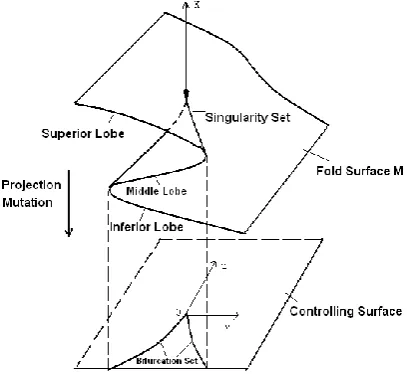
space, is the catastrophe manifold, it has a fold surface M, thus, the equilibrium position is 1, 2 or 3 in different zone. The middle lobe potential function takes a maximum value, and the equilibrium position is unstable, but to the superior lobe and the inferior lobe of the equilibrium position is stable. Figure 1 is the cusp catastrophe model schematic diagram, The equilibrium surface M contains the type all the stationary state solution of formula (1). In the overlap, a point( , )
u v
, in the parameter space, corresponding to three different steady state solutions, this is the reason why call them isolated, as well as the multiplicity of the steady state solution, two steady state solutions together at the edge of the overlapped, they all called non isolated singularity set S, projection to parameter control plane C, get the bifurcation set B.Fig.1 Cusp Catastrophe Model Schematic Diagram
The non-isolated odd point set S is necessary to satisfy the formula (2), but also need to satisfy the following formula:
2
2
2
3
0
U
x
u
x
(3)By type (2) and type (3), we can get the equation of bifurcation set B is
4
u
3
27
v
2
0
, Only when the0
u
, the system will cross bifurcation set mutations.DEEP BURIED TUNNEL INSTABILITY MODEL
Deep buried tunnel excavation, there will be stress reducing zone (relaxation zone), elevated stress zone (bearing zone) and the original rock stress zone around the tunnel. We assume that the tunnel section is circular cross section, no support, elastic-plastic stress diagram of the surrounding rock can be expressed as figure 2(Xue Fu et al.1980).In the figure, R is the plastic zone radius, a is the tunnel excavation radius.
[image:2.595.188.392.263.450.2]Fig2. Tunnel Surrounding Rock Stress and the Partition
(Where 1and 2 are plastically deforming zone; 3 and 4 are elastic deformation zone 1 is relaxation zone;2 and 3 are bearing zone;4 is original rock stress zone.)
Fig3. Rock Stress-Strain Curve
According to the paper(Changbin Yan et al. 2006), the rock constitutive relation can be expressed as: (1) Linear elastic stage:
σ
E
ε
c (4)(2) The plastic softening stage:
3 2
A
1
B
1
1
D D D
D
(5)Where:
2
1
A
1 2
2
1
n
m
m
m
(6)
B
3 A
m
(7)F
D
m
(8)F
D
n
(9) OB C
F D
εD
εC εF
ε
σ
σr
σ
r
3 R
2 1
a
D
,
Dare peak stress and corresponding strain,
F ,
Fare stress and corresponding strain of the curve inflexion point F which after the peak value, E is the rock elastic modulus. The slope absolute value of point F is the rock drop modulus, its value can be obtained as follows:2
λ 3
AEm
(10) In order to reflect the effects of groundwater, a hypothetical water weakening functions will be introduced(Youquanet al. 1994):
20 0
1
1
f w
w
(11) Wherew
is the water content;
0is the saturated softening coefficient of rock-soil body.The equation(11) was put forward by scholars through the experimental curve, It is a monotone decreasing function, in the dry condition, w0, f w
1, in saturated water condition, w1,f w
01.After introducing the water weakening functions in the equation (4) and equation (5), we can get the constitutive relation under the influence of water:
1σ
f w E
c
(12)
2A
31
B
21
1
D D D
f w
D
(13)Where
w
1is rock mass water content in elastic stage;w
2is rock mass water content in the plastic softening stage.DEEP BURIED TUNNEL SURROUNDING ROCK INSTABILITY CUSP CATASTROPHE MODEL
We choose the deep buried tunnel radial displacement
as the state variables, and set the compressive stress and the compressive strain is positive. Assume that within the scope of the surrounding rock, volume incompressible. Then the system total potential energy can be expressed as:E S
U
U
U
(14)Where
U
Eis surrounding rock system elastic strain energy,U
Sis surrounding rock system plastic strain energy.2 E 0
1
1
U
2
r r2
R
rdrd
2 2
1
1
E
a
f w
R
(15)2 S
0
U
Ra
Wrdrd
(16)Where
is radial displacement when r =a, W is Strain-Energy Density in plastic zone, its value can be expressed as:0
0
W
d
(17)To combine formula (13) with formula (17):
2 4
2 34 3 3 2
W
4
3
D D
D D
A
f w
B
f w
a
a
1
A B
Df w
2a
Where
0is radial strain when r =a. Then:
2 2
2 2
2 4 2 3
S 4 3 3 2
U
4 3
D D
D D
A f w R a B f w R a
a a
2 2
2
1 A B R a D f w
(19)
The total potential energy of the system can be obtained:
4 3 2
1 1 1 1
U
A
B
C
D
(20) Where:
2 2
21 4 3
4
DD
A
f w
R
a
A
a
(21)
2 2
2
1 3 2
3
DD
B
f w
R
a
B
a
(22)
21 1
1
Ef w
a
C
R
(23)
2 2
1
1
D 2D
A B
R
a
f w
(24)When
U
/
0
in the formula (20), we can get the equations of equilibrium curved surface M of tunnel stability analysis:' 3 2
1 1 1 1
U
4
A
3
B
2
C
D
0
(25)The equilibrium curved surface M is smooth surface, when
U
'''
0
, we can get the equation of equilibrium curved surface tip point displacement :'''
1 1
U
24
A
6
B
0
(26) So, the radial displacement of the tip point is:1 1
4
FB
a
A
(27)As we can get the value from the equation (27) just as the rock plastic softening extents medium constitutive curve displacement value of the turning points.
According to the paper[8],as one dimensional case, the stiffness can be defined as:
2 ' 2
d U
k
d
(28)Depending on the stiffness definition, we can get: (1) The elastic zone stiffness is:
2 2 1 22
1
e ed U
E
a
k
f w
d
R
(2) The plastic zone stiffness is:
2
2
1 1
2
12
6
s s
d U
k
A
B
d
(30)In the turning point, that is, when
21 2
1
s
R
k
f w
a
(31)Then:
2 1 2 1 22
1
1
e sE
a
f w
R
k
f k
k
f w
R
a
(32)The formula (25) develop as Taylor formula at tip point, interception to cubic term, the standard form of equilibrium curved surface can be obtained:
3
0
x
ux v
(33) Where:x
(34)
3
1
u
fk
(35)
3
1
v
fk
(36)
2 22
1
1
1
E
k
R
R
a
a
(37)
12f w
f
f w
(38)
4
ζ
E
1
A B a
m
(39)Parameter k is the ratio of the stiffness of elastic segment medium to the point
stiffness of plastic softening phase medium, which not consider the effect of water factor, referred to as stiffness ratio; Parameter f is the ratio of the elastic section medium water weakened coefficient to the water weakened coefficient of plastic softening extents, referred to as water weakened coefficient ratio,ζ
is Geometry-mechanical parameters.Thus, we can get bifurcation set control equation according to the catastrophe theory:
3 2
4
u
27
v
0
(40)Formula (35) and (36) into (39):
3
2Only when
u
0
, system will come to a non-equilibrium state, That the necessary conditions of the system instability isu
0
, we can obtain:1
k
f
(42)From above, the necessary and sufficient mechanical conditions of systems instability systems is :
3
24
1
9
1
0
1
fk
fk
k
f
(43)
Formula (37) into (42):
2 22
1
1
1
1
E
k
f
R
R
a
a
(44)
General condition, the water content of the plastic softening zone is more than that of the elastic zone, that is
f w
1
f w
2 , in other words,f
1
, thus, from formula (44), the rock mass instability, the stiffness ratio of its plastic zone is less than 1.So we need to control the size of the relative radius, so as to improve the stiffness ratio of plastic zone and plastic softening zone.By the nature of the equilibrium curved surface M and the solution of cubic equation, we can obtain the hole radial displacement value when mutations by the formula (33).
3
1
3
1
1
2
2(
1)
v
fk
x
u
fk
(45)The formula (45) is the expression of critical radial displacement of the tunnel, the relationship of
f k
, , ζ
must satisfy the formula (43),
can be obtained from formula (27). When the hole radial displacement values reach and exceed the value in formula 45, the surrounding rock will be destroyed, and the surrounding rock instability.ENGINEERING PROJECT APPLICATIONS
Taking Jinping II hydropower engineering project as an example, this research selects the White Mountain Group II surrounding rock at the depth of 2000 m as the research object, and prove the surrounding rock stability by using the cusp catastrophe model.
The tunnel diameter is 13 m, according to the research reports of Hohai University 2003, the related parameters of the White Mountain Group II surrounding rock as follows: Uniaxial compressive strength
c
125.5MPa
, elastic modulusE
=31.62GPa
, Poisson's ratio
0.18
,
D
125.48MPa
,
D
3.7 10
397.87MPa
F
,
F5.8 10
3
.Thus:
m
F D
1.57,
n
F D
0.78
.rock.
CONCLUSION
Catastrophe theory is an effective method to study the instability problem of the tunnel. Because the surrounding rocks system of deep buried tunnel is not only has the complicated deformation failure mechanism, but also has the highly nonlinear characteristics, Using the cusp catastrophe theory to analysis the surrounding rock stability of deep buried tunnel has certain rationality.
Establish a simplified surrounding rock instability model,considering the influence of the water,Introducing water weakening function, using the cusp catastrophe theory, the necessary and sufficient mechanics criterion of the surrounding rock is obtained, and the critical radial displacement of deep buried tunnel instability is obtained. The mechanical model is simple, and it is very different with the actual situation, in order to be closer to the actual situation, Further research is needed to establish more close to the actual mechanics model.
Engineering case study shows that the analysis results consistent with the actual situation. The results of the study can provide a reference for preventing tunnel instability, adopting the reasonable technology of construction and supporting measures.
REFERENCES
[1]Changbin Yan,Guoyuan Xu,2006.Journal of Engineering Geology, 4:508-511. [2]Chuanhua Xu,Wenqing Ren,2004.Rock and Soil Mechanics, 3: 437-441.
[3]Chuanhua Xu,Wenqing Ren,2003.Geotechnical Engineering Technique, 3:142-146.
[4]Chuanhua Xu,2004. In:Nonlinear theory research and application of Rock mass destruction. PhD thesis, Hohai university, China.
[5]Fuhua Ling,1987. In:Catastrophe theory and its application. Shanghai Jiaotong University Press.
[6]Sha Ma,2010. In: Nonlinear theory and method of surrounding rockmass stability.China Water Power Press. [7]Siqing Qin,Zuoyuan Zhang,Shitian Wang and Runqiu Huang,1993.I n: Guidance of nonlinear engineering geology. Southwest jiaotong university press, China.
[8]The research reports of Hohai university, China, 2003. In: Tunnel surrounding rock stability analysis and the experimental study on rock mechanics parameters on high ground stress and external water pressure conditions of the project area in Jinping II hydropower station.
[9]Xue Fu,Yinren Zheng and Huaiheng Liu,1980: Stability analysis of surrounding rock of underground engineering. Coal industry publishing house .