International Journal of Emerging Technology and Advanced Engineering
Website: www.ijetae.com (ISSN 2250-2459, ISO 9001:2008 Certified Journal, Volume 8, Issue 12, December 2018)
122
Implementation of Modified Advanced Encryption Standard
Algorithm for IOT Application
Saket Kumar
1, Mohd. Abdullah
2 1Mtech scholar, 2Associate Professor, Department of Electronics and Communication, SISTec, Bhopal (M.P.), India
Abstract—WiMax, IOT Innovation is utilized for wireless systems administration. Thus, it ends up basic to address the security of information engaged with the innovation. Along these lines, we are including another part of science which is known as Cryptography. The Building part of executing this science into the Innovation of WiMax is the center focal point of this exploration work. So we are going inside and out of the security calculation and investigating its tasks, planning the important modules and with the assistance of EDA instruments accessible, we are doing the check procedure which we call simulation in our phrasing. The individual modules managed are both Encryption and Decryption of WiMax/IOT information. The procedure utilized is block cipher method and Encryption and decryption of WiMax/IOT information is finished with Adjusted Propelled Encryption Standard.
Keywords—WiMax, IOT, Wireless, Security, Cryptography, Encryption, Decryption, Block Cipher, Simulation, Synthesis, Xilinx.
I. INTRODUCTION
WiMAX is an abbreviation for Overall Interoperability for Microwave Access (AXess). It is an innovation for point to multipoint wireless networking[1] . WiMAX can meet the prerequisites of a wide assortment of clients beginning from those in created countries of the world who need to introduce another rapid information network[2] inexpensively without the expense and time required to introduce a wired system, to those in country zones of the nations who require quick access and where wired arrangements conceivably isn't suitable a direct result of the separations and costs associated with it. WiMax is likewise being utilized for portable applications, giving fast information to clients progressing. At the end of the day,
WiMAX technology[3] is a broadband wireless
information interchanges innovation based around the IEEE 802.16 standard[4] giving rapid information over a wide territory.
AES is a cryptographic algorithm[5] . AES is an abbreviation for Cutting edge Encryption Standard. With the assistance of cryptographic calculation, encryption and decryption activities are performed on the information. The goal of such tasks is to give security to the information.
For this situation, its WiMax information. The information is encrypted[6] and after that transmitted. At the less than desirable end, the information is unscrambled to get back the first information. Cryptographic calculation can be executed both on hardware[7] and programming. In the present work, we are usage is focused for equipment stage, which is Xilinx FPGA [8] .
AES can process information blocks[9] of 128 bits, utilizing cipher keys[10] with lengths of either 128, 192, or 256 bits. Rijndael was intended to deal with extra block sizes and key lengths, and anyway they are not embraced in this standard. AES is a symmetric[11] block cipher. This implies a similar arrangement of keys are utilized both at the transmitting and at the less than desirable end. Keys are fundamentally a mystery parallel information of above said settled length[12] which are utilized to scramble (cipher) the first information at the transmitting end to acquire the encoded information and unscramble (de-cipher) the scrambled information to get back the first information at the less than desirable end. In the proposed work we have utilized AES-128[13] . In this way, symmetric cipher requires a solitary key for both encryption and decryption, which is free of the plaintext[14] and the cipher itself. Thus, it is illogical to recover the plaintext exclusively dependent on the cipher content and the decryption calculation, without realizing the encryption key. Along these lines, the mystery of the encryption key is of high significance in symmetric ciphers, for example, AES.
International Journal of Emerging Technology and Advanced Engineering
Website: www.ijetae.com (ISSN 2250-2459, ISO 9001:2008 Certified Journal, Volume 8, Issue 12, December 2018)
123 AES represents Propelled Encryption Standard. AES is essentially a security calculation is utilized for encryption and decryption of information. Encryption is the procedure in which we play out a settled arrangement of operations[19] on the information to randomize[20] the information and change it into some inane shape so that regardless of whether any unapproved specialists gets an entrance of the information, won't have the capacity to acquire the helpful data present in the information. Such information which is evidently negligible is transmitted. Such information can be changed over back to its helpful frame, that is, the genuine information just with the key of the key at the less than desirable end. Keys are fundamentally a mystery twofold information of above said settled length which are utilized to scramble (cipher) the first information at the transmitting end to acquire the encoded information and unscramble (de-cipher) the encoded information to get back the first information at the less than desirable end. Clearly the key with the assistance of which the information will be recovered at the less than desirable end will be known at the less than desirable end preceding the foundation of the correspondence [21]. This procedure of recovering the first information is called decryption. The part of science which manages encryption and decryption of information is known as Cryptography. The calculations with the assistance of which we execute encryption or decryption[22] of information are called Cryptographic calculations.
Cryptographic calculations can be either symmetric or non-symmetric. Symmetric Cryptographic calculations are those in which we utilize a similar arrangement of keys both at the transmitting end and also the less than desirable end. AES is a symmetric block cipher. AES Calculation might be utilized with the three distinctive key lengths of 128,192 and 256. AES is alluded to as 128", "AES-192", and "AES-256" in like manner. In the proposed work we have utilized AES-128. In this manner, symmetric cipher requires a solitary key for both encryption and decryption, which is autonomous of the plaintext and the cipher itself. Consequently, it is illogical to recover the plaintext exclusively dependent on the cipher content and the decryption calculation, without realizing the encryption key. In this manner, the mystery of the encryption key is of high significance in symmetric ciphers, for example, AES.
AES can process information blocks of 128 bits, utilizing cipher keys with lengths of either 128, 192, or 256 bits.
In the proposed work, the key length is 128 bits. Rijndael was intended to deal with extra block sizes and key lengths, and anyway they are not embraced in this standard. The Propelled Encryption Standard (AES) indicates a FIPS-endorsed cryptographic calculation that can be utilized to secure electronic information. Encryption changes over information to an indiscernible frame called ciphertext; unscrambling the ciphertext changes over the information once more into its unique shape, called plaintext. The 128 piece information block is isolated into 16 bytes. These bytes are mapped to a 4×4 exhibit called the state and all the inside task can be performed on state. Inside, the AES calculation's tasks are performed on a two-dimensional cluster of bytes called the State. The encryption procedure incorporates the accompanying changes of states: SubBytes(), ShiftRows(), MixColumns(), and AddRoundKey(). The encryption procedure likewise incorporates a key calendar. The AES calculation takes the Cipher Key, K, and plays out a Key Extension routine to create a key timetable. In the decryption procedure, the Cipher changes are transformed and after that actualized backward request to create a direct Converse Cipher for the AES calculation. The individual changes utilized in the Reverse Cipher are InvShiftRows(), InvSubBytes(), InvMixColumns(), and AddRoundKey() . The decryption procedure additionally incorporates a key calendar like Encryption process.
In this paper, we have actualized WiMax/IOT Security
utilizing Altered Propelled Encryption Standard
Cryptographic Calculation. We have structured WiMax MAES Security Calculation sub-modules[24] , both at the Encryption and Decryption end, in light of the inner activities of the calculation, as referenced previously. Each sub-module is planned, recreated [25] and integrated well ordered according to calculation. The consequences of simulation and synthesis[26] are exhibited independently.
II. SIMULATION RESULT
International Journal of Emerging Technology and Advanced Engineering
Website: www.ijetae.com (ISSN 2250-2459, ISO 9001:2008 Certified Journal, Volume 8, Issue 12, December 2018)
124 Figure 1: I/O Waveform of WiMax AES SubBytes()
[image:3.612.48.298.93.677.2]Figure 2: I/O Waveform of WiMax AES ShiftRows()
[image:3.612.321.575.102.584.2]Figure 3: I/O Waveform of WiMax AES MixColumn()
Figure 4 : I/O Waveform of WiMax AES InvSubBytes()
Figure 5 I/O Waveform of WiMax AES InvShiftRows()
Figure 6: I/O Waveform of WiMax AES InvMixColumn()
III. SYNTHESIS RESULTS
International Journal of Emerging Technology and Advanced Engineering
Website: www.ijetae.com (ISSN 2250-2459, ISO 9001:2008 Certified Journal, Volume 8, Issue 12, December 2018)
[image:4.612.324.579.198.437.2]125 RTL View produced at first can be utilized to acquire further internal dimension see. This is acquired by tapping on every one of the portrayals got. We have acquired five RTL sees from external to inward perspectives. As talked about before, the structured WiMax AES Security Calculation execution has various sub-modules inside it both at the Encryption and Decryption end, in view of the interior activities of the calculation. Each sub-module is structured, reenacted and blended well ordered according to calculation. The simulation results is displayed in the before part, presently here, we present the consequences of synthesis. If it's not too much trouble take note of that RTL see is Innovation explicit and henceforth minimal justifiable from primer research and utility reason.
Figure 7: RTL Schematics of WiMax/IOT MAES
Figure 8: RTL view of proposed MAES algorithm
IV. DESIGN SUMMARY
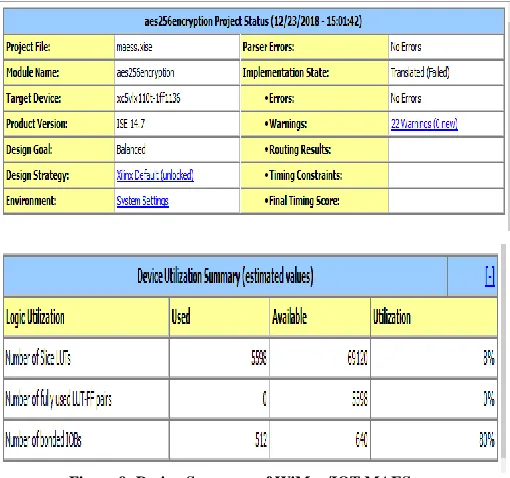
We have structured WiMax/IOT Security utilizing Propelled Encryption Standard Cryptographic Calculation. We have utilized Verilog for this reason. We have utilized Xilinx ISE which have given synthesis results, as abridged in Table 1. Beneath.
[image:4.612.51.288.301.433.2]Additionally, we have portrayed the pictorial portrayal of the outcomes, which is the screen capture of hardware produced Plan Rundown of individual sub-modules both at the WiMax information Encryption end and WiMax information Decryption end.
[image:4.612.47.296.461.597.2] [image:4.612.317.570.476.661.2]Figure 9: Design Summary of WiMax/IOT MAES
Table 1:
Result Comparison of Proposed work with Previous work
Parameters Previous work Proposed work
Type of S-box 1- Dimensional 1- Dimensional
Throughput (No
of Packet
Transmission )
22385 436521 approx
Transmission time 4969.896 milli
sec
29.073 nsec
Efficiency rate 18.35 % 23.7%
International Journal of Emerging Technology and Advanced Engineering
Website: www.ijetae.com (ISSN 2250-2459, ISO 9001:2008 Certified Journal, Volume 8, Issue 12, December 2018)
126 In this work, we have created distinctive modules engaged with the WiMax AES encryption and Decryption for WiMax information. Blended sort of demonstrating is utilized for this reason. The code has been streamlined with the goal that it produces lesser equipment as is obvious from the Structure Outline and Synthesis Report.
V. CONCLUSION
Therefore, it has planned and actualized WiMax/IOT MAES Security Calculation in verilog. Combined it utilizing Xilinx ISE. The FPGA usage offers better speed and powerful and enhanced equipment. FPGA gadget usage additionally indicates least gadget use. FPGA having the adaptability for being used for numerous reason parallel and thus least gadget usage empowers this FPGA to be utilized for different applications at the same time. MAES, a lightweight adaptation of Cutting edge Encryption Standard (AES) which takes care of the demand. Another one-dimensional Substitution Box is proposed by planning a novel condition for building a square grid in relative change period of MAES. Effectiveness rate of MAES is around 23.7% as far as parcel transmission which shows MAES expends less vitality than AES, 38.117ns inertness accomplished and it is material for Asset Imperative Conditions and Web of Things application.
REFERENCES
[1] Pranita K. Gandhewar, Kapil N. Hande, Performance Improvement of IEEE 802.16 / Wimax Using Elliptic Curve Cryptography, (IJCSIT) International Journal of Computer Science and Information Technologies, Vol. 2 (3) , 2018.
[2] Monika rani,, Anil Rose and MridulChawla, Review of Public key cryptography on WiMax using RSA Algorithm, Journal of Engineering Research and Studies,JERS/Vol. II/ Issue IV/October-December, 2017.
[3] PrakashKuppuswamy, C.Chandrasekar, “Enrichment of Security through Cryptographic Public key algorithm based on Block cipher”,
Indian Journal of Computer Science and Engineering (IJCSE), ISSN : 0976-5166 Vol. 2 No. 3 Jun-Jul 2016.
[4] C.Paar “efficent VLSI architecture for bit parallel computations in Galois field (GF)”PHD dissertation institute for Experimental Mathematics university of Essen Germeny 1994
[5] A.Rudra.P.K.Dubey.c.s.jutla.v.kumar.J.R.Rao and P..Rohatgi “Efficent implementation of Rijendel encryption with composite field arithmatic” in proc CHES 2001.Paris France May2015. [6] A.J.Elbirt W.Yip.B.shetwynd and c.parr.An FPGA implementation
and performance evaluation of the AES block cipper candidate algorithm finalist.presented at proc 3rd AES confrence(AES3). [7] V.Fischer and M.Drutarovsky.”two method of Rijendel
implementation in reconfigrational hardware “CHES2001 paris France May 2001.
[8] K.Gaj and p chodowice coparision of the hard ware perforance of the AEs candidates using reconfigrable hardware presented at 3rd AES conf.
[9] A.Satoh.S.Morika.k.Takno.and S. Munetoh “a compact Rijendel hardware architecture with S-box optimization in ASIACRYPT 2001.Gold coast austtrilia 2000.
[10] X.Zhang and K.K.parthi “implementation approaches for the advanced standard alogrithm”IEEE circuit system management vol.2no.4 2002.
[11] J. Daemen and V. Rijmen, AES Proposal: Rijndael, AES Algorithm Submission September 3, 1999
[12] J. Daemen and V. Rijmen, The block cipher Rijndael, Smart Card research and Applications, LNCS 1820, Springer-Verlag, pp. 288-296
[13] A. Lee, NIST Special Publication 800-21, Guideline for Implementing Cryptography in the Federal Government, National Institute of Standards and Technology November 1999.
[14] A. Menezes, P. van Oorschot, and S. Vanstone, Handbook of Applied Cryptography CRC Press, New York, 1997, p. 81-83. [15] J. Nechvatal, et. al., Report on the Development of the Advanced
Encryption Standard (AES), National Institute of Standards and Technology, October 2, 2000.
[16] A. P. Fournaris and O. Koufopavlou Electrical and Computer Engineering Department University of Patras, Patras, GREECE. [17] Ayesha Altaf, M.YounusJaved&Attiq Ahmed, “Security
Enhancements for Privacy and Key Management Protocol in IEEE 802.16e-2005”, Ninth ACIS International Conference on Software Engineering,2008.
[18] T. L. Singal “Wireless communication, “chapter 14Emerging wireless network technology, Tata McGraw Hill Publication, 2010. [19] F.Chee-Da Tsai, J. Cheny, C.W. Chang, W.J. Lien, C. H. Hung, and
J.H., “Design and implementation ofwimax Module forns-2 Simulator”, 2006.