A Monthly Double-Blind Peer Reviewed Refereed Open Access International e-Journal - Included in the International Serial Directories.
GE-International Journal of Engineering Research (GE-IJER) ISSN: (2321-1717)
70 | P a g e
GE-International Journal of Engineering Research
Vol. 4, Issue 6, June 2016 IF- 4.721 ISSN: (2321-1717) © Associated Asia Research Foundation (AARF) Publication
Website: www.aarf.asiaEmail : [email protected] , [email protected]
LIGHTNING ACQUISITION AND BASIC TRIGGERING USING
KINTEX-7 FPGA
Harshit Devakumar1, Ajay Khandare2, Prof.Dr.M.S.Panse3
1
Department Of Electronics Engineering, VJTI, Mumbai, India
2
IMSD Department, SAMEER IITB, Powai Campus, India
3
Department Of Electronics Engineering, VJTI, Mumbai, India
ABSTRACT
In this paper, the basic continuous acquisition of a Lightning signal at the rate of 1 MS/sec has been performed , as well as the time stamping of the acquired signal using the GPS module has been performed on the Lightning Sensor Node. The time stamping has been carried out to determine the Lightning location using the ‘Time of Arrival’ Technique in the further Sferic detection algorithms. The entire implementation has been carried out in real time using the cRIO-9030 controller. The process of data acquisition as well as the time stamping using the GPS module has been carried out on the Kintex-7 FPGA . The cRIO is used to handle the communication to the PC using an Ethernet. Further a triggering algorithm has also been implemented based on Amplitude thresholding on the FPGA. The implementation details along with the obtained results have been summarized in this paper.
Keywords - Sferic, FPGA to RT DMA FIFO, Kintex-7 FPGA, Cloud to Ground Lightning,
cRIO, Network Streams
1. Introduction
This paper primarily focuses on the acquisition of the negative Cloud to Ground Lightning
and development of the Digital Section of the Lightning Sensor Node. The Lightning Sensor
Node currently has a Cross Magnetic Loop Antenna developed by [6] and a ‘B’ field analog
A Monthly Double-Blind Peer Reviewed Refereed Open Access International e-Journal - Included in the International Serial Directories.
GE-International Journal of Engineering Research (GE-IJER) ISSN: (2321-1717)
71 | P a g e
implementation of the data acquisition along with the triggering algorithm. The triggering is
based on the threshold value which is determined by the noise level at the site location, this
threshold parameter has been used as an input to trigger the data acquisition. The acquisition
in the currently developed system is a continuous data acquisition and all the buffers and
memory elements have been efficiently handled on the FPGA as well as the cRIO controller,
as a result there is no data loss while acquiring the data values and the time stamps from the
FPGA .
The data acquired in real time from the FPGA can then in future be used to trigger
the further Sferic processing blocks on the FPGA . The further Sferic processing algorithms
would then be applied on the FPGA and the final confirmed data would then be transmitted in
the form of frames from the FPGA to the cRIO and later to the PC using Network Streams
.Ethernet has been used to transmit data from the cRIO to the PC . This paper focuses on the
Data Acquisition, Time Stamping and the triggering algorithm which have been implemented
on the FPGA . The paper also shows the communication of the data from the cRIO to the PC,
as all the data points have been logged on the PC using the TDMS file format.
2. Design Architecture
This section explains the design details for the implementation which has been carried out on
the FPGA. The design details have already been explained in detail in [1][2]. The important
tasks which have been identified for the current implementation on the FPGA are as follows:
Data Acquisition and Time stamping on the FPGA, Triggering algorithm based on the
Amplitude Thresholding carried out on the FPGA. The design details for the current
implementation on the cRIO has been discussed in detail by [1][2] .The cRIO has been used
to only reconstruct the data and transfer the live data to the PC using Ethernet. The PC is used
to store the data points along with the time stamps and also the live data has been plotted on
the PC using Graph indicators in Labview . The implementation details for the basic
A Monthly Double-Blind Peer Reviewed Refereed Open Access International e-Journal - Included in the International Serial Directories.
GE-International Journal of Engineering Research (GE-IJER) ISSN: (2321-1717)
72 | P a g e
FIG 2.1.FLOW CHART FOR BASIC TRIGGERING
2.1 Significance Of Basic Triggering
The current implementation is used to acquire data continuously for long period of time . The
triggering based on the noise level is the very first step to trigger the acquisition . In this case
it’s a very efficient technique to optimize the resources on the FPGA since the data is not
continuously transmitted, as the threshold is being checked continuously prior to transmitting
the data . In case of a negative lightning event , if the data lies below the threshold for a long
time the FPGA does not waste its resources to buffer the unwanted data and transmit , it still
checks once the data goes above threshold atleast once and in such cases the acquisition is
beingtriggered and the data according to the number of data points to be acquired along with
the relevant time stamp is being transmitted from the FPGA to the cRIO using FPGA to RT
DMA FIFO . This helps in removal of the unwanted data at an early step of the Sferic
detection.
3. Results and Discussion
The lightning signal is a pulse train[8] , due to the current climatic situation this pulse train
was generated using a set of available hardware components as discussed in [1]. The
A Monthly Double-Blind Peer Reviewed Refereed Open Access International e-Journal - Included in the International Serial Directories.
GE-International Journal of Engineering Research (GE-IJER) ISSN: (2321-1717)
73 | P a g e
FIG 3.1.GENERATED PULSE TRAIN
The pulse train shown in Fig 3.1 has been fed as an input to the channel 0 of the NI 9223
ADC module using the BNC connector . The Fig 3.1 shows the pulse train plot as observed
on the Digital Storage Oscilloscope. The Front panel controls on the FPGA used to carry out
the Basic Triggering algorithm has been shown in Fig 3.2
FIG 3.2.FRONT PANEL CONTROLS ON THE FPGA-BASIC TRIGGERING
In the above Front Panel the control parameters are the ‘Number Of Samples to acquire’,
A Monthly Double-Blind Peer Reviewed Refereed Open Access International e-Journal - Included in the International Serial Directories.
GE-International Journal of Engineering Research (GE-IJER) ISSN: (2321-1717)
74 | P a g e
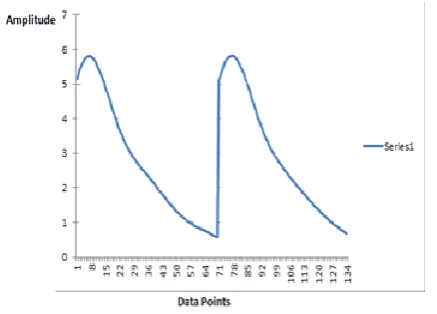
The results obtained after applying the basic triggering logic , as observed on the PC is shown
in Fig.3.3
FIG 3.3.GRAPHICAL PLOT OF DATA CAPTURED ON THE PC
The Fig.3.3 shows the graphical plot of the data logged on the PC in a TDMS file format. The
data values along with the time stamps logged on the PC is shown in Table 3.1
TABLE 3.1:LOGGED DATA VALUES AND TIME STAMPS
5.15299987 18:39 447778us
5.35415649 18:39 447779us
5.518127441 18:39 447780us
5.647171021 18:39 447781us
5.736434937 18:39 447782us
5.787857056 18:39 447783us
5.80305481 18:39 447784us
The Table 3.1 shows the logged values and the timestamps after converting it into UTC. In
Fig 3.2 , the control parameters set on the FPGA show that the threshold has been set to 5 and
the Number of
Samples to acquire has been set to 70 , which indicates that the signal is triggered if its
amplitude exceeds 5 volt and post trigger seventy samples are to be acquired which is
equivalent to a data of seventy microseconds, considering the situation that data is time
stamped in microseconds. The electromagnetic signature of lightning has already been
[image:5.595.191.410.122.279.2] [image:5.595.223.374.395.520.2]A Monthly Double-Blind Peer Reviewed Refereed Open Access International e-Journal - Included in the International Serial Directories.
GE-International Journal of Engineering Research (GE-IJER) ISSN: (2321-1717)
75 | P a g e
Samples to acquire and this parameter would be in microseconds as each sample is acquired
with a microseconds time stamp, after the threshold has been crossed. The implementation of
the algorithm is clear from Fig 3.3 where the acquisition is triggered once the 5 V is crossed
and later seventy data points are acquired as shown in Fig 3.2 and observation from the plot
.The system again waits till the next threshold is crossed once again the acquisition has been
triggered and later seventy data points have been acquired. Since the number of Samples to
acquire has been set to seventy by the user, however, it can be set to any value depending on
the total pulse width of the typical negative Cloud to Ground Lightning.
3.1 Advantages of the implemented basic Triggering algorithm
The significance of the triggering algorithm is efficient data acquisition for long period of
time because the system waits till the trigger point is crossed before acquiring the sample
values along with the time stamp. This helps in efficient data acquisition as there is no
storage of data on the FPGA . Hence, there is no buffer overflow on the FPGA[3][4].This
leads to efficient usage of the memory and also allows data logging for longer period of time.
The limited data can now be sent to the further Sferic processing blocks on the FPGA to
implement the further Sferic processing algorithms in order to determine the data as a valid
lightning data chunk.
4. Conclusion
The current implementation is able to acquire the negative Cloud to Ground lightning within
a frequency range of 3 – 30 Khz . The basic triggering algorithm which has been applied is
based on the
threshold value set by the user. The threshold value is currently a user defined parameter
.This parameter can be made adaptable by implementing the adaptable threshold value by
averaging the sample values when the signal stays below the threshold. The current analog
section of the Sensor Node is designed to work within a frequency range of 3-30 Khz[5]. The
system can be made adaptable in future to work at 1 Mhz frequency, also the digital section
can be implemented with the sampling rate of atleast 10 MS/sec, in order to accurately
A Monthly Double-Blind Peer Reviewed Refereed Open Access International e-Journal - Included in the International Serial Directories.
GE-International Journal of Engineering Research (GE-IJER) ISSN: (2321-1717)
76 | P a g e
References
[1] Harshit Devakumar, Prof.Dr.M.S.Panse, Ajay Khandare and Miheer Mayekar, Design of
Lightning Acquisition And Smart Triggering Using Kintex-7 FPGA And NI cRIO, in International Conference on Recent Trends In Electronics Information Communication Technology, Bangalore India, May 2016,pp.1485-1490(Accepted , yet to be published)
[2] Harshit Devakumar, Ajay Khandare and Prof.Dr.M.S.Panse, Lightning Acquisition and
Processing On Sensor Node Using NI cRIO , International Journal Of Computational
Engineering Research,Vol-06,Issue- 03,March 2016,pp.19-22
[3] D.Bhanu Pratap ,Mr Jaydeep Krishna, Prof.Dr.M.S.Panse and Mr. Rajesh Harsh, Design
of Firmware and Software Application for Motion Control of Multi Leaf Collimator in
Radiotherapy using compactRIO- 9025 as controller, International Journal of Engineering
Research and Applications,Vol-02,Issue- 3,May-Jun- 2012,pp.1375-1378
[4] S.R. Gadgil, D.Verma, Prof.Dr.M.S.Panse and Dr.Kushal Tuckley, Sea State Monitoring
HF Radar
Controller Using Reconfigurable Labview FPGA, in International Conference On Advances in Computing, Control, and Telecommunication Technologies,2009, pp.395-397
[5] Miheer Mayekar, Anil Kulkarni and Bijith Marakarkandy, Designing and simulation of
low frequency cloud to ground lightning receiver for severe weather monitoring application,
in International Conference on Advanced Computing Technologies and Applications, pp.661-670,2015
[6] Swati Sharma, Shoba Krishnan and Ajay Khandare,”Orthogonal Magnetic Loop Antenna
For Lightning Detection” in International Journal of Application or Innovation in
Engineering and Management, 2014
[7] Michael A.Haddad, Vladimir A.Rakov, Steven A.Cummer,”New measurements of
lightning electric fields in Florida: Waveform characteristics, interaction with the ionosphere,
and peak current estimates” in JOURNAL OF GEOPHYSICAL RESEARCH,
A Monthly Double-Blind Peer Reviewed Refereed Open Access International e-Journal - Included in the International Serial Directories.
GE-International Journal of Engineering Research (GE-IJER) ISSN: (2321-1717)
77 | P a g e
[8] Martin A. Uman, and E.Philip Krider,”A Review of Natural Lightning:Experimental Data
and Modeling” in IEEE TRANSACTIONS ON ELECTROMAGNETIC
COMPATABILITY, vol No.2,