Technology (IJRASET)
Various Methods to reduce the Peak to Average
Power Ratio in Orthogonal Frequency Division
Multiplexing
Shally Gujral1, Monika Tuteja2
1,2
Electronics and Communication Department, PTU, Jalandhar (Punjab)
Abstract— The increasing demand on high bit rate and reliable wireless and wire line system has junction rectifier to several new rising modulation techniques. one among the techniques are going to be Orthogonal Frequency Division Multiplexing (OFDM), that offers reliable high bit rate wireless system with cheap complexness. the first reasons OFDM is most popular in most high information measure potency transmission systems ar as a result of it effectively resist Inter Symbol Interference (ISI) and is powerful towards multipath weakening. This paper describes the problem of the height to Average Power magnitude relation (PAPR) in OFDM that could be a major downside, and presents new and variations to existing algorithms to cut back it.
Keywords—OFDM, PAPR, ISI, BER, ACE, CCDF
I. INTRODUCTION
Increase in the demand of wireless systems with high data rates, spectral efficiency and reliability, has led to the designing of enhanced feature system for mobile, fixed and next generation communication. Orthogonal frequency division multiplexing (OFDM) has all the capabilities for high data rate transmission. OFDM basically operates on the principle of splitting high rate data stream into several low rate streams being transmitted simultaneously over a number of subcarriers. All these subcarriers are overlapped with guard band eliminating intersymbol interference (ISI) and increasing efficiency.With all these advantages OFDM systems have several challenges, like, multipath guard interval ISI, high peak to average power ratio (PAPR) etc. but the severe one is PAPR.This high peak to average ratio of power provides high peak signals as input to high power amplifiers (HPA) at transmitters.
II. PAPROFOFDMSYSTEM
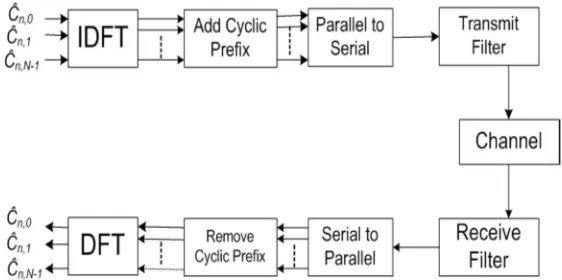
As OFDM signal consists of multiple modulated carriers and able to generate a high peak to average power ratio (PAPR), when these parallel carriers are added up. If N carrier signals which are added together constitute same phase then they generate a peak power which is N times the average power. The increased value of PAPR factor results for clipping noise, non–linear distortion of Power amplifier, BER performance debasement and enhances complexity factor in analog to digital (A/D) or digital to analog (D/A) converter. Let us suppose that, N length data block is represented by the vector as shown X=[X0, X1, X2… XN-1] T where T indicate the duration of any member from set X (Xk), and delineate any single subcarriers {fn ,n=0,1,…..,N-1}. The characteristic feature of multiple subcarriers which are selected to transmit signal is that, they are orthogonal to one another, therefore we have fn
[image:2.612.165.446.563.703.2]= n Δf, where n Δf =1/NT .In this NT indicates the duration of data blocks in OFDM process.
Technology (IJRASET)
III.HYBRIDTECHNIQUES
Hybrid techniques refer to those schemes in which the joint use of more than one PAPR reduction techniques has been proposed. As pointed out by [3], not a single technique can be designated as the best, and choices are usually made based on trade-off between BER, PAPR and overall system complexity.
This covers more recent work as summarized below;
A. Joint PTS and Quantized Clipping Scheme
As obvious from the title, this scheme is a combination of two techniques namely, the conventional Partial Transmit Sequence (PTS) technique and a modified clipping technique. The joint scheme achieves a better trade-off between PAPR and BER performance as compared to other PAPR reduction techniques, as reported by [6]. In this scheme, firstly, the conventional PTS technique is applied to the OFDM signal followed by the modified clipping or quantized clipping (QC).
B. Joint Clippingand Companding Technique
In this technique, clipping & filtering scheme is combined with companding scheme. First, the signalundergoes clipping followed by filtering process used to remove the distortion caused due to clipping. Then, the clipped signal is passed through a companding block. The companding increases the average power of low signal level and attenuates the higher signal level. This technique reduces the PAPR without degrading the BER performance. It has reported that this technique reduces the PAPR to 4 dB without degrading the BER. [1]
C. Joint Precoding and Clipping Technique:
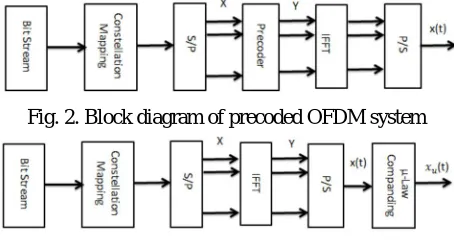
This technique combines the simple clipping scheme with pre-coding or improved Nyquist pulse shaping. The signal is passed through a pre-coding block which acts before the IFFT. This additional block is used to pre-code the pulse shape of the input signal. This removes peaks from the input signal hence reducing PAPR of the signal. The precoded signal (with improved pulse shape) is then passed through the IFFT block. Following IFFT, the signal undergoes clipping to further improve performance of the system.
D. Joint Clipping and ACE Technique:
In this technique, as reported by [9], clipping scheme is combined with Active Constellation Extension (ACE) scheme. Clipping is simple to implement but causes in-band and out-of-band distortion. To remove the in-band distortion, ACE technique is used. ACE technique is based on amplitude pre-distortion of high power amplifier. Due to amplitude pre-distortion, the efficiency of the power amplifier is improved. The advantage comes from the ACE as it does not degrade BER performance.
E. Joint SLM and Quantization ClippingScheme:
This technique, proposed by [10], combines Selective Mapping (SLM) scheme with the quantized clipping scheme. First, the SLM reduces the PAPR and then the quantized clipping operates to improve the efficiency of the system. As it stands, in SLM technique, different copies of the signal are generated and multiplied with different phase sequences.
IV.PAPRINOFDMUSINGHIGHERORDER PARTITIONEDPTSSEQUENCEANDBOSECHAUDHURI HOCQUENGHEMCODES
Orthogonal frequency division multiplexing is the desirable technique to achieve higher speed in data rates and better spectrum
efficiency. In OFDM [1] first higher data stream has been divided into lower streams of data and after modulation these data streams
are together transmitted by orthogonal subcarriers. One of the major challenges in OFDM system is high Peak to average power
Ratio (PAPR), which produced non linear distortion and degrades system performance. As a consequence of increased value of
PAPR, HPA starts operating in non linear region, hence transmitted data be came distorted. One of the simple approaches is clipping
technique [3], in which PAPR has been diminished by clipping the higher peaks of the signal. This technique sometimes encounters
with in-band and out- band interference.
V. PAPRREDUCTIONUSINGPRECODINGANDCOMPANDINGTECHNIQUES
Technology (IJRASET)
[image:4.612.193.420.161.281.2](OFDM) has all the capabilities for high data rate transmission. OFDM basically operates on the principle of splitting high rate data stream into several low rate streams being transmitted simultaneously over a number of subcarriers. All these subcarriers are overlapped with guard band eliminating intersymbol interference (ISI) and increasing efficiency. With all these advantages OFDM systems have several challenges, like, multipath guard interval ISI, high peak to average power ratio (PAPR) etc. but the severe one is PAPR.This high peak to average ratio of power provides high peak signals as input to high power amplifiers (HPA) at transmitters.
Fig. 2. Block diagram of precoded OFDM system
Fig. 3. Block diagram of companded OFDM system
VI.PAPRINMULTIPLE-INPUTMULTIPLE-OUTPUTORTHOGONALFREQUENCY-DIVISIONMULTIPLE ACCESSSYSTEMSUSINGGEODESICDESCENTMETHOD
Orthogonal frequency-division multiplexing (OFDM) schemes [1] are the key modulation for broadband wireless communications over severely time-dispersive channels. However, OFDM signals have high envelope fluctuations and high peak-to-average power ratio (PAPR), which leads to amplification difficulties since linear amplifiers with high backoff are required, which reduces the amplification efficiency [2]. Since the amplifier backoff is lower-bounded by the PAPR, it is desirable to reduce the PAPR of OFDM signals so as to improve the amplification efficiency. Over the last decades, countless techniques were proposed to reduce the PAPR of OFDM signals from the simpler clipping techniques [3–6] to more complex techniques involving different levels of optimisation [7, 8]. Selected mapping (SLM) and partial transmit sequences are among the most popular techniques [9–11]. However, generalisation of these techniques to multiple-input multiple-output (MIMO) systems is not straightforward.
VII. LOW-COMPLEXITYPAPRREDUCTIONMETHOD
Multicarrier transmission such as orthogonal frequency-division multiplexing (OFDM) has been successfully used in various wireless communication technologies. The OFDM system brings the advantages of avoiding frequency selective fading, narrow band interference and inter-symbol interference [1, 2]. The easy implementation of this system, by using fast Fourier transform (FFT), is also quite attractive. However, the OFDM signal is a sum of orthogonal frequency modulated subcarriers. When subcarriers weighted with the corresponding symbol values are added coherently, the resulting high peak-to-average power ratio (PAPR) becomes a major drawback of the OFDM systems due to reduced power efficiency in radio frequency power amplifier (PA) and digital-to-analogue converter (DAC) modules. High PAPR prevents the PA from operating within its linear region, causes additional interference, and induces bit error rate (BER) performance degradation. Moreover, it demands a wider dynamic range in DAC to accommodate the large peaks of the OFDM frame (signal). Such a situation leads to inefficient amplification and increases the cost of the system. Therefore, PAPR reduction techniques play an essential role to improve power efficiency in the OFDM systems.
VIII. PAPRREDUCTIONUSINGCOMBINATIONOFPRECODINGWITHMU-LAWCOMPANDINGTECHNIQUE FORMIMO
Technology (IJRASET)
Multiplexing: In MIMO Multiple antennas are used to send and receive the data.
IX.PAPRREDUCTIONOFOFDMTHROUGHPILOTSHIFTING
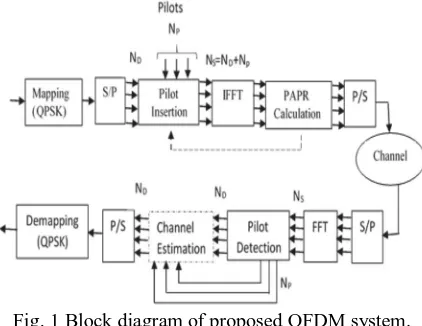
[image:5.612.200.411.225.388.2]This scheme performs very well at a smaller number of pilots without increasing average signal power. It is a ‘blind’ scheme in the sense that it does not send any side information to the receiver. The pilot locations are detected at the receiver efficiently. The accuracy rate is more than 90% for the cases of SNR above 3 dB. The detection scheme performs excellently at a small number of pilots and acceptable detection accuracy is observed at very low SNR. For this reason, it does not degrade BER significantly. Reducing P APR is an important factor in MIMO- OFDM, because it degrades the power amplifier performance. Above the threshold range they become non linear resulting in signal distortion. Several techniques are found in literature to reduce the P APR viz. Coding, Interleaving, selected level mapping, partial transmit sequence, tone reservation [5, 6, 7]. In this paper unitary matrix Precoding with Companding Technique is proposed to reduce the Peak-to-Average Power ratio.
Fig. 1 Block diagram of proposed OFDM system.
X. JOINTCLIPPINGANDAMPLIFYINGTECHNIQUES
The peak clipping and amplification technique is described for multicarrier transmission. In CPAB method, the process of clipping is independent of amplification, where values of
clipping threshold A and amplifying threshold B will determine the value of PAPR and performance for OFDM system. For this, a
balance between reduction and system performance must be required. In addition, the computation calculation is considerably large
when N is increased. Simulation has shown that the algorithm is reliable to estimate the selection of A and B. Large CCDF leads to
improve PA efficiency but with high BER at receiver. Thus, it degrades the system performance. Therefore, the relationship between them must be created to maintain system performance.
XI.ALOWCOMPLEXITYPAPRREDUCTIONSCHEMEBASEDONRADIX-IIIFFT
It is a new computational complexity reduction scheme based on radix-2 inverse fast Fourier transform is proposed. This scheme is
based on N/4 decisive different phase multiplications to the input OFDM signal. The result shows that at about the same PAPR
reduction performance this proposed method provides at least 46.8% complexity reduction compared to CSLM. In this proposed
method only one IFFT is needed, because only N/4 phase vector elements have to be altered by using bi matrices. Hence instead of
using the new IFFT, the idea here is to save the calculations related to the unchanged phases and using them for subsequent search operations.
XII. RECURRINGSLMWITHCYCLICBLOCKCODESSCHEMES
It is a low complexity and easy-toimplement PAPR reduction technique, which incorporated a modifier and a demodifier at the transmitter and the receiver, respectively. Due to simple mathematical and signal operations at the transmitter and at the receiver,
the computational complexity of the proposed technique requires only 4N real additions, which is the lowest among all the available
Technology (IJRASET)
technique is the same. Thus, the proposed technique proffers low complexity, full spectral efficiency, and full data rate without signal distortion and requires no side information to be transmitted.
XIII. PAPRREDUCTIONINEMPLOYINGHIGHERORDERQAM
In this scheme two novel schemes are presented to enhance the PAPR reduction performance of companding transforms in OFDM systems employing higher order QAM. Probabilistic model of the average OFDM symbol power and amplitude is developed and utilized in the design of the proposed schemes. Performance gain is achieved by making the companding operation adapt to changing amplitude distribution, which involves adjusting it according to the average power of input OFDM symbols during application run-time. Simulation results show that the proposed schemes have the unique capability of jointly reducing the PAPR and BER, while keeping OBI unchanged. Hence, the overall performance of the system is significantly enhanced. The schemes have been effectively applied to several state-of-the-art companders. Furthermore, the schemes also enhance the system’s adaptability by providing more possible operating conditions than those viable with conventional companding.
XIV. ITERATIVECLIPPINGANDFILTERINGTECHNIQUEALONGWITHCONVOLUTIONALCODE
A simple iterative clipping and filtering with convolutional codes technique to reduce the PAPR of the OFDM signals. Matlab coding result shows that the proposed technique reduces PAPR more than the existing classical ICF and optimized ICF method without much degradation of the BER. We can further improve the BER performance by using MIMO technique. a simple iterative clipping and filtering with convolutional codes technique to reduce the PAPR of the OFDM signals.
XV. CORRELATIVELYPRECODEDOFDMWITHREDUCEDPAPR
New correlative precoders are designed to endow correlatively precoded OFDM waveforms with reduced PAPR while preserving improved spectral sidelobe suppression or enhanced ICI selfcancellation, either jointly or respectively. By proportioning the correlative order N ¡ M into PAPR reduction order K, ICI selfcancellation order I, and spectral sidelobe suppression order L, we have shown that joint performance characteristics of reduced PAPR, enhanced ICI selfcancellation and improved spectral compactness can be achieved with regular tendency. For IS, PS, and PISprecoded OFDM waveforms providing desired f¡2L¡2 spectral sidelobe decaying, better ICI self cancellation or PAPR reduction can be achieved respectively or jointly at the cost of imposing more redundancy through correlative precoding.
XVI. CONCLUSION
This paper projected and compared techniques for PAPR reduction in OFDM transmission. we compare our proposed technique with other well-known PAPR reduction techniques in terms of BER, data rate, and computational complexity. Furthermore, the error performance of the OFDM system with and without the proposed technique is the same. Due to the low computational complexity of the proposed PAPR reduction technique, it can be implemented using field programmable gate array (FPGA), which is a good future extension of this paper.
REFERENCES
[1] N. Jadhav, M. V. Kutwal, “BER and PAPR Reduction Using Companding Algorithms in OFDM”, International Journal of Application or Innovation in Engineering & Management (IJAIEM),vol. 3, Issue 1, January 2014.
[2] Dinis, R., Gusmão, A.: ‘A class of nonlinear signal processing schemes for bandwidth-efficient OFDM transmission with low envelope fluctuation’, IEEE Trans. Commun., 2004, 52, (11), pp. 2009–2018.
[3] Müller, S., Bräuml, R., Fisscher, R., et al.: ‘OFDM with reduced peak-to-average power ratio by multiple signal representation’, Ann. Telecommun., 1997, 52, (1–2), pp. 58–67.
[4] Krongold, B., Jones, L.: ‘An active-set approach for OFDM PAR reduction via tone reservation’, IEEE Trans. Signal Process., 2004, 52, (2), pp. 495–509 9 Han, S.H., Lee, J.H.: ‘An overview of peak-to-average power ratio reduction techniques for multicarrier transmission’, IEEE Wirel. Commun. Mag., 2005, 12, (12), pp. 56–65.
[5] Cimini, L. Jr., Sollenberger, N.: ‘Peak-to-average power reduction of an OFDM signal using partial transmit sequences’, IEEE Commun. Lett., 2000, 4, (3), pp. 86–88 11 Muller, S., Huber, J.: ‘OFDM with reduced peak-to-average power ratio by optimum combination of partial transmit sequences’, Electron. Lett., 1997, 33, (5), pp. 368–369.
[6] Siegl, C., Fischer, R.F.: ‘Selected basis for PAR reduction in multi-user downlink scenarios using lattice-reduction-aided precoding’, EURASIP J. Adv. Signal Process., 2011, 2011, (17), pp. 1–11.
[7] Baek, M.-S., Kim, M.-J., You, Y.-H., et al.: ‘Semi-blind channel estimation and PAR reduction for MIMO-OFDM system with multiple antennas’, IEEE Trans. Broadcast., 2004, 50, (4), pp. 414–424.
Technology (IJRASET)
[9] Y. Wang, L.-H. Wang, J.-H. Ge, and B. Ai, “An efficient nonlinear companding transform for reducing PAPR of OFDM signals,” IEEE Trans.Broadcast., vol. 58, no. 4, pp. 677–684, Dec. 2012.
[10] S.-S. Jeng and J.-M. Chen, “Efficient PAPR reduction in OFDM systems based on a companding technique with trapezium distribution,” IEEE Trans. Broadcast., vol. 57, no. 2, pp. 291–298, Jun. 2011.
[11] J. Hou, J. Ge, D. Zhai, and J. Li, “Peak-to-average power ratio reduction of OFDM signals with nonlinear companding scheme,” IEEE Trans. Broadcast., vol. 56, no. 2, pp. 258–262, Jun. 2010.
[12] J. Hou, J. H. Ge, and J. Li, “Trapezoidal companding scheme for peakto- average power ratio reduction of OFDM signals,” Electron. Lett., vol. 45, no. 25, pp. 1349–1351, Dec. 2009.
[13] S. A. Aburakhia, E. F. Badran, and D. A. E. Mohamed, “Linear companding transform for the reduction of peak-to-average power ratio of OFDM signals,” IEEE Trans. Broadcast., vol. 55, no. 1, pp. 155–160, Mar. 2009.
[14] ArunGangwar and ManushreeBhardwa j,”An Overview: Peak to Average Power Ratio in OFDM system & its Effect”, International Journal of Communication and Computer Technologies vol. 01 – 02, Issue: 02 (IJCCT), ISSN NUMBER: 2278-9723, September 2012.
[15] Leman Dewangan, Mangal Singh and NeelamDewangan,“A Survey of PAPR Reduction Techniques in LTE-OFDM System”, International Journal of Recent Technology and Engineering (IJRTE), ISSN: 2277-3878, vol-1, Issue-5, November, 2012.
[16] E.Al-dalakta, "PAPR and ICI Reduction Techniques for OFDM Based". Newcastle Unversity, 2012.
[17] Y. Rahmatallah and S. Mohan, "Peak-To-Average Power Ratio Reduction in OFDM Systems: A Survey And Taxonomy". IEEE Communications Surveys & Tutorials, 15(4), 1567–1592, 2013.
[18] C. Pradabpet, S. Chivapreecha, and S. Yimman, "The Hybrid of PTSCAPPR Methods with MA for PAPR Reduction in OFDM Systems". In 13th International Symposium on Communications and Information Technologies (ISCIT) (pp. 680–684). Bangkok, Thailand: Phranakhon Si Ayutthaya Rajabhat University, 2013.
[19] X. Li and L. J. Cimini, "Effects of Clipping and Filtering on the Performance of OFDM". IEEE Communications Letters, 2(5), 1998.