Performance Enhancement of Facial Expression
Recognition using Appearance based features
Jaimini Suthar1, Mahesh Goyani2
Department of Computer Science Engineering, Gujarat Technological University
Abstract— Ability of recognizing facial expression is important part of behavioural science, which helps to ease the communication. This ability can serve in many contexts. Hence, facial expression is an important research area over the last two decades. In this paper, describes the extraction of the minimum number of Gabor wavelet parameters for the recognition of facial expressions and work with facial components like eyes and mouth by using hierarchical approach. The objective of our research was to investigate the performance of a facial expression recognition system and less work with feature extraction to classify expression. This system recognizes basic seven expressions happy, sad, neutral, angry, surprise, fear and disgust. We present a hierarchy for facial region extraction from static image. For determination of face effective areas is used from bounding box. This method has high ability in intelligent selection of areas in facial expression recognition system. Using determination of effective areas classify expression directly. Remaining faces fed to Gabor filter and it further reduces by Principle Component Analysis (PCA) to classify expression using Euclidean distance. Results test on JAFFE database indicates that proposed system for facial expression recognition is good accuracy and generating superior results as compared to other approaches.
Keywords— Facial Expression Recognition (FER), Feature Extraction, Gabor Filter, Principle Component Analysis (PCA),
Linear Discriminant Analysis
I. INTRODUCTION
A human face has significant and unique characteristics, which play most dominant role in recognizing the expression of human faces. Facial Expression Recognition (FER) defined as a change that happens in response to human internal emotional states. It is used in different application of Human Computer Interaction (HCI) like face image processing, facial video surveillance system, and facial animation in the area of Computer Vision, Digital Image Processing and Artificial Intelligence. Automatic recognition of human expression is challenging task and has gained much attention during recent years. In FER, the stage of feature extraction plays a major role. In literature [1], Mehrabian et al. have shown that facial expression contributes 55% to the total communication. While vocal and verbal contributes 38% and 7% respectively.
Ekman and Frisen have identified six basic universally accepted expression in their research discussed in [2]. These basic six expressions are happy, angry, disgust, sad, fear and surprise.
The purpose of the research is to develop an automated and interactive computer vision system for the recognition of human facial expressions. Due to recent advances in image processing, it opens up the wide possibility of interaction with the machine and provides the different techniques for the automatic detection of face from image and classification of emotional and conversational facial signals. Space-time analysis for understanding the facial expressions in the previous work, however suffer the following shortcomings:
A. Most of these technologies are not in real-time to respond to the facial expression of the user. Facial movement patterns are trained offline from the training image dataset, since it limits its reliability for applications large variations between and contains a large number of possible Face action unit combinations [2].
B. In FER, for feature extraction, different techniques are available which depends on geometric and appearance based features. However, these techniques having performance variant according to the input images, rate of recognition of each expression and timely manner.
C. At the step of Classification of expression, classifiers do not generalize well for each expression and adapt the specific properties of database [3].
II. METHODOLOGY
Working with Appearance based features of Human faces for recognizing expression accurately, there is different steps performed for processing, feature extraction and classification. But there is some problem like choosing an appropriate pre-processing method for facial images, finding feature vectors using feature extraction techniques and appropriate classifier. From Literature Survey Gabor Filter reveal more facial expression as both transient and in in-transient way [2].It is favoured by most researcher because its outstanding performance in facial Expression analysis.
A. Gabor filter bank with 5 frequencies and 8 orientations which is normally used for feature extraction require more computational time and handle large number of feature vectors.
B. Secondly, Gabor Filter, when combine with another feature extraction algorithm are complicated to construct. For the solution of following problem is to improve a performance by reducing size of feature vector and work with minimum number of features using PCA followed by Gabor.
C. Working with Facial components such as the eyes and mouth are sufficient for to distinguish facial expression [2].
D. To minimize Gabor feature vectors and working with facial components so, increase performance in terms of recognition rate.
E. Making hierarchical approach for classification of expression. FER proceed in mainly three steps [6]:
1) Preprocessing
2) Feature Extraction
3) Classification
For the proposed methodology, Database: Standard Available Facial Expression Database such as a JAFFE Database. The database contains 213 images of 7 facial expressions (6 basic facial expressions + 1 neutral) posed by 10 Japanese female models. Each image has been rated on 6 emotion adjectives by 60 Japanese subjects [16].
Steps of Proposed Method:
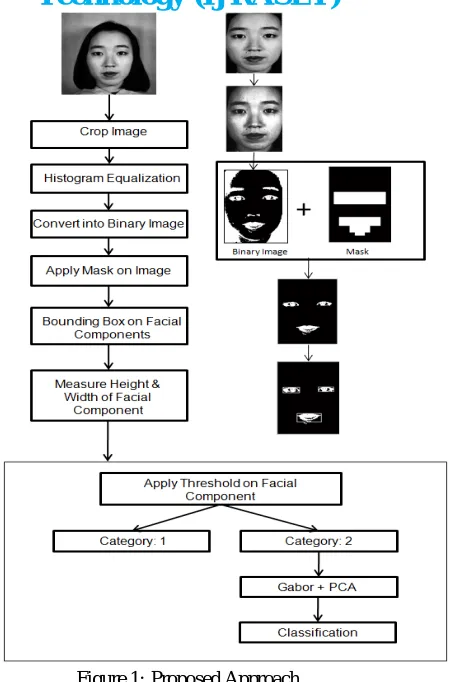
a) Crop the image to localize the face because in facial image there is some background detail which is not necessary.
b) Apply histogram equalization on cropped image. To enhances the contrast of images by transforming the values.
c) Convert image into Binary Image by applying following pseudo code: for each pixel p( i , j ) of image
if pixel p( i , j ) < threshold p( i , j ) ← 0 ;
else
p ( i , j ) ← 255;
end if end for
d) Apply Mask on the Image. The mask is also binary image.
e) Bounding Box on Facial components (Eyes and Mouth). Make bounding box around connected components by pixel 8 and making areas of each facial component.
f) Measure the height and width of facial components. Using bounding box there is box around each eye and mouth by which height and width is measured.
g) Based on Facial components parameters ( Lip Width, Lip Height, Eye Height, Eye Width and its ratio) classify two cluster of expressions are:
i. First is Category: 1 Happy.
ii. Second is Category: 2 Angry, Fear, Disgust, Neutral, Sad and Surprise.
h) On Category: 2, apply GABOR+PCA to extract the features. Gabor Filter having high number of feature redundancy and applies PCA on that to reduce its size.
i) Apply Classification on extracted features using Euclidean Distance.
Figure 1: Proposed Approach Measurement of Facial Components
Here, for the proposed methodology measurements of facial components are taken for point of hierarchical approach. As shown in table 4.1 the parameters are calculated for 30 images in each 7 expression of 10 subjects. It shows average of each expression’s eyes and lip’s height and width and further computing ratio of width/ height.
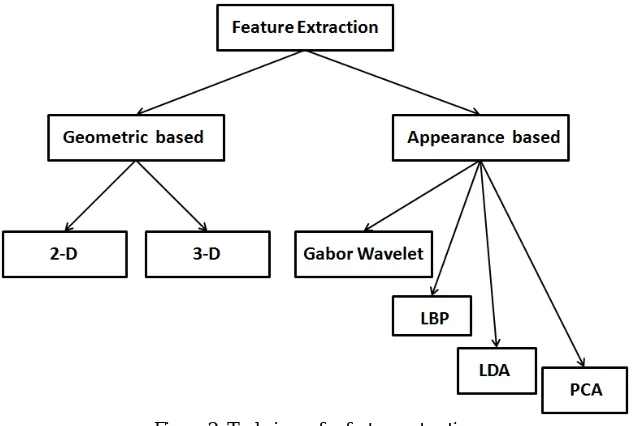
[image:4.612.212.439.66.407.2]After the localization of the face and facial components of the input image, the next step is to extract representative features. Extracting a features affected with expression, is a crucial step from all steps of FER [5]. These feature parameters are further divided into two parts: Geometric based and Appearance/Texture based [6]. As shown in Figure1 different techniques for Appearance based features.
Figure 2: Techniques for feature extraction
Priya Sisodia et. al [6] have used gabor filter bank for detecting an appearance based features. Image was first converted to gray scale and then face was detected and resized. Few of the most representative features are selected through feature selection method and SVM was used for classification.
Rosdiyana Samad et. al [3] developed the algorithm to identify minimum number of Gabor wavelet parameters for natural FER. They convert image into grayscale and resize before applying a Gabor filter after that Gabor features are down sampled and dimensions of feature vector were reduced using PCA. Classification using SVM claims 81.7% recognition rate for FEEDTUM database.
Gabor filter, named after Dennis Gabor, is a linear filter used for detection of edge. Orientation and frequency representations of Gabor filters are similar to those of the human ocular system, and they have been found to be specially reserve for discrimination and texture representation. In the spatial domain, Gaussian kernel function for a 2D Gabor filter which is modulated by a sinusoidal plane wave. Gabor Wavelet is essential filter, which is used to extract local features from image with applying different scale and orientation. Gabor function is defined as [8]:
Where (x, y) represents the pixel position, for center accuracy of filter plane, shows the orientation of Gabor filter, is
standard deviation in x and y direction and and from following equation
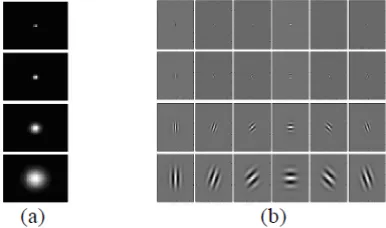
This Gabor function has a Gabor filter in all orientations and then it convolute with the images as shown in figure 3.
Samad Rosdiyana et. al [5] have presented use of edge-based feature extraction with Gabor Features. Image was filter by Gabor and convolute with multiple edge detector. They were use multiple edge detector because each edge detection problem of manual selection of threshold value. The features are reduced in dimension by PCA and classify by SVM, which resulted 91.7% recognition rate for FEEDTUM database among all subject dependent recognition.
Figure 3: Gabor kernel having (a) Four scales and (b) six orientations [8]
Figure 4: Convolute Image with Gabor filter
Due to large number of feature vectors from Gabor Filter,Gabor filter convolute with Image having large number of feature vector.
SizeofGaborFeatures = (m* n * u * v)/(d1*d2) m=number of raw of image
n=number of column of image u=number of scale
v=number of orientation d1=downscaling vector d2=upscaling vector
m=256,n=256, u=5, v=8, d1=4,d2=4 SizeofGaborFeatures = 163840 * 1
So, PCA apply on Gabor Features to reduce size.
PCA is a statistical method for feature extraction, reducing the dimensionality of features. Each face is represented by Eigen vectors which called Eigen faces [12]. Principle steps of algorithm as follows [6]:
1. Normalize all the faces; each image is stored in a vector of size N.
2. Calculate average vector and Subtract average face from each face vector Mean Face as shown in Figure 2.9.
[image:6.612.181.432.224.375.2]Cov= Cov V =⋀V
Where V eigenvectors with respect to eigenvalues
4. Order eigenvectors: Select k best Eigenvector : This matrix of eigenvectors is called eigenspace.
V
5. Project training image: Each of the images is projected into the eigenspace and it called Eigen Faces as in Figure 2.10.
In generally image size is not issue for PCA, but it gives n good result in pose and expression variant images but not in illumination affected images [12].PCA having recognition rate, quick speed and simple calculation [6].
Then, Euclidean Distance is used for classification.
we apply PCA for feature reduction and for classification we use Euclidean Distance.
Euclidean Distance:
Euclidean Distance is a simplest method for classification based on the ordinary distance between two points [11]. The distance between two points A = (x1, y1) and B = (x2, y2) is:
d (A, B) =
III.RESULT
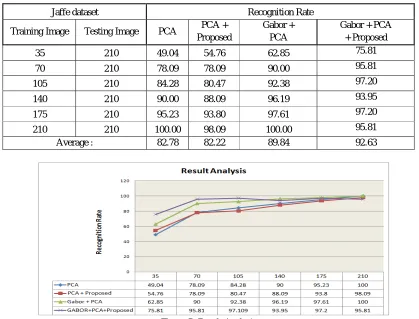
[image:7.612.97.516.392.711.2]TABLE 1:COMPARISON TABLE OF RECOGNITION RATE
Figure 5: Result Analysis
Jaffe dataset Recognition Rate
Training Image Testing Image PCA PCA + Proposed
Gabor + PCA
Gabor + PCA + Proposed
35 210 49.04 54.76 62.85 75.81
70 210 78.09 78.09 90.00 95.81 105 210 84.28 80.47 92.38 97.20
140 210 90.00 88.09 96.19 93.95
IV.CONCLUSIONS
This paper presents investigation and implementing of FER framework which improve the Performance of FER and reducing complexity. This hybrid approach having a good recognition rate compares to other methods of FER and performance is high due to segment the facial image into expression interested region such as an eye, eyebrows, and mouth, which have less size compared to whole image. Gabor + PCA + Proposed having 92.61 % with Euclidean Distance classification, which is higher than Neural network and SVM. In Future, we will make more work with facial component and based on classify more classes which increase performance of feature algorithm.
REFERENCES
[1] Mehrabian A., "Communication without words", Psychology Today, Vol. 2, No. 4, 1968, pp. 53-56.
[2] Ekman, P and Friesen, W, "Facial Action Coding System : A Technique for the Measurement of Facial Movement", Consulting Psychologists Press, Palo Alto, 1978 pp. 10-11.
[3] Samad, Rosdiyana, and Hideyuki Sawada. "Extraction of the minimum number of Gabor wavelet parameters for the recognition of natural facial expressions." Artificial Life and Robotics 16, no. 1 (2011) Springer: pp. 21-31.
[4] Meher, Sukanya Sagarika, and Pallavi Maben. "Face recognition and facial expression identification using PCA." In Advance Computing Conference (IACC), 2014 IEEE International, pp. 1093-1098. IEEE, 2014.
[5] Samad, Rosdiyana, and Hideyuki Sawada. "Edge-based Facial Feature Extraction Using Gabor Wavelet and Convolution Filters." In MVA, pp. 430-433. 2011.
[6] Sisodia, Priya, Akhilesh Verma, and Sachin Kansal. "Human Facial Expression Recognition using Gabor Filter Bank with Minimum Number of Feature Vectors." International Journal of Applied Information Systems (IJAIS) – ISSN: 2249-0868, Volume 5 – No. 9, July 2013 pp. 9-13.
[7] Thai, Le Hoang, Nguyen Do Thai Nguyen, and Tran Son Hai. "A facial expression classification system integrating canny, principal component analysis and artificial neural network." arXiv preprint arXiv:1111.4052 (2011).
[8] Abdulrahman, Muzammil, Tajuddeen R. Gwadabe, Fahad J. Abdu, and Alaa Eleyan. "Gabor wavelet transform based facial expression recognition using PCA and LBP." In Signal Processing and Communications Applications Conference (SIU), 2014 22nd, pp. 2265-2268. IEEE, 2014.
[9] Sobia, M. Carmel, V. Brindha, and A. Abudhahir. "Facial expression recognition using PCA based interface for wheelchair." In Electronics and Communication Systems (ICECS), 2014 International Conference on, pp. 1-6. IEEE, 2014.
[10] Poon Bruce, M. Ashraful Amin, and Hong Yan. "Performance evaluation and comparison of PCA based human face recognition methods for distorted images." International Journal of Machine Learning and Cybernetics 2, no. 4 (2011): 245-259.
[11] Rahulamathavan, Yogachandran, RC-W. Phan, Jonathon A. Chambers, and David J. Parish. "Facial expression recognition in the encrypted domain based on local fisher discriminant analysis." Affective Computing, IEEE Transactions on 4, no. 1 (2013): 83-92.
[12] Sarawagi, Varsha, and K. V. Arya. "Automatic facial expression recognition for image sequences." In Contemporary Computing (IC3), 2013 Sixth International Conference on, pp. 278-282. IEEE, 2013.