Technology (IJRASET)
Fetal ECG Extraction & Analysis Using Wavelet
Transform
Manali Khandve#1, Pooja Khude*2, Aeshwarya Ingale#3, Anil Wanare#4
1,2,3
Student, E&TC, Dr. D.Y. Patil School Of Engineering, Pune,India.
4
Asst.Professor, E&TC, Dr. D.Y. Patil School Of Engineering, Pune,India.
Abstract- The fetal electrocardiogram (ECG) is an analytical tool that measures and records the electrical movement of the heart of the fetus during pregnancy and provides fine details. Analysis of these details allows analysis of a wide range of heart conditions. During this study we propose an algorithm to extract fetal electrocardiogram (FECG) from signals measured of the mother’s abdomen and thorax. As past, lots of studies works have been carry out in this field. A few of these are filtering method and threshold, neural network method, adaptive method and others. Wavelet transform technique is the most popular and efficient method for determining ECG characteristic. This paper explain three algorithm for to find out the fetal heart rates , the proposed algorithm consists of three steps: 1) Abdominal ECG signal (AECG) is acquired from mother’s abdomen and disintegrated to estimate maternal apparatus (MECG signal) using wavelet transform 2) FECG signal is extracted by subtracting MECG signal from AECG signal. 3) Then fetal R peaks are calculated in extracted FECG signal to detect fetal heart rate. This algorithm is implemented on 6 recorded signals using MATLAB and analysis is carried out and results are obtained from this analysis are satisfactory.
Keywords— FECG (Fetal Electrocardiogram), AECG (Abdominal Electrocardiogram), MECG (Mother’s Electrocardiogram), FHR (Fetal Heart Rate),
I. INTRODUCTION
Every year, one of hundred babies born with a few heart defects. Thisisoccurs because of genetic disease, environmental condition like mistreatment of drugs. Heart monitoring is necessary before birth of baby. Hence, Fetal ECG (FECG) signals are essential to observe the heart situation of the fetus, hence any abnormalities detected then it can be solved and observed by doctors. Monitoring FECG is a diagnosis method to observe abnormalities in fetus. During pregnancy stage doctors can easily diagnosis and proper decision can be taken. This is the simplest way to analyse different heart disorder. Different electrical movement of the heart is represented by the FECG and it provides important information.Maternal electrocardiogram (MECG) signal is obtained from chest and FECG signal can be simply obtained from the abdomen of a pregnant women. The subtraction of AECG from MECG results FECG. By placing electrodes on the maternal chest and abdomen, the signal, is generated, gives information regarding the fetal condition which is mostly helpful during diagnosis. The maternal ECG (MECG) signal contains many unwanted interference such as maternal electromyogram (EMG), baseline wander and skin impedance. While abdominal ECG signals contains power line interference, random noise.
Detection of the FECG signal have various methods such as adaptive filtering, neuro-fuzzy, multivariate, neural methods and others .We propose Wavelet Transform for extracting Fetal ECG, wavelet has varying frequency and limited duration. To overcome the limitation of Fourier analysis wavelet analysis is Used. It has special ability to examine signal simultaneously in both time and frequency domain. ICA and PCA techniques are used in Wavelet Transforn. Independent Component Analysis (ICA) is a suitable method for separating unknown component, the FECG “source” from the rest; some different ICA. ICA estimated by INFOMAX algorithm. Principle Component Analysis is suitable for separating known components. Both ICA and PCA are used for data set reduction. In this case we suggest the algorithm for wavelet transform to extract FECG signal to improve the consistency of the FHR extraction. While the amplitude of the extracted FECG signal are all time fluctuated, many methods are not able to detect all the R peaks accurately due to threshold dependency. We propose a threshold detection algorithm, which aim to overcome the complexity of the amplitude threshold and to identify the overlapped R peaks. The proposed algorithm consists of two steps: the AECG and MECG signals using wavelet transform. Then the fetal peaks are detected from FECG signal and FHR are calculated.
II. LITERATURE REVIEW
Technology (IJRASET)
fetal electrocardiogram (FECG) from signals measured of the mother’s abdomen. And which is a diagnostic method that measures and records the electrical activity of the heart of the fetus during pregnancy and provides exquisite details.
B. “Research of fetal ECG extraction using wavelet analysis and adaptive filtering.” Shuicai Wu an, Yanni Shen a, Zhuhuang Zhou a, Lan Lin a, Yanjun Zeng a,n, Xiaofeng Gao [2] (July 2013) . This paper state that a new method for fetal ECG extraction based on wavelet analysis, the least mean square (LMS) adaptive filtering algorithm, and the spatially selective noise filtration (SSNF) algorithm. First, abdominal signals and thoracic signals were processed by stationary wavelet transform (SWT), and the wavelet coefficients at each scale were obtained.
C. “Fetal ECG Extraction from Maternal Abdominal ECG Using Neural Network” M. A. Hasan1, M. I. Ibrahimy1, M. B. I. Reaz2[3] (2009) This paper conclude that developed algorithms on FECG signal extraction from the abdominal ECG signal using Neural Network approach to provide efficient and effective ways of separating and understanding the FECG signal and its nature.
D. “ECG Signal Denoising By Wavelet Transform Thresholding” Mikhled Alfaouri and Khaled Daqrouq Communication and Electronics Engineering Department of Philadelphia University, Jordan, 19392. [4] (2008) According to this paper a new approach based on the threshold value of ECG signal determination is proposed using Wavelet Transform coefficients. Electrocardiography has had a profound influence on the practice of medicine. The electrocardiogram signal contains an important amount of information that can be exploited in different manners.
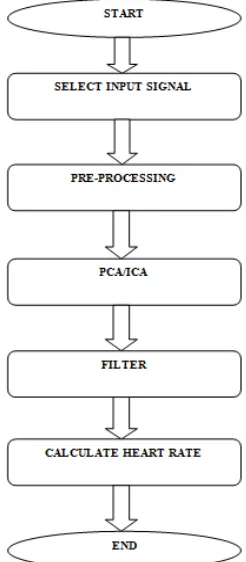
III. METHODOLOGY
[image:3.612.227.350.331.612.2]A. Following methods is adopted for the study
Fig 1. Flowchart for Methodology
IV. WORKING
A. Input signal- We acquire four different ECG signal form mother’s abdomen and chest with help of four different electrodes. Signals are up to 30 weeks of pregnancy.
Technology (IJRASET)
data set reduction. Independent Component Analysis are used for unknown components. Both ICA and PCA are used for signal plotting.
D. Filters-We use Savitzky –Golay filter (sgolay) and Median filter. Golay filter is a digital filter that can be applied to a set of digital data for purpose of smoothing. Median filter is a non linear digital filtering technique often used to remove noise. Such noise reduction is a typical pre-processing step to improve the result of later processing. Both filters PSNR are measure.
E. Calculation of Heart Rate- Comparing both PSNR R peaks are calculated. Which helps to measure Fetal Heart Rate (FHR).
V. RESULT
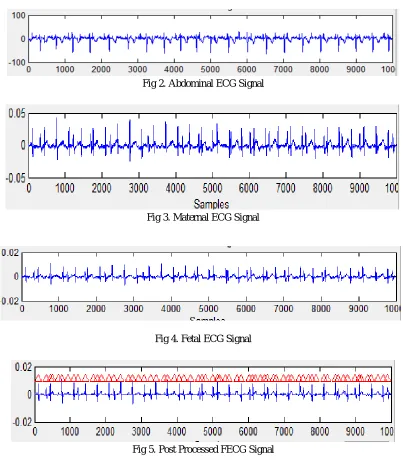
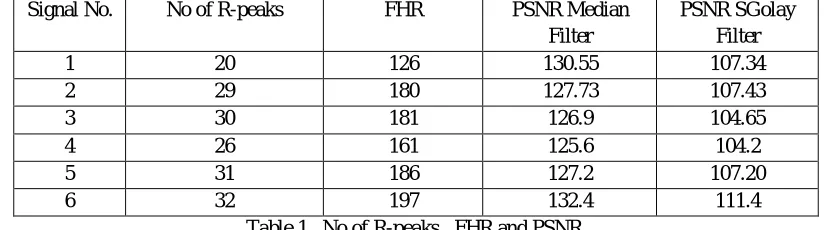
[image:4.612.103.506.249.710.2]The proposed method is implemented on six different signals of dissimilar development period and at the end fetal ECG is extracted. The recordings are shown in fig. 2 shows original AECG signal obtained from Physionet database, fig. 3 shows an estimated MECG signal during the procedure and the extracted fetal ECG is shown in the fig. 4 and fig.5 shows post processed signal. Table 1 summarizes the results obtained by the proposed methodology that includes no. of detected R peaks in the fetal ECG signal and the FHR and also PSNR of both SGolay and median filters.
[image:4.612.108.505.256.470.2]Fig 2. Abdominal ECG Signal
Fig 3. Maternal ECG Signal
Fig 4. Fetal ECG Signal
Technology (IJRASET)
Signal No. No of R-peaks FHR PSNR Median Filter
PSNR SGolay Filter
1 20 126 130.55 107.34
2 29 180 127.73 107.43
3 30 181 126.9 104.65
4 26 161 125.6 104.2
5 31 186 127.2 107.20
[image:5.612.98.514.78.193.2]6 32 197 132.4 111.4
Table 1. No of R-peaks, FHR and PSNR.
VI. CONCLUSION
Various experiments showed that proposed technique achieved excellent results and all the fetal R peaks presented in the AECG signal are detected successfully Post Processed signal. Fetal heart rate and PSNR of both Sgolay and Median filters are calculated and obtained good results. After summarizes the result of the detection on six recorded signals which shows successfully detected R peaks in FECG signals and estimated heart rate of the fetus and PSNR. This study will be practically helpful in medical science which will be utilized for identification of fetus age which avoids miscarriages during pregnancy, also this study will be helpful for to detect the growth and development fetus .
VII.ACKNOWLEDGEMENT
We have immense pleasure in presenting this study. I express my honest and sincere thanks to my guide Prof. Anil. L. Wanare, for his consistent guidelines, inspiration and sympathetic attitude throughout the BE project work. Our sincere thanks towards, Prof. S. N. Kulkarni (Head of Department) for his guidance, valuable suggestions and constant support throughout this work. We are also thankful to all the staff members of Electronics & Telecommunication Department. We are highly obliged to Dr. S. S. Sonawane (Director, Dr.D.Y.Patil School of Engineering, Lohegaon , Pune) who has been constant source of inspiration.
REFERENCES
[1] Reshu Bhoker & J. P Gawande “Fetal ECG Extraction using Wavelet Transform” M.E. Instrumentation & Control, Cummins college of Engg. Pune, Maharashtra. [1] (Volume -1, Issue -4, 2013)
[2] Shuicai Wu an, Yanni Shen a, Zhuhuang Zhou a, Lan Lin a, Yanjun Zeng a,n, Xiaofeng Gao “Research of fetal ECG extraction using wavelet analysis and adaptive filtering.” (July 2013) .
[3] M. A. Hasan1, M. I. Ibrahimy1, M. B. I. Reaz2 “Fetal ECG Extraction from Maternal Abdominal ECG Using Neural Network”(2009)
[4] Mikhled Alfaouri and Khaled Daqrouq “ECG Signal Denoising By Wavelet Transform Thresholding”Communication and Electronics Engineering Department of Philadelphia University, Jordan, 19392. (2008)
[5] Ajit Kumar Sahu & Jyotiranjan raj “Fetal Electrocardiogram Extraction And Analysis” Department of Electronics & Communication Engineering National Institute of Technology, Rourkela Odisha-769008 (2013)