Data Hiding Using Block Based Mosaic Images in
Video
Pawan R Sharma1, Jitendra Mishra 2
1M Tech Scholar Dept of Electronics& Communication, PCST Bhopal, INDIA 2H.O.D Dept of Electronics& Communication, PCST Bhopal, INDIA
Abstract: In today’s modern world the digital technologies have helped peoples to exchange data on large due to availability of fast internet connectivity it has become very easy to exchange data. The security, integrity and reliability of data are crucial aspect behind this exchange process. In this paper we purpose a new method for securely transmission of image over the medium using Block based image mosaicing in video technique, which transforms automatically a given large-volume secret image into a secret-fragment-visible mosaic image of the same dimension. The mosaic image (video) looks similar to the selected source image (Target image), which is one of the frame of the video, and may be used as camouflage of the secret image. This is yielded from secret image by dividing into blocks and transforming their color characteristics to those of corresponding blocks of target image (source video). The information required for recovering the secret image is embedded into the video, into the created mosaic image by lossless data hiding using a key.
Keywords: Data hiding, mosaic, RCM, steganography, video, image.
I. INTRODUCTION
Today’s social life demands many things one of important part is that of data sharing over the digital medium, the security of data is an important part here sometimes an very important document, image or any digital media file is required to send over it security plays an important role if file is lost or hacked it may lead to many problems it can be social as well as personal, There are two common approaches for the process first is image encryption and second is data hiding. The encrypted image is a noise image so secret image is not obtained by any one from encrypted image unless he/she has the correct code i. e key. However, the encrypted image is a meaningless file, which cannot provide any additional information before decryption and may seek an attacker’s attention during transmission process due to its randomness in form. An alternative or other way is to avoid this problem is data hiding that hides a secret message content into a cover image i. e an alternate image so that no one can realize or find the existence of the secret data, in which the data type of the secret message investigated or analysis in this paper, is an image. Existing data hiding method mainly apply the techniques of histogram shifting, difference expansion, LSB sub situation, prediction-error expansion, recursive histogram modification and others [2]. so one filed has emerged here i.e. data hiding. Here in this paper we try to propose a new techniques for data hiding using Block based image mosaicing in video, here we have divided paper in five parts Part 1. Introduction, Part 2 Literature survey, Part 3 proposed methodology & architecture, Part 4 algorithm and simulation, Part 5 result.
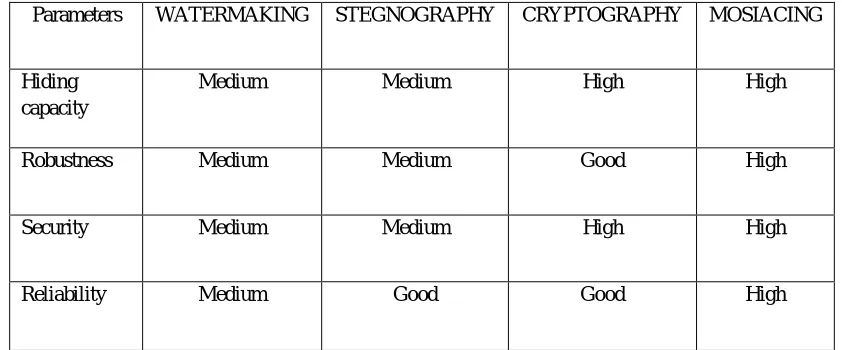
Parameters WATERMAKING STEGNOGRAPHY CRYPTOGRAPHY MOSIACING
Hiding capacity
Medium Medium High High
Robustness Medium Medium Good High
Security Medium Medium High High
[image:2.612.95.516.540.715.2]Reliability Medium Good Good High
II. LITERATURE SURVEY
Many researchers have done lot of work in this respect many techniques have their advantages and many have their disadvantages here we will do the comparison of different authors and there techniques and the advantages
S. Behnia, A. Akhshani, H. Mahmodi, A. Akhavan,
The result shows this technique offers more efficiency to the encryption of image as compared to any other system and it develops security of system, and it offers higher complexity. The algorithm is more efficient and provides a good security for the system. Thien Huynh The, Thuong Le Tien
The proposed method experimental results under various attack shows difference in strength and weakness for different parameters example: Histogram equalization, LPF, JPEG compression, Cropping, Gaussian noise. The proposed method
Effectively resists attack for Gaussian filter, JPEG compression and has good evidence through PSNR. However the method lags in some geometric attacks such as cropping and Gaussian noise. Chia-Chen Lin, Pei-Feng Shiu
The result shows when compared with existing system the Data hiding capacity of this scheme is much more high and image quality of the stego-image is higher and the security of the data is also protect wall as they are embedded in DCT coefficient. Ya-Lin Lee and W.H. Tsai This method is a new technique used for data hiding and has many pros compared to the existing data hiding techniques as can be viewed after review the results, the technique creates a meaningful mosaic image and transforms a image which is to be hided into mosaic with same size, here the original image can be recovered losslessly from the created mosaic. The security of this technique is guarded by the secret key, a limitation of this technique is that size of target image should match the secret image or have to resize before mosaic image, if this is not done then mosaic image will become blurred, rest the system is ideal for data hiding.
III. PROPOSED METHODOLOGY & ARCHITECTURE
In this dissertation a method is proposed for data hiding and securely transmitting of data using block based mosaicing using a video. Here in this technique the target or cover image is selected from a video, as a video is sequence of frame of image and to be hide secret image is used to create a mosaic image i.e. a mosaic video. Here a video can be chosen of a choice so there is no need of database. Here in this domain many researchers have proposed efficient and effective method for data hiding. Lai and Tsai [2] first proposed an efficient method for image mosaic and data hiding but the obvious weakness of the system was requirement of larger database of target image of same size. Lee and Tsai [1] proposed a technique in which they were able to remove the weakness of database and kept the merits of the system; in their proposed system they used image to image mosaicing. The aim of over system is to design a technique to transmit and hide data in video by creating mosaic for video free from database. Where unwanted user doesn’t identify the secret data here we use video to hide data which has the visual appearance.
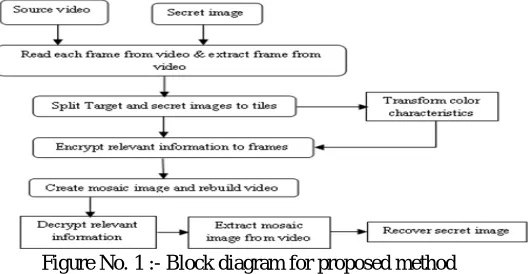
A. The proposed method includes two main phases as shown by the flow diagram of Fig.
1) Mosaic video (image) creation and
2) Secret video (image) recovery.
In the first phase, a mosaic image is obtained, which consists of the blocks of an input secret image with colour corrections according to a similarity criterion based on color variations or difference. The process consist four stages:
[image:3.612.182.448.558.695.2]Fitting the tile or blocks images of the secret image into the source blocks (T) of a preselected source image T;
Figure No. 1 :- Block diagram for proposed method
In the second phase, the embedded information is extracted to recover nearly lossless the secret image from the generated mosaic image. The phase includes two stages:
1) Extracting the embedded information from the mosaic for recovery of secret image
2) Recovering the secret image using the extracted information from mosaic using the data embedded.
IV. ALGORITHM AND SIMULATION
The user has to select a video (AVI) which would be used as source file and upload it. It is followed by decompressing or resizing the video frames into the range between 800x800 to 1028 x728 pixels format.
A. The algorithm in the proposed method is divided as
1) Algorithm 1 for Mosaic video creation
2) Algorithm 2 for Secret image recover from video
B. Algorithm 1 Mosaic image creation (Video)
1) Input: a secret image S, a target image (video) T, and a secret key K.
2) Output: a secret-fragment-visible mosaic image F.
Step.1. If the size of the target image T is different from that of the secret image S, change the size of T to be identical to that of S;
and divide the secret image S into n tile
Step.2. Compute the means and the standard deviations of each tile image and each target block r the three color
Step.3. The tile images are to be sorted
Step.4.know Create a mosaic image F by fitting the tile images into the corresponding target blocks according to L.
Step.5. Create a table TB with 256 entries, for color conversion each with an index corresponding to a residual value
Step.6. For each mapping represent the means by 8 bits; and represent the standard deviation quotient 7 bits, where c = r, g, or b.
color channel.
Step.7. For each pixel in each tile image of mosaic image F with color value where color channel c = r, g, or b, transform into a
new value by (4); if is not smaller than 255 or if it is not larger than 0, then change to be 255 or 0, respectively; compute a
residual value Ri for pixel and increment by 1 the count in the entry in the counting table TB whose index is identical to Ri.
Step.8. Here we have to compute the RMSE values of each color transformed tile image in F for rotating with respect to its
corresponding target block after rotating into each of the directions available θ = (0∘, 90∘, 180∘, 270∘ ); and rotate into the
optimal direction θ with the smallest RMSE value.
Step.9. Construct a Huffman table HT using the content of the counting table TB to encode all the residual values computed previously.
Step.10. For each tile image in mosaic image F, construct a bit stream for recovering , including the bit-segments which
encode the data items.
Step.11. Concatenate the bit streams of all tile images in mosaic image F in a raster-scan order to form a total bit stream ; use
the secret key K to encrypt into another bit streamM; and embedMinto F by the reversible contrast mapping.
Step.12. Construct a bit stream I including: 1) the number of conducted iterations for embedding M; 2) the number of pixel pairs
Npair used in the last iteration; and 4) the Huffman table HT constructed for the residuals; and embed the bit stream I into mosaic
image F.
C. Algorithm 2: For Secret image recover from video frames
1) Input: a mosaic image F with n tile images {T1, T2 ,...Tn}and the secret key K
2) Output: the secret image S
Step.1. Extract from F mosaic image (video) the bit stream I by a reverse version and obtain the following data items: 1) the number of iterations 2) the total number of pixel pairs used in the last iteration; and 4) the Huffman table HT
Step.2. Extract the bit stream Step.3. Decrypt the bit stream by K
Step.4. Decompose Minto n bit streams M1 throughM for the n to-be-constructed tile images T1 through T in S, respectively.
Step.5. Decode Mfor each tile image T
Step.6. Recover one by one in a raster-scan order the tile images T, i= 1 through n, of the desired secret image S
Step.7.Compute and compose all the final tile images after performing operation to obtain the desired secret image S as output. Here for simulation process we use MATLAB; the proposed method in this paper is related to video, in this section the detail process is explained below.
Create the .m file in MATLAB which contain the code for creating the mosaic image (video); the code defines the methodology for result i.e., how to perform the operations. Let the file be Video.m file which contain the code. Select the Target video T with extension *.avi and Secrete Image S, here the important thing which is to be done is to select the size 1028x768 i.e., T should be identical to S; if the image is not identical we have resize it. As from the algorithm 1 whole process is explained for creating the mosaic image. Here we have select the FF 1:20 the value can be varied accordingly.
1) Create a folder on your desktop called Mosaic video
2) Save one video with *.avi as target video and secrete and the Video.m file into the folder you just created.
3) Open Mat lab program on the personal computer you are working on.
4) Open the Video.m file
5) Change the script so that it uses the images you want to mosaic ,Run Video.m file an new window open, select an input image
(Target video) & secret image
6) On main window two different figures will open in two windows first Target video Figure 2 secret image.
7) Figure 3 i.e. video will be the mosaic video
The main AVI fie is nothing but a sequence of image called frames. Initially we will like to stream the video and collect all the frames and also collect the information if the video sequence is large enough, the frame period can be accordingly large. The encoder reads these parameters from a file
The above mentioned steps explain in brief the mosaic video creation techniques and the steps involved in creation.
This method is divided into two phases a) mosaic image creation b) recovery, the first phase is sub divided into the following parts & the details has been explained in previous chapter
8) Colour transformation between blocks
9) Choosing appropriate target blocks and rotating blocks
10) Embedding information for secret image recovery
As experiment has been conducted to test the proposed method here we have taken input as video *.avi as target or source file and secret image as S and video frame rate 1:20 which can be varied accordingly.
[image:5.612.128.509.607.718.2]
IV. RESULT
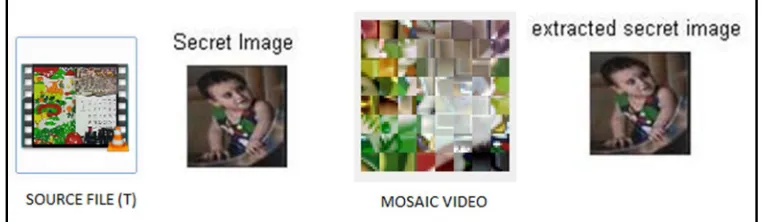
We simulate our proposed method in METLAB, a series of experiment have been conducted to test the proposed method using secret image and target image (video) with different sizes, here the result are related to 1024 x768.
The figure 2 represent the result yielded from the proposed method, the color characteristics of the transformed tile image and its corresponding target block are the same but color distribution of may vary different. The visual appearance of the target video and mosaic video may have less similarity to the corresponding source video.
A limitation of the proposed method is that size of both the source file and secret image has to be same; otherwise it will be blurred. Here in proposed method we have option to resize the image
Only the receiver who has the key can decrypted the secret image. However a hacker who does not have key may try decoding the secret image back. Fortunately, the number of all possible permutations here is n! So the probability to correctly guess the permutation is p =1/n! So breaking the system by this way of guessing is computationally infeasible. And block based technique makes it more complex for the hacker to rearrange by guessing
REFERENCES
[1] Ya-Lin Lee and W.H. Tsai,” A new secure image transmission technique via secret-fragment –visible mosaic image by nearly reversible color transformations”, IEEE Trans, circuits and systems for video technology, vol.24, No. 4,April 2014
[2] I. J. Lai and W. H. Tsai, “Secret-fragment-visible mosaic image—A new computer art and its application to information hiding,” IEEE Trans. Inf. Forensic Security. vol. 6, no. 3, pp. 936–945, Sep. 2011
[3] S. Behnia, A. Akhshani, H. Mahmodi, A. Akhavan - “A novel algorithm for image encryption based on mixture of chaotic maps” Science Direct Elsevier, pp.408-419, 2006
[4] Thien Huynh the, Thuong Le Tien, “An Efficient Blind Watermarking Method based On Significant Difference of Wavelet Tree Quantization using Adaptive Threshold”, IJEEE, Vol 1 No 2, pp 98-103, June 2013
[5] Chia-Chen Lin, Pei-FengShiu, “High Capacity Data Hiding Scheme for DCT-based Images” Journal of Information Hiding and Multimedia Signal Processing, Vol1, No 3,pp 220-240, July 2010
[6] John Justin, Manimurugan S, “A survey on Various Encryption Techniques”, IJSCE ISSN: 2231-2307, Volume 2 Issue 1, March 2012
[7] Ross J Anderson, Fabien A.P.Petitcolas, “On the Limitations of Stenography” IEEE Journal of selected area in communications, ISSN: 0733-8716, May 199 [8] Mehmet U. Celik, Gaurav Sharma, A. Murat Tekalp, Eli Saber, “REVERSIBLE DATA HIDING” IEEE ICIP 2002, Page No 157 – 160, 200
[9] Vinit Agham, Tareek Pattewar, “Data Hiding Technique By Using RGB-LSB Mechanism” ISBN No.978-1-4799-3834-6/14/$31.00©2014 IEE