Technology (IJRASET)
Language-Independent ORB (Oriented Fast &
Rotated Brief) Algorithm for Handwritten
Documents
Shweta Shevgekar1, Mrs. Prof. M. S. Deole2 1
ME Student, 2Assistant Professor, Department of E&TC
Abstract-Handwritten character recognition is a demanding task in the image processing because handwriting varies from person to person. And also handwriting styles, sizes and its orientation make it complex. Applications like, handwritten text in reading bank cheques, Zip Code recognition and for removing the problem of handling documents manually, digital data is necessary. Recognition of handwritten characters using either a scanned document, or direct acquisition of image using Mat lab, followed by the implementation of various other Mat lab toolboxes like Image Processing to process the scanned or acquired image. Here OCR block diagram explained that how character are recognize accurately.
Many feature-based algorithms are well-suited for character recognition like like SIFT, Language Independent Text-Line Extraction, Thresholding, Robust, Training, Ullman Algorithm, Structured Learning, ORB(oriented fast & rotated brief), SURF. But Oriented FAST and Rotated BRIEF (ORB) is a very fast binary descriptor which is faster than Scale-invariant feature transform (SIFT), it can be verified through experiments. Fast key point detector and BRIEF descriptor are important because of they have best performance and resonable cost. The recognize method for object recognition is Scale invariant feature transform (SIFT), which is very useful for feature extraction but it is computationally difficult due to its weighty workload required in local feature extraction and matching operation. Therefore for better performance and low complexity, ORB provides better solution.
Recently there is a growing trend among worldwide researchers to recognize handwritten characters of many languages and scripts. Much of research work is done in English, Chinese and Japanese like languages .However, on Indian scripts the research work is lagging; most of research work is available is mainly on Devanagri and Bangala scripts. The work on other Indian scripts is in beginning stage. Therefore we have proposed offline recognition of handwritten characters of differen languagest characters.
Keywords—Offline text-independent writer identification, ORB, word segmentation, scale and orientation histogram
I. INTRODUCTION
The automatic segmentation and recognition of text on scanned image documents has enabled many applications such as editing of previously printed documents and books, searching for words in that image documents etc. The off-line handwriting segmentation and recognition field are uses great interest in researchers, since there is a high level of ambiguity and complexity in such kind of image documents, and because of the necessity of Optical Character Recognition (OCR) in lots of application especially in office automation. Segmentation and Recognition of cursive handwritten text is the most difficult case in the field of OCR. Much less research has been done on the task of segmentation and recognizing of Marathi texts. The objective of this project is to provide a better way to segment and recognize off-line handwritten Marathi documents.
Automatic offline text-independent writer identification is very important. For example- forensic analysis, documents authorization etc. It is used to determine the writer of a text among a number of known writers using their handwriting images.
When writing a document, the structures of the whole word are stable and have a strong discretive for writers. Therefore, the structures between characters in the same word are very important for characterizing writer’s individuality.
Technology (IJRASET)
descriptor, that why we call it as ORB (Oriented FAST and Rotated BRIEF). Both Fast key point detector and BRIEF descriptor are
attractive because of they have better performance and low cost The recognize method for object recognition is Scale invariant
feature transform (SIFT), which is very useful for feature extraction but it is computationally difficult due to its weighty workload required in local feature extraction and matching operation. Therefore in this paper ORB is used for writer identification.
In comparison to languages like English and Japanese, the recognition on Indian languages and scripts is relatively lagging behind. Among available research work on Indian languages most of research work is available is mainly on Devanagri and Bengali scripts. The work on other Indian languages is in fewer amounts. The objective of this paper is to provide a better way to segment and recognize off-line handwritten different languages documents.
II. LITERATURE SURVEY
Plamondon et al. [1] explained a survey of early research literatures with respect to automatic writer identification.
SIFT (Scale Invariant Feature Transform) explained by Lowe in 2004.It is useful for object recognition , rotation of image, scaling, removing noise and also illumination changes [2]. Bulacu et al. [3] explained an approach which is based on texture-level The existing approaches of writer identification can be roughly divided into texture-based approaches and structure-based approaches.. Hanusiak et al [8] used a grey-level co-occurrence matrix for the extraction of textual features from the handwriting images.
Du et al [5] proposed a wavelet-based method for handwriting images.
Bertolini et al [9] explained both local binary patterns and local phase quantization as texture descriptors of handwritings for writer verification and identification. It extracts features from the points on contours of handwritings.
Bulacu [3] explained edge direction distribution, edge-hinge distribution and directional co-occurrence PDF to characterize the individuality of the writers. Chan[4] take two pages of handwritten text as input and it determine if they have been produced by the same writer. It used the features to characterize a page of text include writing slant and skew, character height. Siddiqi et al [6] divided handwriting text into small fragments with and then extracted codebook based features to represent writers individuality. Schomaker et al [3] and Ghiasi et al [10] employed the coordinates of the points on the resample contours of the connected components and form feature vector for generation of codebook and writer identification.
Siddiqi et al [6] extracted features of the chain code from handwriting contours for identification.
Jain et al [7] and Ghiasi et al [10] used straight line segments to fit the connected-component contour of handwriting and extracted the features according to the relationship of these segments. Xiangqian Wu, et. al. explained SIFT algorithm for Offline Text-Independent Writer Identification[11].
Prashant Aglave,et,al. explained implementation of high performance feature extraction method using oriented fast and rotated brief algorithm[12]. Jewoong Ryu, et.al., explained a word segmentation algorithm for handwritten document images. Segmentation of document images into text-lines and words is an important step for the document understanding [13]. However, unlike machine-printed documents, the segmentation of handwritten documents is still considered a challenging problem due to (i) irregular spacings between words and (ii) variations of writing styles depending on the person. They formulated the segmentation problem as a binary quadratic programming and estimated the parameters with the structured learning method. Also, due to the Structured SVM, all parameters are estimated in a principled way and it is believed that method can be easily extended to other databases.
III. OCR (OP[TICAL CHARACTER RECOGNITION)
The storage of scanned documents has to be bulky in size and many processing applications as searching for content, editing maintenance are either hard or impossible. Such documents require human being to process them manually, for example, postman’s manual processing for recognition and sorting of postal addresses and zip code. Optical character recognition (OCR) translates such scanned images of printed, handwritten documents into machine encoded text. This translated machine encoded text can be searched and can be processed in many other ways according to requirements. It also requires tiny size for storage in comparison to scanned documents. OCR helps human ease and reduces their job of manually handling and processing of documents. Computerized processing to recognize individual character is required to convert scanned document into machine encoded form.
A. The primary objective is to speed up the process of character recognition in document processing. As a result the system can
process huge number of documents with-in less time and hence saves the time.
B. Since our character recognition is based on a grid infrastructure, it aims to recognize multiple heterogeneous characters that
Technology (IJRASET)
IV. FEATURE EXTRACTION
A. ORB:(Oriented FAST and Rotated BRIEF) Algorithm
Prashant Aglave,et,al. explained implementation of high performance feature extraction method using oriented fast and rotated brief algorithm[4].
Feature-based image matching is an important property like object recognition, 3D stereo reconstruction, structure-from-motion and images stitching. And these work on real-time performance. Algorithms which is based on Feature extraction are well-suited for such operations. Speeded up Robust Features (SURF), Oriented FAST and Rotated BRIEF (ORB), Scale-invariant feature transform (SIFT) are different algorithms related to image processing. ORB is fast binary descriptor and also BRIEF is rotation invariant and resistant to noise.ORB is the scale invariance and rotation in variance algorithm for object detection method.
The recognize method for object recognition is Scale invariant feature transform (SIFT), which is very useful for feature extraction but it is computationally difficult due to its weighty workload required in local feature extraction and matching operation. Therefore for better performance and low complexity, ORB provides better solution. To improve the rotation invariance, moments are computed with x , y and it should be in a circular region of radius r, and r define size of the patch. For descriptors, BRIEF gives very few results with rotation. So what ORB used “steer” BRIEF. For any set of feature of n binary tests at (xi, yi) location, define a 2times n matrix, S which contains the coordinates of these pixels.
S=(x1---xn
y1---yn)
Then using the orientation of patch, theta, its rotation matrix is found. ORB discretize the angle to increments of 2 pi /30 (12 degrees), and construct a lookup table of precomputed BRIEF patterns. After that the correct set of points S theta will be used to
compute its descriptor. Therefore using the patch orientation θ and the corresponding rotation matrix Rtheta, we construct a
“steered” version Stheta of S:
Sθ = Rθ * S
[image:4.612.69.541.392.697.2]V. SYSTEM BLOCK DIAGRAM
Technology (IJRASET)
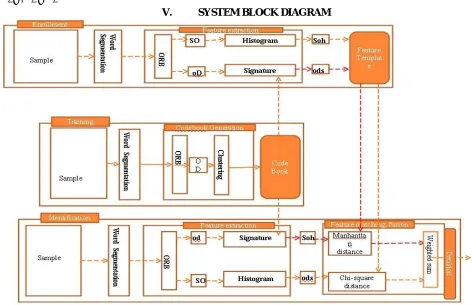
This method based on three stages: training , enrollment, and identification, In these stages, the handwriting image is segmented into word regions (WRs).
Then the ORB is referring to identify the key points and extract descriptors, and the corresponding scales and orientations (SOs) from the WRs. In the training stage, ORB descriptors (ODs) extracted from the training dataset and then used to generate a codebook for the use of enrollment and identification. In the enrollment stage, two features, called OD signature (ODS) and SO histogram (SOH), are extracted from ODs and SOs of WRs of the enrolling handwriting image and stored for identification. In the identification stage, the ODS and SOH are extracted from the input handwriting images and after matching distances, they are fused to form the final matching distance for decision. Word segmentation, codebook generation, feature extraction, and feature matching and fusion are the important parts of the system.
B. Word Segmentation
1) First converting handwritten image (I) to binary image.
2) Getting all connected components (Ccs) in Ibi and then computing their average height havg
3) Filtering Ibi with an isotropic LoG filter to get the filtered image Ifi.
4) Binarizing Ifi to get a binary image Ifb by using threshold.
5) Assigning each connected component in binary image to the nearest connected regions of filt to form semi word regions (SWR)
which colored different.
6) Combining the SWR‟s to induce the word regions in line with the gap between the adjacent SWR‟s.
7) Dividing the overlapping Connected Components runs along multiple text lines from middle line of these boundary box.
C. Codebook Generation
After word segmentation many word regions (WRs) are obtained. For each WR, we refer the algorithm i.e. ORB. It identifies a number of key points and also extracts descriptors, scales, and orientations. We may obtain a large and varying amount of key points from different handwriting images. For limited and fixed number of features, we cluster the ODs of the key points extracted from the training samples into N categories and represent each category with its center, which is called a code. All of the N codes form a OD codebook with size N. And based on the codebook, we will compute a histogram with limited and fixed dimension as feature vector for writer identification.
D. Feature Extraction
Since the text in the identifying handwriting document may be totally different with the text in the enrolled handwriting document in offline text-independent writer identification system, the layout of the key points may be totally different in the different handwriting images, even if they are written by the same person. Therefore, we will not consider the positions of the key points in the feature extraction and matching. We just take into account the frequency of each OD and SO occurrences in a handwriting image.
E. Feature Matching and Fusion
In this work, because of its simplicity and high efficiency, the Manhattan distance is adopted to measure the dissimilarity between two ODSs.
Technology (IJRASET)
VI. RESULT
We are created our own synthetic different languages dataset for analyzing the performance of a system. The dataset is as follows:
Language Input Image
Marathi
Hindi
English
Bangali
Kannad
Technology (IJRASET)
Training Time (ms)
Hindi Marathi English Sanskrit Kannad Bangali
0.22152 0.070421 0.2012 0.27242 0.8713 0.11314
Testing Time(ms)
Hindi Marathi English Sanskrit Kannad Bangali
0.084466 0.081555 0.11048 0.11065 0.083129 0.15479
Accuracy(%)
Hindi Marathi English Sanskrit Kannad Bangali
68.66 71.4286 75 66.70 66.667 71.62
0 0.1 0.2 0.3 0.4 0.5 0.6 0.7 0.8 0.9 1
Hindi Marathi English Sanskrit Kannad Bangali
Tr a in n in g Ti m e Language 0 0.02 0.04 0.06 0.08 0.1 0.12 0.14 0.16 0.18
Hindi Marathi English Sanskrit Kannad Bangali
Technology (IJRASET)
VII. CONCLUSION
ORB uses the known FAST key point detector and the BRIEF descriptor. Therefore by using ORB, it gives better and faster result for different languages. And also ORB is the scale invariance and rotation in variance algorithm for object detection method. We can improve the performance of system of parallel computation.
VIII. ACKNOWLEDGMENT
The authors are thankful to Prof. S. P. Agnihotri-HOD, Dr. P. C. Kulkarni-Principal, Mr. P. M. Deshpande-Project Director, Sir M. S. Gosavi-Director, G. E. S. R. H. Sapat College of Engineering, Nashik, Maharashtra, India.
REFERENCES
[1] R. Plamondon and G. Lorette, “Automatic signature verification and writer identification—The state of the art,” Pattern Recognit., vol. 22 no. 2, pp. 107–131, Feb. 1989.
[2] D. Lowe, “Distinctive image features from scale-invariant keypoints,”Int. J. Comput. Vis., vol. 60, no. 2, pp. 91–110, Nov. 2004.
[3] M. Bulacu and L. Schomaker, “Text-independent writer identification and verification using textural and allographic features,” IEEE Trans.Pattern Anal. Mach. Intell., vol. 29, no. 4, pp. 701–717, Apr. 2007.
[4] Chan, S. K., Viard -Gaudin, C., Tay, Y. H. (2008)"Online writer Identification using character prototypes distributions," In Proceedings of SPIE - The International Society for Optical Engineering.
[5] L. Du, X. You, H. Xu, Z. Gao, and Y. Tang, “Wavelet domain local binary pattern features for writer identification,” in Proc. 20th Int. Conf. Pattern Recognit., Istanbul, Turkey, 2010, pp. 3691–3694.
[6] I. Siddiqi and N. Vincent, “Text independent writer recognition using redundant writing patterns with contour-based orientation and curvature features,” Pattern Recognit., vol. 43, no. 11, pp. 3853–3865, Nov. 2010
[7] R. Jain and D. Doermann, “Offline writer identification using k-adjacent segments,” in Proc. Int. Conf. Document Anal. Recognit., Beijing, China, 2011, pp. 769–773
[8] R. Hanusiak, L. Oliveira, E. Justino, and R. Sabourin, “Writer verification using texture-based features,” Int. J. Document Anal. Recognit. vol. 15, no. 3, pp. 213–226, Sep. 2012
[9] D. Bertolini, L. Oliveira, E. Justino, and R. Sabourin, “Texture-based descriptors for writer identification and verification,” Expert Syst. Appl., vol. 40, no. 6, pp. 2069–2080, May 2013
[10] G. Ghiasi and R. Safabakhsh, “Offline text-independent writer identification using codebook and efficient code extraction methods,” Image Vis. Comput., vol. 31, no. 5, pp. 379–391, May 2013.
[11] Xiangqian Wu, Member, IEEE, Youbao Tang, and WeiBu, Member, IEEE ,“Offline Text-Independent Writer Identification Based on Scale Invariant Feature Transform ”,IEEE TRANSACTIONS ON INFORMATION FORENSICS AND SECURITY, VOL. 9, MARCH 201
[12] Prashant Aglave1, Vijaykumar.S. Kolkure2 , Implementation of high performance feature extraction method using oriented fast and rotated brief algorithm,IJRET: International Journal of Research in Engineering and Technolog
[13] Jewoong Ryu, Hyung Il Koo, Member, IEEE, and NamIk Cho, Senior Member, IEEE, “Word Segmentation Method for Handwritten Documents based on Structured Learning” ,IEEE SIGNAL PROCESSING LETTERS, VOL. 22, NO. 8, AUGUST 2015.
62 64 66 68 70 72 74 76
Hindi Marathi English Sanskrit Kannad Bangali