2016 International Conference on Artificial Intelligence and Computer Science (AICS 2016) ISBN: 978-1-60595-411-0
Image Retrieval Based on Fused CNN Features
Feng ZHANG
*and Bao-jiang ZHONG
School of Computer Science and Technology, Soochow University, Suzhou, Jiangsu 215000, China
*E-mail: [email protected]
Keywords: Convolutional neural networks, Feature extraction, Image retrieval, Feature fusion.
Abstract. Recently, various convolutional neural network (CNN) models have demonstrated their powerful ability as a universal representation for different image recognition tasks. In this paper, image retrieval with different kinds of CNN is considered. Firstly, we extract three kinds of CNN features with the current popular pre-trained CNN models to process image retrieval, respectively. Then, we compute weighted average of the similarity scores of these CNN features and propose an image retrieval algorithm based on the fused CNN features. Extensive experiments on two publicly available datasets well demonstrate that the proposed algorithm is clearly better than the retrieval algorithms based on individual CNN features and other current image retrieval algorithms.
Introduction
The universality of smartphones, digital cameras and other portable image capture devices, as well as the popularity of WeChat, micro-blog and other data sharing platforms, have led to an explosion of images on the network. Faced with the massive image data, the methods of traditional manual annotation have been unable to cope with it. The content-based image retrieval has gradually become a hot spot of scientific research, and the related application of image retrieval technology has been developed.
In recent years, due to the development of convolutional neural networks (CNN) [1, 2], significant progress has been made in visual recognition, e.g., image classification and object detection. Especially, a big breakthrough in image classification is made by [2], which has achieved the state-of-the-art performance (with 10% gain over the method based on hand-crafted features) in large-scale object recognition. The CNN architecture combines low-level features into abstract high-level features with non-linear transformation, which enables it to have capacity to learn the semantic representation from images. So far, many CNN models have been proposed, such as the AlexNet model [2], the VGGNet model [3], the GoogLeNet model [4], the ResNet model [5] and so
on. Donahue et al. [6] and Razavian et al. [7] demonstrated that features extracted from the
CNN Models and Feature Extraction
Through an experimental comparison, we choose the pre-trained VGGNet model [3], GoogLeNet model [4] and ResNet model [5] to extract different kinds of CNN features. These CNN models and CNN feature extraction process are mainly introduced as following.
VGGNet model. VGG increases the depth of the original architecture [2] to 16-19 layers, which is
substantially deeper than what has been used in the prior art. To reduce the number of parameters in such deep networks, VGG uses very small (3×3) convolution filters in all layers and the convolutional stride is set to 1 pixel. Considering the speed and accuracy, we choose the 16-layer pre-trained VGGNet model to extract image features. For convolution layers and max-pooling layers have much higher dimension, fully-connected layers are usually used as feature representation for images. Following Hiton’s guidance like AlexNet [2], we extract 4096 dimensional feature of the layer fc7 as the description of each input image. The structure of VGGNet-16 model can be found in [3].
GoogLeNet model. GoogLeNet is a 22-layer deep convolutional neural network architecture. The
main hallmark of this architecture is the improved utilization of the computing resources inside the network. To optimize its quality, the architectural decisions are based on the Hebbian principle and the intuition of multi-scale processing. It uses 12 times fewer parameters than AlexNet [2], while being significantly more accurate. Its architectural details can be found in [4]. According to our experience, we extract 1024 dimensional feature of the layer pool5 as the representation of the image for image retrieval.
ResNet model. ResNet is a residual learning framework that is deeper but needs less training time
than those used previously. These residual networks are easier to optimize, and can gain accuracy from considerably increased depth. In the ImageNet dataset, the depth of these residual nets is up to 152 layers; that is 7 times deeper than VGGNet [3], but still have lower complexity. The architectures of residual networks can been seen in [5]. In our experiments, we choose the 152-layer pre-trained model to extract the 2048 dimensional feature of the layer pool5 as the representation of the image.
[image:2.612.151.461.524.568.2]It is known that normalization and PCA are common methods used in the feature processing step [7]. Accordingly, when all the CNN features are extracted, we reduce the dimensionality of the feature vectors to 128 by PCA in bid to speed up the retrieval time, and each feature vector is normalized in l2-norm which is convenient to measure the similarity of two feature vectors by cosine distance. Retrieval accuracy of the individual CNN features from the above three pre-trained models on two datasets is presented in Table 1.
Table 1. Retrieval accuracy of the individual CNN features on two datasets.
Datasets/CNN models VGGNet-16 GoogLeNet ResNet-152 Corel-10k, mAP 0.552 0.517 0.617 Caltech-256, mAP 0.467 0.49 0.469
Image Similarity Calculation
In this paper, we use the weighted feature distance to compute the similarity between the query image
denoted as Q and each image denoted as I in the database. Then the result of retrieval is returned
according to the order of similarity. Here the cosine distance is used to measure the CNN feature similarity of the two images, which is calculated as follows.
2 2
( ) ( ) ( , )
( ) ( )
h Q h I S Q I
h Q h I
(1)
where ( )h Q and ( )h I represent the CNN features of Q and I, respectively, and both
2
( )
h Q and
2
( )
The fusion strategy of multiple feature similarity scores include the sum, product, maximum, minimum rules and so on. Among them, we employ the product rule for the following two reasons. Firstly, previous work [10, 11, 12] proved that the product rule has the performance of not less than the sum rule. Secondly, when using product rule, the feature combination of different meaning does not need heavy feature normalization. Based on the above three kinds of CNN feature similarity
scores and product rule, the similarity betweenQandIis defined as bellow.
( , ) ( , )wv ( , )wg ( , )wr
v g r
Sim Q I S Q I S Q I S Q I
, (2)
where wv, wg, wrare the weights corresponding to the above three CNN feature similarity scores
with wvwg+wr 1. Based on the results of simulation experiments, the default values of these
parameters in Corel-10k dataset are taken aswv 0.2,wg 0.2,wr 0.6 and these in Caltech-256
dataset are taken aswv 0.3,wg 0.4,wr 0.3. Note that, (2) can be transformed into a sum form by
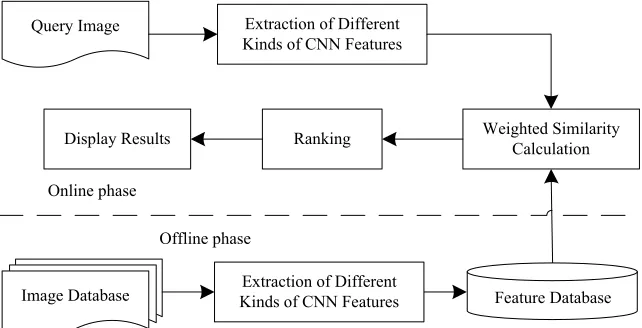
a logarithmic operation to reduce computational complexity. The flow chart of our proposed image retrieval algorithm is shown in Fig. 1.
Query Image
Feature Database Extraction of Different
Kinds of CNN Features
Extraction of Different Kinds of CNN Features Image Database
Weighted Similarity Calculation Ranking
Display Results
Online phase
[image:3.612.146.467.294.458.2]Offline phase
Figure 1. The flow chart of the image retrieval based on fused CNN features.
Experiments
Datasets and Evaluation Criteria
Two datasets are adopted to test our retrieval algorithm, including Corel-10k [13] and Caltech-256 [14]. Corel-10k dataset contains 10000 images, a total of 100 categories, each category contains 100 images. Images of the same category contain the same semantic information, including the categories of flowers, birds, beaches, buildings, etc.. Each image in the dataset is used as query. Caltech-256 dataset contains 30607 images consisting of 256 categories, including furniture, animals, sports equipment, vehicles and son on. We randomly select 5000 images from the database as queries to test the performance of the algorithm. In all experiments, Precision-Recall curve (PR curve) and Mean Average Precision (mAP) are used to evaluate our algorithm on the above two datasets.
Comparison of Retrieval Performance of Individual Features and Fused Features
performance of the three individual CNN features and their fused form on the Corel-10k dataset and Caltech-256 dataset. In the legends, V, G and R represent VGGNet-16, GoogLeNet and ResNet-152, respectively. An important conclusion from Fig. 2 can be drawn that the retrieval results of the fused features are better than that of the individual features.
0 0.2 0.4 0.6 0.8 1
0.4 0.5 0.6 0.7 0.8 0.9 1 Recall Pr ec is io n VGGNet-16 GoogLeNet ResNet-152 V+G V+R G+R V+G+R
0 0.2 0.4 0.6 0.8 1
0.4 0.5 0.6 0.7 0.8 0.9 1 Recall Pr ec is io n VGGNet-16 GoogLeNet ResNet-152 V+G V+R G+R V+G+R
[image:4.612.104.500.133.289.2](a) (b)
Figure 2. PR curves of retrieval performance of individual features and fused features. (a) the Corel-10k dataset; (b) the Caltech-256 dataset.
Comparison between Our Algorithm and the Existing Retrieval Algorithms
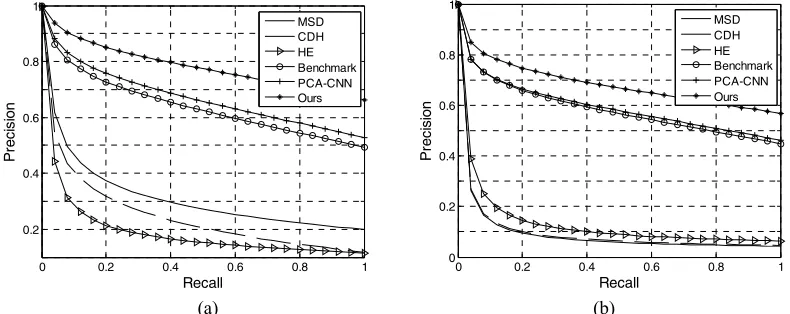
According to the above experimental results, we choose CNN features of VGGNet-16, GoogLeNet and ResNet-152 to describe the semantics of the image, and complete the image retrieval based on fused features by the weighted similarity calculation. In order to fairly evaluate the retrieval accuracy of our algorithm, we select the following retrieval algorithms as references, MSD [13], CDH [15], HE [16], PCA-CNN [9] and we also extract the VGGNet-16 CNN features for image retrieval which acts as the CNN-based benchmark algorithm. For the sake of fairness, CNN features of the PCA-CNN algorithm are extracted from the pre-trained VGGNet-16 which is better than the original CNN model.
The PR curves of the comparison algorithms and our algorithm on Corel-10k dataset and Caltech-256 dataset are plotted in Fig. 3(a) and 3(b). Table 2 shows the specific numerical results on the two datasets. It can be seen from Fig. 3 and Table 2 that the proposed algorithm is clearly higher than the algorithms of MSD, CDH, HE, PCA-CNN and CNN-based benchmark.
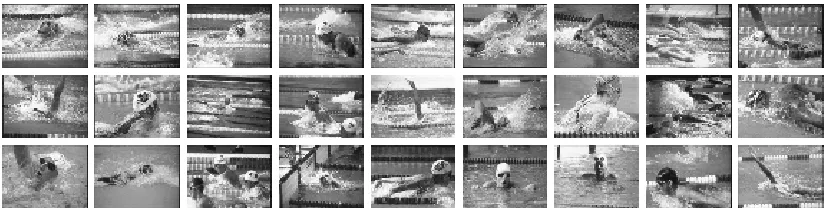
Fig. 4 and Fig. 5 show two retrieval examples using the Corel-10k dataset and Caltech-256 dataset. In Figure 4 and Figure 5, the query images are images of a football helmet and swimming, which contain obvious semantic features. It can been seen that all of the top 27 retrieved images show a good match to the query images.
0 0.2 0.4 0.6 0.8 1
0.2 0.4 0.6 0.8 1 Recall Pr ec is io n MSD CDH HE Benchmark PCA-CNN Ours
0 0.2 0.4 0.6 0.8 1
0 0.2 0.4 0.6 0.8 1 Recall P re cis io n MSD CDH HE Benchmark PCA-CNN Ours
[image:4.612.104.499.570.727.2](a) (b)
Table 2. Retrieval results of other algorithms and our algorithm.
Datasets/Algorithms MSD CDH HE Benchmark PCA-CNN Ours
Corel-10k, mAP 0.179 0.18 0.1 0.519 0.552 0.644
[image:5.612.99.510.82.248.2]Caltech-256, mAP 0.03 0.039 0.02 0.45 0.467 0.536
Figure 4. An example of image retrieval using our algorithm on the Caltech-256 dataset. (The top-left image is the query image, and the similar image returned include the query image itself.)
Figure 5. An example of image retrieval using our algorithm on the Corel-10k dataset. (The top-left image is the query image, and the similar image returned include the query image itself.)
Conclusions
In an image retrieval system, the CNN-based retrieval system often has a better query experience. The returned results of such system are in line with user’s psychological needs. In order to better apply the CNN features to image retrieval and enhance the retrieval performance, we fuse different kinds of CNN features for image retrieval by the weighted average of features similarity and the product rule. Firstly, three different CNN features of images are extracted. Then the weighted feature similarities between the query image and database image are computed by product rule. Finally, the images with top-n highest scores are returned as the retrieval result. Extensive experiments on two publicly available datasets have shown that our algorithm has obvious advantages over that based on individual CNN features and other current retrieval algorithms.
Acknowledgement
This research is supported by the National Natural Science Foundation of China under grants 61572341.
References
[1] Y. LeCun, K. Kavukcuoglu and C. Farabet, Convolutional networks and applications in vision,
ISCAS, Paris, France, 2010, pp. 253-256.
[2] A. Krizhevsky, I. Sutskever and G.E. Hinton, ImageNet classification with deep convolutional
[image:5.612.99.514.291.397.2][3] K. Simonyan and A. Zisserman, Very deep convolutional networks for large-scale image recognition, arXiv preprint arXiv: 1409.1556, 2014.
[4] C. Szegedy, W. Liu and Y. Jia, Going deeper with convolution, CVPR, Columbus, USA, 2014,
pp. 1-9.
[5] K. He, X. Zhang and S. Ren, Deep residual learning for image recognition, arXiv preprint arXiv,
2015.
[6] J. Donahue and Y. Jia, DeCAF: a deep convolutional activation feature for generic visual
recognition, ICML, Beijing, China, 2014, pp. 647-655.
[7] H. Wang and Y. Cai, Deep learning for image retrieval: what works and what doesn't, ICDM
Workshop, Atlantic City, USA, 2015, pp. 1576-1583.
[8] A.S. Razavian, H. Azizpour and J. Sullivan, CNN features off-the-shelf: an astounding baseline
for recognition, CVPR Workshops, 2014: 806-813.
[9] A. Babenko, A. Slesarev and A. Chigorin, Neural codes for image retrieval, ECCV, Zurich,
Switzerland, 2014, pp. 584-599.
[10] L. Zheng and S. Wang, Query-adaptive late fusion for image search and person
re-identification, CVPR, Boston, USA, 2015, pp. 1741-1750.
[11] J. Kittler, M. Hatef and R.P.W. Duin: submitted to Journal of Pattern Analysis and Machine
Intelligence, 1998, 20(3): 226-239.
[12] F.M. Alkoot and J. Kittler: submitted to Journal of Pattern Recognition Letters, 1999, 20(11):
1361-1369.
[13] G.H. Liu, Z.Y. Li and L.Zhang: submitted to Journal of Pattern Recognition, 2011, 44(9):
2123-2133.
[14] B.G. Griffin, A. Holub and P. Perona. The caltech-256, Caltech Technical Report, 2010.
[15] G.H. Liu and J.Y. Yang: submitted to Journal of Pattern Recognition, 2013, 46(1): 188-198.
[16] H. Jegou and M. Douze, Hamming embedding and weak geometric consistency for large scale