Determination of Image Features for Content-based
Image Retrieval using Interactive Genetic Algorithm
Sharvari M. Waikar
M.E. StudentDepartment of Electronics and Telecommunication Engineering
S.S.G.M.C.E.Shegaon
K.B.Khanchandani,
Ph. DProfessor
Department of Electronics and Telecommunication Engineering
S.S.G.M.C.E.Shegaon
ABSTRACT
The development of content-based image retrieval (CBIR) system has become a significant research issue nowadays, as the digital image libraries and other multimedia databases are mounting very fast in the different areas. It is important to effectively and precisely retrieve the desired images from a large image database. Most of the approaches proposed are for finding the image features and some of the approaches include the user’s subjectivity and preferences in the image retrieval process. This paper explains mainly about the determination of the image features like color, texture, and edge for the content-based image retrieval system which uses the interactive genetic algorithm. The color feature is extracted by using mean and standard deviation, the texture feature is extracted by using gray level co- occurrence matrix (GLCM) and the edge features of an image are extracted by using the edge histogram descriptor (EHD). Here the term interactive genetic algorithm (IGA) helps to reach more close to the user’s need and satisfaction of image retrieval.
General Terms
Gray Level Co-occurrence Matrix (GLCM), Interactive Genetic Algorithm (IGA), Edge Histogram Descriptor (EHD).
Keywords
Content-based image retrieval (CBIR), color, texture, edge, image features.
1.
INTRODUCTION
In current years the large amount of image data has been created in the diverse areas like entertainment, art galleries, fashion design, education, medicine, industry, criminal investigations, forensics etc. Hence there is need to efficiently store and retrieve the data correctly. The content-based image retrieval system helps to manage the image data efficiently. The image retrieval can be done by using two ways that are: text based approach and content based approach. Traditional text-based image search engine employs the manual annotation of images for image retrieval but the problem of manual image annotation was it requires large volumes of databases and vast amount of labour. Also the procedure was time consuming. Another problem of text based approach is human perception means observation of any image is different for different persons. To solve these problems related to text based image retrieval or traditional image search engines the content-based image retrieval comes into existence. There are some working system, like QBIC system of IBM, Chabot of U.C. Berkeley, QVE of Hirata and Kato, Photobook of the Massachusetts Institute of Technology (MIT), and Image Surfer of Interpix Software [1]. The conventional method does not have the facility to involve the user in the retrieval process and hence the process gets difficult when an image required to the user can’t be clearly specified as it deals with
the emotion. Therefore using interactive evolutionary computation (EC) the problem can be minimized [1]. The interactive genetic algorithm (IGA) can be applied in the system after the similarity measure of the image features of query image and the image in the database have been performed. CBIR has become an active and progressing study area in an image retrieval field. Most of the CBIR algorithms developed apply the low-level image features to retrieve the images. There is difference between the actual image representation and the user’s information need which is called the semantic gap in CBIR systems. To reduce the semantic gap the (IGA) can be applied to the system, which is the feedback mechanism [2]. User can give feedback to the system whether the retrieved image is of user’s interest or not. This paper mainly focused on extracting or determining the image features like color, texture, and edge required for similarity measure of an image.
2.
CONTENT-BASED IMAGE
RETRIEVAL
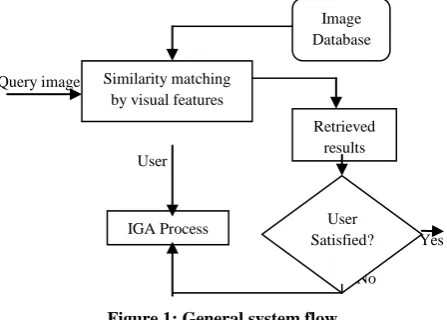
Content-based image retrieval (CBIR) is a technique for retrieving images from the image database depending on the different image features such as color, texture, shape or edge. The images can be retrieved by giving the input query image or sketched figures to the system. The block diagram is given in figure 1.
Query image
User
[image:1.595.317.541.494.654.2]
Yes No
Figure 1: General system flow
Here the retrieval process is carried out by doing similarity matching by visuals features of an image with the images in the database and then the user gets involved in the process. If user is satisfied then the retrieval process will end and if the user is not satisfied then by applying interactive genetic algorithm (IGA) again the retrieval process will be continued. According to the figure 1, the system operates in four phases which are-Querying, Similarity computation, Retrieval, and Incremental search via IGA [2].
Image Database Similarity matching
by visual features
Retrieved results
3.
IMAGE FEATURES AND IGA
The retrieval of images can be done after finding the similarities between the input query image and the database image. Image features of an image can include text-based image features like key words, image tagging and visual features like color, texture, shape, edge. According to the requirement one can use any visual features to represent an image. The important task of the content-based image retrieval system is to extract the image features properly by using the suitable feature extraction technique.
3.1
Color Feature Extraction
The human visual system gives response to the light and there is interaction of light with objects. The color can be defined as the perception that depends upon this response. It plays the key role in determination of the visual feature of an image. Color feature is one of the extensively used visual features in content-based image retrieval. There are number of color spaces to represent an image in the field of image retrieval. It is also important task to select the appropriate color space according to the application. Most popular color space is RGB which stands for Red-Green-Blue. The RGB space is having the additive primary colors of light Red, Green and Blue. The human way of perceiving the color is somewhat different and the RGB color space does not exactly correspond to that way [3].Therefore we are using the Hue, Saturation, Value (HSV) color space in our approach. Hue is used to distinguish the colors or it correspond to a pure color, the saturation gives information about the percentage of white light added to a pure color and the value corresponds to the perceived light intensity or it gives brightness. In an image, color distribution of pixels is having sufficient information. The mean of pixel colors gives information of the principal color of an image, whereas standard deviation of pixel colors gives the variation of pixel colors [4].The mean (μ) and the standard deviation (σ) of a color image are given below:
𝜇 = 1 𝑁 𝑃𝑖
𝑁
𝑖=1
𝜎 = 1
𝑁 − 1 𝑃𝑖− 𝜇 2 𝑁
𝑖=1
1/2
Where μ = [μH, μS, μV] T and σ = [σH, σS, σV] T. Each
component of μ and σ provides the information about the hue, saturation, and value respectively. Pi specifies the ith pixel of an image [5].
3.2
Texture Feature Extraction
The visual patterns that include properties of homogeneity and that do not result from the presence of only a single color or intensity, that visual patterns can be termed as texture. The texture can be different like texture of trees, texture of any surface, texture of clothes etc. It can be represented by three techniques which are- Statistical techniques use the statistical properties of different gray levels of pixels in an image. Structural techniques use the texels of an image and Spectral techniques use Fourier spectrum [3]. We are using the (GLCM) gray-level co-occurrence matrix to determine the texture feature in our approach. Co-occurrence matrix is related to the second-order statistical property of the sub band wavelet coefficients. The elements (i, j) of the co-occurrence matrix, with parameters d and θ can be defined as the joint probability. Normally d is small since the dependency exists
between neighbouring wavelet coefficients [6]. Here we are using a gray level co-occurrence matrix, which is an easy and effective method for representing the texture. GLCM gives the probability p (i, j; d, θ) that two pixels in an image, which are having distance d and angle θ, and hold gray levels i and j. The GLCM can be mathematically defined as given below:
𝑝 𝑖, 𝑗; 𝑑, 𝜃 = # 𝑥1, 𝑦1 𝑥2, 𝑦2 |𝑔 𝑥1, 𝑦1 = 𝑖, 𝑔 𝑥2, 𝑦2 = 𝑗, 𝑥1, 𝑦1 − 𝑥2, 𝑦2 = 𝑑, ∠ 𝑥1, 𝑦2 , 𝑥2, 𝑦2 = 𝜃
Where # indicates the number of occurrences within the window with i and j are the intensity levels of a first pixel and second pixel at positions (x1, y1) and (x2, y2), respectively. For simplicity and to reduce the computation effort, we are finding the GLCM according to one direction (i.e., θ = 0◦) with a distance d (= 1) [2].
3.3
Edge Feature Extraction
Edge feature can be expressed by using histogram. Histogram is one of the simple techniques. Edge is an important feature to extract the image content. Human eyes sensitivity is more for edge features as compared to color, texture features in image perception. In the image space the edge histogram gives information about the frequency and directionality of brightness changes in an image [4]. We are extracting the edge feature by adopting edge histogram descriptor (EHD) for description of edges in an image. EHD helps in improving the retrieval performance [7]. The steps involved in the EHD process are given below [2].
1) The image is divided into 4 × 4 subimages.
2) Further each subimage is divided into nonoverlapping image blocks with a small size.
3) Then edges in each image block are categorized into five types which are- vertical, horizontal, 45◦ diagonal, 135◦ diagonal and nondirectional edges.
4) The histogram will get for each subimage which represents the relative frequency of occurrence of five types of edges in the corresponding subimage.
5) After examining all the image blocks in a subimage, the five-bin values are normalized by the total number of blocks in a subimage. Then the normalized bin values are quantized for the binary representation. These normalized and quantized bins constitute the EHD.
fitness function and value is assigned to them to represent its merit; 2) selection-chromosomes which is having better fitness are selected to generate the new population; and 3) mating- here genetic operators like crossover and mutation are applied to the selected chromosomes to produce fresh ones for the next generation. These three steps are iterated for numerous generations until a suitable solution is found or the termination criterion is met [2]. There is difference between the construction of the fitness function of GA and IGA. The fitness is determined by the user’s evaluation in the IGA and not by the predefined mathematical formula as in the GA. In the creative applications such as architecture, art, music, design, it is difficult to evaluate the fitness because the measure depends generally on the human mind. Many of the conventional applications of GA do not have the ability to utilize the human intuition and emotion suitably in some applications. To overcome this problem, the technique called interactive genetic algorithm (IGA) can be applied [8]. Here user can interactively determine which members of the population will reproduce. Based on the user’s input the IGA will automatically generate the next generation. GAs can be widely applied in many areas of engineering such as signal processing, in system identification, and in the information mining problems [9]. Genetic Programming based technique for system identification of complex biomedical data, has also been proposed [10]. An adaptive genetic algorithm (AGA) can be used for an active noise control (ANC) system [11]. The IGA can be applied for the biomedical application [12]. It means the genetic algorithm can be used for processing of biomedical data. GAs also has been productively applied in the research of CBIR [13]. The GA using relevance feedback for CBIR has also explained [14]. The GA and relevance feedback are used for computing the image similarities [15].
4.
EXPERIMENTAL RESULTS
In this section the resultant output for determination of the color, texture and edge features of an image has been explained. The database required for this system is generalized. There is not a standard image database. Also there is no agreement on the type and the number of images in the database. Normally the image retrieval systems are
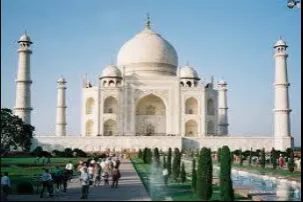
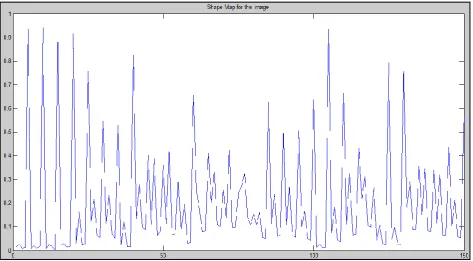
[image:3.595.353.505.277.378.2]intended for the general databases [2]. For the color feature extraction we will get the numerical value for the mean and the standard deviation of the pixels in the image as a resultant output. For the texture and edge feature extraction we will get the graph. Figure 2 shows an example query image from the generalized database. Figure 3 shows the graph for the texture feature which gives the relation between the number of occurrence of same change in gray levels of two adjacent pixels and maximum gray levels. Figure 4 gives the graph for the edge or shape feature and it explains the relation between frequency and directionality in brightness changes in an image. In this way we can extract the image features for the similarity computation of query images and database images for content-based image retrieval system using interactive genetic algorithm (IGA). The contents can be extracted by using the above mentioned algorithms or stages in the software Matlab. This paper mainly focuses on the extraction process of image features for the content-based image retrieval system using IGA.
Fig 2: An Example Query Image
5.
CONCLUSION AND FUTURE WORK
The CBIR system helps to manage the images in the different fields easily. The database for this system can be as per the user’s requirement and need. Our paper helps to explain the extraction of the contents of the image features of the images from the collected image database. This paper mainly focuses on the study of determination of the visual features of an
[image:3.595.63.541.506.772.2]Figure 4: Edge Map for the Example Query
image required for the content-based image retrieval using interactive genetic algorithm (IGA). By using these visual features extraction methods further the similarity measurement of image features can be performed in the CBIR systems. As compared to conventional approaches that are based on visual features only, the method using IGA can provide an interactive mechanism. Here the color feature can be extracted by using mean and standard deviation, the texture can be found out by using the GLCM, whereas the edge feature can be extracted by applying the EHD. The future work can be progressed considering more low-level or high level image descriptors to reach more closely to the user’s expectation of image retrieval and to increase the retrieval accuracy of the content-based image retrieval system using IGA.
6.
ACKNOWLEDGMENTS
The author would like to thank to the principal S.S.G.M.C.E. Shegaon, who had supported during the writing of this paper. Also the author would like to thank the anonymous reviewers.
7.
REFERENCES
[1] Cho, Sung-Bae, and Joo-Young Lee. "A human-oriented image retrieval system using interactive genetic algorithm." Systems, Man and Cybernetics, Part A: systems and humans, IEEE Transactions on 32.3 (2002): 452-458.
[2] Lai, Chih-Chin, and Ying-Chuan Chen. "A user-oriented image retrieval system based on interactive genetic algorithm." Instrumentation and Measurement, IEEE Transactions on 60.10 (2011): 3318-3325.
[3] Khokher, Amandeep, and Rajneesh Talwar. "Content-based Image Retrieval: Feature Extraction Techniques and Applications." Conference proceedings. 2012.
[4] Sindhu, S., & Prakash, C. O. Development of the Content Based Image Retrieval Using Color, Texture and Edge Features‖. International Journal of Computer Trends and Technology (IJCTT)– volume, 4, 1879-1884.
[5] Lu, T. C., & Chang, C. C. (2007). Color image retrieval technique based on color features and image bitmap. Information processing & management, 43(2), 461-472.
[6] Pi, H., Tong, C. S., Choy, S. K., & Zhang, H. (2006). A fast and effective model for wavelet subband histograms and its application in texture image retrieval. Image Processing, IEEE Transactions on, 15(10), 3078-3088.
[7] Park, Dong Kwon, Yoon Seok Jeon, and Chee Sun Won. "Efficient use of local edge histogram descriptor." Proceedings of the 2000 ACM workshops on Multimedia. ACM, 2000.
[8] Cho, Sung-Bae. "Towards creative evolutionary systems with interactive genetic algorithm." Applied Intelligence 16.2 (2002): 129-138.
[9] Beligiannis, G., Skarlas, L., & Likothanassis, S. (2004). A generic applied evolutionary hybrid technique. Signal Processing Magazine, IEEE, 21(3), 28-38.
[10]Beligiannis, Grigorios N., et al. "Nonlinear model structure identification of complex biomedical data using a genetic-programming-based technique."Instrumentation and Measurement, IEEE Transactions on 54.6 (2005): 2184-2190.
algorithm."Instrumentation and Measurement, IEEE Transactions on 59.9 (2010): 2315-2327.
[12]Osowski, Stainslaw, et al. "Application of support vector machine and genetic algorithm for improved blood cell recognition." Instrumentation and Measurement, IEEE Transactions on 58.7 (2009): 2159-2168.
[13]Paravati, Gianluca, et al. "A genetic algorithm for target tracking in FLIR video sequences using intensity variation function." Instrumentation and Measurement, IEEE Transactions on 58.10 (2009): 3457-3467.
[14]da Silva, Sérgio F., Marcos Aurélio Batista, and Célia A. Zorzo Barcelos. "Adaptive image retrieval through the use of a genetic algorithm." Tools with Artificial Intelligence, 2007. ICTAI 2007. 19th IEEE International Conference on. Vol. 1. IEEE, 2007. [15]Stejić, Zoran, Yasufumi Takama, and Kaoru Hirota.
"Genetic algorithm-based relevance feedback for image retrieval using local similarity patterns."Information processing & management 39.1 (2003): 1-23.